New Energy Vehicle PoC Inductors Market Insights
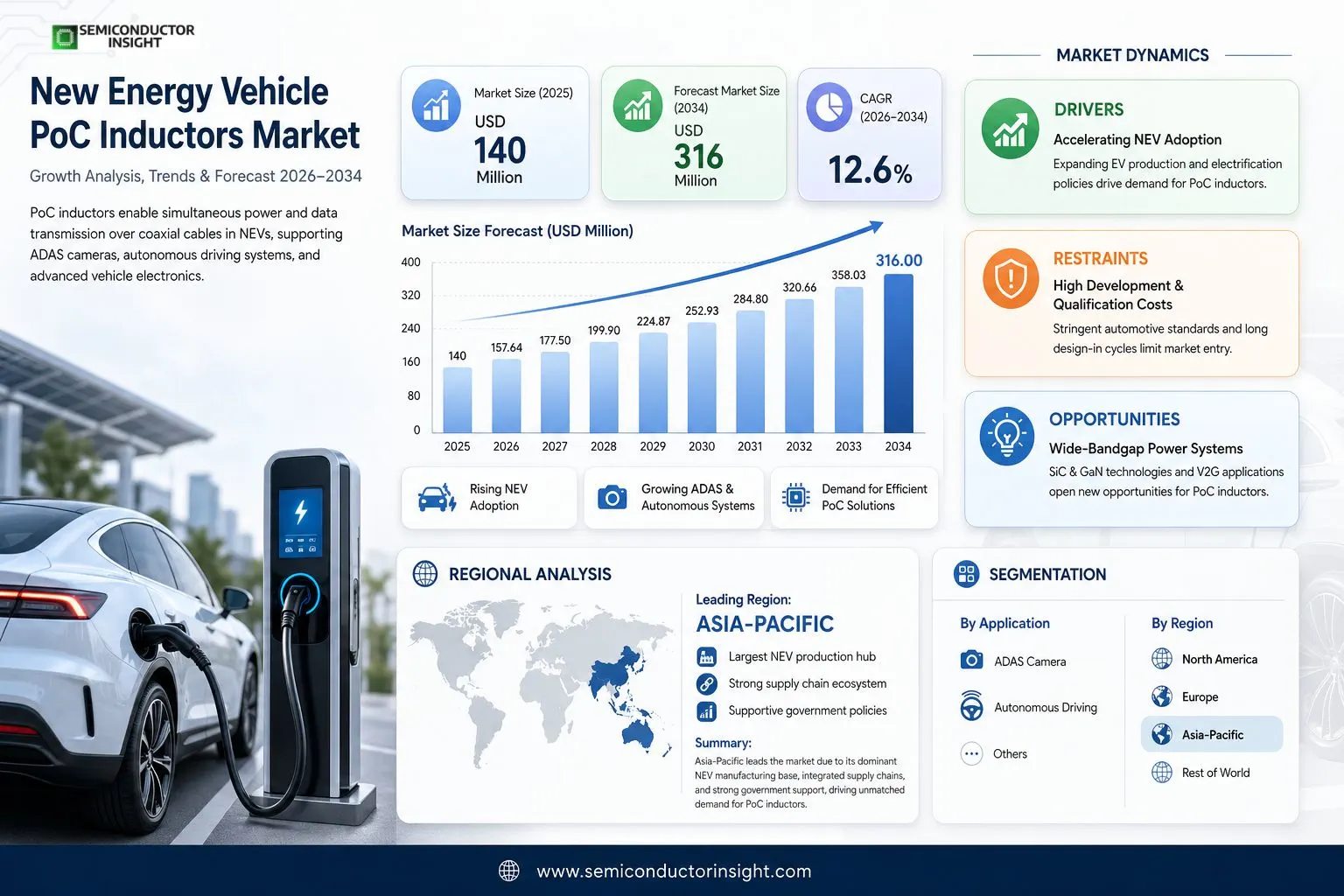
Global New Energy Vehicle PoC Inductors market size was valued at USD 140 million in 2025. The market is projected to grow from USD 157.64 million in 2026 to USD 316 million by 2034, exhibiting a CAGR of 12.6% during the forecast period.
Power over Coaxial (PoC) technology involves the simultaneous transmission of power and data signals over coaxial cables. In the context of New Energy Vehicles (NEVs), PoC inductors play a significant role in enabling efficient power transfer and signal integrity within the vehicle’s electrical systems. These inductors are specifically engineered to support PoC functionality, allowing seamless co-transmission of power and data over coaxial cables across a range of NEV applications, including ADAS cameras and autonomous driving systems. Key product types in this space include the Wound Ferrite Core Type, Multilayer Type, and other emerging configurations tailored to evolving automotive standards.
The market is gaining strong momentum driven by the accelerating global adoption of new energy vehicles, the rapid expansion of advanced driver-assistance systems (ADAS), and the growing integration of autonomous driving technologies. Furthermore, increasing regulatory pressure on vehicle emissions across major economies , particularly in China, Europe, and North America , continues to propel NEV production volumes, directly amplifying demand for high-performance PoC inductors. Leading participants operating in this market include TDK, Murata, Eaton, Shenzhen Sunlord Electronics, and Cenker, who collectively accounted for a significant share of global revenues in 2025.
MARKET DRIVERS
Accelerating Global Adoption of New Energy Vehicles Fueling Demand for PoC Inductors
The rapid expansion of the new energy vehicle (NEV) sector worldwide is one of the most significant forces driving New Energy Vehicle PoC Inductors Market. As governments across major economies implement stringent emission regulations and provide incentives for electric vehicle adoption, automakers are scaling up NEV production at an unprecedented pace. Power over Chassis (PoC) inductors are critical passive components used in the onboard power management, DC-DC converters, and battery management systems of NEVs, making their demand directly correlated with NEV production volumes. The increasing penetration of battery electric vehicles (BEVs) and plug-in hybrid electric vehicles (PHEVs) in markets such as China, Europe, and North America is creating sustained long-term demand for high-performance PoC inductors.
Rising Complexity of NEV Power Electronics Architectures Driving High-Performance Inductor Requirements
Modern NEV platforms are increasingly incorporating advanced power electronics architectures, including 800V high-voltage systems, bidirectional onboard chargers (OBCs), and multi-phase DC-DC converters. These sophisticated systems require PoC inductors capable of handling elevated current loads, high switching frequencies, and extreme thermal conditions. The transition from 400V to 800V battery architectures, which enables faster charging and improved drivetrain efficiency, directly increases the technical specifications demanded from PoC inductors. Manufacturers in New Energy Vehicle PoC Inductors Market are responding by developing inductors with higher saturation current ratings, lower DC resistance, and enhanced thermal stability to meet the evolving needs of next-generation NEV powertrains.
➤ The growing deployment of fast-charging infrastructure globally is reinforcing demand for robust, high-frequency PoC inductors capable of managing high power densities within compact NEV power systems.
Government-backed industrial policies, including China’s NEV mandate, the European Union’s 2035 internal combustion engine phase-out plan, and the U.S. Inflation Reduction Act’s EV tax credit provisions, are creating a stable and expanding market environment. These regulatory tailwinds are encouraging NEV manufacturers to increase annual production targets, which in turn drives procurement of critical components including PoC inductors. The alignment of public policy with industrial investment is expected to sustain strong growth momentum in New Energy Vehicle PoC Inductors Market through the forecast period.
MARKET CHALLENGES
Stringent Miniaturization Requirements Creating Design and Manufacturing Complexity for PoC Inductor Suppliers
One of the primary challenges in New Energy Vehicle PoC Inductors Market is the ongoing demand for component miniaturization without compromising electrical performance. NEV manufacturers are under continuous pressure to reduce the size and weight of power electronics modules to improve overall vehicle energy efficiency and maximize cabin or cargo space. Designing PoC inductors that maintain high inductance values, low losses, and adequate current handling capability within increasingly smaller form factors requires significant investment in advanced materials research and precision manufacturing processes. This challenge is particularly acute for suppliers serving premium NEV platforms where performance benchmarks are exceptionally demanding.
Other Challenges
Raw Material Price Volatility
New Energy Vehicle PoC Inductors Market is exposed to fluctuations in the prices of key raw materials, including ferrite cores, copper windings, and specialized magnetic alloys. Supply chain disruptions and geopolitical tensions affecting the availability of rare earth elements and high-grade magnetic materials can significantly impact production costs and profit margins for inductor manufacturers. Managing material cost pressures while maintaining competitive pricing for NEV OEM customers remains a persistent operational challenge across the industry.
Thermal Management in High-Power Applications
As NEV power systems push toward higher voltage and power density configurations, the thermal management of PoC inductors becomes increasingly challenging. Inductors operating at high switching frequencies generate significant core and copper losses, which must be effectively dissipated to prevent performance degradation or component failure. Developing inductors with improved thermal conductivity and integrating them reliably within tightly packaged power modules requires close collaboration between inductor suppliers and NEV system integrators, adding complexity to the design validation and qualification process.
MARKET RESTRAINTS
High Development and Qualification Costs Limiting Market Entry for Smaller Inductor Manufacturers
The automotive-grade qualification process for PoC inductors is rigorous and time-intensive, requiring compliance with standards such as AEC-Q200 for passive components. The extensive testing protocols covering thermal cycling, humidity resistance, vibration endurance, and electromagnetic compatibility represent a substantial financial and operational barrier, particularly for smaller or newer entrants in New Energy Vehicle PoC Inductors Market. Established players with existing automotive customer relationships and certified manufacturing infrastructure hold a significant competitive advantage, which can slow the pace of market diversification and limit pricing competition.
Supply Chain Concentration and Geopolitical Risks Constraining Market Stability
A notable restraint within New Energy Vehicle PoC Inductors Market is the geographic concentration of key raw material sources and component manufacturing capabilities. A significant proportion of high-grade ferrite materials and magnetic cores used in PoC inductor production are sourced from a limited number of suppliers concentrated in specific regions. This concentration creates vulnerability to supply disruptions arising from geopolitical developments, trade restrictions, or natural events. NEV manufacturers and tier-1 suppliers are increasingly scrutinizing their supply chains for critical passive components, and the lack of diversified sourcing options for PoC inductors remains a structural restraint on market resilience and growth predictability.
The long design-in cycles characteristic of the automotive industry also act as a restraint on the pace of adoption for next-generation PoC inductor technologies. Once a specific inductor design is validated and integrated into an NEV platform, substituting it with an alternative component requires a full re-qualification process, which can span 18 to 36 months. This inertia limits the ability of the market to rapidly incorporate innovations in inductor materials or topologies, slowing the commercial realization of performance improvements even when technically superior solutions are available.
MARKET OPPORTUNITIES
Emergence of Wide-Bandgap Semiconductor-Based Power Systems Opening New Design Opportunities for PoC Inductors
The accelerating adoption of silicon carbide (SiC) and gallium nitride (GaN) power semiconductors in NEV inverters, DC-DC converters, and onboard chargers presents a significant opportunity for New Energy Vehicle PoC Inductors Market. Wide-bandgap devices operate at switching frequencies far exceeding those achievable with conventional silicon-based components, enabling the use of smaller passive components including inductors. This technological shift incentivizes inductor manufacturers to develop advanced high-frequency PoC inductor solutions optimized for SiC and GaN system architectures, creating a new product development avenue with strong differentiation potential and premium pricing opportunities in the NEV supply chain.
Expansion of NEV Production in Emerging Markets Broadening the Geographic Opportunity Landscape
Beyond established markets in China, Europe, and North America, the NEV industry is experiencing growing momentum in Southeast Asia, India, and Latin America, supported by new domestic manufacturing policies and infrastructure investments. This geographic expansion of NEV production represents a meaningful growth opportunity for PoC inductor suppliers capable of establishing local supply relationships or expanding distribution networks in these emerging markets. As regional NEV ecosystems mature, demand for locally qualified and competitively priced PoC inductors is expected to grow, providing market participants with avenues to diversify revenue streams and reduce dependence on a limited number of high-volume NEV markets.
The increasing focus on vehicle-to-grid (V2G) technology and bidirectional charging capabilities in next-generation NEV platforms introduces additional application opportunities for advanced PoC inductors. Bidirectional power conversion systems require inductors with specific characteristics including low core losses across a wide frequency range and high thermal endurance under variable load conditions. As V2G-capable NEV platforms gain commercial traction, demand for specialized PoC inductors engineered for bidirectional power flow applications is anticipated to grow, representing a differentiated and high-value segment within the broader New Energy Vehicle PoC Inductors Market.
New Energy Vehicle PoC Inductors Market Trends
Rising Integration of Power over Coaxial Technology in New Energy Vehicles
New Energy Vehicle PoC Inductors Market is experiencing sustained momentum driven by the accelerating global transition toward electric and hybrid vehicle platforms. Power over Coaxial (PoC) technology, which enables simultaneous transmission of power and data signals through coaxial cables, has become increasingly critical in NEV electrical architectures. PoC inductors serve as foundational components ensuring signal integrity and efficient power transfer within these systems. As automotive OEMs continue to integrate more sophisticated in-vehicle electronics, the demand for reliable, high-performance PoC inductors has grown considerably across both passenger and commercial NEV segments.
Other Trends
Surge in ADAS Camera and Autonomous Driving Applications
One of the most prominent trends shaping New Energy Vehicle PoC Inductors Market is the rapid expansion of Advanced Driver Assistance Systems (ADAS) and autonomous driving technologies. ADAS cameras rely heavily on coaxial cable infrastructure, making PoC inductors indispensable for maintaining stable data transmission and power delivery simultaneously. As regulatory frameworks across North America, Europe, and Asia increasingly mandate safety features such as lane departure warnings and collision avoidance systems, automakers are embedding greater numbers of coaxial-connected cameras and sensors per vehicle. This trend is directly amplifying demand for PoC inductors capable of operating reliably under the demanding electromagnetic environments typical of NEV platforms.
Wound Ferrite Core Type Inductors Gaining Traction
Among product types, Wound Ferrite Core inductors are witnessing growing adoption within NEV PoC applications. Their superior magnetic permeability and efficient energy handling characteristics make them well-suited for the high-frequency signal environments present in modern electric vehicle systems. Manufacturers including TDK, Murata, and Shenzhen Sunlord Electronics have been actively developing wound ferrite core variants optimized specifically for NEV coaxial architectures, reflecting the broader industry shift toward component miniaturization without compromising electrical performance.
Asia-Pacific Dominates While Global Competition Intensifies
Asia-Pacific, led primarily by China, continues to represent the largest regional market for New Energy Vehicle PoC Inductors, underpinned by China’s commanding position in global NEV production and sales. Meanwhile, competitive dynamics are intensifying as global manufacturers such as Eaton and Cenker expand their NEV-focused product portfolios alongside established Asian suppliers. Europe is also emerging as a significant demand center, supported by stringent emissions regulations accelerating EV adoption across Germany, France, and the United Kingdom. This geographic diversification of demand is encouraging manufacturers to localize production and strengthen regional supply chains, a trend expected to define market strategy in the coming years.
COMPETITIVE LANDSCAPE
Key Industry Players
New Energy Vehicle PoC Inductors Market , Global Competitive Intelligence and Strategic Player Analysis
Global New Energy Vehicle (NEV) PoC Inductors market is characterized by a moderately consolidated competitive landscape, with a handful of well-established electronic component manufacturers commanding a significant portion of total revenue. Leading the competitive hierarchy is TDK Corporation, widely recognized for its advanced magnetic component engineering and deep integration within automotive-grade supply chains. TDK’s dominance is reinforced by its broad portfolio of inductors optimized for Power over Coaxial (PoC) applications, catering specifically to high-growth segments such as ADAS cameras and autonomous driving systems. Murata Manufacturing, another formidable global player, leverages its multilayer inductor technology and strong R&D investment to address the miniaturization and signal integrity demands prevalent in NEV electrical architectures. Eaton Corporation brings its power management expertise to bear, offering robust inductive solutions that meet the stringent electromagnetic compatibility requirements of modern electric vehicles. Together, the top five global players accounted for a substantial share of the market’s approximately USD 140 million valuation in 2025, reflecting the importance of technological capability, automotive qualification credentials, and established OEM relationships in shaping competitive positioning.
Beyond the top-tier multinationals, a growing cohort of specialized and regional manufacturers is making meaningful inroads into the NEV PoC Inductors space. Shenzhen Sunlord Electronics has emerged as a prominent Chinese domestic player, benefiting from proximity to China’s expansive NEV manufacturing ecosystem and its competitive cost structure in wound ferrite core and multilayer inductor production. Cenker, another China-based manufacturer, is actively expanding its automotive inductor offerings to capture demand driven by the rapid electrification of passenger and commercial vehicles across Asia. As the market is projected to grow at a CAGR of 12.6% to reach USD 316 million by 2034, competition is expected to intensify, with players differentiating on product reliability, thermal performance, compact form factors, and the ability to meet evolving automotive safety and electromagnetic standards for PoC-enabled systems in next-generation NEV platforms.
List of Key New Energy Vehicle PoC Inductors Companies Profiled
- TDK Corporation
- Murata Manufacturing Co., Ltd.
- Eaton Corporation
- Shenzhen Sunlord Electronics Co., Ltd.
- Cenker Electronics
- Vishay Intertechnology, Inc.
- Bourns, Inc.
- Taiyo Yuden Co., Ltd.
- Würth Elektronik GmbH & Co. KG
- Chilisin Electronics Corp.
- Sumida Corporation
- Sagami Elec Co., Ltd.
- YAGEO Corporation
- Laird Technologies (Laird Performance Materials)
- Coilcraft, Inc.
Segment Analysis:
| Segment Category | Sub-Segments | Key Insights |
| By Type |
|
Wound Ferrite Core Type holds the dominant position in the NEV PoC Inductors market, driven by its superior magnetic permeability and ability to handle high-frequency power transmission with minimal energy loss.
|
| By Application |
|
ADAS Camera systems represent the leading application segment for NEV PoC Inductors, as the proliferation of advanced driver assistance technologies has significantly increased demand for reliable power and data co-transmission solutions.
|
| By End User |
|
Battery Electric Vehicles (BEV) constitute the dominant end-user segment, owing to their fully electrified architectures that demand highly efficient, interference-resistant power and signal management components throughout the vehicle.
|
| By Vehicle Class |
|
Passenger Vehicles lead this segment as the primary adopters of NEV technologies and the largest consumers of ADAS-enabled coaxial camera systems that depend on PoC inductors for seamless power and data co-transmission.
|
| By Sales Channel |
|
Original Equipment Manufacturer (OEM) channel dominates the sales landscape for NEV PoC Inductors, as automakers integrate these components directly into vehicle electrical architectures during the design and manufacturing phase to ensure system-level performance and compliance.
|
Regional Analysis: New Energy Vehicle PoC Inductors Market
Asia-Pacific
China’s dominance in New Energy Vehicle PoC Inductors Market stems from its vertically integrated NEV industrial base. Domestic inductor manufacturers benefit from proximity to battery and power module producers, enabling streamlined co-development of application-specific inductive components. State-backed procurement incentives and local content regulations further entrench Chinese suppliers as preferred partners for domestic automakers scaling their electric platforms rapidly.
Japan and South Korea contribute high-value innovation to the regional New Energy Vehicle PoC Inductors Market through advanced material science and precision winding technologies. Established electronics conglomerates in these countries are pioneering next-generation ferrite and metal composite core inductors tailored for high-frequency DC-DC converters and onboard chargers, addressing the evolving demands of premium and performance-oriented electric vehicle platforms.
India and Southeast Asian nations are emerging as significant contributors to New Energy Vehicle PoC Inductors Market as regional governments accelerate EV adoption policies. Rising two-wheeler and three-wheeler electrification in India creates distinct inductor demand profiles, while Vietnam and Thailand attract component manufacturing investments from global suppliers seeking cost-competitive production bases closer to expanding ASEAN automotive assembly corridors.
Regional players in New Energy Vehicle PoC Inductors Market are actively diversifying supply chains to mitigate concentration risk. Multi-sourcing strategies, nearshoring of critical raw materials such as magnetic ferrite powders, and investment in automated winding and inspection lines are enabling Asia-Pacific inductor suppliers to maintain delivery reliability amid fluctuating upstream material availability and growing cross-border logistics complexities.
North America
North America represents a strategically pivotal region in New Energy Vehicle PoC Inductors Market, anchored by the United States’ concerted push toward domestic EV supply chain development. Legislative frameworks emphasizing domestic sourcing of EV components have created fresh opportunities for inductor suppliers to establish or expand manufacturing presence within the region. The rapid scaling of battery electric vehicle production by legacy automakers and new entrants alike is generating sustained demand for compact, high-performance PoC inductors suited to advanced powertrain and charging architectures. Canada’s growing battery materials sector and Mexico’s established automotive manufacturing corridor further contribute to a maturing regional ecosystem. Research collaborations between universities, national laboratories, and private component makers are accelerating the development of inductors capable of meeting the thermal and efficiency demands of next-generation North American EV platforms, positioning the region for accelerated growth in New Energy Vehicle PoC Inductors Market through the forecast period.
Europe
Europe occupies a prominent position in New Energy Vehicle PoC Inductors Market, shaped by the continent’s stringent emissions regulations and ambitious fleet electrification timelines. Germany, France, and Scandinavia lead regional demand, underpinned by the electrification programs of major European automotive groups and the presence of sophisticated Tier 1 supplier networks. European inductor manufacturers are differentiated by their focus on compliance with automotive-grade quality standards and lifecycle sustainability requirements, including responsible mineral sourcing and end-of-life recyclability. The region’s emphasis on high-voltage architectures for long-range passenger and commercial EVs demands inductors with elevated insulation ratings and power density characteristics. Policy-driven investments in gigafactories and power electronics clusters across Germany, Poland, and France are creating co-location opportunities for PoC inductor suppliers, strengthening the regional value chain for New Energy Vehicle PoC Inductors Market and reducing import dependency over the coming years.
South America
South America presents a developing but progressively relevant market within Global New Energy Vehicle PoC Inductors Market landscape. Brazil leads the regional transition, supported by government incentives aimed at accelerating electric mobility adoption across passenger and commercial vehicle segments. The country’s existing automotive manufacturing infrastructure provides a foundation for integrating localized EV component supply chains, including passive electronics such as PoC inductors. Chile and Colombia are also registering increased interest in electric public transportation, creating early-stage demand for powertrain inductive components. While the region currently relies substantially on imported inductors from Asia and Europe, growing foreign direct investment in local electronics manufacturing and favourable raw material availability , particularly copper and lithium , suggest South America will progressively build domestic inductor supply capabilities aligned with the expanding New Energy Vehicle PoC Inductors Market in the mid-to-long term.
Middle East & Africa
The Middle East and Africa region is at a nascent but noteworthy stage of engagement with New Energy Vehicle PoC Inductors Market. Gulf Cooperation Council nations, particularly the UAE and Saudi Arabia, are advancing EV adoption as part of broader economic diversification and sustainability agendas, with electric public transit and government fleet electrification programs creating initial inductor demand. South Africa stands out on the African continent as a nascent automotive manufacturing hub exploring EV transition pathways. The region currently depends on imports for virtually all PoC inductor requirements; however, growing partnerships with Asian and European component suppliers are laying the groundwork for improved supply security. As charging infrastructure expands and consumer EV uptake accelerates across key urban markets, the Middle East and Africa are expected to represent an increasingly relevant demand frontier for New Energy Vehicle PoC Inductors Market toward the latter years of the 2026–2034 forecast horizon.
Report Scope
This market research report provides a comprehensive analysis of New Energy Vehicle PoC Inductors Market, covering the forecast period 2026–2034. It offers detailed insights into market dynamics, technological advancements, competitive landscape, and key trends shaping the industry.
Key focus areas of the report include:
- Market Overview: The report begins with an overview outlining its current market scenario, key growth indicators, and industry transformation drivers. It discusses macroeconomic factors, demand–supply balance, regulatory landscape, and the strategic role of PoC inductors in powering advancements across industries such as automotive, telecommunications, consumer electronics, and industrial automation.
- Market Size & Forecast: Historical data and future projections for revenue, unit shipments, and market value across major regions and segments.
- Segmentation Analysis: Detailed breakdown by product type, technology, application, and end-user industry to identify high-growth segments and investment opportunities.
- Regional Insights: Insights into market performance across North America, Europe, Asia-Pacific, Latin America, and the Middle East & Africa, including country-level analysis where relevant.
- Competitive Landscape: Profiles of leading market participants, including their product offerings, R&D focus, manufacturing capacity, pricing strategies, and recent developments such as mergers, acquisitions, and partnerships.
- Technology Trends & Innovation: Assessment of emerging technologies, integration of AI/IoT, Power over Coaxial (PoC) design trends, fabrication techniques, and evolving industry standards.
- Market Drivers & Restraints: Evaluation of factors driving market growth along with challenges, supply chain constraints, regulatory issues, and market-entry barriers.
- Stakeholder Insights: Insights for component suppliers, OEMs, system integrators, investors, and policymakers regarding the evolving ecosystem and strategic opportunities.
Primary and secondary research methods are employed, including interviews with industry experts, data from verified sources, and real-time market intelligence to ensure the accuracy and reliability of the insights presented.
FREQUENTLY ASKED QUESTIONS:
What is the current market size of New Energy Vehicle PoC Inductors Market?
-> Global New Energy Vehicle PoC Inductors Market was valued at USD 140 million in 2025 and is expected to reach USD 316 million by 2034, growing at a CAGR of 12.6% during the forecast period.
Which key companies operate in New Energy Vehicle PoC Inductors Market?
-> Key players include TDK, Murata, Eaton, Shenzhen Sunlord Electronics, and Cenker, among others.
What are the key growth drivers?
-> Key growth drivers include rapid adoption of New Energy Vehicles (NEVs), growing demand for ADAS camera systems and autonomous driving technologies, and the need for efficient power and data transmission over coaxial cables. The ability of PoC inductors to enable simultaneous transmission of power and data signals within vehicle electrical systems is a critical enabler of this growth.
Which region dominates the market?
-> Asia is a leading region in New Energy Vehicle PoC Inductors Market, with China representing a significant share due to its strong NEV manufacturing base. North America, led by the U.S., also represents a substantial market, while Europe remains an important and growing region driven by stringent emission regulations and EV adoption policies.
What are the emerging trends?
-> Emerging trends include increasing integration of PoC inductors in ADAS camera systems, expansion of autonomous driving applications, advancement in Wound Ferrite Core and Multilayer inductor technologies, and growing investments in NEV infrastructure across key global markets.

Get Sample Report PDF for Exclusive Insights
Report Sample Includes
- Table of Contents
- List of Tables & Figures
- Charts, Research Methodology, and more...
 Download Sample Report PDF