MARKET INSIGHTS
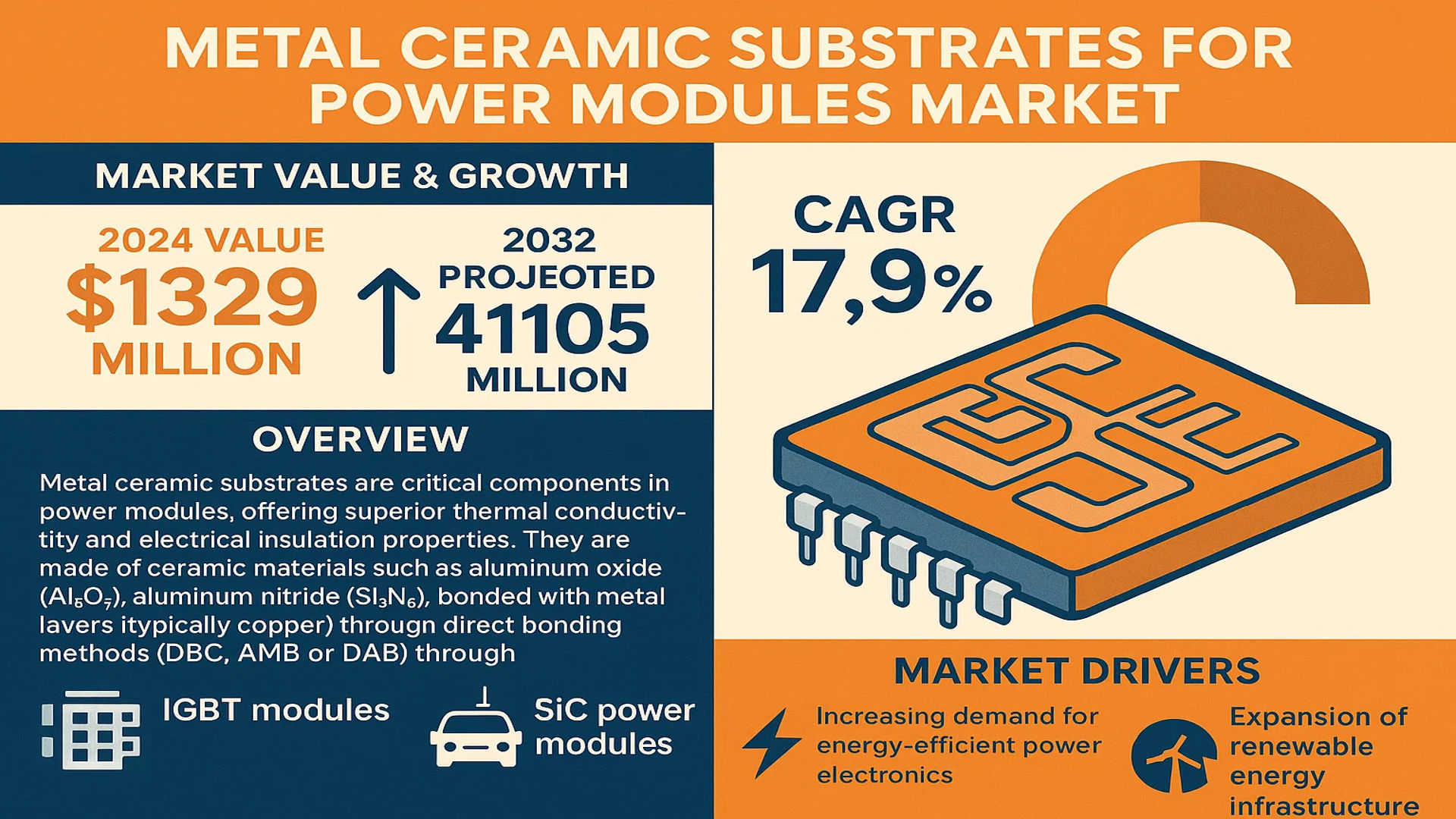
The global Metal Ceramic Substrates for Power Modules Market was valued at 1329 million in 2024 and is projected to reach US$ 4105 million by 2032, at a CAGR of 17.9% during the forecast period.
Metal ceramic substrates are critical components in power modules, offering superior thermal conductivity and electrical insulation properties. These substrates are composed of ceramic materials such as aluminum oxide (Al2O3), aluminum nitride (AlN), or silicon nitride (Si3N4), bonded with metal layers (typically copper) through processes like direct bonding (DBC), active metal brazing (AMB), or direct aluminum bonding (DAB). They are widely used in insulated gate bipolar transistor (IGBT) modules and silicon carbide (SiC) power modules for applications ranging from industrial to automotive sectors.
The market growth is driven by increasing demand for energy-efficient power electronics, rapid adoption of electric vehicles, and expansion of renewable energy infrastructure. While the automotive sector dominates application share, industrial applications are growing steadily due to automation trends. Furthermore, technological advancements in substrate materials and manufacturing processes are creating new opportunities. Key players like Rogers Corporation, KCC Corporation, and Heraeus Electronics collectively hold significant market share, with strategic expansions and R&D investments shaping the competitive landscape.
MARKET DYNAMICS
MARKET DRIVERS
Expanding Electric Vehicle Production Accelerates Demand for Metal Ceramic Substrates
The rapid global transition toward electric vehicles (EVs) represents the most significant growth driver for metal ceramic substrates. With EV production projected to exceed 40 million units annually by 2030, substrate manufacturers face unprecedented demand. These critical components form the backbone of power modules in EV inverters, where they provide essential thermal management and electrical insulation. The automotive sector’s shift to 800V battery systems further intensifies requirements for advanced substrates capable of handling higher power densities while maintaining reliability under extreme conditions.
Renewable Energy Expansion Fuels Market Growth
Global investments in renewable energy infrastructure, particularly solar and wind power installations, create substantial opportunities for power module substrates. The photovoltaic inverter market alone is forecast to surpass $12 billion by 2026, with each installation requiring multiple power modules containing ceramic substrates. These components enable efficient power conversion while withstanding the harsh environmental conditions typical of renewable energy applications. The growing adoption of silicon carbide (SiC) and gallium nitride (GaN) semiconductors in these systems further elevates performance requirements, driving innovation in substrate materials and manufacturing techniques.
Moreover, government policies mandating clean energy transitions across major economies continue to stimulate market growth. The increasing capacity of offshore wind farms and utility-scale solar installations creates sustained demand for robust power electronics systems where ceramic substrates play an indispensable role.
MARKET CHALLENGES
Material Cost Volatility Presents Significant Production Challenges
Manufacturers face mounting pressure from fluctuating raw material costs, particularly for specialized ceramics and high-purity metals used in substrate production. The prices of aluminum oxide, aluminum nitride, and copper – essential components in DBC and AMB substrates – have shown extreme volatility in recent years, sometimes exceeding 30% quarterly variation. These cost fluctuations make long-term pricing strategies difficult while squeezing profit margins for substrate producers.
Other Challenges
Yield Optimization Complexities
Achieving high production yields remains an ongoing struggle, particularly for advanced AMB substrates where the bonding process between ceramics and metals requires precise control. Even minute variations in temperature profiles or pressure application during manufacturing can result in delamination or microcracks, leading to significant scrap rates that may reach 15-20% for complex designs.
Thermal Stress Management
As power modules push toward higher current densities, managing thermal expansion mismatches between substrate layers grows increasingly difficult. The coefficient of thermal expansion (CTE) differences between ceramic and metal layers creates mechanical stresses that can compromise long-term reliability, especially in applications experiencing frequent thermal cycling.
MARKET RESTRAINTS
Technical Barriers Limit Small-Scale Manufacturer Participation
The metal ceramic substrate market presents substantial entry barriers for new competitors due to the specialized expertise required in materials science, precision manufacturing, and quality control. Establishing production capabilities for high-reliability substrates demands investments exceeding $50 million for a basic facility, with lead times of 2-3 years before achieving commercial-scale output. This capital intensity reinforces the dominance of established players and limits market competition.
Furthermore, the lack of standardized testing protocols across different applications complicates product qualification processes. Each power module manufacturer typically requires customized validation procedures, forcing substrate producers to maintain multiple quality systems and delaying time-to-market for new products.
MARKET OPPORTUNITIES
Next-Generation Semiconductor Technologies Create New Application Frontiers
The emergence of wide-bandgap semiconductors like SiC and GaN unlocks transformative opportunities for substrate innovation. These advanced materials operate at higher temperatures and voltages than traditional silicon devices, requiring substrates with enhanced thermal conductivity and mechanical stability. The SiC power device market alone is projected to grow at 30% CAGR through 2030, creating parallel demand for compatible ceramic substrates optimized for these cutting-edge applications.
Additionally, the industrial IoT revolution drives demand for smarter power modules featuring integrated sensors. Substrate manufacturers developing embedded monitoring capabilities within their products can command premium pricing while enabling predictive maintenance solutions for critical power electronics systems.
METAL CERAMIC SUBSTRATES FOR POWER MODULES MARKET TRENDS
Growing Demand for High-Performance Power Electronics Drives Market Expansion
The global metal ceramic substrates for power modules market is experiencing robust growth, propelled by increasing demand for high-performance, thermally efficient solutions in power electronics. Metal ceramic substrates, particularly used in IGBT and SiC modules, are critical for enhancing thermal management and electrical insulation in power devices. The market is expected to grow from $1.33 billion in 2024 to $4.11 billion by 2032, reflecting a CAGR of 17.9%. This surge is driven by the rising adoption of electric vehicles (EVs), renewable energy systems, and industrial automation, all of which require advanced power modules with superior thermal conductivity and reliability.
Other Trends
Transition to Active Metal Brazed (AMB) Substrates
The shift toward Active Metal Brazed (AMB) substrates is gaining momentum due to their superior thermal and mechanical performance compared to traditional DCB (Direct Bonded Copper) variants. AMB substrates, with their enhanced thermal cycling resistance and higher power density capabilities, are increasingly preferred in automotive and industrial applications. Industry reports indicate that the AMB segment is projected to grow at a higher CAGR of over 20% in the next six years, driven by their use in high-voltage power modules for electric vehicle inverters and renewable energy converters.
Electrification of Automotive Sector Fuels Adoption
The automotive industry is undergoing a paradigm shift toward electrification, boosting the demand for metal ceramic substrates in power modules. With automakers accelerating EV production, the need for compact and efficient power electronics has surged. Power modules containing SiC (Silicon Carbide) and IGBT (Insulated-Gate Bipolar Transistor) components rely heavily on advanced metal ceramic substrates to ensure thermal dissipation and electrical insulation. China and the U.S. lead in market adoption, contributing significantly to global revenue as automakers ramp up investments in power electronics. Furthermore, regulatory mandates favoring emission reductions are compelling manufacturers to integrate high-performance substrates into next-generation powertrains.
COMPETITIVE LANDSCAPE
Key Industry Players
Innovation and Strategic Expansion Drive Market Leadership
The global Metal Ceramic Substrates for Power Modules market is characterized by a dynamic competitive environment where established players compete with emerging companies through technological advancements and geographic expansion. Currently valued at $1.33 billion in 2024, the market is projected to grow at an impressive CAGR of 17.9%, reaching $4.11 billion by 2032. This growth trajectory is fueled by increasing demand from automotive, industrial, and renewable energy applications.
Rogers Corporation leads the market with its comprehensive portfolio of Direct Bonded Copper (DBC) and Active Metal Brazed (AMB) substrates, commanding a significant revenue share. The company’s strength lies in its strong foothold in North America and Europe, along with continuous R&D investments. Meanwhile, Kyocera and Mitsubishi Materials dominate the Asian markets, leveraging their deep expertise in ceramic technologies and established manufacturing networks.
Chinese manufacturers such as Jiangsu Fulehua Semiconductor Technology and Shengda Tech are rapidly gaining market share due to competitive pricing and government support for domestic semiconductor supply chains. Their expansion strategies primarily focus on increasing production capacity to meet rising local demand.
Strategic partnerships and vertical integration are becoming key differentiators in this market. For instance, Heraeus Electronics recently expanded its AMB substrate production capacity to address growing demand for high-power EV applications. Similarly, Littelfuse IXYS has strengthened its position through technological innovations in silicon carbide (SiC) compatible substrates.
List of Major Metal Ceramic Substrate Manufacturers
- Rogers Corporation (U.S.)
- Jiangsu Fulehua Semiconductor Technology (China)
- KCC (South Korea)
- Shengda Tech (China)
- Heraeus Electronics (Germany)
- Nanjing Zhongjiang New Material Science & Technology (China)
- Mitsubishi Materials (Japan)
- BYD (China)
- Littelfuse IXYS (U.S.)
- Kyocera (Japan)
- Toshiba Materials (Japan)
- Denka (Japan)
- Zhejiang TC Ceramic Electronic (China)
- DOWA METALTECH (Japan)
- Beijing Moshi Technology (China)
Market competition is intensifying as players increasingly focus on material innovations to enhance thermal conductivity and reliability. The shift toward wide-bandgap semiconductors like SiC and GaN is driving demand for specialized substrates, creating opportunities for companies that can offer optimized solutions. While Japanese manufacturers continue to lead in technology development, Chinese companies are closing the gap through aggressive capacity expansions and government-backed research initiatives.
Segment Analysis:
By Type
AMB Substrates Segment Leads the Market Owing to Superior Thermal Management Properties
The market is segmented based on type into:
- AMB Substrates
- Subtypes: AlN-based, Si3N4-based
- DCB Substrates
- Subtypes: Al2O3-based, ZrO2-based
- DBA Substrates
- Others
By Application
Automotive Segment Shows Rapid Growth Driven by EV Adoption
The market is segmented based on application into:
- Industrial
- Automotive
- PV and Wind Power
- Rail Transport
- Consumer Appliance
- Other
By Material
AlN-based Ceramics Gain Preference for High Thermal Conductivity
The market is segmented based on material composition into:
- AlN (Aluminum Nitride)
- Al2O3 (Alumina)
- Si3N4 (Silicon Nitride)
- BeO (Beryllium Oxide)
- Others
By End User
Power Electronics Manufacturers Are Primary Consumers
The market is segmented based on end users into:
- IGBT Module Manufacturers
- SiC Module Manufacturers
- Power Semiconductor Providers
- Research Institutions
Regional Analysis: Metal Ceramic Substrates for Power Modules Market
Asia-Pacific
As the global leader in the metal ceramic substrates for power modules market, Asia-Pacific is fueled by China’s dominant position in semiconductor and power electronics manufacturing. The region accounted for over 45% of global demand in 2024, driven by China’s rapid EV adoption and renewable energy investments. Key players like BYD and Fujian Huaqing Electronic Material Technology are expanding production capacities to meet local demand, particularly for AMB substrates used in automotive IGBT modules. Japan and South Korea remain critical markets for high-performance substrates, supported by advanced semiconductor fabrication ecosystems. While cost competition is intense, technological advancements in SiC modules are accelerating regional growth.
North America
Stringent efficiency standards for power electronics in automotive and industrial applications position North America as a high-value market. The U.S. leads with 32% regional revenue share, attributed to demand from EV manufacturers like Tesla and renewable energy projects. Federal initiatives like the CHIPS Act are incentivizing domestic production of power modules, indirectly boosting substrate demand. However, reliance on imports for mid-range substrates persists due to higher local manufacturing costs. Rogers Corporation and Littelfuse IXYS maintain strong market positions by focusing on R&D for thermal management solutions in next-gen power devices.
Europe
Europe’s market growth is propelled by the automotive sector’s transition to electrification and strict energy efficiency directives. Germany, housing major automotive OEMs and industrial manufacturers, consumes over 28% of regional substrates, primarily DCB and AMB types. The EU’s focus on carbon neutrality is driving investments in wind power converters and smart grid infrastructure, creating sustained demand. However, the region faces supply chain vulnerabilities due to dependence on Asian ceramic powder suppliers. Local players like Heraeus Electronics are addressing this through vertical integration strategies while complying with RoHS and REACH regulations.
South America
The region shows nascent but promising growth, with Brazil emerging as a focal point for power module assembly plants serving the automotive and appliance industries. Market expansion is constrained by limited local substrate production capabilities, necessitating imports primarily from China. The renewable energy sector, particularly in Chile and Argentina, presents opportunities for DBA substrates in solar inverters. Economic volatility and underdeveloped semiconductor ecosystems remain key challenges, though multinationals are beginning to establish regional partnerships to bypass import tariffs.
Middle East & Africa
MEA’s market is in early development stages, with growth concentrated in UAE and Saudi Arabia’s industrial and energy sectors. The region benefits from increasing grid modernization projects and datacenter investments, driving demand for high-reliability power modules. Local manufacturing is virtually nonexistent, creating opportunities for global suppliers like Kyocera and Mitsubishi Materials. While market penetration is currently low, the energy transition initiatives across Gulf countries indicate long-term potential for ceramic substrate adoption in power electronics infrastructure.
Report Scope
This market research report provides a comprehensive analysis of the global and regional Metal Ceramic Substrates for Power Modules markets, covering the forecast period 2025–2032. It offers detailed insights into market dynamics, technological advancements, competitive landscape, and key trends shaping the industry.
Key focus areas of the report include:
- Market Size & Forecast: Historical data and future projections for revenue, unit shipments, and market value across major regions and segments. The global Metal Ceramic Substrates for Power Modules market was valued at USD 1,329 million in 2024 and is projected to reach USD 4,105 million by 2032, growing at a CAGR of 17.9%.
- Segmentation Analysis: Detailed breakdown by product type (AMB, DCB, DBA substrates), application (Industrial, Automotive, PV & Wind Power, Rail Transport, Consumer Appliance, Others), and end-user industry to identify high-growth segments.
- Regional Outlook: Insights into market performance across North America, Europe, Asia-Pacific, Latin America, and Middle East & Africa. The U.S. market is estimated at USD million in 2024, while China is forecast to reach USD million by 2032.
- Competitive Landscape: Profiles of 18 leading market participants including Rogers, Jiangsu Fulehua, KCC, Heraeus Electronics, Mitsubishi Materials, BYD, and Kyocera, with their product portfolios, manufacturing capacities, and recent M&A activities.
- Technology Trends & Innovation: Assessment of emerging substrate technologies for IGBT and SiC modules, advanced bonding techniques, and thermal management solutions.
- Market Drivers & Restraints: Evaluation of EV adoption, renewable energy expansion, 5G infrastructure growth versus raw material price volatility and supply chain challenges.
- Stakeholder Analysis: Strategic insights for semiconductor manufacturers, power module producers, automotive OEMs, and investors regarding the evolving supply chain dynamics.
The research methodology combines primary interviews with industry experts and secondary data from verified sources, ensuring accuracy and reliability of market projections and trend analysis.
FREQUENTLY ASKED QUESTIONS:
What is the current market size of Global Metal Ceramic Substrates for Power Modules?
-> Metal Ceramic Substrates for Power Modules Market was valued at 1329 million in 2024 and is projected to reach US$ 4105 million by 2032, at a CAGR of 17.9%.
Which key companies dominate this market?
-> Major players include Rogers, KCC, Heraeus Electronics, Mitsubishi Materials, BYD, Kyocera, with the top five holding approximately % market share in 2024.
What are the key growth drivers?
-> Primary drivers include electric vehicle production growth, renewable energy expansion, 5G infrastructure deployment, and industrial automation trends.
Which substrate type shows highest growth potential?
-> AMB substrates are projected to show significant growth, reaching USD million by 2032 with a robust CAGR over the forecast period.
What are the emerging application areas?
-> Emerging applications include SiC-based power modules for EVs, high-power industrial drives, and next-generation power conversion systems.

Get Sample Report PDF for Exclusive Insights
Report Sample Includes
- Table of Contents
- List of Tables & Figures
- Charts, Research Methodology, and more...
 Download Sample Report PDF