MEMS Acceleration Sensors Market, Trends, Business Strategies 2026-2033

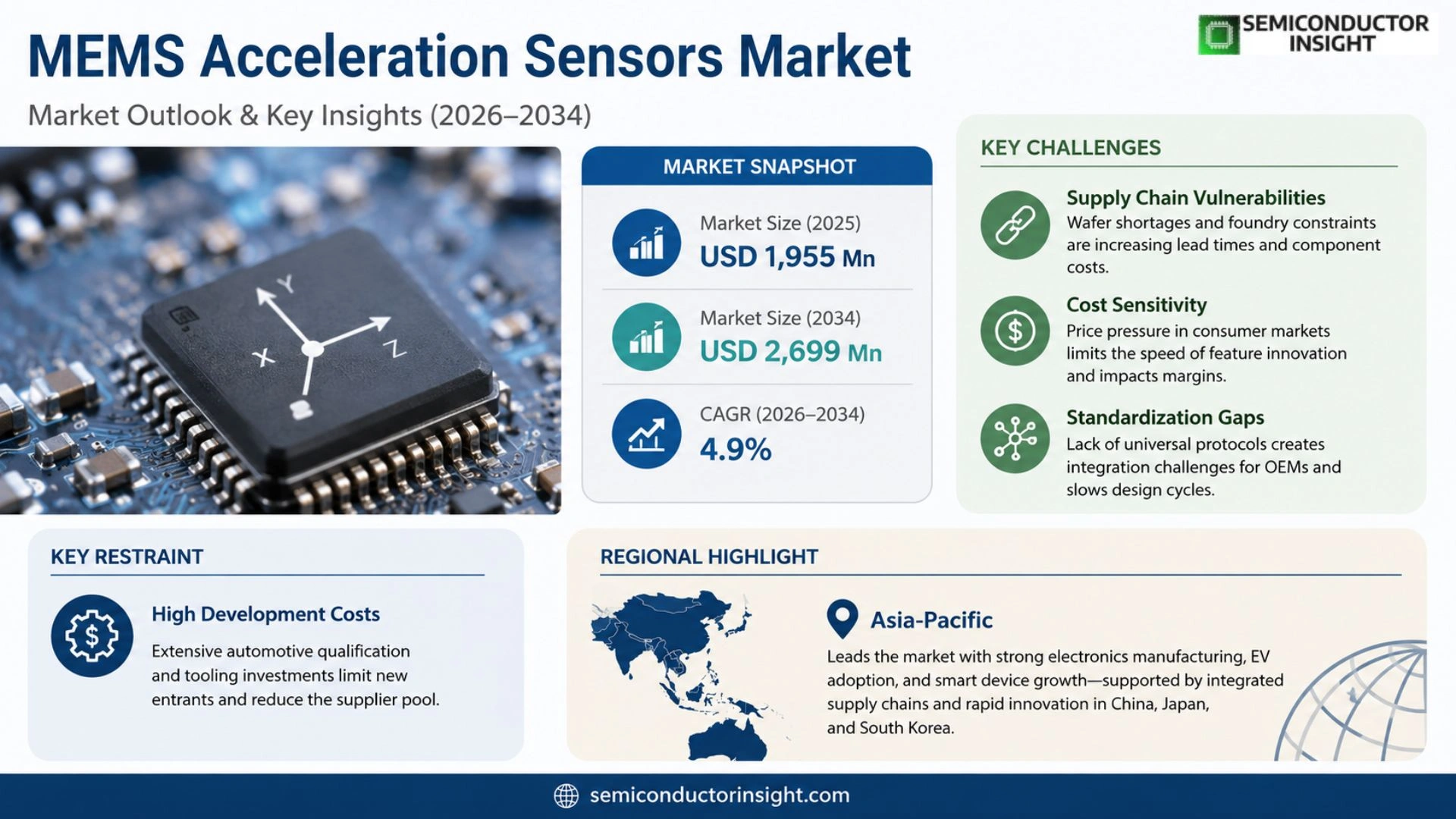
MEMS Acceleration Sensors Market size was valued at USD 1.96 billion in 2025. The market is projected to grow from USD 2.07 billion in 2026 to USD 2.70 billion by 2033, exhibiting a CAGR of 4.9% during the forecast period.

PDF Icon Download Sample Report PDF
  • Quick Dispatch

    All Orders

  • Secure Payment

    100% Secure Payment

Price range: $1,500.00 through $4,250.00

Clear

Market Insights

Global MEMS Acceleration Sensors Market size was valued at USD 1.96 billion in 2025. The market is projected to grow from USD 2.07 billion in 2026 to USD 2.70 billion by 2033, exhibiting a CAGR of 4.9% during the forecast period.

MEMS acceleration sensors, commonly referred to as MEMS accelerometers, are compact devices fabricated using Micro-Electro-Mechanical Systems (MEMS) technology. These sensors measure linear acceleration, including motion, vibration, shock, and static forces such as gravity. They convert physical acceleration into electrical signals primarily through capacitive sensing though piezoresistive and piezoelectric methods are also utilized. This functionality enables electronic systems to detect movement, orientation, and dynamic forces with high precision.

The market growth is driven by increasing demand in consumer electronics, automotive safety systems, and industrial automation applications. In consumer electronics, MEMS accelerometers are integral for screen orientation, gesture recognition, and power management in smartphones and wearables. The automotive sector relies on these sensors for airbag deployment, electronic stability control (ESC), and advanced driver-assistance systems (ADAS). Furthermore, industrial applications such as predictive maintenance and condition monitoring are expanding due to the rise of Industry 4.0 initiatives.

Xyz market size & forecast

MARKET DRIVERS

Rising Demand in Consumer Electronics

MEMS Acceleration Sensors Market is experiencing significant growth due to increasing adoption in smartphones, wearables, and IoT devices. Advanced features like gesture recognition and motion tracking are driving manufacturers to integrate these sensors into newer product lines. The consumer electronics segment accounts for over 35% of the total MEMS acceleration sensor demand.

Automotive Safety Regulations

Stringent government regulations mandating electronic stability control (ESC) and airbag deployment systems have boosted the adoption of MEMS acceleration sensors in automotive applications. These sensors are critical for detecting collisions and enabling rapid safety responses in vehicles, with the automotive sector projected to grow at 8.2% CAGR over the next five years.

The shift toward Industry 4.0 has accelerated the deployment of MEMS-based condition monitoring systems in manufacturing plants globally.

MARKET CHALLENGES

High Manufacturing Complexity

Fabricating MEMS acceleration sensors requires sophisticated semiconductor processes and cleanroom facilities, leading to high production costs. Maintaining consistent quality across high-volume manufacturing remains a significant challenge for suppliers.

Other Challenges

Limited Performance in Extreme Conditions
MEMS acceleration sensors face reliability issues in high-temperature or high-vibration environments, restricting their use in certain industrial and aerospace applications where more expensive alternatives are preferred.

MARKET RESTRAINTS

Price Pressure from Competing Technologies

Emerging non-MEMS inertial measurement units (IMUs) based on optical and piezoelectric principles are challenging the cost advantage of traditional MEMS acceleration sensors, particularly in high-precision applications where performance outweighs price considerations.

MARKET OPPORTUNITIES

Expansion in Healthcare Applications

The healthcare sector presents significant growth potential for MEMS acceleration sensors, particularly in patient monitoring systems and medical wearables. Global medical sensor market incorporating MEMS technology is expected to exceed USD 5 billion by 2028, with acceleration sensors playing a key role in fall detection and movement analysis applications.
MEMS Acceleration Sensors Market Trends

Sustained Growth in Consumer Electronics and Smart Devices

The consumer electronics sector remains the largest driver for MEMS acceleration sensors, accounting for over 45% of total unit shipments. Smartphones, wearables, and IoT devices integrate these sensors for motion detection, screen orientation, and activity tracking. With rising demand for miniaturized, low-power components, MEMS accelerometers have become standard in nearly all portable electronics, shipping over 2.8 billion units annually in smartphones alone.

Other Trends

Automotive Safety and Electrification Driving Demand

Automotive applications represent the fastest-growing segment, with MEMS accelerometers critical for airbag systems, electronic stability control, and ADAS features. The shift toward electric vehicles has further increased demand, as these sensors are essential for battery management and motor vibration monitoring. The automotive segment is projected to grow at 6.1% CAGR through 2033.

Industrial Automation and Predictive Maintenance Expansion

Industrial applications are adopting MEMS accelerometers for vibration monitoring and predictive maintenance in manufacturing equipment. The growing Industrial IoT sector requires rugged, low-power sensors for continuous operation in harsh environments, creating new opportunities beyond traditional consumer markets. This segment is expected to account for 18% of the market by 2033.

Technological Advancements in Sensor Design

Manufacturers are developing multi-axis capacitive MEMS accelerometers with improved accuracy and lower power consumption. The shift toward wafer-level packaging and system-in-package solutions enables higher integration with other sensors, reducing costs while maintaining performance.

Regional Market Developments

Asia-Pacific dominates the MEMS Acceleration Sensors Market with 58% share, driven by consumer electronics manufacturing in China and automotive production in Japan and South Korea. North America shows strong growth in industrial and aerospace applications, while Europe leads in automotive-grade sensor development.

COMPETITIVE LANDSCAPE

Key Industry Players

Global MEMS Acceleration Sensors Market Leaders and Innovators

MEMS Acceleration Sensors Market is dominated by established semiconductor giants and specialized sensor manufacturers, with Bosch, STMicroelectronics, and NXP Semiconductors collectively holding over 45% of the global market share. Bosch maintains technological leadership through its proprietary bulk-micromachined capacitive sensors, particularly for automotive safety applications. STMicroelectronics leads in consumer electronics with high-volume production of 3-axis digital accelerometers, while NXP specializes in high-reliability industrial-grade solutions.

Several niche players have carved out specialized positions: Murata Manufacturing focuses on ultra-miniature accelerometers for wearables, Analog Devices offers precision industrial solutions, and TDK has gained traction in automotive vibration monitoring. Emerging Chinese manufacturers like MiraMEMS and XDLK Microsystem are aggressively expanding their market presence with cost-competitive offerings, particularly in consumer applications, though still trailing in high-reliability segments.

List of Key MEMS Acceleration Sensors Companies Profiled

Segment Analysis:

Segment Category Sub-Segments Key Insights
By Type
  • Capacitive Type
  • Piezoelectric Type
  • Piezoresistive Type
  • Other
Capacitive Type dominates due to superior performance in consumer electronics and automotive applications.

  • Offers higher accuracy and lower power consumption ideal for battery-operated devices
  • Wide adoption in smartphones and wearables drives production economies of scale
  • Increasing integration with gyroscopes for inertial measurement units in automotive and industrial applications
By Application
  • Automotive
  • Consumer Electronics
  • Aerospace and Defense
  • Industrial
  • Other
Consumer Electronics remains the largest application segment with continuous growth opportunities.

  • Essential for motion sensing in smartphones, tablets, and wearable devices
  • Growing AR/VR applications create new use cases for high-performance MEMS accelerometers
  • Smart home devices leveraging motion detection for energy efficiency and security
By End User
  • OEMs
  • System Integrators
  • Research Institutions
  • Maintenance Service Providers
OEMs account for the majority of demand across all major application segments.

  • Consumer electronics manufacturers drive high-volume purchases with strict cost requirements
  • Automotive OEMs prioritize reliability and long-term supply agreements
  • Industrial equipment manufacturers increasingly standardize on MEMS solutions for predictive maintenance
By Sensing Axis
  • Single-axis
  • Dual-axis
  • Multi-axis
Multi-axis sensors are gaining traction across applications.

  • Preferred for advanced motion tracking in automotive safety systems and industrial monitoring
  • Enables comprehensive vibration analysis for predictive maintenance applications
  • Increasing integration with gyroscopes and magnetometers for complete inertial measurement
By Technology
  • Open-loop
  • Closed-loop
  • Hybrid
Closed-loop systems are preferred for high-performance applications.

  • Provides better linearity and stability for automotive safety systems
  • Increasing adoption in industrial vibration monitoring applications
  • Higher accuracy justifies premium pricing in mission-critical aerospace applications

Regional Analysis: Global MEMS Acceleration Sensors Market

Asia-Pacific

The Asia-Pacific region dominates the global MEMS Acceleration Sensors Market, driven by massive consumer electronics production and rapid industrialization. China serves as the manufacturing hub for smartphones and IoT devices that extensively incorporate MEMS sensors. Japan leads in automotive MEMS applications with its advanced vehicle safety systems. South Korea’s strong semiconductor industry supports MEMS sensor innovation for wearables and mobile devices. Southeast Asian countries are witnessing growing adoption in industrial automation applications. Regional governments are actively supporting MEMS technology development through favorable policies and R&D investments. The presence of major electronics OEMs and tier-1 automotive suppliers creates a robust ecosystem for MEMS acceleration sensor adoption across multiple industries in this region.

China’s Manufacturing Dominance
China accounts for over 60% of global MEMS sensor production capacity, with specialized industrial clusters in Shenzhen and Shanghai. The country’s strong electronics supply chain enables cost-effective MEMS acceleration sensor manufacturing for global markets.
Japan’s Automotive Leadership
Japanese automakers integrate MEMS acceleration sensors in advanced driver assistance systems (ADAS) and vehicle stability controls. The country’s stringent safety regulations accelerate MEMS adoption in automotive electronics.
South Korea’s Tech Innovation
Leading South Korean electronics firms are developing high-precision MEMS acceleration sensors for next-generation smartphones and foldable devices. The country’s 5G infrastructure supports IoT applications requiring MEMS sensors.
India’s Emerging Market Growth
India’s expanding automotive and industrial sectors are driving MEMS acceleration sensor demand. Government initiatives like Make in India are encouraging local MEMS component manufacturing.

North America
North America maintains strong demand for high-performance MEMS acceleration sensors, particularly in aerospace and defense applications. The region benefits from advanced R&D capabilities and early adoption of new MEMS technologies. U.S.-based manufacturers lead in developing specialized MEMS sensors for medical devices and industrial equipment. Silicon Valley continues to drive innovation in miniaturized sensor designs. Canadian markets show increasing adoption of MEMS sensors in automotive safety systems and smart infrastructure projects.

Europe
Europe’s MEMS acceleration sensor market is characterized by strict quality standards and advanced industrial applications. Germany’s automotive industry extensively uses MEMS sensors in premium vehicle platforms. The region’s focus on industrial automation and robotics creates substantial demand for vibration monitoring sensors. Nordic countries are emerging as innovation hubs for MEMS-based wearables and health monitoring devices. EU regulations on vehicle safety and emissions continue to drive MEMS sensor integration in automobiles.

Middle East & Africa
The Middle East shows growing interest in MEMS acceleration sensors for oil & gas equipment monitoring and smart city projects. UAE and Saudi Arabia are leading adopters of industrial IoT solutions incorporating MEMS technology. Africa’s market remains nascent but shows potential in automotive aftermarket applications and consumer device repairs. Infrastructure development projects across the region may boost demand for structural health monitoring sensors.

South America
Brazil represents the largest South American market for MEMS acceleration sensors, primarily in automotive and industrial applications. Argentina and Chile show steady growth in mining equipment sensor adoption. The region benefits from increasing foreign investments in electronics manufacturing. Local governments are implementing policies to encourage domestic production of electronic components including MEMS devices.

Report Scope

This market research report provides a comprehensive analysis of the MEMS Acceleration Sensors Market , covering the forecast period 2025–2033. It offers detailed insights into market dynamics, technological advancements, competitive landscape, and key trends shaping the industry.

Key focus areas of the report include:

  • Market Overview: The report begins with an overview outlining its current market scenario, key growth indicators, and industry transformation drivers. It discusses macroeconomic factors, demand–supply balance, regulatory landscape, and the strategic role of semiconductors in powering advancements across industries such as automotive, telecommunications, consumer electronics, and industrial automation.
  • Market Size & Forecast: Historical data and future projections for revenue, unit shipments, and market value across major regions and segments.
  • Segmentation Analysis: Detailed breakdown by product type, technology, application, and end-user industry to identify high-growth segments and investment opportunities.
  • Regional Insights: Insights into market performance across North America, Europe, Asia-Pacific, Latin America, and the Middle East & Africa, including country-level analysis where relevant.
  • Competitive Landscape: Profiles of leading market participants, including their product offerings, R&D focus, manufacturing capacity, pricing strategies, and recent developments such as mergers, acquisitions, and partnerships.
  • Technology Trends & Innovation: Assessment of emerging technologies, integration of AI/IoT, semiconductor design trends, fabrication techniques, and evolving industry standards.
  • Market Drivers & Restraints: Evaluation of factors driving market growth along with challenges, supply chain constraints, regulatory issues, and market-entry barriers.
  • Stakeholder Insights: Insights for component suppliers, OEMs, system integrators, investors, and policymakers regarding the evolving ecosystem and strategic opportunities.

Primary and secondary research methods are employed, including interviews with industry experts, data from verified sources, and real-time market intelligence to ensure the accuracy and reliability of the insights presented.

FREQUENTLY ASKED QUESTIONS:

What is the current market size of MEMS Acceleration Sensors Market?

-> MEMS Acceleration Sensors Market size was valued at USD 1.96 billion in 2025. The market is projected to grow from USD 2.07 billion in 2026 to USD 2.70 billion by 2033, exhibiting a CAGR of 4.9% during the forecast period.

Which key companies operate in MEMS Acceleration Sensors Market?

-> Key players include Bosch, NXP Semiconductors, STMicroelectronics, Murata Manufacturing, Analog Devices, TDK, Honeywell, and TE Connectivity, among others.

What are the key growth drivers?

-> Key growth drivers include sustained demand in consumer electronics, increasing automotive safety regulations, and expansion of industrial automation and IIoT applications.

Which region dominates the market?

-> Asia is the dominant region, with significant contributions from China, Japan, and South Korea.

What are the emerging trends?

-> Emerging trends include miniaturization of sensors, integration in AR/VR devices, and predictive maintenance applications in industrial settings.

MEMS Acceleration Sensors Market, Trends, Business Strategies 2026-2033

Get Sample Report PDF for Exclusive Insights

Report Sample Includes

  • Table of Contents
  • List of Tables & Figures
  • Charts, Research Methodology, and more...

PDF Icon Download Sample Report PDF
SKU: 9bfd6d1099b9
Category:

Download Sample Report

Table of Content

1 Introduction to Research & Analysis Reports
1.1 MEMS Acceleration Sensors Market Definition
1.2 Market Segments
1.2.1 Segment by Type
1.2.2 Segment by Application
1.3 Global MEMS Acceleration Sensors Market Overview
1.4 Features & Benefits of This Report
1.5 Methodology & Sources of Information
1.5.1 Research Methodology
1.5.2 Research Process
1.5.3 Base Year
1.5.4 Report Assumptions & Caveats
2 Global MEMS Acceleration Sensors Overall Market Size
2.1 Global MEMS Acceleration Sensors Market Size: 2024 VS 2032
2.2 Global MEMS Acceleration Sensors Market Size, Prospects & Forecasts: 2020-2032
2.3 Global MEMS Acceleration Sensors Sales: 2020-2032
3 Company Landscape
3.1 Top MEMS Acceleration Sensors Players in Global Market
3.2 Top Global MEMS Acceleration Sensors Companies Ranked by Revenue
3.3 Global MEMS Acceleration Sensors Revenue by Companies
3.4 Global MEMS Acceleration Sensors Sales by Companies
3.5 Global MEMS Acceleration Sensors Price by Manufacturer (2020-2025)
3.6 Top 3 and Top 5 MEMS Acceleration Sensors Companies in Global Market, by Revenue in 2024
3.7 Global Manufacturers MEMS Acceleration Sensors Product Type
3.8 Tier 1, Tier 2, and Tier 3 MEMS Acceleration Sensors Players in Global Market
3.8.1 List of Global Tier 1 MEMS Acceleration Sensors Companies
3.8.2 List of Global Tier 2 and Tier 3 MEMS Acceleration Sensors Companies
4 Sights by Product
4.1 Overview
4.1.1 Segment by Type – Global MEMS Acceleration Sensors Market Size Markets, 2024 & 2032
4.1.2 Piezoresistive Type
4.1.3 Capacitive Type
4.1.4 Hot Air Flow Type
4.1.5 Others
4.2 Segment by Type – Global MEMS Acceleration Sensors Revenue & Forecasts
4.2.1 Segment by Type – Global MEMS Acceleration Sensors Revenue, 2020-2025
4.2.2 Segment by Type – Global MEMS Acceleration Sensors Revenue, 2026-2032
4.2.3 Segment by Type – Global MEMS Acceleration Sensors Revenue Market Share, 2020-2032
4.3 Segment by Type – Global MEMS Acceleration Sensors Sales & Forecasts
4.3.1 Segment by Type – Global MEMS Acceleration Sensors Sales, 2020-2025
4.3.2 Segment by Type – Global MEMS Acceleration Sensors Sales, 2026-2032
4.3.3 Segment by Type – Global MEMS Acceleration Sensors Sales Market Share, 2020-2032
4.4 Segment by Type – Global MEMS Acceleration Sensors Price (Manufacturers Selling Prices), 2020-2032
5 Sights by Application
5.1 Overview
5.1.1 Segment by Application – Global MEMS Acceleration Sensors Market Size, 2024 & 2032
5.1.2 Automotive Industry
5.1.3 Aerospace Industry
5.1.4 Geological Survey Industry
5.1.5 Others
5.2 Segment by Application – Global MEMS Acceleration Sensors Revenue & Forecasts
5.2.1 Segment by Application – Global MEMS Acceleration Sensors Revenue, 2020-2025
5.2.2 Segment by Application – Global MEMS Acceleration Sensors Revenue, 2026-2032
5.2.3 Segment by Application – Global MEMS Acceleration Sensors Revenue Market Share, 2020-2032
5.3 Segment by Application – Global MEMS Acceleration Sensors Sales & Forecasts
5.3.1 Segment by Application – Global MEMS Acceleration Sensors Sales, 2020-2025
5.3.2 Segment by Application – Global MEMS Acceleration Sensors Sales, 2026-2032
5.3.3 Segment by Application – Global MEMS Acceleration Sensors Sales Market Share, 2020-2032
5.4 Segment by Application – Global MEMS Acceleration Sensors Price (Manufacturers Selling Prices), 2020-2032
6 Sights by Region
6.1 By Region – Global MEMS Acceleration Sensors Market Size, 2024 & 2032
6.2 By Region – Global MEMS Acceleration Sensors Revenue & Forecasts
6.2.1 By Region – Global MEMS Acceleration Sensors Revenue, 2020-2025
6.2.2 By Region – Global MEMS Acceleration Sensors Revenue, 2026-2032
6.2.3 By Region – Global MEMS Acceleration Sensors Revenue Market Share, 2020-2032
6.3 By Region – Global MEMS Acceleration Sensors Sales & Forecasts
6.3.1 By Region – Global MEMS Acceleration Sensors Sales, 2020-2025
6.3.2 By Region – Global MEMS Acceleration Sensors Sales, 2026-2032
6.3.3 By Region – Global MEMS Acceleration Sensors Sales Market Share, 2020-2032
6.4 North America
6.4.1 By Country – North America MEMS Acceleration Sensors Revenue, 2020-2032
6.4.2 By Country – North America MEMS Acceleration Sensors Sales, 2020-2032
6.4.3 United States MEMS Acceleration Sensors Market Size, 2020-2032
6.4.4 Canada MEMS Acceleration Sensors Market Size, 2020-2032
6.4.5 Mexico MEMS Acceleration Sensors Market Size, 2020-2032
6.5 Europe
6.5.1 By Country – Europe MEMS Acceleration Sensors Revenue, 2020-2032
6.5.2 By Country – Europe MEMS Acceleration Sensors Sales, 2020-2032
6.5.3 Germany MEMS Acceleration Sensors Market Size, 2020-2032
6.5.4 France MEMS Acceleration Sensors Market Size, 2020-2032
6.5.5 U.K. MEMS Acceleration Sensors Market Size, 2020-2032
6.5.6 Italy MEMS Acceleration Sensors Market Size, 2020-2032
6.5.7 Russia MEMS Acceleration Sensors Market Size, 2020-2032
6.5.8 Nordic Countries MEMS Acceleration Sensors Market Size, 2020-2032
6.5.9 Benelux MEMS Acceleration Sensors Market Size, 2020-2032
6.6 Asia
6.6.1 By Region – Asia MEMS Acceleration Sensors Revenue, 2020-2032
6.6.2 By Region – Asia MEMS Acceleration Sensors Sales, 2020-2032
6.6.3 China MEMS Acceleration Sensors Market Size, 2020-2032
6.6.4 Japan MEMS Acceleration Sensors Market Size, 2020-2032
6.6.5 South Korea MEMS Acceleration Sensors Market Size, 2020-2032
6.6.6 Southeast Asia MEMS Acceleration Sensors Market Size, 2020-2032
6.6.7 India MEMS Acceleration Sensors Market Size, 2020-2032
6.7 South America
6.7.1 By Country – South America MEMS Acceleration Sensors Revenue, 2020-2032
6.7.2 By Country – South America MEMS Acceleration Sensors Sales, 2020-2032
6.7.3 Brazil MEMS Acceleration Sensors Market Size, 2020-2032
6.7.4 Argentina MEMS Acceleration Sensors Market Size, 2020-2032
6.8 Middle East & Africa
6.8.1 By Country – Middle East & Africa MEMS Acceleration Sensors Revenue, 2020-2032
6.8.2 By Country – Middle East & Africa MEMS Acceleration Sensors Sales, 2020-2032
6.8.3 Turkey MEMS Acceleration Sensors Market Size, 2020-2032
6.8.4 Israel MEMS Acceleration Sensors Market Size, 2020-2032
6.8.5 Saudi Arabia MEMS Acceleration Sensors Market Size, 2020-2032
6.8.6 UAE MEMS Acceleration Sensors Market Size, 2020-2032
7 Manufacturers & Brands Profiles
7.1 Colibrys
7.1.1 Colibrys Company Summary
7.1.2 Colibrys Business Overview
7.1.3 Colibrys MEMS Acceleration Sensors Major Product Offerings
7.1.4 Colibrys MEMS Acceleration Sensors Sales and Revenue in Global (2020-2025)
7.1.5 Colibrys Key News & Latest Developments
7.2 ADI
7.2.1 ADI Company Summary
7.2.2 ADI Business Overview
7.2.3 ADI MEMS Acceleration Sensors Major Product Offerings
7.2.4 ADI MEMS Acceleration Sensors Sales and Revenue in Global (2020-2025)
7.2.5 ADI Key News & Latest Developments
7.3 ST Microelectronics
7.3.1 ST Microelectronics Company Summary
7.3.2 ST Microelectronics Business Overview
7.3.3 ST Microelectronics MEMS Acceleration Sensors Major Product Offerings
7.3.4 ST Microelectronics MEMS Acceleration Sensors Sales and Revenue in Global (2020-2025)
7.3.5 ST Microelectronics Key News & Latest Developments
7.4 TE Connectivity
7.4.1 TE Connectivity Company Summary
7.4.2 TE Connectivity Business Overview
7.4.3 TE Connectivity MEMS Acceleration Sensors Major Product Offerings
7.4.4 TE Connectivity MEMS Acceleration Sensors Sales and Revenue in Global (2020-2025)
7.4.5 TE Connectivity Key News & Latest Developments
7.5 Tronics Microsystems
7.5.1 Tronics Microsystems Company Summary
7.5.2 Tronics Microsystems Business Overview
7.5.3 Tronics Microsystems MEMS Acceleration Sensors Major Product Offerings
7.5.4 Tronics Microsystems MEMS Acceleration Sensors Sales and Revenue in Global (2020-2025)
7.5.5 Tronics Microsystems Key News & Latest Developments
7.6 DYTRAN
7.6.1 DYTRAN Company Summary
7.6.2 DYTRAN Business Overview
7.6.3 DYTRAN MEMS Acceleration Sensors Major Product Offerings
7.6.4 DYTRAN MEMS Acceleration Sensors Sales and Revenue in Global (2020-2025)
7.6.5 DYTRAN Key News & Latest Developments
7.7 Murata Manufacturing
7.7.1 Murata Manufacturing Company Summary
7.7.2 Murata Manufacturing Business Overview
7.7.3 Murata Manufacturing MEMS Acceleration Sensors Major Product Offerings
7.7.4 Murata Manufacturing MEMS Acceleration Sensors Sales and Revenue in Global (2020-2025)
7.7.5 Murata Manufacturing Key News & Latest Developments
7.8 Memsensing Microsystems (Suzhou,China)
7.8.1 Memsensing Microsystems (Suzhou,China) Company Summary
7.8.2 Memsensing Microsystems (Suzhou,China) Business Overview
7.8.3 Memsensing Microsystems (Suzhou,China) MEMS Acceleration Sensors Major Product Offerings
7.8.4 Memsensing Microsystems (Suzhou,China) MEMS Acceleration Sensors Sales and Revenue in Global (2020-2025)
7.8.5 Memsensing Microsystems (Suzhou,China) Key News & Latest Developments
7.9 Texas Instruments
7.9.1 Texas Instruments Company Summary
7.9.2 Texas Instruments Business Overview
7.9.3 Texas Instruments MEMS Acceleration Sensors Major Product Offerings
7.9.4 Texas Instruments MEMS Acceleration Sensors Sales and Revenue in Global (2020-2025)
7.9.5 Texas Instruments Key News & Latest Developments
7.10 Qingdao Zhiteng Microelectronics Co
7.10.1 Qingdao Zhiteng Microelectronics Co Company Summary
7.10.2 Qingdao Zhiteng Microelectronics Co Business Overview
7.10.3 Qingdao Zhiteng Microelectronics Co MEMS Acceleration Sensors Major Product Offerings
7.10.4 Qingdao Zhiteng Microelectronics Co MEMS Acceleration Sensors Sales and Revenue in Global (2020-2025)
7.10.5 Qingdao Zhiteng Microelectronics Co Key News & Latest Developments
7.11 Nanjing Dome Measurement and Control Technology Co
7.11.1 Nanjing Dome Measurement and Control Technology Co Company Summary
7.11.2 Nanjing Dome Measurement and Control Technology Co Business Overview
7.11.3 Nanjing Dome Measurement and Control Technology Co MEMS Acceleration Sensors Major Product Offerings
7.11.4 Nanjing Dome Measurement and Control Technology Co MEMS Acceleration Sensors Sales and Revenue in Global (2020-2025)
7.11.5 Nanjing Dome Measurement and Control Technology Co Key News & Latest Developments
7.12 Jiaxing Najie Microelectronics Technology Co
7.12.1 Jiaxing Najie Microelectronics Technology Co Company Summary
7.12.2 Jiaxing Najie Microelectronics Technology Co Business Overview
7.12.3 Jiaxing Najie Microelectronics Technology Co MEMS Acceleration Sensors Major Product Offerings
7.12.4 Jiaxing Najie Microelectronics Technology Co MEMS Acceleration Sensors Sales and Revenue in Global (2020-2025)
7.12.5 Jiaxing Najie Microelectronics Technology Co Key News & Latest Developments
7.13 Yangzhou Xiyuan Electronic Technology Co
7.13.1 Yangzhou Xiyuan Electronic Technology Co Company Summary
7.13.2 Yangzhou Xiyuan Electronic Technology Co Business Overview
7.13.3 Yangzhou Xiyuan Electronic Technology Co MEMS Acceleration Sensors Major Product Offerings
7.13.4 Yangzhou Xiyuan Electronic Technology Co MEMS Acceleration Sensors Sales and Revenue in Global (2020-2025)
7.13.5 Yangzhou Xiyuan Electronic Technology Co Key News & Latest Developments
7.14 MEMSIC
7.14.1 MEMSIC Company Summary
7.14.2 MEMSIC Business Overview
7.14.3 MEMSIC MEMS Acceleration Sensors Major Product Offerings
7.14.4 MEMSIC MEMS Acceleration Sensors Sales and Revenue in Global (2020-2025)
7.14.5 MEMSIC Key News & Latest Developments
8 Global MEMS Acceleration Sensors Production Capacity, Analysis
8.1 Global MEMS Acceleration Sensors Production Capacity, 2020-2032
8.2 MEMS Acceleration Sensors Production Capacity of Key Manufacturers in Global Market
8.3 Global MEMS Acceleration Sensors Production by Region
9 Key Market Trends, Opportunity, Drivers and Restraints
9.1 Market Opportunities & Trends
9.2 Market Drivers
9.3 Market Restraints
10 MEMS Acceleration Sensors Supply Chain Analysis
10.1 MEMS Acceleration Sensors Industry Value Chain
10.2 MEMS Acceleration Sensors Upstream Market
10.3 MEMS Acceleration Sensors Downstream and Clients
10.4 Marketing Channels Analysis
10.4.1 Marketing Channels
10.4.2 MEMS Acceleration Sensors Distributors and Sales Agents in Global
11 Conclusion
12 Appendix
12.1 Note
12.2 Examples of Clients
12.3 DisclaimerList of Tables
Table 1. Key Players of MEMS Acceleration Sensors in Global Market
Table 2. Top MEMS Acceleration Sensors Players in Global Market, Ranking by Revenue (2024)
Table 3. Global MEMS Acceleration Sensors Revenue by Companies, (US$, Mn), 2020-2025
Table 4. Global MEMS Acceleration Sensors Revenue Share by Companies, 2020-2025
Table 5. Global MEMS Acceleration Sensors Sales by Companies, (K Units), 2020-2025
Table 6. Global MEMS Acceleration Sensors Sales Share by Companies, 2020-2025
Table 7. Key Manufacturers MEMS Acceleration Sensors Price (2020-2025) & (US$/Unit)
Table 8. Global Manufacturers MEMS Acceleration Sensors Product Type
Table 9. List of Global Tier 1 MEMS Acceleration Sensors Companies, Revenue (US$, Mn) in 2024 and Market Share
Table 10. List of Global Tier 2 and Tier 3 MEMS Acceleration Sensors Companies, Revenue (US$, Mn) in 2024 and Market Share
Table 11. Segment by Type – Global MEMS Acceleration Sensors Revenue, (US$, Mn), 2024 & 2032
Table 12. Segment by Type – Global MEMS Acceleration Sensors Revenue (US$, Mn), 2020-2025
Table 13. Segment by Type – Global MEMS Acceleration Sensors Revenue (US$, Mn), 2026-2032
Table 14. Segment by Type – Global MEMS Acceleration Sensors Sales (K Units), 2020-2025
Table 15. Segment by Type – Global MEMS Acceleration Sensors Sales (K Units), 2026-2032
Table 16. Segment by Application – Global MEMS Acceleration Sensors Revenue, (US$, Mn), 2024 & 2032
Table 17. Segment by Application – Global MEMS Acceleration Sensors Revenue, (US$, Mn), 2020-2025
Table 18. Segment by Application – Global MEMS Acceleration Sensors Revenue, (US$, Mn), 2026-2032
Table 19. Segment by Application – Global MEMS Acceleration Sensors Sales, (K Units), 2020-2025
Table 20. Segment by Application – Global MEMS Acceleration Sensors Sales, (K Units), 2026-2032
Table 21. By Region – Global MEMS Acceleration Sensors Revenue, (US$, Mn), 2025-2032
Table 22. By Region – Global MEMS Acceleration Sensors Revenue, (US$, Mn), 2020-2025
Table 23. By Region – Global MEMS Acceleration Sensors Revenue, (US$, Mn), 2026-2032
Table 24. By Region – Global MEMS Acceleration Sensors Sales, (K Units), 2020-2025
Table 25. By Region – Global MEMS Acceleration Sensors Sales, (K Units), 2026-2032
Table 26. By Country – North America MEMS Acceleration Sensors Revenue, (US$, Mn), 2020-2025
Table 27. By Country – North America MEMS Acceleration Sensors Revenue, (US$, Mn), 2026-2032
Table 28. By Country – North America MEMS Acceleration Sensors Sales, (K Units), 2020-2025
Table 29. By Country – North America MEMS Acceleration Sensors Sales, (K Units), 2026-2032
Table 30. By Country – Europe MEMS Acceleration Sensors Revenue, (US$, Mn), 2020-2025
Table 31. By Country – Europe MEMS Acceleration Sensors Revenue, (US$, Mn), 2026-2032
Table 32. By Country – Europe MEMS Acceleration Sensors Sales, (K Units), 2020-2025
Table 33. By Country – Europe MEMS Acceleration Sensors Sales, (K Units), 2026-2032
Table 34. By Region – Asia MEMS Acceleration Sensors Revenue, (US$, Mn), 2020-2025
Table 35. By Region – Asia MEMS Acceleration Sensors Revenue, (US$, Mn), 2026-2032
Table 36. By Region – Asia MEMS Acceleration Sensors Sales, (K Units), 2020-2025
Table 37. By Region – Asia MEMS Acceleration Sensors Sales, (K Units), 2026-2032
Table 38. By Country – South America MEMS Acceleration Sensors Revenue, (US$, Mn), 2020-2025
Table 39. By Country – South America MEMS Acceleration Sensors Revenue, (US$, Mn), 2026-2032
Table 40. By Country – South America MEMS Acceleration Sensors Sales, (K Units), 2020-2025
Table 41. By Country – South America MEMS Acceleration Sensors Sales, (K Units), 2026-2032
Table 42. By Country – Middle East & Africa MEMS Acceleration Sensors Revenue, (US$, Mn), 2020-2025
Table 43. By Country – Middle East & Africa MEMS Acceleration Sensors Revenue, (US$, Mn), 2026-2032
Table 44. By Country – Middle East & Africa MEMS Acceleration Sensors Sales, (K Units), 2020-2025
Table 45. By Country – Middle East & Africa MEMS Acceleration Sensors Sales, (K Units), 2026-2032
Table 46. Colibrys Company Summary
Table 47. Colibrys MEMS Acceleration Sensors Product Offerings
Table 48. Colibrys MEMS Acceleration Sensors Sales (K Units), Revenue (US$, Mn) and Average Price (US$/Unit) & (2020-2025)
Table 49. Colibrys Key News & Latest Developments
Table 50. ADI Company Summary
Table 51. ADI MEMS Acceleration Sensors Product Offerings
Table 52. ADI MEMS Acceleration Sensors Sales (K Units), Revenue (US$, Mn) and Average Price (US$/Unit) & (2020-2025)
Table 53. ADI Key News & Latest Developments
Table 54. ST Microelectronics Company Summary
Table 55. ST Microelectronics MEMS Acceleration Sensors Product Offerings
Table 56. ST Microelectronics MEMS Acceleration Sensors Sales (K Units), Revenue (US$, Mn) and Average Price (US$/Unit) & (2020-2025)
Table 57. ST Microelectronics Key News & Latest Developments
Table 58. TE Connectivity Company Summary
Table 59. TE Connectivity MEMS Acceleration Sensors Product Offerings
Table 60. TE Connectivity MEMS Acceleration Sensors Sales (K Units), Revenue (US$, Mn) and Average Price (US$/Unit) & (2020-2025)
Table 61. TE Connectivity Key News & Latest Developments
Table 62. Tronics Microsystems Company Summary
Table 63. Tronics Microsystems MEMS Acceleration Sensors Product Offerings
Table 64. Tronics Microsystems MEMS Acceleration Sensors Sales (K Units), Revenue (US$, Mn) and Average Price (US$/Unit) & (2020-2025)
Table 65. Tronics Microsystems Key News & Latest Developments
Table 66. DYTRAN Company Summary
Table 67. DYTRAN MEMS Acceleration Sensors Product Offerings
Table 68. DYTRAN MEMS Acceleration Sensors Sales (K Units), Revenue (US$, Mn) and Average Price (US$/Unit) & (2020-2025)
Table 69. DYTRAN Key News & Latest Developments
Table 70. Murata Manufacturing Company Summary
Table 71. Murata Manufacturing MEMS Acceleration Sensors Product Offerings
Table 72. Murata Manufacturing MEMS Acceleration Sensors Sales (K Units), Revenue (US$, Mn) and Average Price (US$/Unit) & (2020-2025)
Table 73. Murata Manufacturing Key News & Latest Developments
Table 74. Memsensing Microsystems (Suzhou,China) Company Summary
Table 75. Memsensing Microsystems (Suzhou,China) MEMS Acceleration Sensors Product Offerings
Table 76. Memsensing Microsystems (Suzhou,China) MEMS Acceleration Sensors Sales (K Units), Revenue (US$, Mn) and Average Price (US$/Unit) & (2020-2025)
Table 77. Memsensing Microsystems (Suzhou,China) Key News & Latest Developments
Table 78. Texas Instruments Company Summary
Table 79. Texas Instruments MEMS Acceleration Sensors Product Offerings
Table 80. Texas Instruments MEMS Acceleration Sensors Sales (K Units), Revenue (US$, Mn) and Average Price (US$/Unit) & (2020-2025)
Table 81. Texas Instruments Key News & Latest Developments
Table 82. Qingdao Zhiteng Microelectronics Co Company Summary
Table 83. Qingdao Zhiteng Microelectronics Co MEMS Acceleration Sensors Product Offerings
Table 84. Qingdao Zhiteng Microelectronics Co MEMS Acceleration Sensors Sales (K Units), Revenue (US$, Mn) and Average Price (US$/Unit) & (2020-2025)
Table 85. Qingdao Zhiteng Microelectronics Co Key News & Latest Developments
Table 86. Nanjing Dome Measurement and Control Technology Co Company Summary
Table 87. Nanjing Dome Measurement and Control Technology Co MEMS Acceleration Sensors Product Offerings
Table 88. Nanjing Dome Measurement and Control Technology Co MEMS Acceleration Sensors Sales (K Units), Revenue (US$, Mn) and Average Price (US$/Unit) & (2020-2025)
Table 89. Nanjing Dome Measurement and Control Technology Co Key News & Latest Developments
Table 90. Jiaxing Najie Microelectronics Technology Co Company Summary
Table 91. Jiaxing Najie Microelectronics Technology Co MEMS Acceleration Sensors Product Offerings
Table 92. Jiaxing Najie Microelectronics Technology Co MEMS Acceleration Sensors Sales (K Units), Revenue (US$, Mn) and Average Price (US$/Unit) & (2020-2025)
Table 93. Jiaxing Najie Microelectronics Technology Co Key News & Latest Developments
Table 94. Yangzhou Xiyuan Electronic Technology Co Company Summary
Table 95. Yangzhou Xiyuan Electronic Technology Co MEMS Acceleration Sensors Product Offerings
Table 96. Yangzhou Xiyuan Electronic Technology Co MEMS Acceleration Sensors Sales (K Units), Revenue (US$, Mn) and Average Price (US$/Unit) & (2020-2025)
Table 97. Yangzhou Xiyuan Electronic Technology Co Key News & Latest Developments
Table 98. MEMSIC Company Summary
Table 99. MEMSIC MEMS Acceleration Sensors Product Offerings
Table 100. MEMSIC MEMS Acceleration Sensors Sales (K Units), Revenue (US$, Mn) and Average Price (US$/Unit) & (2020-2025)
Table 101. MEMSIC Key News & Latest Developments
Table 102. MEMS Acceleration Sensors Capacity of Key Manufacturers in Global Market, 2023-2025 (K Units)
Table 103. Global MEMS Acceleration Sensors Capacity Market Share of Key Manufacturers, 2023-2025
Table 104. Global MEMS Acceleration Sensors Production by Region, 2020-2025 (K Units)
Table 105. Global MEMS Acceleration Sensors Production by Region, 2026-2032 (K Units)
Table 106. MEMS Acceleration Sensors Market Opportunities & Trends in Global Market
Table 107. MEMS Acceleration Sensors Market Drivers in Global Market
Table 108. MEMS Acceleration Sensors Market Restraints in Global Market
Table 109. MEMS Acceleration Sensors Raw Materials
Table 110. MEMS Acceleration Sensors Raw Materials Suppliers in Global Market
Table 111. Typical MEMS Acceleration Sensors Downstream
Table 112. MEMS Acceleration Sensors Downstream Clients in Global Market
Table 113. MEMS Acceleration Sensors Distributors and Sales Agents in Global Market

List of Figures
Figure 1. MEMS Acceleration Sensors Product Picture
Figure 2. MEMS Acceleration Sensors Segment by Type in 2024
Figure 3. MEMS Acceleration Sensors Segment by Application in 2024
Figure 4. Global MEMS Acceleration Sensors Market Overview: 2024
Figure 5. Key Caveats
Figure 6. Global MEMS Acceleration Sensors Market Size: 2024 VS 2032 (US$, Mn)
Figure 7. Global MEMS Acceleration Sensors Revenue: 2020-2032 (US$, Mn)
Figure 8. MEMS Acceleration Sensors Sales in Global Market: 2020-2032 (K Units)
Figure 9. The Top 3 and 5 Players Market Share by MEMS Acceleration Sensors Revenue in 2024
Figure 10. Segment by Type – Global MEMS Acceleration Sensors Revenue, (US$, Mn), 2024 & 2032
Figure 11. Segment by Type – Global MEMS Acceleration Sensors Revenue Market Share, 2020-2032
Figure 12. Segment by Type – Global MEMS Acceleration Sensors Sales Market Share, 2020-2032
Figure 13. Segment by Type – Global MEMS Acceleration Sensors Price (US$/Unit), 2020-2032
Figure 14. Segment by Application – Global MEMS Acceleration Sensors Revenue, (US$, Mn), 2024 & 2032
Figure 15. Segment by Application – Global MEMS Acceleration Sensors Revenue Market Share, 2020-2032
Figure 16. Segment by Application – Global MEMS Acceleration Sensors Sales Market Share, 2020-2032
Figure 17. Segment by Application -Global MEMS Acceleration Sensors Price (US$/Unit), 2020-2032
Figure 18. By Region – Global MEMS Acceleration Sensors Revenue, (US$, Mn), 2025 & 2032
Figure 19. By Region – Global MEMS Acceleration Sensors Revenue Market Share, 2020 VS 2024 VS 2032
Figure 20. By Region – Global MEMS Acceleration Sensors Revenue Market Share, 2020-2032
Figure 21. By Region – Global MEMS Acceleration Sensors Sales Market Share, 2020-2032
Figure 22. By Country – North America MEMS Acceleration Sensors Revenue Market Share, 2020-2032
Figure 23. By Country – North America MEMS Acceleration Sensors Sales Market Share, 2020-2032
Figure 24. United States MEMS Acceleration Sensors Revenue, (US$, Mn), 2020-2032
Figure 25. Canada MEMS Acceleration Sensors Revenue, (US$, Mn), 2020-2032
Figure 26. Mexico MEMS Acceleration Sensors Revenue, (US$, Mn), 2020-2032
Figure 27. By Country – Europe MEMS Acceleration Sensors Revenue Market Share, 2020-2032
Figure 28. By Country – Europe MEMS Acceleration Sensors Sales Market Share, 2020-2032
Figure 29. Germany MEMS Acceleration Sensors Revenue, (US$, Mn), 2020-2032
Figure 30. France MEMS Acceleration Sensors Revenue, (US$, Mn), 2020-2032
Figure 31. U.K. MEMS Acceleration Sensors Revenue, (US$, Mn), 2020-2032
Figure 32. Italy MEMS Acceleration Sensors Revenue, (US$, Mn), 2020-2032
Figure 33. Russia MEMS Acceleration Sensors Revenue, (US$, Mn), 2020-2032
Figure 34. Nordic Countries MEMS Acceleration Sensors Revenue, (US$, Mn), 2020-2032
Figure 35. Benelux MEMS Acceleration Sensors Revenue, (US$, Mn), 2020-2032
Figure 36. By Region – Asia MEMS Acceleration Sensors Revenue Market Share, 2020-2032
Figure 37. By Region – Asia MEMS Acceleration Sensors Sales Market Share, 2020-2032
Figure 38. China MEMS Acceleration Sensors Revenue, (US$, Mn), 2020-2032
Figure 39. Japan MEMS Acceleration Sensors Revenue, (US$, Mn), 2020-2032
Figure 40. South Korea MEMS Acceleration Sensors Revenue, (US$, Mn), 2020-2032
Figure 41. Southeast Asia MEMS Acceleration Sensors Revenue, (US$, Mn), 2020-2032
Figure 42. India MEMS Acceleration Sensors Revenue, (US$, Mn), 2020-2032
Figure 43. By Country – South America MEMS Acceleration Sensors Revenue Market Share, 2020-2032
Figure 44. By Country – South America MEMS Acceleration Sensors Sales, Market Share, 2020-2032
Figure 45. Brazil MEMS Acceleration Sensors Revenue, (US$, Mn), 2020-2032
Figure 46. Argentina MEMS Acceleration Sensors Revenue, (US$, Mn), 2020-2032
Figure 47. By Country – Middle East & Africa MEMS Acceleration Sensors Revenue, Market Share, 2020-2032
Figure 48. By Country – Middle East & Africa MEMS Acceleration Sensors Sales, Market Share, 2020-2032
Figure 49. Turkey MEMS Acceleration Sensors Revenue, (US$, Mn), 2020-2032
Figure 50. Israel MEMS Acceleration Sensors Revenue, (US$, Mn), 2020-2032
Figure 51. Saudi Arabia MEMS Acceleration Sensors Revenue, (US$, Mn), 2020-2032
Figure 52. UAE MEMS Acceleration Sensors Revenue, (US$, Mn), 2020-2032
Figure 53. Global MEMS Acceleration Sensors Production Capacity (K Units), 2020-2032
Figure 54. The Percentage of Production MEMS Acceleration Sensors by Region, 2024 VS 2032
Figure 55. MEMS Acceleration Sensors Industry Value Chain
Figure 56. Marketing Channels