MARKET INSIGHTS
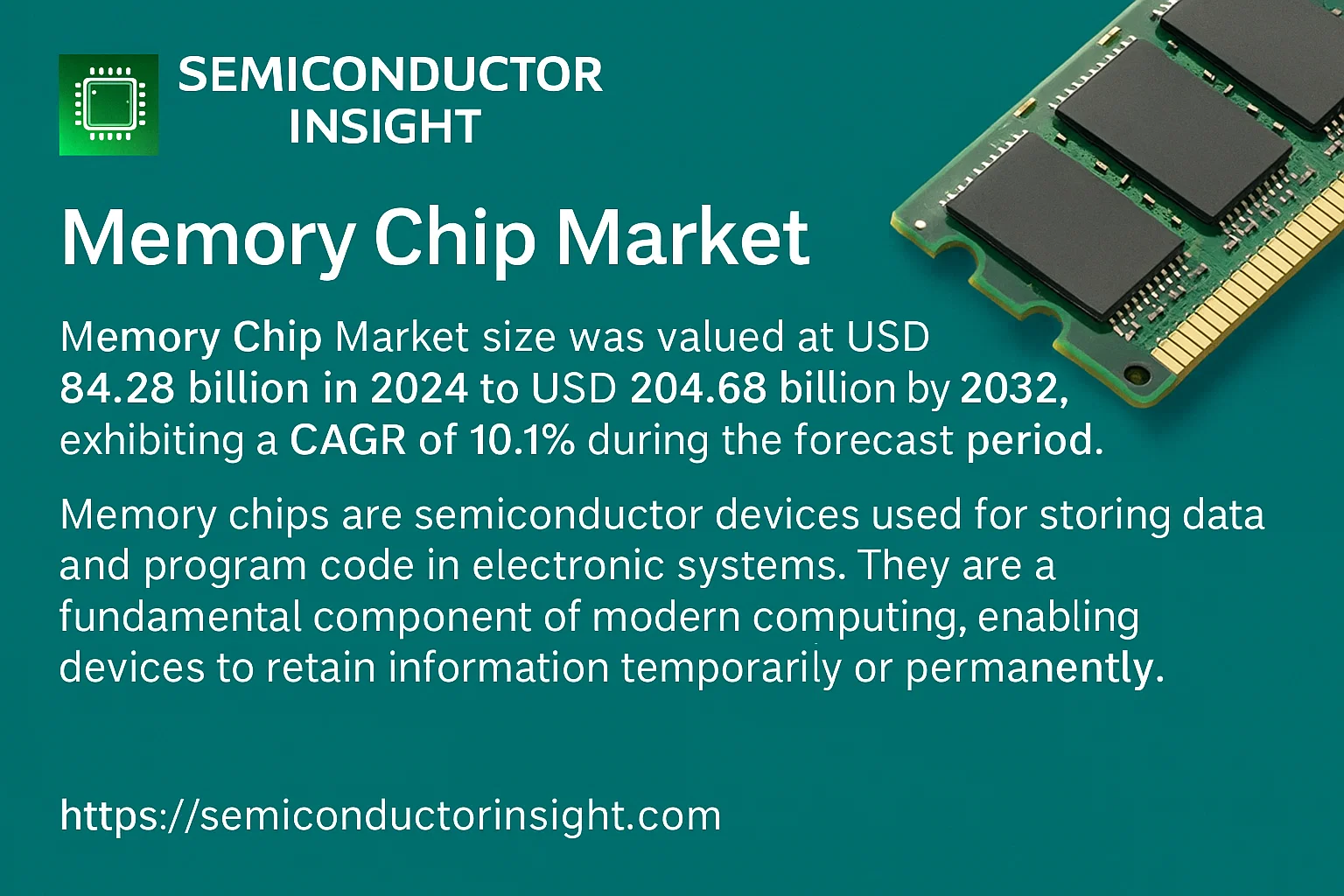
Global Memory Chip Market size was valued at USD 84.28 billion in 2024 to USD 204.68 billion by 2032, exhibiting a CAGR of 10.1% during the forecast period.
Memory chips are semiconductor devices used for storing data and program code in electronic systems. They are a fundamental component of modern computing, enabling devices to retain information temporarily or permanently. The primary types include volatile memory like DRAM (Dynamic Random-Access Memory) for high-speed data access and non-volatile memory such as NAND Flash for persistent storage, alongside ROM (Read-Only Memory) and other specialized variants.
The market is experiencing robust growth driven by the exponential increase in data generation from technologies like AI, big data, and the Internet of Things (IoT), which demand higher performance and capacity. Furthermore, the proliferation of consumer electronics, including advanced smartphones and gaming consoles, continues to fuel demand for high-density storage solutions. The automotive sector represents a significant emerging driver; the advancement towards autonomous and electric vehicles requires sophisticated memory chips for processing vast amounts of sensor data in real-time.
MARKET DRIVERS
Proliferation of Data-Intensive Applications
The exponential growth in data generation from artificial intelligence, machine learning, 5G connectivity, and the Internet of Things (IoT) is a primary force propelling the memory chip market. These technologies require vast amounts of high-speed, high-density memory for data processing and storage, creating sustained demand for both DRAM and NAND flash memory.
Expansion of Cloud Computing and Data Centers
The global shift towards cloud-based services and hyperscale data centers necessitates massive server deployments, each requiring significant memory capacity. The demand for efficient data handling and storage solutions in these facilities is a critical driver for advanced memory technologies, including High Bandwidth Memory (HBM) and faster DDR5 modules.
➤ The transition to DDR5 memory is accelerating, offering double the bandwidth and improved power efficiency over DDR4, which is crucial for next-generation servers and PCs.
Furthermore, the automotive sector is emerging as a significant driver, with modern vehicles incorporating advanced driver-assistance systems (ADAS) and infotainment systems that rely heavily on robust memory solutions for real-time data processing.
MARKET CHALLENGES
High Capital Intensity and Cyclical Nature
The memory chip industry is characterized by extremely high capital expenditure for constructing and maintaining advanced fabrication plants (fabs). This, combined with the market’s historical cyclicality of boom and bust periods driven by supply-demand imbalances, poses a significant challenge for manufacturers in planning long-term investments and maintaining profitability.
Other Challenges
Technological Complexity and Scaling Limits
As chip manufacturers approach the physical limits of semiconductor miniaturization, the technical challenges and costs associated with developing next-generation nodes (e.g., sub-10nm processes) increase dramatically. This slows the pace of innovation and increases R&D expenditure.
Supply Chain Vulnerabilities and Geopolitical Tensions
The highly concentrated global supply chain, particularly for raw materials and advanced manufacturing equipment, creates vulnerabilities. Geopolitical issues and trade restrictions can disrupt supply, leading to price volatility and production delays for memory chips worldwide.
MARKET RESTRAINTS
Price Volatility and Inventory Gluts
Memory chip prices are highly susceptible to fluctuations based on global supply and demand dynamics. Periods of oversupply, often resulting from previous overinvestment in production capacity, can lead to significant price declines and inventory gluts, thereby restraining market revenue growth and pressuring manufacturer margins.
Slowing Growth in Traditional End Markets
While new applications are driving growth, the maturation of key traditional markets like smartphones and personal computers acts as a restraint. Growth rates in these segments have slowed, limiting the volume-driven demand for memory chips that previously fueled much of the market’s expansion.
MARKET OPPORTUNITIES
Artificial Intelligence and High-Performance Computing
The AI revolution represents a monumental opportunity for the memory chip market. Training and running complex AI models require specialized, high-bandwidth memory like HBM, which offers substantially higher performance than traditional DRAM. The demand for AI-capable infrastructure in data centers and edge devices is creating a new, high-growth segment.
Emerging Memory Technologies
There is significant opportunity in the development and commercialization of next-generation non-volatile memory technologies, such as MRAM (Magnetoresistive RAM) and PCRAM (Phase-Change RAM). These technologies promise faster speeds, lower power consumption, and greater endurance than NAND flash, potentially opening up new applications in enterprise storage and embedded systems.
The push for sustainability and energy efficiency is also creating opportunities for memory chips that consume less power, which is critical for large-scale data centers aiming to reduce their carbon footprint and operational costs.
Memory Chip Market Trends
Data-Driven Applications Fueling Market Expansion
The global memory chip market is experiencing significant growth, driven by an insatiable demand for data storage and processing. Valued at $84,280 million in 2024, the market is projected to reach $204,680 million by 2032, expanding at a compound annual growth rate (CAGR) of 10.1%. This robust growth is primarily a response to the rapid proliferation of big data, cloud computing, and the Internet of Things (IoT). These technologies generate massive datasets, compelling enterprises and service providers to invest heavily in higher-performance, larger-capacity memory chips to manage the load effectively.
Other Trends
AI and Machine Learning Demands
Artificial intelligence and machine learning applications are placing unprecedented demands on memory infrastructure. The training and operation of complex models require the processing and storage of immense volumes of data in real-time. This necessitates memory chips that offer not only high capacity but also exceptionally fast data access speeds and bandwidth. This trend is a key driver for innovation in high-performance memory types like DRAM and advanced NAND flash, pushing the boundaries of chip architecture to support the computational intensity of AI workloads.
Consumer Electronics and Automotive Innovation
The consumer electronics sector continues to be a major driver of memory chip demand. The relentless evolution of smartphones, tablets, laptops, and gaming consoles requires ever-increasing storage performance and capacity. High-end smartphones and next-generation game consoles, in particular, are catalysts for the adoption of high-speed, high-capacity storage solutions like solid-state drives (SSDs). Concurrently, the automotive industry has emerged as a critical growth segment. The advancement of autonomous driving, connected car technologies (Internet of Vehicles), and new energy vehicles is fueling demand. The rise in vehicle intelligence requires extensive environmental perception through numerous sensors and microcontrollers, leading to a massive increase in the need for high-performance non-volatile memory for data and program storage, making it a significant force shaping the market’s future.
COMPETITIVE LANDSCAPE
Key Industry Players
A Market Dominated by Giants with a Strong Supporting Cast of Specialists
The global Memory Chip market structure is an oligopoly, characterized by high concentration and significant capital barriers to entry. The competitive landscape is dominated by a triumvirate of South Korean and American behemoths: Samsung Electronics, SK Hynix, and Micron Technology. This top tier collectively commands a substantial portion of the global market share, primarily through their leadership in the high-volume DRAM and NAND flash memory segments. Their competitive advantage is sustained by immense investments in research and development, continuous process technology migration to smaller nodes (which increases density and reduces cost), and massive manufacturing scale. The recent market focus on high-performance computing, artificial intelligence, and data centers has further cemented the position of these leaders, as these applications demand the most advanced memory solutions.
Beyond the leading trio, a second tier of established players caters to specific niches and applications, ensuring a dynamic and multifaceted market. Companies like Kioxia and Western Digital are formidable forces in the NAND flash memory market, particularly for client and enterprise Solid-State Drives (SSDs). Other significant manufacturers, such as Winbond, Nanya Technology, and Macronix, specialize in products like NOR flash, specialty DRAM, and ROM, serving markets including automotive electronics, industrial applications, and consumer embedded systems. Furthermore, the rise of Chinese competitors, most notably Yangtze Memory Technologies Corp (YMTC), signifies a strategic shift, as national interests and supply chain diversification efforts introduce new variables into the global competitive equation. GigaDevice is another key player noted for its NOR flash and MCU products.
List of Key Memory Chip Companies Profiled
- Samsung Electronics
- SK Hynix
- Micron Technology
- Kioxia
- Western Digital
- Winbond Electronics
- Nanya Technology
- Macronix International
- GigaDevice Semiconductor
- Yangtze Memory Technologies Corp (YMTC)
- Texas Instruments
- Infineon Technologies
- STMicroelectronics
Segment Analysis:
| Segment Category | Sub-Segments | Key Insights |
| By Type |
|
NAND Flash continues to be a cornerstone of the memory chip market, driven by its essential role in solid-state storage solutions that are increasingly replacing traditional hard drives. The demand for higher-density and faster NAND is accelerating due to its critical function in data centers, enterprise servers, and high-end consumer electronics like smartphones and laptops. Concurrently, DRAM is experiencing robust growth as a leading segment, primarily because it is indispensable for system performance in computing applications, providing the high-speed working memory required for processing complex tasks in servers, PCs, and AI systems. The evolution of both segments is heavily influenced by the industry-wide push toward higher performance and greater energy efficiency. |
| By Application |
|
Servers represent a dominant and rapidly expanding application segment, fueled by the exponential growth in cloud computing, big data analytics, and the infrastructural demands of artificial intelligence. These applications require immense, high-speed memory for real-time data processing and storage. The Automobiles segment is also emerging as a key growth area, with the advancement of autonomous driving and vehicle connectivity necessitating robust, reliable memory solutions for sensor data processing and in-car infotainment systems. Meanwhile, the ubiquitous Mobile Devices segment continues to drive consistent volume demand, particularly for advanced NAND flash to support higher-resolution content and sophisticated mobile applications. |
| By End User |
|
Enterprise & Data Centers are the dominant end-user segment, as organizations increasingly rely on powerful computing infrastructure for cloud services, AI model training, and large-scale data management. This segment demands memory chips that offer not only high capacity and speed but also exceptional reliability and durability for continuous operation. The Consumer Electronics segment remains a massive and dynamic market, driven by the perpetual cycle of innovation in smartphones, gaming consoles, and personal computers that require faster and denser memory. The Automotive Industry is a high-growth end user, with its stringent requirements for memory that can operate reliably in harsh environments while supporting advanced driver-assistance systems. |
| By Technology Node |
|
Leading-edge (sub-20nm) technology is the primary driver of innovation and performance in the memory chip market. This segment is critical for manufacturing high-density, low-power-consumption DRAM and 3D NAND chips that are essential for cutting-edge applications in data centers and premium mobile devices. The push toward smaller nodes is fundamental to achieving the performance and capacity scaling demanded by advanced computing. While the Mainstream node segment supports a vast volume of applications with a balanced cost-to-performance ratio, the Legacy node segment remains vital for specific applications like automotive microcontrollers and industrial systems where extreme miniaturization is less critical than proven reliability and cost-effectiveness. |
| By Volatility |
|
Non-Volatile Memory, particularly NAND Flash, stands as the leading segment by volatility due to its fundamental role as the primary storage medium across几乎所有电子设备. Its ability to retain data without power makes it indispensable for permanent storage in everything from USB drives and SSDs to the embedded storage in smartphones and servers. The growth of data-centric applications ensures sustained high demand for high-capacity non-volatile memory. Volatile Memory, primarily DRAM, is equally crucial as the leading working memory solution, providing the high-speed temporary storage necessary for active data processing in CPUs and GPUs. The synergy between these two types is critical for overall system architecture, with advancements in one often driving requirements in the other. |
Regional Analysis: Memory Chip Market
Asia-Pacific’s manufacturing supremacy is built on decades of investment in advanced fabrication plants. The concentration of leading memory chip fabricators in a tight geographic area creates unparalleled supply chain efficiency. These companies continuously push the boundaries of process node technology, producing the highest density and most advanced memory chips, which are essential for next-generation applications like AI and high-performance computing.
The region boasts a deeply integrated and resilient supply chain, encompassing everything from wafer production and specialty chemicals to advanced equipment manufacturing and assembly. This vertical integration minimizes logistical hurdles and reduces time-to-market for new products. Close proximity of suppliers to major manufacturers fosters strong collaborative relationships, enabling rapid problem-solving and co-development of new materials and processes.
National governments across the region, particularly in China, South Korea, and Taiwan, have identified semiconductors as a strategic industry. This has resulted in substantial subsidies, tax incentives, and research grants aimed at bolstering domestic capabilities. Policies are designed to foster innovation, protect intellectual property, and secure access to critical materials, creating a highly supportive environment for sustained growth and technological leadership.
Demand is fueled by the region’s massive electronics manufacturing sector, which produces a vast majority of the world’s smartphones, laptops, and data center equipment. Rising disposable incomes and digital transformation initiatives across emerging economies further amplify consumption. The rapid adoption of technologies such as 5G, IoT, and artificial intelligence within the region ensures a persistent and growing need for high-performance memory solutions.
North America
North America, led by the United States, is a critical hub for memory chip design, innovation, and high-value consumption. The region is home to leading technology companies that are primary consumers of advanced memory, including major cloud service providers, server manufacturers, and PC makers. While its manufacturing footprint for memory is smaller than Asia-Pacific, its influence is profound through companies like Micron Technology, which plays a key global role. The market is characterized by strong demand from enterprise data centers, the gaming industry, and the automotive sector, where requirements for reliability and performance are exceptionally high. Investments in research and development are significant, focusing on next-generation architectures like Compute Express Link (CXL) and memory-centric computing to address future data-intensive workloads.
Europe
The European memory chip market is primarily driven by demand from its robust automotive, industrial, and telecommunications sectors. The region has a strong focus on specialized, high-reliability memory solutions for automotive electronics, industrial automation, and embedded systems. While it lacks large-scale memory fabrication, it possesses significant expertise in research and design, with several academic and corporate R&D centers pushing innovation in non-volatile memory technologies. The market is also influenced by stringent regulatory standards for quality, safety, and data privacy, which shape the types of memory products in demand. Strategic initiatives at the EU level aim to increase semiconductor sovereignty, leading to investments in building a more resilient supply chain for critical components like memory chips.
South America
The South American memory chip market is a growing but still emerging segment, largely driven by imports to meet domestic demand. Brazil and Argentina are the largest markets, with consumption primarily fueled by the consumer electronics sector, including smartphones and computers. The region’s economic volatility can lead to fluctuating demand, but a growing middle class and increasing digitalization present long-term growth opportunities. Local manufacturing of memory chips is minimal, making the region highly dependent on global supply chains. Market dynamics are influenced by import tariffs, currency exchange rates, and government policies aimed at fostering local technology industries, though establishing a significant manufacturing base remains a long-term challenge.
Middle East & Africa
The memory chip market in the Middle East & Africa is characterized by disparate levels of development. The Middle East, particularly the Gulf Cooperation Council (GCC) countries, shows stronger demand driven by large-scale government-led digital transformation projects, smart city initiatives, and investments in data centers. In contrast, the African market is more fragmented, with growth centered on mobile device penetration and the gradual expansion of internet infrastructure. The region as a whole is almost entirely reliant on imports, with no notable local memory chip production. Market growth is tied to economic diversification efforts in oil-rich nations and the broader trend of digital adoption across the continent, though infrastructure challenges can impede rapid expansion.
Report Scope
This market research report provides a comprehensive analysis of the Memory Chip Market , covering the forecast period 2025–2032. It offers detailed insights into market dynamics, technological advancements, competitive landscape, and key trends shaping the industry.
Key focus areas of the report include:
- Market Overview: The report begins with an overview outlining its current market scenario, key growth indicators, and industry transformation drivers. It discusses macroeconomic factors, demand–supply balance, regulatory landscape, and the strategic role of semiconductors in powering advancements across industries such as automotive, telecommunications, consumer electronics, and industrial automation.
- Market Size & Forecast: Historical data and future projections for revenue, unit shipments, and market value across major regions and segments.
- Segmentation Analysis: Detailed breakdown by product type, technology, application, and end-user industry to identify high-growth segments and investment opportunities.
- Regional Insights: Insights into market performance across North America, Europe, Asia-Pacific, Latin America, and the Middle East & Africa, including country-level analysis where relevant.
- Competitive Landscape: Profiles of leading market participants, including their product offerings, R&D focus, manufacturing capacity, pricing strategies, and recent developments such as mergers, acquisitions, and partnerships.
- Technology Trends & Innovation: Assessment of emerging technologies, integration of AI/IoT, semiconductor design trends, fabrication techniques, and evolving industry standards.
- Market Drivers & Restraints: Evaluation of factors driving market growth along with challenges, supply chain constraints, regulatory issues, and market-entry barriers.
- Stakeholder Insights: Insights for component suppliers, OEMs, system integrators, investors, and policymakers regarding the evolving ecosystem and strategic opportunities.
Primary and secondary research methods are employed, including interviews with industry experts, data from verified sources, and real-time market intelligence to ensure the accuracy and reliability of the insights presented.
FREQUENTLY ASKED QUESTIONS:
What is the current market size of Memory Chip Market?
-> Global Memory Chip Market was valued at USD 84280 million in 2024 and is projected to reach USD 204680 million by 2032, exhibiting a CAGR of 10.1% during the forecast period.
Which key companies operate in Memory Chip Market?
-> Key players include Samsung, SK Hynix, Micron, Kioxia, Western Digital, Winbond, Nanya, Macronix, GigaDevice, and YMTC, among others.
What are the key growth drivers?
-> Key growth drivers include the rapid development of big data, cloud computing, and the Internet of Things (IoT), increasing demand from consumer electronics, and the automotive industry’s growing need for high-performance storage chips for autonomous driving and intelligent vehicles.
Which region dominates the market?
-> Asia is a dominant market, with significant contributions from countries such as China, Japan, South Korea, and Southeast Asia.
What are the emerging trends?
-> Emerging trends include the integration of AI and machine learning driving demand for higher-performance chips, the rising demand for high-capacity storage in gaming and virtual reality devices, and the surge in non-volatile memory demand from the automotive electronics sector.

Get Sample Report PDF for Exclusive Insights
Report Sample Includes
- Table of Contents
- List of Tables & Figures
- Charts, Research Methodology, and more...
 Download Sample Report PDF