MARKET INSIGHTS
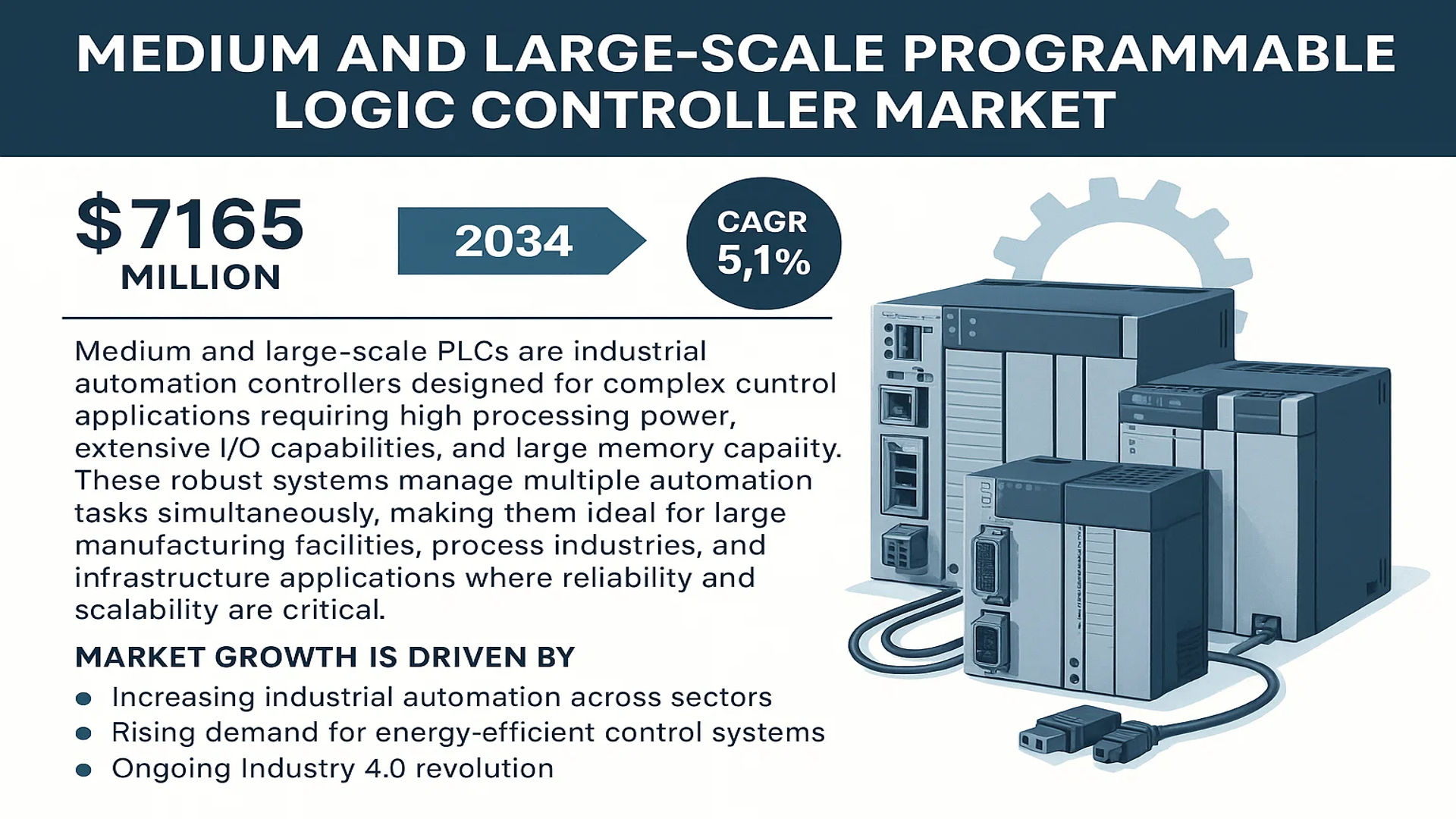
The global Medium and Large-scale Programmable Logic Controller Market was valued at 7165 million in 2024 and is projected to reach US$ 10110 million by 2032, at a CAGR of 5.1% during the forecast period.
Medium and large-scale PLCs are industrial automation controllers designed for complex control applications requiring high processing power, extensive I/O capabilities, and large memory capacity. These robust systems manage multiple automation tasks simultaneously, making them ideal for large manufacturing facilities, process industries, and infrastructure applications where reliability and scalability are critical.
The market growth is driven by increasing industrial automation across sectors, rising demand for energy-efficient control systems, and the ongoing Industry 4.0 revolution. While North America currently holds significant market share, Asia-Pacific is emerging as the fastest-growing region due to rapid industrialization in China and India. Leading manufacturers like Siemens AG, Rockwell Automation, and Mitsubishi Electric Corporation are investing heavily in IoT-enabled PLC solutions to maintain competitive advantage in this evolving market landscape.
MARKET DYNAMICS
MARKET DRIVERS
Industrial Automation Boom Accelerates PLC Demand
The global push toward industrial automation is driving unprecedented demand for medium and large-scale programmable logic controllers (PLCs). As manufacturers adopt Industry 4.0 principles, PLCs serve as the backbone for smart factories, enabling seamless integration of machines, sensors, and control systems. The worldwide industrial automation market expansion, projected to maintain a compound annual growth rate exceeding 8% through 2030, directly correlates with PLC adoption. These advanced control systems provide the computational power needed for predictive maintenance, real-time monitoring, and complex automation sequences that traditional controllers cannot handle.
Infrastructure Modernization in Emerging Economies Fuels Growth
Developing nations are investing heavily in modernizing their industrial infrastructure, creating substantial opportunities for large-scale PLC deployments. Countries like China and India are allocating significant portions of their GDP to upgrade manufacturing facilities, power plants, and transportation systems. For instance, China’s Made in China 2025 initiative specifically prioritizes advanced automation technologies, driving double-digit annual growth in PLC adoption across its industrial sector. Similarly, infrastructure projects across Southeast Asia and the Middle East frequently specify medium and large PLCs as essential components for new facilities.
The energy sector’s digital transformation represents another key growth driver. Modern power generation and distribution systems increasingly rely on large-scale PLCs to manage complex grid operations and integrate renewable energy sources. This trend is particularly pronounced in regions undergoing rapid renewable energy adoption, where PLCs facilitate the sophisticated control needed for variable power inputs.
MARKET RESTRAINTS
High Initial Costs Deter Small and Medium Enterprises
While medium and large-scale PLCs offer superior capabilities, their substantial upfront investment creates a significant barrier to adoption, particularly for small and medium-sized manufacturers. A comprehensive PLC implementation typically requires not just the controller hardware, but also specialized software, skilled personnel, and sometimes entire system retrofits. For many operations still using conventional control systems, the business case for upgrading remains challenging despite long-term efficiency gains.
Additionally, the growing complexity of modern PLC systems presents operational challenges. As controllers incorporate more advanced features like artificial intelligence and edge computing capabilities, they demand corresponding upgrades in supporting infrastructure and workforce skills. This creates a mismatch in some markets where industrial facilities may not have the technical readiness to fully leverage next-generation PLC features.
MARKET CHALLENGES
Cybersecurity Risks in Connected Industrial Environments
The increasing connectivity of industrial control systems introduces significant cybersecurity vulnerabilities that challenge PLC adoption. Medium and large-scale PLCs, serving as central control points in networked installations, represent attractive targets for malicious actors. Recent years have seen a dramatic increase in sophisticated cyber attacks targeting industrial control systems, with PLCs often serving as entry points.
Manufacturers face the dual challenge of implementing robust security measures while maintaining system performance and accessibility. The industrial sector’s traditional focus on reliability and uptime often conflicts with necessary security protocols that might introduce latency or require temporary downtime for updates. Furthermore, the lengthy operational lifespans of many industrial PLC installations mean that older systems lacking modern security features remain in widespread use.
Workforce shortages compound these technical challenges. The specialized skills needed to implement and maintain secure PLC systems remain in short supply globally, with many industrial firms reporting difficulties finding qualified automation engineers and cybersecurity specialists.
MARKET OPPORTUNITIES
Emerging Applications in Sustainability and Smart Cities
The global emphasis on sustainability and smart city development is creating new avenues for PLC innovation. Modern environmental control systems for buildings, wastewater treatment plants, and renewable energy facilities increasingly incorporate large-scale PLCs for optimized operations. Smart city initiatives worldwide are driving demand for sophisticated control systems that can manage complex municipal infrastructure, from traffic grids to district energy networks.
Manufacturers are responding with purpose-built PLC solutions featuring improved energy monitoring capabilities and tighter integration with sustainability-focused technologies. Some recent developments include PLCs specifically designed for electric vehicle charging networks and advanced building management systems, illustrating how traditional industrial control technology is finding applications in emerging markets.
Furthermore, the shift toward subscription-based and cloud-connected PLC solutions presents opportunities for manufacturers to develop recurring revenue models. These approaches can help mitigate initial cost barriers while providing customers with ongoing access to system updates and remote monitoring capabilities.
MEDIUM AND LARGE-SCALE PROGRAMMABLE LOGIC CONTROLLER MARKET TRENDS
Industry 4.0 Adoption Driving Demand for Advanced PLC Solutions
The rise of Industry 4.0 initiatives has significantly increased the adoption of medium and large-scale programmable logic controllers (PLCs) globally. These PLCs are essential for handling complex automation tasks in smart factories, where real-time data processing and industrial networking are critical. With increasing investments in industrial IoT (IIoT) infrastructure, the demand for high-performance PLCs capable of managing extensive input/output systems has grown. Medium and large PLCs accounted for nearly 42% of the total programmable controller market in 2023, demonstrating their indispensability in modern industrial automation.
Other Trends
Shift Towards Modular and Flexible Systems
The need for modular PLC architectures has emerged as a key trend, particularly in industries requiring scalable automation solutions. Manufacturers are increasingly opting for large-scale PLCs with expandable memory capacities and communication modules that support Ethernet/IP, PROFINET, and other industrial protocols. This flexibility allows seamless integration with other factory automation components while reducing long-term operational costs. The modular PLC segment is projected to grow at a 7.3% CAGR through 2032, outpacing traditional fixed-configuration PLCs.
Expansion in Energy and Infrastructure Applications
The energy sector represents one of the fastest-growing applications for medium and large PLCs, particularly in power generation and distribution systems. With renewables accounting for over 30% of global electricity production, PLCs play a critical role in managing complex grid automation and smart utility networks. Similarly, large-scale infrastructure projects increasingly rely on high-capacity PLCs for transportation systems, water treatment plants, and building automation. This diversification of application areas is creating new revenue streams for PLC manufacturers while driving technological innovation.
Integration of AI and Edge Computing Capabilities
Recent advancements have seen PLC manufacturers incorporating AI-powered predictive maintenance and edge computing features into their medium and large-scale controllers. These intelligent systems can analyze equipment performance data in real-time, reducing unplanned downtime by up to 45% in some industrial applications. The convergence of PLC functionality with edge computing allows for decentralized decision-making, particularly beneficial in large-scale manufacturing operations with distributed production lines. This technological evolution is reshaping traditional automation architectures and creating demand for next-generation PLC solutions.
COMPETITIVE LANDSCAPE
Key Industry Players
Automation Giants Intensify Market Competition Through Innovation and Strategic Expansion
The global Medium and Large-scale Programmable Logic Controller (PLC) market features a highly competitive landscape dominated by established automation leaders, emerging challengers, and regional specialists. Siemens AG continues to lead the sector with its SIMATIC S7 series, leveraging its expansive IoT integration capabilities and industrial ecosystem. The company commands significant market influence across Europe, North America, and Asia-Pacific through continuous R&D investment exceeding 5% of annual revenue.
Rockwell Automation and Mitsubishi Electric Corporation follow closely, capturing major shares through their differentiated offerings. Rockwell’s ControlLogix platforms demonstrate particular strength in North American manufacturing sectors, while Mitsubishi’s Melsec iQ-R series dominates Japanese and Southeast Asian markets through precise motion control capabilities tailored for high-speed production lines.
Meanwhile, ABB(B&R) has gained notable traction by combining its machine automation portfolio with digital twin technologies, recording 12% YOY growth in PLC solutions. Similarly, Schneider Electric‘s Modicon and EcoStruxure platforms have become industry benchmarks, particularly in energy infrastructure applications where safety-certified systems command premium positioning.
These market leaders face increasing competition from regional specialists like China’s HollySys and Inovance, which are capturing emerging market share through cost-optimized solutions. Their success stems from localized support networks and government-backed smart manufacturing initiatives opening new growth avenues.
List of Key Medium and Large-scale PLC Manufacturers Profiled
- Siemens AG (Germany)
- Rockwell Automation (U.S.)
- Mitsubishi Electric Corporation (Japan)
- ABB(B&R) (Switzerland)
- Schneider Electric (France)
- Omron Corporation (Japan)
- Emerson(GE Fanuc) (U.S.)
- Bosch Rexroth (Germany)
- HollySys (China)
- Inovance (China)
- Delta Electronics (Taiwan)
- Keyence Corporation (Japan)
Segment Analysis:
By Type
Medium PLC Segment Holds Significant Market Share Due to Rising Demand in Industrial Automation
The market is segmented based on type into:
- Medium PLC
- Large PLC
By Application
Industrial Automation Segment Leads Owing to Increasing Manufacturing Automation Globally
The market is segmented based on application into:
- Industrial Automation
- Process Control
- Energy and Infrastructure
- Others
By End User
Manufacturing Sector Dominates Due to High Adoption of Automation Solutions
The market is segmented based on end user into:
- Manufacturing
- Oil & Gas
- Chemical
- Power Generation
- Others
By Technology
Modular PLC Segment Shows Strong Growth Potential
The market is segmented based on technology into:
- Compact PLC
- Modular PLC
- Rack-mounted PLC
Regional Analysis: Medium and Large-scale Programmable Logic Controller Market
Asia-Pacific
The Asia-Pacific region dominates the global PLC market, accounting for the highest revenue share due to rapid industrialization in China, India, and Southeast Asia. China alone represents over 35% of regional demand, driven by massive investments in smart manufacturing under the “Made in China 2025” initiative. Japan maintains strong technological leadership through companies like Mitsubishi Electric and Omron, while India’s growing automotive and electronics sectors fuel demand for advanced automation solutions. However, cost sensitivity in emerging markets creates a competitive landscape where mid-range PLCs often outperform premium models. The region is also witnessing increased adoption of IoT-enabled PLCs as manufacturers embrace Industry 4.0 transformation.
North America
North America’s mature industrial sector maintains steady demand for high-performance PLCs, particularly in oil & gas, automotive, and aerospace applications. The U.S. leads with stringent safety standards and early adoption of industrial IoT solutions, where Rockwell Automation and Emerson hold significant market share. Recent reshoring initiatives and infrastructure bills are driving modernization projects that require advanced control systems. Canadian manufacturers are increasingly integrating cybersecurity features into PLCs to protect critical infrastructure. While growth remains stable, higher manufacturing costs compared to Asian alternatives present ongoing competitive challenges for regional suppliers.
Europe
European demand focuses on energy-efficient and sustainable automation solutions, with Germany’s Industrie 4.0 strategy setting regional standards. Siemens and ABB dominate the premium PLC segment, particularly in automotive and pharmaceutical applications where precision and reliability are paramount. The EU’s Green Deal initiatives are accelerating the replacement of legacy systems with smart, energy-saving controllers. However, slower economic growth in some member states and complex regulatory requirements have tempered expansion. Recent developments include increased R&D investment in edge-computing enabled PLCs to support distributed manufacturing networks across the region.
South America
The South American market shows potential but remains constrained by economic instability and limited industrial investment. Brazil accounts for nearly 60% of regional PLC demand, primarily in mining, food processing, and water treatment applications. Local manufacturers increasingly opt for cost-effective medium-scale PLCs from Chinese suppliers, though quality concerns persist. Infrastructure projects in Argentina and Chile are creating new opportunities, particularly for PLCs used in renewable energy systems. Market growth remains modest compared to other regions, with political uncertainties and currency fluctuations continuing to impact capital expenditures in industrial automation.
Middle East & Africa
This emerging market is showing the fastest growth rates, albeit from a small base, driven by oil & gas automation and smart city initiatives. The UAE and Saudi Arabia lead adoption, with major investments in industrial zones requiring advanced control systems. South Africa serves as a regional hub for mining and manufacturing applications. Challenges include limited technical expertise and reliance on imported solutions, though local partnerships with global PLC manufacturers are gradually improving service infrastructure. The market shows particular promise for ruggedized PLCs suited for harsh environments in extraction industries and remote infrastructure projects.
Report Scope
This market research report provides a comprehensive analysis of the Global Medium and Large-scale Programmable Logic Controller (PLC) market, covering the forecast period 2024–2032. It offers detailed insights into market dynamics, technological advancements, competitive landscape, and key trends shaping industrial automation.
Key focus areas of the report include:
- Market Size & Forecast: Historical data and future projections for revenue (USD million) and unit shipments (K Units) across product types, applications, and regions. The market was valued at USD 7,165 million in 2024, projected to reach USD 10,110 million by 2032 at a 5.1% CAGR.
- Segmentation Analysis: Detailed breakdown by Type (Medium PLC, Large PLC) and Application (Industrial Automation, Process Control, Energy & Infrastructure) to identify high-growth segments.
- Regional Outlook: Market performance across North America, Europe, Asia-Pacific, Latin America, and MEA, with country-level insights for the U.S., China, Germany, Japan, and other key markets.
- Competitive Landscape: Profiles of 20+ leading manufacturers including Siemens AG, Rockwell Automation, Mitsubishi Electric, Schneider Electric, and ABB, covering their market share, product portfolios, and strategic developments.
- Technology Trends: Analysis of Industry 4.0 integration, IoT-enabled PLCs, AI applications in industrial control systems, and cybersecurity enhancements.
- Market Drivers & Restraints: Evaluation of industrial automation demand, smart manufacturing growth versus high implementation costs and supply chain challenges.
- Stakeholder Analysis: Strategic insights for OEMs, system integrators, industrial end-users, and investors on market opportunities and competitive positioning.
The report employs primary research (industry expert interviews) and secondary research (verified market data, company financials) to ensure accuracy and reliability.
FREQUENTLY ASKED QUESTIONS:
What is the current market size of Global Medium and Large-scale PLC Market?
->Medium and Large-scale Programmable Logic Controller Market was valued at 7165 million in 2024 and is projected to reach US$ 10110 million by 2032, at a CAGR of 5.1% during the forecast period.
Which companies lead the Global PLC market?
-> Top players include Siemens AG, Rockwell Automation, Mitsubishi Electric, Schneider Electric, ABB, Omron, and Emerson, collectively holding over 60% market share.
What drives PLC market growth?
-> Key drivers are Industry 4.0 adoption, increasing factory automation investments, and demand for energy-efficient control systems.
Which region dominates PLC adoption?
-> Asia-Pacific leads with 42% market share (2024), driven by China’s manufacturing expansion, while Europe remains strong in advanced industrial applications.
What are emerging PLC technologies?
-> Emerging trends include edge computing integration, cloud-based PLC systems, and predictive maintenance capabilities through AI/ML.

Get Sample Report PDF for Exclusive Insights
Report Sample Includes
- Table of Contents
- List of Tables & Figures
- Charts, Research Methodology, and more...