SEMICONDUCTOR INSIGHT
MARKET RESEARCH REPORT

LTCC and HTCC Market

2026 to 2034
MARKET INTELLIGENCE
ACROSS KEY REGIONS
2026 EDITION
DIELECTRIC MATERIALS Semiconductor Market Research

LTCC and HTCC Market

Trends, Business Strategies 2026-2034

◷
UPDATED 11 September 2026
▤
REPORT LENGTH Detailed Report
▣
REPORT CODE 5d731fe59ff6
▯
FORMATS PDF

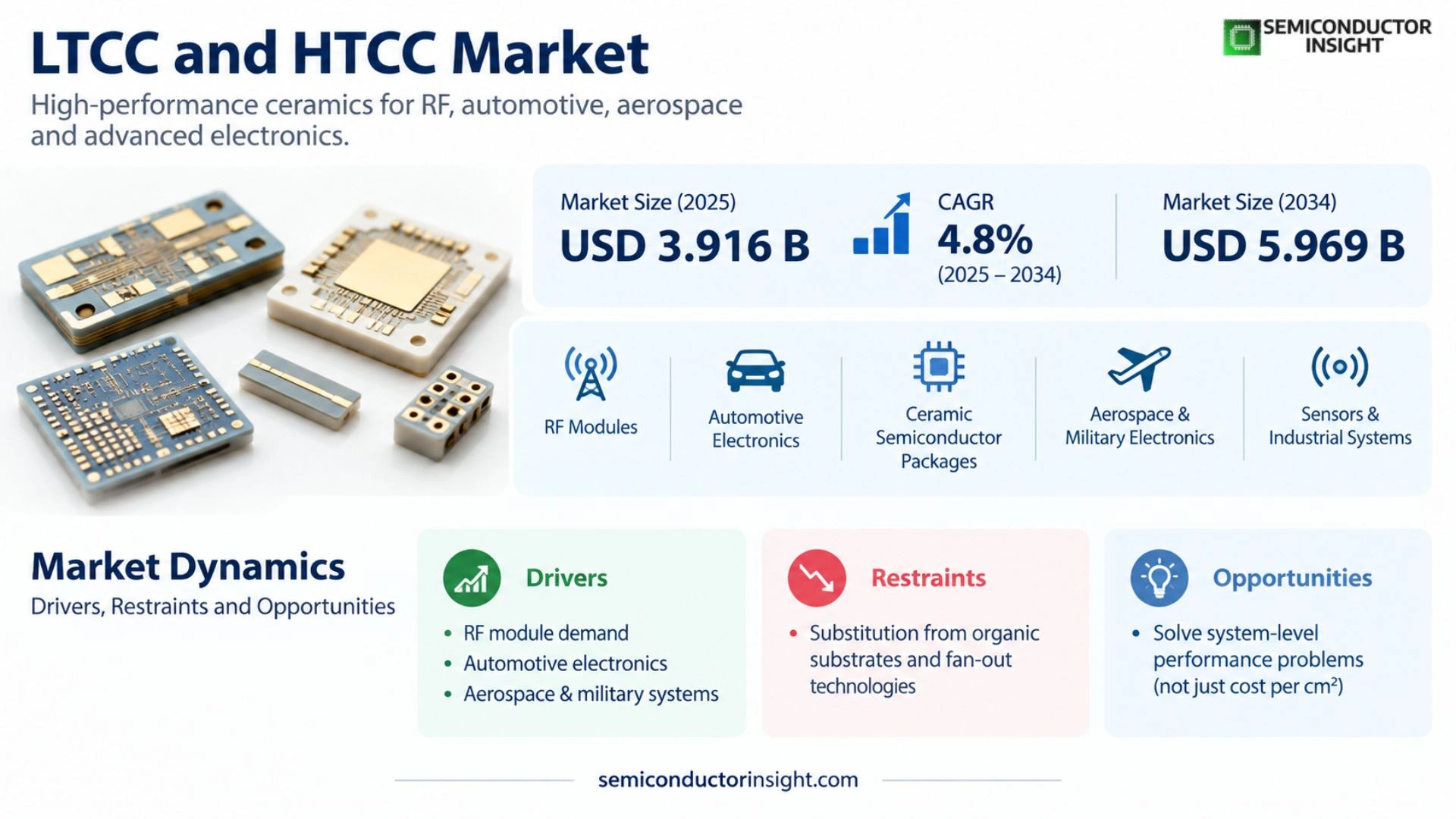
LTCC and HTCC Market is rebased from published anchors of USD 3.916 billion in 2025 and USD 5.969 billion in 2034. Those anchors imply about 4.8% annual compound growth, which is used consistently instead of the controlling page’s displayed 5.6% rate. Demand is driven by RF modules, automotive electronics, ceramic semiconductor packages, aerospace and military electronics, sensors and industrial systems.

Get the sample PDF with study scope, segmentation and methodology details.

Key Statistics

2025 Market Size
USD 3.916 billion
2034 Projected Size
USD 5.969 billion
CAGR (2026–2034)
4.8%
Largest Market in 2025
Asia Pacific

Key Takeaways

  • LTCC and HTCC Market is rebased from published anchors of USD 3.9 billion in 2024 and USD 5.7 billion in 2032 to approximately USD 3.916 billion in 2025 and USD 5.969 billion in 2034. Those anchors imply about 4.8% annual compound growth, which is used consistently instead of the controlling page’s displayed 5.6% rate. Demand is driven by RF modules, automotive electronics, ceramic semiconductor packages, aerospace and military electronics, sensors and industrial systems.
  • LTCC and HTCC address different performance envelopes. Kyocera describes LTCC as a glass-ceramic material co-fired at lower temperatures that allows low-resistance copper conductors and reduced high-frequency transmission loss. MARUWA’s alumina HTCC data show thermal conductivity around 15–16 W/m·K, flexural strength of 350 MPa and breakdown strength above 15 kV/mm, while its AlN multilayer ceramic reaches 170 W/m·K. These contrasts explain why LTCC is strong in RF integration and HTCC in thermal, hermetic and harsh-environment packaging.
  • Asia Pacific is the largest region because Japan houses Murata, TDK, Kyocera and MARUWA and the wider region contains the world’s largest electronics, automotive and telecom manufacturing base. OICA reported Asia-Pacific produced about 59.2 million vehicles in 2025, more than 61% of global output, while GSMA projects 1.5 billion 5G connections in Asia Pacific by 2030. These end markets directly support ceramic filters, RF modules, sensor packages and high-reliability electronic substrates.
  • High-reliability applications create a durable value pool beyond consumer electronics. SIPRI reported military expenditure in Asia and Oceania reached USD 681 billion in 2025, up 8.1%, while AMETEK Aegis specifies HTCC packages for military and defense cryogenic systems with minimum ten-year vacuum-life targets and helium leak capability down to 1×10⁻¹³ cc/sec at a 15 psi differential. Such specifications favor qualified ceramic package suppliers even when lower-cost organic substrates are available for less demanding applications.

LTCC and HTCC Market Overview

Low Temperature Co-fired Ceramic and High Temperature Co-fired Ceramic technologies create multilayer substrates and packages by printing conductors and vias on ceramic green sheets, stacking the layers and co-firing them into a dense monolithic structure. The controlling scope divides the market into LTCC and HTCC by type; Consumer Electronics, Communication Package, Automotive Electronics, Aerospace and Military, Industrial and Others by application; Electronics Manufacturers, Automotive OEMs, Telecom Providers and Defense Contractors by end user; and alumina-based HTCC, aluminum-nitride HTCC and glass-ceramic LTCC by material composition.

LTCC is commercially attractive for compact RF and microwave functions because lower firing temperatures permit copper, silver or other low-resistance conductors and enable embedded passive structures. TDK uses LTCC in diplexers and filters for smartphones, wireless automotive systems, base stations, navigation, Bluetooth and WLAN. Kyocera’s LTCC materials have dielectric constants around 5.6–6.2 depending on formulation and support fine multilayer structures for advanced semiconductors and high-frequency devices. These attributes favor communication packages and miniaturized electronics.

HTCC prioritizes reliability, thermal stability and hermetic packaging. MARUWA’s 92% alumina HTCC offers multilayer wiring, cavity structures, volume resistivity above 10¹⁴ ohm-centimeters and breakdown strength above 15 kV/mm, with applications including sensors, MEMS, optical communications and LEDs. AMETEK Aegis uses HTCC feedthroughs in cryogenic defense assemblies where vacuum integrity and extreme-environment performance matter. This positions HTCC as a high-value solution in aerospace, defense, power and specialized semiconductor packaging even when unit volumes are lower than consumer LTCC.

Segment Analysis: By Type

Type Market interpretation
LTCC (Low Temperature Co-fired Ceramics) LTCC is the broader volume segment because it combines multilayer integration with low-loss conductors and compact RF functionality. TDK’s LTCC diplexers and filters are designed for smartphones, wireless automotive equipment and base stations, while Kyocera positions LTCC for advanced semiconductor and high-frequency packages. Growth is supported by 5G, Wi-Fi, automotive radar and miniaturized modules. Competition focuses on dielectric loss, dimensional control, embedded passive integration, conductor resistance and high-volume co-firing yield.
HTCC (High Temperature Co-fired Ceramics) HTCC serves applications where alumina or aluminum-nitride ceramic strength, hermeticity, thermal stability and long-term reliability outweigh the higher firing temperature and use of refractory metallization. MARUWA’s alumina HTCC specifications show 350 MPa flexural strength and more than 15 kV/mm breakdown strength, while AMETEK Aegis targets cryogenic and defense packages. The segment is important in MEMS, sensors, optical communications, aerospace, defense and harsh-environment semiconductor packages where organic alternatives may not meet lifecycle requirements.

Segment Analysis: By Application

Application Demand characteristics
Consumer Electronics Consumer electronics supports large LTCC volumes through smartphones, wearables, wireless devices and compact modules that require filters, diplexers and integrated passive functions. The commercial requirement is high output with tight dimensional control, low insertion loss and small package size. Asian manufacturing concentration strengthens regional supply. Competition is price-sensitive, but suppliers with proprietary ceramic formulations and embedded-component capability can maintain differentiation because device makers repeatedly push for thinner modules and more RF functionality in limited board area.
Communication Package Communication packages are a high-value LTCC application because 5G and future 6G systems require high-frequency signal routing, filtering and module integration with low transmission loss. GSMA reported 18% of Asia Pacific mobile connections were already 5G in 2024 and expects 50% by 2030, while operators planned USD 254 billion of further regional network investment through 2030. TDK’s LTCC RF components and Kyocera’s low-loss LTCC materials directly target this demand.
Automotive Electronics Automotive electronics uses LTCC and HTCC in RF modules, sensors, control electronics and packages exposed to vibration and temperature cycling. OICA reported Asia-Pacific produced 59.2 million vehicles in 2025 and China alone produced 34.53 million, creating a large regional electronics base. EVs and advanced driver-assistance systems increase RF, sensing and power-electronic content, supporting ceramic substrates where dimensional stability, heat resistance and high-frequency performance justify higher component cost.
Aerospace and Military Aerospace and military applications favor HTCC because hermeticity, mechanical strength, vacuum compatibility and high-temperature reliability are more important than lowest cost. SIPRI reported global military expenditure reached USD 2.887 trillion in 2025, with Asia and Oceania up 8.1% and Europe up 14%. AMETEK Aegis specifies HTCC feedthroughs and packages for cryogenic defense systems, showing how qualified ceramic solutions capture value in long-life programs with demanding leak-rate and environmental requirements.
Industrial Industrial applications include sensors, optical modules, MEMS, control systems and high-temperature electronics. MARUWA explicitly lists sensor, MEMS, optical communication and LED packages for its multilayer HTCC technologies. Factory automation and energy equipment require stable electrical insulation, thermal cycling performance and compact routing, while volumes are smaller than consumer electronics. The segment therefore supports custom designs and premium pricing where material properties reduce failure risk or allow electronics to operate closer to heat-generating components.
Others Other uses include medical electronics, satellite payloads, scientific instrumentation, specialty lighting and navigation modules. These niches can require biocompatibility, hermetic sealing, unusual cavity structures or low-loss RF performance that standard organic substrates cannot provide. Suppliers with flexible design rules and low-volume engineering services can compete even without consumer-scale capacity. The economic opportunity comes from solving a performance constraint that affects the entire system, allowing ceramic package value to exceed its share of total bill of materials.

LTCC and HTCC market Size

Regional Analysis

Asia Pacific is the largest LTCC and HTCC market because Japan is home to several technology leaders and the broader region dominates vehicle, electronics and telecom manufacturing. North America is a high-value aerospace, defense, medical and communications market; Europe is strong in automotive, industrial and defense electronics; South America remains import-led; and Middle East & Africa is driven by defense, telecom and industrial infrastructure. Regional demand therefore differs not only by volume but by qualification level, with Asia emphasizing scale and the West supporting many high-reliability niches.

Region Position Evidence-led basis
Asia Pacific Largest Japan-based ceramic leaders, 59.2 million vehicles produced in Asia-Pacific in 2025, and rapid 5G growth create both supply and demand concentration.
North America High-value specialty market Aerospace, defense, medical, optical and communications applications support hermetic and customized ceramic packages.
Europe Automotive and defense market Strong automotive electronics, industrial instrumentation and 14% growth in 2025 military spending support high-reliability ceramics.
South America Smaller import-led market Automotive, telecom and industrial equipment create demand, but most advanced ceramic substrates and packages are imported.
Middle East & Africa Project-led market Telecom rollout, defense spending, energy and industrial systems create selective demand for RF and high-reliability ceramic packaging.

Asia Pacific

PositionLargest market
Lead economiesChina, Korea, Taiwan
Core demandDevices and packaging
OutlookStrong

Asia Pacific combines the strongest supplier cluster with the largest downstream manufacturing base. Japan’s Murata, TDK, Kyocera and MARUWA provide ceramics, RF components and semiconductor packages, while China, South Korea and Taiwan supply smartphones, telecom equipment, vehicles and semiconductors at enormous scale. GSMA reported mobile technologies contributed USD 1 trillion to Asia Pacific’s economy in 2025 and forecasts 1.5 billion regional 5G connections by 2030. This creates recurring demand for compact RF filtering, modules, sensors and high-reliability packages using LTCC or HTCC.

Country / subregion Commercial logic
Japan Technology center for LTCC/HTCC materials and components, with Kyocera, Murata, TDK and MARUWA providing global product platforms.
China Large telecom, consumer electronics and automotive production drives volume demand and supports growing domestic ceramic substrate suppliers.
South Korea & Taiwan Semiconductor, networking and electronics ecosystems create demand for RF modules, packages and high-performance ceramic interconnect.

Dated market instances

2025–2026 demand signal – Asia Pacific combines the strongest supplier cluster with the largest downstream manufacturing base. 5 billion regional 5G connections by 2030.
Technology and standards evidence – Japan’s Murata, TDK, Kyocera and MARUWA provide ceramics, RF components and semiconductor packages, while China, South Korea and Taiwan supply smartphones, telecom equipment, vehicles and semiconductors at enormous scale. This creates recurring demand for compact RF filtering, modules, sensors and high-reliability packages using LTCC or HTCC.
Commercial implication – GSMA reported mobile technologies contributed USD 1 trillion to Asia Pacific’s economy in 2025 and forecasts 1.
The full report extends this regional view with country-level sizing, segment splits, adoption timing and supplier-position analysis.

North America

PositionHigh-value design market
Lead countryUnited States
Core demandMobile and embedded
OutlookModerate to strong

North America is a high-value application market because aerospace, defense, medical, semiconductor, optical and communications customers purchase ceramic packages for reliability and specialized electrical performance. AMETEK Aegis manufactures HTCC packages for cryogenic defense systems and specifies very low helium leak rates and long vacuum life, while AdTech Ceramics and other U.S. suppliers serve customized ceramic package programs. The regional business model therefore emphasizes engineering, qualification and lifecycle support more than the highest unit volume, with long program durations supporting recurring revenue once a package is approved.

Country / subregion Commercial logic
United States Defense, aerospace, medical, semiconductor and communications customers support specialized HTCC/LTCC packages.
Canada Photonics, telecom and aerospace systems create niche demand supplied through North American component and packaging channels.
Mexico Electronics and automotive manufacturing create indirect demand for ceramic modules and imported packages.

Dated market instances

2025–2026 demand signal – North America is a high-value application market because aerospace, defense, medical, semiconductor, optical and communications customers purchase ceramic packages for reliability and specialized electrical performance. suppliers serve customized ceramic package programs.
Technology and standards evidence – AMETEK Aegis manufactures HTCC packages for cryogenic defense systems and specifies very low helium leak rates and long vacuum life, while AdTech Ceramics and other U. The regional business model therefore emphasizes engineering, qualification and lifecycle support more than the highest unit volume, with long program durations supporting recurring revenue once a package is approved.
Commercial implication – S.
The full report extends this regional view with country-level sizing, segment splits, adoption timing and supplier-position analysis.

Europe

PositionIndustrial specialist market
Lead marketsGermany, France, UK
Core demandAutomotive and industrial
OutlookModerate

Europe’s LTCC and HTCC demand is centered on automotive electronics, industrial sensing, aerospace, defense and specialized photonics. German and French equipment makers value ceramic packages where thermal stability, hermeticity and high-frequency behavior are required across long product lifecycles. European military expenditure rose 14% in 2025 to USD 864 billion according to SIPRI, supporting electronics modernization in defense platforms. Automotive demand also remains significant even as vehicle production is flatter than Asia, creating a high-value market for radar, sensing and power-electronic ceramic components.

Country / subregion Commercial logic
Germany Automotive, industrial and RF electronics support LTCC/HTCC demand in sensors, radar modules and high-reliability packaging.
France Aerospace, defense and hermetic-package supplier Egide create demand for specialized ceramic packaging.
Central & Eastern Europe Automotive electronics manufacturing creates volume demand supplied through European and Asian ceramic-component chains.

Dated market instances

2025–2026 demand signal – Europe’s LTCC and HTCC demand is centered on automotive electronics, industrial sensing, aerospace, defense and specialized photonics. Automotive demand also remains significant even as vehicle production is flatter than Asia, creating a high-value market for radar, sensing and power-electronic ceramic components.
Technology and standards evidence – German and French equipment makers value ceramic packages where thermal stability, hermeticity and high-frequency behavior are required across long product lifecycles.
Commercial implication – European military expenditure rose 14% in 2025 to USD 864 billion according to SIPRI, supporting electronics modernization in defense platforms.
The full report extends this regional view with country-level sizing, segment splits, adoption timing and supplier-position analysis.

South America

PositionEmerging downstream market
Lead countryBrazil
Core demandDevices and telecom
OutlookGradual

South America is a smaller direct LTCC/HTCC market because advanced ceramic package production is limited, but Brazil and neighboring countries manufacture vehicles, industrial equipment and telecom systems that contain imported RF modules and ceramic packages. Demand is therefore embedded in components rather than visible as large local substrate shipments. Suppliers typically serve the region through global OEM programs or distributors. The strongest opportunities are automotive electronics, wireless infrastructure, medical equipment and industrial sensors, where ceramic performance is specified at the design stage by multinational customers.

Country / subregion Commercial logic
Brazil Largest regional electronics and automotive market, creating indirect demand for LTCC RF modules and ceramic sensor packages.
Argentina Smaller automotive and industrial base with demand largely embedded in imported electronic assemblies.
Rest of South America Telecom rollout and industrial instrumentation create niche demand, but direct ceramic substrate purchasing remains limited.

Dated market instances

2025–2026 demand signal – South America is a smaller direct LTCC/HTCC market because advanced ceramic package production is limited, but Brazil and neighboring countries manufacture vehicles, industrial equipment and telecom systems that contain imported RF modules and ceramic packages. The strongest opportunities are automotive electronics, wireless infrastructure, medical equipment and industrial sensors, where ceramic performance is specified at the design stage by multinational customers.
Technology and standards evidence – Demand is therefore embedded in components rather than visible as large local substrate shipments.
Commercial implication – Suppliers typically serve the region through global OEM programs or distributors.
The full report extends this regional view with country-level sizing, segment splits, adoption timing and supplier-position analysis.

Middle East & Africa

PositionEmerging demand market
Lead hubsGCC and South Africa
Core demand5G and infrastructure
OutlookFrom a low base

Middle East & Africa is a project-led market where telecom, defense, energy and industrial systems create selective ceramic-package demand. Gulf states are investing in advanced communications and defense capabilities, while African markets expand mobile infrastructure and industrial monitoring. SIPRI reported Middle Eastern military expenditure around USD 218 billion in 2025 and African spending of USD 58.2 billion, up 8.5%. These budgets support radar, communications and sensing electronics where high-reliability packages can use HTCC, although most components are imported through global defense and equipment suppliers.

Country / subregion Commercial logic
Saudi Arabia Defense modernization, telecom and industrial investment create demand for RF modules and high-reliability electronic packages.
United Arab Emirates Advanced communications, aerospace and infrastructure projects support specialized ceramic component demand.
South Africa Telecom, mining, defense and industrial electronics create niche demand supplied primarily through imported modules.

Dated market instances

2025–2026 demand signal – Middle East & Africa is a project-led market where telecom, defense, energy and industrial systems create selective ceramic-package demand. 2 billion, up 8.
Technology and standards evidence – Gulf states are investing in advanced communications and defense capabilities, while African markets expand mobile infrastructure and industrial monitoring. 5%.
Commercial implication – SIPRI reported Middle Eastern military expenditure around USD 218 billion in 2025 and African spending of USD 58. These budgets support radar, communications and sensing electronics where high-reliability packages can use HTCC, although most components are imported through global defense and equipment suppliers.
The full report extends this regional view with country-level sizing, segment splits, adoption timing and supplier-position analysis.

Key LTCC and HTCC Manufacturers and Competitive Landscape

Competition is concentrated among Japanese ceramic and electronic-component companies in LTCC, while HTCC includes global and regional specialists serving hermetic and high-reliability packaging. Murata, TDK and Kyocera combine material science, high-volume multilayer processing and deep electronics customer relationships. MARUWA competes through alumina and AlN multilayer ceramic technology, while AMETEK Aegis, AdTech Ceramics and Egide target specialized package requirements. Chinese suppliers including CETC-affiliated entities, Jiangsu Yixing, Chaozhou Three-Circle and Hebei Sinopack are important in domestic and regional supply chains.

Material formulation and co-firing process control are major barriers to entry. LTCC requires ceramic tapes, conductor pastes, lamination and firing profiles that maintain shrinkage control and electrical performance across many layers. HTCC requires refractory metallization and high-temperature firing while preserving cavity geometry, hermeticity and via reliability. Customers qualify not only the nominal material but the entire process. This creates long supplier relationships because changing a ceramic package can alter RF behavior, thermal expansion, wire bonding, solderability or environmental reliability.

Competitive group Companies
Global Japanese leaders Murata Manufacturing; TDK Corporation; Kyocera (AVX); NGK/NTK; Maruwa.
Specialty Western suppliers Egide; NEO Tech; AdTech Ceramics; AMETEK Aegis; SoarTech.
Chinese and regional suppliers CETC 43 (Shengda Electronics); Jiangsu Yixing Electronics; Chaozhou Three-Circle (Group); Hebei Sinopack Electronic Tech & CETC 13; Beijing BDStar Navigation (Glead).

Companies covered in the report

  • Murata Manufacturing
  • TDK Corporation
  • Kyocera (AVX)
  • NGK/NTK
  • MARUWA
  • Egide
  • NEO Tech
  • AdTech Ceramics
  • AMETEK Aegis
  • SoarTech
  • CETC 43 (Shengda Electronics)
  • Jiangsu Yixing Electronics
  • Chaozhou Three-Circle (Group)
  • Hebei Sinopack Electronic Tech & CETC 13
  • Beijing BDStar Navigation (Glead)

The complete controlling company set is retained for competitive profiling. Evaluation distinguishes large LTCC electronic-component groups from specialist HTCC and hermetic-package manufacturers by ceramic formulation, conductor system, multilayer precision, thermal behavior, cavity capability and qualification record. The fifteen participants are not treated as interchangeable because their scale, material focus and exposure to RF, automotive, medical, aerospace and defense programs differ materially.

Ceramic Material Selection, Co-firing Yield and Reliability Qualification Analysis

LTCC and HTCC capacity depends on ceramic powder and glass formulation, tape casting, via punching, conductor printing, layer alignment, lamination, controlled co-firing, plating and inspection. Yield is sensitive to shrinkage, warpage, conductor adhesion and layer registration, so nominal furnace capacity cannot be treated as fully interchangeable across products. High-volume LTCC RF components require repeatable automated processing, while specialized HTCC packages may use lower volumes but more complex cavities, metallization and hermeticity testing. Qualified process windows therefore define effective capacity more than equipment count alone.

Regional capacity is concentrated in Asia, especially Japan and China, because major suppliers combine ceramic materials, component fabrication and electronics customers. New capacity decisions must balance consumer-electronics cycles against long-lifecycle automotive and defense demand. Kyocera’s continued ceramic-package development and the presence of multiple Chinese HTCC suppliers show that capacity is broadening, but advanced materials and customer qualification remain barriers. Western suppliers tend to focus on specialized packages where engineering complexity and program qualification justify smaller, higher-value production lines.

LTCC and HTCC Market Dynamics: Drivers, Restraints and Opportunities

The central dynamic is substitution between ceramic and organic packaging. Organic substrates and fan-out technologies can offer lower cost and very fine wiring for many digital applications, while LTCC and HTCC retain advantages where RF loss, embedded passives, hermeticity, temperature stability or mechanical reliability are decisive. Kyocera’s LTCC data emphasize low-loss copper conductors, and AMETEK Aegis demonstrates HTCC in extreme cryogenic environments. Ceramic suppliers grow when they solve a system-level performance problem rather than competing directly with organic substrates on cost per square centimeter.

Miniaturization creates both opportunity and manufacturing pressure. More RF bands, sensors and computing functions must fit into smaller devices, increasing the value of multilayer routing and embedded passives. At the same time, thinner layers and tighter vias raise yield sensitivity. Suppliers must improve material uniformity, printing resolution and firing control while maintaining reliability. This favors companies with proprietary ceramic formulations and long process experience, but it also encourages customers to use multiple suppliers where products can be qualified to reduce concentration risk.

MARKET DRIVERS

Factor Directional CAGR impact Most exposed market Time horizon
5G and RF-module miniaturization +1.0 to +1.6 percentage points LTCC communications components Medium term
Automotive electronics content +0.8 to +1.3 percentage points Sensors and RF modules Medium term
High-reliability defense demand +0.5 to +0.9 percentage points HTCC hermetic packages Long term

5G and future high-frequency connectivity are major drivers because RF front ends require compact filters, diplexers, antenna-related modules and low-loss routing. TDK explicitly uses LTCC technology in diplexers and filters for smartphones, base stations and automotive wireless systems. GSMA reported Asia Pacific operators invested USD 220 billion in 5G networks from 2019 through 2024 and planned another USD 254 billion through 2030. That infrastructure and device ecosystem creates continuing demand for high-frequency ceramic components.

Automotive and defense electronics create a second durable driver. OICA reported Asia-Pacific vehicle production rose 7.6% to roughly 59.2 million units in 2025, while SIPRI reported global military expenditure reached USD 2.887 trillion in the same year. Vehicles add radar, connectivity, power and sensing functions, while defense systems require communications, radar and harsh-environment electronics. Both sectors favor materials that maintain electrical and mechanical performance across temperature, vibration and long qualification lifecycles.

MARKET RESTRAINTS

Factor Directional CAGR impact Most exposed market Time horizon
Co-firing yield and material control -0.9 to -1.4 percentage points Fine multilayer structures Immediate
Organic-package substitution -0.6 to -1.0 percentage points Cost-sensitive electronics Medium term
Long qualification cycles -0.5 to -0.8 percentage points Defense and medical programs Long term

High manufacturing complexity is the primary restraint because multilayer ceramic production requires tight control of tape thickness, metallization, alignment and shrinkage through co-firing. Defects can be buried inside laminated structures and discovered only after significant processing, creating yield losses. HTCC additionally requires high-temperature furnaces and refractory metals, while LTCC glass-ceramic formulations must balance low firing temperature with RF and mechanical properties. These requirements raise capital intensity and make rapid transfer of production between factories difficult.

Competition from organic substrates and alternative RF integration technologies is a second restraint. Fan-out packaging, advanced organic laminates and integrated RF semiconductor processes can replace ceramic solutions where cost, fine-line density or package thickness matters more than hermeticity and thermal stability. LTCC and HTCC suppliers must therefore focus on applications where their material properties are genuinely valuable. Commoditization risk is highest in standard parts, while custom high-frequency or hermetic packages are more defensible but have longer qualification cycles.

MARKET OPPORTUNITIES

Advanced semiconductor and optical packaging is an important opportunity because ceramic rigidity, cavity structures and high-density multilayer routing can solve warpage and thermal challenges. Kyocera’s April 2026 multilayer ceramic core substrate for AI semiconductors uses 75 micrometer vias and 200 micrometer via pitch, demonstrating how ceramic expertise can move into larger and denser packages. Although this product extends beyond traditional LTCC/HTCC definitions, it confirms that multilayer ceramic processing remains strategically relevant as package size and integration complexity increase.

High-reliability thermal packages create another opportunity. MARUWA’s AlN multilayer ceramic technology provides thermal conductivity of about 170 W/m·K, substantially above standard alumina, while HTCC architectures support cavities and hermetic feedthroughs. Power electronics, laser modules, MEMS, aerospace sensors and defense cryogenic systems can justify premium ceramic materials when heat removal or seal integrity determines system reliability. Suppliers can increase value by offering design simulation, metallization, plating and final package integration rather than selling bare ceramic substrates.

LTCC and HTCC Materials, Metallization and Qualification Ecosystem Analysis

The supply chain begins with alumina, aluminum nitride, glass-ceramic powders, binders and conductor materials such as tungsten, molybdenum, copper, silver or gold depending on firing temperature and design. These materials are processed into ceramic tapes and conductor pastes, patterned into individual layers, laminated and co-fired. Post-fire operations include plating, brazing, sealing, dicing and electrical or hermetic testing. The finished substrate or package is then integrated with semiconductor dies, passives, lids, optical components or connectors before reaching electronics OEMs.

Supply-chain risk is concentrated in specialized materials, furnaces, proprietary formulations and qualification. A customer cannot simply replace one LTCC tape or HTCC metallization system without validating shrinkage, RF response, bondability and reliability. Japanese suppliers benefit from integrated material and component expertise, while Chinese manufacturers are developing local alternatives. Western high-reliability package suppliers rely on secure material traceability and long product lifecycles. Dual sourcing is therefore easiest for standardized RF components and hardest for custom hermetic packages designed around a specific ceramic process.

Recent Developments in the LTCC and HTCC Market

Developments tracked to September 2026. Entries follow official company or industry publications.

  • April 2026: Kyocera announced commercialization of a new multilayer ceramic core substrate for advanced AI semiconductor packages. The design uses vias as small as 75 µm with 200 µm pitch and targets reduced warpage plus high-density three-dimensional wiring. Although the product addresses advanced packaging rather than only conventional LTCC/HTCC modules, it demonstrates continuing innovation in multilayer ceramic processing and creates adjacent opportunities for ceramic package suppliers. Source.
  • January 2025: TDK announced mass production of a 1,250 V, 10 nF C0G multilayer ceramic capacitor in 3225 size, with initial production planned at one million units per month from Japan. The component is not itself an LTCC substrate, but the development is relevant to the broader multilayer ceramics manufacturing ecosystem because it shows continuing process scaling, high-voltage automotive demand and material-engineering investment at a major controlling-scope supplier. Source.
  • 2025–2026: Kyocera continues to market LTCC package materials GL570, GL580 and GL773 using copper co-fired conductors, with dielectric constants around 5.6–6.2 and formulations tailored for low loss, miniaturization or board-level reliability. The portfolio demonstrates commercial differentiation through proprietary material systems rather than a single generic LTCC recipe, allowing packages to be optimized for high-frequency devices, embedded functions and advanced semiconductor applications. Source.
  • 2025–2026: MARUWA’s current HTCC portfolio includes alumina multilayer packages with approximately 15–16 W/m·K thermal conductivity, 350 MPa flexural strength and breakdown strength above 15 kV/mm, plus AlN multilayer packages reaching approximately 170 W/m·K thermal conductivity. These specifications illustrate how suppliers are widening ceramic material choices so customers can trade cost, thermal performance and expansion behavior across sensor, MEMS, optical and LED packages. Source.
  • 2025–2026: AMETEK Aegis continues to supply HTCC feedthroughs and ceramic packages for cryogenic military and defense systems, specifying minimum ten-year vacuum life and helium leak capabilities down to 1×10⁻¹³ cc/sec at 15 psi differential. The product requirements demonstrate continuing demand for ceramic packages in applications where vacuum integrity and long-term environmental reliability are more important than the lower cost of organic substrate alternatives. Source.

REPORT SCOPE & SEGMENTATION

Scope dimension Coverage
Market window Published anchors of USD 3.9 billion in 2024 and USD 5.7 billion in 2032 rebase to approximately USD 3.916 billion in 2025 and USD 5.969 billion in 2034. The anchor-implied CAGR is 4.8%.
By Type LTCC (Low Temperature Co-fired Ceramics); HTCC (High Temperature Co-fired Ceramics).
By Application Consumer Electronics; Communication Package; Automotive Electronics; Aerospace and Military; Industrial; Others.
By End User Electronics Manufacturers; Automotive OEMs; Telecom Providers; Defense Contractors.
By Material Composition Alumina-based HTCC; Aluminum Nitride HTCC; Glass-Ceramic LTCC.
Companies Murata Manufacturing; TDK Corporation; Kyocera (AVX); NGK/NTK; Maruwa; Egide; NEO Tech; AdTech Ceramics; AMETEK Aegis; SoarTech; CETC 43 (Shengda Electronics); Jiangsu Yixing Electronics; Chaozhou Three-Circle (Group); Hebei Sinopack Electronic Tech & CETC 13; Beijing BDStar Navigation (Glead)

Forecast reconciliation confirms USD 3.916 billion, USD 5.969 billion, 4.8% as the controlling rebased metrics for the 2025–2034 planning window. The calculation preserves the published endpoint relationship and applies compound growth consistently across elapsed annual periods. This validation note is provided so readers can reproduce the arithmetic, compare it with the source anchors and avoid relying on a headline percentage that may be rounded or internally inconsistent.

Frequently Asked Questions

What is the LTCC and HTCC Market size in 2025?

The published market anchors are USD 3.9 billion in 2024 and USD 5.7 billion in 2032. Applying the compound growth factor implied by those anchors gives approximately USD 3.916 billion in 2025. The market covers LTCC and HTCC ceramic substrates, circuits and packages used across consumer electronics, communication packages, automotive electronics, aerospace and military systems, industrial equipment and other specialized applications.

What is the projected market size by 2034?

Extending the same growth factor through 2034 produces approximately USD 5.969 billion. The anchor-derived growth rate is about 4.8% annually. This projection reflects steady rather than explosive growth because ceramic packages occupy performance-driven niches, while organic substrates and other packaging technologies remain alternatives in cost-sensitive applications. Expansion is strongest where high-frequency performance, thermal stability, hermeticity or long-life reliability justify ceramic materials.

Which region is largest?

Asia Pacific is the largest market because Japan hosts leading LTCC and HTCC suppliers and the wider region dominates vehicle, electronics and telecom production. OICA reported Asia-Pacific produced about 59.2 million vehicles in 2025, more than 61% of global output, while GSMA forecasts 1.5 billion regional 5G connections by 2030. These end markets create dense demand for RF modules, sensors and ceramic packages.

What is the difference between LTCC and HTCC?

LTCC is co-fired at lower temperatures and can use low-resistance conductor metals such as copper, making it attractive for compact high-frequency circuits and embedded passive functions. HTCC is fired at substantially higher temperatures, usually with alumina or aluminum nitride and refractory metallization, and is favored where mechanical strength, thermal stability, cavity structures or hermeticity matter. The two technologies therefore overlap but serve different electrical and reliability requirements.

Why is LTCC important for 5G?

LTCC can integrate multilayer conductors, filters and passive structures while maintaining relatively low dielectric loss at high frequencies. TDK uses LTCC technology in diplexers and filters for smartphones, automotive wireless equipment and base stations. As devices support more RF bands and network operators deploy more 5G infrastructure, compact low-loss components become more valuable. LTCC’s ability to combine routing and passive functionality in a small ceramic body supports that trend.

Why is HTCC used in aerospace and defense?

HTCC packages offer mechanical strength, temperature resistance and hermetic structures suitable for harsh environments. AMETEK Aegis supplies HTCC feedthroughs for cryogenic military systems and specifies very low helium leak rates and long vacuum life. These requirements are difficult for many organic packages to match. Aerospace and defense programs also value long product availability and traceable manufacturing processes, creating strong qualification barriers that protect approved HTCC suppliers.

Which material compositions are covered?

The controlling material segmentation includes alumina-based HTCC, aluminum-nitride HTCC and glass-ceramic LTCC. Alumina offers established mechanical and electrical performance; aluminum nitride provides much higher thermal conductivity for heat-intensive packages; and glass-ceramic LTCC enables lower firing temperatures and low-resistance conductors for high-frequency circuits. Material selection is therefore driven by the required thermal, RF, mechanical and package-integration performance rather than a single universal ceramic formulation.

Which companies are profiled?

The report profiles Murata Manufacturing, TDK Corporation, Kyocera (AVX), NGK/NTK, Maruwa, Egide, NEO Tech, AdTech Ceramics, AMETEK Aegis, SoarTech, CETC 43 (Shengda Electronics), Jiangsu Yixing Electronics, Chaozhou Three-Circle (Group), Hebei Sinopack Electronic Tech & CETC 13 and Beijing BDStar Navigation (Glead). The list spans high-volume electronics suppliers and specialized hermetic-package manufacturers.

What are the main restraints?

The principal restraints are manufacturing complexity, yield sensitivity and competition from organic or fan-out packaging. Multilayer ceramic structures must maintain precise alignment and shrinkage through firing, and specialized HTCC packages add high-temperature furnaces, refractory metallization and hermetic testing. Ceramic solutions therefore carry higher cost and longer qualification than some alternatives. They remain competitive when RF loss, thermal behavior, cavity structures or reliability create system-level value.

Where are the strongest opportunities?

The strongest opportunities are 5G and future wireless modules, automotive radar and sensing, high-reliability aerospace and defense packages, thermal packaging and advanced semiconductor or optical modules. Suppliers can increase value by combining ceramic materials with multilayer design, plating, hermetic sealing and simulation support. Custom packages are especially attractive because qualification and system integration create higher switching costs than commodity ceramic substrates.
LTCC and HTCC Market, Trends, Business Strategies 2026-2034

Get Sample Report PDF for Exclusive Insights

Report Sample Includes

  • Table of Contents
  • List of Tables & Figures
  • Charts, Research Methodology, and more...

PDF Icon Download Sample Report PDF
SKU: 5d731fe59ff6
Category:
License Type

Corporate License, Excel License, PDF and Excel Databook License

Download Sample Report

Table of Content

1 Introduction to Research & Analysis Reports
1.1 LTCC and HTCC Market Definition
1.2 Market Segments
1.2.1 Segment by Type
1.2.2 Segment by Application
1.3 Global LTCC and HTCC Market Overview
1.4 Features & Benefits of This Report
1.5 Methodology & Sources of Information
1.5.1 Research Methodology
1.5.2 Research Process
1.5.3 Base Year
1.5.4 Report Assumptions & Caveats
2 Global LTCC and HTCC Overall Market Size
2.1 Global LTCC and HTCC Market Size: 2024 VS 2032
2.2 Global LTCC and HTCC Market Size, Prospects & Forecasts: 2020-2032
2.3 Global LTCC and HTCC Sales: 2020-2032
3 Company Landscape
3.1 Top LTCC and HTCC Players in Global Market
3.2 Top Global LTCC and HTCC Companies Ranked by Revenue
3.3 Global LTCC and HTCC Revenue by Companies
3.4 Global LTCC and HTCC Sales by Companies
3.5 Global LTCC and HTCC Price by Manufacturer (2020-2025)
3.6 Top 3 and Top 5 LTCC and HTCC Companies in Global Market, by Revenue in 2024
3.7 Global Manufacturers LTCC and HTCC Product Type
3.8 Tier 1, Tier 2, and Tier 3 LTCC and HTCC Players in Global Market
3.8.1 List of Global Tier 1 LTCC and HTCC Companies
3.8.2 List of Global Tier 2 and Tier 3 LTCC and HTCC Companies
4 Sights by Product
4.1 Overview
4.1.1 Segment by Type – Global LTCC and HTCC Market Size Markets, 2024 & 2032
4.1.2 LTCC
4.1.3 HTCC
4.2 Segment by Type – Global LTCC and HTCC Revenue & Forecasts
4.2.1 Segment by Type – Global LTCC and HTCC Revenue, 2020-2025
4.2.2 Segment by Type – Global LTCC and HTCC Revenue, 2026-2032
4.2.3 Segment by Type – Global LTCC and HTCC Revenue Market Share, 2020-2032
4.3 Segment by Type – Global LTCC and HTCC Sales & Forecasts
4.3.1 Segment by Type – Global LTCC and HTCC Sales, 2020-2025
4.3.2 Segment by Type – Global LTCC and HTCC Sales, 2026-2032
4.3.3 Segment by Type – Global LTCC and HTCC Sales Market Share, 2020-2032
4.4 Segment by Type – Global LTCC and HTCC Price (Manufacturers Selling Prices), 2020-2032
5 Sights by Application
5.1 Overview
5.1.1 Segment by Application – Global LTCC and HTCC Market Size, 2024 & 2032
5.1.2 Consumer Electronics
5.1.3 Communication Package
5.1.4 Industrial
5.1.5 Automotive Electronics
5.1.6 Aerospace and Military
5.1.7 Others
5.2 Segment by Application – Global LTCC and HTCC Revenue & Forecasts
5.2.1 Segment by Application – Global LTCC and HTCC Revenue, 2020-2025
5.2.2 Segment by Application – Global LTCC and HTCC Revenue, 2026-2032
5.2.3 Segment by Application – Global LTCC and HTCC Revenue Market Share, 2020-2032
5.3 Segment by Application – Global LTCC and HTCC Sales & Forecasts
5.3.1 Segment by Application – Global LTCC and HTCC Sales, 2020-2025
5.3.2 Segment by Application – Global LTCC and HTCC Sales, 2026-2032
5.3.3 Segment by Application – Global LTCC and HTCC Sales Market Share, 2020-2032
5.4 Segment by Application – Global LTCC and HTCC Price (Manufacturers Selling Prices), 2020-2032
6 Sights by Region
6.1 By Region – Global LTCC and HTCC Market Size, 2024 & 2032
6.2 By Region – Global LTCC and HTCC Revenue & Forecasts
6.2.1 By Region – Global LTCC and HTCC Revenue, 2020-2025
6.2.2 By Region – Global LTCC and HTCC Revenue, 2026-2032
6.2.3 By Region – Global LTCC and HTCC Revenue Market Share, 2020-2032
6.3 By Region – Global LTCC and HTCC Sales & Forecasts
6.3.1 By Region – Global LTCC and HTCC Sales, 2020-2025
6.3.2 By Region – Global LTCC and HTCC Sales, 2026-2032
6.3.3 By Region – Global LTCC and HTCC Sales Market Share, 2020-2032
6.4 North America
6.4.1 By Country – North America LTCC and HTCC Revenue, 2020-2032
6.4.2 By Country – North America LTCC and HTCC Sales, 2020-2032
6.4.3 United States LTCC and HTCC Market Size, 2020-2032
6.4.4 Canada LTCC and HTCC Market Size, 2020-2032
6.4.5 Mexico LTCC and HTCC Market Size, 2020-2032
6.5 Europe
6.5.1 By Country – Europe LTCC and HTCC Revenue, 2020-2032
6.5.2 By Country – Europe LTCC and HTCC Sales, 2020-2032
6.5.3 Germany LTCC and HTCC Market Size, 2020-2032
6.5.4 France LTCC and HTCC Market Size, 2020-2032
6.5.5 U.K. LTCC and HTCC Market Size, 2020-2032
6.5.6 Italy LTCC and HTCC Market Size, 2020-2032
6.5.7 Russia LTCC and HTCC Market Size, 2020-2032
6.5.8 Nordic Countries LTCC and HTCC Market Size, 2020-2032
6.5.9 Benelux LTCC and HTCC Market Size, 2020-2032
6.6 Asia
6.6.1 By Region – Asia LTCC and HTCC Revenue, 2020-2032
6.6.2 By Region – Asia LTCC and HTCC Sales, 2020-2032
6.6.3 China LTCC and HTCC Market Size, 2020-2032
6.6.4 Japan LTCC and HTCC Market Size, 2020-2032
6.6.5 South Korea LTCC and HTCC Market Size, 2020-2032
6.6.6 Southeast Asia LTCC and HTCC Market Size, 2020-2032
6.6.7 India LTCC and HTCC Market Size, 2020-2032
6.7 South America
6.7.1 By Country – South America LTCC and HTCC Revenue, 2020-2032
6.7.2 By Country – South America LTCC and HTCC Sales, 2020-2032
6.7.3 Brazil LTCC and HTCC Market Size, 2020-2032
6.7.4 Argentina LTCC and HTCC Market Size, 2020-2032
6.8 Middle East & Africa
6.8.1 By Country – Middle East & Africa LTCC and HTCC Revenue, 2020-2032
6.8.2 By Country – Middle East & Africa LTCC and HTCC Sales, 2020-2032
6.8.3 Turkey LTCC and HTCC Market Size, 2020-2032
6.8.4 Israel LTCC and HTCC Market Size, 2020-2032
6.8.5 Saudi Arabia LTCC and HTCC Market Size, 2020-2032
6.8.6 UAE LTCC and HTCC Market Size, 2020-2032
7 Manufacturers & Brands Profiles
7.1 Kyocera
7.1.1 Kyocera Company Summary
7.1.2 Kyocera Business Overview
7.1.3 Kyocera LTCC and HTCC Major Product Offerings
7.1.4 Kyocera LTCC and HTCC Sales and Revenue in Global (2020-2025)
7.1.5 Kyocera Key News & Latest Developments
7.2 Maruwa
7.2.1 Maruwa Company Summary
7.2.2 Maruwa Business Overview
7.2.3 Maruwa LTCC and HTCC Major Product Offerings
7.2.4 Maruwa LTCC and HTCC Sales and Revenue in Global (2020-2025)
7.2.5 Maruwa Key News & Latest Developments
7.3 NGK/NTK
7.3.1 NGK/NTK Company Summary
7.3.2 NGK/NTK Business Overview
7.3.3 NGK/NTK LTCC and HTCC Major Product Offerings
7.3.4 NGK/NTK LTCC and HTCC Sales and Revenue in Global (2020-2025)
7.3.5 NGK/NTK Key News & Latest Developments
7.4 Egide
7.4.1 Egide Company Summary
7.4.2 Egide Business Overview
7.4.3 Egide LTCC and HTCC Major Product Offerings
7.4.4 Egide LTCC and HTCC Sales and Revenue in Global (2020-2025)
7.4.5 Egide Key News & Latest Developments
7.5 NEO Tech
7.5.1 NEO Tech Company Summary
7.5.2 NEO Tech Business Overview
7.5.3 NEO Tech LTCC and HTCC Major Product Offerings
7.5.4 NEO Tech LTCC and HTCC Sales and Revenue in Global (2020-2025)
7.5.5 NEO Tech Key News & Latest Developments
7.6 AdTech Ceramics
7.6.1 AdTech Ceramics Company Summary
7.6.2 AdTech Ceramics Business Overview
7.6.3 AdTech Ceramics LTCC and HTCC Major Product Offerings
7.6.4 AdTech Ceramics LTCC and HTCC Sales and Revenue in Global (2020-2025)
7.6.5 AdTech Ceramics Key News & Latest Developments
7.7 AMETEK Aegis
7.7.1 AMETEK Aegis Company Summary
7.7.2 AMETEK Aegis Business Overview
7.7.3 AMETEK Aegis LTCC and HTCC Major Product Offerings
7.7.4 AMETEK Aegis LTCC and HTCC Sales and Revenue in Global (2020-2025)
7.7.5 AMETEK Aegis Key News & Latest Developments
7.8 Electronic Products, Inc. (EPI)
7.8.1 Electronic Products, Inc. (EPI) Company Summary
7.8.2 Electronic Products, Inc. (EPI) Business Overview
7.8.3 Electronic Products, Inc. (EPI) LTCC and HTCC Major Product Offerings
7.8.4 Electronic Products, Inc. (EPI) LTCC and HTCC Sales and Revenue in Global (2020-2025)
7.8.5 Electronic Products, Inc. (EPI) Key News & Latest Developments
7.9 SoarTech
7.9.1 SoarTech Company Summary
7.9.2 SoarTech Business Overview
7.9.3 SoarTech LTCC and HTCC Major Product Offerings
7.9.4 SoarTech LTCC and HTCC Sales and Revenue in Global (2020-2025)
7.9.5 SoarTech Key News & Latest Developments
7.10 CETC 43 (Shengda Electronics)
7.10.1 CETC 43 (Shengda Electronics) Company Summary
7.10.2 CETC 43 (Shengda Electronics) Business Overview
7.10.3 CETC 43 (Shengda Electronics) LTCC and HTCC Major Product Offerings
7.10.4 CETC 43 (Shengda Electronics) LTCC and HTCC Sales and Revenue in Global (2020-2025)
7.10.5 CETC 43 (Shengda Electronics) Key News & Latest Developments
7.11 Jiangsu Yixing Electronics
7.11.1 Jiangsu Yixing Electronics Company Summary
7.11.2 Jiangsu Yixing Electronics Business Overview
7.11.3 Jiangsu Yixing Electronics LTCC and HTCC Major Product Offerings
7.11.4 Jiangsu Yixing Electronics LTCC and HTCC Sales and Revenue in Global (2020-2025)
7.11.5 Jiangsu Yixing Electronics Key News & Latest Developments
7.12 Chaozhou Three-Circle (Group)
7.12.1 Chaozhou Three-Circle (Group) Company Summary
7.12.2 Chaozhou Three-Circle (Group) Business Overview
7.12.3 Chaozhou Three-Circle (Group) LTCC and HTCC Major Product Offerings
7.12.4 Chaozhou Three-Circle (Group) LTCC and HTCC Sales and Revenue in Global (2020-2025)
7.12.5 Chaozhou Three-Circle (Group) Key News & Latest Developments
7.13 Hebei Sinopack Electronic Tech & CETC 13
7.13.1 Hebei Sinopack Electronic Tech & CETC 13 Company Summary
7.13.2 Hebei Sinopack Electronic Tech & CETC 13 Business Overview
7.13.3 Hebei Sinopack Electronic Tech & CETC 13 LTCC and HTCC Major Product Offerings
7.13.4 Hebei Sinopack Electronic Tech & CETC 13 LTCC and HTCC Sales and Revenue in Global (2020-2025)
7.13.5 Hebei Sinopack Electronic Tech & CETC 13 Key News & Latest Developments
7.14 Beijing BDStar Navigation (Glead)
7.14.1 Beijing BDStar Navigation (Glead) Company Summary
7.14.2 Beijing BDStar Navigation (Glead) Business Overview
7.14.3 Beijing BDStar Navigation (Glead) LTCC and HTCC Major Product Offerings
7.14.4 Beijing BDStar Navigation (Glead) LTCC and HTCC Sales and Revenue in Global (2020-2025)
7.14.5 Beijing BDStar Navigation (Glead) Key News & Latest Developments
7.15 Fujian Minhang Electronics
7.15.1 Fujian Minhang Electronics Company Summary
7.15.2 Fujian Minhang Electronics Business Overview
7.15.3 Fujian Minhang Electronics LTCC and HTCC Major Product Offerings
7.15.4 Fujian Minhang Electronics LTCC and HTCC Sales and Revenue in Global (2020-2025)
7.15.5 Fujian Minhang Electronics Key News & Latest Developments
7.16 RF Materials (METALLIFE)
7.16.1 RF Materials (METALLIFE) Company Summary
7.16.2 RF Materials (METALLIFE) Business Overview
7.16.3 RF Materials (METALLIFE) LTCC and HTCC Major Product Offerings
7.16.4 RF Materials (METALLIFE) LTCC and HTCC Sales and Revenue in Global (2020-2025)
7.16.5 RF Materials (METALLIFE) Key News & Latest Developments
7.17 CETC 55
7.17.1 CETC 55 Company Summary
7.17.2 CETC 55 Business Overview
7.17.3 CETC 55 LTCC and HTCC Major Product Offerings
7.17.4 CETC 55 LTCC and HTCC Sales and Revenue in Global (2020-2025)
7.17.5 CETC 55 Key News & Latest Developments
7.18 Qingdao Kerry Electronics
7.18.1 Qingdao Kerry Electronics Company Summary
7.18.2 Qingdao Kerry Electronics Business Overview
7.18.3 Qingdao Kerry Electronics LTCC and HTCC Major Product Offerings
7.18.4 Qingdao Kerry Electronics LTCC and HTCC Sales and Revenue in Global (2020-2025)
7.18.5 Qingdao Kerry Electronics Key News & Latest Developments
7.19 Murata Manufacturing
7.19.1 Murata Manufacturing Company Summary
7.19.2 Murata Manufacturing Business Overview
7.19.3 Murata Manufacturing LTCC and HTCC Major Product Offerings
7.19.4 Murata Manufacturing LTCC and HTCC Sales and Revenue in Global (2020-2025)
7.19.5 Murata Manufacturing Key News & Latest Developments
7.20 TDK Corporation
7.20.1 TDK Corporation Company Summary
7.20.2 TDK Corporation Business Overview
7.20.3 TDK Corporation LTCC and HTCC Major Product Offerings
7.20.4 TDK Corporation LTCC and HTCC Sales and Revenue in Global (2020-2025)
7.20.5 TDK Corporation Key News & Latest Developments
7.21 Mini-Circuits
7.21.1 Mini-Circuits Company Summary
7.21.2 Mini-Circuits Business Overview
7.21.3 Mini-Circuits LTCC and HTCC Major Product Offerings
7.21.4 Mini-Circuits LTCC and HTCC Sales and Revenue in Global (2020-2025)
7.21.5 Mini-Circuits Key News & Latest Developments
7.22 Taiyo Yuden
7.22.1 Taiyo Yuden Company Summary
7.22.2 Taiyo Yuden Business Overview
7.22.3 Taiyo Yuden LTCC and HTCC Major Product Offerings
7.22.4 Taiyo Yuden LTCC and HTCC Sales and Revenue in Global (2020-2025)
7.22.5 Taiyo Yuden Key News & Latest Developments
7.23 Samsung Electro-Mechanics
7.23.1 Samsung Electro-Mechanics Company Summary
7.23.2 Samsung Electro-Mechanics Business Overview
7.23.3 Samsung Electro-Mechanics LTCC and HTCC Major Product Offerings
7.23.4 Samsung Electro-Mechanics LTCC and HTCC Sales and Revenue in Global (2020-2025)
7.23.5 Samsung Electro-Mechanics Key News & Latest Developments
7.24 Yokowo
7.24.1 Yokowo Company Summary
7.24.2 Yokowo Business Overview
7.24.3 Yokowo LTCC and HTCC Major Product Offerings
7.24.4 Yokowo LTCC and HTCC Sales and Revenue in Global (2020-2025)
7.24.5 Yokowo Key News & Latest Developments
7.25 KOA (Via Electronic)
7.25.1 KOA (Via Electronic) Company Summary
7.25.2 KOA (Via Electronic) Business Overview
7.25.3 KOA (Via Electronic) LTCC and HTCC Major Product Offerings
7.25.4 KOA (Via Electronic) LTCC and HTCC Sales and Revenue in Global (2020-2025)
7.25.5 KOA (Via Electronic) Key News & Latest Developments
7.26 Proterial, Ltd
7.26.1 Proterial, Ltd Company Summary
7.26.2 Proterial, Ltd Business Overview
7.26.3 Proterial, Ltd LTCC and HTCC Major Product Offerings
7.26.4 Proterial, Ltd LTCC and HTCC Sales and Revenue in Global (2020-2025)
7.26.5 Proterial, Ltd Key News & Latest Developments
7.27 Nikko
7.27.1 Nikko Company Summary
7.27.2 Nikko Business Overview
7.27.3 Nikko LTCC and HTCC Major Product Offerings
7.27.4 Nikko LTCC and HTCC Sales and Revenue in Global (2020-2025)
7.27.5 Nikko Key News & Latest Developments
7.28 Adamant Namiki
7.28.1 Adamant Namiki Company Summary
7.28.2 Adamant Namiki Business Overview
7.28.3 Adamant Namiki LTCC and HTCC Major Product Offerings
7.28.4 Adamant Namiki LTCC and HTCC Sales and Revenue in Global (2020-2025)
7.28.5 Adamant Namiki Key News & Latest Developments
7.29 IMST GmbH
7.29.1 IMST GmbH Company Summary
7.29.2 IMST GmbH Business Overview
7.29.3 IMST GmbH LTCC and HTCC Major Product Offerings
7.29.4 IMST GmbH LTCC and HTCC Sales and Revenue in Global (2020-2025)
7.29.5 IMST GmbH Key News & Latest Developments
7.30 MST
7.30.1 MST Company Summary
7.30.2 MST Business Overview
7.30.3 MST LTCC and HTCC Major Product Offerings
7.30.4 MST LTCC and HTCC Sales and Revenue in Global (2020-2025)
7.30.5 MST Key News & Latest Developments
7.31 Spectrum Control
7.31.1 Spectrum Control Company Summary
7.31.2 Spectrum Control Business Overview
7.31.3 Spectrum Control LTCC and HTCC Major Product Offerings
7.31.4 Spectrum Control LTCC and HTCC Sales and Revenue in Global (2020-2025)
7.31.5 Spectrum Control Key News & Latest Developments
7.32 Selmic
7.32.1 Selmic Company Summary
7.32.2 Selmic Business Overview
7.32.3 Selmic LTCC and HTCC Major Product Offerings
7.32.4 Selmic LTCC and HTCC Sales and Revenue in Global (2020-2025)
7.32.5 Selmic Key News & Latest Developments
7.33 Raltron Electronics
7.33.1 Raltron Electronics Company Summary
7.33.2 Raltron Electronics Business Overview
7.33.3 Raltron Electronics LTCC and HTCC Major Product Offerings
7.33.4 Raltron Electronics LTCC and HTCC Sales and Revenue in Global (2020-2025)
7.33.5 Raltron Electronics Key News & Latest Developments
7.34 ACX Corp
7.34.1 ACX Corp Company Summary
7.34.2 ACX Corp Business Overview
7.34.3 ACX Corp LTCC and HTCC Major Product Offerings
7.34.4 ACX Corp LTCC and HTCC Sales and Revenue in Global (2020-2025)
7.34.5 ACX Corp Key News & Latest Developments
7.35 Yageo (Chilisin)
7.35.1 Yageo (Chilisin) Company Summary
7.35.2 Yageo (Chilisin) Business Overview
7.35.3 Yageo (Chilisin) LTCC and HTCC Major Product Offerings
7.35.4 Yageo (Chilisin) LTCC and HTCC Sales and Revenue in Global (2020-2025)
7.35.5 Yageo (Chilisin) Key News & Latest Developments
7.36 Walsin Technology
7.36.1 Walsin Technology Company Summary
7.36.2 Walsin Technology Business Overview
7.36.3 Walsin Technology LTCC and HTCC Major Product Offerings
7.36.4 Walsin Technology LTCC and HTCC Sales and Revenue in Global (2020-2025)
7.36.5 Walsin Technology Key News & Latest Developments
7.37 Shenzhen Sunlord Electronics
7.37.1 Shenzhen Sunlord Electronics Company Summary
7.37.2 Shenzhen Sunlord Electronics Business Overview
7.37.3 Shenzhen Sunlord Electronics LTCC and HTCC Major Product Offerings
7.37.4 Shenzhen Sunlord Electronics LTCC and HTCC Sales and Revenue in Global (2020-2025)
7.37.5 Shenzhen Sunlord Electronics Key News & Latest Developments
7.38 Microgate
7.38.1 Microgate Company Summary
7.38.2 Microgate Business Overview
7.38.3 Microgate LTCC and HTCC Major Product Offerings
7.38.4 Microgate LTCC and HTCC Sales and Revenue in Global (2020-2025)
7.38.5 Microgate Key News & Latest Developments
7.39 Fenghua Advanced Technology
7.39.1 Fenghua Advanced Technology Company Summary
7.39.2 Fenghua Advanced Technology Business Overview
7.39.3 Fenghua Advanced Technology LTCC and HTCC Major Product Offerings
7.39.4 Fenghua Advanced Technology LTCC and HTCC Sales and Revenue in Global (2020-2025)
7.39.5 Fenghua Advanced Technology Key News & Latest Developments
7.40 YanChuang Optoelectronic Technology
7.40.1 YanChuang Optoelectronic Technology Company Summary
7.40.2 YanChuang Optoelectronic Technology Business Overview
7.40.3 YanChuang Optoelectronic Technology LTCC and HTCC Major Product Offerings
7.40.4 YanChuang Optoelectronic Technology LTCC and HTCC Sales and Revenue in Global (2020-2025)
7.40.5 YanChuang Optoelectronic Technology Key News & Latest Developments
8 Global LTCC and HTCC Production Capacity, Analysis
8.1 Global LTCC and HTCC Production Capacity, 2020-2032
8.2 LTCC and HTCC Production Capacity of Key Manufacturers in Global Market
8.3 Global LTCC and HTCC Production by Region
9 Key Market Trends, Opportunity, Drivers and Restraints
9.1 Market Opportunities & Trends
9.2 Market Drivers
9.3 Market Restraints
10 LTCC and HTCC Supply Chain Analysis
10.1 LTCC and HTCC Industry Value Chain
10.2 LTCC and HTCC Upstream Market
10.3 LTCC and HTCC Downstream and Clients
10.4 Marketing Channels Analysis
10.4.1 Marketing Channels
10.4.2 LTCC and HTCC Distributors and Sales Agents in Global
11 Conclusion
12 Appendix
12.1 Note
12.2 Examples of Clients
12.3 DisclaimerList of Tables
Table 1. Key Players of LTCC and HTCC in Global Market
Table 2. Top LTCC and HTCC Players in Global Market, Ranking by Revenue (2024)
Table 3. Global LTCC and HTCC Revenue by Companies, (US$, Mn), 2020-2025
Table 4. Global LTCC and HTCC Revenue Share by Companies, 2020-2025
Table 5. Global LTCC and HTCC Sales by Companies, (K Units), 2020-2025
Table 6. Global LTCC and HTCC Sales Share by Companies, 2020-2025
Table 7. Key Manufacturers LTCC and HTCC Price (2020-2025) & (US$/K Units)
Table 8. Global Manufacturers LTCC and HTCC Product Type
Table 9. List of Global Tier 1 LTCC and HTCC Companies, Revenue (US$, Mn) in 2024 and Market Share
Table 10. List of Global Tier 2 and Tier 3 LTCC and HTCC Companies, Revenue (US$, Mn) in 2024 and Market Share
Table 11. Segment by Type – Global LTCC and HTCC Revenue, (US$, Mn), 2024 & 2032
Table 12. Segment by Type – Global LTCC and HTCC Revenue (US$, Mn), 2020-2025
Table 13. Segment by Type – Global LTCC and HTCC Revenue (US$, Mn), 2026-2032
Table 14. Segment by Type – Global LTCC and HTCC Sales (K Units), 2020-2025
Table 15. Segment by Type – Global LTCC and HTCC Sales (K Units), 2026-2032
Table 16. Segment by Application – Global LTCC and HTCC Revenue, (US$, Mn), 2024 & 2032
Table 17. Segment by Application – Global LTCC and HTCC Revenue, (US$, Mn), 2020-2025
Table 18. Segment by Application – Global LTCC and HTCC Revenue, (US$, Mn), 2026-2032
Table 19. Segment by Application – Global LTCC and HTCC Sales, (K Units), 2020-2025
Table 20. Segment by Application – Global LTCC and HTCC Sales, (K Units), 2026-2032
Table 21. By Region – Global LTCC and HTCC Revenue, (US$, Mn), 2025-2032
Table 22. By Region – Global LTCC and HTCC Revenue, (US$, Mn), 2020-2025
Table 23. By Region – Global LTCC and HTCC Revenue, (US$, Mn), 2026-2032
Table 24. By Region – Global LTCC and HTCC Sales, (K Units), 2020-2025
Table 25. By Region – Global LTCC and HTCC Sales, (K Units), 2026-2032
Table 26. By Country – North America LTCC and HTCC Revenue, (US$, Mn), 2020-2025
Table 27. By Country – North America LTCC and HTCC Revenue, (US$, Mn), 2026-2032
Table 28. By Country – North America LTCC and HTCC Sales, (K Units), 2020-2025
Table 29. By Country – North America LTCC and HTCC Sales, (K Units), 2026-2032
Table 30. By Country – Europe LTCC and HTCC Revenue, (US$, Mn), 2020-2025
Table 31. By Country – Europe LTCC and HTCC Revenue, (US$, Mn), 2026-2032
Table 32. By Country – Europe LTCC and HTCC Sales, (K Units), 2020-2025
Table 33. By Country – Europe LTCC and HTCC Sales, (K Units), 2026-2032
Table 34. By Region – Asia LTCC and HTCC Revenue, (US$, Mn), 2020-2025
Table 35. By Region – Asia LTCC and HTCC Revenue, (US$, Mn), 2026-2032
Table 36. By Region – Asia LTCC and HTCC Sales, (K Units), 2020-2025
Table 37. By Region – Asia LTCC and HTCC Sales, (K Units), 2026-2032
Table 38. By Country – South America LTCC and HTCC Revenue, (US$, Mn), 2020-2025
Table 39. By Country – South America LTCC and HTCC Revenue, (US$, Mn), 2026-2032
Table 40. By Country – South America LTCC and HTCC Sales, (K Units), 2020-2025
Table 41. By Country – South America LTCC and HTCC Sales, (K Units), 2026-2032
Table 42. By Country – Middle East & Africa LTCC and HTCC Revenue, (US$, Mn), 2020-2025
Table 43. By Country – Middle East & Africa LTCC and HTCC Revenue, (US$, Mn), 2026-2032
Table 44. By Country – Middle East & Africa LTCC and HTCC Sales, (K Units), 2020-2025
Table 45. By Country – Middle East & Africa LTCC and HTCC Sales, (K Units), 2026-2032
Table 46. Kyocera Company Summary
Table 47. Kyocera LTCC and HTCC Product Offerings
Table 48. Kyocera LTCC and HTCC Sales (K Units), Revenue (US$, Mn) and Average Price (US$/K Units) & (2020-2025)
Table 49. Kyocera Key News & Latest Developments
Table 50. Maruwa Company Summary
Table 51. Maruwa LTCC and HTCC Product Offerings
Table 52. Maruwa LTCC and HTCC Sales (K Units), Revenue (US$, Mn) and Average Price (US$/K Units) & (2020-2025)
Table 53. Maruwa Key News & Latest Developments
Table 54. NGK/NTK Company Summary
Table 55. NGK/NTK LTCC and HTCC Product Offerings
Table 56. NGK/NTK LTCC and HTCC Sales (K Units), Revenue (US$, Mn) and Average Price (US$/K Units) & (2020-2025)
Table 57. NGK/NTK Key News & Latest Developments
Table 58. Egide Company Summary
Table 59. Egide LTCC and HTCC Product Offerings
Table 60. Egide LTCC and HTCC Sales (K Units), Revenue (US$, Mn) and Average Price (US$/K Units) & (2020-2025)
Table 61. Egide Key News & Latest Developments
Table 62. NEO Tech Company Summary
Table 63. NEO Tech LTCC and HTCC Product Offerings
Table 64. NEO Tech LTCC and HTCC Sales (K Units), Revenue (US$, Mn) and Average Price (US$/K Units) & (2020-2025)
Table 65. NEO Tech Key News & Latest Developments
Table 66. AdTech Ceramics Company Summary
Table 67. AdTech Ceramics LTCC and HTCC Product Offerings
Table 68. AdTech Ceramics LTCC and HTCC Sales (K Units), Revenue (US$, Mn) and Average Price (US$/K Units) & (2020-2025)
Table 69. AdTech Ceramics Key News & Latest Developments
Table 70. AMETEK Aegis Company Summary
Table 71. AMETEK Aegis LTCC and HTCC Product Offerings
Table 72. AMETEK Aegis LTCC and HTCC Sales (K Units), Revenue (US$, Mn) and Average Price (US$/K Units) & (2020-2025)
Table 73. AMETEK Aegis Key News & Latest Developments
Table 74. Electronic Products, Inc. (EPI) Company Summary
Table 75. Electronic Products, Inc. (EPI) LTCC and HTCC Product Offerings
Table 76. Electronic Products, Inc. (EPI) LTCC and HTCC Sales (K Units), Revenue (US$, Mn) and Average Price (US$/K Units) & (2020-2025)
Table 77. Electronic Products, Inc. (EPI) Key News & Latest Developments
Table 78. SoarTech Company Summary
Table 79. SoarTech LTCC and HTCC Product Offerings
Table 80. SoarTech LTCC and HTCC Sales (K Units), Revenue (US$, Mn) and Average Price (US$/K Units) & (2020-2025)
Table 81. SoarTech Key News & Latest Developments
Table 82. CETC 43 (Shengda Electronics) Company Summary
Table 83. CETC 43 (Shengda Electronics) LTCC and HTCC Product Offerings
Table 84. CETC 43 (Shengda Electronics) LTCC and HTCC Sales (K Units), Revenue (US$, Mn) and Average Price (US$/K Units) & (2020-2025)
Table 85. CETC 43 (Shengda Electronics) Key News & Latest Developments
Table 86. Jiangsu Yixing Electronics Company Summary
Table 87. Jiangsu Yixing Electronics LTCC and HTCC Product Offerings
Table 88. Jiangsu Yixing Electronics LTCC and HTCC Sales (K Units), Revenue (US$, Mn) and Average Price (US$/K Units) & (2020-2025)
Table 89. Jiangsu Yixing Electronics Key News & Latest Developments
Table 90. Chaozhou Three-Circle (Group) Company Summary
Table 91. Chaozhou Three-Circle (Group) LTCC and HTCC Product Offerings
Table 92. Chaozhou Three-Circle (Group) LTCC and HTCC Sales (K Units), Revenue (US$, Mn) and Average Price (US$/K Units) & (2020-2025)
Table 93. Chaozhou Three-Circle (Group) Key News & Latest Developments
Table 94. Hebei Sinopack Electronic Tech & CETC 13 Company Summary
Table 95. Hebei Sinopack Electronic Tech & CETC 13 LTCC and HTCC Product Offerings
Table 96. Hebei Sinopack Electronic Tech & CETC 13 LTCC and HTCC Sales (K Units), Revenue (US$, Mn) and Average Price (US$/K Units) & (2020-2025)
Table 97. Hebei Sinopack Electronic Tech & CETC 13 Key News & Latest Developments
Table 98. Beijing BDStar Navigation (Glead) Company Summary
Table 99. Beijing BDStar Navigation (Glead) LTCC and HTCC Product Offerings
Table 100. Beijing BDStar Navigation (Glead) LTCC and HTCC Sales (K Units), Revenue (US$, Mn) and Average Price (US$/K Units) & (2020-2025)
Table 101. Beijing BDStar Navigation (Glead) Key News & Latest Developments
Table 102. Fujian Minhang Electronics Company Summary
Table 103. Fujian Minhang Electronics LTCC and HTCC Product Offerings
Table 104. Fujian Minhang Electronics LTCC and HTCC Sales (K Units), Revenue (US$, Mn) and Average Price (US$/K Units) & (2020-2025)
Table 105. Fujian Minhang Electronics Key News & Latest Developments
Table 106. RF Materials (METALLIFE) Company Summary
Table 107. RF Materials (METALLIFE) LTCC and HTCC Product Offerings
Table 108. RF Materials (METALLIFE) LTCC and HTCC Sales (K Units), Revenue (US$, Mn) and Average Price (US$/K Units) & (2020-2025)
Table 109. RF Materials (METALLIFE) Key News & Latest Developments
Table 110. CETC 55 Company Summary
Table 111. CETC 55 LTCC and HTCC Product Offerings
Table 112. CETC 55 LTCC and HTCC Sales (K Units), Revenue (US$, Mn) and Average Price (US$/K Units) & (2020-2025)
Table 113. CETC 55 Key News & Latest Developments
Table 114. Qingdao Kerry Electronics Company Summary
Table 115. Qingdao Kerry Electronics LTCC and HTCC Product Offerings
Table 116. Qingdao Kerry Electronics LTCC and HTCC Sales (K Units), Revenue (US$, Mn) and Average Price (US$/K Units) & (2020-2025)
Table 117. Qingdao Kerry Electronics Key News & Latest Developments
Table 118. Murata Manufacturing Company Summary
Table 119. Murata Manufacturing LTCC and HTCC Product Offerings
Table 120. Murata Manufacturing LTCC and HTCC Sales (K Units), Revenue (US$, Mn) and Average Price (US$/K Units) & (2020-2025)
Table 121. Murata Manufacturing Key News & Latest Developments
Table 122. TDK Corporation Company Summary
Table 123. TDK Corporation LTCC and HTCC Product Offerings
Table 124. TDK Corporation LTCC and HTCC Sales (K Units), Revenue (US$, Mn) and Average Price (US$/K Units) & (2020-2025)
Table 125. TDK Corporation Key News & Latest Developments
Table 126. Mini-Circuits Company Summary
Table 127. Mini-Circuits LTCC and HTCC Product Offerings
Table 128. Mini-Circuits LTCC and HTCC Sales (K Units), Revenue (US$, Mn) and Average Price (US$/K Units) & (2020-2025)
Table 129. Mini-Circuits Key News & Latest Developments
Table 130. Taiyo Yuden Company Summary
Table 131. Taiyo Yuden LTCC and HTCC Product Offerings
Table 132. Taiyo Yuden LTCC and HTCC Sales (K Units), Revenue (US$, Mn) and Average Price (US$/K Units) & (2020-2025)
Table 133. Taiyo Yuden Key News & Latest Developments
Table 134. Samsung Electro-Mechanics Company Summary
Table 135. Samsung Electro-Mechanics LTCC and HTCC Product Offerings
Table 136. Samsung Electro-Mechanics LTCC and HTCC Sales (K Units), Revenue (US$, Mn) and Average Price (US$/K Units) & (2020-2025)
Table 137. Samsung Electro-Mechanics Key News & Latest Developments
Table 138. Yokowo Company Summary
Table 139. Yokowo LTCC and HTCC Product Offerings
Table 140. Yokowo LTCC and HTCC Sales (K Units), Revenue (US$, Mn) and Average Price (US$/K Units) & (2020-2025)
Table 141. Yokowo Key News & Latest Developments
Table 142. KOA (Via Electronic) Company Summary
Table 143. KOA (Via Electronic) LTCC and HTCC Product Offerings
Table 144. KOA (Via Electronic) LTCC and HTCC Sales (K Units), Revenue (US$, Mn) and Average Price (US$/K Units) & (2020-2025)
Table 145. KOA (Via Electronic) Key News & Latest Developments
Table 146. Proterial, Ltd Company Summary
Table 147. Proterial, Ltd LTCC and HTCC Product Offerings
Table 148. Proterial, Ltd LTCC and HTCC Sales (K Units), Revenue (US$, Mn) and Average Price (US$/K Units) & (2020-2025)
Table 149. Proterial, Ltd Key News & Latest Developments
Table 150. Nikko Company Summary
Table 151. Nikko LTCC and HTCC Product Offerings
Table 152. Nikko LTCC and HTCC Sales (K Units), Revenue (US$, Mn) and Average Price (US$/K Units) & (2020-2025)
Table 153. Nikko Key News & Latest Developments
Table 154. Adamant Namiki Company Summary
Table 155. Adamant Namiki LTCC and HTCC Product Offerings
Table 156. Adamant Namiki LTCC and HTCC Sales (K Units), Revenue (US$, Mn) and Average Price (US$/K Units) & (2020-2025)
Table 157. Adamant Namiki Key News & Latest Developments
Table 158. IMST GmbH Company Summary
Table 159. IMST GmbH LTCC and HTCC Product Offerings
Table 160. IMST GmbH LTCC and HTCC Sales (K Units), Revenue (US$, Mn) and Average Price (US$/K Units) & (2020-2025)
Table 161. IMST GmbH Key News & Latest Developments
Table 162. MST Company Summary
Table 163. MST LTCC and HTCC Product Offerings
Table 164. MST LTCC and HTCC Sales (K Units), Revenue (US$, Mn) and Average Price (US$/K Units) & (2020-2025)
Table 165. MST Key News & Latest Developments
Table 166. Spectrum Control Company Summary
Table 167. Spectrum Control LTCC and HTCC Product Offerings
Table 168. Spectrum Control LTCC and HTCC Sales (K Units), Revenue (US$, Mn) and Average Price (US$/K Units) & (2020-2025)
Table 169. Spectrum Control Key News & Latest Developments
Table 170. Selmic Company Summary
Table 171. Selmic LTCC and HTCC Product Offerings
Table 172. Selmic LTCC and HTCC Sales (K Units), Revenue (US$, Mn) and Average Price (US$/K Units) & (2020-2025)
Table 173. Selmic Key News & Latest Developments
Table 174. Raltron Electronics Company Summary
Table 175. Raltron Electronics LTCC and HTCC Product Offerings
Table 176. Raltron Electronics LTCC and HTCC Sales (K Units), Revenue (US$, Mn) and Average Price (US$/K Units) & (2020-2025)
Table 177. Raltron Electronics Key News & Latest Developments
Table 178. ACX Corp Company Summary
Table 179. ACX Corp LTCC and HTCC Product Offerings
Table 180. ACX Corp LTCC and HTCC Sales (K Units), Revenue (US$, Mn) and Average Price (US$/K Units) & (2020-2025)
Table 181. ACX Corp Key News & Latest Developments
Table 182. Yageo (Chilisin) Company Summary
Table 183. Yageo (Chilisin) LTCC and HTCC Product Offerings
Table 184. Yageo (Chilisin) LTCC and HTCC Sales (K Units), Revenue (US$, Mn) and Average Price (US$/K Units) & (2020-2025)
Table 185. Yageo (Chilisin) Key News & Latest Developments
Table 186. Walsin Technology Company Summary
Table 187. Walsin Technology LTCC and HTCC Product Offerings
Table 188. Walsin Technology LTCC and HTCC Sales (K Units), Revenue (US$, Mn) and Average Price (US$/K Units) & (2020-2025)
Table 189. Walsin Technology Key News & Latest Developments
Table 190. Shenzhen Sunlord Electronics Company Summary
Table 191. Shenzhen Sunlord Electronics LTCC and HTCC Product Offerings
Table 192. Shenzhen Sunlord Electronics LTCC and HTCC Sales (K Units), Revenue (US$, Mn) and Average Price (US$/K Units) & (2020-2025)
Table 193. Shenzhen Sunlord Electronics Key News & Latest Developments
Table 194. Microgate Company Summary
Table 195. Microgate LTCC and HTCC Product Offerings
Table 196. Microgate LTCC and HTCC Sales (K Units), Revenue (US$, Mn) and Average Price (US$/K Units) & (2020-2025)
Table 197. Microgate Key News & Latest Developments
Table 198. Fenghua Advanced Technology Company Summary
Table 199. Fenghua Advanced Technology LTCC and HTCC Product Offerings
Table 200. Fenghua Advanced Technology LTCC and HTCC Sales (K Units), Revenue (US$, Mn) and Average Price (US$/K Units) & (2020-2025)
Table 201. Fenghua Advanced Technology Key News & Latest Developments
Table 202. YanChuang Optoelectronic Technology Company Summary
Table 203. YanChuang Optoelectronic Technology LTCC and HTCC Product Offerings
Table 204. YanChuang Optoelectronic Technology LTCC and HTCC Sales (K Units), Revenue (US$, Mn) and Average Price (US$/K Units) & (2020-2025)
Table 205. YanChuang Optoelectronic Technology Key News & Latest Developments
Table 206. LTCC and HTCC Capacity of Key Manufacturers in Global Market, 2023-2025 (K Units)
Table 207. Global LTCC and HTCC Capacity Market Share of Key Manufacturers, 2023-2025
Table 208. Global LTCC and HTCC Production by Region, 2020-2025 (K Units)
Table 209. Global LTCC and HTCC Production by Region, 2026-2032 (K Units)
Table 210. LTCC and HTCC Market Opportunities & Trends in Global Market
Table 211. LTCC and HTCC Market Drivers in Global Market
Table 212. LTCC and HTCC Market Restraints in Global Market
Table 213. LTCC and HTCC Raw Materials
Table 214. LTCC and HTCC Raw Materials Suppliers in Global Market
Table 215. Typical LTCC and HTCC Downstream
Table 216. LTCC and HTCC Downstream Clients in Global Market
Table 217. LTCC and HTCC Distributors and Sales Agents in Global Market

List of Figures
Figure 1. LTCC and HTCC Product Picture
Figure 2. LTCC and HTCC Segment by Type in 2024
Figure 3. LTCC and HTCC Segment by Application in 2024
Figure 4. Global LTCC and HTCC Market Overview: 2024
Figure 5. Key Caveats
Figure 6. Global LTCC and HTCC Market Size: 2024 VS 2032 (US$, Mn)
Figure 7. Global LTCC and HTCC Revenue: 2020-2032 (US$, Mn)
Figure 8. LTCC and HTCC Sales in Global Market: 2020-2032 (K Units)
Figure 9. The Top 3 and 5 Players Market Share by LTCC and HTCC Revenue in 2024
Figure 10. Segment by Type – Global LTCC and HTCC Revenue, (US$, Mn), 2024 & 2032
Figure 11. Segment by Type – Global LTCC and HTCC Revenue Market Share, 2020-2032
Figure 12. Segment by Type – Global LTCC and HTCC Sales Market Share, 2020-2032
Figure 13. Segment by Type – Global LTCC and HTCC Price (US$/K Units), 2020-2032
Figure 14. Segment by Application – Global LTCC and HTCC Revenue, (US$, Mn), 2024 & 2032
Figure 15. Segment by Application – Global LTCC and HTCC Revenue Market Share, 2020-2032
Figure 16. Segment by Application – Global LTCC and HTCC Sales Market Share, 2020-2032
Figure 17. Segment by Application -Global LTCC and HTCC Price (US$/K Units), 2020-2032
Figure 18. By Region – Global LTCC and HTCC Revenue, (US$, Mn), 2025 & 2032
Figure 19. By Region – Global LTCC and HTCC Revenue Market Share, 2020 VS 2024 VS 2032
Figure 20. By Region – Global LTCC and HTCC Revenue Market Share, 2020-2032
Figure 21. By Region – Global LTCC and HTCC Sales Market Share, 2020-2032
Figure 22. By Country – North America LTCC and HTCC Revenue Market Share, 2020-2032
Figure 23. By Country – North America LTCC and HTCC Sales Market Share, 2020-2032
Figure 24. United States LTCC and HTCC Revenue, (US$, Mn), 2020-2032
Figure 25. Canada LTCC and HTCC Revenue, (US$, Mn), 2020-2032
Figure 26. Mexico LTCC and HTCC Revenue, (US$, Mn), 2020-2032
Figure 27. By Country – Europe LTCC and HTCC Revenue Market Share, 2020-2032
Figure 28. By Country – Europe LTCC and HTCC Sales Market Share, 2020-2032
Figure 29. Germany LTCC and HTCC Revenue, (US$, Mn), 2020-2032
Figure 30. France LTCC and HTCC Revenue, (US$, Mn), 2020-2032
Figure 31. U.K. LTCC and HTCC Revenue, (US$, Mn), 2020-2032
Figure 32. Italy LTCC and HTCC Revenue, (US$, Mn), 2020-2032
Figure 33. Russia LTCC and HTCC Revenue, (US$, Mn), 2020-2032
Figure 34. Nordic Countries LTCC and HTCC Revenue, (US$, Mn), 2020-2032
Figure 35. Benelux LTCC and HTCC Revenue, (US$, Mn), 2020-2032
Figure 36. By Region – Asia LTCC and HTCC Revenue Market Share, 2020-2032
Figure 37. By Region – Asia LTCC and HTCC Sales Market Share, 2020-2032
Figure 38. China LTCC and HTCC Revenue, (US$, Mn), 2020-2032
Figure 39. Japan LTCC and HTCC Revenue, (US$, Mn), 2020-2032
Figure 40. South Korea LTCC and HTCC Revenue, (US$, Mn), 2020-2032
Figure 41. Southeast Asia LTCC and HTCC Revenue, (US$, Mn), 2020-2032
Figure 42. India LTCC and HTCC Revenue, (US$, Mn), 2020-2032
Figure 43. By Country – South America LTCC and HTCC Revenue Market Share, 2020-2032
Figure 44. By Country – South America LTCC and HTCC Sales, Market Share, 2020-2032
Figure 45. Brazil LTCC and HTCC Revenue, (US$, Mn), 2020-2032
Figure 46. Argentina LTCC and HTCC Revenue, (US$, Mn), 2020-2032
Figure 47. By Country – Middle East & Africa LTCC and HTCC Revenue, Market Share, 2020-2032
Figure 48. By Country – Middle East & Africa LTCC and HTCC Sales, Market Share, 2020-2032
Figure 49. Turkey LTCC and HTCC Revenue, (US$, Mn), 2020-2032
Figure 50. Israel LTCC and HTCC Revenue, (US$, Mn), 2020-2032
Figure 51. Saudi Arabia LTCC and HTCC Revenue, (US$, Mn), 2020-2032
Figure 52. UAE LTCC and HTCC Revenue, (US$, Mn), 2020-2032
Figure 53. Global LTCC and HTCC Production Capacity (K Units), 2020-2032
Figure 54. The Percentage of Production LTCC and HTCC by Region, 2024 VS 2032
Figure 55. LTCC and HTCC Industry Value Chain
Figure 56. Marketing Channels