Market Insights
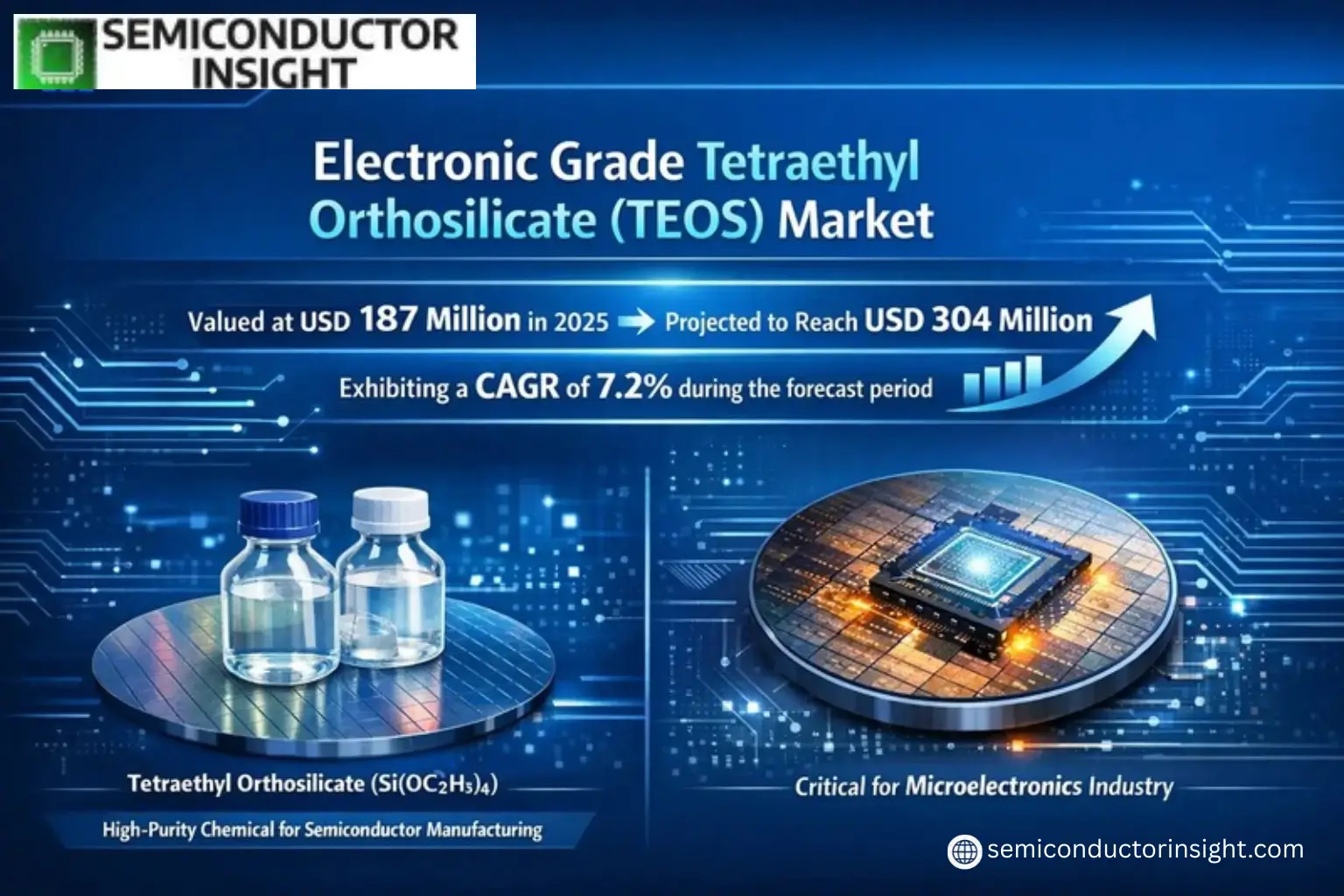
Electronic Grade Tetraethyl Orthosilicate (TEOS) Market was valued at USD 187 million in 2025 and is projected to reach USD 304 million by 2033, exhibiting a CAGR of 7.2% during the forecast period.
Tetraethyl Orthosilicate (TEOS), chemically represented as Si(OC2H5)4, is a high-purity microelectronic chemical essential for semiconductor manufacturing. As a third-generation semiconductor material, electronic-grade TEOS is widely utilized in chemical vapor deposition (CVD) processes to form silicon dioxide films, which act as insulating or conductive layers, anti-reflective coatings, and etching barriers in integrated circuits (ICs), discrete devices, and microelectromechanical systems (MEMS).
The market growth is driven by increasing demand for advanced semiconductor components, particularly in Asia Pacific, which dominates with an 84% revenue share. Key players like Entegris, Merck (Versum Materials), and Evonik lead the industry, collectively holding over 83.9% of the global market. Purity 9N TEOS accounts for 53% of product demand, while ICs and discrete devices represent 92% of applications.
MARKET DRIVERS
Growing Semiconductor Industry Demand
Electronic Grade Tetraethyl Orthosilicate (TEOS) Market is primarily driven by the expanding semiconductor industry, where TEOS is widely used as a precursor for silicon dioxide deposition. With the global semiconductor market projected to reach USD 600 billion by 2025, the demand for high-purity TEOS continues to rise. TEOS is critical for advanced chip manufacturing processes in 5G, AI, and IoT applications, creating sustained market growth.
Advancements in Thin-Film Deposition Technologies
CVD and PECVD technologies have evolved significantly, increasing the adoption of Electronic Grade TEOS for creating high-quality dielectric layers. Manufacturers are focusing on ultra-high purity grades (99.9999%) to meet the stringent requirements of next-generation electronic devices. The shift toward smaller node sizes in semiconductor fabrication further amplifies TEOS demand.
Additionally, the rise of 3D NAND flash memory and advanced packaging solutions has created new application areas for TEOS, reinforcing its position as a key material in microelectronics manufacturing.
MARKET CHALLENGES
Stringent Purity Requirements
Producing Electronic Grade Tetraethyl Orthosilicate (TEOS) with contamination levels below 1ppb remains technically challenging and cost-intensive. Even minor impurities can compromise semiconductor performance, requiring specialized production facilities and stringent quality control measures throughout the supply chain.
Other Challenges
Supply Chain Vulnerabilities
The TEOS market faces disruptions from geopolitical factors affecting silicon and ethanol supplies, which are key raw materials. Recent trade restrictions have created price volatility, with TEOS prices fluctuating up to 15% within single quarters.
MARKET RESTRAINTS
High Production Costs
The complex purification processes required for Electronic Grade TEOS result in production costs approximately 40-50% higher than industrial-grade variants. This cost premium limits adoption in price-sensitive applications, despite the material’s superior performance characteristics. Some manufacturers are exploring alternative precursors to mitigate these cost challenges.
MARKET OPPORTUNITIES
Emerging Memory Technologies
The development of novel memory solutions like ReRAM and MRAM presents new growth avenues for Electronic Grade TEOS suppliers. These technologies require ultra-thin, high-quality dielectric layers where TEOS demonstrates superior performance over competing materials. Industry analysts predict memory applications will account for 30% of TEOS demand by 2028.
Current Trends in the Electronic Grade Tetraethyl Orthosilicate (TEOS) Market
Rapid Market Growth Driven by Semiconductor Industry
Global Electronic Grade Tetraethyl Orthosilicate (TEOS) Market is experiencing robust growth, valued at USD 187 million in 2025 and projected to reach USD 304 million by 2033 at a 7.2% CAGR. This expansion is primarily fueled by increasing demand from the semiconductor sector, where TEOS serves as a critical material for chemical vapor deposition processes. The Asia Pacific region dominates with 84% market share, reflecting concentrated semiconductor manufacturing operations in countries like China, South Korea, and Taiwan.
Other Trends
Purity Specifications Gaining Importance
Within product segments, Purity 9N TEOS accounts for 53% of the market, demonstrating the industry’s shift toward higher-grade materials. Manufacturers are investing heavily in purification technologies to meet stringent semiconductor fabrication requirements, where impurity levels significantly impact device performance and yield rates.
Consolidated Competitive Landscape
The Electronic Grade TEOS market is highly concentrated, with the top five players controlling 83.9% of global revenue. Entegris leads with a 26% market share, followed by multinational chemical companies including Merck, Evonik, and Asian producers like SoulBrain Co Ltd. This consolidation drives continuous R&D investments and strategic partnerships across the supply chain.
Application-Specific Demand Patterns
ICs and discrete devices represent 92% of TEOS consumption, highlighting its essential role in mainstream semiconductor production. MEMS applications, while smaller (8%), show promising growth potential as miniaturization trends continue in electronics manufacturing.
Supply Chain and Regional Dynamics
Trade policies and semiconductor export controls are reshaping supply networks, with manufacturers establishing regional production hubs to ensure stability. The US import tariffs on Chinese semiconductor materials have particularly influenced pricing strategies and inventory management approaches across the industry.
COMPETITIVE LANDSCAPE
Key Industry Players
Market Dominance and Strategic Positioning in Electronic Grade TEOS
Global Electronic Grade Tetraethyl Orthosilicate (TEOS) Market is characterized by high concentration, with the top five players collectively holding 83.9% revenue share as of 2022. Entegris emerges as the undisputed market leader with a 26% revenue share, leveraging its advanced purification technologies and strategic partnerships with semiconductor manufacturers. The competitive landscape is further shaped by stringent quality requirements for 9N purity TEOS (53% market share) and the critical application in ICs and Discrete Devices (92% demand share). Regional dominance rests with Asia-Pacific, accounting for 84% of global consumption due to concentrated semiconductor manufacturing hubs.
Niche players are gaining traction through specialized production capabilities and regional supply chain advantages. Companies like Guizhou Wylton Jinglin Electronic Material and Suzhou JinHong Gas have strengthened their positions in the Chinese market through government-supported semiconductor initiatives. Meanwhile, chemical conglomerates such as Merck and Evonik maintain competitiveness through vertical integration in electronic materials. The market sees increasing R&D focus on high-purity formulations and customized TEOS solutions for advanced packaging applications.
List of Key Electronic Grade TEOS Companies Profiled
- Entegris
- Merck (Versum Materials)
- Evonik
- Fujifilm
- ADEKA
- Dockweiler Chemicals
- SoulBrain Co Ltd
- Guizhou Wylton Jinglin Electronic Material
- Suzhou JinHong Gas
- Shin-Etsu Chemical
- MGC Pure Chemicals
- Air Liquide Electronics
- Kanto Chemical
- Mitsubishi Chemical
- Patanjali Chemicals
Segment Analysis:
| Segment Category | Sub-Segments | Key Insights |
| By Type |
|
Purity 9N dominates due to:
|
| By Application |
|
ICs and Discrete Devices represents the primary growth driver:
|
| By End User |
|
Foundries demonstrate strongest adoption due to:
|
| By Manufacturing Process |
|
CVD Processes show dominant preference because:
|
| By Packaging |
|
Bottles remain the preferred packaging format due to:
|
Regional Analysis: Asia-Pacific Electronic Grade Tetraethyl Orthosilicate (TEOS) Market
China’s Yangtze River Delta and Pearl River Delta regions have emerged as global semiconductor powerhouses, driving massive TEOS consumption for CVD applications in chip fabrication. Taiwan’s Hsinchu Science Park represents another critical demand center.
Local TEOS producers benefit from proximity to major electronics manufacturers and specialized chemical logistics infrastructure. Japan and South Korea have developed advanced purification technologies for electronic-grade TEOS production.
Joint ventures between international TEOS suppliers and local partners accelerate technology transfer. Increasing investment in R&D facilities across the region supports development of next-generation TEOS formulations.
Governments offer tax incentives for domestic semiconductor materials production. National self-sufficiency initiatives in countries like China directly impact TEOS sourcing strategies and local production capacity expansions.
North America
North America maintains a strong position in the Electronic Grade Tetraethyl Orthosilicate market, driven by advanced semiconductor R&D and concentrated fab operations. The U.S. benefits from established TEOS supply chains serving major chipmakers and defense electronics applications. High-purity TEOS demand grows alongside investments in domestic semiconductor manufacturing under the CHIPS Act. Strict quality standards govern TEOS usage in aerospace and military electronics, creating specialized market segments. Regional producers focus on developing ultra-high-purity TEOS formulations for cutting-edge applications.
Europe
Europe’s Electronic Grade TEOS market shows steady growth, supported by automotive electronics and industrial semiconductor demand. Germany and France lead in TEOS consumption for MEMS and power electronics applications. Environmental regulations promote closed-loop TEOS recycling systems among European manufacturers. The presence of specialized chemical producers ensures consistent supply of high-grade TEOS, though reliance on imports remains for some ultra-pure grades. Collaborative R&D initiatives between academic institutions and industry players drive TEOS innovation.
Middle East & Africa
The MEA region represents an emerging market for Electronic Grade TEOS, with growth concentrated in GCC countries developing technology hubs. Investments in semiconductor packaging and testing facilities create new TEOS demand channels. Limited local production capacity necessitates imports, primarily from Asia and Europe. Strategic location serves as a potential distribution hub for TEOS supplies to adjacent markets. Market growth is constrained by underdeveloped electronics manufacturing ecosystems in most countries.
South America
South America shows nascent but growing Electronic Grade TEOS demand, primarily serving the Brazilian and Mexican electronics industries. Limited local production and quality constraints affect TEOS availability. Most requirements are met through imports from North American and Asian suppliers. The region presents untapped potential as electronics manufacturing expands, though infrastructure challenges persist. Regulatory harmonization efforts aim to facilitate TEOS trade across regional markets.
Report Scope
This market research report provides a comprehensive analysis of the Electronic Grade Tetraethyl Orthosilicate (TEOS) Market, covering the forecast period 2025–2033. It offers detailed insights into market dynamics, technological advancements, competitive landscape, and key trends shaping the industry.
Key focus areas of the report include:
- Market Overview: The report begins with an overview outlining its current market scenario, key growth indicators, and industry transformation drivers. It discusses macroeconomic factors, demand–supply balance, regulatory landscape, and the strategic role of semiconductors in powering advancements across industries such as automotive, telecommunications, consumer electronics, and industrial automation.
- Market Size & Forecast: Historical data and future projections for revenue, unit shipments, and market value across major regions and segments.
- Segmentation Analysis: Detailed breakdown by product type, technology, application, and end-user industry to identify high-growth segments and investment opportunities.
- Regional Insights: Insights into market performance across North America, Europe, Asia-Pacific, Latin America, and the Middle East & Africa, including country-level analysis where relevant.
- Competitive Landscape: Profiles of leading market participants, including their product offerings, R&D focus, manufacturing capacity, pricing strategies, and recent developments such as mergers, acquisitions, and partnerships.
- Technology Trends & Innovation: Assessment of emerging technologies, integration of AI/IoT, semiconductor design trends, fabrication techniques, and evolving industry standards.
- Market Drivers & Restraints: Evaluation of factors driving market growth along with challenges, supply chain constraints, regulatory issues, and market-entry barriers.
- Stakeholder Insights: Insights for component suppliers, OEMs, system integrators, investors, and policymakers regarding the evolving ecosystem and strategic opportunities.
Primary and secondary research methods are employed, including interviews with industry experts, data from verified sources, and real-time market intelligence to ensure the accuracy and reliability of the insights presented.
FREQUENTLY ASKED QUESTIONS:
What is the current market size of Electronic Grade Tetraethyl Orthosilicate (TEOS) Market?
-> Electronic Grade Tetraethyl Orthosilicate (TEOS) Market was valued at USD 187 million in 2025 and is projected to reach USD 304 million by 2033, exhibiting a CAGR of 7.2% during the forecast period.
Which key companies operate in Electronic Grade Tetraethyl Orthosilicate (TEOS) Market?
-> Key players include Entegris, SoulBrain Co Ltd, Merck (Versum Materials), ADEKA, Fujifilm, Dockweiler Chemicals, Evonik, Guizhou Wylton Jinglin Electronic Material, and Suzhou JinHong Gas. Entegris leads the market with over 26% revenue share in 2022.
What are the key growth drivers?
-> Key growth drivers include increasing semiconductor manufacturing, demand for advanced microelectronic chemicals, and growth in MEMS and discrete device production.
Which region dominates the market?
-> Asia Pacific dominates the market with 84% revenue share, driven by semiconductor manufacturing hubs in China, Japan, and South Korea.
What are the emerging trends?
-> Emerging trends include rising adoption of Purity 9N TEOS (53% market share), expansion of semiconductor fabrication facilities, and increasing demand for ICs and Discrete Devices (92% application share).

Get Sample Report PDF for Exclusive Insights
Report Sample Includes
- Table of Contents
- List of Tables & Figures
- Charts, Research Methodology, and more...
 Download Sample Report PDF