LPDDR6 AI Mobile Memory Market Insights
Global LPDDR6 AI Mobile Memory market size was valued at USD 0.85 billion in 2025. The market will increase from USD 0.92 billion in 2026 to USD 1.78 billion by 2034, reflecting a CAGR of 7.5% during the forecast period.
LPDDR6 AI Mobile Memory represents the next‑generation low‑power DRAM designed for on‑device artificial‑intelligence workloads. It delivers bandwidth exceeding 8 GB/s per pin while maintaining power consumption below 1 µJ/bit, enabling real‑time inference on smartphones, wearables, AR/VR headsets and autonomous‑vehicle edge modules.
The expansion of this segment stems from several forces: manufacturers are allocating capital toward advanced packaging that supports higher I/O counts; mobile OEMs seek longer battery life while running increasingly complex neural networks; and standards bodies have ratified specifications that allow tighter integration of compute accelerators with memory subsystems. Recent collaborations,such as Samsung’s partnership with Qualcomm on an integrated LPDDR6‑AI platform announced in early 2024,and Micron’s roadmap disclosure for volume production by 2025 illustrate how industry leaders are positioning themselves for the forthcoming demand surge.
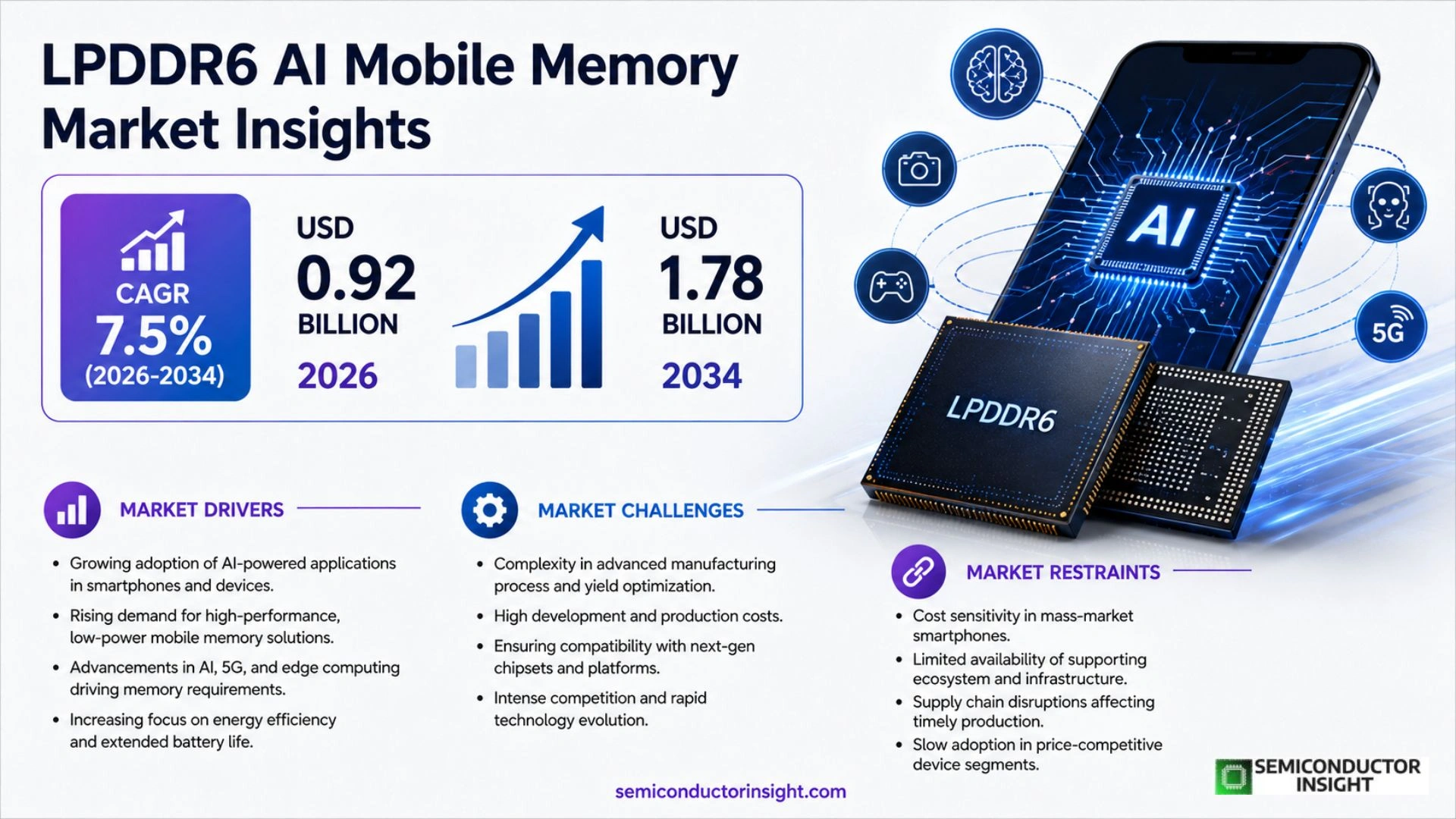
MARKET DRIVERS
Performance Demands from Edge AI Devices
Smartphones and wearables are now expected to run inference models locally, which forces chip designers to look beyond LPDDR5. LPDDR6 AI Mobile Memory Market benefits from this shift because the new standard offers up to 30 % higher data‑rate while keeping latency in check, enabling real‑time image recognition without cloud fallback.
Thermal Efficiency Gains
System‑level power budgets have tightened as manufacturers pack more AI cores into slimmer chassis. LPDDR6 introduces a refined signaling architecture that cuts dynamic power consumption per gigabit transferred, translating into cooler operation and longer battery life,two factors that directly influence purchase decisions.
➤ “Adoption of LPDDR6 is reshaping the design language of next‑generation mobile AI platforms,” notes a senior engineer at a leading chipset fab.
These technical advantages are compelling enough that OEMs are incorporating LPDDR6 into flagship models already, creating a ripple effect that lifts the entire LPDDR6 AI Mobile Memory Market as component suppliers scramble to meet the new specifications.
MARKET CHALLENGES
Manufacturing Complexity
Transitioning to the finer geometry required for LPDDR6 strains existing fabs. Yield rates dip during early production runs, prompting manufacturers to allocate extra wafer capacity to maintain throughput, which in turn inflates unit costs.
Other Challenges
Supply Chain Constraints
Limited availability of high‑purity silicon substrates and the need for upgraded testing equipment create bottlenecks that can delay product launches, especially for smaller OEMs that lack direct access to tier‑one fabs.
MARKET RESTRAINTS
Cost Sensitivity in Mass‑Market Smartphones
Even though LPDDR6 delivers clear technical benefits, the incremental cost over LPDDR5 remains a sticking point for high‑volume devices where price per unit drives margins. Brands targeting price‑competitive segments may postpone migration until economies of scale reduce the premium.
MARKET OPPORTUNITIES
Emerging Applications in Augmented Reality
AR headsets require fast frame buffers and seamless AI‑assisted tracking, both of which benefit from the bandwidth and power efficiencies of LPDDR6. As developers roll out more immersive experiences, component suppliers that can guarantee stable supply and competitive pricing stand to capture a sizable share of this nascent ecosystem.
LPDDR6 AI Mobile Memory Market Trends
Performance‑Driven Architecture Gains Traction
The introduction of LPDDR6 AI Mobile Memory marks a decisive shift in how mobile devices handle on‑device artificial‑intelligence workloads. By offering more than 8 GB/s per pin while keeping energy use under 1 µJ/bit, the technology enables real‑time inference without compromising battery life. Mobile OEMs are therefore prioritizing silicon that can sustain larger neural‑network models, a requirement that directly influences bill‑of‑materials decisions and device design cycles. The ability to deliver higher bandwidth at a marginal power cost creates a compelling value proposition for smartphones, wearables, and emerging AR/VR platforms, compelling manufacturers to redesign memory hierarchies around this new capability.
Other Trends
Advanced Packaging and I/O Scaling
Suppliers are expanding investment in advanced packaging techniques that accommodate the increased pin counts required by LPDDR6. Chiplets and fan‑out wafer‑level packaging are becoming standard tools to meet the density demands without inflating form factor. This shift reduces latency between the memory and compute blocks, translating into smoother user experiences for AI‑enhanced applications. As the ecosystem matures, the cost premium associated with these packaging solutions is expected to shrink, encouraging broader adoption across mid‑tier devices.
Integration with Edge AI Accelerators
Recent collaborations,most notably the Samsung‑Qualcomm joint effort announced in early 2024 and Micron’s roadmap for volume production slated for 2025,illustrate how manufacturers are aligning memory development with edge accelerator roadmaps. By co‑optimizing memory interfaces and AI cores, these partnerships aim to minimize data movement overhead, a critical factor for latency‑sensitive applications such as autonomous‑vehicle edge modules and real‑time translation. The strategic alignment also signals an industry consensus that memory will no longer be a peripheral component but a core element of AI‑centric system‑on‑chip designs. Companies that can deliver tightly coupled LPDDR6 solutions stand to secure long‑term contracts with tier‑one OEMs, reshaping the competitive landscape.
COMPETITIVE LANDSCAPE
Key Industry Players
LPDDR6 AI Mobile Memory: Competitive Dynamics in 2024‑2025
Samsung Electronics continues to dominate LPDDR6 AI Mobile Memory segment, leveraging its vertically integrated fabs and a longstanding partnership with Qualcomm that culminated in an early‑2024 integrated LPDDR6‑AI platform. The company’s ability to marry advanced packaging with high‑bandwidth I/O gives it a clear advantage in serving flagship smartphones and emerging AR/VR devices. Micron Technology follows closely, having disclosed a volume‑production roadmap for LPDDR6 chips slated for 2025, and positioning its product line to capture OEM demand for power‑efficient on‑device inference. SK Hynix rounds out the triad of incumbents, differentiating through aggressive price‑to‑performance engineering and a strong foothold in the Chinese mobile market. Collectively, these three firms command the bulk of wafer capacity, set pricing benchmarks, and influence the standard‑setting bodies that define pin‑count and bandwidth specifications. Their scale enables large‑volume contracts with global handset makers, while their R&D budgets sustain rapid iteration cycles essential for maintaining a lead in a technology where every microjoule of energy saved translates into measurable battery life gains for end users.
Beyond the dominant trio, a cadre of niche players is shaping specialized corners of the LPDDR6 ecosystem. In addition to United Microelectronics Corporation (UMC), which offers foundry services tailored to low‑power DRAM, Taiwanese firm Powerchip Semiconductor Manufacturing Corp. (PSMC) is positioning itself as a cost‑effective alternative for mid‑range devices. Japan’s Renesas Electronics supplies peripheral controllers that improve memory‑accelerator communication, while India’s Tata Elxsi provides system‑level integration services that accelerate time‑to‑market for emerging AI‑enabled wearables. European newcomer Everspin Technologies focuses on MRAM‑based hybrid solutions that could complement LPDDR6 in edge‑compute modules. Smaller firms such as Novelda Power and PanMemTech are targeting niche applications like autonomous‑vehicle edge modules and high‑performance AR headsets, where custom I/O configurations and ultra‑low latency are paramount. The growing diversity of these participants underscores a market that, while led by a few heavyweights, remains fertile for specialized innovations and collaborative product‑development arrangements.
List of Key LPDDR6 AI Mobile Memory Companies Profiled
- Samsung Electronics
- Micron Technology
- SK Hynix
- United Microelectronics Corporation
- Powerchip Semiconductor Manufacturing Corp.
- Renesas Electronics
- Tata Elxsi
- Everspin Technologies
- Novelda Power
- PanMemTech
- MediaTek Inc.
- Qualcomm
Segment Analysis:
| Segment Category | Sub-Segments | Key Insights |
| By Type |
|
LPDDR6 with AI acceleration
|
| By Application |
|
Smartphones
|
| By End User |
|
OEMs (device manufacturers)
|
| By Device Category |
|
Flagship smartphones
|
| By Integration Strategy |
|
Package‑on‑Package (PoP) integration
|
Regional Analysis: LPDDR6 AI Mobile Memory Market
Chip architects in the region are embracing heterogeneous integration, stacking LPDDR6 beneath application processors to shave latency. This approach dovetails with AI accelerators that thrive on rapid data shuttling, fostering a design ethos where memory and compute are co‑engineered rather than loosely coupled.
Recent disruptions have driven manufacturers to diversify wafer sources, establishing secondary lines in Vietnam and the Philippines. This redundancy lowers risk exposure and stabilizes component availability for mobile OEMs targeting rapid product cycles.
End‑user demand for on‑device AI, from real‑time translation to advanced photography, is compelling smartphone makers to tout memory performance as a differentiator, accelerating LPDDR6 integration across flagship portfolios.
Established memory vendors are locking in strategic partnerships with foundries, while emerging players leverage niche process nodes to capture niche segments, intensifying rivalry and stimulating rapid innovation cycles.
North America
North America remains a crucial testing ground for LPDDR6 AI Mobile Memory Market concepts, thanks to a dense concentration of device innovators and AI research labs. Companies are piloting advanced power‑management algorithms that exploit the memory’s deep‑sleep states, aiming to extend battery endurance in premium smartphones. Meanwhile, regulatory scrutiny around data privacy pushes manufacturers to process AI workloads locally, reinforcing the value proposition of on‑device memory solutions. The region’s venture ecosystem also nurtures startups focused on memory‑centric AI frameworks, indicating a pipeline of differentiated software that could expand the market’s functional scope.
Europe
In Europe, stringent energy‑efficiency directives are compelling mobile OEMs to prioritize components that minimize draw without sacrificing performance. LPDDR6’s lower voltage envelope aligns with these targets, prompting automotive and wearable manufacturers to explore crossover applications beyond phones. Additionally, collaborative research initiatives across the EU are probing new error‑correction schemes tailored for AI inference, potentially unlocking higher reliability for mission‑critical edge devices. The combined regulatory push and research momentum suggest a gradual but steady uptake of the technology across premium segments.
South America
South America presents a heterogeneous adoption picture, with leading markets such as Brazil displaying early enthusiasm for AI‑enhanced smartphones, while others lag due to pricing sensitivity. Nevertheless, the region’s expanding 4G/5G rollout creates a fertile backdrop for LPDDR6 deployment, as carriers demand higher throughput to support streaming and cloud‑augmented services. Local manufacturers are beginning to partner with memory suppliers to tailor cost‑effective variants, balancing performance aspirations with price realities.
Middle East & Africa
The Middle East & Africa region is characterized by burgeoning mobile penetration coupled with a youthful consumer base eager for AI‑driven experiences. While infrastructure varies, pockets of high‑end device adoption in Gulf states are accelerating demand for memory that can sustain intensive AI workloads. Meanwhile, African markets, driven by cost‑conscious buyers, are seeing telecom operators promote devices that leverage LPDDR6’s efficiency to extend handset life cycles, subtly shifting market expectations toward smarter, longer‑lasting hardware.
Report Scope
This market research report provides a comprehensive analysis of the LPDDR6 AI Mobile Memory Market , covering the forecast period 2026–2034. It offers detailed insights into market dynamics, technological advancements, competitive landscape, and key trends shaping the industry.
Key focus areas of the report include:
- Market Overview: The report begins with an overview outlining its current market scenario, key growth indicators, and industry transformation drivers. It discusses macroeconomic factors, demand–supply balance, regulatory landscape, and the strategic role of semiconductors in powering advancements across industries such as automotive, telecommunications, consumer electronics, and industrial automation.
- Market Size & Forecast: Historical data and future projections for revenue, unit shipments, and market value across major regions and segments.
- Segmentation Analysis: Detailed breakdown by product type, technology, application, and end-user industry to identify high-growth segments and investment opportunities.
- Regional Insights: Insights into market performance across North America, Europe, Asia-Pacific, Latin America, and the Middle East & Africa, including country-level analysis where relevant.
- Competitive Landscape: Profiles of leading market participants, including their product offerings, R&D focus, manufacturing capacity, pricing strategies, and recent developments such as mergers, acquisitions, and partnerships.
- Technology Trends & Innovation: Assessment of emerging technologies, integration of AI/IoT, semiconductor design trends, fabrication techniques, and evolving industry standards.
- Market Drivers & Restraints: Evaluation of factors driving market growth along with challenges, supply chain constraints, regulatory issues, and market-entry barriers.
- Stakeholder Insights: Insights for component suppliers, OEMs, system integrators, investors, and policymakers regarding the evolving ecosystem and strategic opportunities.
Primary and secondary research methods are employed, including interviews with industry experts, data from verified sources, and real-time market intelligence to ensure the accuracy and reliability of the insights presented.
FREQUENTLY ASKED QUESTIONS:
What is the current market size of LPDDR6 AI Mobile Memory Market?
-> LPDDR6 AI Mobile Memory market will increase from USD 0.92 billion in 2026 to USD 1.78 billion by 2034, reflecting a CAGR of 7.5%
Which key companies operate in LPDDR6 AI Mobile Memory Market?
-> Key players include Samsung Electronics, Qualcomm, Micron Technology, SK Hynix, and MediaTek, among others.
What are the key growth drivers?
-> Key growth drivers include rising AI workloads on mobile devices, demand for higher bandwidth low‑power DRAM, advanced packaging investments, and OEM requirements for longer battery life.
Which region dominates the market?
-> Asia-Pacific leads the market, driven by strong semiconductor ecosystems in China, South Korea, and Japan, while also showing the fastest growth rates.
What are the emerging trends?
-> Emerging trends include tighter integration of LPDDR6 with on‑chip AI accelerators, 3D‑stacked memory architectures, and advanced packaging techniques such as chip‑on‑wafer bonding.
Get Sample Report PDF for Exclusive Insights
Report Sample Includes
- Table of Contents
- List of Tables & Figures
- Charts, Research Methodology, and more...
 Download Sample Report PDF