Low COP and COP Free Wafer Market, Trends, Business Strategies 2025-2032

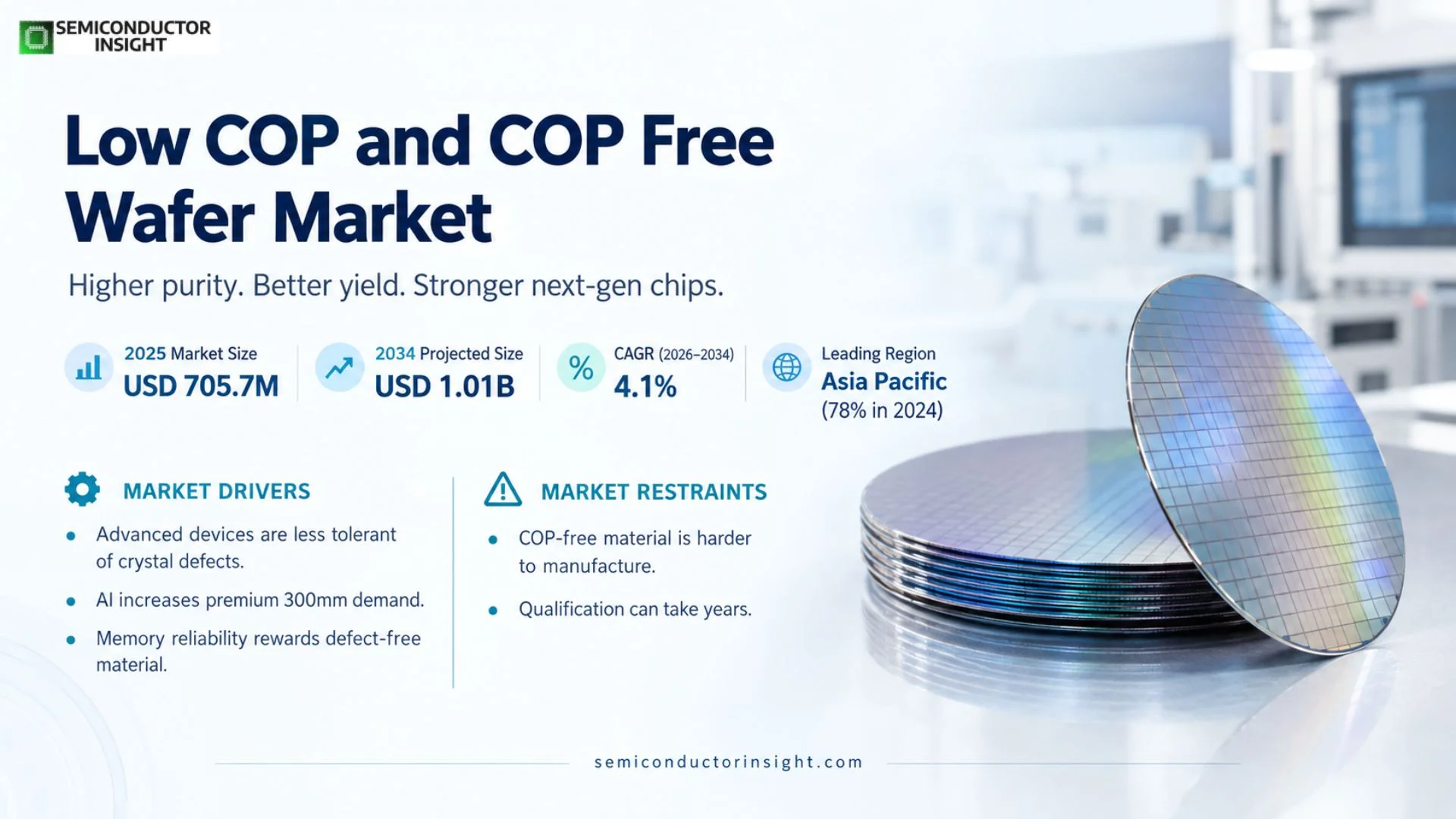
Low COP and COP Free Wafer Market size was valued at US$ 678 million in 2024 and is projected to reach US$ 934 million by 2032, at a CAGR of 4.1% during the forecast period 2025-2032

PDF Icon Download Sample Report PDF
  • Quick Dispatch

    All Orders

  • Secure Payment

    100% Secure Payment

Price range: $1,500.00 through $4,250.00

Clear

MARKET INSIGHTS

The global Low COP and COP Free Wafer Market size was valued at US$ 678 million in 2024 and is projected to reach US$ 934 million by 2032, at a CAGR of 4.1% during the forecast period 2025-2032.

Low COP (Crystal Originated Pit) and COP Free Wafers are advanced semiconductor substrates characterized by exceptionally low defect densities. These wafers are critical for manufacturing high-performance integrated circuits, particularly for applications demanding superior yield and reliability such as 5G chips, AI processors, and automotive semiconductors. The wafer types primarily include 8-inch and 12-inch variants, with 12-inch wafers gaining dominance due to their cost efficiency in advanced nodes.

The market growth is driven by increasing demand for high-performance computing and the semiconductor industry’s transition to smaller process nodes (below 10nm). While the Asia-Pacific region dominates production with 78% market share in 2024, North America shows the fastest growth at 12.1% CAGR due to domestic semiconductor manufacturing initiatives. Key challenges include high production costs and technical complexities in maintaining defect-free crystal structures. Major players like ShinEtsu and Global Wafers are investing heavily in R&D, with ShinEtsu announcing a USD 300 million expansion of its COP Free Wafer production in 2023.

MARKET DYNAMICS

MARKET DRIVERS

Expansion of 5G and IoT Technologies to Propel Demand for Advanced Wafers

The global rollout of 5G networks and the proliferation of IoT devices are creating unprecedented demand for high-performance semiconductor wafers. Low COP (Crystal Originated Pit) and COP-free wafers with superior surface quality are becoming essential for manufacturing power-efficient, high-frequency chips required for these applications. The semiconductor industry is projected to grow significantly with 5G infrastructure investments expected to surpass $200 billion annually by 2025. Major foundries are actively expanding production capacity, with wafer manufacturers seeing strong demand for defect-free substrates that enable higher chip yields.

Automotive Semiconductor Boom Driving Wafer Quality Requirements

The automotive semiconductor market is undergoing rapid transformation with the shift toward electric vehicles and autonomous driving systems. These applications require highly reliable chips manufactured on premium quality wafers with minimal defects. The average semiconductor content per vehicle is forecast to exceed $1,000 by 2030, with power semiconductors and sensors accounting for the majority of growth. Leading wafer producers have responded by investing in advanced crystal growth techniques that reduce COP defects while maintaining competitive production costs. The stringent reliability requirements of automotive-grade semiconductors create strong demand for low defect density wafers.

Advanced Packaging Technologies Creating New Applications

Emerging packaging approaches like 2.5D and 3D IC integration are creating new opportunities for specialty wafer products. These advanced packaging techniques require wafers with exceptional surface quality and uniformity to enable high-density interconnects. The advanced packaging market is growing at approximately 8% annually, driven by the need for heterogeneous integration in artificial intelligence and high-performance computing applications. Wafer manufacturers are developing specialized products with tailored surface properties to meet these evolving requirements, particularly for applications demanding ultra-low defect densities below 0.1/cm².

MARKET RESTRAINTS

High Production Costs and Capital Intensity Limiting Market Expansion

Manufacturing low COP and COP-free wafers requires significant capital investment in specialized crystal growth equipment and cleanroom facilities. The cost of establishing a 300mm wafer fab can exceed $5 billion, creating substantial barriers to entry. Smaller manufacturers often struggle to compete with established players who benefit from economies of scale. While demand is growing, price sensitivity remains high in certain market segments, limiting the adoption of premium-priced low-defect wafers for cost-sensitive applications.

Materials Supply Chain Vulnerabilities Impacting Production

Wafer production relies on ultra-pure polysilicon and other specialized materials that have experienced supply constraints. Recent disruptions in the supply of key semiconductor materials have highlighted vulnerabilities in the wafer manufacturing ecosystem. The industry’s heavy concentration of polysilicon production capacity creates potential bottlenecks that could affect wafer availability. Additionally, geopolitical factors have introduced uncertainties into the supply of certain critical materials needed for advanced wafer production processes.

Technical Challenges in Large Diameter Wafer Production

As manufacturers transition to larger wafer sizes to improve efficiency, maintaining low defect densities becomes increasingly challenging. Producing 300mm and emerging 450mm wafers with COP-free characteristics requires advancements in crystal growth control and processing technologies. The industry continues to face yield challenges at these larger dimensions, particularly for wafers targeting advanced process nodes below 10nm. These technical hurdles may temporarily constrain market growth until more robust manufacturing processes are developed.

MARKET CHALLENGES

Intensifying Competition from Alternative Substrate Materials

The semiconductor industry is exploring various alternative substrate materials that could potentially compete with traditional silicon wafers. Emerging materials like silicon carbide and gallium nitride offer performance advantages for certain power electronics applications. While silicon remains dominant for most applications, these alternatives are gaining traction in niche markets, particularly for high-voltage and high-frequency applications. Wafer manufacturers must continuously innovate to maintain silicon’s cost-performance advantage against these emerging substrate technologies.

Other Challenges

Quality Consistency Across Production Batches
Maintaining consistent wafer quality across high-volume production remains an ongoing challenge, particularly as defect detection requirements become more stringent. Even minor variations in processing conditions can affect defect densities, requiring sophisticated process control systems. The industry is investing heavily in smart manufacturing technologies to enhance quality consistency while managing production costs.

Rapid Technology Node Transitions
The accelerating pace of semiconductor technology transitions creates challenges for wafer suppliers. Each new process node typically introduces more stringent wafer quality requirements, forcing manufacturers to continually upgrade their processes. The compressed timelines for introducing new wafer specifications create operational challenges across the supply chain.

MARKET OPPORTUNITIES

Emerging Applications in Photonics and MEMS Creating New Growth Avenues

The growing adoption of silicon photonics and MEMS (Micro-Electro-Mechanical Systems) technologies is creating demand for specialized wafer products with unique surface properties. Silicon photonics applications particularly benefit from wafers with ultra-low defect densities, enabling high-performance optical components. The silicon photonics market is projected to grow at a compound annual rate exceeding 20%, driven by data center and telecommunications applications. Wafer manufacturers have opportunities to develop tailored products optimized for these emerging applications.

Regional Semiconductor Manufacturing Expansion Fueling Demand

Government initiatives worldwide to strengthen domestic semiconductor supply chains are driving significant investments in new wafer fabrication facilities. Several countries have announced plans to build new fabs with substantial capacity expansions projected over the next five years. This geographic diversification of semiconductor manufacturing creates opportunities for wafer suppliers to establish new customer relationships and expand their geographic footprint. The establishment of new fabrication clusters in regions like Southeast Asia and North America presents particularly promising growth prospects.

Advancements in Wafer Inspection Technologies Enabling Higher Quality Standards

Breakthroughs in wafer inspection and metrology technologies are creating opportunities to improve quality control while reducing costs. Advanced inspection systems utilizing machine learning and artificial intelligence can detect sub-surface defects more effectively than conventional methods. These technologies enable wafer manufacturers to achieve new quality benchmarks while maintaining production efficiency. The development of more sophisticated characterization techniques also facilitates the introduction of innovative wafer products optimized for specific applications.

LOW COP AND COP FREE WAFER MARKET TRENDS

Rising Demand for Energy-Efficient Semiconductor Manufacturing Drives Market Growth

The global semiconductor industry is undergoing a transformative shift toward sustainable manufacturing practices, with Low COP (Coefficient of Performance) and COP Free Wafers emerging as critical components in reducing energy consumption. These wafers—designed to minimize thermal losses during fabrication—are gaining traction as foundries seek to lower operational costs and meet stringent environmental regulations. Market projections indicate that the sector will reach US$ million by 2032, growing at a notable CAGR, particularly in regions like Asia-Pacific where semiconductor production is concentrated. While fabricators initially resisted the transition due to higher upfront costs, the long-term energy savings (up to 30% in some cases) are compelling adoption.

Other Trends

Expansion of 12-Inch Wafer Production

The industry-wide shift toward 12-inch wafer formats is accelerating demand for advanced Low COP solutions. Larger wafers inherently face greater thermal management challenges during processes like chemical vapor deposition (CVD) and etching. Manufacturers are now prioritizing wafers with ultra-low thermal resistance layers, which reduce the energy needed to maintain process stability. This trend aligns with broader semiconductor forecasts, where 12-inch wafers are expected to capture over 75% of global production capacity by 2025, up from 68% in 2024.

Geopolitical Factors Reshaping Supply Chains

Recent trade policies and regional manufacturing incentives are dramatically influencing wafer sourcing strategies. The CHIPS and Science Act in the U.S. and similar initiatives in the EU have spurred local investments in substrate production, reducing reliance on traditional Asian suppliers. However, technical limitations in new facilities—particularly in achieving sub-5nm node compatibility with Low COP wafers—are creating temporary supply-demand imbalances. Meanwhile, China’s push for self-sufficiency has led to a 22% year-over-year increase in domestic wafer R&D spending, though quality consistency remains a challenge for export markets.

COMPETITIVE LANDSCAPE

Key Industry Players

Semiconductor Wafer Manufacturers Expand Production Capabilities Amid Growing Demand

The global low COP and COP-free wafer market demonstrates a moderately concentrated competitive structure, with established semiconductor material suppliers dominating production capacities while regional players strengthen their foothold in niche applications. Global Wafers maintains a leadership position, controlling approximately 15-18% of the total market share in 2024 through its vertically integrated operations across Taiwan, Japan, and the United States. The company’s competitive advantage stems from its proprietary crystal growth technologies enabling superior oxygen concentration control below 5 ppma (parts per million atomic).

ShinEtsu Chemical follows closely with a 12-14% market share, leveraging its advanced 300mm wafer production lines in Japan. Meanwhile, Siltronic AG (a subsidiary of GlobalWafers since 2022) has been aggressively expanding its Dresden facility to address the European automotive semiconductor shortage, demonstrating how geopolitical factors are reshaping production strategies.

Chinese manufacturers are making significant strides, as evidenced by Zhonghuan Semiconductor’s 30% year-over-year capacity increase in 2024. While currently holding 8-10% market share, domestic players benefit from government subsidies under China’s 14th Five-Year Plan for semiconductor self-sufficiency. However, export controls on advanced node wafers (≤14nm) continue to limit their global expansion.

The market sees increasing specialization, with companies like GRITEK focusing on epitaxial wafers for power devices and Chongqing Advanced Silicon Technology developing customized solutions for MEMS applications. This product differentiation strategy helps mid-sized players compete against industry giants while addressing emerging requirements in 5G infrastructure and electric vehicle components.

List of Key Low COP and COP-Free Wafer Manufacturers

  • Global Wafers (Taiwan)
  • ShinEtsu Chemical (Japan)
  • SANRITSU CHEMICALS (Japan)
  • Hangzhou Semiconductor Wafer (China)
  • Zhonghuan Semiconductor (China)
  • GRITEK (China)
  • Chongqing Advanced Silicon Technology (China)
  • Siltronic AG (Germany)
  • SK Siltron (South Korea)

The competitive dynamics are further influenced by strategic partnerships, such as the recent collaboration between GlobalWafers and Belgian research institute imec to develop defect-free 200mm wafers for IoT applications. Such alliances are becoming crucial as the industry balances between scaling mature nodes (180nm-40nm) and developing advanced substrates for next-generation chips.

Segment Analysis:

By Type

12 Inch Wafer Segment Dominates the Market Due to Higher Efficiency and Cost-Effectiveness in Semiconductor Production

The market is segmented based on type into:

  • 8 Inch Wafer
  • 12 Inch Wafer
  • Others (including customized wafer sizes for niche applications)

By Application

Logic/MPU Segment Leads Owing to Rising Demand for High-Performance Computing and AI Chips

The market is segmented based on application into:

  • Memory (DRAM, NAND Flash, etc.)
  • Logic/MPU (Microprocessor Units)
  • Analog (Power Management ICs, RF Components)
  • Discrete Device & Sensor
  • Others (Optoelectronics, MEMS, etc.)

By End User

Foundries Segment Accounts for Major Share Due to Increasing Outsourcing of Semiconductor Manufacturing

The market is segmented based on end user into:

  • Integrated Device Manufacturers (IDMs)
  • Foundries
  • Fabless Semiconductor Companies
  • Research Institutions

By Technology

Traditional Silicon Wafers Remain Dominant While Advanced Materials Gain Traction

The market is segmented based on technology into:

  • Silicon Wafers
  • Silicon-on-Insulator (SOI) Wafers
  • Compound Semiconductor Wafers (GaAs, GaN, SiC)
  • Others (Epi Wafers, Polished Wafers)

Regional Analysis: Low COP and COP Free Wafer Market

North America
The North American market for Low COP and COP Free Wafers is characterized by high demand from the semiconductor industry, particularly in the U.S., where companies are investing heavily in advanced manufacturing technologies. With the Chips and Science Act allocating $52 billion to bolster domestic semiconductor production, the region is witnessing accelerated adoption of high-purity wafers for memory and logic applications. Stringent quality control standards and a focus on reducing crystal-originated pit (COP) defects drive the preference for defect-free wafers, especially in 12-inch variants used for cutting-edge nodes. However, higher production costs and reliance on imports for raw silicon remain challenges for local manufacturers.

Europe
Europe’s semiconductor wafer market is growing steadily, supported by initiatives like the European Chips Act which aims to double the region’s share in global production to 20% by 2030. Countries such as Germany and France are leading in demand for Low COP wafers, driven by automotive and industrial chip requirements. The presence of major research institutions and collaborative projects, such as those under the EU’s Horizon Europe program, fosters innovation in wafer fabrication technologies. Nevertheless, the region faces competition from Asian suppliers, and wafer production remains fragmented compared to larger global players, impacting economies of scale.

Asia-Pacific
As the dominant hub for semiconductor manufacturing, Asia-Pacific accounts for the largest share of the Low COP and COP Free Wafer market. China, Taiwan, South Korea, and Japan lead production, with companies like ShinEtsu and Zhonghuan Semiconductor expanding their capacities. The region benefits from strong government support, such as China’s “Big Fund” initiatives and South Korea’s semiconductor competitiveness plans. However, geopolitical tensions and supply chain disruptions pose risks. While cost competitiveness keeps demand high for 8-inch wafers, there is a visible shift toward 12-inch wafers to meet the needs of advanced logic and memory applications. Foundries and IDMs in the region are increasingly prioritizing defect-free wafer solutions to enhance yields.

South America
The South American market is still in a nascent stage, with limited local wafer production capabilities. Brazil and Argentina show moderate demand, primarily from consumer electronics and automotive sectors, but rely heavily on imports due to underdeveloped semiconductor infrastructure. Economic volatility and a lack of regulatory incentives for domestic manufacturing hinder progress. Despite this, niche opportunities exist in MEMS and sensor applications, where smaller wafer sizes are used. The long-term potential could improve if regional governments introduce policies to attract semiconductor investments.

Middle East & Africa
This region is gradually emerging as a prospective market, with countries such as Saudi Arabia and the UAE investing in semiconductor ecosystem development as part of their economic diversification strategies. While wafer production is minimal, demand for Low COP wafers is influenced by telecommunications and IoT device manufacturing. However, infrastructural gaps and a reliance on imported semiconductor materials slow market expansion. Partnerships with global foundries and technical universities could foster future growth, though progress remains gradual due to limited indigenous expertise.

Report Scope

This market research report provides a comprehensive analysis of the global Low COP and COP Free Wafer market, covering the forecast period 2025–2032. It offers detailed insights into market dynamics, technological advancements, competitive landscape, and key trends shaping the semiconductor wafer industry.

Key focus areas of the report include:

  • Market Size & Forecast: Historical data and future projections for revenue and unit shipments across major regions and segments. The global Low COP and COP Free Wafer market was valued at US$ 678 million in 2024 and is projected to reach US$ 934 million by 2032.
  • Segmentation Analysis: Detailed breakdown by wafer size (8-inch, 12-inch, others) and application (Memory, Logic/MPU, Analog, Discrete Device & Sensor) to identify high-growth segments.
  • Regional Outlook: Insights into market performance across North America, Europe, Asia-Pacific, Latin America, and Middle East & Africa, with Asia-Pacific accounting for 65% of global demand in 2024.
  • Competitive Landscape: Profiles of leading manufacturers including Global Wafers, ShinEtsu, and Zhonghuan Semiconductor, covering their market share, production capacity, and strategic initiatives.
  • Technology Trends: Assessment of advanced wafer fabrication techniques, defect reduction technologies, and emerging industry standards for COP-free wafers.
  • Market Drivers & Restraints: Evaluation of factors including semiconductor industry growth, demand for high-quality wafers, and challenges in manufacturing processes.
  • Stakeholder Analysis: Strategic insights for semiconductor manufacturers, wafer suppliers, equipment vendors, and investors in the value chain.

The research methodology combines primary interviews with industry experts and analysis of verified market data from semiconductor industry associations and financial reports.

FREQUENTLY ASKED QUESTIONS:

What is the current market size of Global Low COP and COP Free Wafer Market?

-> Low COP and COP Free Wafer Market size was valued at US$ 678 million in 2024 and is projected to reach US$ 934 million by 2032, at a CAGR of 4.1% during the forecast period 2025-2032.

Which key companies operate in Global Low COP and COP Free Wafer Market?

-> Key players include Global Wafers, ShinEtsu, SANRITSU CHEMICALS, Hangzhou Semiconductor Wafer, and Zhonghuan Semiconductor, among others.

What are the key growth drivers?

-> Key growth drivers include increasing semiconductor demand, advanced node manufacturing requirements, and quality improvements in wafer production.

Which region dominates the market?

-> Asia-Pacific dominates with over 65% market share, driven by semiconductor manufacturing in China, Taiwan, South Korea and Japan.

What are the emerging trends?

-> Emerging trends include larger wafer size adoption (12-inch), AI-driven defect detection, and sustainable wafer manufacturing processes.

Low COP and COP Free Wafer Market, Trends, Business Strategies 2025-2032

Get Sample Report PDF for Exclusive Insights

Report Sample Includes

  • Table of Contents
  • List of Tables & Figures
  • Charts, Research Methodology, and more...

PDF Icon Download Sample Report PDF

Download Sample Report

Table of Content

1 Introduction to Research & Analysis Reports
1.1 Low COP and COP Free Wafer Market Definition
1.2 Market Segments
1.2.1 Segment by Type
1.2.2 Segment by Application
1.3 Global Low COP and COP Free Wafer Market Overview
1.4 Features & Benefits of This Report
1.5 Methodology & Sources of Information
1.5.1 Research Methodology
1.5.2 Research Process
1.5.3 Base Year
1.5.4 Report Assumptions & Caveats
2 Global Low COP and COP Free Wafer Overall Market Size
2.1 Global Low COP and COP Free Wafer Market Size: 2024 VS 2032
2.2 Global Low COP and COP Free Wafer Market Size, Prospects & Forecasts: 2020-2032
2.3 Global Low COP and COP Free Wafer Sales: 2020-2032
3 Company Landscape
3.1 Top Low COP and COP Free Wafer Players in Global Market
3.2 Top Global Low COP and COP Free Wafer Companies Ranked by Revenue
3.3 Global Low COP and COP Free Wafer Revenue by Companies
3.4 Global Low COP and COP Free Wafer Sales by Companies
3.5 Global Low COP and COP Free Wafer Price by Manufacturer (2020-2025)
3.6 Top 3 and Top 5 Low COP and COP Free Wafer Companies in Global Market, by Revenue in 2024
3.7 Global Manufacturers Low COP and COP Free Wafer Product Type
3.8 Tier 1, Tier 2, and Tier 3 Low COP and COP Free Wafer Players in Global Market
3.8.1 List of Global Tier 1 Low COP and COP Free Wafer Companies
3.8.2 List of Global Tier 2 and Tier 3 Low COP and COP Free Wafer Companies
4 Sights by Product
4.1 Overview
4.1.1 Segment by Type – Global Low COP and COP Free Wafer Market Size Markets, 2024 & 2032
4.1.2 8 Inch Wafer
4.1.3 12 Inch Wafer
4.1.4 Others
4.2 Segment by Type – Global Low COP and COP Free Wafer Revenue & Forecasts
4.2.1 Segment by Type – Global Low COP and COP Free Wafer Revenue, 2020-2025
4.2.2 Segment by Type – Global Low COP and COP Free Wafer Revenue, 2026-2032
4.2.3 Segment by Type – Global Low COP and COP Free Wafer Revenue Market Share, 2020-2032
4.3 Segment by Type – Global Low COP and COP Free Wafer Sales & Forecasts
4.3.1 Segment by Type – Global Low COP and COP Free Wafer Sales, 2020-2025
4.3.2 Segment by Type – Global Low COP and COP Free Wafer Sales, 2026-2032
4.3.3 Segment by Type – Global Low COP and COP Free Wafer Sales Market Share, 2020-2032
4.4 Segment by Type – Global Low COP and COP Free Wafer Price (Manufacturers Selling Prices), 2020-2032
5 Sights by Application
5.1 Overview
5.1.1 Segment by Application – Global Low COP and COP Free Wafer Market Size, 2024 & 2032
5.1.2 Memory
5.1.3 Logic/MPU
5.1.4 Analog
5.1.5 Discrete Device & Sensor
5.1.6 Others
5.2 Segment by Application – Global Low COP and COP Free Wafer Revenue & Forecasts
5.2.1 Segment by Application – Global Low COP and COP Free Wafer Revenue, 2020-2025
5.2.2 Segment by Application – Global Low COP and COP Free Wafer Revenue, 2026-2032
5.2.3 Segment by Application – Global Low COP and COP Free Wafer Revenue Market Share, 2020-2032
5.3 Segment by Application – Global Low COP and COP Free Wafer Sales & Forecasts
5.3.1 Segment by Application – Global Low COP and COP Free Wafer Sales, 2020-2025
5.3.2 Segment by Application – Global Low COP and COP Free Wafer Sales, 2026-2032
5.3.3 Segment by Application – Global Low COP and COP Free Wafer Sales Market Share, 2020-2032
5.4 Segment by Application – Global Low COP and COP Free Wafer Price (Manufacturers Selling Prices), 2020-2032
6 Sights by Region
6.1 By Region – Global Low COP and COP Free Wafer Market Size, 2024 & 2032
6.2 By Region – Global Low COP and COP Free Wafer Revenue & Forecasts
6.2.1 By Region – Global Low COP and COP Free Wafer Revenue, 2020-2025
6.2.2 By Region – Global Low COP and COP Free Wafer Revenue, 2026-2032
6.2.3 By Region – Global Low COP and COP Free Wafer Revenue Market Share, 2020-2032
6.3 By Region – Global Low COP and COP Free Wafer Sales & Forecasts
6.3.1 By Region – Global Low COP and COP Free Wafer Sales, 2020-2025
6.3.2 By Region – Global Low COP and COP Free Wafer Sales, 2026-2032
6.3.3 By Region – Global Low COP and COP Free Wafer Sales Market Share, 2020-2032
6.4 North America
6.4.1 By Country – North America Low COP and COP Free Wafer Revenue, 2020-2032
6.4.2 By Country – North America Low COP and COP Free Wafer Sales, 2020-2032
6.4.3 United States Low COP and COP Free Wafer Market Size, 2020-2032
6.4.4 Canada Low COP and COP Free Wafer Market Size, 2020-2032
6.4.5 Mexico Low COP and COP Free Wafer Market Size, 2020-2032
6.5 Europe
6.5.1 By Country – Europe Low COP and COP Free Wafer Revenue, 2020-2032
6.5.2 By Country – Europe Low COP and COP Free Wafer Sales, 2020-2032
6.5.3 Germany Low COP and COP Free Wafer Market Size, 2020-2032
6.5.4 France Low COP and COP Free Wafer Market Size, 2020-2032
6.5.5 U.K. Low COP and COP Free Wafer Market Size, 2020-2032
6.5.6 Italy Low COP and COP Free Wafer Market Size, 2020-2032
6.5.7 Russia Low COP and COP Free Wafer Market Size, 2020-2032
6.5.8 Nordic Countries Low COP and COP Free Wafer Market Size, 2020-2032
6.5.9 Benelux Low COP and COP Free Wafer Market Size, 2020-2032
6.6 Asia
6.6.1 By Region – Asia Low COP and COP Free Wafer Revenue, 2020-2032
6.6.2 By Region – Asia Low COP and COP Free Wafer Sales, 2020-2032
6.6.3 China Low COP and COP Free Wafer Market Size, 2020-2032
6.6.4 Japan Low COP and COP Free Wafer Market Size, 2020-2032
6.6.5 South Korea Low COP and COP Free Wafer Market Size, 2020-2032
6.6.6 Southeast Asia Low COP and COP Free Wafer Market Size, 2020-2032
6.6.7 India Low COP and COP Free Wafer Market Size, 2020-2032
6.7 South America
6.7.1 By Country – South America Low COP and COP Free Wafer Revenue, 2020-2032
6.7.2 By Country – South America Low COP and COP Free Wafer Sales, 2020-2032
6.7.3 Brazil Low COP and COP Free Wafer Market Size, 2020-2032
6.7.4 Argentina Low COP and COP Free Wafer Market Size, 2020-2032
6.8 Middle East & Africa
6.8.1 By Country – Middle East & Africa Low COP and COP Free Wafer Revenue, 2020-2032
6.8.2 By Country – Middle East & Africa Low COP and COP Free Wafer Sales, 2020-2032
6.8.3 Turkey Low COP and COP Free Wafer Market Size, 2020-2032
6.8.4 Israel Low COP and COP Free Wafer Market Size, 2020-2032
6.8.5 Saudi Arabia Low COP and COP Free Wafer Market Size, 2020-2032
6.8.6 UAE Low COP and COP Free Wafer Market Size, 2020-2032
7 Manufacturers & Brands Profiles
7.1 Global Wafers
7.1.1 Global Wafers Company Summary
7.1.2 Global Wafers Business Overview
7.1.3 Global Wafers Low COP and COP Free Wafer Major Product Offerings
7.1.4 Global Wafers Low COP and COP Free Wafer Sales and Revenue in Global (2020-2025)
7.1.5 Global Wafers Key News & Latest Developments
7.2 ShinEtsu
7.2.1 ShinEtsu Company Summary
7.2.2 ShinEtsu Business Overview
7.2.3 ShinEtsu Low COP and COP Free Wafer Major Product Offerings
7.2.4 ShinEtsu Low COP and COP Free Wafer Sales and Revenue in Global (2020-2025)
7.2.5 ShinEtsu Key News & Latest Developments
7.3 SANRITSU CHEMICALS
7.3.1 SANRITSU CHEMICALS Company Summary
7.3.2 SANRITSU CHEMICALS Business Overview
7.3.3 SANRITSU CHEMICALS Low COP and COP Free Wafer Major Product Offerings
7.3.4 SANRITSU CHEMICALS Low COP and COP Free Wafer Sales and Revenue in Global (2020-2025)
7.3.5 SANRITSU CHEMICALS Key News & Latest Developments
7.4 Hangzhou Semiconductor Wafer
7.4.1 Hangzhou Semiconductor Wafer Company Summary
7.4.2 Hangzhou Semiconductor Wafer Business Overview
7.4.3 Hangzhou Semiconductor Wafer Low COP and COP Free Wafer Major Product Offerings
7.4.4 Hangzhou Semiconductor Wafer Low COP and COP Free Wafer Sales and Revenue in Global (2020-2025)
7.4.5 Hangzhou Semiconductor Wafer Key News & Latest Developments
7.5 Zhonghuan Semiconductor
7.5.1 Zhonghuan Semiconductor Company Summary
7.5.2 Zhonghuan Semiconductor Business Overview
7.5.3 Zhonghuan Semiconductor Low COP and COP Free Wafer Major Product Offerings
7.5.4 Zhonghuan Semiconductor Low COP and COP Free Wafer Sales and Revenue in Global (2020-2025)
7.5.5 Zhonghuan Semiconductor Key News & Latest Developments
7.6 GRITEK
7.6.1 GRITEK Company Summary
7.6.2 GRITEK Business Overview
7.6.3 GRITEK Low COP and COP Free Wafer Major Product Offerings
7.6.4 GRITEK Low COP and COP Free Wafer Sales and Revenue in Global (2020-2025)
7.6.5 GRITEK Key News & Latest Developments
7.7 Chongqing Advanced Silicon Technology
7.7.1 Chongqing Advanced Silicon Technology Company Summary
7.7.2 Chongqing Advanced Silicon Technology Business Overview
7.7.3 Chongqing Advanced Silicon Technology Low COP and COP Free Wafer Major Product Offerings
7.7.4 Chongqing Advanced Silicon Technology Low COP and COP Free Wafer Sales and Revenue in Global (2020-2025)
7.7.5 Chongqing Advanced Silicon Technology Key News & Latest Developments
8 Global Low COP and COP Free Wafer Production Capacity, Analysis
8.1 Global Low COP and COP Free Wafer Production Capacity, 2020-2032
8.2 Low COP and COP Free Wafer Production Capacity of Key Manufacturers in Global Market
8.3 Global Low COP and COP Free Wafer Production by Region
9 Key Market Trends, Opportunity, Drivers and Restraints
9.1 Market Opportunities & Trends
9.2 Market Drivers
9.3 Market Restraints
10 Low COP and COP Free Wafer Supply Chain Analysis
10.1 Low COP and COP Free Wafer Industry Value Chain
10.2 Low COP and COP Free Wafer Upstream Market
10.3 Low COP and COP Free Wafer Downstream and Clients
10.4 Marketing Channels Analysis
10.4.1 Marketing Channels
10.4.2 Low COP and COP Free Wafer Distributors and Sales Agents in Global
11 Conclusion
12 Appendix
12.1 Note
12.2 Examples of Clients
12.3 DisclaimerList of Tables
Table 1. Key Players of Low COP and COP Free Wafer in Global Market
Table 2. Top Low COP and COP Free Wafer Players in Global Market, Ranking by Revenue (2024)
Table 3. Global Low COP and COP Free Wafer Revenue by Companies, (US$, Mn), 2020-2025
Table 4. Global Low COP and COP Free Wafer Revenue Share by Companies, 2020-2025
Table 5. Global Low COP and COP Free Wafer Sales by Companies, (K Pieces), 2020-2025
Table 6. Global Low COP and COP Free Wafer Sales Share by Companies, 2020-2025
Table 7. Key Manufacturers Low COP and COP Free Wafer Price (2020-2025) & (US$/Pieces)
Table 8. Global Manufacturers Low COP and COP Free Wafer Product Type
Table 9. List of Global Tier 1 Low COP and COP Free Wafer Companies, Revenue (US$, Mn) in 2024 and Market Share
Table 10. List of Global Tier 2 and Tier 3 Low COP and COP Free Wafer Companies, Revenue (US$, Mn) in 2024 and Market Share
Table 11. Segment by Type – Global Low COP and COP Free Wafer Revenue, (US$, Mn), 2024 & 2032
Table 12. Segment by Type – Global Low COP and COP Free Wafer Revenue (US$, Mn), 2020-2025
Table 13. Segment by Type – Global Low COP and COP Free Wafer Revenue (US$, Mn), 2026-2032
Table 14. Segment by Type – Global Low COP and COP Free Wafer Sales (K Pieces), 2020-2025
Table 15. Segment by Type – Global Low COP and COP Free Wafer Sales (K Pieces), 2026-2032
Table 16. Segment by Application – Global Low COP and COP Free Wafer Revenue, (US$, Mn), 2024 & 2032
Table 17. Segment by Application – Global Low COP and COP Free Wafer Revenue, (US$, Mn), 2020-2025
Table 18. Segment by Application – Global Low COP and COP Free Wafer Revenue, (US$, Mn), 2026-2032
Table 19. Segment by Application – Global Low COP and COP Free Wafer Sales, (K Pieces), 2020-2025
Table 20. Segment by Application – Global Low COP and COP Free Wafer Sales, (K Pieces), 2026-2032
Table 21. By Region – Global Low COP and COP Free Wafer Revenue, (US$, Mn), 2025-2032
Table 22. By Region – Global Low COP and COP Free Wafer Revenue, (US$, Mn), 2020-2025
Table 23. By Region – Global Low COP and COP Free Wafer Revenue, (US$, Mn), 2026-2032
Table 24. By Region – Global Low COP and COP Free Wafer Sales, (K Pieces), 2020-2025
Table 25. By Region – Global Low COP and COP Free Wafer Sales, (K Pieces), 2026-2032
Table 26. By Country – North America Low COP and COP Free Wafer Revenue, (US$, Mn), 2020-2025
Table 27. By Country – North America Low COP and COP Free Wafer Revenue, (US$, Mn), 2026-2032
Table 28. By Country – North America Low COP and COP Free Wafer Sales, (K Pieces), 2020-2025
Table 29. By Country – North America Low COP and COP Free Wafer Sales, (K Pieces), 2026-2032
Table 30. By Country – Europe Low COP and COP Free Wafer Revenue, (US$, Mn), 2020-2025
Table 31. By Country – Europe Low COP and COP Free Wafer Revenue, (US$, Mn), 2026-2032
Table 32. By Country – Europe Low COP and COP Free Wafer Sales, (K Pieces), 2020-2025
Table 33. By Country – Europe Low COP and COP Free Wafer Sales, (K Pieces), 2026-2032
Table 34. By Region – Asia Low COP and COP Free Wafer Revenue, (US$, Mn), 2020-2025
Table 35. By Region – Asia Low COP and COP Free Wafer Revenue, (US$, Mn), 2026-2032
Table 36. By Region – Asia Low COP and COP Free Wafer Sales, (K Pieces), 2020-2025
Table 37. By Region – Asia Low COP and COP Free Wafer Sales, (K Pieces), 2026-2032
Table 38. By Country – South America Low COP and COP Free Wafer Revenue, (US$, Mn), 2020-2025
Table 39. By Country – South America Low COP and COP Free Wafer Revenue, (US$, Mn), 2026-2032
Table 40. By Country – South America Low COP and COP Free Wafer Sales, (K Pieces), 2020-2025
Table 41. By Country – South America Low COP and COP Free Wafer Sales, (K Pieces), 2026-2032
Table 42. By Country – Middle East & Africa Low COP and COP Free Wafer Revenue, (US$, Mn), 2020-2025
Table 43. By Country – Middle East & Africa Low COP and COP Free Wafer Revenue, (US$, Mn), 2026-2032
Table 44. By Country – Middle East & Africa Low COP and COP Free Wafer Sales, (K Pieces), 2020-2025
Table 45. By Country – Middle East & Africa Low COP and COP Free Wafer Sales, (K Pieces), 2026-2032
Table 46. Global Wafers Company Summary
Table 47. Global Wafers Low COP and COP Free Wafer Product Offerings
Table 48. Global Wafers Low COP and COP Free Wafer Sales (K Pieces), Revenue (US$, Mn) and Average Price (US$/Pieces) & (2020-2025)
Table 49. Global Wafers Key News & Latest Developments
Table 50. ShinEtsu Company Summary
Table 51. ShinEtsu Low COP and COP Free Wafer Product Offerings
Table 52. ShinEtsu Low COP and COP Free Wafer Sales (K Pieces), Revenue (US$, Mn) and Average Price (US$/Pieces) & (2020-2025)
Table 53. ShinEtsu Key News & Latest Developments
Table 54. SANRITSU CHEMICALS Company Summary
Table 55. SANRITSU CHEMICALS Low COP and COP Free Wafer Product Offerings
Table 56. SANRITSU CHEMICALS Low COP and COP Free Wafer Sales (K Pieces), Revenue (US$, Mn) and Average Price (US$/Pieces) & (2020-2025)
Table 57. SANRITSU CHEMICALS Key News & Latest Developments
Table 58. Hangzhou Semiconductor Wafer Company Summary
Table 59. Hangzhou Semiconductor Wafer Low COP and COP Free Wafer Product Offerings
Table 60. Hangzhou Semiconductor Wafer Low COP and COP Free Wafer Sales (K Pieces), Revenue (US$, Mn) and Average Price (US$/Pieces) & (2020-2025)
Table 61. Hangzhou Semiconductor Wafer Key News & Latest Developments
Table 62. Zhonghuan Semiconductor Company Summary
Table 63. Zhonghuan Semiconductor Low COP and COP Free Wafer Product Offerings
Table 64. Zhonghuan Semiconductor Low COP and COP Free Wafer Sales (K Pieces), Revenue (US$, Mn) and Average Price (US$/Pieces) & (2020-2025)
Table 65. Zhonghuan Semiconductor Key News & Latest Developments
Table 66. GRITEK Company Summary
Table 67. GRITEK Low COP and COP Free Wafer Product Offerings
Table 68. GRITEK Low COP and COP Free Wafer Sales (K Pieces), Revenue (US$, Mn) and Average Price (US$/Pieces) & (2020-2025)
Table 69. GRITEK Key News & Latest Developments
Table 70. Chongqing Advanced Silicon Technology Company Summary
Table 71. Chongqing Advanced Silicon Technology Low COP and COP Free Wafer Product Offerings
Table 72. Chongqing Advanced Silicon Technology Low COP and COP Free Wafer Sales (K Pieces), Revenue (US$, Mn) and Average Price (US$/Pieces) & (2020-2025)
Table 73. Chongqing Advanced Silicon Technology Key News & Latest Developments
Table 74. Low COP and COP Free Wafer Capacity of Key Manufacturers in Global Market, 2023-2025 (K Pieces)
Table 75. Global Low COP and COP Free Wafer Capacity Market Share of Key Manufacturers, 2023-2025
Table 76. Global Low COP and COP Free Wafer Production by Region, 2020-2025 (K Pieces)
Table 77. Global Low COP and COP Free Wafer Production by Region, 2026-2032 (K Pieces)
Table 78. Low COP and COP Free Wafer Market Opportunities & Trends in Global Market
Table 79. Low COP and COP Free Wafer Market Drivers in Global Market
Table 80. Low COP and COP Free Wafer Market Restraints in Global Market
Table 81. Low COP and COP Free Wafer Raw Materials
Table 82. Low COP and COP Free Wafer Raw Materials Suppliers in Global Market
Table 83. Typical Low COP and COP Free Wafer Downstream
Table 84. Low COP and COP Free Wafer Downstream Clients in Global Market
Table 85. Low COP and COP Free Wafer Distributors and Sales Agents in Global Market

List of Figures
Figure 1. Low COP and COP Free Wafer Product Picture
Figure 2. Low COP and COP Free Wafer Segment by Type in 2024
Figure 3. Low COP and COP Free Wafer Segment by Application in 2024
Figure 4. Global Low COP and COP Free Wafer Market Overview: 2024
Figure 5. Key Caveats
Figure 6. Global Low COP and COP Free Wafer Market Size: 2024 VS 2032 (US$, Mn)
Figure 7. Global Low COP and COP Free Wafer Revenue: 2020-2032 (US$, Mn)
Figure 8. Low COP and COP Free Wafer Sales in Global Market: 2020-2032 (K Pieces)
Figure 9. The Top 3 and 5 Players Market Share by Low COP and COP Free Wafer Revenue in 2024
Figure 10. Segment by Type – Global Low COP and COP Free Wafer Revenue, (US$, Mn), 2024 & 2032
Figure 11. Segment by Type – Global Low COP and COP Free Wafer Revenue Market Share, 2020-2032
Figure 12. Segment by Type – Global Low COP and COP Free Wafer Sales Market Share, 2020-2032
Figure 13. Segment by Type – Global Low COP and COP Free Wafer Price (US$/Pieces), 2020-2032
Figure 14. Segment by Application – Global Low COP and COP Free Wafer Revenue, (US$, Mn), 2024 & 2032
Figure 15. Segment by Application – Global Low COP and COP Free Wafer Revenue Market Share, 2020-2032
Figure 16. Segment by Application – Global Low COP and COP Free Wafer Sales Market Share, 2020-2032
Figure 17. Segment by Application -Global Low COP and COP Free Wafer Price (US$/Pieces), 2020-2032
Figure 18. By Region – Global Low COP and COP Free Wafer Revenue, (US$, Mn), 2025 & 2032
Figure 19. By Region – Global Low COP and COP Free Wafer Revenue Market Share, 2020 VS 2024 VS 2032
Figure 20. By Region – Global Low COP and COP Free Wafer Revenue Market Share, 2020-2032
Figure 21. By Region – Global Low COP and COP Free Wafer Sales Market Share, 2020-2032
Figure 22. By Country – North America Low COP and COP Free Wafer Revenue Market Share, 2020-2032
Figure 23. By Country – North America Low COP and COP Free Wafer Sales Market Share, 2020-2032
Figure 24. United States Low COP and COP Free Wafer Revenue, (US$, Mn), 2020-2032
Figure 25. Canada Low COP and COP Free Wafer Revenue, (US$, Mn), 2020-2032
Figure 26. Mexico Low COP and COP Free Wafer Revenue, (US$, Mn), 2020-2032
Figure 27. By Country – Europe Low COP and COP Free Wafer Revenue Market Share, 2020-2032
Figure 28. By Country – Europe Low COP and COP Free Wafer Sales Market Share, 2020-2032
Figure 29. Germany Low COP and COP Free Wafer Revenue, (US$, Mn), 2020-2032
Figure 30. France Low COP and COP Free Wafer Revenue, (US$, Mn), 2020-2032
Figure 31. U.K. Low COP and COP Free Wafer Revenue, (US$, Mn), 2020-2032
Figure 32. Italy Low COP and COP Free Wafer Revenue, (US$, Mn), 2020-2032
Figure 33. Russia Low COP and COP Free Wafer Revenue, (US$, Mn), 2020-2032
Figure 34. Nordic Countries Low COP and COP Free Wafer Revenue, (US$, Mn), 2020-2032
Figure 35. Benelux Low COP and COP Free Wafer Revenue, (US$, Mn), 2020-2032
Figure 36. By Region – Asia Low COP and COP Free Wafer Revenue Market Share, 2020-2032
Figure 37. By Region – Asia Low COP and COP Free Wafer Sales Market Share, 2020-2032
Figure 38. China Low COP and COP Free Wafer Revenue, (US$, Mn), 2020-2032
Figure 39. Japan Low COP and COP Free Wafer Revenue, (US$, Mn), 2020-2032
Figure 40. South Korea Low COP and COP Free Wafer Revenue, (US$, Mn), 2020-2032
Figure 41. Southeast Asia Low COP and COP Free Wafer Revenue, (US$, Mn), 2020-2032
Figure 42. India Low COP and COP Free Wafer Revenue, (US$, Mn), 2020-2032
Figure 43. By Country – South America Low COP and COP Free Wafer Revenue Market Share, 2020-2032
Figure 44. By Country – South America Low COP and COP Free Wafer Sales, Market Share, 2020-2032
Figure 45. Brazil Low COP and COP Free Wafer Revenue, (US$, Mn), 2020-2032
Figure 46. Argentina Low COP and COP Free Wafer Revenue, (US$, Mn), 2020-2032
Figure 47. By Country – Middle East & Africa Low COP and COP Free Wafer Revenue, Market Share, 2020-2032
Figure 48. By Country – Middle East & Africa Low COP and COP Free Wafer Sales, Market Share, 2020-2032
Figure 49. Turkey Low COP and COP Free Wafer Revenue, (US$, Mn), 2020-2032
Figure 50. Israel Low COP and COP Free Wafer Revenue, (US$, Mn), 2020-2032
Figure 51. Saudi Arabia Low COP and COP Free Wafer Revenue, (US$, Mn), 2020-2032
Figure 52. UAE Low COP and COP Free Wafer Revenue, (US$, Mn), 2020-2032
Figure 53. Global Low COP and COP Free Wafer Production Capacity (K Pieces), 2020-2032
Figure 54. The Percentage of Production Low COP and COP Free Wafer by Region, 2024 VS 2032
Figure 55. Low COP and COP Free Wafer Industry Value Chain
Figure 56. Marketing Channels