Liquid Molding Compounds (LMC) Market, Trends, Business Strategies 2025-2032

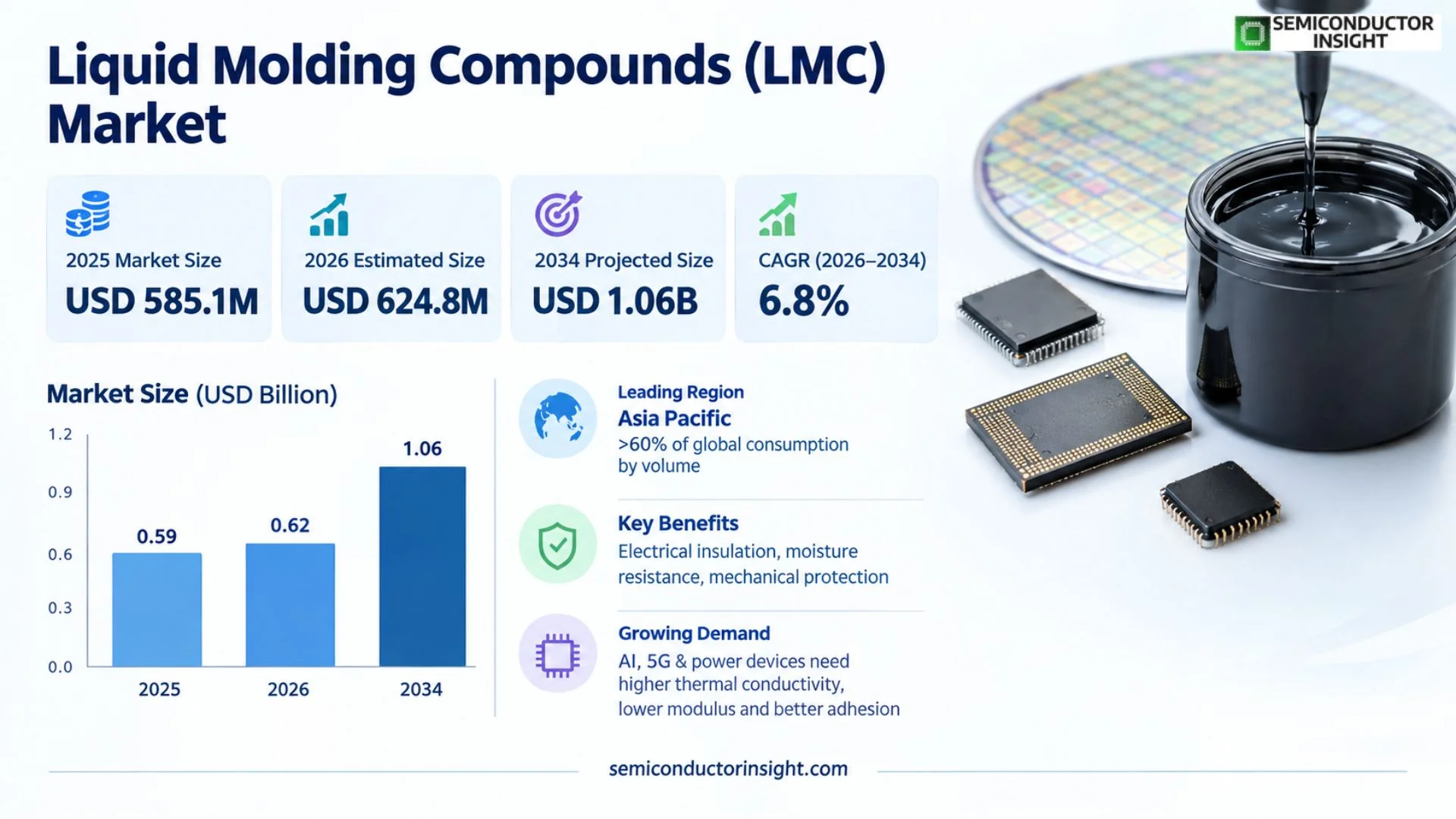
Liquid Molding Compounds (LMC) Market was valued at 548 million in 2024 and is projected to reach US$ 926 million by 2032, at a CAGR of 7.7% during the forecast period

PDF Icon Download Sample Report PDF
  • Quick Dispatch

    All Orders

  • Secure Payment

    100% Secure Payment

Price range: $1,500.00 through $4,250.00

Clear

MARKET INSIGHTS

The global Liquid Molding Compounds (LMC) Market was valued at 548 million in 2024 and is projected to reach US$ 926 million by 2032, at a CAGR of 7.7% during the forecast period.

Liquid Molding Compounds (LMC) are advanced thermosetting polymer systems used primarily for the encapsulation and protection of semiconductor devices. These materials are engineered to provide excellent moisture resistance, electrical insulation, thermal conductivity, and mechanical protection to sensitive electronic components such as integrated circuits (ICs), power semiconductors, and microelectromechanical systems (MEMS). The two primary types are Liquid Epoxy Underfill and Liquid Epoxy Encapsulant Material, each tailored for specific packaging requirements like void-free filling and stress relief.

The market is experiencing robust growth driven by the escalating demand for advanced semiconductor packaging in key sectors such as 5G infrastructure, automotive electronics, artificial intelligence, and consumer electronics. The relentless trend toward miniaturization and higher integration, exemplified by technologies like Fan-Out Wafer Level Packaging (FOWLP) and 3D-IC packaging, necessitates LMCs with superior performance characteristics, including higher thermal conductivity and low-stress formulations. Furthermore, strategic initiatives from leading manufacturers focusing on material innovation and capacity expansion are significantly contributing to market expansion. Key players such as Nagase ChemteX, Shin-Etsu Chemical, and NAMICS operate in the market with extensive product portfolios and global reach.

Liquid Molding Compounds (LMC) Market

MARKET DYNAMICS

MARKET DRIVERS

Rising Demand for Advanced Semiconductor Packaging to Propel Market Growth

The global semiconductor industry is undergoing a transformative shift toward advanced packaging technologies, driven by the proliferation of high-performance computing, 5G infrastructure, and automotive electronics. Liquid Molding Compounds (LMC) are integral to this evolution, providing essential encapsulation and protection for increasingly complex and miniaturized semiconductor devices. The adoption of System-in-Package (SiP) and 3D-IC packaging has surged, with these advanced techniques accounting for over 40% of the total semiconductor packaging market. LMCs ensure reliability, thermal management, and environmental protection in these configurations, making them indispensable. The expansion of the electric vehicle market, which relies heavily on power semiconductors requiring robust encapsulation, further accelerates demand. With the automotive semiconductor market projected to grow at a compound annual growth rate exceeding 8%, the need for high-performance LMCs is set to rise substantially.

Technological Innovations in LMC Formulations to Enhance Market Expansion

Continuous innovation in LMC materials is a significant driver, as manufacturers develop formulations tailored to meet the specific requirements of modern semiconductor applications. There is a growing emphasis on enhancing thermal conductivity, with next-generation LMCs achieving values exceeding 4 W/mK, a critical improvement for managing heat in high-power devices such as those used in artificial intelligence and data centers. Additionally, the development of low-stress LMCs has gained traction, reducing the risk of damage to delicate components during the curing process. These advancements are particularly important for applications like Fan-Out Wafer Level Packaging (FOWLP), where precision and reliability are paramount. The introduction of halogen-free and environmentally friendly LMCs also aligns with global sustainability trends, appealing to manufacturers seeking greener alternatives without compromising performance.

Growth in Consumer Electronics and IoT Devices to Fuel LMC Adoption

The exponential growth in consumer electronics and the Internet of Things (IoT) ecosystem is creating robust demand for LMCs. Devices such as smartphones, wearables, and smart home systems require compact, reliable semiconductor packaging to ensure longevity and performance under varying environmental conditions. The miniaturization trend in electronics has led to thinner and more integrated packages, where LMCs provide critical protection against moisture, chemicals, and mechanical stress. With over 30 billion IoT devices expected to be in use globally by 2025, the need for efficient encapsulation materials is more pressing than ever. Furthermore, the rollout of 5G technology necessitates advanced RF components and modules that rely on high-performance LMCs for signal integrity and durability, reinforcing market growth.

MARKET RESTRAINTS

High Production Costs and Raw Material Price Volatility to Limit Market Penetration

While the Liquid Molding Compounds market shows promising growth, it is constrained by the high costs associated with production and raw material procurement. The specialized epoxy resins, fillers, and additives used in LMC formulations are subject to price fluctuations due to supply chain disruptions and geopolitical factors. For instance, the cost of silver-coated fillers, essential for enhancing thermal conductivity, has increased by approximately 15% over the past year, impacting overall manufacturing expenses. These cost pressures are particularly challenging for small and medium-sized enterprises that may lack the bargaining power to secure favorable pricing. Additionally, the research and development required to create advanced LMC formulations involves significant investment, which can deter new entrants and slow down innovation in price-sensitive markets.

Stringent Regulatory and Environmental Compliance to Hinder Market Development

Compliance with stringent environmental and safety regulations presents a considerable restraint for the LMC market. Regulatory bodies worldwide are imposing stricter guidelines on the use of hazardous substances, such as halogens and heavy metals, in electronic materials. The Restriction of Hazardous Substances (RoHS) directive and similar regulations require manufacturers to reformulate their products, often at increased cost and complexity. Moreover, the disposal and recycling of electronic waste containing LMCs are becoming more regulated, adding to the lifecycle management challenges. Companies must invest in sustainable practices and materials to meet these requirements, which can delay product launches and increase operational overhead. Navigating this complex regulatory landscape is particularly burdensome for global players who must adhere to varying standards across different regions.

Technical Challenges in Processing and Application to Restrain Market Growth

The application of Liquid Molding Compounds involves precise processing conditions, such as controlled temperature, pressure, and curing time, to achieve optimal performance. Deviations in these parameters can lead to defects like void formation, delamination, or insufficient encapsulation, compromising device reliability. As semiconductor packages become more complex and thinner, the margin for error narrows, requiring highly specialized equipment and expertise. The industry faces a shortage of skilled technicians capable of managing these advanced processes, which can lead to production inefficiencies and increased scrap rates. Furthermore, the compatibility of LMCs with various substrate materials and lead frames must be meticulously tested, adding time and cost to the development cycle. These technical hurdles can slow adoption, especially in emerging markets where manufacturing capabilities are still evolving.

MARKET CHALLENGES

Intense Competition and Market Fragmentation to Challenge Profitability

The Liquid Molding Compounds market is characterized by intense competition and a fragmented landscape, with numerous players vying for market share. This competition often leads to price wars, squeezing profit margins and compelling companies to continuously innovate to maintain relevance. Larger corporations with extensive resources can invest in cutting-edge research and development, while smaller firms may struggle to keep pace. The presence of alternative encapsulation technologies, such as solid molding compounds and gel encapsulants, further intensifies competition. Companies must differentiate their products through superior performance characteristics, such as higher thermal conductivity or better reliability, to justify premium pricing. However, achieving such differentiation requires sustained investment, which can be challenging in a cost-sensitive environment.

Other Challenges

Supply Chain Disruptions
Global supply chain vulnerabilities pose significant challenges to the LMC market. Dependence on raw materials from specific geographic regions, coupled with logistical bottlenecks, can lead to delays and increased costs. Recent events have highlighted how disruptions can impact production schedules and lead to shortages, affecting the ability of manufacturers to meet growing demand.

Rapid Technological Obsolescence
The fast-paced evolution of semiconductor technology means that LMC formulations must constantly adapt to new requirements. Products that are state-of-the-art today may become obsolete within a few years, necessitating continuous innovation. This rapid turnover requires significant investment in research and development, posing a challenge for companies with limited resources.

MARKET OPPORTUNITIES

Expansion in Emerging Economies and Renewable Energy Sectors to Unlock New Growth Avenues

Emerging economies present significant growth opportunities for the Liquid Molding Compounds market, driven by increasing industrialization and the adoption of advanced electronics. Countries in Asia, such as India and Southeast Asian nations, are investing heavily in semiconductor manufacturing infrastructure, creating demand for high-quality encapsulation materials. Additionally, the renewable energy sector, particularly solar and wind power, relies on power electronics that require robust protection against harsh environmental conditions. LMCs are increasingly used in photovoltaic inverters and wind turbine converters, where reliability and longevity are critical. The global push toward renewable energy, supported by government initiatives and investments, is expected to drive demand for LMCs in these applications, offering a lucrative avenue for market expansion.

Advancements in Automotive Electronics and Autonomous Vehicles to Create New Opportunities

The automotive industry’s shift toward electric and autonomous vehicles is generating unprecedented demand for advanced semiconductor packages, which in turn boosts the need for high-performance LMCs. Electric vehicles utilize numerous power modules and sensors that require effective thermal management and protection from vibrations and moisture. Autonomous driving systems, with their reliance on high-speed data processing and sensor fusion, further amplify this demand. The automotive semiconductor market is projected to grow robustly, with advanced packaging technologies playing a key role. LMCs that offer low stress, high thermal conductivity, and reliability under extreme conditions are well-positioned to capitalize on this trend. Collaborations between LMC manufacturers and automotive OEMs are likely to increase, driving innovation and market growth.

Strategic Partnerships and Research Collaborations to Enhance Market Prospects

Strategic partnerships and collaborations between LMC manufacturers, semiconductor companies, and research institutions are poised to create significant opportunities. These alliances facilitate the development of tailored solutions for specific applications, such as 5G infrastructure or medical devices, where performance requirements are stringent. Joint research initiatives can accelerate the innovation cycle, leading to the introduction of advanced LMC formulations with improved properties. Additionally, mergers and acquisitions enable companies to expand their product portfolios and geographic reach, strengthening their competitive position. The trend toward vertical integration in the semiconductor supply chain also encourages closer collaboration between material suppliers and device manufacturers, ensuring that LMCs meet the evolving needs of the industry.

LIQUID MOLDING COMPOUNDS (LMC) MARKET TRENDS

Demand Surge from Advanced Semiconductor Packaging to Emerge as a Trend in the Market

The global semiconductor industry’s relentless push toward miniaturization and higher performance is fundamentally reshaping the Liquid Molding Compounds (LMC) market. This demand is primarily driven by the proliferation of advanced packaging technologies such as Fan-Out Wafer Level Packaging (FOWLP) and 2.5D/3D integrated circuits. These sophisticated packaging methods require LMCs that offer superior flow characteristics to encapsulate intricate, high-density interconnects without causing voids or damaging delicate structures. The market for advanced packaging platforms is projected to grow significantly, directly fueling the consumption of specialized LMCs. Furthermore, the automotive sector’s electrification and the rollout of 5G infrastructure necessitate semiconductors that can operate reliably in harsh environments, creating a non-negotiable need for high-performance encapsulation materials that provide excellent moisture resistance, thermal stability, and mechanical protection. This confluence of technological demands from multiple high-growth sectors positions LMCs as a critical enabling material, with their adoption becoming a key trend for ensuring device longevity and performance.

Other Trends

Formulation Innovation for Enhanced Thermal and Mechanical Properties

While meeting the basic requirements of protection is essential, a dominant trend is the development of next-generation LMC formulations engineered for specific, enhanced properties. A primary focus is on achieving higher thermal conductivity to manage the immense heat generated by high-power devices used in electric vehicles, data centers, and AI accelerators. Manufacturers are innovating with novel filler materials, such as advanced ceramics and boron nitride, to create compounds that can efficiently dissipate heat, a critical factor in preventing thermal runaway and ensuring device reliability. Concurrently, there is a significant shift toward low-stress and low-warpage formulations. As packages become larger and thinner, the mechanical stress exerted by the curing encapsulant can lead to warpage or even silicon die cracking. Advanced LMCs are being designed with modified chemistries and optimized filler size distributions to minimize this internal stress, which is particularly crucial for large-panel fan-out packaging and other cutting-edge applications where structural integrity is paramount.

Geographic Expansion and Supply Chain Localization

The geographic landscape of the LMC market is evolving rapidly, influenced by global semiconductor manufacturing trends and geopolitical factors. While the Asia-Pacific region, led by Taiwan, South Korea, and China, remains the dominant consumer due to its concentration of semiconductor fabrication and packaging facilities, there is a growing trend of supply chain localization and capacity expansion in other regions. Initiatives like the CHIPS Act in the United States and similar policies in Europe are catalyzing billions of dollars in investments for new semiconductor manufacturing plants. This creation of new manufacturing hubs is strategically driving demand for local sources of high-purity materials, including LMCs, to reduce logistical risks and ensure a resilient supply chain. Consequently, major LMC suppliers are establishing production facilities and strengthening their distribution networks in North America and Europe to serve these emerging clusters, marking a significant shift from a previously Asia-centric supply model to a more diversified global footprint.

COMPETITIVE LANDSCAPE

Key Industry Players

Companies Focus on Technological Innovation and Strategic Expansion to Capture Market Share

The global Liquid Molding Compounds (LMC) market exhibits a semi-consolidated competitive structure, characterized by the presence of established multinational chemical corporations alongside specialized regional manufacturers. This dynamic is driven by the critical role LMCs play in advanced semiconductor packaging, where performance specifications around thermal management, miniaturization, and reliability are paramount. Market leadership is often determined by a company’s ability to innovate rapidly and form deep, collaborative relationships with major semiconductor foundries and OSATs (Outsourced Semiconductor Assembly and Test providers).

Shin-Etsu Chemical Co., Ltd. (Japan) is widely recognized as a dominant force in the global LMC space. Its preeminence is built upon a comprehensive portfolio of high-purity electronic materials and a formidable global manufacturing footprint that ensures supply chain resilience. The company’s significant R&D investment, particularly in developing low-stress and high-thermal-conductivity formulations for 3D-IC and Fan-Out packaging, allows it to command a substantial market share. Its deep integration with the Asian semiconductor ecosystem, especially in Taiwan, South Korea, and Japan, provides a formidable competitive moat.

Similarly, Nagase ChemteX Corporation (Japan) and NAMICS Corporation (Japan) have carved out significant niches by specializing in advanced underfill and encapsulation materials. Their growth is intrinsically linked to the booming demand for high-performance computing, automotive electronics, and 5G infrastructure. These companies compete not just on product performance but also on technical support and co-development capabilities, working directly with clients to create custom-formulated LMCs for specific application challenges.

Meanwhile, a cohort of strong players from the Greater China region, including Eternal Materials Co., Ltd. (Taiwan) and Wuhan Sanxuan Technology Co., Ltd. (China), are aggressively expanding their influence. Their strategy often involves competing on cost-efficiency while simultaneously upgrading their technological capabilities to meet the demands of leading domestic semiconductor manufacturers. Their expansion is further fueled by supportive government policies aimed at strengthening regional semiconductor supply chains.

The competitive intensity is further heightened by continuous strategic initiatives such as capacity expansions, targeted mergers and acquisitions, and the launch of novel products tailored for next-generation applications like artificial intelligence and electric vehicles. Companies that can successfully navigate the complex technical requirements and build robust, global supply networks are best positioned to capitalize on the market’s robust growth trajectory.

List of Key Liquid Molding Compounds (LMC) Companies Profiled

Segment Analysis:

By Type

Liquid Epoxy Encapsulant Material Segment Dominates the Market Due to Superior Protection and Reliability in Advanced Semiconductor Packaging

The market is segmented based on type into:

  • Liquid Epoxy Underfill
  • Liquid Epoxy Encapsulant Material

By Application

Fan-Out Wafer Level Packaging (FOWLP) Segment Leads Due to High Demand for Miniaturization and Enhanced Performance in 5G and AI Applications

The market is segmented based on application into:

  • Fan-Out Wafer Level Packaging (FOWLP)
  • Ball Grid Array Package (BGA)
  • Other

By End-User Industry

Consumer Electronics Segment Holds Significant Share Driven by Proliferation of Smart Devices and Wearables

The market is segmented based on end-user industry into:

  • Consumer Electronics
  • Automotive
  • Telecommunications
  • Industrial
  • Aerospace & Defense

By Function

Encapsulation Segment is Critical for Ensuring Long-Term Device Reliability and Protection Against Environmental Stressors

The market is segmented based on function into:

  • Encapsulation
  • Underfilling
  • Glob Topping

Regional Analysis: Liquid Molding Compounds (LMC) Market

Asia-Pacific
The Asia-Pacific region is the undisputed leader in the global LMC market, accounting for over 60% of global consumption by volume. This dominance is fueled by the region’s colossal semiconductor manufacturing ecosystem, particularly in Taiwan, South Korea, China, and Japan. The relentless expansion of 5G infrastructure, electric vehicle production, and consumer electronics assembly lines in these countries creates immense, sustained demand for advanced semiconductor packaging materials. While cost-competitive standard LMC formulations are widely used, there is a pronounced and accelerating shift toward high-performance, specialized compounds. This is driven by the need to package increasingly complex chips for AI, high-performance computing, and automotive applications. Local manufacturers are heavily investing in R&D to develop next-generation LMCs with higher thermal conductivity and lower stress to meet these sophisticated requirements.

North America
North America is a high-value, innovation-centric market for LMCs, characterized by demand for cutting-edge, application-specific formulations. The region’s market is propelled by its advanced semiconductor design and packaging industry, heavy investment in R&D, and the presence of major fabless companies and integrated device manufacturers (IDMs). Demand is particularly strong for LMCs used in advanced packaging techniques like 2.5D/3D IC packaging and Fan-Out Wafer-Level Packaging (FOWLP) for applications in data centers, AI accelerators, and aerospace and defense electronics. Stringent quality and reliability standards necessitate the use of premium LMCs with superior performance characteristics. The market is also influenced by government initiatives and funding aimed at bolstering domestic semiconductor production, which indirectly supports the advanced materials supply chain.

Europe
The European LMC market is defined by its strong automotive and industrial sectors, which demand highly reliable and durable semiconductor components. This drives the need for robust LMCs that can withstand harsh operating environments, including extreme temperatures and vibrations, particularly for automotive-grade electronics. The region’s market is also shaped by stringent environmental regulations, such as the EU’s RoHS and REACH directives, which push manufacturers toward developing and adopting more environmentally sustainable compound formulations. While the region may not have the same volume of semiconductor fabrication as Asia, it possesses significant expertise in specialized, high-margin segments like power semiconductors and sensors. Collaboration between chemical companies and automotive OEMs is a key trend, fostering innovation in material science tailored to specific European industrial needs.

South America
The LMC market in South America is nascent and developing, primarily serving the region’s consumer electronics and industrial manufacturing sectors. The market volume is relatively small compared to global leaders, as there is limited local semiconductor production. Most demand is met through imports of standard LMC products. Growth is gradual and is tied to the overall expansion of the regional electronics manufacturing base and economic stability. The adoption of advanced, high-performance LMCs is limited, with a stronger focus on cost-effective solutions for less complex applications. However, as global supply chains diversify, there is potential for slow but steady growth in demand as local manufacturing capabilities improve over the long term.

Middle East & Africa
This region represents an emerging and opportunistic market for LMCs, though it is currently the smallest in terms of global market share. Demand is primarily linked to the electronics assembly and consumer goods markets, with limited local production of semiconductors. The market is characterized by imports of basic LMC products to support these industries. Economic development initiatives and investments in technological infrastructure in certain nations present a long-term growth potential. However, the current market is constrained by a lack of a significant local semiconductor ecosystem and a focus on more mature, cost-effective technologies rather than the advanced LMCs driving growth in other regions.

Report Scope

This market research report provides a comprehensive analysis of the global and regional Liquid Molding Compounds (LMC) market, covering the forecast period 2025–2032. It offers detailed insights into market dynamics, technological advancements, competitive landscape, and key trends shaping the industry.

Key focus areas of the report include:

  • Market Size & Forecast: Historical data and future projections for revenue, unit shipments, and market value across major regions and segments.
  • Segmentation Analysis: Detailed breakdown by product type, technology, application, and end-user industry to identify high-growth segments and investment opportunities.
  • Regional Outlook: Insights into market performance across North America, Europe, Asia-Pacific, Latin America, and the Middle East & Africa, including country-level analysis where relevant.
  • Competitive Landscape: Profiles of leading market participants, including their product offerings, R&D focus, manufacturing capacity, pricing strategies, and recent developments such as mergers, acquisitions, and partnerships.
  • Technology Trends & Innovation: Assessment of emerging technologies, integration of AI/IoT, semiconductor design trends, fabrication techniques, and evolving industry standards.
  • Market Drivers & Restraints: Evaluation of factors driving market growth along with challenges, supply chain constraints, regulatory issues, and market-entry barriers.
  • Stakeholder Analysis: Insights for component suppliers, OEMs, system integrators, investors, and policymakers regarding the evolving ecosystem and strategic opportunities.

Primary and secondary research methods are employed, including interviews with industry experts, data from verified sources, and real-time market intelligence to ensure the accuracy and reliability of the insights presented.

FREQUENTLY ASKED QUESTIONS:

What is the current market size of Global Liquid Molding Compounds (LMC) Market?

-> Liquid Molding Compounds (LMC) Market was valued at 548 million in 2024 and is projected to reach US$ 926 million by 2032, at a CAGR of 7.7% during the forecast period

Which key companies operate in Global Liquid Molding Compounds (LMC) Market?

-> Key players include Nagase ChemteX, NAMICS, Shin-Etsu Chemical, Eternal Materials, HHCK, Scienchem, and Wuhan Sanxuan Technology, among others.

What are the key growth drivers?

-> Key growth drivers include advancements in semiconductor packaging, demand from 5G and automotive electronics, and the trend towards miniaturization and integration of electronic components.

Which region dominates the market?

-> Asia-Pacific is the dominant and fastest-growing region, driven by semiconductor manufacturing hubs in China, Japan, South Korea, and Taiwan.

What are the emerging trends?

-> Emerging trends include the development of high thermal conductivity formulations, low-stress LMCs for advanced packaging, and customized compounds for specific applications like Fan-Out Wafer Level Packaging (FOWLP).

Liquid Molding Compounds (LMC) Market, Trends, Business Strategies 2025-2032

Get Sample Report PDF for Exclusive Insights

Report Sample Includes

  • Table of Contents
  • List of Tables & Figures
  • Charts, Research Methodology, and more...
PDF Icon Download Sample Report PDF

Download Sample Report

Table of Content

1 Introduction to Research & Analysis Reports
1.1 Liquid Molding Compounds (LMC) Market Definition
1.2 Market Segments
1.2.1 Segment by Type
1.2.2 Segment by Application
1.3 Global Liquid Molding Compounds (LMC) Market Overview
1.4 Features & Benefits of This Report
1.5 Methodology & Sources of Information
1.5.1 Research Methodology
1.5.2 Research Process
1.5.3 Base Year
1.5.4 Report Assumptions & Caveats
2 Global Liquid Molding Compounds (LMC) Overall Market Size
2.1 Global Liquid Molding Compounds (LMC) Market Size: 2024 VS 2032
2.2 Global Liquid Molding Compounds (LMC) Market Size, Prospects & Forecasts: 2020-2032
2.3 Global Liquid Molding Compounds (LMC) Sales: 2020-2032
3 Company Landscape
3.1 Top Liquid Molding Compounds (LMC) Players in Global Market
3.2 Top Global Liquid Molding Compounds (LMC) Companies Ranked by Revenue
3.3 Global Liquid Molding Compounds (LMC) Revenue by Companies
3.4 Global Liquid Molding Compounds (LMC) Sales by Companies
3.5 Global Liquid Molding Compounds (LMC) Price by Manufacturer (2020-2025)
3.6 Top 3 and Top 5 Liquid Molding Compounds (LMC) Companies in Global Market, by Revenue in 2024
3.7 Global Manufacturers Liquid Molding Compounds (LMC) Product Type
3.8 Tier 1, Tier 2, and Tier 3 Liquid Molding Compounds (LMC) Players in Global Market
3.8.1 List of Global Tier 1 Liquid Molding Compounds (LMC) Companies
3.8.2 List of Global Tier 2 and Tier 3 Liquid Molding Compounds (LMC) Companies
4 Sights by Product
4.1 Overview
4.1.1 Segment by Type – Global Liquid Molding Compounds (LMC) Market Size Markets, 2024 & 2032
4.1.2 Liquid Epoxy Underfill
4.1.3 Liquid Epoxy Encapsulat Material
4.2 Segment by Type – Global Liquid Molding Compounds (LMC) Revenue & Forecasts
4.2.1 Segment by Type – Global Liquid Molding Compounds (LMC) Revenue, 2020-2025
4.2.2 Segment by Type – Global Liquid Molding Compounds (LMC) Revenue, 2026-2032
4.2.3 Segment by Type – Global Liquid Molding Compounds (LMC) Revenue Market Share, 2020-2032
4.3 Segment by Type – Global Liquid Molding Compounds (LMC) Sales & Forecasts
4.3.1 Segment by Type – Global Liquid Molding Compounds (LMC) Sales, 2020-2025
4.3.2 Segment by Type – Global Liquid Molding Compounds (LMC) Sales, 2026-2032
4.3.3 Segment by Type – Global Liquid Molding Compounds (LMC) Sales Market Share, 2020-2032
4.4 Segment by Type – Global Liquid Molding Compounds (LMC) Price (Manufacturers Selling Prices), 2020-2032
5 Sights by Application
5.1 Overview
5.1.1 Segment by Application – Global Liquid Molding Compounds (LMC) Market Size, 2024 & 2032
5.1.2 Fan-Out Wafer Level Packaging (FOWLP)
5.1.3 Ball Grid Array Package (BGA)
5.1.4 Other
5.2 Segment by Application – Global Liquid Molding Compounds (LMC) Revenue & Forecasts
5.2.1 Segment by Application – Global Liquid Molding Compounds (LMC) Revenue, 2020-2025
5.2.2 Segment by Application – Global Liquid Molding Compounds (LMC) Revenue, 2026-2032
5.2.3 Segment by Application – Global Liquid Molding Compounds (LMC) Revenue Market Share, 2020-2032
5.3 Segment by Application – Global Liquid Molding Compounds (LMC) Sales & Forecasts
5.3.1 Segment by Application – Global Liquid Molding Compounds (LMC) Sales, 2020-2025
5.3.2 Segment by Application – Global Liquid Molding Compounds (LMC) Sales, 2026-2032
5.3.3 Segment by Application – Global Liquid Molding Compounds (LMC) Sales Market Share, 2020-2032
5.4 Segment by Application – Global Liquid Molding Compounds (LMC) Price (Manufacturers Selling Prices), 2020-2032
6 Sights by Region
6.1 By Region – Global Liquid Molding Compounds (LMC) Market Size, 2024 & 2032
6.2 By Region – Global Liquid Molding Compounds (LMC) Revenue & Forecasts
6.2.1 By Region – Global Liquid Molding Compounds (LMC) Revenue, 2020-2025
6.2.2 By Region – Global Liquid Molding Compounds (LMC) Revenue, 2026-2032
6.2.3 By Region – Global Liquid Molding Compounds (LMC) Revenue Market Share, 2020-2032
6.3 By Region – Global Liquid Molding Compounds (LMC) Sales & Forecasts
6.3.1 By Region – Global Liquid Molding Compounds (LMC) Sales, 2020-2025
6.3.2 By Region – Global Liquid Molding Compounds (LMC) Sales, 2026-2032
6.3.3 By Region – Global Liquid Molding Compounds (LMC) Sales Market Share, 2020-2032
6.4 North America
6.4.1 By Country – North America Liquid Molding Compounds (LMC) Revenue, 2020-2032
6.4.2 By Country – North America Liquid Molding Compounds (LMC) Sales, 2020-2032
6.4.3 United States Liquid Molding Compounds (LMC) Market Size, 2020-2032
6.4.4 Canada Liquid Molding Compounds (LMC) Market Size, 2020-2032
6.4.5 Mexico Liquid Molding Compounds (LMC) Market Size, 2020-2032
6.5 Europe
6.5.1 By Country – Europe Liquid Molding Compounds (LMC) Revenue, 2020-2032
6.5.2 By Country – Europe Liquid Molding Compounds (LMC) Sales, 2020-2032
6.5.3 Germany Liquid Molding Compounds (LMC) Market Size, 2020-2032
6.5.4 France Liquid Molding Compounds (LMC) Market Size, 2020-2032
6.5.5 U.K. Liquid Molding Compounds (LMC) Market Size, 2020-2032
6.5.6 Italy Liquid Molding Compounds (LMC) Market Size, 2020-2032
6.5.7 Russia Liquid Molding Compounds (LMC) Market Size, 2020-2032
6.5.8 Nordic Countries Liquid Molding Compounds (LMC) Market Size, 2020-2032
6.5.9 Benelux Liquid Molding Compounds (LMC) Market Size, 2020-2032
6.6 Asia
6.6.1 By Region – Asia Liquid Molding Compounds (LMC) Revenue, 2020-2032
6.6.2 By Region – Asia Liquid Molding Compounds (LMC) Sales, 2020-2032
6.6.3 China Liquid Molding Compounds (LMC) Market Size, 2020-2032
6.6.4 Japan Liquid Molding Compounds (LMC) Market Size, 2020-2032
6.6.5 South Korea Liquid Molding Compounds (LMC) Market Size, 2020-2032
6.6.6 Southeast Asia Liquid Molding Compounds (LMC) Market Size, 2020-2032
6.6.7 India Liquid Molding Compounds (LMC) Market Size, 2020-2032
6.7 South America
6.7.1 By Country – South America Liquid Molding Compounds (LMC) Revenue, 2020-2032
6.7.2 By Country – South America Liquid Molding Compounds (LMC) Sales, 2020-2032
6.7.3 Brazil Liquid Molding Compounds (LMC) Market Size, 2020-2032
6.7.4 Argentina Liquid Molding Compounds (LMC) Market Size, 2020-2032
6.8 Middle East & Africa
6.8.1 By Country – Middle East & Africa Liquid Molding Compounds (LMC) Revenue, 2020-2032
6.8.2 By Country – Middle East & Africa Liquid Molding Compounds (LMC) Sales, 2020-2032
6.8.3 Turkey Liquid Molding Compounds (LMC) Market Size, 2020-2032
6.8.4 Israel Liquid Molding Compounds (LMC) Market Size, 2020-2032
6.8.5 Saudi Arabia Liquid Molding Compounds (LMC) Market Size, 2020-2032
6.8.6 UAE Liquid Molding Compounds (LMC) Market Size, 2020-2032
7 Manufacturers & Brands Profiles
7.1 Nagase ChemteX
7.1.1 Nagase ChemteX Company Summary
7.1.2 Nagase ChemteX Business Overview
7.1.3 Nagase ChemteX Liquid Molding Compounds (LMC) Major Product Offerings
7.1.4 Nagase ChemteX Liquid Molding Compounds (LMC) Sales and Revenue in Global (2020-2025)
7.1.5 Nagase ChemteX Key News & Latest Developments
7.2 NAMICS
7.2.1 NAMICS Company Summary
7.2.2 NAMICS Business Overview
7.2.3 NAMICS Liquid Molding Compounds (LMC) Major Product Offerings
7.2.4 NAMICS Liquid Molding Compounds (LMC) Sales and Revenue in Global (2020-2025)
7.2.5 NAMICS Key News & Latest Developments
7.3 Shin-Etsu Chemical
7.3.1 Shin-Etsu Chemical Company Summary
7.3.2 Shin-Etsu Chemical Business Overview
7.3.3 Shin-Etsu Chemical Liquid Molding Compounds (LMC) Major Product Offerings
7.3.4 Shin-Etsu Chemical Liquid Molding Compounds (LMC) Sales and Revenue in Global (2020-2025)
7.3.5 Shin-Etsu Chemical Key News & Latest Developments
7.4 Eternal Materials
7.4.1 Eternal Materials Company Summary
7.4.2 Eternal Materials Business Overview
7.4.3 Eternal Materials Liquid Molding Compounds (LMC) Major Product Offerings
7.4.4 Eternal Materials Liquid Molding Compounds (LMC) Sales and Revenue in Global (2020-2025)
7.4.5 Eternal Materials Key News & Latest Developments
7.5 HHCK
7.5.1 HHCK Company Summary
7.5.2 HHCK Business Overview
7.5.3 HHCK Liquid Molding Compounds (LMC) Major Product Offerings
7.5.4 HHCK Liquid Molding Compounds (LMC) Sales and Revenue in Global (2020-2025)
7.5.5 HHCK Key News & Latest Developments
7.6 Scienchem
7.6.1 Scienchem Company Summary
7.6.2 Scienchem Business Overview
7.6.3 Scienchem Liquid Molding Compounds (LMC) Major Product Offerings
7.6.4 Scienchem Liquid Molding Compounds (LMC) Sales and Revenue in Global (2020-2025)
7.6.5 Scienchem Key News & Latest Developments
7.7 Wuhan Sanxuan Technology
7.7.1 Wuhan Sanxuan Technology Company Summary
7.7.2 Wuhan Sanxuan Technology Business Overview
7.7.3 Wuhan Sanxuan Technology Liquid Molding Compounds (LMC) Major Product Offerings
7.7.4 Wuhan Sanxuan Technology Liquid Molding Compounds (LMC) Sales and Revenue in Global (2020-2025)
7.7.5 Wuhan Sanxuan Technology Key News & Latest Developments
8 Global Liquid Molding Compounds (LMC) Production Capacity, Analysis
8.1 Global Liquid Molding Compounds (LMC) Production Capacity, 2020-2032
8.2 Liquid Molding Compounds (LMC) Production Capacity of Key Manufacturers in Global Market
8.3 Global Liquid Molding Compounds (LMC) Production by Region
9 Key Market Trends, Opportunity, Drivers and Restraints
9.1 Market Opportunities & Trends
9.2 Market Drivers
9.3 Market Restraints
10 Liquid Molding Compounds (LMC) Supply Chain Analysis
10.1 Liquid Molding Compounds (LMC) Industry Value Chain
10.2 Liquid Molding Compounds (LMC) Upstream Market
10.3 Liquid Molding Compounds (LMC) Downstream and Clients
10.4 Marketing Channels Analysis
10.4.1 Marketing Channels
10.4.2 Liquid Molding Compounds (LMC) Distributors and Sales Agents in Global
11 Conclusion
12 Appendix
12.1 Note
12.2 Examples of Clients
12.3 DisclaimerList of Tables
Table 1. Key Players of Liquid Molding Compounds (LMC) in Global Market
Table 2. Top Liquid Molding Compounds (LMC) Players in Global Market, Ranking by Revenue (2024)
Table 3. Global Liquid Molding Compounds (LMC) Revenue by Companies, (US$, Mn), 2020-2025
Table 4. Global Liquid Molding Compounds (LMC) Revenue Share by Companies, 2020-2025
Table 5. Global Liquid Molding Compounds (LMC) Sales by Companies, (Tons), 2020-2025
Table 6. Global Liquid Molding Compounds (LMC) Sales Share by Companies, 2020-2025
Table 7. Key Manufacturers Liquid Molding Compounds (LMC) Price (2020-2025) & (US$/Kg)
Table 8. Global Manufacturers Liquid Molding Compounds (LMC) Product Type
Table 9. List of Global Tier 1 Liquid Molding Compounds (LMC) Companies, Revenue (US$, Mn) in 2024 and Market Share
Table 10. List of Global Tier 2 and Tier 3 Liquid Molding Compounds (LMC) Companies, Revenue (US$, Mn) in 2024 and Market Share
Table 11. Segment by Type – Global Liquid Molding Compounds (LMC) Revenue, (US$, Mn), 2024 & 2032
Table 12. Segment by Type – Global Liquid Molding Compounds (LMC) Revenue (US$, Mn), 2020-2025
Table 13. Segment by Type – Global Liquid Molding Compounds (LMC) Revenue (US$, Mn), 2026-2032
Table 14. Segment by Type – Global Liquid Molding Compounds (LMC) Sales (Tons), 2020-2025
Table 15. Segment by Type – Global Liquid Molding Compounds (LMC) Sales (Tons), 2026-2032
Table 16. Segment by Application – Global Liquid Molding Compounds (LMC) Revenue, (US$, Mn), 2024 & 2032
Table 17. Segment by Application – Global Liquid Molding Compounds (LMC) Revenue, (US$, Mn), 2020-2025
Table 18. Segment by Application – Global Liquid Molding Compounds (LMC) Revenue, (US$, Mn), 2026-2032
Table 19. Segment by Application – Global Liquid Molding Compounds (LMC) Sales, (Tons), 2020-2025
Table 20. Segment by Application – Global Liquid Molding Compounds (LMC) Sales, (Tons), 2026-2032
Table 21. By Region – Global Liquid Molding Compounds (LMC) Revenue, (US$, Mn), 2025-2032
Table 22. By Region – Global Liquid Molding Compounds (LMC) Revenue, (US$, Mn), 2020-2025
Table 23. By Region – Global Liquid Molding Compounds (LMC) Revenue, (US$, Mn), 2026-2032
Table 24. By Region – Global Liquid Molding Compounds (LMC) Sales, (Tons), 2020-2025
Table 25. By Region – Global Liquid Molding Compounds (LMC) Sales, (Tons), 2026-2032
Table 26. By Country – North America Liquid Molding Compounds (LMC) Revenue, (US$, Mn), 2020-2025
Table 27. By Country – North America Liquid Molding Compounds (LMC) Revenue, (US$, Mn), 2026-2032
Table 28. By Country – North America Liquid Molding Compounds (LMC) Sales, (Tons), 2020-2025
Table 29. By Country – North America Liquid Molding Compounds (LMC) Sales, (Tons), 2026-2032
Table 30. By Country – Europe Liquid Molding Compounds (LMC) Revenue, (US$, Mn), 2020-2025
Table 31. By Country – Europe Liquid Molding Compounds (LMC) Revenue, (US$, Mn), 2026-2032
Table 32. By Country – Europe Liquid Molding Compounds (LMC) Sales, (Tons), 2020-2025
Table 33. By Country – Europe Liquid Molding Compounds (LMC) Sales, (Tons), 2026-2032
Table 34. By Region – Asia Liquid Molding Compounds (LMC) Revenue, (US$, Mn), 2020-2025
Table 35. By Region – Asia Liquid Molding Compounds (LMC) Revenue, (US$, Mn), 2026-2032
Table 36. By Region – Asia Liquid Molding Compounds (LMC) Sales, (Tons), 2020-2025
Table 37. By Region – Asia Liquid Molding Compounds (LMC) Sales, (Tons), 2026-2032
Table 38. By Country – South America Liquid Molding Compounds (LMC) Revenue, (US$, Mn), 2020-2025
Table 39. By Country – South America Liquid Molding Compounds (LMC) Revenue, (US$, Mn), 2026-2032
Table 40. By Country – South America Liquid Molding Compounds (LMC) Sales, (Tons), 2020-2025
Table 41. By Country – South America Liquid Molding Compounds (LMC) Sales, (Tons), 2026-2032
Table 42. By Country – Middle East & Africa Liquid Molding Compounds (LMC) Revenue, (US$, Mn), 2020-2025
Table 43. By Country – Middle East & Africa Liquid Molding Compounds (LMC) Revenue, (US$, Mn), 2026-2032
Table 44. By Country – Middle East & Africa Liquid Molding Compounds (LMC) Sales, (Tons), 2020-2025
Table 45. By Country – Middle East & Africa Liquid Molding Compounds (LMC) Sales, (Tons), 2026-2032
Table 46. Nagase ChemteX Company Summary
Table 47. Nagase ChemteX Liquid Molding Compounds (LMC) Product Offerings
Table 48. Nagase ChemteX Liquid Molding Compounds (LMC) Sales (Tons), Revenue (US$, Mn) and Average Price (US$/Kg) & (2020-2025)
Table 49. Nagase ChemteX Key News & Latest Developments
Table 50. NAMICS Company Summary
Table 51. NAMICS Liquid Molding Compounds (LMC) Product Offerings
Table 52. NAMICS Liquid Molding Compounds (LMC) Sales (Tons), Revenue (US$, Mn) and Average Price (US$/Kg) & (2020-2025)
Table 53. NAMICS Key News & Latest Developments
Table 54. Shin-Etsu Chemical Company Summary
Table 55. Shin-Etsu Chemical Liquid Molding Compounds (LMC) Product Offerings
Table 56. Shin-Etsu Chemical Liquid Molding Compounds (LMC) Sales (Tons), Revenue (US$, Mn) and Average Price (US$/Kg) & (2020-2025)
Table 57. Shin-Etsu Chemical Key News & Latest Developments
Table 58. Eternal Materials Company Summary
Table 59. Eternal Materials Liquid Molding Compounds (LMC) Product Offerings
Table 60. Eternal Materials Liquid Molding Compounds (LMC) Sales (Tons), Revenue (US$, Mn) and Average Price (US$/Kg) & (2020-2025)
Table 61. Eternal Materials Key News & Latest Developments
Table 62. HHCK Company Summary
Table 63. HHCK Liquid Molding Compounds (LMC) Product Offerings
Table 64. HHCK Liquid Molding Compounds (LMC) Sales (Tons), Revenue (US$, Mn) and Average Price (US$/Kg) & (2020-2025)
Table 65. HHCK Key News & Latest Developments
Table 66. Scienchem Company Summary
Table 67. Scienchem Liquid Molding Compounds (LMC) Product Offerings
Table 68. Scienchem Liquid Molding Compounds (LMC) Sales (Tons), Revenue (US$, Mn) and Average Price (US$/Kg) & (2020-2025)
Table 69. Scienchem Key News & Latest Developments
Table 70. Wuhan Sanxuan Technology Company Summary
Table 71. Wuhan Sanxuan Technology Liquid Molding Compounds (LMC) Product Offerings
Table 72. Wuhan Sanxuan Technology Liquid Molding Compounds (LMC) Sales (Tons), Revenue (US$, Mn) and Average Price (US$/Kg) & (2020-2025)
Table 73. Wuhan Sanxuan Technology Key News & Latest Developments
Table 74. Liquid Molding Compounds (LMC) Capacity of Key Manufacturers in Global Market, 2023-2025 (Tons)
Table 75. Global Liquid Molding Compounds (LMC) Capacity Market Share of Key Manufacturers, 2023-2025
Table 76. Global Liquid Molding Compounds (LMC) Production by Region, 2020-2025 (Tons)
Table 77. Global Liquid Molding Compounds (LMC) Production by Region, 2026-2032 (Tons)
Table 78. Liquid Molding Compounds (LMC) Market Opportunities & Trends in Global Market
Table 79. Liquid Molding Compounds (LMC) Market Drivers in Global Market
Table 80. Liquid Molding Compounds (LMC) Market Restraints in Global Market
Table 81. Liquid Molding Compounds (LMC) Raw Materials
Table 82. Liquid Molding Compounds (LMC) Raw Materials Suppliers in Global Market
Table 83. Typical Liquid Molding Compounds (LMC) Downstream
Table 84. Liquid Molding Compounds (LMC) Downstream Clients in Global Market
Table 85. Liquid Molding Compounds (LMC) Distributors and Sales Agents in Global Market

List of Figures
Figure 1. Liquid Molding Compounds (LMC) Product Picture
Figure 2. Liquid Molding Compounds (LMC) Segment by Type in 2024
Figure 3. Liquid Molding Compounds (LMC) Segment by Application in 2024
Figure 4. Global Liquid Molding Compounds (LMC) Market Overview: 2024
Figure 5. Key Caveats
Figure 6. Global Liquid Molding Compounds (LMC) Market Size: 2024 VS 2032 (US$, Mn)
Figure 7. Global Liquid Molding Compounds (LMC) Revenue: 2020-2032 (US$, Mn)
Figure 8. Liquid Molding Compounds (LMC) Sales in Global Market: 2020-2032 (Tons)
Figure 9. The Top 3 and 5 Players Market Share by Liquid Molding Compounds (LMC) Revenue in 2024
Figure 10. Segment by Type – Global Liquid Molding Compounds (LMC) Revenue, (US$, Mn), 2024 & 2032
Figure 11. Segment by Type – Global Liquid Molding Compounds (LMC) Revenue Market Share, 2020-2032
Figure 12. Segment by Type – Global Liquid Molding Compounds (LMC) Sales Market Share, 2020-2032
Figure 13. Segment by Type – Global Liquid Molding Compounds (LMC) Price (US$/Kg), 2020-2032
Figure 14. Segment by Application – Global Liquid Molding Compounds (LMC) Revenue, (US$, Mn), 2024 & 2032
Figure 15. Segment by Application – Global Liquid Molding Compounds (LMC) Revenue Market Share, 2020-2032
Figure 16. Segment by Application – Global Liquid Molding Compounds (LMC) Sales Market Share, 2020-2032
Figure 17. Segment by Application -Global Liquid Molding Compounds (LMC) Price (US$/Kg), 2020-2032
Figure 18. By Region – Global Liquid Molding Compounds (LMC) Revenue, (US$, Mn), 2025 & 2032
Figure 19. By Region – Global Liquid Molding Compounds (LMC) Revenue Market Share, 2020 VS 2024 VS 2032
Figure 20. By Region – Global Liquid Molding Compounds (LMC) Revenue Market Share, 2020-2032
Figure 21. By Region – Global Liquid Molding Compounds (LMC) Sales Market Share, 2020-2032
Figure 22. By Country – North America Liquid Molding Compounds (LMC) Revenue Market Share, 2020-2032
Figure 23. By Country – North America Liquid Molding Compounds (LMC) Sales Market Share, 2020-2032
Figure 24. United States Liquid Molding Compounds (LMC) Revenue, (US$, Mn), 2020-2032
Figure 25. Canada Liquid Molding Compounds (LMC) Revenue, (US$, Mn), 2020-2032
Figure 26. Mexico Liquid Molding Compounds (LMC) Revenue, (US$, Mn), 2020-2032
Figure 27. By Country – Europe Liquid Molding Compounds (LMC) Revenue Market Share, 2020-2032
Figure 28. By Country – Europe Liquid Molding Compounds (LMC) Sales Market Share, 2020-2032
Figure 29. Germany Liquid Molding Compounds (LMC) Revenue, (US$, Mn), 2020-2032
Figure 30. France Liquid Molding Compounds (LMC) Revenue, (US$, Mn), 2020-2032
Figure 31. U.K. Liquid Molding Compounds (LMC) Revenue, (US$, Mn), 2020-2032
Figure 32. Italy Liquid Molding Compounds (LMC) Revenue, (US$, Mn), 2020-2032
Figure 33. Russia Liquid Molding Compounds (LMC) Revenue, (US$, Mn), 2020-2032
Figure 34. Nordic Countries Liquid Molding Compounds (LMC) Revenue, (US$, Mn), 2020-2032
Figure 35. Benelux Liquid Molding Compounds (LMC) Revenue, (US$, Mn), 2020-2032
Figure 36. By Region – Asia Liquid Molding Compounds (LMC) Revenue Market Share, 2020-2032
Figure 37. By Region – Asia Liquid Molding Compounds (LMC) Sales Market Share, 2020-2032
Figure 38. China Liquid Molding Compounds (LMC) Revenue, (US$, Mn), 2020-2032
Figure 39. Japan Liquid Molding Compounds (LMC) Revenue, (US$, Mn), 2020-2032
Figure 40. South Korea Liquid Molding Compounds (LMC) Revenue, (US$, Mn), 2020-2032
Figure 41. Southeast Asia Liquid Molding Compounds (LMC) Revenue, (US$, Mn), 2020-2032
Figure 42. India Liquid Molding Compounds (LMC) Revenue, (US$, Mn), 2020-2032
Figure 43. By Country – South America Liquid Molding Compounds (LMC) Revenue Market Share, 2020-2032
Figure 44. By Country – South America Liquid Molding Compounds (LMC) Sales, Market Share, 2020-2032
Figure 45. Brazil Liquid Molding Compounds (LMC) Revenue, (US$, Mn), 2020-2032
Figure 46. Argentina Liquid Molding Compounds (LMC) Revenue, (US$, Mn), 2020-2032
Figure 47. By Country – Middle East & Africa Liquid Molding Compounds (LMC) Revenue, Market Share, 2020-2032
Figure 48. By Country – Middle East & Africa Liquid Molding Compounds (LMC) Sales, Market Share, 2020-2032
Figure 49. Turkey Liquid Molding Compounds (LMC) Revenue, (US$, Mn), 2020-2032
Figure 50. Israel Liquid Molding Compounds (LMC) Revenue, (US$, Mn), 2020-2032
Figure 51. Saudi Arabia Liquid Molding Compounds (LMC) Revenue, (US$, Mn), 2020-2032
Figure 52. UAE Liquid Molding Compounds (LMC) Revenue, (US$, Mn), 2020-2032
Figure 53. Global Liquid Molding Compounds (LMC) Production Capacity (Tons), 2020-2032
Figure 54. The Percentage of Production Liquid Molding Compounds (LMC) by Region, 2024 VS 2032
Figure 55. Liquid Molding Compounds (LMC) Industry Value Chain
Figure 56. Marketing Channels