LiDAR Silicon Photonic Chip Market Insights
Global LiDAR Silicon Photonic Chip market size was valued at USD 136 million in 2025. The market is projected to grow from USD 154 million in 2026 to USD 421 million by 2034, exhibiting a CAGR of 13.4% during the forecast period.
LiDAR silicon photonic chips are advanced semiconductor components that calculate the distance between a target and a sensor by emitting a laser beam toward a target object and measuring the time difference or frequency change of the reflected light. These data are used to build a three-dimensional map of the environment and provide accurate spatial positioning. The chips are categorized by transmission loss performance, including segments such as Transmission Loss: Less Than 0.1dB/cm, Transmission Loss: 0.1–0.15dB/cm, and Transmission Loss: Above 0.15dB/cm, and find application across Mechanical Laser Radar, Semi-Solid Laser Radar, and Solid-State Laser Radar systems.
The market is witnessing strong momentum driven by rapid advancements in autonomous vehicle technology, robotics, and smart infrastructure, all of which demand highly precise and miniaturized sensing solutions. Furthermore, the integration of silicon photonics with LiDAR technology enables significant cost reduction and improved scalability over conventional discrete optical components, making these chips increasingly attractive to original equipment manufacturers. Key players operating in Global LiDAR Silicon Photonic Chip market include Tower Semiconductor, Intel, Mobileye, Scantinel, SiLC Technologies, LuminWave, Guo Ke Guang Xin (Haining) Technology, Yangzhou Qunfa, and Shanghai Xihe, among others, collectively shaping the competitive landscape through continued R&D investment and strategic partnerships.
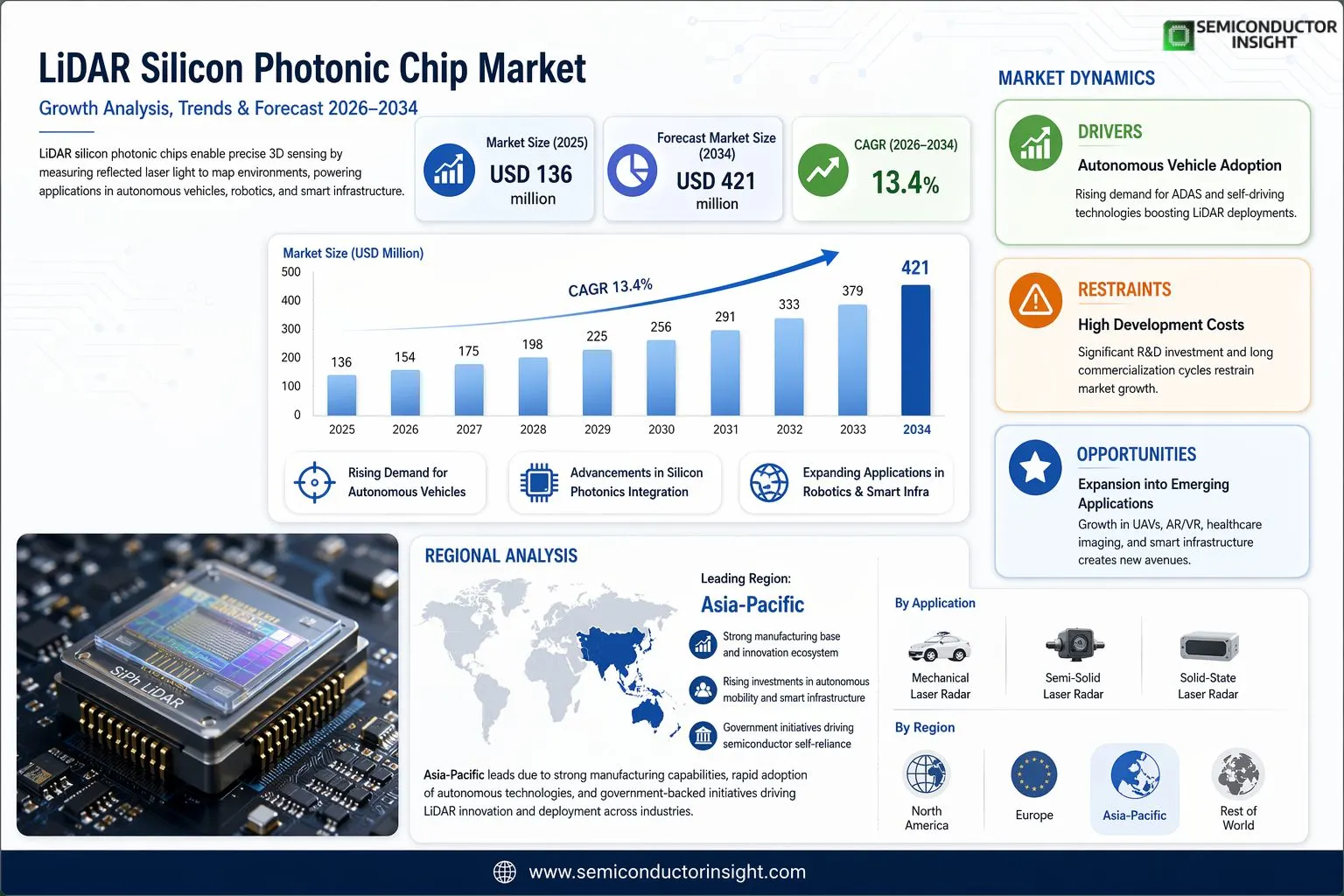
MARKET DRIVERS
Accelerating Adoption of Autonomous Vehicles and Advanced Driver Assistance Systems (ADAS)
LiDAR Silicon Photonic Chip Market is experiencing robust momentum, driven primarily by the rapid expansion of autonomous vehicle development and the integration of advanced driver assistance systems across passenger and commercial vehicles. Silicon photonics-based LiDAR solutions offer a compelling combination of miniaturization, high-speed data processing, and cost efficiency compared to traditional mechanical LiDAR systems. As automotive OEMs and Tier-1 suppliers accelerate their roadmaps toward Level 3 and Level 4 autonomy, demand for compact, reliable, and scalable LiDAR sensing modules built on silicon photonic platforms continues to intensify. The transition from bulky rotating LiDAR systems to solid-state silicon photonic alternatives is a defining trend shaping product development strategies across the industry.
Surging Demand Across Industrial Automation, Robotics, and Smart Infrastructure
Beyond automotive applications, LiDAR Silicon Photonic Chip Market is gaining strong traction in industrial automation, collaborative robotics, smart city infrastructure, and precision agriculture. Silicon photonic chips enable LiDAR systems to achieve higher resolution point clouds, extended range, and improved environmental resilience at form factors that are practical for deployment in drones, automated guided vehicles (AGVs), and infrastructure monitoring networks. Governments and private enterprises globally are investing in smart city initiatives and Industry 4.0 transformation programs, creating sustained downstream demand for LiDAR-enabled sensing technologies built on advanced silicon photonic architectures.
➤ The convergence of silicon photonics with FMCW (Frequency-Modulated Continuous Wave) LiDAR technology is emerging as a pivotal innovation, enabling simultaneous measurement of distance and velocity with significantly reduced susceptibility to interference , a capability increasingly demanded in both automotive and industrial sensing applications.
Additionally, the ongoing scaling of semiconductor fabrication capabilities, particularly the compatibility of silicon photonic chip manufacturing with standard CMOS foundry processes, is a significant market driver. This compatibility allows LiDAR silicon photonic chip developers to leverage existing high-volume semiconductor infrastructure, accelerating production scale-up and reducing per-unit costs. The ability to integrate photonic and electronic components on a single chip platform is steadily narrowing the cost gap between LiDAR and conventional camera-based sensing, broadening the total addressable market for silicon photonic LiDAR solutions.
MARKET CHALLENGES
Technical Complexity in Achieving High-Performance Optical Integration at Commercial Scale
Despite considerable technological progress, LiDAR Silicon Photonic Chip Market faces substantial challenges related to the precision engineering required for high-performance photonic integration. Achieving low optical insertion loss, efficient fiber-to-chip coupling, and stable thermal management within densely integrated silicon photonic circuits remains technically demanding. Wafer-level testing, packaging, and hermetic sealing of silicon photonic LiDAR chips add complexity and cost to the manufacturing process. Developers must balance performance optimization , including beam-steering accuracy, signal-to-noise ratio, and operating wavelength stability , against the imperative for cost-competitive, high-volume production, a tension that continues to challenge engineering and operations teams across the industry.
Other Challenges
Ecosystem Fragmentation and Lack of Standardization
LiDAR Silicon Photonic Chip Market currently lacks widely adopted industry standards governing interface protocols, data formats, and performance benchmarking methodologies. This fragmentation complicates system integration for end-users who must evaluate and qualify components from multiple vendors with differing specifications and performance characteristics. The absence of standardized test frameworks increases time-to-deployment and raises qualification costs, particularly in automotive applications where rigorous functional safety certifications such as ISO 26262 compliance are mandatory prerequisites for commercialization.
Supply Chain Vulnerabilities and Specialized Material Dependencies
Silicon photonic LiDAR chip production relies on specialized materials and components, including indium phosphide (InP) laser sources, germanium photodetectors, and ultra-low-loss waveguide materials, which are subject to supply concentration risks and geopolitical trade sensitivities. Disruptions in Global semiconductor supply chain, as demonstrated during recent years, can delay product development timelines and constrain production capacity. Diversifying the supplier base for these specialized photonic components remains a strategic priority but is hindered by the limited number of qualified foundries and material suppliers capable of meeting the exacting specifications required for LiDAR silicon photonic applications.
MARKET RESTRAINTS
High Development Costs and Extended Commercialization Timelines
One of the primary restraints tempering growth in LiDAR Silicon Photonic Chip Market is the substantial capital investment required for research and development, prototype iteration, and qualification testing prior to commercial deployment. Silicon photonic chip design is a highly specialized discipline requiring expertise across photonic engineering, semiconductor process technology, and systems integration. Non-recurring engineering (NRE) costs associated with photonic integrated circuit (PIC) tape-outs at leading-edge foundries are significant, and multiple design iterations are typically necessary to meet automotive-grade performance and reliability specifications. These financial and timeline barriers disproportionately affect smaller innovators and startups, consolidating development activity among well-capitalized players.
Competition from Alternative Sensing Technologies and Incumbent LiDAR Architectures
LiDAR Silicon Photonic Chip Market also faces competitive pressure from alternative sensing modalities, including high-resolution radar, structured light systems, and advanced camera-based perception platforms enhanced by artificial intelligence. In certain application segments, particularly short-range industrial sensing and some automotive ADAS use cases, these alternative technologies offer sufficient performance at lower system cost, potentially limiting the addressable market for silicon photonic LiDAR solutions. Furthermore, incumbent LiDAR architectures , including established mechanical spinning systems and first-generation solid-state designs , retain significant installed bases and ecosystem support, creating switching cost barriers that can slow adoption of newer silicon photonic chip-based platforms even where technical superiority is demonstrated.
MARKET OPPORTUNITIES
Expansion into Emerging Applications: UAVs, AR/VR, and Healthcare Imaging
LiDAR Silicon Photonic Chip Market is well-positioned to capitalize on a broadening range of emerging application verticals beyond its core automotive and industrial segments. In the unmanned aerial vehicle (UAV) sector, the size, weight, and power (SWaP) advantages of silicon photonic LiDAR chips make them highly attractive for payload-sensitive drone platforms used in mapping, infrastructure inspection, and precision agriculture. In the consumer electronics domain, the integration of miniaturized LiDAR silicon photonic chips into augmented reality (AR) and virtual reality (VR) headsets is gaining strategic interest among leading technology firms seeking enhanced spatial mapping and gesture recognition capabilities. Additionally, early-stage investigations into LiDAR-based optical coherence tomography (OCT) and biomedical imaging applications suggest a longer-term pathway for silicon photonic LiDAR technology into clinical diagnostics and point-of-care sensing.
Strategic Partnerships, Foundry Ecosystem Development, and Government R&D Investment
Significant market opportunities are arising from the formation of strategic partnerships between LiDAR silicon photonic chip developers, semiconductor foundries, and systems integrators. Leading photonic foundries are expanding their process design kit (PDK) offerings and multi-project wafer (MPW) programs tailored to photonic integrated circuit development, reducing barriers to entry for new market participants. Simultaneously, government-backed R&D programs in North America, Europe, and Asia-Pacific are directing substantial funding toward silicon photonics as a strategic technology for national competitiveness in sensing, communications, and quantum technologies. These public-private investment flows are accelerating foundry infrastructure development, workforce capability building, and pre-competitive research, collectively strengthening the commercial ecosystem supporting LiDAR Silicon Photonic Chip Market over the medium to long term.
Trends
Rising Adoption of Solid-State LiDAR Driving Silicon Photonic Chip Innovation
LiDAR Silicon Photonic Chip Market is witnessing significant transformation as automotive, robotics, and industrial automation sectors increasingly demand compact, high-performance sensing solutions. Silicon photonic chips used in LiDAR systems operate by emitting laser beams toward target objects and measuring the time difference or frequency change of reflected light, enabling the construction of precise three-dimensional environmental maps. This core capability is accelerating adoption across autonomous vehicle platforms and advanced driver-assistance systems (ADAS), where spatial accuracy and low transmission loss are critical requirements. The shift from mechanical laser radar to solid-state laser radar architectures is particularly notable, as solid-state configurations offer improved durability, reduced form factor, and greater suitability for mass production integration.
Other Trends
Low Transmission Loss Technology Gaining Competitive Importance
Within LiDAR Silicon Photonic Chip Market, transmission loss performance has emerged as a key differentiating factor among product offerings. Chips classified under the Transmission Loss: Less Than 0.1dB/cm segment are attracting strong interest from high-precision application developers, as lower optical loss directly translates to improved signal integrity, longer detection range, and reduced power consumption. Leading manufacturers including Tower Semiconductor, Intel, Mobileye, SiLC Technologies, and Scantinel are actively investing in fabrication process refinements to achieve and maintain performance within this low-loss threshold, reflecting the segment’s growing commercial relevance.
Asia-Pacific Emerging as a Manufacturing and Innovation Hub
Geographically, Asia-Pacific , particularly China , is establishing itself as both a manufacturing base and an innovation center for silicon photonic chip development tailored to LiDAR applications. Domestic players such as Guo Ke Guang Xin (Haining) Technology, Yangzhou Qunfa, and Shanghai Xihe are expanding their production capabilities and R&D investments, contributing to a more competitive global supplier landscape. This regional momentum is supported by government-backed initiatives promoting semiconductor self-sufficiency and the rapid scaling of domestic autonomous vehicle and smart infrastructure programs.
Semi-Solid Laser Radar Applications Bridging Technology Transition
The semi-solid laser radar application segment is playing an important bridging role in LiDAR Silicon Photonic Chip Market, offering a middle ground between the mechanical and fully solid-state approaches. This segment is drawing interest from automotive OEMs and Tier-1 suppliers seeking to balance cost considerations with performance improvements during the current phase of autonomous driving technology maturation. As integration between photonic chip design and system-level packaging continues to advance, industry participants are expected to consolidate around solutions that deliver scalable performance across mechanical, semi-solid, and solid-state radar platforms, further shaping the competitive and technological trajectory of the broader market.
COMPETITIVE LANDSCAPE
Key Industry Players
LiDAR Silicon Photonic Chip Market , Competitive Dynamics and Leading Manufacturer Profiles
Global LiDAR Silicon Photonic Chip market, valued at approximately USD 136 million in 2025 and projected to reach USD 322 million by 2032 at a CAGR of 13.4%, is characterized by a moderately consolidated competitive landscape with a mix of established semiconductor giants and agile deep-tech startups. Intel and its autonomous driving subsidiary Mobileye collectively represent significant market influence, leveraging decades of semiconductor fabrication expertise and large-scale silicon photonics integration capabilities to develop high-performance LiDAR chips for automotive and industrial applications. Tower Semiconductor further strengthens the established player segment, offering specialized foundry services tailored to photonic integrated circuits that underpin next-generation solid-state and semi-solid LiDAR systems. These top-tier players benefit from robust R&D budgets, global manufacturing footprints, and established customer relationships across the automotive, robotics, and smart infrastructure verticals, collectively accounting for a substantial share of Global market revenue in 2025.
Beyond the dominant incumbents, LiDAR Silicon Photonic Chip Market is witnessing growing contributions from specialized innovators and regionally significant players. SiLC Technologies has gained recognition for its vision-on-chip architecture, integrating coherent LiDAR sensing directly onto silicon photonic platforms, while Scantinel Photonics focuses on FMCW-based LiDAR chip solutions offering superior velocity resolution and noise immunity. LuminWave continues to advance its photonic chip portfolio targeting long-range detection and low-transmission-loss performance below 0.1 dB/cm , the fastest-growing product segment in the market. On the Asia-Pacific front, Chinese firms such as Guo Ke Guang Xin (Haining) Technology, Yangzhou Qunfa, and Shanghai Xihe are expanding their manufacturing capacities and technological capabilities, capitalizing on strong domestic demand and government-backed initiatives in autonomous mobility and smart city infrastructure. The intensifying competition across both performance benchmarks and cost structures is expected to drive further consolidation, strategic partnerships, and technology licensing agreements throughout the forecast period.
List of Key LiDAR Silicon Photonic Chip Companies Profiled
- Tower Semiconductor
- Intel
- Mobileye
- Scantinel Photonics
- SiLC Technologies
- LuminWave
- Guo Ke Guang Xin (Haining) Technology
- Yangzhou Qunfa
- Shanghai Xihe
Segment Analysis:
| Segment Category | Sub-Segments | Key Insights |
| By Type |
|
Transmission Loss: Less Than 0.1dB/cm is the leading segment in LiDAR Silicon Photonic Chip Market, driven by its superior optical efficiency and signal integrity.
|
| By Application |
|
Solid-State Laser Radar is rapidly emerging as the dominant application segment, benefiting from the elimination of moving mechanical components and the resulting gains in durability, compactness, and reliability.
|
| By End User |
|
Automotive & Autonomous Vehicles constitutes the largest and most strategically significant end-user segment for LiDAR silicon photonic chips, propelled by Global push toward Level 3 and above autonomous driving systems.
|
| By Integration Level |
|
Fully Integrated System-on-Chip (SoC) is the most forward-looking and strategically prioritized sub-segment, as it consolidates laser source, waveguide routing, beam steering, and photodetection onto a single monolithic platform.
|
| By Detection Technology |
|
Frequency-Modulated Continuous Wave (FMCW) technology is gaining decisive momentum as the leading detection paradigm within LiDAR Silicon Photonic Chip Market, owing to its inherent ability to simultaneously measure both distance and velocity in a single coherent measurement cycle.
|
Regional Analysis: LiDAR Silicon Photonic Chip Market
North America
North America’s autonomous vehicle industry remains one of the primary demand drivers for LiDAR Silicon Photonic Chip Market. Leading robotaxi operators, automotive OEMs, and self-driving technology developers are deeply integrated with photonic chip suppliers, fostering co-development relationships that accelerate chip miniaturization, power efficiency improvements, and long-range sensing capabilities critical to safe autonomous navigation in complex urban environments.
The U.S. defense sector represents a significant and strategically important segment within LiDAR Silicon Photonic Chip Market. Military programs targeting unmanned aerial vehicles, precision targeting, terrain mapping, and battlefield awareness systems increasingly rely on compact, high-resolution LiDAR silicon photonic chip modules. Government procurement contracts and DARPA-funded research continue to stimulate innovation in rugged, high-performance photonic sensing architectures.
North America benefits from a well-established semiconductor fabrication and photonic chip design ecosystem. Access to advanced CMOS-compatible silicon photonics foundries enables faster prototyping and volume production of LiDAR silicon photonic chips. Ongoing government initiatives to strengthen domestic semiconductor supply chains further reinforce the region’s capacity to scale LiDAR photonic chip manufacturing without dependency on offshore foundries.
Leading universities and national laboratories across North America are actively advancing silicon photonics research relevant to LiDAR applications. Collaborative programs between academic institutions and private enterprises are yielding breakthroughs in optical phased array design, coherent detection, and chip-scale beam steering , all of which are foundational to next-generation LiDAR silicon photonic chip performance and cost reduction trajectories.
Europe
Europe occupies a prominent position in Global LiDAR silicon photonic chip market, underpinned by its strong tradition of precision engineering, advanced optics manufacturing, and a progressively stringent regulatory environment that incentivizes the adoption of intelligent sensing technologies in automotive and industrial applications. Germany, the Netherlands, France, and the United Kingdom serve as key innovation hubs, with a dense network of research institutes, automotive suppliers, and photonics companies actively developing and commercializing LiDAR silicon photonic chip solutions. The European Union’s Horizon research funding programs and its commitment to autonomous mobility and smart city infrastructure have created favorable conditions for LiDAR silicon photonic chip market growth. European automotive giants are investing heavily in ADAS and fully autonomous driving platforms, generating substantial upstream demand for high-performance photonic sensing chips. Additionally, the region’s focus on industrial automation, robotics, and precision agriculture is diversifying end-use applications beyond mobility, broadening the addressable market for LiDAR silicon photonic chip technologies through 2034.
Asia-Pacific
Asia-Pacific is emerging as one of the fastest-evolving regions within LiDAR Silicon Photonic Chip Market, propelled by rapid industrialization, aggressive government investment in smart transportation, and the explosive growth of domestic autonomous vehicle and consumer electronics industries. China leads regional dynamics, with state-backed programs supporting the development of indigenous LiDAR silicon photonic chip capabilities as part of broader semiconductor self-sufficiency strategies. Japan and South Korea contribute through their world-class semiconductor fabrication expertise and deep integration within global electronics supply chains. The proliferation of smart city projects across Southeast Asia and India is creating new demand vectors for LiDAR silicon photonic chip-based sensing in infrastructure monitoring, traffic management, and urban planning. While the region faces challenges related to intellectual property protection and technology standardization, its cost-competitive manufacturing environment and expanding domestic market base position Asia-Pacific as a critical growth engine for LiDAR Silicon Photonic Chip Market through the forecast period.
South America
South America represents an emerging frontier for LiDAR Silicon Photonic Chip Market, with growth primarily driven by increasing awareness of intelligent transportation systems, smart agriculture, and infrastructure modernization initiatives. Brazil, as the region’s largest economy, is at the forefront of exploring LiDAR silicon photonic chip applications in precision farming and urban mobility planning. While the region currently accounts for a modest share of global LiDAR silicon photonic chip demand, ongoing investments in digital infrastructure and gradual regulatory reforms supporting autonomous technology adoption are expected to create incremental market opportunities over the 2026 to 2034 forecast window. Challenges such as import dependency for advanced semiconductor components, limited local manufacturing capacity, and economic volatility may temper near-term growth. Nevertheless, international technology partnerships and foreign direct investment into South American tech ecosystems are laying the groundwork for more sustained engagement with Global LiDAR silicon photonic chip supply chain in the coming years.
Middle East & Africa
The Middle East and Africa region is at a nascent but increasingly strategic stage of engagement with LiDAR Silicon Photonic Chip Market. Gulf Cooperation Council nations, particularly the United Arab Emirates and Saudi Arabia, are channeling substantial investment into smart city development, autonomous logistics, and next-generation transportation infrastructure as part of their broader economic diversification agendas. These ambitions are generating demand for advanced sensing technologies including LiDAR silicon photonic chip-based systems in urban planning, port automation, and mobility-as-a-service platforms. Africa’s participation remains limited in the near term, though growing interest in precision agriculture, environmental monitoring, and infrastructure mapping presents longer-term potential for LiDAR silicon photonic chip adoption. As regional governments continue to prioritize technology-driven development and as global LiDAR silicon photonic chip vendors expand their distribution and support networks into these markets, the Middle East and Africa are expected to gradually increase their contribution to overall market growth through 2034.
Report Scope
This market research report provides a comprehensive analysis of LiDAR Silicon Photonic Chip Market, covering the forecast period 2026–2032. It offers detailed insights into market dynamics, technological advancements, competitive landscape, and key trends shaping the industry.
Key focus areas of the report include:
- Market Overview: The report begins with an overview outlining its current market scenario, key growth indicators, and industry transformation drivers. It discusses macroeconomic factors, demand–supply balance, regulatory landscape, and the strategic role of LiDAR silicon photonic chips in powering advancements across industries such as automotive, autonomous vehicles, telecommunications, robotics, and industrial automation.
- Market Size & Forecast: Historical data and future projections for revenue, unit shipments, and market value across major regions and segments.
- Segmentation Analysis: Detailed breakdown by product type (transmission loss categories), application (Mechanical, Semi-Solid, and Solid-State Laser Radar), and end-user industry to identify high-growth segments and investment opportunities.
- Regional Insights: Insights into market performance across North America, Europe, Asia-Pacific, Latin America, and the Middle East & Africa, including country-level analysis where relevant.
- Competitive Landscape: Profiles of leading market participants, including their product offerings, R&D focus, manufacturing capacity, pricing strategies, and recent developments such as mergers, acquisitions, and partnerships.
- Technology Trends & Innovation: Assessment of emerging technologies, integration of AI/IoT, silicon photonics design trends, fabrication techniques, and evolving industry standards.
- Market Drivers & Restraints: Evaluation of factors driving market growth along with challenges, supply chain constraints, regulatory issues, and market-entry barriers.
- Stakeholder Insights: Insights for component suppliers, OEMs, system integrators, investors, and policymakers regarding the evolving ecosystem and strategic opportunities.
Primary and secondary research methods are employed, including interviews with industry experts, data from verified sources, and real-time market intelligence to ensure the accuracy and reliability of the insights presented.
FREQUENTLY ASKED QUESTIONS:
What is the current market size of LiDAR Silicon Photonic Chip Market?
-> Global LiDAR Silicon Photonic Chip Market was valued at USD 136 million in 2025 and is projected to reach USD 322 million by 2032, growing at a CAGR of 13.4% during the forecast period.
Which key companies operate in LiDAR Silicon Photonic Chip Market?
-> Key players include Tower Semiconductor, Intel, Mobileye, Scantinel, SiLC Technologies, LuminWave, Guo Ke Guang Xin (Haining) Technology, Yangzhou Qunfa, and Shanghai Xihe, among others. In 2025, Global top five players collectively held a significant share of the market in terms of revenue.
What are the key growth drivers in LiDAR Silicon Photonic Chip Market?
-> Key growth drivers include rising adoption of autonomous and semi-autonomous vehicles, increasing demand for 3D environmental mapping, advancements in solid-state LiDAR systems, and growing integration of LiDAR technology in robotics, smart infrastructure, and industrial automation.
Which region dominates LiDAR Silicon Photonic Chip Market?
-> Asia , particularly China, Japan, and South Korea , represents a major and fast-growing regional market, while North America, led by the United States, remains a dominant market driven by strong investments in autonomous vehicle technology and semiconductor R&D.
What are the emerging trends in LiDAR Silicon Photonic Chip Market?
-> Emerging trends include miniaturization of LiDAR silicon photonic chips, integration of AI-based signal processing, development of solid-state laser radar systems, adoption of low-transmission-loss photonic waveguides (less than 0.1dB/cm), and increasing collaboration between semiconductor manufacturers and automotive OEMs.

Get Sample Report PDF for Exclusive Insights
Report Sample Includes
- Table of Contents
- List of Tables & Figures
- Charts, Research Methodology, and more...
 Download Sample Report PDF