Li-Fi attocell for industrial wireless time-sensitive networking Market Insights
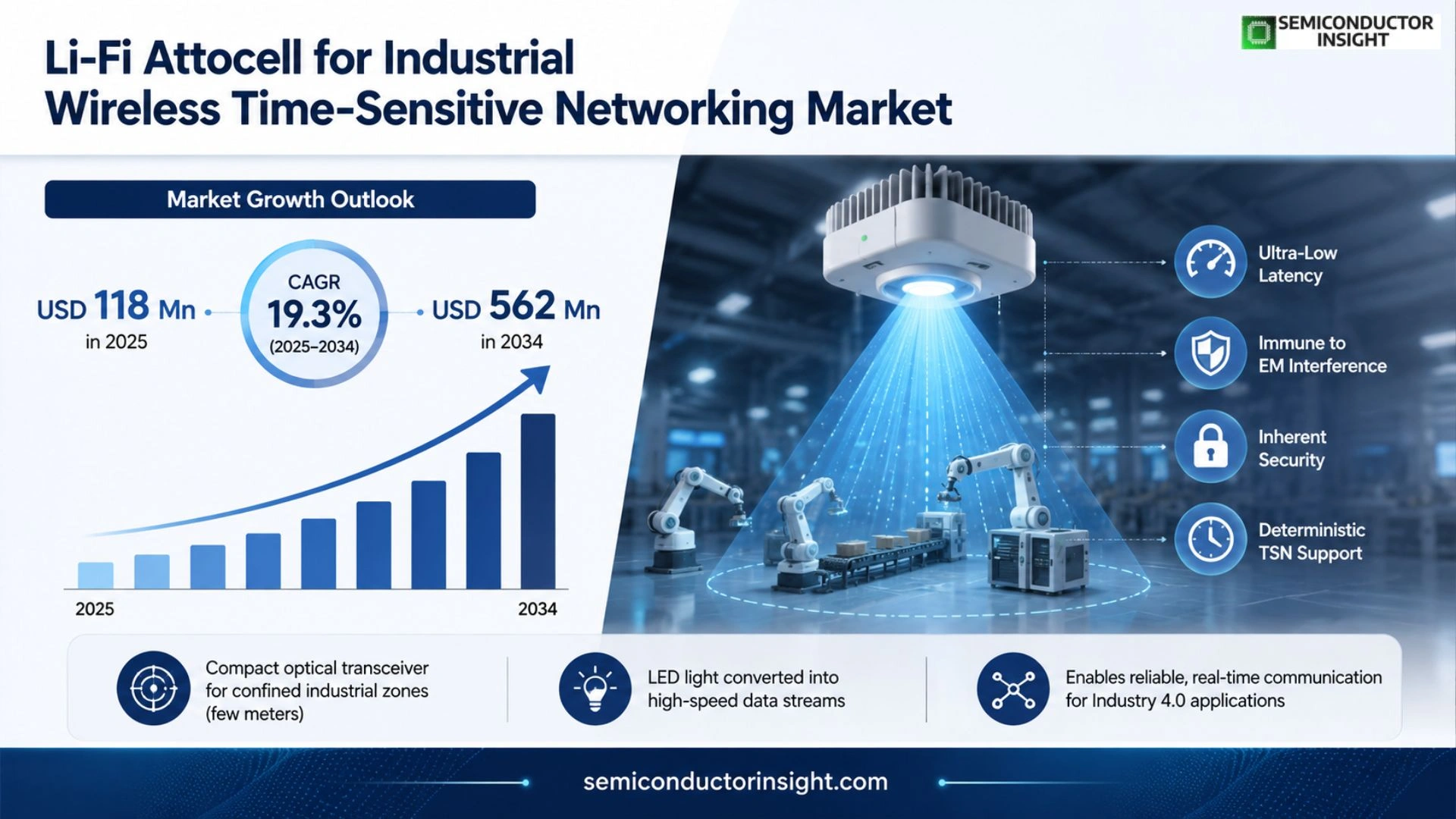
Global Li‑Fi attocell for industrial wireless time‑sensitive networking market size was valued at USD 118 million in 2025. The market is projected to grow from USD 118 million in 2025 to USD 562 million by 2034, exhibiting a CAGR of 19.3% during the forecast period.
Li‑Fi attocells are compact optical transceiver units that convert LED light into high‑speed data streams within confined zones,typically a few meters,enabling ultra‑low latency communication required by Time‑Sensitive Networking (TSN) protocols in industrial environments. By leveraging visible light spectrum, these devices provide deterministic bandwidth allocation, immunity to electromagnetic interference, and inherent security because light does not penetrate opaque barriers.
The market momentum stems from the rapid rollout of Industry 4.0 initiatives, where manufacturers demand sub‑millisecond synchronization for robotics, motion control, and real‑time monitoring. Furthermore, the convergence of Li‑Fi with TSN standards such as IEEE 802.1Qbv accelerates adoption across smart factories and logistics hubs. Leading innovators,including pureLiFi, Oledcomm, Signify (Philips Lighting), and Velmenni,are expanding product portfolios and forming strategic alliances with automation equipment vendors to embed attocell modules directly into production lines.
MARKET DRIVERS
Increasing Demand for Low‑Latency Connectivity
Li‑Fi attocell for industrial wireless time‑sensitive networking Market is being propelled by manufacturers who require sub‑millisecond response times for robotic control and real‑time monitoring. As production lines adopt edge‑computing architectures, the need for deterministic, interference‑free links has become a strategic priority.
Advancements in LED and Sensor Technologies
Recent breakthroughs in high‑efficiency LEDs and photodetectors have lowered power consumption while boosting data rates above 10 Gbps. These technical gains enable dense deployment of attocells across factory floors without compromising illumination standards.
➤ The integration of Li‑Fi attocell solutions can cut end‑to‑end latency by up to 30 % compared with traditional RF links, directly enhancing T‑SN performance.
Combined, these drivers are creating a compelling business case for early adopters seeking to future‑proof their operations against the growing complexity of Industry 4.0 ecosystems.
MARKET CHALLENGES
Technical Integration Barriers
Implementing Li‑Fi attocell networks alongside existing RF infrastructure requires careful layout planning to avoid line‑of‑sight obstructions. Many industrial sites still rely on legacy equipment that cannot directly interface with optical transceivers, leading to additional engineering overhead.
Other Challenges
Regulatory and Standardization
The absence of unified global standards for optical wireless communication in harsh industrial environments hampers cross‑vendor compatibility, prompting manufacturers to adopt proprietary solutions that may limit scalability.
MARKET RESTRAINTS
High Initial Capital Expenditure
Deploying a full‑scale Li‑Fi attocell architecture demands significant upfront investment in LED arrays, photodiode receivers, and specialized networking hardware. For small‑to‑mid‑size enterprises, the payback horizon can extend beyond typical budgeting cycles, restraining rapid market penetration.
MARKET OPPORTUNITIES
Emerging Smart Factory Initiatives
Governments and industry consortia are launching incentive programs to accelerate digital transformation in manufacturing. These initiatives create a fertile environment for Li‑Fi attocell solutions that promise ultra‑reliable, low‑latency links essential for real‑time control loops and predictive maintenance, positioning the market for robust growth over the next decade.
Li-Fi attocell for industrial wireless time-sensitive networking Market Trends
Industrial Adoption Accelerated by TSN Integration
Li‑Fi attocell for industrial wireless time‑sensitive networking Market is experiencing rapid uptake as manufacturers seek deterministic, sub‑millisecond communication across production lines. By embedding compact optical transceiver units directly into machinery, factories achieve virtually zero electromagnetic interference, a critical factor in environments dense with metal and high‑power equipment. The convergence with Time‑Sensitive Networking (TSN) standards such as IEEE 802.1Qbv ensures that bandwidth is allocated predictably, enabling synchronized motion control for robotic cells and real‑time sensor feedback. This technical alignment has become a cornerstone of Industry 4.0 roadmaps, prompting equipment vendors to qualify attocell modules as integral components rather than optional addons.
Other Trends
Regulatory and Standards Development
Standard‑setting bodies are formalizing safety and performance criteria specific to visible‑light communication in industrial zones. Recent drafts emphasize minimum illumination levels, optical eye‑safety thresholds, and coexistence protocols with existing wireless spectra. These guidelines reduce deployment risk and accelerate approval cycles for system integrators. Simultaneously, regional regulators are harmonizing certification processes, which lowers entry barriers for multinational manufacturers and encourages cross‑border technology transfer. The emerging consensus around compliance reinforces confidence among plant operators, fostering broader rollout across automated warehouses and assembly cells.
Emerging Applications in Smart Logistics
Beyond traditional manufacturing floors, Li‑Fi attocell for industrial wireless time‑sensitive networking Market is extending into logistics hubs where high‑speed data exchange governs conveyor coordination and inventory tracking. Visible‑light links installed on loading dock ceilings provide secure, line‑of‑sight channels that are immune to radio‑frequency congestion common in dense urban depots. This reliability supports automated guided vehicles (AGVs) that rely on precise timing to avoid collisions and optimize routing efficiency. As operators integrate these optical nodes with edge‑computing platforms, they achieve real‑time analytics that drive predictive maintenance and dynamic workload balancing, further demonstrating the technology’s versatility across the industrial spectrum.
COMPETITIVE LANDSCAPE
Key Industry Players
Li‑Fi Attocell for Industrial Wireless Time‑Sensitive Networking Market Overview
The competitive field is anchored by a handful of vertically integrated innovators that control both the optical transceiver technology and the software stack required for deterministic TSN performance. pureLiFi leads with its proprietary Light™ platform, delivering sub‑millisecond latency and seamless integration into industrial controllers. Oledcomm follows closely, leveraging its long‑standing expertise in visible‑light communication to ship pre‑certified attocell modules for robotic cells. Signify (Philips Lighting) adds scale through its global lighting infrastructure, embedding attocell chips into high‑efficacy LED fixtures that double as data nodes. Velmenni differentiates with modular plug‑and‑play designs that can be retrofitted onto existing factory lighting, enabling rapid rollout of compliant TSN zones. Collectively these four firms command the majority of revenue, benefit from strategic alliances with automation OEMs, and shape the emerging standards ecosystem.
Beyond the core quartet, a diverse set of niche and regionally strong players enrich the landscape. Fraunhofer HHI contributes cutting‑edge research prototypes that transition into commercial units for high‑precision logistics. Lumentum supplies high‑power VCSEL arrays that extend attocell range in large‑floor facilities. Acuity Brands offers lighting‑centric solutions for North American smart factories. Samsung and Huawei have entered the market with LED‑based data emitters targeting high‑volume consumer‑industrial crossover projects. Cisco and Nokia provide converged networking platforms that integrate Li‑Fi attocells with 5G backhaul for hybrid connectivity. Smaller specialists such as OAI Technologies, Lightwave Logic, and Pointr Labs focus on ultra‑secure, line‑of‑sight configurations for aerospace and defense manufacturing. This breadth of participants ensures competitive pricing, rapid innovation, and localized support across the global value chain.
List of Key Li‑Fi Attocell for Industrial Wireless Time‑Sensitive Networking Companies Profiled
- pureLiFi
- Oledcomm
- Signify (Philips Lighting)
- Velmenni
- Fraunhofer HHI
- Lumentum
- Acuity Brands
- Samsung
- Huawei
- Cisco
- Nokia
- OAI Technologies
- Lightwave Logic
- Pointr Labs
Segment Analysis:
| Segment Category | Sub-Segments | Key Insights |
| By Type |
|
LED‑based Attocells are favored for their ease of integration with existing lighting infrastructure, enabling seamless rollout in factories. • Their broad illumination pattern supports multiple concurrent links, fostering dense network topologies. • They benefit from mature LED manufacturing processes, delivering reliable performance under harsh industrial conditions. • The optical spectrum they occupy offers innate immunity to electromagnetic interference, a critical factor in electrically noisy environments. |
| By Application |
|
Robotics and Motion Control drives demand for deterministic latency, as precise synchronization is essential for coordinated robot arms. • Li‑Fi attocells provide sub‑millisecond response times that align with TSN requirements, ensuring smooth motion trajectories. • Their line‑of‑sight nature simplifies interference management in densely packed robotic cells. • Integration with edge controllers enables real‑time feedback loops, enhancing productivity and safety. |
| By End User |
|
Automotive Manufacturing benefits from the high‑security profile of light‑based links, protecting proprietary design data. • The deterministic bandwidth allocation supports synchronized conveyor systems and paint‑shop robotics. • Light‑only communication prevents crosstalk with high‑power welding equipment, preserving signal integrity. • Compact attocell modules can be embedded directly into overhead lighting, reducing cabling complexity. |
| By Deployment Scenario |
|
Fixed Installation in Production Lines leverages the stability of ceiling‑mounted attocells to create a reliable backbone for TSN. • Predictable placement ensures consistent line‑of‑sight and minimizes link interruptions. • Integration with existing lighting reduces additional infrastructure costs. • The static layout facilitates precise network planning and deterministic QoS enforcement across the entire line. |
| By Integration Layer |
|
Edge Computing Nodes act as convergence points where Li‑Fi attocell streams are processed and relayed to broader plant networks. • Their proximity to data sources reduces latency further than centralized servers. • They enable localized orchestration of TSN schedules, improving determinism for time‑critical tasks. • Tight coupling with industrial control software creates a seamless workflow from sensor acquisition to actuation. |
Regional Analysis: North America
The manufacturing sector in North America is a primary adopter of Li-Fi for time-sensitive networking. The need for reliable wireless connectivity in factories, warehouses, and production lines is driving investments in Li-Fi attocell solutions. This technology facilitates real-time monitoring of production processes, asset tracking, and seamless communication between machines and workers.
The healthcare industry in North America is exploring Li-Fi’s potential for secure and reliable data transmission in hospitals and research facilities. The technology’s ability to operate without radio frequency interference is particularly beneficial in environments with sensitive medical equipment. Applications include wireless access to patient records, real-time monitoring of vital signs, and secure communication between medical devices.
The logistics and supply chain sector in North America is leveraging Li-Fi attocells for enhanced tracking and management of goods. The technology enables real-time visibility of inventory, improves efficiency in warehouse operations, and facilitates seamless communication between transportation hubs. This contributes to a more agile and responsive supply chain.
Significant research and development efforts are underway in North America to further optimize Li-Fi technology for industrial applications. These initiatives focus on improving data transmission speeds, expanding coverage areas, and enhancing the integration of Li-Fi with existing industrial communication systems.
Europe
Europe presents a steady growth opportunity for the Li-Fi attocell for industrial wireless time-sensitive networking Market. The region’s strong emphasis on technological innovation and industrial automation creates a conducive environment for Li-Fi adoption across various sectors. While the pace of adoption might be slightly slower than in North America, the long-term potential remains significant, particularly in countries with advanced manufacturing industries like Germany and the UK. The focus on energy efficiency and data security further supports the appeal of Li-Fi technology. Regional regulations promoting digital transformation and smart manufacturing are also contributing to the market’s expansion.
Asia-Pacific
Asia-Pacific is expected to be the fastest-growing region for the Li-Fi attocell for industrial wireless time-sensitive networking Market. Rapid industrialization, particularly in countries like China and India, is driving substantial demand for high-performance wireless communication solutions. The growing adoption of Industry 4.0 initiatives and the increasing investment in smart factories are key factors fueling this growth. The region’s large manufacturing base and the need for real-time data transmission in various industrial processes create a significant market opportunity. Government support for technological advancements and the expanding digital infrastructure further contribute to the region’s growth trajectory.
South America
South America represents an emerging market for the Li-Fi attocell for industrial wireless time-sensitive networking Market. The region’s developing industrial sector and increasing focus on technological upgrades are creating new opportunities for Li-Fi adoption. While the market is currently smaller compared to North America and Asia-Pacific, the potential for growth is substantial, particularly in countries with strong manufacturing and mining industries. The need for reliable wireless connectivity in challenging industrial environments is a key driver for Li-Fi solutions.
Middle East & Africa
The Middle East & Africa region is anticipated to witness moderate growth in the Li-Fi attocell for industrial wireless time-sensitive networking Market. The increasing investments in industrial infrastructure and the growing adoption of smart manufacturing practices are driving demand for advanced wireless communication technologies. The region’s focus on digital transformation and the development of industrial hubs are creating new opportunities for Li-Fi deployment. While the market size is relatively smaller compared to other regions, the long-term outlook is positive, with potential for significant growth in the coming years.
Report Scope
This market research report provides a comprehensive analysis of the Li-Fi attocell for industrial wireless time-sensitive networking Market , covering the forecast period 2026–2034. It offers detailed insights into market dynamics, technological advancements, competitive landscape, and key trends shaping the industry.
Key focus areas of the report include:
- Market Overview: The report begins with an overview outlining its current market scenario, key growth indicators, and industry transformation drivers. It discusses macroeconomic factors, demand–supply balance, regulatory landscape, and the strategic role of semiconductors in powering advancements across industries such as automotive, telecommunications, consumer electronics, and industrial automation.
- Market Size & Forecast: Historical data and future projections for revenue, unit shipments, and market value across major regions and segments.
- Segmentation Analysis: Detailed breakdown by product type, technology, application, and end-user industry to identify high-growth segments and investment opportunities.
- Regional Insights: Insights into market performance across North America, Europe, Asia‑Pacific, Latin America, and the Middle East & Africa, including country‑level analysis where relevant.
- Competitive Landscape: Profiles of leading market participants, including their product offerings, R&D focus, manufacturing capacity, pricing strategies, and recent developments such as mergers, acquisitions, and partnerships.
- Technology Trends & Innovation: Assessment of emerging technologies, integration of AI/IoT, semiconductor design trends, fabrication techniques, and evolving industry standards.
- Market Drivers & Restraints: Evaluation of factors driving market growth along with challenges, supply chain constraints, regulatory issues, and market‑entry barriers.
- Stakeholder Insights: Insights for component suppliers, OEMs, system integrators, investors, and policymakers regarding the evolving ecosystem and strategic opportunities.
Primary and secondary research methods are employed, including interviews with industry experts, data from verified sources, and real‑time market intelligence to ensure the accuracy and reliability of the insights presented.
FREQUENTLY ASKED QUESTIONS:
What is the current market size of Li‑Fi attocell for industrial wireless time‑sensitive networking Market?
-> Li‑Fi attocell for industrial wireless time‑sensitive networking Market was valued at USD 118 million in 2025 and is expected to reach USD 562 million by 2034, reflecting a CAGR of 19.3%.
Which key companies operate in Li‑Fi attocell for industrial wireless time‑sensitive networking Market?
-> Key players include pureLiFi, Oledcomm, Signify (Philips Lighting), and Velmenni, among others.
What are the key growth drivers?
-> Key growth drivers include Industry 4.0 adoption, demand for sub‑millisecond synchronization in robotics and motion control, and the convergence of Li‑Fi with TSN standards such as IEEE 802.1Qbv.
Which region dominates the market?
-> The reference data does not specify a dominant region for this market.
What are the emerging trends?
-> Emerging trends include integration of Li‑Fi attocells with TSN protocols, embedding attocell modules directly into industrial equipment, and strategic alliances between lighting manufacturers and automation vendors.

Get Sample Report PDF for Exclusive Insights
Report Sample Includes
- Table of Contents
- List of Tables & Figures
- Charts, Research Methodology, and more...
 Download Sample Report PDF