LED Cinema Screen Market Insights
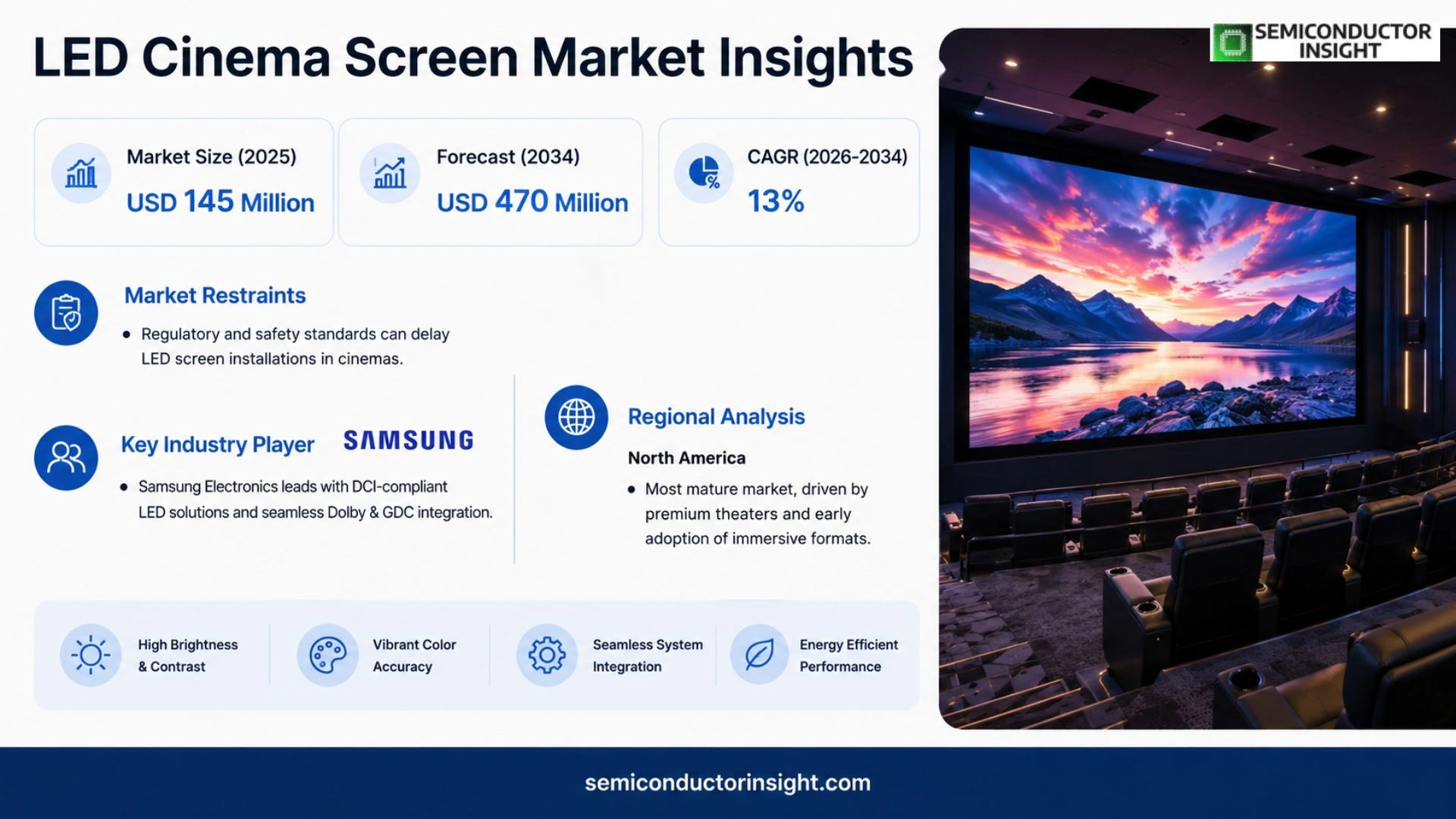
LED Cinema Screen market size was valued at USD 145 million in 2025. The market expands from USD 145 million in 2025 to an estimated USD 470 million by 2034, reflecting an implied compound annual growth rate of roughly 13 % over the forecast period.
An LED cinema screen functions as a direct‑view display panel that replaces traditional projector systems in large‑screen venues. By employing high‑brightness LEDs, it delivers a wider color gamut, deeper blacks and uniform luminance, which mitigates ambient‑light limitations common with conventional screens.
The adoption curve accelerates because exhibitors seek premium experiences that can host live events, sports or corporate presentations alongside movies, thereby improving venue utilization and ancillary revenue streams. However, high upfront capital outlay, structural retrofits and thermal management requirements continue to limit broader rollout, so suppliers with proven service networks and scalable deployment models tend to secure flagship projects.
MARKET DRIVERS
Rising Demand for Immersive Viewing Experiences
The shift from traditional projection to full‑frame LED panels is reshaping cinema architecture. Operators report that patrons are willing to pay a premium for brighter colors, deeper contrast, and seamless visual continuity across the entire screen surface. This willingness translates into higher per‑ticket revenue, encouraging chains to allocate capital toward LED upgrades.
Technological Advancements Reducing Lifecycle Costs
Recent breakthroughs in modular LED modules and improved heat‑dissipation designs have extended panel longevity to 10‑12 years, narrowing the gap between initial outlay and long‑term return. Maintenance cycles have become less frequent, allowing theatres to plan cash flows with greater certainty.
➤ Operators that adopt LED technology now are positioning themselves to capture premium‑pricing segments as audience expectations evolve.
In parallel, content creators are experimenting with high‑dynamic‑range (HDR) and 12‑bit color grading, which can only be reproduced faithfully on LED displays. The synergy between production quality and exhibition capability creates a virtuous cycle that fuels further investment in LED Cinema Screen Market.
MARKET CHALLENGES
High Capital Requirements and Financing Constraints
Deploying a full‑scale LED wall often demands an upfront spend that exceeds the budget of independent venues. Even when financing options exist, lenders scrutinize cash‑flow projections closely, delaying rollout schedules.
Other Challenges
Content Compatibility
A significant portion of legacy film libraries were mastered for xenon projection. Converting these titles to LED‑optimized formats incurs additional costs, and the lack of a standardized conversion pipeline hampers rapid adoption.
MARKET RESTRAINTS
Regulatory and Safety Standards
LED installations must comply with stringent fire‑rating certifications and electromagnetic interference limits, especially in older multiplexes retrofitted with new panels. The approval process can add months to project timelines, discouraging some operators from committing to large‑scale upgrades.
MARKET OPPORTUNITIES
Expansion into Tier‑2 and Tier‑3 Urban Centers
Emerging economies are witnessing a surge in cinema construction beyond metropolitan hubs. These new venues are often built from the ground up, allowing developers to embed LED technology as a baseline rather than a retrofit. Early entrants can secure long‑term service contracts and establish brand differentiation in these rapidly growing markets.
LED Cinema Screen Market Trends
Premium Auditorium Adoption Accelerates
The shift from traditional projection to direct‑view LED panels is reshaping the high‑end cinema segment. In 2025, 811 units were installed worldwide at an average price of US$196 K, delivering a revenue spike that lifted the market to roughly US$145 million. Operators cite the deeper blacks, uniform brightness, and resilience to ambient light as decisive factors for flagship auditoria. Because the visual upgrade dovetails with premium sound systems and recliner seating, exhibitors can command higher ticket tiers and ancillary income from premium‑priced concessions. The strategic implication is clear: cinema chains that deploy LED screens early acquire a branding advantage that differentiates their premium halls from commodity competitors, thereby strengthening loyalty among experience‑oriented patrons.
Other Trends
Multipurpose Content Platforms
Beyond feature films, LED screens are being leveraged as versatile content hubs. The direct‑view architecture supports live‑streamed sports, e‑sports tournaments, and corporate events without compromising image quality. This functionality elevates utilization rates during off‑peak hours, turning previously idle screen time into revenue‑generating slots for rentals or pay‑per‑view streams. The operational playbook is maturing as media servers, calibration tools, and secure playback workflows become standardized, reducing the perceived risk of expanding the content mix. For venue owners, the ability to diversify programming mitigates the volatility of box‑office receipts and opens cross‑industry partnership opportunities.
Supply‑Chain Maturation and Cost Pressures
Up‑front capital outlays, structural retrofits, and thermal management have limited broader adoption. However, manufacturers reporting gross margins of 25‑35 % are scaling production capacities, which narrows price differentials with high‑lumens projector stacks. Suppliers with established service networks are winning flagship contracts, while incremental improvements in LED packaging,such as the transition from SMD to MicroLED modules,promise longer lifespans and lower total‑ownership costs. As deployment models become more repeatable, the barrier to entry for mid‑size cinema chains diminishes, signaling a gradual transition from niche premium showcases toward a more common choice for new builds and major refurbishments.
COMPETITIVE LANDSCAPE
Key Industry Players
LED Cinema Screen Market – Competitive Overview
Samsung Electronics dominates the top‑tier segment by coupling its high‑brightness LED modules with a robust cinema‑server ecosystem that satisfies DCI compliance and offers seamless Dolby and GDC integration. The company leverages a global service network to guarantee rapid installation and after‑sales support, a capability that translates into a disproportionate share of flagship cinema projects in North America, Europe and premium venues in Asia. LG Electronics follows closely, differentiating itself through a modular cabinet architecture that reduces floor‑space requirements and accelerates upgrade cycles for multiplex operators seeking to retrofit existing auditoria without extensive civil works.
Beyond the two giants, a cluster of specialist manufacturers fuels competition in niche and emerging markets. Shenzhen Timewaying and Shenzhen Unilumin Technology have built reputations for delivering cost‑effective MicroLED and COB solutions that appeal to regional chains prioritising rapid rollout over ultra‑high resolution. Leyard Optoelectronic’s strength lies in its integrated wall systems that incorporate calibration and monitoring tools directly into the panel, simplifying the operational playbook for independent theatres. Meanwhile, AET, Shanghai Muge Technology, Nanjing Lopu Technology, BOE Technology Group, QSTECH and several emerging Chinese firms focus on high‑density pixel pitches for 8K displays, positioning themselves as suppliers for luxury flagship sites and new‑build cinemas where brand differentiation is paramount.
List of Key LED Cinema Screen Companies Profiled
- Samsung Electronics
- LG Electronics
- Sony
- Leyard Optoelectronic
- Shenzhen Timewaying
- Shenzhen Unilumin Technology
- AET
- Shanghai Muge Technology
- Nanjing Lopu Technology
- BOE Technology Group
- QSTECH
- Sharp Electronics
- Panasonic Corporation
- Christie Digital Systems
- Barco NV
Segment Analysis:
| Segment Category | Sub-Segments | Key Insights |
| By Type |
|
8K High‑Resolution drives premium cinema experiences through unparalleled visual fidelity.
|
| By Application |
|
Premium Cinema Auditoria remain the anchor for LED screen adoption.
|
| By End User |
|
Commercial Cinema Chains drive market momentum through scale and brand influence.
|
| By System Architecture |
|
Modular Cabinet‑based architecture is favored for its flexibility.
|
| By LED Packaging Technology |
|
COB Technology delivers superior uniformity and brightness.
|
Regional Analysis: LED Cinema Screen Market
North America
Studios are delivering HDR‑rich productions that exploit the high peak brightness of LED panels, encouraging exhibitors to align screen technology with content strategy. This synergy fuels a virtuous cycle: as more premium titles arrive, theatres justify further capital investment, reinforcing the region’s trajectory in LED Cinema Screen Market.
Proximity to key component manufacturers in the United States and Mexico reduces lead times for LED modules, enabling quicker project execution. The localized supply chain also cushions the region from trans‑oceanic disruptions that have plagued other markets, sustaining steady rollout momentum.
Energy‑efficiency standards and local building codes increasingly favour low‑power, high‑luminosity solutions. LED screens meet these criteria, allowing operators to align compliance with commercial advantage, a factor that subtly reshapes procurement decisions across the continent.
Venture capital and private‑equity funds targeting experiential entertainment have shown a pronounced appetite for LED‑based cinema upgrades. Their involvement accelerates adoption cycles, offering smaller chains access to financing that would otherwise be out of reach.
Europe
European exhibitors are leveraging a tradition of collaborative standards bodies to harmonise screen specifications across borders. The region’s emphasis on sustainability drives interest in LED technology, which promises lower energy consumption relative to laser projection. Moreover, a growing boutique cinema segment in cities such as Paris and Berlin is experimenting with modular LED panels to create flexible auditoria that can host both mainstream releases and niche festivals, positioning Europe as a laboratory for adaptive venue concepts within LED Cinema Screen Market.
Asia‑Pacific
In Asia‑Pacific, rapid urbanisation and rising middle‑class disposable income generate demand for premium cinematic experiences. Markets like China and South Korea are witnessing flagship multiplexes install ultra‑large LED walls to differentiate themselves from home‑streaming alternatives. While cost sensitivities remain high in emerging economies, joint‑venture models that pool resources across regional partners are allowing smaller operators to test LED installations without committing to full‑scale conversion.
South America
South American chains are confronting legacy infrastructure challenges, yet they view LED cinema screens as a lever to revitalize attendance amidst competitive pressure from streaming platforms. Brazil’s recent tax incentives for energy‑efficient cinema upgrades reduce operational expenditure, making LED technology an attractive proposition for owners seeking to improve profitability while enhancing visual quality.
Middle East & Africa
The Middle East & Africa region is distinguished by a concentration of high‑spending leisure venues in affluent urban centres. Luxury multiplex operators in Dubai and Johannesburg are adopting LED screens to meet the expectations of a discerning clientele accustomed to cutting‑edge visual displays. In parallel, emerging markets in Africa are beginning to pilot LED installations in partnership with international equipment providers, signalling the early stages of market entry for LED Cinema Screen Market.
Report Scope
This market research report provides a comprehensive analysis of the LED Cinema Screen Market , covering the forecast period 2026–2034. It offers detailed insights into market dynamics, technological advancements, competitive landscape, and key trends shaping the industry.
Key focus areas of the report include:
- Market Overview: The report begins with an overview outlining its current market scenario, key growth indicators, and industry transformation drivers. It discusses macroeconomic factors, demand–supply balance, regulatory landscape, and the strategic role of semiconductors in powering advancements across industries such as automotive, telecommunications, consumer electronics, and industrial automation.
- Market Size & Forecast: Historical data and future projections for revenue, unit shipments, and market value across major regions and segments.
- Segmentation Analysis: Detailed breakdown by product type, technology, application, and end-user industry to identify high-growth segments and investment opportunities.
- Regional Insights: Insights into market performance across North America, Europe, Asia-Pacific, Latin America, and the Middle East & Africa, including country-level analysis where relevant.
- Competitive Landscape: Profiles of leading market participants, including their product offerings, R&D focus, manufacturing capacity, pricing strategies, and recent developments such as mergers, acquisitions, and partnerships.
- Technology Trends & Innovation: Assessment of emerging technologies, integration of AI/IoT, semiconductor design trends, fabrication techniques, and evolving industry standards.
- Market Drivers & Restraints: Evaluation of factors driving market growth along with challenges, supply chain constraints, regulatory issues, and market-entry barriers.
- Stakeholder Insights: Insights for component suppliers, OEMs, system integrators, investors, and policymakers regarding the evolving ecosystem and strategic opportunities.
Primary and secondary research methods are employed, including interviews with industry experts, data from verified sources, and real-time market intelligence to ensure the accuracy and reliability of the insights presented.
FREQUENTLY ASKED QUESTIONS:
What is the current market size of LED Cinema Screen Market?
-> LED Cinema Screen market expands from USD 145 million in 2025 to an estimated USD 470 million by 2034
Which key companies operate in LED Cinema Screen Market?
-> Key players include Samsung Electronics, LG Electronics, Sony, Shenzhen Timewaying, Leyard Optoelectronic, Shenzhen Unilumin Technology, AET, Shanghai Muge Technology, Nanjing Lopu Technology, BOE Technology Group, QSTECH.
What are the key growth drivers?
-> Key growth drivers include higher brightness, wider color gamut, stronger contrast, broader viewing angle, premium auditorium experience, and the ability to support alternative content such as live events, sports, gaming, and corporate sessions.
Which region dominates the market?
-> Asia-Pacific dominates the market, driven by strong adoption in China, Japan, and South Korea, while Europe and North America show steady growth.
What are the emerging trends?
-> Emerging trends include integration of immersive sound systems, multi‑purpose content platforms, modular cabinet‑based architectures, and increased deployment in premium new‑build and refurbished cinema venues.

Get Sample Report PDF for Exclusive Insights
Report Sample Includes
- Table of Contents
- List of Tables & Figures
- Charts, Research Methodology, and more...
 Download Sample Report PDF