Market Insights
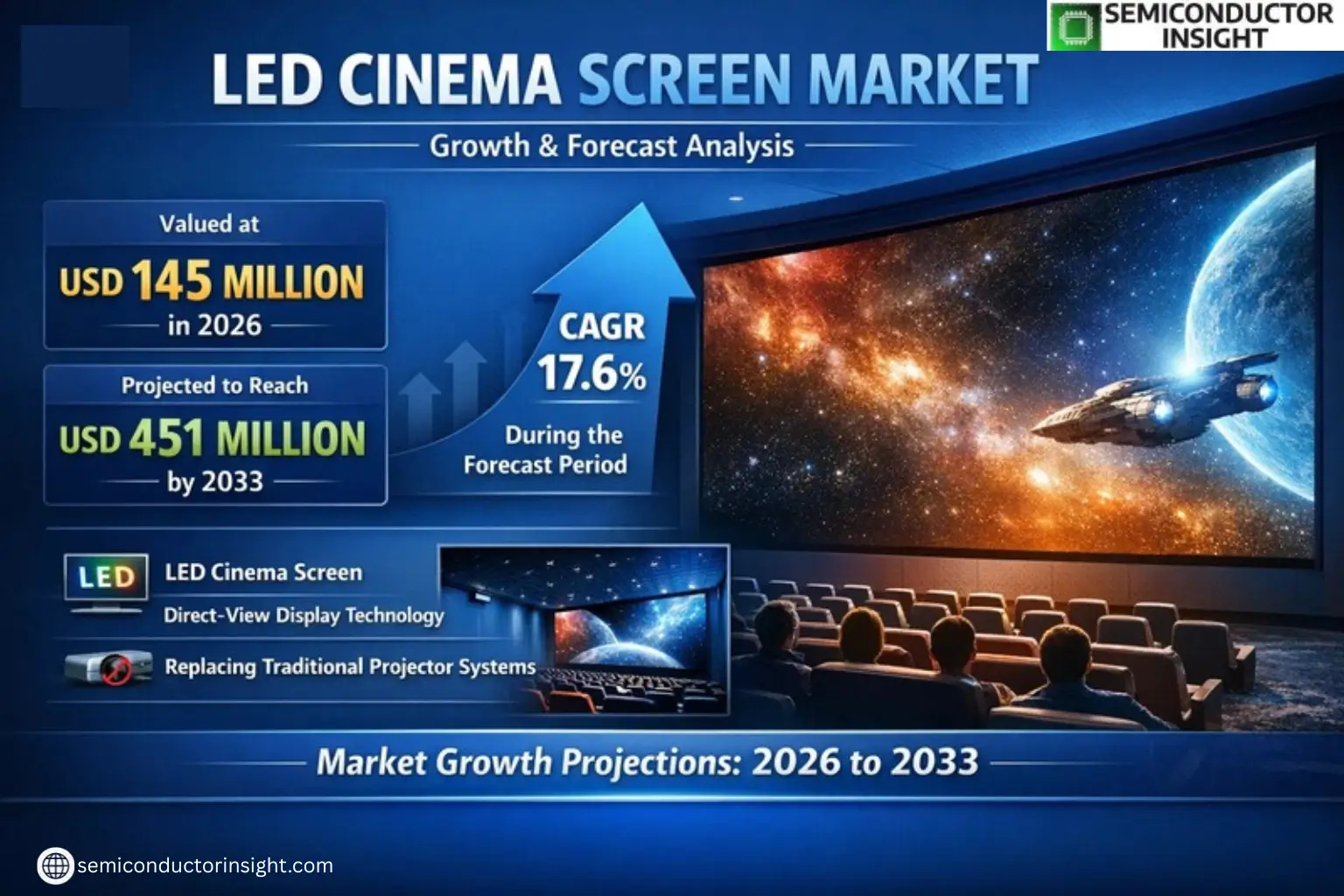
Global LED Cinema Screen Market was valued at USD 145 million in 2026 and is projected to reach USD 451 million by 2033, exhibiting a CAGR of 17.6% during the forecast period.
An LED cinema screen is a direct-view display technology designed to replace traditional projector-based systems in theaters. These screens utilize advanced LED panels to deliver superior brightness, contrast, and color accuracy while eliminating the need for external projection equipment. The technology enables higher dynamic range (HDR) performance and wider viewing angles compared to conventional solutions.
The market growth is driven by increasing demand for premium cinematic experiences, technological advancements in micro-LED displays, and the rising adoption of digital cinema formats. However, high installation costs and infrastructure requirements remain key challenges for widespread adoption. Major industry players including Samsung Electronics, LG Electronics, and Sony are investing heavily in R&D to develop more cost-effective solutions while maintaining DCI (Digital Cinema Initiatives) compliance standards for theatrical exhibition.
MARKET DRIVERS
Increasing Demand for Premium Cinematic Experiences
The rising consumer preference for high-quality visual experiences is accelerating the adoption of LED cinema screens globally. With superior brightness, contrast ratios, and color accuracy compared to traditional projection systems, LED displays are setting new benchmarks in the cinema industry. Major theater chains are upgrading to LED screens to attract audiences seeking immersive viewing experiences.
Technological Advancements in Display Solutions
Recent developments in microLED and OLED technologies have significantly improved the performance and affordability of LED cinema screens. These innovations enable finer pixel pitches, higher resolutions, and better energy efficiency, making them viable for large-scale installations. The average lifespan of modern LED screens has also increased to over 60,000 hours, reducing long-term operational costs for theater owners.
Government initiatives promoting digital infrastructure in emerging economies are further supporting market expansion, with several countries offering incentives for cinema modernization programs.
MARKET CHALLENGES
High Initial Investment Costs
The upfront capital required for LED cinema screen installations remains a significant barrier, with large-format displays costing 3-5 times more than traditional projection systems. This financial hurdle is particularly challenging for small and independent theater operators.
Other Challenges
Content Compatibility Issues
Many existing digital cinema packages (DCPs) require format adjustments to align with LED display specifications, creating additional costs and workflow complexities for content distributors.
MARKET RESTRAINTS
Limited Adoption in Small-Scale Theaters
Approximately 65% of single-screen theaters worldwide still rely on conventional projection systems due to budget constraints and space limitations. The high maintenance requirements of LED screens also deter smaller venues with limited technical staff.
MARKET OPPORTUNITIES
Expansion in Emerging Markets
Rapid urbanization and growing middle-class populations in Asia Pacific and Latin America present significant growth potential. Theater chains in these regions are increasingly adopting LED cinema screens to differentiate their offerings and capture premium ticket pricing opportunities.
LED Cinema Screen Market Trends
Premium Visual Experience Driving Adoption
LED Cinema Screen Market is experiencing rapid growth, with the global market projected to reach USD 451 million by 2033 at a 17.6% CAGR. This expansion stems from exhibitors upgrading to LED technology for its superior visual performance including deeper blacks, higher contrast ratios, and better brightness uniformity compared to traditional projection systems. Major cinema chains are adopting LED screens as premium auditorium differentiators, particularly in flagship locations.
Other Trends
Expanding Application Beyond Traditional Cinema
LED cinema screens are increasingly being utilized for alternative content such as live sports broadcasts, e-sports competitions, and corporate events. This multi-purpose capability improves venue utilization rates and creates additional revenue streams beyond traditional film screenings, with some venues reporting up to 30% increased occupancy rates when incorporating event programming.
Technological Advancements and Market Segmentation
The market is seeing segmentation by resolution (4K currently dominates with 65% share), system architecture (modular cabinets lead with 72% adoption), and LED packaging technology (SMD holds 58% market share). Recent developments in COB and MicroLED technologies are beginning to impact the competitive landscape, offering improved pixel density and reliability for cinema applications.
Regional Growth Patterns
Asia-Pacific currently leads in LED Cinema Screen adoption (42% market share), followed by North America (29%) and Europe (21%). China’s domestic manufacturers have gained significant market presence, accounting for approximately 38% of global unit shipments in 2026 through competitive pricing and localized service networks.
Challenges in Market Expansion
Despite strong growth projections, the LED Cinema Screen market faces barriers including high capital costs (averaging USD 196,000 per unit), complex installation requirements, and the need for specialized maintenance. These factors currently limit broader adoption beyond premium auditorium installations, though industry standardization efforts are gradually reducing deployment friction.
COMPETITIVE LANDSCAPE
Key Industry Players
LED Cinema Screen Market Dominated by Display Technology Giants and Chinese Manufacturers
Samsung Electronics and LG Electronics currently lead the LED Cinema Screen Market through their advanced display technologies and established cinema partnerships. Both companies benefit from vertical integration across display components and have deployed premium LED cinema solutions in major theater chains globally. The market exhibits an oligopolistic structure in premium segments, with these two Korean manufacturers accounting for over 40% of 2026’s unit sales. Secondary competition comes from specialized Chinese manufacturers who offer more cost-competitive solutions for mid-tier cinema deployments.
Niche players like Sony, Leyard Optoelectronic, and BOE Technology Group are carving out significant positions through technological differentiation. Sony leverages its cinema heritage with high-end reference-grade systems, while Chinese manufacturers compete on rapid deployment capabilities and modular designs. Emerging competitors like Shenzhen Timewaying and Shanghai Muge Technology are gaining traction in Asia-Pacific markets through aggressive pricing and localized service networks.
List of Key LED Cinema Screen Companies Profiled
- Samsung Electronics
- LG Electronics
- Sony
- Shenzhen Timewaying
- Leyard Optoelectronic
- Shenzhen Unilumin Technology
- AET
- Shanghai Muge Technology
- Nanjing Lopu Technology
- BOE Technology Group
- QSTECH
- Barco
- NEC Display Solutions
- Christie Digital Systems
- SiliconCore Technology
Segment Analysis:
| Segment Category | Sub-Segments | Key Insights |
| By Type |
|
4K Resolution dominates as the industry standard for premium cinema experiences:
|
| By Application |
|
Commercial Cinemas remain the primary adoption driver:
|
| By End User |
|
Cinema Chains lead adoption due to several strategic factors:
|
| By Technology |
|
SMD LED represents the most mature cinema-grade solution:
|
| By Installation Type |
|
New Installations dominate the current market:
|
Regional Analysis: LED Cinema Screen Market
China accounts for over 40% of Asia-Pacific’s LED cinema screen installations, with aggressive expansion plans from domestic exhibitors. The country’s “Smart Cinema” initiatives prioritize high-brightness LED displays that enhance 3D and HDR content.
Japanese manufacturers lead in developing high-resolution LED cinema screens with superior contrast ratios. The market benefits from close collaboration between electronics giants and major theater chains to refine display technologies.
India presents the fastest growth opportunities as multiplex chains upgrade premium screens. The market is transitioning from traditional projection to LED solutions in metro cities, though cost remains a barrier for nationwide adoption.
Thailand, Indonesia, and Malaysia are witnessing increased LED screen deployments in luxury cinemas. Regional exhibitors leverage LED technology to differentiate offerings and justify premium ticket pricing in competitive urban markets.
North America
The North American LED Cinema Screen Market demonstrates steady adoption focused on premium large format auditoriums. Major theater chains are implementing LED walls primarily in flagship locations across major cities, prioritizing visual quality over rapid expansion. The region benefits from strong partnerships between display manufacturers and Hollywood studios to optimize content for direct-view LED technology. While conversion costs remain high compared to laser projection, the superior brightness and contrast drive adoption for special event screenings and 3D presentations. Canada shows particular interest in LED screens for immersive cinema formats in urban entertainment districts.
Europe
European markets exhibit cautious but growing interest in LED cinema screens, with adoption concentrated in Western Europe. The UK, Germany, and France lead deployments, focusing on high-end multiplex locations and independent premium cinemas. Strict energy regulations push manufacturers to develop more efficient LED cinema solutions in the region. A strong arthouse cinema culture creates demand for smaller-format LED screens with superior color accuracy. Eastern Europe shows potential but lags due to higher infrastructure costs and preference for traditional projection systems in most markets.
Middle East & Africa
The Middle East represents a high-growth niche market for LED cinema screens, particularly in Gulf countries where luxury cinemas dominate. UAE and Saudi Arabia lead regional adoption with theaters incorporating LED walls as centerpieces of premium entertainment complexes. Africa shows minimal adoption outside South Africa, though some urban multiplexes in Nigeria and Kenya are beginning to explore LED technology for differentiation. The region faces challenges from high import costs and lack of local technical support infrastructure.
South America
South America’s LED Cinema Screen Market remains in early stages, with Brazil and Argentina showing the most activity. Economic volatility limits large-scale deployments, though major cities feature isolated installations in upscale theaters. The region shows potential as manufacturers develop more cost-effective solutions tailored for developing markets. Chile and Colombia demonstrate growing interest as part of multiplex renovation projects targeting affluent urban demographics.
Report Scope
This market research report provides a comprehensive analysis of the LED Cinema Screen Market, covering the forecast period 2026–2033. It offers detailed insights into market dynamics, technological advancements, competitive landscape, and key trends shaping the industry.
Key focus areas of the report include:
- Market Overview: The report begins with an overview outlining its current market scenario, key growth indicators, and industry transformation drivers. It discusses macroeconomic factors, demand–supply balance, regulatory landscape, and the strategic role of semiconductors in powering advancements across industries such as automotive, telecommunications, consumer electronics, and industrial automation.
- Market Size & Forecast: Historical data and future projections for revenue, unit shipments, and market value across major regions and segments.
- Segmentation Analysis: Detailed breakdown by product type, technology, application, and end-user industry to identify high-growth segments and investment opportunities.
- Regional Insights: Insights into market performance across North America, Europe, Asia-Pacific, Latin America, and the Middle East & Africa, including country-level analysis where relevant.
- Competitive Landscape: Profiles of leading market participants, including their product offerings, R&D focus, manufacturing capacity, pricing strategies, and recent developments such as mergers, acquisitions, and partnerships.
- Technology Trends & Innovation: Assessment of emerging technologies, integration of AI/IoT, semiconductor design trends, fabrication techniques, and evolving industry standards.
- Market Drivers & Restraints: Evaluation of factors driving market growth along with challenges, supply chain constraints, regulatory issues, and market-entry barriers.
- Stakeholder Insights: Insights for component suppliers, OEMs, system integrators, investors, and policymakers regarding the evolving ecosystem and strategic opportunities.
Primary and secondary research methods are employed, including interviews with industry experts, data from verified sources, and real-time market intelligence to ensure the accuracy and reliability of the insights presented.
FREQUENTLY ASKED QUESTIONS:
What is the current market size of LED Cinema Screen Market?
-> LED Cinema Screen Market was valued at USD 145 million in 2026 and is projected to reach USD 451 million by 2033, exhibiting a CAGR of 17.6% during the forecast period.
What is the CAGR of the LED Cinema Screen Market?
-> The LED Cinema Screen Market is expected to grow at a CAGR of 17.6% during the forecast period 2026-2033.
Which key companies operate in LED Cinema Screen Market?
-> Key players include Samsung Electronics, LG Electronics, Sony, Shenzhen Timewaying, Leyard Optoelectronic, Shenzhen Unilumin Technology, AET, Shanghai Muge Technology, Nanjing Lopu Technology, BOE Technology Group, and QSTECH.
What are the key growth drivers?
-> Key growth drivers include superior image quality over traditional projection, multi-purpose content capabilities, premium cinema experiences, and increasing adoption of digital cinema technologies.
Which application segment dominates the market?
-> The Cinema segment dominates the market, accounting for the largest share of LED Cinema Screen deployments.
What are the emerging trends?
-> Emerging trends include adoption of higher resolution screens (4K/8K), integration with immersive sound systems, and use of advanced LED packaging technologies (COB/IMD).

Get Sample Report PDF for Exclusive Insights
Report Sample Includes
- Table of Contents
- List of Tables & Figures
- Charts, Research Methodology, and more...
 Download Sample Report PDF