Integrated Cockpit Controller Market Insights
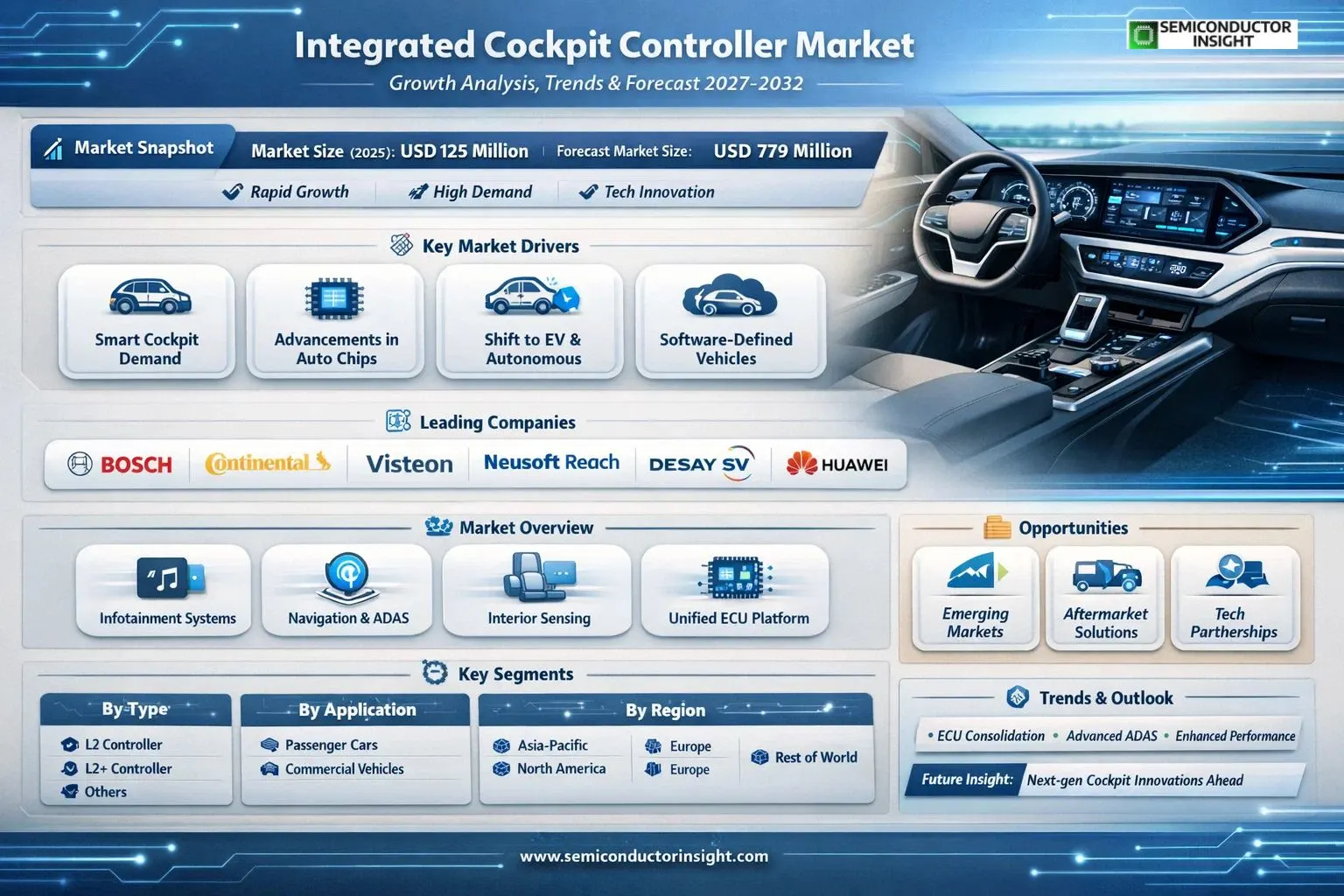
Global Integrated Cockpit Controller market size was valued at USD 125 million in 2025. The market is projected to reach USD 779 million by 2032, exhibiting a CAGR of 30.6% during the forecast period.
Integrated Cockpit Controllers represent a compelling alternative, replacing multiple electronic control units (ECUs) with a single, powerful compute platform capable of supporting audio, infotainment, connectivity, navigation, interior sensing, and real-time vision. These controllers not only consolidate ECUs but also enable higher levels of performance and scalability to meet expanding requirements for memory, graphics, and computational speed.
The market is experiencing rapid growth due to surging demand for intelligent cockpits, advancements in automotive semiconductors, and the transition to software-defined vehicles. For example, Integrated Cockpit Controllers can support multiple tuner module variations to meet specific requirements of individual countries and regions, reducing complexity and cost while supporting global operations. Key players including Bosch, Continental, Visteon, Neusoft Reach, Desay SV, HUAWEI, HARMAN, Aptiv, and Beijing Jingwei Hirain Technologies hold significant market shares with diverse portfolios driving innovation.
MARKET DRIVERS
Advancements in Vehicle Connectivity
Integrated Cockpit Controller Market is experiencing robust growth due to the increasing integration of advanced driver-assistance systems (ADAS) and infotainment features in modern vehicles. Automakers are prioritizing centralized controllers to manage multiple displays, navigation, and connectivity modules efficiently, reducing wiring complexity and enhancing performance. This trend is evident as global vehicle production incorporates more high-end cockpits, with projections indicating a market expansion at a CAGR of over 12% through 2030.
Electrification and Autonomous Driving Trends
The shift toward electric vehicles (EVs) and Level 3+ autonomy is a key driver, necessitating powerful integrated cockpit controllers capable of handling real-time data from sensors and cameras. These systems consolidate functions like digital clusters, head-up displays, and voice assistants, improving user experience. Major OEMs have adopted such controllers, boosting demand in Integrated Cockpit Controller Market.
➤ EV adoption has surged, with over 14 million units sold globally in 2023, amplifying the need for sophisticated cockpit integration.
Consumer preference for seamless digital interfaces further accelerates adoption, as integrated solutions lower costs by up to 20% compared to distributed architectures.
MARKET CHALLENGES
Supply Chain Disruptions
Persistent semiconductor shortages continue to hinder production in Integrated Cockpit Controller Market, delaying new vehicle launches and increasing costs for Tier 1 suppliers. Despite recovery efforts, lead times for high-performance chips remain extended, impacting scalability.
Other Challenges
Cybersecurity Vulnerabilities
Rising connected features expose cockpit controllers to hacking risks, requiring stringent compliance with standards like ISO/SAE 21434. This adds development time and expenses.
Integration Complexity
Merging legacy and new systems poses technical hurdles, often leading to compatibility issues and higher validation efforts for OEMs.
MARKET RESTRAINTS
Regulatory and Safety Standards
Stringent automotive regulations, including UNECE and FMVSS requirements, impose rigorous testing on Integrated Cockpit Controller Market components, slowing innovation timelines. Functional safety certifications like ASIL-D compliance demand extensive resources, restraining smaller players.High initial investment for R&D in high-compute platforms limits market entry, particularly in price-sensitive segments like mass-market sedans.Legacy vehicle fleets with distributed electronics resist full cockpit integration, capping retrofit potential and maintaining fragmented architectures.
Economic volatility
in regions like Europe further restrains growth, with OEMs deferring upgrades amid inflation pressures.
MARKET OPPORTUNITIES
Expansion in Emerging Markets
Integrated Cockpit Controller Market holds significant potential in Asia-Pacific and Latin America, where rising middle-class incomes drive premium vehicle demand. Local manufacturers are investing in next-gen cockpits to compete globally.Aftermarket solutions for upgrading older vehicles present lucrative avenues, with modular controllers enabling over-the-air updates and feature enhancements.Partnerships between tech giants and automakers for AI-driven interfaces open new revenue streams, projected to capture 25% market share by 2028.
Sustainability initiatives
favor efficient controllers that reduce vehicle weight and power consumption, aligning with global net-zero goals.
Integrated Cockpit Controller Market Trends
Shift Toward ECU Consolidation
Integrated Cockpit Controller Market is experiencing a significant shift as automotive manufacturers move away from multiple electronic control units toward a unified compute platform. This integration replaces disparate ECUs handling audio, infotainment, connectivity, navigation, interior sensing, and real-time vision with a single powerful controller. Such consolidation streamlines vehicle architecture, reduces wiring complexity, and lowers overall system weight, aligning with industry demands for efficiency and cost savings.
Other Trends
Enhanced Performance and Scalability
Integrated Cockpit Controllers deliver superior performance by supporting expanded memory, advanced graphics, and higher computational speeds. They enable scalability to accommodate evolving vehicle requirements, including support for multiple tuner module variations tailored to regional standards. This flexibility allows original equipment manufacturers to maintain a standardized main computing platform across global markets, minimizing development costs and complexity while ensuring compliance with diverse regulatory environments.
Growth in Advanced Driver Assistance Integration
Another prominent trend involves the integration of L2 and L2+ controllers within the Integrated Cockpit Controller ecosystem, primarily for passenger cars, with increasing adoption in commercial vehicles. Leading manufacturers such as Bosch, Continental, Visteon, Neusoft Reach, Desay SV, HUAWEI, HARMAN, and Aptiv are driving innovation through consolidated platforms that enhance cockpit functionalities alongside driver assistance features. Regional dynamics show strong momentum in Asia, particularly China, alongside established markets in North America and Europe, as suppliers address challenges like supply chain obstacles and competitive pressures. This evolution supports broader industry strategies for software-defined vehicles, fostering opportunities in connectivity and sensing technologies.
COMPETITIVE LANDSCAPE
Key Industry Players
Leading Manufacturers Shaping Integrated Cockpit Controller Market
Integrated Cockpit Controller Market is characterized by a moderately concentrated structure dominated by established automotive Tier 1 suppliers and emerging technology firms. Leading players such as Bosch and Continental hold significant market shares, with the global top five companies accounting for a substantial portion of revenue in 2025. These giants leverage their extensive expertise in electronic control units (ECUs) and software-defined vehicle architectures to consolidate multiple functions—including infotainment, connectivity, navigation, and advanced driver assistance—into high-performance single platforms. Their scale enables cost efficiencies and rapid scalability, supporting OEMs in diverse geographies through modular designs that adapt to regional requirements like tuner variations.
Beyond the top tier, niche and regional players are carving out positions through specialized innovations and partnerships. Chinese firms like Neusoft Reach, Desay SV, and Beijing Jingwei Hirain Technologies are rapidly gaining traction, particularly in Asia-Pacific, by offering cost-competitive solutions tailored for passenger and commercial vehicles. Technology specialists such as HUAWEI and HARMAN contribute advanced connectivity and audio-visual capabilities, while Aptiv and ZF Friedrichshafen AG focus on integrating sensing and real-time vision processing. These players enhance market dynamism, fostering competition in L2/L2+ controllers and driving advancements amid high growth projections to US$779 million by 2032 at a 30.6% CAGR.
List of Key Integrated Cockpit Controller Companies Profiled
- Bosch
- Continental
- Visteon
- Neusoft Reach
- Desay SV
- HUAWEI
- HARMAN
- Aptiv
- Beijing Jingwei Hirain Technologies
- ZF Friedrichshafen AG
- Joyson Electronic
- Denso
Segment Analysis:
| Segment Category | Sub-Segments | Key Insights |
| By Type |
|
L2 Controller
|
| By Application |
|
Passenger Cars
|
| By End User |
|
Automotive OEMs
|
| By Vehicle Class |
|
Luxury Class
|
| By Propulsion Type |
|
Electric Vehicles
|
Regional Analysis: Integrated Cockpit Controller Market
Asia-Pacific
Asia-Pacific’s vast production capacity supports widespread integration of cockpit controllers, with OEMs embedding advanced modules early in design cycles to streamline manufacturing and reduce wiring complexity in vehicle architectures.
The surge in electric vehicle platforms demands efficient power management within cockpit controllers, fostering innovations that align with battery optimization and autonomous driving features prevalent in the region.
Dense clusters of electronics suppliers enable rapid prototyping and customization of integrated cockpit controller market offerings, ensuring compatibility with high-volume sedan and SUV segments.
Tech-savvy consumers push for seamless digital cockpits, prompting investments in controllers with enhanced multimedia and voice recognition capabilities tailored to regional preferences.
North America
North America exhibits strong growth in Integrated Cockpit Controller Market, propelled by innovation in premium and autonomous vehicles. Leading automakers prioritize advanced driver assistance systems integrated into cockpit controllers for safer, more intuitive experiences. Tech firms collaborate on software ecosystems that enable over-the-air enhancements, catering to discerning consumers valuing luxury features. Regulatory emphasis on vehicle safety standards drives adoption of robust, fail-safe architectures. The region’s mature supply chain supports high-end customizations, though challenges persist in aligning diverse stakeholder technologies. Overall, North America positions itself as a pioneer in cockpit evolution, focusing on user-centric designs that blend entertainment, navigation, and control seamlessly.
Europe
Europe’s integrated cockpit controller market thrives amid stringent emission and safety regulations, compelling OEMs to adopt efficient, consolidated electronic units. Luxury brands lead in deploying sophisticated interfaces that integrate heads-up displays and gesture controls, enhancing premium driving dynamics. Collaborative R&D among suppliers fosters zonal controller advancements, reducing vehicle weight and complexity. Consumer demand for sustainable, connected mobility accelerates market penetration, with a focus on cybersecurity in shared cockpit platforms. Despite supply disruptions, Europe’s engineering prowess ensures high reliability, setting benchmarks for Integrated Cockpit Controller Market in refined vehicle segments.
South America
South America represents an emerging hub in Integrated Cockpit Controller Market, where cost-sensitive consumers drive demand for affordable yet feature-rich solutions. Local assembly plants integrate basic cockpit controllers to modernize aging fleets, emphasizing durability in rugged terrains. Partnerships with global suppliers introduce entry-level smart features, bridging the gap to advanced connectivity. Economic recovery bolsters investments in urban mobility, favoring compact controllers suited to small vehicles. Challenges like infrastructure limitations are offset by adaptive strategies, positioning the region for gradual upscale in cockpit technology adoption.
Middle East & Africa
The Middle East & Africa integrated cockpit controller market gains momentum from urbanization and fleet electrification trends. Oil-rich economies invest in luxury SUVs with opulent cockpit integrations, while African markets prioritize rugged, reliable controllers for off-road applications. Regional collaborations enhance local content in manufacturing, promoting transferable skills in electronics. Rising connectivity needs support navigation-heavy designs, though harsh climates demand resilient components. Strategic alliances pave the way for broader access to advanced cockpit features, fostering long-term market maturation.
Report Scope
This market research report provides a comprehensive analysis of Integrated Cockpit Controller Market, covering the forecast period 2027–2032. It offers detailed insights into market dynamics, technological advancements, competitive landscape, and key trends shaping the industry.
Key focus areas of the report include:
- Market Overview: The report begins with an overview outlining its current market scenario, key growth indicators, and industry transformation drivers. It discusses macroeconomic factors, demand–supply balance, regulatory landscape, and the strategic role of semiconductors in powering advancements across industries such as automotive, telecommunications, consumer electronics, and industrial automation.
- Market Size & Forecast: Historical data and future projections for revenue, unit shipments, and market value across major regions and segments.
- Segmentation Analysis: Detailed breakdown by product type, technology, application, and end-user industry to identify high-growth segments and investment opportunities.
- Regional Insights: Insights into market performance across North America, Europe, Asia-Pacific, Latin America, and the Middle East & Africa, including country-level analysis where relevant.
- Competitive Landscape: Profiles of leading market participants, including their product offerings, R&D focus, manufacturing capacity, pricing strategies, and recent developments such as mergers, acquisitions, and partnerships.
- Technology Trends & Innovation: Assessment of emerging technologies, integration of AI/IoT, semiconductor design trends, fabrication techniques, and evolving industry standards.
- Market Drivers & Restraints: Evaluation of factors driving market growth along with challenges, supply chain constraints, regulatory issues, and market-entry barriers.
- Stakeholder Insights: Insights for component suppliers, OEMs, system integrators, investors, and policymakers regarding the evolving ecosystem and strategic opportunities.
Primary and secondary research methods are employed, including interviews with industry experts, data from verified sources, and real-time market intelligence to ensure the accuracy and reliability of the insights presented.
FREQUENTLY ASKED QUESTIONS:
What is the current market size of Integrated Cockpit Controller Market?
-> Integrated Cockpit Controller Market was valued at USD 125 million in 2025 and is expected to reach USD 779 million by 2032 at a CAGR of 30.6% during the forecast period.
Which key companies operate in Integrated Cockpit Controller Market?
-> Key players include Bosch, Continental, Visteon, Neusoft Reach, Cookoo, Desay SV, HUAWEI, HARMAN, Aptiv, Beijing Jingwei Hirain Technologies, among others.
What are the key growth drivers?
-> Key growth drivers include consolidation of multiple ECUs into a single compute platform supporting audio, infotainment, connectivity, navigation, interior sensing, and real-time vision, along with enhanced performance and scalability.
Which region dominates the market?
-> Asia is the fastest-growing region, with significant presence in China, while North America, particularly the U.S., holds a key market position.
What are the emerging trends?
-> Emerging trends include support for multiple tuner module variations to meet regional requirements, reducing complexity and costs for OEMs operating globally.

Get Sample Report PDF for Exclusive Insights
Report Sample Includes
- Table of Contents
- List of Tables & Figures
- Charts, Research Methodology, and more...
 Download Sample Report PDF