
Key Statistics
Key Takeaways
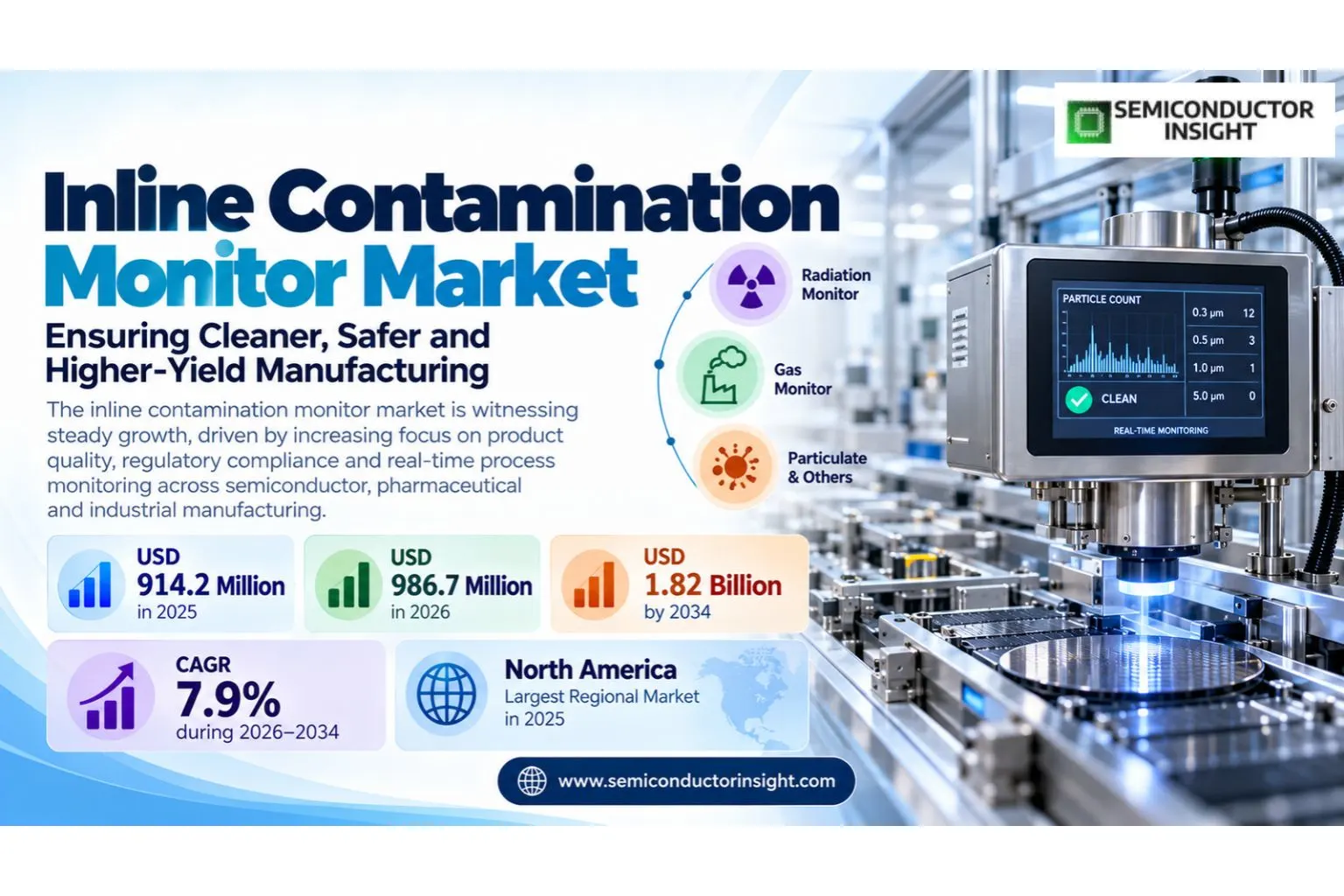
- Inline contamination monitor market was valued at USD 914.2 million in 2025 and is projected to reach USD 1.82 billion by 2034, representing a 7.9% CAGR over 2026–2034.
- Radiation monitoring remains the largest product class because nuclear plants, isotope facilities and radiation medicine require documented contamination control across personnel, surfaces and controlled areas.
- Nuclear power facilities are the largest application, while medical and pharmaceutical environments add demand for compact monitors, continuous logging and contamination traceability.
- North America leads through its large nuclear installed base, mature radiation-protection rules and concentration of specialist instrument suppliers, while Asia Pacific expands with new nuclear and industrial capacity.
- Real-time continuous monitoring is gaining strategic value because connected systems can centralize alarms, trend measurements and reduce dependence on manual survey routines.
Inline Contamination Monitor Market Overview
Inline contamination monitor market was valued at USD 914.2 million in 2025, is estimated at USD 986.7 million in 2026, and is projected to reach USD 1.82 billion by 2034, advancing at a 7.9% CAGR during 2026–2034. North America represents the largest regional market in 2025, supported by the concentration of relevant manufacturing, downstream demand and supplier ecosystems.
Inline contamination monitors provide continuous or high-frequency measurement of radioactive, gaseous or particulate contamination in process streams, controlled areas and safety-critical facilities. Depending on the application, systems use scintillation detectors, proportional counters, gas sensors or related detection methods to identify contamination before it spreads through personnel routes or industrial processes.
The market is driven by compliance, process safety and the cost of undetected contamination. Nuclear facilities remain the most demanding environment because systems must support low background, calibrated alarms and traceable data, while medical and industrial users increasingly value remote access, digital records and integration with site-wide monitoring networks.
The commercial structure of the inline contamination monitor market is shaped by design qualification, production economics and the interaction between component performance and downstream system requirements. Suppliers that can combine consistent manufacturing, application engineering and supply assurance are better positioned to convert technical eligibility into repeat business. Customer decisions increasingly account for lifecycle continuity, geographic resilience and integration cost, which makes proven process control and ecosystem compatibility as important as nominal product capability.
Segment Analysis: By Type
By type, the Inline Contamination Monitor market is segmented into Radiation Monitor, Gas Monitor, Others. Radiation monitors dominate high-value installations because alpha, beta, gamma and neutron contamination require dedicated detectors and regulated measurement procedures. Gas and particulate monitors broaden the market into pharmaceutical and industrial process environments where continuous air or process-stream quality is critical. Purchasing decisions vary by performance requirement, qualification burden, integration complexity and lifecycle economics, so suppliers compete on application fit rather than on a single technical specification.
| Type | Role in the market | Demand characteristics |
|---|---|---|
| Radiation Monitor | Radiation Monitor addresses a distinct part of the product and process mix. Its commercial position depends on technical fit, manufacturing maturity, integration requirements and customer qualification rather than on headline specifications alone. | Demand is strongest where the segment aligns with established customer designs, predictable supply, and measurable system-level performance. Suppliers that can document repeatability, compatibility and lifecycle support are better placed to defend design wins. |
| Gas Monitor | Gas Monitor addresses a distinct part of the product and process mix. Its commercial position depends on technical fit, manufacturing maturity, integration requirements and customer qualification rather than on headline specifications alone. | Demand is strongest where the segment aligns with established customer designs, predictable supply, and measurable system-level performance. Suppliers that can document repeatability, compatibility and lifecycle support are better placed to defend design wins. |
| Others | Others addresses a distinct part of the product and process mix. Its commercial position depends on technical fit, manufacturing maturity, integration requirements and customer qualification rather than on headline specifications alone. | Demand is strongest where the segment aligns with established customer designs, predictable supply, and measurable system-level performance. Suppliers that can document repeatability, compatibility and lifecycle support are better placed to defend design wins. |
Segment Analysis: By Technology
By technology, the Inline Contamination Monitor market is segmented into Fixed Monitoring Systems, Portable Monitoring Devices, Real-time Continuous Monitoring. Fixed and continuous systems dominate high-throughput controlled areas, while portable instruments remain essential for surveys, incident response and maintenance work. Networked real-time platforms create additional value through centralized supervision. Purchasing decisions vary by performance requirement, qualification burden, integration complexity and lifecycle economics, so suppliers compete on application fit rather than on a single technical specification.
| Technology | Role in the market | Demand characteristics |
|---|---|---|
| Fixed Monitoring Systems | Fixed Monitoring Systems represents a relevant purchasing and deployment pathway within this market. Commercial attractiveness depends on how well it aligns with customer architecture, supply-chain constraints and required performance. | Growth is linked to design-in activity, installed-base transitions and the ability of suppliers to meet qualification, cost and availability requirements over the full product lifecycle. |
| Portable Monitoring Devices | Portable Monitoring Devices represents a relevant purchasing and deployment pathway within this market. Commercial attractiveness depends on how well it aligns with customer architecture, supply-chain constraints and required performance. | Growth is linked to design-in activity, installed-base transitions and the ability of suppliers to meet qualification, cost and availability requirements over the full product lifecycle. |
| Real-time Continuous Monitoring | Real-time Continuous Monitoring represents a relevant purchasing and deployment pathway within this market. Commercial attractiveness depends on how well it aligns with customer architecture, supply-chain constraints and required performance. | Growth is linked to design-in activity, installed-base transitions and the ability of suppliers to meet qualification, cost and availability requirements over the full product lifecycle. |
Segment Analysis: By Application
By application, the Inline Contamination Monitor market is segmented into Nuclear Power Facilities, Medical Industry, Others. Nuclear power facilities lead because contamination control is embedded in routine operation, maintenance and access control. Medical applications add demand in nuclear medicine, radiotherapy and isotope-handling areas, while other industrial uses focus on process integrity and worker protection. Purchasing decisions vary by performance requirement, qualification burden, integration complexity and lifecycle economics, so suppliers compete on application fit rather than on a single technical specification.
| Application | Role in the market | Demand characteristics |
|---|---|---|
| Nuclear Power Facilities | Nuclear Power Facilities creates demand when the underlying system requires the market’s core function at production scale. Procurement is normally tied to platform launches, equipment upgrades, capacity expansion or replacement cycles. | Buyers evaluate reliability, qualification time, integration cost and vendor support alongside unit economics. Adoption accelerates when the solution removes a system bottleneck or supports a new performance tier without creating disproportionate redesign risk. |
| Medical Industry | Medical Industry creates demand when the underlying system requires the market’s core function at production scale. Procurement is normally tied to platform launches, equipment upgrades, capacity expansion or replacement cycles. | Buyers evaluate reliability, qualification time, integration cost and vendor support alongside unit economics. Adoption accelerates when the solution removes a system bottleneck or supports a new performance tier without creating disproportionate redesign risk. |
| Others | Others creates demand when the underlying system requires the market’s core function at production scale. Procurement is normally tied to platform launches, equipment upgrades, capacity expansion or replacement cycles. | Buyers evaluate reliability, qualification time, integration cost and vendor support alongside unit economics. Adoption accelerates when the solution removes a system bottleneck or supports a new performance tier without creating disproportionate redesign risk. |
Segment Analysis: By Detection Range
By detection range, the Inline Contamination Monitor market is segmented into Low-range Detectors, Medium-range Detectors, High-range Detectors. High-sensitivity detectors are required where permissible contamination levels are low or background discrimination is difficult. Medium- and lower-range instruments address broader industrial and routine survey needs. Purchasing decisions vary by performance requirement, qualification burden, integration complexity and lifecycle economics, so suppliers compete on application fit rather than on a single technical specification.
| Detection Range | Role in the market | Demand characteristics |
|---|---|---|
| Low-range Detectors | Low-range Detectors represents a relevant purchasing and deployment pathway within this market. Commercial attractiveness depends on how well it aligns with customer architecture, supply-chain constraints and required performance. | Growth is linked to design-in activity, installed-base transitions and the ability of suppliers to meet qualification, cost and availability requirements over the full product lifecycle. |
| Medium-range Detectors | Medium-range Detectors represents a relevant purchasing and deployment pathway within this market. Commercial attractiveness depends on how well it aligns with customer architecture, supply-chain constraints and required performance. | Growth is linked to design-in activity, installed-base transitions and the ability of suppliers to meet qualification, cost and availability requirements over the full product lifecycle. |
| High-range Detectors | High-range Detectors represents a relevant purchasing and deployment pathway within this market. Commercial attractiveness depends on how well it aligns with customer architecture, supply-chain constraints and required performance. | Growth is linked to design-in activity, installed-base transitions and the ability of suppliers to meet qualification, cost and availability requirements over the full product lifecycle. |
Regional Analysis
North America leads the inline contamination monitor market in 2025, while regional growth patterns differ according to manufacturing concentration, customer investment cycles, regulation, product mix and supply-chain access. The most important regional distinction is not simply market size; it is the mechanism that converts local investment and end-market demand into qualified purchases.
How does regional demand differ across the inline contamination monitor market?
Regional demand for inline contamination monitor is structurally uneven because manufacturing assets, design centers, downstream customers and qualification ecosystems are not distributed evenly. Asia Pacific typically has the deepest electronics manufacturing base, North America combines technology development with capital investment, Europe emphasizes reliability and industrial requirements, and emerging regions are more dependent on imported systems. These differences influence vendor selection, inventory policy, service expectations and the pace at which new technologies are adopted.
| Region | Market position | Growth outlook | Demand profile | Supplier-selection gate |
|---|---|---|---|---|
| North America | Largest | Strong | Nuclear, medical and compliance led | Regulatory qualification and lifecycle support |
| Europe | Mature high-compliance market | Moderate | Nuclear safety and decommissioning led | Standards compliance and installed-base service |
| Asia Pacific | Fastest growing | Very strong | Nuclear expansion and industrialization led | Cost, localization and qualification |
| South America | Emerging | Selective | Nuclear research and medical led | Budget and service availability |
| Middle East & Africa | Developing | Moderate | Nuclear, mining and medical led | Technical support and regulation |
Detailed Regional Blocks
Competitive Landscape
Competition in the inline contamination monitor market is determined by technical qualification, manufacturing consistency, customer relationships and the ability to support product lifecycles. Price matters, but it rarely overrides reliability, integration effort or switching cost once a supplier has been designed into a production platform.
The competitive field includes Berthold Technologies, Tracerco, MP Filtri, Des-Case, ADM Nuclear Technologies, Mirion Technologies, alongside other specialized suppliers. Market share can shift when a vendor gains access to a new platform, expands qualified capacity or introduces a technology that materially improves system performance. Because customer validation can be lengthy, incumbent suppliers often benefit from continuity, while challengers need a clear technical or supply-chain advantage to displace an approved source.
Competitive strategy is increasingly multi-dimensional. Leading suppliers invest in process or product development, application engineering and regional support at the same time, while customers seek second-source options where technically feasible. This creates a market in which differentiation is sustained through documented performance, manufacturing yield, quality systems, responsiveness and the ability to support future roadmap transitions without forcing unnecessary redesigns.
| Company | Competitive position | Primary basis of competition |
|---|---|---|
| Berthold Technologies | Established global / strategic supplier | Competes through product capability, qualification, account access and supply execution. |
| Tracerco | Established global / strategic supplier | Competes through product capability, qualification, account access and supply execution. |
| MP Filtri | Established global / strategic supplier | Competes through product capability, qualification, account access and supply execution. |
| Des-Case | Specialist / regional competitor | Competes through product capability, qualification, account access and supply execution. |
| ADM Nuclear Technologies | Specialist / regional competitor | Competes through product capability, qualification, account access and supply execution. |
| Mirion Technologies | Specialist / regional competitor | Competes through product capability, qualification, account access and supply execution. |
| Ludlum Measurements | Specialist / regional competitor | Competes through product capability, qualification, account access and supply execution. |
| Nutronic | Focused challenger / niche participant | Competes through product capability, qualification, account access and supply execution. |
| Bright Technologies | Focused challenger / niche participant | Competes through product capability, qualification, account access and supply execution. |
| ATOMTEX | Focused challenger / niche participant | Competes through product capability, qualification, account access and supply execution. |
| NUVIATECH Instruments | Focused challenger / niche participant | Competes through product capability, qualification, account access and supply execution. |
Production Capacity Analysis
Production capacity depends on detector fabrication, low-noise electronics, calibration infrastructure, shielding and software integration rather than high-volume assembly alone. Nuclear-grade systems require traceable calibration and long product support, making qualified engineering and service capacity critical.
Europe and North America host many established radiation-instrument suppliers, while Asia is expanding both demand and manufacturing. Because customers often operate equipment for many years, spare parts, software updates and recalibration services are a significant part of effective supply capacity.
Capacity should therefore be evaluated on a qualified-output basis rather than as nominal installed capability. A supplier may possess equipment or production lines that appear suitable but still require customer-specific validation, process tuning, test correlation or upstream material qualification. This distinction becomes especially important during demand spikes, when headline capacity can overstate the volume that is immediately available for a particular application, technology generation or reliability class.
Market Dynamics
The inline contamination monitor market is being shaped by rising performance requirements and technology transitions on the demand side, while qualification complexity, supply concentration and cost discipline constrain the pace of adoption. The balance of these forces favors suppliers that can solve a measurable system problem without increasing integration risk.
Demand expansion is not uniform across all product variants or customer groups. New technology creates attractive design opportunities, but buyers typically require a clear economic or performance case before changing a qualified architecture. At the same time, supply-chain localization, capacity investment and tighter quality requirements are changing procurement behavior. As a result, growth is likely to concentrate around applications where performance upgrades, manufacturing scale and lifecycle value reinforce one another.
Market Drivers
Four forces provide the strongest support for demand in the inline contamination monitor market: performance-driven technology upgrades, expansion of relevant downstream applications, investment in manufacturing or infrastructure, and the need for more resilient supply. Their importance varies by segment, but each creates a direct reason for customers to qualify or purchase additional solutions.
| Driver | Impact | Commercial mechanism |
|---|---|---|
| Nuclear safety requirements sustain mandatory monitoring | High | Operating and decommissioning nuclear facilities require contamination control at personnel exits, work areas and process boundaries. |
| Digital logging improves traceability | High | Networked monitors can centralize measurements, alarms and background trends for audit and incident review. |
| Medical and isotope activity broadens demand | Medium-High | Nuclear medicine and radiopharmaceutical facilities require reliable contamination checks in compact clinical environments. |
| New nuclear capacity expands installed equipment | Medium-High | New reactors and fuel-cycle facilities create fresh demand for area, personnel and process contamination monitoring. |
Nuclear safety requirements sustain mandatory monitoring
Operating and decommissioning nuclear facilities require contamination control at personnel exits, work areas and process boundaries. The commercial effect is strongest where customers can link the technology change to higher throughput, lower power, improved reliability, reduced lifecycle cost or access to a new end-market requirement.
Digital logging improves traceability
Networked monitors can centralize measurements, alarms and background trends for audit and incident review. The commercial effect is strongest where customers can link the technology change to higher throughput, lower power, improved reliability, reduced lifecycle cost or access to a new end-market requirement.
Medical and isotope activity broadens demand
Nuclear medicine and radiopharmaceutical facilities require reliable contamination checks in compact clinical environments. The commercial effect is strongest where customers can link the technology change to higher throughput, lower power, improved reliability, reduced lifecycle cost or access to a new end-market requirement.
New nuclear capacity expands installed equipment
New reactors and fuel-cycle facilities create fresh demand for area, personnel and process contamination monitoring. The commercial effect is strongest where customers can link the technology change to higher throughput, lower power, improved reliability, reduced lifecycle cost or access to a new end-market requirement.
Market Restraints
Growth is moderated by qualification burden, cyclical purchasing, technology substitution and supply-chain risk. These restraints do not eliminate demand, but they can extend sales cycles, limit supplier switching and reduce the speed at which technically superior solutions convert into production revenue.
| Restraint | Impact | Commercial consequence |
|---|---|---|
| High-end systems carry significant installation and service cost | High | Nuclear-grade detectors, shielding, calibration and networking make fixed monitoring systems expensive for smaller facilities. |
| Harsh environments accelerate detector wear | High | Heat, humidity, corrosive materials and high radiation fields can degrade sensors and electronics. |
| Integration with legacy safety systems can be difficult | Medium | Older facilities may require custom interfaces to connect new monitors with plant databases and alarm systems. |
| Qualified technical staff remain essential | Medium | Accurate interpretation, calibration and maintenance require trained radiation-protection personnel. |
High-end systems carry significant installation and service cost
Nuclear-grade detectors, shielding, calibration and networking make fixed monitoring systems expensive for smaller facilities. Suppliers can mitigate part of this pressure through stronger qualification support, transparent lifecycle planning, dual-source strategies and better alignment between product roadmaps and customer production schedules.
Harsh environments accelerate detector wear
Heat, humidity, corrosive materials and high radiation fields can degrade sensors and electronics. Suppliers can mitigate part of this pressure through stronger qualification support, transparent lifecycle planning, dual-source strategies and better alignment between product roadmaps and customer production schedules.
Integration with legacy safety systems can be difficult
Older facilities may require custom interfaces to connect new monitors with plant databases and alarm systems. Suppliers can mitigate part of this pressure through stronger qualification support, transparent lifecycle planning, dual-source strategies and better alignment between product roadmaps and customer production schedules.
Qualified technical staff remain essential
Accurate interpretation, calibration and maintenance require trained radiation-protection personnel. Suppliers can mitigate part of this pressure through stronger qualification support, transparent lifecycle planning, dual-source strategies and better alignment between product roadmaps and customer production schedules.
Market Opportunities
The most attractive opportunities in the inline contamination monitor market occur where a technology transition creates measurable value and where suppliers can enter before the customer architecture is locked. Early engagement, application-specific engineering and credible supply planning can convert these windows into durable design positions.
Centralized facility monitoring
Networked instruments can feed common dashboards and databases for faster response and compliance reporting. The opportunity is strongest for suppliers that can demonstrate performance with production-relevant data, provide engineering support during qualification and maintain a roadmap that gives customers confidence in long-term availability.
Decommissioning and waste management
Long-running cleanup programs require portable, personnel and fixed contamination monitoring across changing work zones. The opportunity is strongest for suppliers that can demonstrate performance with production-relevant data, provide engineering support during qualification and maintain a roadmap that gives customers confidence in long-term availability.
Compact medical monitors
Smaller devices with simpler workflows can expand adoption in nuclear medicine and radiopharmaceutical facilities. The opportunity is strongest for suppliers that can demonstrate performance with production-relevant data, provide engineering support during qualification and maintain a roadmap that gives customers confidence in long-term availability.
Predictive maintenance of safety instruments
Remote diagnostics and condition monitoring can reduce downtime and help facilities schedule detector service proactively. The opportunity is strongest for suppliers that can demonstrate performance with production-relevant data, provide engineering support during qualification and maintain a roadmap that gives customers confidence in long-term availability.
Supply Chain Analysis
Detectors and sensor elements
Scintillators, proportional counters, gas sensors and associated materials convert contamination into measurable signals. Value capture at this stage depends on quality consistency, technical differentiation and the difficulty of substitution. Bottlenecks can propagate downstream when qualification or material compatibility prevents customers from shifting quickly to an alternative supplier.
Electronics and signal processing
Low-noise amplifiers, counters, controllers and software convert detector output into calibrated readings and alarms. Value capture at this stage depends on quality consistency, technical differentiation and the difficulty of substitution. Bottlenecks can propagate downstream when qualification or material compatibility prevents customers from shifting quickly to an alternative supplier.
System integration and calibration
Manufacturers assemble fixed or portable systems and verify sensitivity, background response and alarm behavior. Value capture at this stage depends on quality consistency, technical differentiation and the difficulty of substitution. Bottlenecks can propagate downstream when qualification or material compatibility prevents customers from shifting quickly to an alternative supplier.
Facility deployment and service
Nuclear, medical and industrial users integrate monitors into controlled areas and maintain them through scheduled calibration. Value capture at this stage depends on quality consistency, technical differentiation and the difficulty of substitution. Bottlenecks can propagate downstream when qualification or material compatibility prevents customers from shifting quickly to an alternative supplier.
Recent Developments
Recent developments show how technology roadmaps, manufacturing investment and standards are changing the competitive requirements of the inline contamination monitor market. The entries below are selected for their direct relevance to product capability, capacity, qualification or downstream adoption rather than for general corporate activity.
Mirion’s Sirius Core contamination monitor is positioned for high-traffic nuclear environments with 24/7 operation, LAN and USB connectivity, central monitoring support and compliance with IEC 61098 and ISO 11929. Source
Berthold continues to offer a broad contamination-measurement portfolio spanning portable instruments, hand-foot systems and full-body monitoring, supporting layered radiation-protection programs across nuclear and research sites. Source
Berthold’s Body Scan system combines alpha, beta and gamma contamination measurement with automatic background updates, SQL result storage and remote-monitoring options, demonstrating the shift toward digitally managed personnel monitoring. Source
Report Scope & Segmentation
| Report attribute | Coverage |
|---|---|
| Market | Inline Contamination Monitor |
| Base Year | 2025 |
| Estimated Year | 2026 |
| Forecast Period | 2026–2034 |
| 2025 Market Size | USD 914.2 million |
| 2026 Estimated Size | USD 986.7 million |
| 2034 Forecast Size | USD 1.82 billion |
| CAGR (2026–2034) | 7.9% |
| Largest Market in 2025 | North America |
| By Type | Radiation Monitor, Gas Monitor, Others |
| By Application | Nuclear Power Facilities, Medical Industry, Others |
| By Technology | Fixed Monitoring Systems, Portable Monitoring Devices, Real-time Continuous Monitoring |
| By Detection Range | Low-range Detectors, Medium-range Detectors, High-range Detectors |
| Companies Profiled | Berthold Technologies, Tracerco, MP Filtri, Des-Case, ADM Nuclear Technologies, Mirion Technologies, Ludlum Measurements, Nutronic, Bright Technologies, ATOMTEX, NUVIATECH Instruments |
Frequently Asked Questions
What was the inline contamination monitor market size in 2025?
The global inline contamination monitor market was valued at USD 914.2 million in 2025. The 2025 value is the base-year reference used throughout this overview and provides the starting point for comparing the 2026 estimate and the 2034 forecast.
What is the projected inline contamination monitor market size in 2034?
The global market is projected to reach USD 1.82 billion by 2034. The forecast reflects the interaction of downstream adoption, technology transitions, production investment and the qualification requirements that shape commercial conversion across the market.
What is the CAGR of the inline contamination monitor market from 2026 to 2034?
The inline contamination monitor market is expected to expand at a 7.9% CAGR during 2026–2034. Growth will not be uniform across every product or region because customer qualification, capital cycles, supply constraints and application-specific performance requirements differ materially.
Which region is the largest inline contamination monitor market?
North America is the largest regional market in 2025. Its position is supported by the concentration of relevant manufacturing, customers, technology ecosystems and downstream demand, although the precise commercial mechanism differs by country and application.
How is the inline contamination monitor market segmented by type?
By type, the market is segmented into Radiation Monitor, Gas Monitor, Others. These categories address different performance, cost and integration requirements, so supplier selection depends on application fit, qualification history and lifecycle economics rather than a single specification.
What are the main applications for inline contamination monitor?
By application, the market covers Nuclear Power Facilities, Medical Industry, Others. Demand in each application is linked to platform launches, capacity expansion, equipment replacement and the degree to which the technology improves system performance or manufacturing economics.
What are the principal growth drivers for the inline contamination monitor market?
Key drivers include nuclear safety requirements sustain mandatory monitoring and digital logging improves traceability. These forces increase demand when customers can translate technical improvements into higher performance, lower cost, greater reliability or access to new applications.
What are the main restraints in the inline contamination monitor market?
Important restraints include high-end systems carry significant installation and service cost and harsh environments accelerate detector wear. The resulting qualification burden, purchasing cyclicality and technology risk can extend sales cycles and limit rapid supplier substitution even when new solutions offer clear technical advantages.
Which companies participate in the inline contamination monitor market?
Companies profiled in this market include Berthold Technologies, Tracerco, MP Filtri, Des-Case, ADM Nuclear Technologies, Mirion Technologies, Ludlum Measurements, Nutronic. Competition centers on qualification, product or process performance, manufacturing consistency, customer support and the ability to maintain supply across the required product lifecycle.
What should buyers evaluate when selecting a inline contamination monitor supplier?
Buyers should evaluate demonstrated performance, qualification history, manufacturing consistency, lifecycle support, supply resilience and integration cost. A technically strong product can still face adoption barriers if it increases redesign risk, lacks regional support or cannot meet the customer’s production and quality requirements.
Research Sources & Evidence Base
View research sources used for this overview.
- Mirion Technologies. Sirius Core contamination monitor — 24/7 personnel contamination monitoring, connectivity and standards support.
- Berthold Technologies. Contamination Measurement Systems — Current portfolio for portable, personnel and whole-body contamination measurement.
- Berthold Technologies. Body Scan Full-Body Contamination Monitor — Alpha, beta and gamma measurement, background tracking and data-management functions.

Get Sample Report PDF for Exclusive Insights
Report Sample Includes
- Table of Contents
- List of Tables & Figures
- Charts, Research Methodology, and more...
 Download Sample Report PDF



