MARKET INSIGHTS
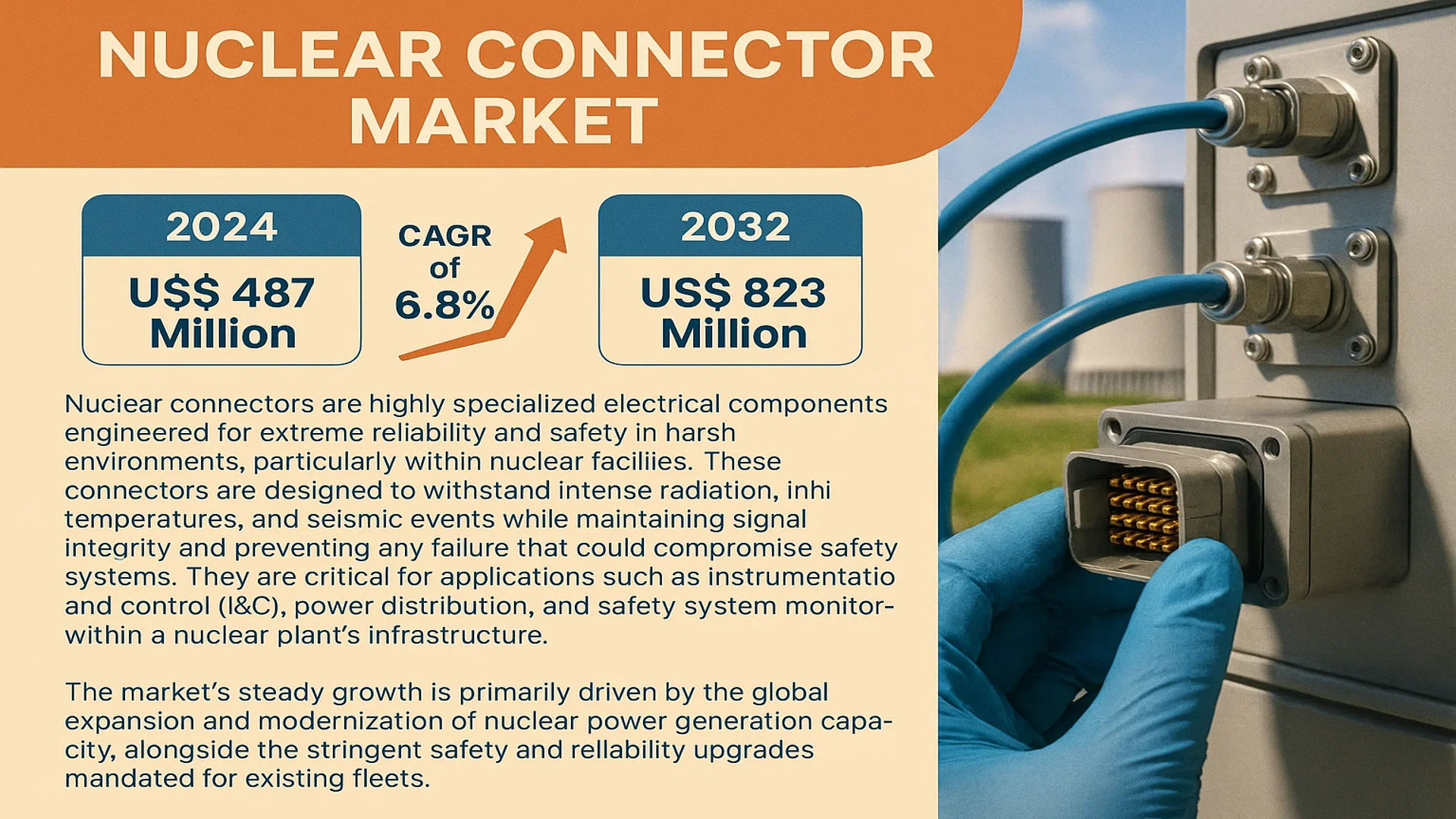
The global Nuclear Connector Market size was valued at US$ 487 million in 2024 and is projected to reach US$ 823 million by 2032, at a CAGR of 6.8% during the forecast period 2025-2032.
Nuclear connectors are highly specialized electrical components engineered for extreme reliability and safety in harsh environments, particularly within nuclear facilities. These connectors are designed to withstand intense radiation, high temperatures, and seismic events while maintaining signal integrity and preventing any failure that could compromise safety systems. They are critical for applications such as instrumentation and control (I&C), power distribution, and safety system monitoring within a nuclear plant’s infrastructure.
The market’s steady growth is primarily driven by the global expansion and modernization of nuclear power generation capacity, alongside the stringent safety and reliability upgrades mandated for existing fleets. For instance, organic materials dominate the product segment with over 61% market share due to their superior sealing and radiation resistance properties. Furthermore, the nuclear power plant application is the largest end-use segment, commanding over 91% of the market, because these facilities require vast quantities of highly reliable connectors for operational and safety-critical systems. Key players such as Schott, Fischer Connectors, and Souriau collectively hold a significant market share of approximately 36%, focusing on innovation to meet evolving regulatory and performance demands.
MARKET DYNAMICS
MARKET DRIVERS
Global Expansion of Nuclear Power Infrastructure to Drive Market Growth
The nuclear connector market is experiencing substantial growth driven by the global expansion of nuclear power infrastructure. Over 50 countries are currently developing or considering nuclear power programs, with more than 60 new reactors under construction worldwide. This expansion represents a significant increase from previous decades and creates substantial demand for specialized connectors that meet stringent nuclear safety standards. The increasing global energy demand, coupled with the push for carbon-neutral energy sources, has accelerated nuclear power plant construction and modernization projects. Countries including China, India, Russia, and several European nations are investing heavily in nuclear energy, with China alone accounting for approximately 40% of global nuclear construction projects. This widespread nuclear infrastructure development directly fuels the demand for high-reliability nuclear connectors that ensure safe and efficient power plant operations.
Stringent Safety Regulations and Modernization Initiatives to Boost Market Demand
Enhanced safety regulations following major nuclear incidents have significantly driven the nuclear connector market. Regulatory bodies worldwide have implemented more rigorous standards for nuclear components, particularly those critical to safety systems. These regulations mandate the use of connectors that can withstand extreme conditions including high radiation, extreme temperatures, and seismic events. The modernization of existing nuclear facilities represents another major driver, with many countries extending the operational life of their nuclear plants beyond original design lifetimes. Life extension programs often require complete replacement of electrical systems and connectors to meet current safety standards. This creates a substantial aftermarket demand for nuclear-grade connectors, with maintenance and upgrade activities accounting for approximately 35% of the total market revenue. The continuous evolution of safety protocols ensures sustained demand for connectors that exceed previous performance specifications.
Advancements in Connector Technology to Accelerate Market Adoption
Technological advancements in connector design and materials are driving market growth by enabling higher performance and reliability. Modern nuclear connectors incorporate advanced materials such as specialized alloys and radiation-resistant polymers that provide superior performance in harsh nuclear environments. These technological improvements have resulted in connectors that maintain integrity under radiation doses exceeding 10^6 Gy and temperatures ranging from -200°C to 400°C. The development of miniaturized connectors for instrumentation and control systems has expanded application possibilities while maintaining nuclear-grade reliability. Recent innovations include connectors with integrated monitoring capabilities that can detect potential failures before they occur, enhancing overall plant safety. These technological advancements not only improve safety but also reduce maintenance costs and downtime, making nuclear power more economically viable and driving further adoption of advanced connector solutions.
MARKET CHALLENGES
High Development and Certification Costs to Challenge Market Entry
The nuclear connector market faces significant challenges due to the exceptionally high costs associated with development and certification processes. Nuclear-grade connectors must undergo rigorous testing and qualification procedures that can take several years and cost millions of dollars per connector type. The certification process involves extensive radiation testing, thermal cycling, mechanical stress testing, and seismic qualification to ensure compliance with international nuclear standards. These requirements create substantial barriers to entry for new market participants and limit innovation due to the financial risks involved. The specialized materials required for nuclear applications, such as radiation-resistant alloys and ceramics, further increase production costs. Additionally, the limited production volumes compared to commercial connectors result in higher per-unit costs, making nuclear connectors approximately 300-500% more expensive than industrial-grade equivalents with similar specifications.
Other Challenges
Supply Chain Complexity
The nuclear connector market faces substantial supply chain challenges due to the highly specialized nature of required components and materials. Sourcing radiation-resistant materials involves dealing with limited suppliers and complex international regulations regarding nuclear-related components. The stringent quality assurance requirements mandate extensive documentation and traceability for every component, creating administrative burdens that slow down production and increase costs. Recent global supply chain disruptions have further exacerbated these challenges, causing delays in critical nuclear projects and increasing lead times for specialized connectors from 12-18 months to 24-36 months in some cases.
Technical Performance Requirements
Meeting the extreme technical requirements of nuclear applications presents ongoing challenges for connector manufacturers. Connectors must maintain performance under cumulative radiation doses that can exceed 10^9 rads while resisting degradation from chemical exposure and extreme temperature fluctuations. The need for connectors to remain operational during seismic events requires designs that can withstand acceleration forces up to 10g without failure. These demanding performance criteria necessitate continuous research and development investments while limiting the pool of manufacturers capable of producing compliant products.
MARKET RESTRAINTS
Political and Public Opposition to Nuclear Energy to Restrict Market Growth
Political uncertainty and public opposition to nuclear energy represent significant restraints on the nuclear connector market. Many countries face political debates regarding nuclear energy policy, with some nations phasing out nuclear power entirely while others face public resistance to new plant construction. This uncertainty creates volatile demand patterns that make long-term planning challenging for connector manufacturers. The development timeline for nuclear projects, often exceeding 10 years from planning to operation, means that political changes can abruptly cancel or delay projects that represent substantial market opportunities. Public perception issues, particularly following high-profile nuclear incidents, continue to affect the pace of nuclear energy adoption globally. These factors combine to create an unpredictable market environment where planned projects representing billions of dollars in potential connector demand can be cancelled or postponed indefinitely due to changing political landscapes or public opinion.
Limited Number of Qualified Suppliers to Constrain Market Expansion
The nuclear connector market faces constraints due to the limited number of suppliers qualified to produce nuclear-grade components. The stringent qualification requirements and extensive documentation needed for nuclear applications restrict market participation to only a handful of specialized manufacturers worldwide. This limited supplier base creates capacity constraints during periods of high demand and reduces competitive pressure that might otherwise drive innovation and cost reduction. The extensive time required to qualify new suppliers—often taking 3-5 years—means that supply cannot quickly respond to demand fluctuations. This situation creates vulnerability in the supply chain and can lead to project delays when existing suppliers reach capacity limitations. The concentration of manufacturing capability among few players also creates geographic supply challenges, particularly for regions without local qualified suppliers that must import connectors with associated logistical complexities and potential regulatory hurdles.
Aging Workforce and Skills Shortage to Impede Market Development
The nuclear connector market is experiencing significant restraints due to an aging workforce and shortage of specialized skills. The nuclear industry faces a demographic challenge with a substantial portion of experienced engineers and technicians approaching retirement age. This knowledge loss is particularly critical in connector design and manufacturing, where nuclear-specific expertise requires years to develop. The highly specialized nature of nuclear connector technology means that replacing experienced personnel is difficult, as the required knowledge combines nuclear physics, materials science, and precision engineering. Educational institutions produce few graduates with nuclear specialization, creating a pipeline problem that threatens long-term market sustainability. This skills shortage affects not only manufacturing but also quality assurance, testing, and certification processes that are essential for nuclear compliance. The limited talent pool drives up labor costs and can extend project timelines when specialized expertise is unavailable.
MARKET OPPORTUNITIES
Small Modular Reactor Development to Create New Market Opportunities
The emerging small modular reactor (SMR) market presents substantial growth opportunities for nuclear connector manufacturers. SMRs represent a fundamental shift in nuclear power plant design, with simplified systems and standardized components that require specialized connector solutions. The modular nature of these reactors creates demand for connectors that facilitate rapid assembly and disassembly while maintaining nuclear-grade reliability. Current projections indicate over 80 SMR projects in various development stages worldwide, representing a potential market expansion of approximately 40% for nuclear components including connectors. The reduced size and standardized design of SMRs allow for connector designs that can be produced in higher volumes than traditional nuclear connectors, potentially reducing costs while maintaining safety margins. This market segment is particularly attractive because it represents new construction rather than replacement demand, creating opportunities for innovative connector designs specifically optimized for modular reactor applications.
Digitalization and Smart Connector Technologies to Enable Market Expansion
The integration of digital technologies into nuclear connectors creates significant market opportunities through the development of smart connector systems. Modern nuclear facilities increasingly incorporate digital monitoring and control systems that require connectors with integrated sensing and communication capabilities. Smart connectors can monitor their own condition, detect potential failures before they occur, and communicate performance data to maintenance systems. This capability enhances plant safety while reducing maintenance costs and unplanned downtime. The transition to digital instrumentation and control systems in nuclear plants drives demand for connectors that support high-speed data transmission while maintaining immunity to electromagnetic interference and radiation-induced degradation. The market for intelligent connector systems is growing rapidly as nuclear operators seek to improve operational efficiency and safety through digital transformation initiatives. This trend represents a fundamental shift from passive connection components to active, intelligent systems that provide additional value beyond basic electrical connectivity.
Emerging Nuclear Applications to Drive Diversified Market Growth
Beyond traditional power generation, emerging nuclear applications create diversified opportunities for connector manufacturers. Nuclear technology is expanding into areas including medical isotope production, nuclear propulsion for maritime applications, and space nuclear power systems. Each of these applications requires specialized connectors that meet nuclear safety standards while addressing unique environmental challenges. The medical isotope production market alone represents a growing opportunity, with increasing demand for radioactive isotopes used in cancer treatment and medical imaging. Nuclear-powered ships and submarines require connectors that can withstand marine environments while providing nuclear-grade reliability. Space nuclear systems, particularly for deep space missions, demand connectors that operate reliably in vacuum conditions under intense radiation exposure. These emerging applications diversify the nuclear connector market beyond traditional power plant applications, reducing dependence on the cyclical nature of power plant construction while opening new revenue streams with different technical requirements and growth trajectories.
NUCLEAR CONNECTOR MARKET TRENDS
Global Expansion of Nuclear Energy Infrastructure Driving Market Growth
The global nuclear connector market is experiencing significant growth due to the worldwide expansion and modernization of nuclear energy infrastructure. Over 50 new nuclear reactors are currently under construction globally, with major projects concentrated in Asia-Pacific and Eastern Europe, creating sustained demand for high-reliability connector systems. This expansion is not limited to new builds; life extension programs for existing reactors, which can extend operational lifetimes by 20-30 years, require comprehensive refurbishment including connector replacement. The market is further propelled by increasing investments in small modular reactors (SMRs), with over 70 designs in various stages of development worldwide. These advanced reactor designs necessitate specialized connector solutions that can withstand extreme environmental conditions while maintaining signal integrity and safety performance.
Other Trends
Technological Advancements in Connector Materials and Design
Recent technological innovations are revolutionizing nuclear connector performance and reliability. Manufacturers are increasingly utilizing advanced organic materials, which currently dominate over 61% of the market share, offering superior radiation resistance and thermal stability. The development of glass-metal sealing technologies has enabled connectors to maintain hermetic integrity under extreme pressure and temperature fluctuations encountered in nuclear environments. Furthermore, the integration of smart monitoring capabilities within connector systems allows for real-time performance tracking and predictive maintenance, significantly enhancing operational safety. These advancements are particularly crucial as nuclear facilities increasingly implement digital instrumentation and control systems, requiring connectors that can handle higher data transmission rates while maintaining electromagnetic compatibility.
Stringent Safety Regulations and Quality Standards Shaping Market Dynamics
The nuclear connector market is profoundly influenced by increasingly stringent international safety standards and regulatory requirements. Connectors must comply with rigorous certifications such as IEEE 323 for qualification of Class 1E equipment and IEC 62138 for nuclear power plant applications. The implementation of these standards has driven manufacturers to invest heavily in research and development, with leading companies allocating approximately 7-10% of their annual revenue to innovation. This regulatory environment has created significant barriers to entry, consolidating market share among established players with proven track records in nuclear applications. The emphasis on safety has also accelerated the adoption of redundant connection systems and fault-tolerant designs, particularly in safety-critical applications where connector failure could compromise entire safety systems.
COMPETITIVE LANDSCAPE
Key Industry Players
Market Leaders Focus on Robustness and Reliability to Secure Critical Contracts
The global nuclear connector market exhibits a semi-consolidated structure, characterized by the presence of a few dominant international players and several specialized regional manufacturers. These companies operate within a highly stringent regulatory environment, where product reliability, safety certifications, and long-term performance are paramount. The market’s competitive dynamics are heavily influenced by the ability to meet rigorous international standards, such as those set by the IEEE and IEC, for radiation resistance, seismic performance, and fire safety.
TE Connectivity and Amphenol Corporation are established leaders, collectively commanding a significant portion of the global market share. Their dominance is largely attributed to their extensive, diversified product portfolios that cater to both commercial nuclear power plants and specialized research applications. Furthermore, their global manufacturing and supply chain networks provide a critical advantage in serving large-scale international projects, ensuring timely delivery and local support.
European specialists, namely Fischer Connectors and Souriau (a part of Eaton), also hold considerable market influence. These companies are renowned for their engineering expertise in developing connectors that withstand extreme conditions, including high levels of ionizing radiation and elevated temperatures. Their growth is sustained through continuous investment in research and development, leading to innovations in materials science, such as advanced organic compounds and glass-metal sealing technologies, which enhance connector longevity and integrity.
Meanwhile, other key players like Stäubli and Schott AG are strengthening their positions through strategic expansions and a focus on high-value segments. For instance, Schott’s expertise in glass-to-metal seals is critical for feedthrough applications, providing a unique competitive edge. These companies are actively pursuing contracts for next-generation reactor designs, including small modular reactors (SMRs) and fusion energy projects, which represent the future growth frontier for the industry.
Additionally, the competitive landscape is seeing increased activity from firms such as Curtiss-Wright and Lemo, who are leveraging their heritage in defense and aerospace to meet the ultra-high-reliability demands of the nuclear sector. Their strategy often involves adapting proven technologies from other critical industries, thereby reducing development risk and accelerating time-to-market for new nuclear-grade solutions.
List of Key Nuclear Connector Companies Profiled
- TE Connectivity (Switzerland)
- Amphenol Corporation (U.S.)
- Fischer Connectors (Switzerland)
- Souriau (France)
- Stäubli (Switzerland)
- Schott AG (Germany)
- Lemo (Switzerland)
- Curtiss-Wright (U.S.)
- Glenair (U.S.)
- JONHON (China)
- NAMCO (India)
- Axon (France)
Segment Analysis:
By Material
Organic Materials Segment Dominates the Market Due to Superior Radiation Resistance and Reliability
The market is segmented based on material into:
- Organic Materials
- Subtypes: High-performance thermoplastics, specialized elastomers, and others
- Glass-Metal
- Subtypes: Hermetic glass-to-metal seals, ceramic-to-metal seals, and others
By Application
Nuclear Power Plant Segment Leads Due to Critical Safety and Control System Requirements
The market is segmented based on application into:
- Nuclear Power Plant
- Research Institute
- Other
By Product Type
Circular Connectors Hold Significant Market Share Owing to Their Robust Design and High Reliability
The market is segmented based on product type into:
- Circular Connectors
- Rectangular Connectors
- Fiber Optic Connectors
- RF Connectors
- Others
By Region
Asia-Pacific Represents a Key Growth Region Driven by New Nuclear Infrastructure Development
The market is segmented based on region into:
- North America
- Europe
- Asia-Pacific
- South America
- Middle East & Africa
Regional Analysis: Nuclear Connector Market
Asia-Pacific
The Asia-Pacific region is the dominant force in the global nuclear connector market, accounting for the highest consumption volume and the most significant growth potential. This leadership is primarily driven by China, which is aggressively expanding its nuclear power capacity as part of its broader energy strategy to reduce carbon emissions. China’s “Belt and Road” initiative also fosters international nuclear energy projects, further stimulating demand for high-reliability components. India is another key growth engine, with ambitious plans to increase the share of nuclear power in its energy mix to support rapid urbanization and industrialization. While cost sensitivity can influence procurement decisions, the sheer scale of infrastructure development, stringent new build safety standards, and a gradual but definitive shift towards next-generation reactor technologies create a robust and sustained demand for connectors from leading global suppliers.
North America
Characterized by a mature nuclear fleet, the North American market’s primary driver is life extension and modernization programs for existing nuclear power plants. Regulatory bodies like the U.S. Nuclear Regulatory Commission (NRC) enforce rigorous standards for component qualification and replacement, ensuring a steady demand for connectors that meet or exceed original equipment specifications. While new reactor construction is limited, significant investments are being made in Small Modular Reactors (SMRs), which represent a forward-looking opportunity for connector manufacturers. The market is highly quality-conscious, with a strong preference for connectors that offer enhanced safety, reliability, and ease of maintenance, often supplied by established players with deep regulatory experience.
Europe
The European market is defined by a dual dynamic: the decommissioning of older nuclear facilities and the construction of new, advanced reactors in select countries. Nations like France and the UK are investing in new nuclear projects, such as the Hinkley Point C, which require connectors that meet the latest safety and performance criteria. Simultaneously, extensive decommissioning projects across Germany and other nations create demand for specialized connectors used in waste handling and remote operations. The regulatory environment, heavily influenced by EU-wide safety directives (e.g., EURATOM), is exceptionally strict, mandating the highest levels of quality, documentation, and traceability for all nuclear components, including connectors.
South America
The nuclear connector market in South America is in a developmental phase, with growth opportunities tied to specific national energy programs. Argentina and Brazil possess the most active nuclear sectors in the region, with ongoing projects to complete and maintain their power plants. However, market expansion is often tempered by economic volatility, which can delay large-scale infrastructure investments and lead to protracted procurement cycles. While there is a recognized need for reliable nuclear components, budget constraints can sometimes prioritize cost over advanced technological features, presenting a specific market segment for robust and proven connector solutions.
Middle East & Africa
This region presents an emerging but strategically important market for nuclear connectors. The primary growth is concentrated in the Middle East, where countries like the UAE have successfully commissioned their first nuclear power plant (Barakah) and others, such as Saudi Arabia, are exploring ambitious nuclear energy programs. These greenfield projects demand the most modern and certified connector technologies from the outset. In contrast, the African market remains nascent, with only South Africa currently operating a nuclear power plant. Growth across Africa is contingent on future political commitment to nuclear energy, economic stability, and the development of necessary regulatory frameworks, indicating a longer-term horizon for significant market development.
Report Scope
This market research report provides a comprehensive analysis of the global Nuclear Connector market, covering the forecast period 2025–2032. It offers detailed insights into market dynamics, technological advancements, competitive landscape, and key trends shaping the industry.
Key focus areas of the report include:
- Market Size & Forecast: Historical data and future projections for revenue, unit shipments, and market value across major regions and segments.
- Segmentation Analysis: Detailed breakdown by material type, application, and end-user industry to identify high-growth segments and investment opportunities.
- Regional Outlook: Insights into market performance across North America, Europe, Asia-Pacific, Latin America, and the Middle East & Africa, including country-level analysis where relevant.
- Competitive Landscape: Profiles of leading market participants, including their product offerings, R&D focus, manufacturing capacity, pricing strategies, and recent developments such as mergers, acquisitions, and partnerships.
- Technology Trends & Innovation: Assessment of emerging technologies, integration of advanced materials, evolving industry standards, and safety compliance requirements.
- Market Drivers & Restraints: Evaluation of factors driving market growth along with challenges, supply chain constraints, regulatory issues, and market-entry barriers.
- Stakeholder Analysis: Insights for component suppliers, OEMs, system integrators, investors, and policymakers regarding the evolving ecosystem and strategic opportunities.
Primary and secondary research methods are employed, including interviews with industry experts, data from verified sources, and real-time market intelligence to ensure the accuracy and reliability of the insights presented.
FREQUENTLY ASKED QUESTIONS:
What is the current market size of Global Nuclear Connector Market?
->Nuclear Connector Market size was valued at US$ 487 million in 2024 and is projected to reach US$ 823 million by 2032, at a CAGR of 6.8% during the forecast period 2025-2032.
Which key companies operate in Global Nuclear Connector Market?
-> Key players include Schott, Fischer Connectors, Souriau, Amphenol Corporation, Stäubli, TE Connectivity, Lemo, Curtiss-Wright, JONHON, NAMCO, Glenair, and Axon, among others.
What are the key growth drivers?
-> Key growth drivers include global investments in nuclear energy infrastructure, increasing demand for reliable and safe connectivity solutions in nuclear power plants, and technological advancements in connector materials and designs.
Which region dominates the market?
-> Asia-Pacific is the fastest-growing region, driven by significant nuclear energy expansion in China and other developing economies, while Europe and North America remain mature markets with established nuclear infrastructure.
What are the emerging trends?
-> Emerging trends include development of radiation-resistant materials, miniaturization of connector components, integration of smart monitoring capabilities, and increased focus on safety and regulatory compliance.

Get Sample Report PDF for Exclusive Insights
Report Sample Includes
- Table of Contents
- List of Tables & Figures
- Charts, Research Methodology, and more...
 Download Sample Report PDF