Industrial drives market Insights
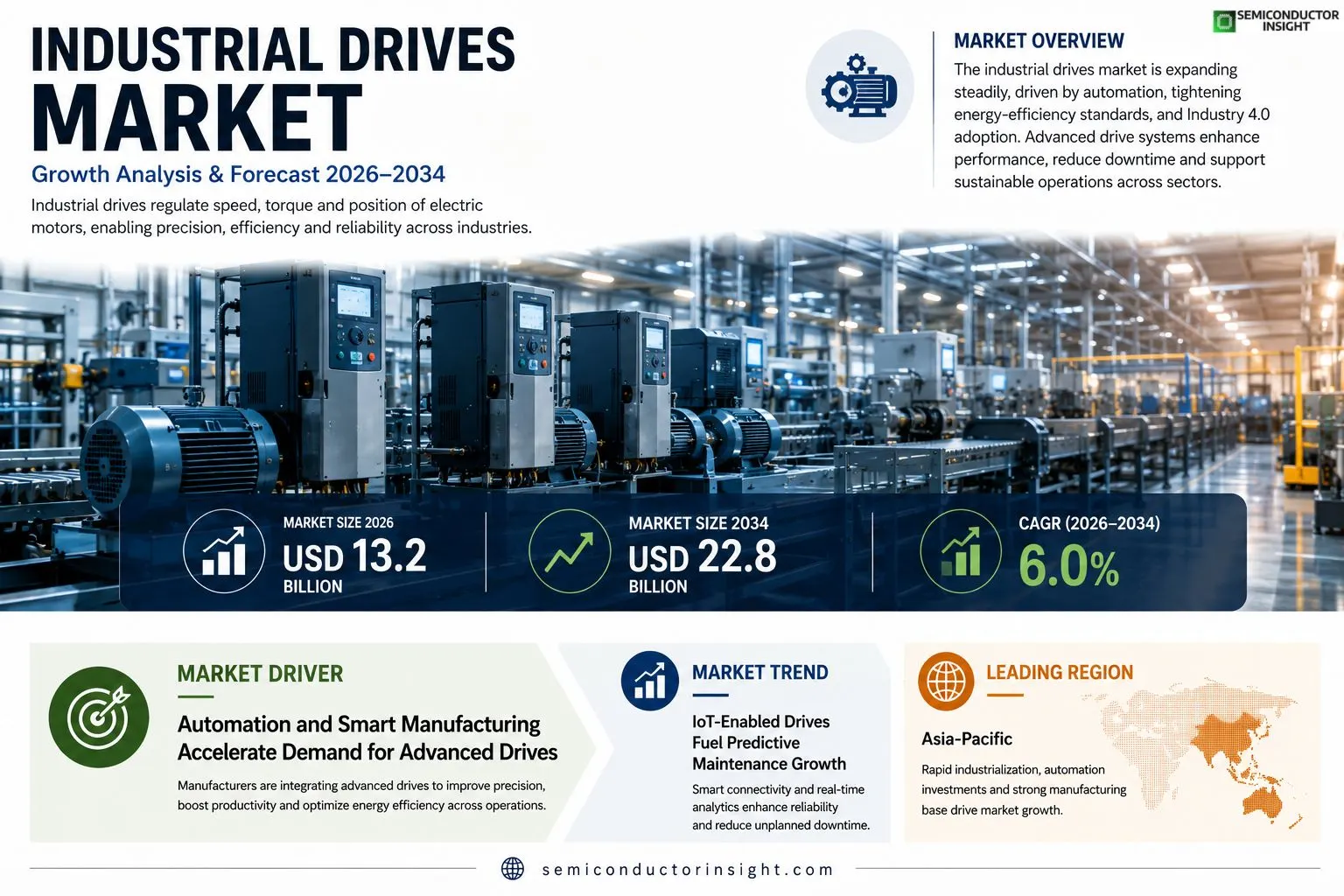
Industrial drives market size was valued at USD 13.2 billion in 2025. The market is projected to grow from USD 13.2 billion in 2025 to USD 22.8 billion by 2034, exhibiting a CAGR of 6.0% during the forecast period.
Industrial drives are electromechanical systems that regulate speed, torque and position of electric motors across sectors such as manufacturing, HVAC, water treatment and renewable energy.
Key product families include variable‑frequency drives (VFDs), servo drives, soft starters and gearless motor‑drive units.
These solutions enable precise motion control while improving energy efficiency and reducing mechanical wear.The market is experiencing robust expansion because manufacturers are accelerating automation initiatives and governments are tightening energy‑efficiency standards.
Furthermore, the rise of Industry 4.0 technologies,such as IoT‑enabled predictive maintenance,drives demand for smarter drive solutions.
However, high upfront capital costs can slow adoption in small‑scale operations.
Key players like Siemens AG, ABB Ltd., Schneider Electric SE and Mitsubishi Electric are continuously launching advanced drive platforms; for example, Siemens introduced its “Sinamics S120” high‑performance drive series in early 2024 to support complex robotics applications.
MARKET DRIVERS
Automation and Smart Manufacturing
Industrial drives market is being propelled by the rapid integration of automation technologies in factories worldwide. Advanced variable‑frequency drives enable precise motor control, reducing cycle times and increasing overall equipment effectiveness. Manufacturers are upgrading legacy systems to achieve higher throughput and lower downtime, which directly fuels demand for sophisticated drive solutions.
Energy‑Efficiency Regulations
Stringent energy‑saving policies across Europe, North America and Asia compel plants to adopt high‑efficiency drives. Compliance with standards such as IEC 61800 and ISO 50001 not only reduces electricity bills but also lowers carbon footprints, making energy‑efficient drives a strategic investment for forward‑looking firms.
➤ demand for industrial drives is projected to exceed 200 million units by 2028, driven by automation and energy‑efficiency mandates.
In addition, the growing prevalence of predictive‑maintenance platforms leverages drive data to pre‑empt equipment failures, further solidifying the role of drives as critical enablers of the fourth industrial revolution.
MARKET CHALLENGES
High Initial Capital Expenditure
While long‑term savings are evident, the upfront cost of advanced drives remains a barrier for small‑ and medium‑sized enterprises. High‑performance silicon‑carbide (SiC) and gallium‑nitride (GaN) technologies, though offering superior efficiency, command premium pricing that can delay adoption cycles.
Other Challenges
Supply Chain Constraints
The recent semiconductor shortage has tightened the availability of critical power modules, extending lead times for drive manufacturers and increasing inventory costs for end users.
MARKET RESTRAINTS
Regulatory Compliance Costs
Meeting diverse regional safety and electromagnetic‑compatibility standards adds complexity and expense to product development. Companies must invest in extensive testing and certification processes, which can slow time‑to‑market and compress profit margins, especially in emerging economies where regulatory frameworks are still evolving.
MARKET OPPORTUNITIES
IoT‑Enabled and Edge‑Intelligent Drives
The convergence of industrial drives with Internet‑of‑Things platforms opens new revenue streams through subscription‑based analytics services. Edge‑intelligent drives can process sensor data locally, offering real‑time optimization without relying on cloud latency. This capability is especially attractive for remote or harsh environments, positioning Industrial drives market for accelerated growth in the next decade.
Industrial drives market Trends
Accelerating Automation and Energy‑Efficiency Standards
Manufacturers across manufacturing, HVAC, water treatment and renewable‑energy sectors are expanding the use of electromechanical drive solutions to meet stricter energy‑efficiency mandates. Variable‑frequency drives, servo drives and soft starters are being deployed to fine‑tune motor speed and torque, resulting in lower electricity consumption and reduced wear on mechanical components. The regulatory push, combined with the need for higher productivity, is prompting plant managers to replace legacy motor controls with modern drive platforms that deliver real‑time monitoring and adaptive control. These shifts are reshaping procurement cycles, as capital‑intensive investments are justified by long‑term operational savings and compliance benefits.
Other Trends
Smart Integration with IoT and Industry 4.0
Connectivity is becoming a decisive factor for drive adoption. IoT‑enabled drives now feed performance data to cloud‑based analytics engines, allowing predictive‑maintenance algorithms to forecast bearing wear or voltage anomalies before a failure occurs. This proactive approach reduces unexpected downtime and aligns with the broader Industry 4.0 vision of fully networked production lines. Leading vendors such as Siemens, ABB and Schneider Electric have introduced firmware updates that support standard communication protocols like OPC UA and MQTT, simplifying integration with existing supervisory control and data acquisition (SCADA) systems. As a result, end users are gaining actionable insights that improve overall equipment effectiveness while maintaining a lean maintenance workforce.
Emerging Product Innovations
Product families are evolving to address niche applications. Gearless motor‑drive units are gaining traction in high‑speed conveyors where compactness and low inertia are critical. Servo drives are being optimized for robotics, delivering sub‑micron positioning accuracy that supports complex assembly tasks. Meanwhile, manufacturers are introducing modular drive kits that allow rapid scaling of capacity without extensive rewiring. These innovations are reflected in recent product launches, such as the Sinamics S120 series, which combines high‑power density with integrated safety functions for demanding robotic environments. The ongoing refinement of drive technology underscores a market trajectory focused on efficiency, flexibility and digital readiness.
COMPETITIVE LANDSCAPEKey Industry Players
Industrial drives market Competitive Overview
Industrial drives market, valued at USD 13.2 billion in 2025, is dominated by a handful of technology leaders that shape product road‑maps and set performance benchmarks. Siemens AG, ABB Ltd., Schneider Electric SE and Mitsubishi Electric Corp. command the bulk of revenue, leveraging deep R&D pipelines to launch high‑efficiency variable‑frequency drives, servo drives and gearless motor‑drive units. Their platforms, such as Siemens’ “Sinamics S120”, integrate Industry 4.0 connectivity, enabling predictive maintenance and tighter energy‑use controls. This concentration of scale and innovation sustains a CAGR of roughly 6 % as manufacturers across automotive, HVAC, water treatment and renewable energy accelerate automation and comply with tightening energy‑efficiency standards.Beyond the tier‑one giants, a diverse cohort of specialist and regional players adds depth to the competitive landscape. Companies like Yaskawa Electric Corp., Danfoss A/S, Hitachi Ltd., Bosch Rexroth, Fuji Electric, Nidec Corporation and Emerson Electric Co. focus on niche drive families,servo solutions for robotics, soft starters for heavy‑duty pumps, or compact drives for smart factories. These firms differentiate through application‑specific engineering, aggressive pricing and localized support, allowing them to capture market share in segments where large OEMs may have limited focus. The combined effect of these niche innovators expands the overall ecosystem, fostering continual advancements in motion control, energy savings and IoT‑enabled drive management.
List of Key Industrial Drives Companies Profiled
- Siemens AG
- ABB Ltd.
- Schneider Electric SE
- Mitsubishi Electric Corp.
- Yaskawa Electric Corp.
- Danfoss A/S
- Hitachi Ltd.
- Bosch Rexroth
- Fuji Electric
- Nidec Corporation
- Emerson Electric Co.
- Rockwell Automation
- WEG Industries
- Ingersoll Rand
Segment Analysis:
| Segment Category | Sub-Segments | Key Insights |
| By Type |
|
Variable‑Frequency Drives
|
| By Application |
|
Manufacturing and Process Automation
|
| By End User |
|
Automotive Manufacturing
|
| By Technology Integration |
|
IoT‑Enabled Smart Drives
|
| By Functional Role |
|
Torque Regulation
|
Regional Analysis: North America
United States
The United States Industrial drives market is undergoing transformation, propelled by the digital revolution and a growing emphasis on operational efficiency. Companies are increasingly investing in advanced drive technologies to meet evolving industry demands. The expansion of sectors like food and beverage, pharmaceuticals, and water treatment further contributes to market growth. The stringent regulatory landscape related to energy efficiency also plays a role in shaping the demand for energy-saving drive solutions. Innovation in drive design, including the development of smaller, more powerful, and more versatile drives, ensures a competitive edge. The demand is not only focused on traditional applications but is expanding into new areas like renewable energy and electric vehicle charging infrastructure.
The manufacturing sector, a primary consumer of industrial drives, is adapting to automation and digital transformation. This involves adopting more sophisticated control systems and energy-efficient technologies, leading to increased demand for advanced drive solutions. The focus on precision and reliability in manufacturing processes drives the need for high-performance drives.
Government regulations and corporate sustainability goals are intensifying the demand for energy-efficient industrial drives. This includes the adoption of VFDs and other technologies that optimize motor performance and reduce energy consumption, contributing to cost savings and environmental responsibility.
The integration of industrial drives with Industry 4.0 technologies, such as IoT and cloud computing, is transforming industrial operations. This enables real-time monitoring, predictive maintenance, and optimized control of industrial processes. Connectivity and data analytics are key differentiators in the market.
Ongoing infrastructure projects across the United States are driving demand for industrial drives in sectors like construction, transportation, and utilities. These projects require robust and reliable motor control systems to operate efficiently and safely.
Europe
The European Industrial drives market presents a diverse landscape, influenced by stringent environmental regulations and a strong emphasis on sustainable manufacturing. The region is witnessing a steady growth in demand for energy-efficient drives, driven by policies such as the European Union’s industrial strategy. The automotive industry, a significant consumer of industrial drives in Europe, is undergoing a transition towards electric vehicles, creating new opportunities for drive technologies used in electric powertrains and charging infrastructure. The market is characterized by a high adoption rate of advanced drive solutions and a focus on digitalization and automation. Furthermore, the increasing focus on circular economy principles is driving demand for drives that optimize energy usage and minimize waste. Italy, Germany, and the UK are key markets within Europe, each with distinct industrial profiles and market dynamics.
Asia-Pacific
Asia-Pacific is the fastest-growing market for industrial drives ly, driven by rapid industrialization in countries like China, India, and Southeast Asia. The expansion of manufacturing industries, coupled with increasing investments in infrastructure and automation, is fueling the demand for a wide range of industrial drives. China, in particular, represents a dominant market, with significant growth potential in sectors like automotive, electronics, and general manufacturing. The region is also witnessing a shift towards higher-value, intelligent drive systems powered by IoT and cloud connectivity. Government initiatives to promote domestic manufacturing and technological innovation are supporting the growth of Industrial drives market. The increasing focus on energy conservation and pollution control is further driving demand for efficient drive technologies.
South America
Industrial drives market in South America is showing moderate growth, primarily driven by the expansion of the manufacturing sector in countries like Brazil and Argentina. The agricultural and mining industries are significant consumers of industrial drives in the region, particularly for pumps, compressors, and material handling equipment. The increasing adoption of automation and digitalization in these sectors is fueling demand for more sophisticated drive solutions. Government investments in infrastructure projects, such as transportation and energy, are also contributing to market growth. However, economic fluctuations and political uncertainties can impact the pace of market expansion.
Middle East & Africa
Industrial drives market in the Middle East and Africa is experiencing growth, driven by increasing investments in infrastructure development, particularly in the oil and gas, construction, and manufacturing sectors. The expansion of the petrochemical industry in the Middle East is a key driver of demand for industrial drives. The construction of new cities and infrastructure projects across the region is also fueling demand. However, the market faces challenges related to economic volatility, political instability, and limited technological expertise in some areas. The focus is shifting towards energy efficiency and the adoption of modern drive technologies to optimize industrial processes.
Report Scope
This market research report provides a comprehensive analysis of the Industrial drives market , covering the forecast period 2026–2034. It offers detailed insights into market dynamics, technological advancements, competitive landscape, and key trends shaping the industry.
Key focus areas of the report include:
- Market Overview: The report begins with an overview outlining its current market scenario, key growth indicators, and industry transformation drivers. It discusses macroeconomic factors, demand–supply balance, regulatory landscape, and the strategic role of semiconductors in powering advancements across industries such as automotive, telecommunications, consumer electronics, and industrial automation.
- Market Size & Forecast: Historical data and future projections for revenue, unit shipments, and market value across major regions and segments.
- Segmentation Analysis: Detailed breakdown by product type, technology, application, and end-user industry to identify high-growth segments and investment opportunities.
- Regional Insights: Insights into market performance across North America, Europe, Asia-Pacific, Latin America, and the Middle East & Africa, including country-level analysis where relevant.
- Competitive Landscape: Profiles of leading market participants, including their product offerings, R&D focus, manufacturing capacity, pricing strategies, and recent developments such as mergers, acquisitions, and partnerships.
- Technology Trends & Innovation: Assessment of emerging technologies, integration of AI/IoT, semiconductor design trends, fabrication techniques, and evolving industry standards.
- Market Drivers & Restraints: Evaluation of factors driving market growth along with challenges, supply chain constraints, regulatory issues, and market-entry barriers.
- Stakeholder Insights: Insights for component suppliers, OEMs, system integrators, investors, and policymakers regarding the evolving ecosystem and strategic opportunities.
Primary and secondary research methods are employed, including interviews with industry experts, data from verified sources, and real-time market intelligence to ensure the accuracy and reliability of the insights presented.
FREQUENTLY ASKED QUESTIONS:
What is the current market size of Industrial drives market?
-> Industrial drives market was valued at USD 13.2 billion in 2025 and is expected to reach USD 22.8 billion by 2034, exhibiting a CAGR of 6.0% during the forecast period.
Which key companies operate in Industrial drives market?
-> Key players include Siemens AG, ABB Ltd., Schneider Electric SE, Mitsubishi Electric, among others.
What are the key growth drivers?
-> Key growth drivers include accelerating automation initiatives, tightening energy‑efficiency standards, and the adoption of Industry 4.0 technologies such as IoT‑enabled predictive maintenance.
Which region dominates the market?
-> The reference material does not specify a dominant region for Industrial drives market.
What are the emerging trends?
-> Emerging trends include integration of smart IoT sensors for predictive maintenance, increased use of variable‑frequency drives to improve energy efficiency, and development of advanced servo and gearless motor‑drive solutions for robotics and renewable energy applications.

Get Sample Report PDF for Exclusive Insights
Report Sample Includes
- Table of Contents
- List of Tables & Figures
- Charts, Research Methodology, and more...