Key Statistics
Key Takeaways
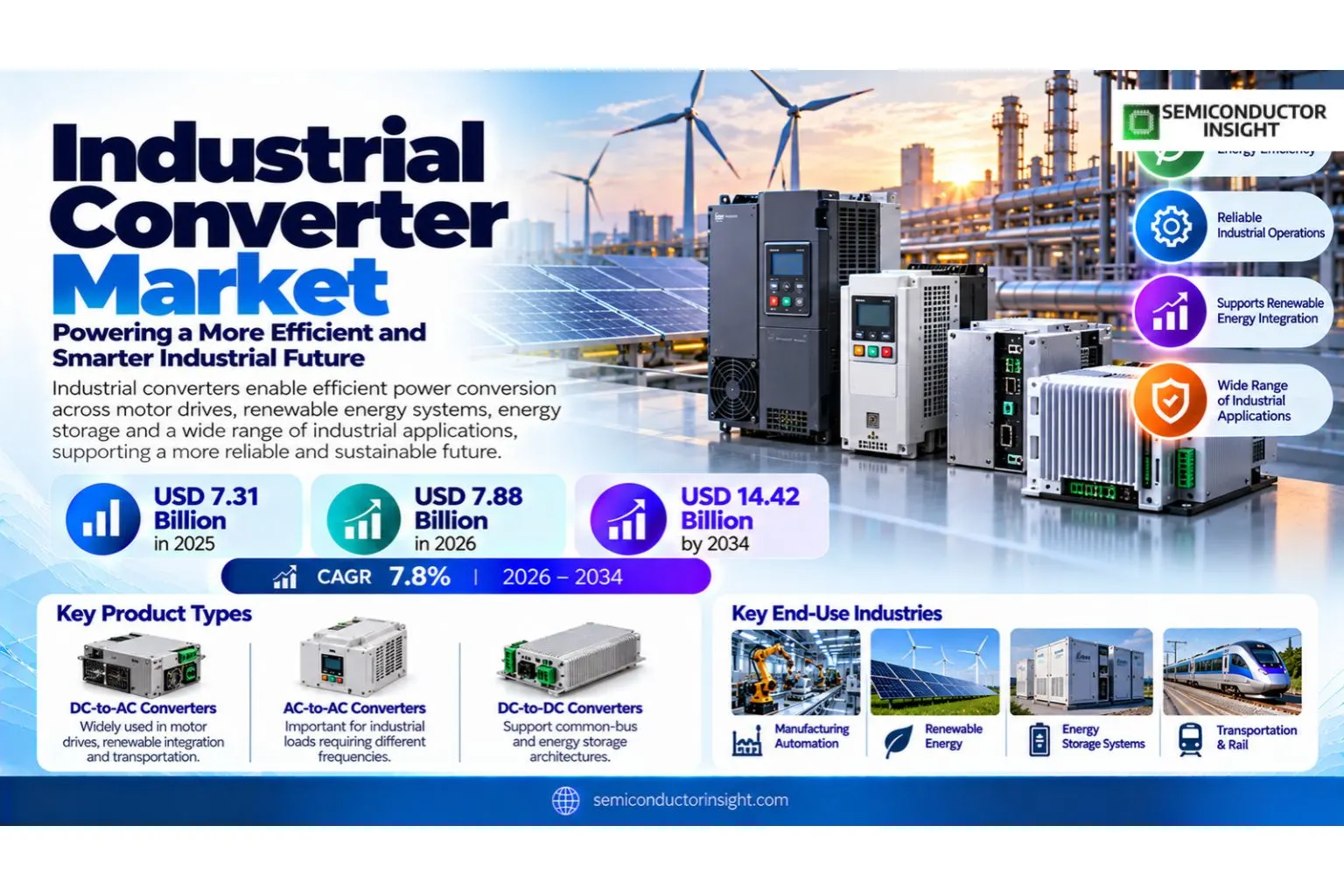
- The market is valued at USD 7.31 billion in 2025 and is projected to reach USD 14.42 billion by 2034, representing a 7.8% CAGR over 2026–2034.
- DC to AC Converter is a major product segment, while adjacent variants are expanding as performance, integration and cost requirements evolve.
- Transportation is a leading application area, supported by demand across Chemical Industry, Iron & Steel.
- Asia Pacific is the largest market in 2025 based on current demand, manufacturing concentration and ecosystem maturity.
Industrial Converter Market Overview
Industrial Converter systems transform electrical power between AC and DC forms, voltage levels or frequencies so industrial equipment can operate efficiently and reliably. They are core components in motor drives, robotics, energy storage, transport, process plants and grid interconnections where raw supply conditions do not directly match the electrical requirements of the load.
Modern converter platforms are becoming more modular, regenerative and software controlled. Common DC buses allow energy sharing between drives, while DC-DC stages connect batteries or supercapacitors for peak shaving and braking-energy recovery. Medium-voltage converters are also improving efficiency, power density and harmonic performance for large industrial motors. Suppliers that translate technical improvements into measurable gains in efficiency, uptime, cost, throughput or workflow simplicity are better positioned to win long-duration programs and repeat purchases.
Segment Analysis: By Type
DC-to-AC converters account for a large value share because inverter stages are central to motor drives, renewable integration, battery systems and transportation. AC-to-AC frequency converters remain important where industrial loads must bridge different frequencies, while DC-to-DC converters support common-bus and storage architectures. Within this segment, customers increasingly compare lifecycle support, qualification requirements, integration effort and total ownership cost rather than relying on a single specification or upfront price.
| Type | Market relevance |
|---|---|
| DC to AC Converter | Motor drives, storage and inverter applications. |
| AC to AC Converter | Frequency conversion and grid matching. |
| DC to DC Converter | Common DC bus and storage interfaces. |
Segment Analysis: By Application
Transportation and manufacturing are major growth applications because electrified rail, marine, robotics and automated production require precise power conversion. Chemical and metals industries add high-power demand where reliability and controlled motor speed directly affect process uptime and energy use. Within this segment, customers increasingly compare lifecycle support, qualification requirements, integration effort and total ownership cost rather than relying on a single specification or upfront price.
| Application | Market relevance |
|---|---|
| Transportation | Rail, marine and electrified transport. |
| Chemical Industry | Pumps, compressors and continuous processes. |
| Iron & Steel | Large motor and furnace systems. |
| Robotics | Servo drives and automated machinery. |
| Automotive | EV manufacturing and testing. |
| Others | Other process and infrastructure uses. |
Segment Analysis: By Voltage Range
Low-voltage systems dominate unit volume, while medium-voltage converters capture high value in large motors, compressors and process industries. High-voltage systems are specialized for grid, heavy industry and very large power-transfer applications. Within this segment, customers increasingly compare lifecycle support, qualification requirements, integration effort and total ownership cost rather than relying on a single specification or upfront price.
| Voltage Range | Market relevance |
|---|---|
| Low Voltage | Broad machinery and facility applications. |
| Medium Voltage | Large industrial drives and compressors. |
| High Voltage | Grid and very-high-power conversion. |
Segment Analysis: By End User
Manufacturing is the broadest end-user base, while energy and utilities add fast-growing demand as renewable generation, storage and electrification increase the need for bidirectional conversion, frequency control and grid-compatible power electronics. Within this segment, customers increasingly compare lifecycle support, qualification requirements, integration effort and total ownership cost rather than relying on a single specification or upfront price.
| End User | Market relevance |
|---|---|
| Manufacturing | Largest installed base. |
| Energy & Power | Renewables, storage and grid integration. |
| Oil & Gas | Drilling, pumping and process systems. |
| Utilities | Power-system stability and interconnection. |
| Others | Specialist industrial users. |
Regional Analysis
Asia Pacific leads through manufacturing scale, industrial automation, EV production and infrastructure investment in China, Japan, South Korea and India. Europe and North America remain high-value markets for energy-efficient drives, process industries and grid-support systems. Regional share also reflects supplier depth, engineering support, manufacturing concentration and the speed at which new Industrial Converter designs can move from evaluation into repeat deployment.
| Region | 2025 Position | Growth Outlook | Demand Profile |
|---|---|---|---|
| Asia Pacific | Largest | Strong | Manufacturing, robotics and infrastructure led |
| Europe | Technology and efficiency market | Moderate-strong | Industrial automation and energy transition led |
| North America | Large high-value market | Strong | Manufacturing, oil & gas and electrification led |
| South America | Emerging | Moderate-strong | Mining, process and renewable led |
| Middle East & Africa | Developing | Strong | Oil & gas, utilities and infrastructure led |
Detailed Regional Blocks
Why is Asia Pacific important to this market?
Asia Pacific leads because China and other regional economies operate enormous installed bases of industrial motors, robotics and process equipment. Expanding factories and electrified transport create broad demand across low- and medium-voltage converters. In Asia Pacific, procurement decisions also depend on service coverage, qualification resources, logistics and long-term availability, so ecosystem maturity can materially influence adoption even when core technology performance is similar.
| Country / Subregion | Role | Market Context |
|---|---|---|
| China | Largest manufacturing market | Automation, EVs and heavy industry drive demand. |
| Japan | Robotics and precision industry | High-performance drives support advanced factories. |
| India | Fast industrial growth | Infrastructure and manufacturing expand converter installations. |
- ABB’s current industrial power-conversion portfolio spans low-voltage and medium-voltage drives, grid interconnection and DC-DC systems.
- The ACS6080 medium-voltage platform reaches up to 36 MW and more than 99% converter efficiency for demanding industrial drives.
- Regional automation growth increases demand for regenerative and multi-drive systems that can share energy across production lines.
Why is Europe important to this market?
Europe is a major technology market through ABB, Siemens and industrial OEM ecosystems. Energy costs and decarbonization policies create strong incentives for high-efficiency motor control, regenerative drives and grid-compatible conversion. In Europe, procurement decisions also depend on service coverage, qualification resources, logistics and long-term availability, so ecosystem maturity can materially influence adoption even when core technology performance is similar.
| Country / Subregion | Role | Market Context |
|---|---|---|
| Germany | Industrial automation hub | Machinery and process industries support drives. |
| Switzerland | Power-conversion technology hub | ABB and industrial systems expertise support innovation. |
| Nordic countries | Marine and energy applications | Regenerative and DC-grid systems create demand. |
- ABB’s ACS880 DC-DC converter transfers energy between a common DC bus and external batteries or supercapacitors.
- Industrial interconnection converters are used to bridge 50 Hz and 60 Hz systems and support stable plant power.
- Regeneration can reduce energy use where motors frequently brake or reverse.
Why is North America important to this market?
North America combines process industries, data centers, manufacturing reshoring and energy infrastructure. Converter demand spans drives, UPS, battery systems and specialized high-power applications. In North America, procurement decisions also depend on service coverage, qualification resources, logistics and long-term availability, so ecosystem maturity can materially influence adoption even when core technology performance is similar.
| Country / Subregion | Role | Market Context |
|---|---|---|
| United States | Largest regional market | Manufacturing and energy systems drive broad demand. |
| Canada | Energy and mining | High-power process equipment supports converters. |
| Mexico | Manufacturing hub | Automotive and industrial facilities expand drive installations. |
- High-power converters support compressors, pumps and process loads where uptime has direct economic value.
- Battery-coupled DC buses can absorb braking energy and reduce peak grid demand.
- Industrial reshoring creates greenfield opportunities for efficient converter systems.
Why is South America important to this market?
South America is an emerging market led by Brazil and Chile, with mining, metals, oil and renewable generation creating strong medium-voltage and high-power conversion needs. In South America, procurement decisions also depend on service coverage, qualification resources, logistics and long-term availability, so ecosystem maturity can materially influence adoption even when core technology performance is similar.
| Country / Subregion | Role | Market Context |
|---|---|---|
| Brazil | Largest regional market | Industry and energy projects support converters. |
| Chile | Mining and renewables | Large motors and power systems create high-value demand. |
| Argentina | Process-industry niche | Oil, gas and industrial applications support use. |
- Mining conveyors, mills and pumps benefit from variable-speed conversion.
- Remote renewable projects increasingly require power conditioning and storage interfaces.
- Service availability is critical for high-power industrial assets.
Why is Middle East & Africa important to this market?
Middle East and Africa demand is expanding through oil and gas, water, mining, renewables and major infrastructure projects. Harsh operating environments favor robust converter platforms with strong service support. In Middle East & Africa, procurement decisions also depend on service coverage, qualification resources, logistics and long-term availability, so ecosystem maturity can materially influence adoption even when core technology performance is similar.
| Country / Subregion | Role | Market Context |
|---|---|---|
| Saudi Arabia | Energy and industrial investment | Large process projects expand converter demand. |
| United Arab Emirates | Infrastructure and utilities | High-efficiency systems support new facilities. |
| South Africa | Mining and industrial market | Medium-voltage drives serve heavy industry. |
- High ambient temperatures increase the value of efficient thermal design.
- Water pumping and desalination create large variable-speed drive applications.
- Renewable-energy investment broadens demand beyond traditional oil and gas.
Competitive Landscape
ABB, Siemens, Schneider Electric, Mitsubishi Electric, Yaskawa, Danfoss, Rockwell Automation, Fuji Electric and specialist converter suppliers compete on efficiency, power range, reliability, controls, safety and service. Software integration and predictive maintenance are increasingly important differentiators.
| Company | Position | Relevant capability |
|---|---|---|
| ABB | Key participant | Broad low- and medium-voltage converter portfolio including regenerative, DC-DC and grid-interconnection systems. |
| Siemens | Key participant | Large industrial-drive and converter installed base across automation and process industries. |
| Schneider Electric | Key participant | Competes through product breadth, integration capability, qualification and customer support. |
| Mitsubishi Electric | Key participant | Competes through product breadth, integration capability, qualification and customer support. |
| Yaskawa Electric | Key participant | Competes through product breadth, integration capability, qualification and customer support. |
| Danfoss | Key participant | High-efficiency drives and power-electronics platforms for industrial and energy applications. |
| Rockwell Automation | Key participant | Competes through product breadth, integration capability, qualification and customer support. |
| Fuji Electric | Key participant | Competes through product breadth, integration capability, qualification and customer support. |
| MORNSUN | Key participant | Competes through product breadth, integration capability, qualification and customer support. |
| Analog Devices | Key participant | Competes through product breadth, integration capability, qualification and customer support. |
Production Capacity Analysis
Industrial converter capacity depends on IGBT or SiC power modules, capacitors, magnetics, control electronics, cooling systems and cabinet assembly. Semiconductor availability can constrain production, but engineering and high-power test capability are also important for medium-voltage systems. Scaling output without degrading consistency requires stable upstream materials, disciplined process control and final testing that catches performance drift before products reach high-value customer systems.
Manufacturing is geographically diversified, with large regional factories serving industrial customers. Effective capacity increasingly includes software commissioning, remote diagnostics and service because downtime risk makes lifecycle support integral to the purchase decision. Second-source planning and regional technical support therefore become increasingly important as deployments expand and buyers seek supply continuity without repeating lengthy qualification work.
Market Dynamics
The market is shifting from one-way motor control toward bidirectional energy management. Regenerative drives, common DC buses and storage interfaces allow plants to recover braking energy, stabilize local power and reduce peak demand rather than dissipating excess energy as heat. This is changing competitive behavior because vendors increasingly sell system-level value, workflow integration and lifecycle economics rather than an isolated component specification.
Wide-bandgap semiconductors are gradually entering selected converter classes, but mature IGBT platforms remain dominant at many industrial power levels. Adoption is determined by total system value, switching frequency, efficiency, cooling and the cost of requalifying proven drive architectures. Buyers consequently evaluate total ownership cost, qualification effort and roadmap stability across the life of a program instead of focusing only on initial purchase price.
Market Drivers
| Factor | Analyst Interpretation |
|---|---|
| Factory automation | More controlled motors and robots increase converter installations. |
| Energy efficiency | Variable-speed drives reduce electricity use in pumps, fans and compressors. |
| Electrified transport | Rail, marine and automotive systems require high-power conversion. |
| Energy storage | Bidirectional DC links and battery systems expand converter functionality. |
Market Restraints
| Factor | Analyst Interpretation |
|---|---|
| High capital cost | Medium- and high-power systems require significant upfront investment. |
| Engineering complexity | Harmonics, protection and thermal design require skilled integration. |
| Industrial cyclicality | Heavy-industry investment can fluctuate with commodity and economic cycles. |
| Long equipment lifecycles | Installed drives may remain operational for many years. |
Market Opportunities
| Factor | Analyst Interpretation |
|---|---|
| Regenerative drives | Energy recovery improves economics in cyclic industrial loads. |
| DC microgrids | Common-bus architectures can integrate storage and renewables. |
| SiC medium-voltage conversion | Higher switching frequency can reduce passive component size. |
| Digital service models | Condition monitoring can create recurring revenue around installed converter fleets. |
Supply Chain Analysis
The value chain combines power semiconductors, passive components, cooling, controls, enclosures, system software and industrial service. High-power products require extensive factory testing and site commissioning before entering continuous-duty operation. Traceability and coordination between component suppliers, integrators and end users are important because failures found late in the chain can be far more expensive than the underlying part itself.
| Supply Chain Stage | Role in the Market |
|---|---|
| Power modules and passives | IGBTs, SiC devices, capacitors and magnetics form the conversion stage. |
| Converter assembly | Power electronics, cooling and controls are integrated into modules or cabinets. |
| Control software and commissioning | Firmware, grid codes and motor parameters are configured for the application. |
| Industrial operation and service | Converters run motors, grids and storage systems with long-term maintenance support. |
Recent Developments
| Date | Development | Source |
|---|---|---|
| 2026 | ABB continues the ACS880-1604 DC-DC converter platform for bidirectional energy transfer between common DC buses and batteries or supercapacitors. | ABB |
| 2026 | ABB's ACS6080 medium-voltage drive platform covers applications up to 36 MW and reports converter efficiency above 99%. | ABB |
| 2026 | ABB continues industrial interconnection converters designed to link systems operating at different grid frequencies such as 50 Hz and 60 Hz. | ABB |
Report Scope & Segmentation
| Scope Item | Coverage |
|---|---|
| Base Year | 2025 |
| Estimated Year | 2026 |
| Forecast Period | 2026–2034 |
| 2025 Market Size | USD 7.31 billion |
| 2026 Estimated Size | USD 7.88 billion |
| 2034 Forecast Size | USD 14.42 billion |
| CAGR (2026–2034) | 7.8% |
| Largest Market in 2025 | Asia Pacific |
| Category | Power Electronics / Industrial Conversion / Drives & Converters |
| By Type | DC to AC Converter, AC to AC Converter, DC to DC Converter |
| By Application | Transportation, Chemical Industry, Iron & Steel, Robotics, Automotive, Others |
| By Voltage Range | Low Voltage, Medium Voltage, High Voltage |
| By End User | Manufacturing, Energy & Power, Oil & Gas, Utilities, Others |
Frequently Asked Questions
What is the 2025 market size of the Industrial Converter market?
The market is valued at USD 7.31 billion in 2025.
What is the projected 2034 market size of the Industrial Converter market?
The market is projected to reach USD 14.42 billion by 2034.
What is the CAGR of the Industrial Converter market from 2026 to 2034?
The market is expected to expand at a CAGR of 7.8% during 2026–2034.
Which region leads the Industrial Converter market?
Asia Pacific is the largest market in 2025 based on the current demand, manufacturing and deployment structure.
Which type segment is important in the Industrial Converter market?
DC to AC Converter is a major segment, while adjacent product variants are gaining share as performance and integration requirements evolve.
What is the main application for Industrial Converter products?
Transportation is a leading application, with additional growth coming from Chemical Industry, Iron & Steel.
What drives growth in the Industrial Converter market?
More controlled motors and robots increase converter installations.
What is a key restraint for the Industrial Converter market?
Medium- and high-power systems require significant upfront investment.
Which companies participate in the Industrial Converter market?
Key participants include ABB, Siemens, Schneider Electric, Mitsubishi Electric, Yaskawa Electric, alongside other specialized suppliers and system companies.
What technology trend is shaping the Industrial Converter market?
Energy recovery improves economics in cyclic industrial loads.
Research Sources & Evidence Base
View research sources used for this overview.
- ABB — Power Conversion and Control: Industrial conversion, grid and drive application framework. Source
- ABB — ACS880-1604 DC-DC Converter: Bidirectional common-bus energy-storage conversion. Source
- ABB — ACS6080 Medium Voltage Drive: High-power range, efficiency and industrial-drive specifications. Source
Get Sample Report PDF for Exclusive Insights
Report Sample Includes
- Table of Contents
- List of Tables & Figures
- Charts, Research Methodology, and more...
 Download Sample Report PDF