
Robotics ToF Driver IC Market Insights
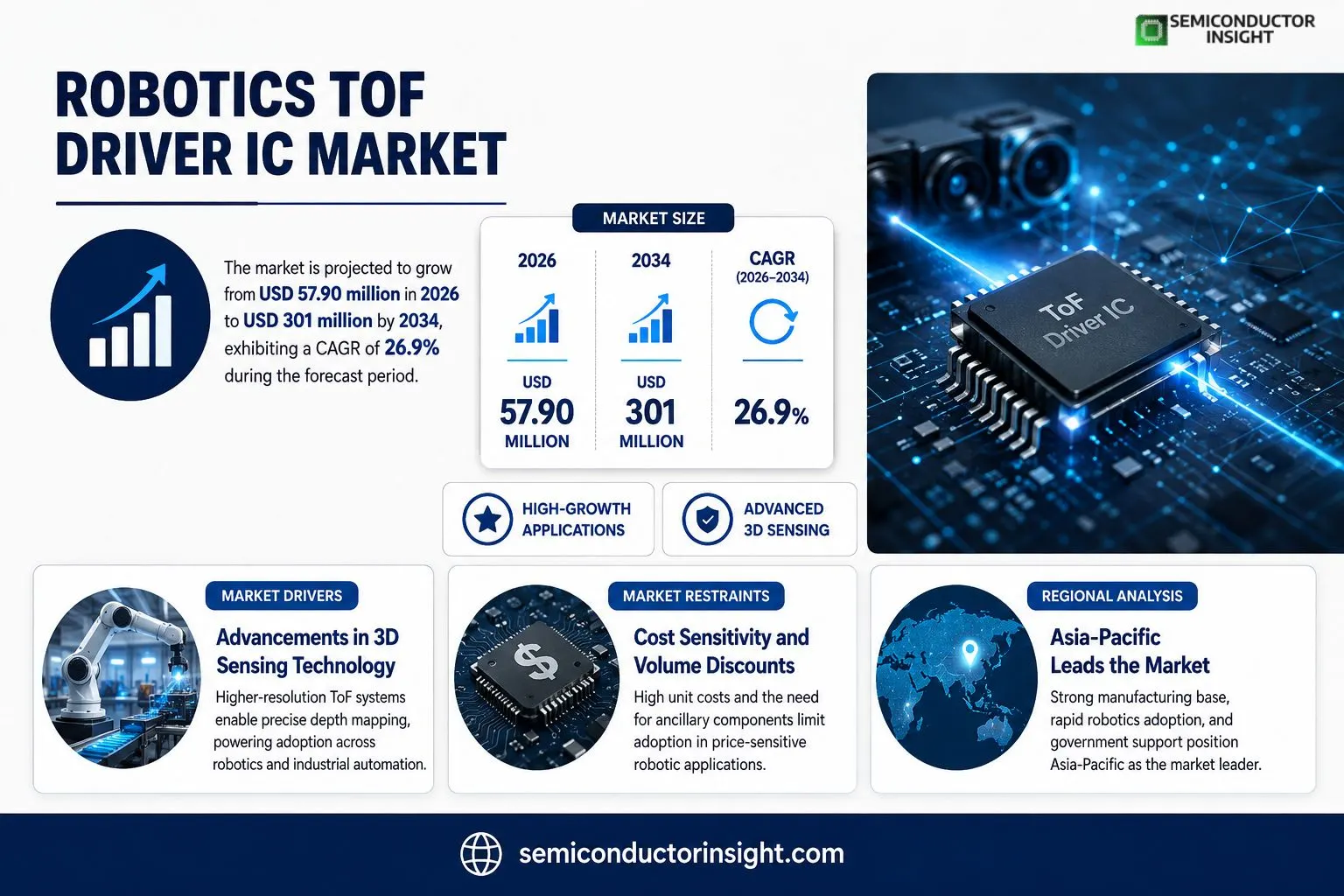
Robotics ToF Driver IC market size was valued at USD 57.90 million in 2025. The market is forecasted to increase from USD 57.90 million in 2025 to USD 301 million by 2034, exhibiting a CAGR of 26.9 % during the forecast period.
Robotics ToF driver ICs are semiconductor components positioned on the emitter side of a three‑dimensional depth‑sensing chain. Their primary function is to drive VCSELs or laser diodes with high peak current and fast modulation, enabling distance measurement, depth mapping, and object recognition when paired with Time‑of‑Flight image sensors or SPAD receivers. Current solutions from Sony, Infineon, AKM, EPC and Awinic extend the technology beyond short‑range mobile uses into robotics, industrial vision, automotive cabin sensing and safety systems.
MARKET DRIVERS
Advancements in 3D Sensing Technology
The convergence of higher‑resolution time‑of‑flight (ToF) architectures and lower power consumption has elevated the attractiveness of depth‑aware modules for robotics platforms. Manufacturers are now able to embed compact sensors that deliver centimeter‑level accuracy, allowing robots to navigate complex environments with confidence. This technical leap fuels greater adoption of Robotics ToF Driver IC Market across both industrial and service sectors.
Increasing Automation in Manufacturing
Factories worldwide are upgrading legacy lines with collaborative robots that require precise spatial awareness to coexist safely with human operators. The demand for driver ICs that translate raw photonic data into reliable distance metrics has risen in step with higher throughput goals. Companies that secure robust driver solutions can accelerate cycle times while reducing downtime linked to collision incidents.
➤ Robust ToF driver ICs are becoming the de‑facto interface between sensors and control algorithms, enabling real‑time path planning that was previously confined to research labs.
Vendors that pair advanced driver ICs with open‑source software ecosystems create a virtuous loop: developers gain faster time‑to‑market, end users experience more adaptable robots, and the overall market velocity picks up. This feedback cycle underpins sustained growth for the sector.
MARKET CHALLENGES
Technical Integration Barriers
Deploying ToF driver ICs within heterogeneous robot architectures often requires custom firmware and precise board‑level tuning. Small and medium‑sized system integrators lack the engineering bandwidth to manage these complexities, leading to longer development cycles and higher upfront costs.
Other Challenges
Supply Chain Volatility
Fluctuations in semiconductor raw‑material availability translate into lead‑time uncertainties for driver IC inventories. End‑users who cannot guarantee component supply risk production bottlenecks, prompting many to maintain safety stocks that erode profit margins.
MARKET RESTRAINTS
Cost Sensitivity and Volume Discounts
While performance metrics have improved, the unit price of high‑precision ToF driver ICs remains above the threshold for low‑margin robotic applications such as consumer‑grade cleaning devices. Buyers often negotiate steep volume discounts, but manufacturers struggle to sustain margins without compromising R&D investment, creating a pricing ceiling that restrains broader market diffusion.Additionally, the need for ancillary componentssuch as precision clock generators and low‑noise amplifiersadds to the bill of materials, making total system cost assessments critical before large‑scale adoption.
MARKET OPPORTUNITIES
Emerging Applications in Service Robotics
Service robots deployed in healthcare, hospitality, and retail are beginning to rely on depth perception for tasks ranging from patient monitoring to inventory scanning. These verticals prioritize safety and reliability, attributes that are directly enhanced by sophisticated ToF driver ICs. Early movers that align product roadmaps with these use‑cases can capture premium pricing and establish brand leadership.Furthermore, the rise of edge‑AI processing opens a pathway for driver ICs that embed preliminary signal conditioning on‑chip, reducing data bandwidth requirements and enabling tighter integration with neural‑network accelerators. This architectural shift presents a clear avenue for differentiation in a crowded semiconductor landscape.
Robotics ToF Driver IC Market Trends
System‑Level Integration Gains Traction
The most visible shift in the Robotics ToF Driver IC arena is the move from isolated driver blocks toward tightly coupled sensor‑driver modules. Manufacturers such as Sony and Infineon now ship solutions that embed high‑speed modulation, peak‑current boost, eye‑safety logic, and temperature monitoring within a single footprint that directly mates to VCSEL arrays. This integration reduces board‑level interconnects, trims BOM cost and improves signal integritycritical for robot OEMs that demand sub‑millimeter ranging accuracy in electrically noisy factories. The trend is reinforced by the rise of collaborative robots (cobots) where compact form‑factor and fast time‑of‑flight cycles translate into smoother human‑machine interaction.
Other Trends
Performance Metrics Expand Beyond Pulse Power
Earlier driver designs were judged solely on their ability to generate a laser pulse. Today, buyers scrutinize modulation frequency, rise/fall time, EMC behavior, and built‑in redundancy. EPC’s GaN‑based ICs illustrate this change, delivering >10 GHz modulation while maintaining low thermal resistance. For automotive‑grade sensors, the added safety layerssuch as fail‑safe shutdown and real‑time temperature throttlingare becoming non‑negotiable, pushing suppliers to embed more intelligence at the silicon level.
Multi‑Market Demand Fuels Diversified Portfolios
Industrial robotics, mobile service units, in‑cabin automotive sensing, and high‑end consumer 3D vision each contribute to volume growth. The International Federation of Robotics reported over half a million new industrial robot installations in 2024, with a strong concentration in Asia. Simultaneously, cabin monitoring systems in premium vehicles are adopting ToF modules for occupant detection. This cross‑segment pull forces IC providers to certify products for varying reliability classesfrom rugged factory environments to automotive safety standardsthereby widening the overall addressable market.
Regional Supply‑Chain Realignment Shapes Competitive Landscape
Japan continues to dominate high‑performance VCSEL driver design, leveraging legacy expertise in optoelectronics. Europe, led by Infineon, concentrates on automotive‑grade integration, emphasizing long‑term reliability and compliance with EU safety directives. The United States differentiates through GaN technology that enables higher current density in smaller packages, appealing to defense and high‑end industrial customers. Meanwhile, Chinese firms such as Awinic have accelerated productization, targeting cost‑sensitive mass markets in Southeast Asia. This multi‑pole distribution means that robot manufacturers can source drivers that best align with their regional compliance requirements and cost structures, while also benefiting from a competitive pricing environment driven by overlapping capabilities.
COMPETITIVE LANDSCAPE
Key Industry Players
Robotics ToF Driver IC Market – Competitive Overview
Sony Semiconductor Solutions Corporation dominates the upper‑end segment, leveraging its deep VCSEL expertise and automotive‑grade qualification to secure most of the high‑volume contracts with Tier‑1 automotive suppliers and industrial robot OEMs. Sony’s integrated driver‑sensor roadmap couples high‑frequency modulation with built‑in eye‑safety mechanisms, enabling customers to reduce bill‑of‑materials while meeting stringent reliability standards. Infineon Technologies AG follows closely, differentiating through a portfolio that merges its REAL3 imagers with proprietary driver blocks, thereby offering a tighter sensor‑driver co‑design that appeals to manufacturers targeting rugged industrial vision systems. Awinic Technology Co., Ltd. and Efficient Power Conversion Corporation (EPC) round out the leadership tier, each advancing GaN‑based high‑current architectures that shrink footprints and improve thermal performanceattributes that are increasingly decisive as robot manufacturers push for higher power density within constrained chassis.Beyond the marquee names, a cluster of niche innovators is reshaping specific sub‑segments. Renesas Electronics Corporation supplies automotive‑grade drivers with extensive diagnostic features, catering to in‑cabin safety applications. onsemi and Nuvoton Technology Corporation have concentrated on iToF and Pulse‑ToF solutions that excel in short‑range obstacle detection for mobile robots and service‑robot platforms. Dongwoon Anatech Co., Ltd. and Asahi Kasei Microdevices Corporation focus on multi‑junction VCSEL driver integration, addressing the needs of high‑resolution 3D cameras used in consumer electronics and precision manufacturing. Smaller European and Asian players such as STMicroelectronics, Analog Devices, Melexis, and Himax contribute specialized interfaces (LVDS, SPI) and temperature‑monitoring blocks, allowing system integrators to assemble highly customized sensing modules without over‑engineering the driver core.
List of Key Robotics ToF Driver IC Companies Profiled
- Sony Semiconductor Solutions Corporation
- Infineon Technologies AG
- Awinic Technology Co., Ltd.
- Efficient Power Conversion Corporation
- Renesas Electronics Corporation
- onsemi
- Nuvoton Technology Corporation
- Dongwoon Anatech Co., Ltd.
- Asahi Kasei Microdevices Corporation
- STMicroelectronics
- Analog Devices
- Melexis
- Himax Technologies, Inc.
- Texas Instruments
Segment Analysis:
| Segment Category | Sub-Segments | Key Insights |
| By Type |
|
Leading Segment
|
| By Application |
|
Leading Segment
|
| By End User |
|
Leading Segment
|
| By Technology |
|
Leading Segment
|
| By Integration Level |
|
Leading Segment
|
Regional Analysis: Robotics ToF Driver IC Market
Asia‑Pacific
Taiwan’s semiconductor fabs dominate volume output, while South Korea supplies advanced node capabilities; this geographic split creates a resilient supply chain that can absorb demand spikes without resorting to cross‑continental shipping delays.
Urban middle‑class expansion drives purchases of vacuum, lawn‑mowing, and personal assistant robots, each relying on ToF drivers for obstacle avoidance, thereby expanding the market beyond industrial niches.
National strategies in Japan and Singapore allocate budget lines to robotics R&D, granting tax rebates to firms that integrate ToF technology, which accelerates prototype throughput and market entry.
Regional logistics hubs near port cities enable rapid component distribution, mitigating the impact of geopolitical tension that could otherwise interrupt flow from traditional western suppliers.
North America
The United States maintains a strong design talent pool that focuses on high‑performance ToF driver architectures for autonomous warehouse platforms. While most silicon is imported, domestic chip design houses differentiate through AI‑enhanced perception algorithms that layer on top of standard depth data. Canadian research institutions contribute cutting‑edge simulations that feed back into product roadmaps, ensuring the North American segment remains a hub for advanced functional integration rather than pure volume production.
Europe
European manufacturers emphasize safety‑critical applications, especially in collaborative industrial robots used on automotive assembly lines. Regulations from the EU drive a preference for components with proven reliability, prompting local distributors to curate a narrow set of ToF driver suppliers that meet stringent quality certifications. Additionally, sustainability agendas push OEMs toward energy‑efficient drivers, opening niche opportunities for low‑power IC designs.
South America
Brazil and Argentina are witnessing a modest uptick in agricultural robotics, where ToF drivers support terrain mapping for autonomous tractors. Limited local fab capacity means the region relies on imports, but partnerships with Asian vendors are maturing, offering joint‑development projects that tailor driver performance to tropical environments and rugged field conditions.
Middle East & Africa
In the Gulf Cooperation Council, investments in smart city infrastructure generate demand for security and delivery drones that embed ToF drivers for precise landing. African markets, though still nascent, are beginning to explore low‑cost service robots for healthcare delivery, prompting a gradual entry of cost‑effective driver ICs through regional distributors.
Report Scope
This market research report provides a comprehensive analysis of the Robotics ToF Driver IC Market , covering the forecast period 2026–2034. It offers detailed insights into market dynamics, technological advancements, competitive landscape, and key trends shaping the industry.
Key focus areas of the report include:
- Market Overview: The report begins with an overview outlining its current market scenario, key growth indicators, and industry transformation drivers. It discusses macroeconomic factors, demand–supply balance, regulatory landscape, and the strategic role of semiconductors in powering advancements across industries such as automotive, telecommunications, consumer electronics, and industrial automation.
- Market Size & Forecast: Historical data and future projections for revenue, unit shipments, and market value across major regions and segments.
- Segmentation Analysis: Detailed breakdown by product type, technology, application, and end-user industry to identify high-growth segments and investment opportunities.
- Regional Insights: Insights into market performance across North America, Europe, Asia-Pacific, Latin America, and the Middle East & Africa, including country-level analysis where relevant.
- Competitive Landscape: Profiles of leading market participants, including their product offerings, R&D focus, manufacturing capacity, pricing strategies, and recent developments such as mergers, acquisitions, and partnerships.
- Technology Trends & Innovation: Assessment of emerging technologies, integration of AI/IoT, semiconductor design trends, fabrication techniques, and evolving industry standards.
- Market Drivers & Restraints: Evaluation of factors driving market growth along with challenges, supply chain constraints, regulatory issues, and market-entry barriers.
- Stakeholder Insights: Insights for component suppliers, OEMs, system integrators, investors, and policymakers regarding the evolving ecosystem and strategic opportunities.
Primary and secondary research methods are employed, including interviews with industry experts, data from verified sources, and real-time market intelligence to ensure the accuracy and reliability of the insights presented.
FREQUENTLY ASKED QUESTIONS:
What is the current market size of Robotics ToF Driver IC Market?
-> Robotics ToF Driver IC Market was valued at USD 57.90 million in 2025 and is expected to reach USD 301 million by 2034, at a CAGR of 26.9% during the forecast period
Which key companies operate in Robotics ToF Driver IC Market?
-> Key players include Sony Semiconductor Solutions Corporation, Asahi Kasei Microdevices Corporation, Infineon Technologies AG, Efficient Power Conversion Corporation, Awinic Technology Co., Ltd., Renesas Electronics Corporation, onsemi, Nuvoton Technology Corporation, and Dongwoon Anatech Co., Ltd.
What are the key growth drivers?
-> Key growth drivers include expansion of industrial and service robots, increasing adoption of 3D depth sensing in automotive cabin and industrial vision, rising demand for high‑speed, high‑current VCSEL drivers, and safety‑critical applications in robotics and industrial automation.
Which region dominates the market?
-> Asia remains the dominant region, driven by dense robot deployment, extensive consumer electronics supply chains, and rapid growth in automotive electronics.
What are the emerging trends?
-> Emerging trends include system‑level integration of driver ICs with imagers and algorithms, miniaturization using GaN technology, higher power‑density designs, enhanced safety redundancy, and multi‑scenario adaptability for robotics, automotive and industrial safety applications.
Get Sample Report PDF for Exclusive Insights
Report Sample Includes
- Table of Contents
- List of Tables & Figures
- Charts, Research Methodology, and more...





