MARKET INSIGHTS
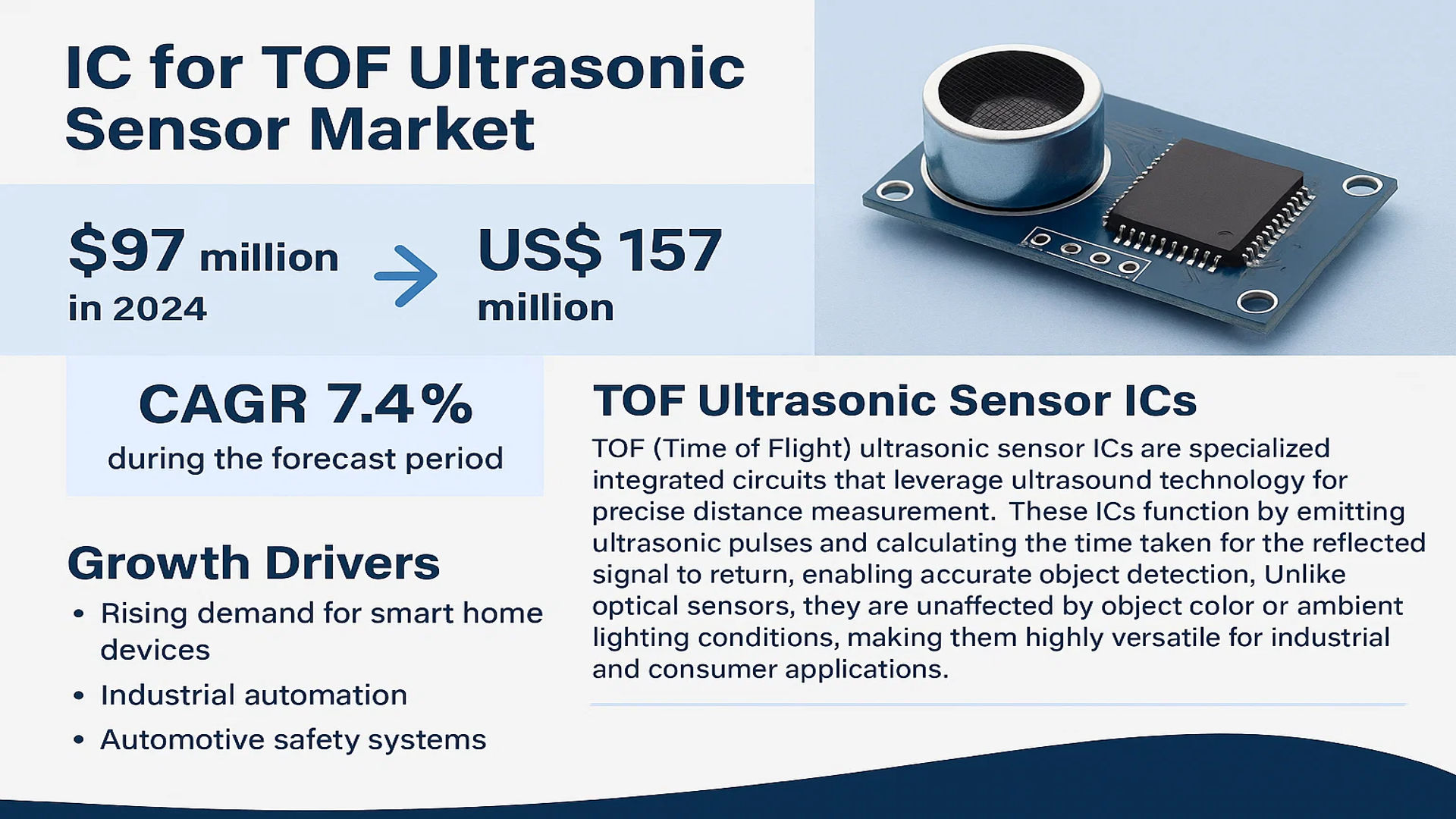
The global IC for TOF Ultrasonic Sensor Market was valued at 97 million in 2024 and is projected to reach US$ 157 million by 2032, at a CAGR of 7.4% during the forecast period.
TOF (Time of Flight) ultrasonic sensor ICs are specialized integrated circuits that leverage ultrasound technology for precise distance measurement. These ICs function by emitting ultrasonic pulses and calculating the time taken for the reflected signal to return, enabling accurate object detection. Unlike optical sensors, they are unaffected by object color or ambient lighting conditions, making them highly versatile for industrial and consumer applications.
The market is experiencing steady growth due to rising demand for smart home devices, industrial automation, and automotive safety systems. Key regions like the U.S. and China are driving adoption, with significant investments in IoT infrastructure. The AFE IC segment is expected to witness accelerated growth, supported by advancements in signal processing efficiency. Leading players such as Texas Instruments, Maxim Integrated (Analog Devices), and Elmos Semiconductor dominate the market with innovative solutions tailored for diverse applications.
MARKET DYNAMICS
MARKET DRIVERS
Rising Adoption in Automotive and Industrial Applications Fuels Market Expansion
The automotive industry’s increasing integration of advanced driver-assistance systems (ADAS) is a primary growth driver for TOF ultrasonic sensor ICs. These components enable precise object detection for parking assistance, blind-spot monitoring, and autonomous emergency braking. With the global ADAS market projected to grow substantially, demand for reliable distance measurement solutions like ultrasonic TOF sensors continues to rise. The industrial sector also contributes significantly, utilizing these ICs for liquid level measurement, robotics positioning, and collision avoidance systems in warehouses.
Smart Home and IoT Revolution Accelerates Demand
Consumer appetite for smart home devices incorporating ultrasonic sensing technology has surged, with applications ranging from automatic faucets to smart lighting systems. The ability of TOF ultrasonic ICs to operate reliably regardless of lighting conditions makes them indispensable for IoT devices. Market growth is further propelled by their use in emerging augmented reality (AR) and virtual reality (VR) applications, where precise movement tracking enhances user experience. The global smart home market’s rapid expansion continues to create new opportunities for ultrasonic sensor IC implementations.
Technological Advancements Enhance Market Penetration
Recent innovations in IC design have significantly improved the accuracy and power efficiency of TOF ultrasonic sensors. Advanced signal processing algorithms now enable sub-millimeter measurement precision, while low-power designs extend battery life for portable devices. Leading manufacturers continue to release integrated solutions that combine analog front-end (AFE) and digital processing functions into single chips, reducing system complexity and cost. These technological improvements are making ultrasonic sensing viable for broader applications, from medical devices to consumer drones.
MARKET RESTRAINTS
Competition from Alternative Sensing Technologies Limits Growth Potential
While TOF ultrasonic sensors offer certain advantages, they face intense competition from optical and LiDAR-based solutions in many applications. Infrared sensors and cameras often provide higher resolution for gesture recognition, while LiDAR systems deliver superior range and accuracy for autonomous vehicles. In consumer electronics, capacitive and optical fingerprint sensors dominate biometric applications that could potentially use ultrasonic technology. This competitive landscape requires ultrasonic sensor IC providers to continuously innovate to maintain their market position.
Environmental Factors Impact Performance and Reliability
Despite their robustness compared to optical sensors, ultrasonic ICs still face performance limitations in certain environmental conditions. Temperature variations can affect sound wave propagation speed, requiring compensation algorithms that add complexity. High humidity environments may attenuate ultrasonic signals, while multiple reflection scenarios in confined spaces can challenge distance measurement accuracy. These physical constraints limit adoption in some industrial and outdoor applications where environmental conditions are highly variable.
Supply Chain and Fabrication Challenges Constrain Production
The semiconductor industry’s cyclical nature impacts TOF ultrasonic sensor IC availability, with wafer supply and packaging capacity occasionally creating bottlenecks. Specialized MEMS structures in some ultrasonic sensors require dedicated fabrication lines, limiting production scalability compared to standard CMOS processes. These manufacturing complexities contribute to longer lead times and higher production costs compared to some alternative sensing technologies, particularly for high-volume consumer applications where price sensitivity is extreme.
MARKET OPPORTUNITIES
Emerging Medical Applications Open New Revenue Streams
The healthcare sector presents significant untapped potential for TOF ultrasonic sensor ICs. Advancements in non-contact vital sign monitoring, such as respiration rate detection through chest wall movement tracking, create opportunities for compact ultrasonic solutions. Medical device manufacturers are exploring these ICs for applications ranging from drug delivery monitoring to assistive technologies for visually impaired users. As regulatory pathways for medical devices become clearer, adoption in this high-value sector could accelerate dramatically.
Industrial Automation Investments Drive Demand Growth
Manufacturing modernization initiatives worldwide are creating robust demand for reliable sensing solutions. TOF ultrasonic ICs are finding increasing use in robotic material handling, automated guided vehicles (AGVs), and precise positioning systems. The transition to Industry 4.0 standards, emphasizing real-time monitoring and adaptive processes, favors ultrasonic technology’s ability to provide continuous, accurate distance measurements in challenging industrial environments. This trend is particularly strong in clean energy sectors like battery manufacturing and solar panel production.
Partnerships Across Value Chain Strengthen Market Position
Strategic collaborations between IC manufacturers, sensor module producers, and end-system integrators are creating vertically optimized solutions. Recent alliances have focused on developing application-specific reference designs that reduce time-to-market for OEMs. By working closely with software partners to enhance processing algorithms, and with materials suppliers to improve transducer efficiency, the industry is positioning ultrasonic sensing as a versatile solution across multiple high-growth markets.
MARKET CHALLENGES
Design Complexity Increases Development Costs and Time
Developing high-performance TOF ultrasonic sensor ICs requires expertise across multiple domains, including analog mixed-signal design, ultrasound physics, and advanced packaging. The need to integrate sensitive analog front-ends with powerful digital signal processors leads to lengthy development cycles and substantial R&D investment. Achieving optimal performance often requires custom transducer matching and specialized calibration procedures, creating additional hurdles for mass production and testing.
Standardization Gaps Hinder Ecosystem Development
The absence of universal standards for ultrasonic sensing interfaces and protocols creates compatibility challenges across different vendors’ solutions. While some application-specific standards exist in automotive contexts, most consumer and industrial implementations require custom integration work. This fragmentation increases development costs for end-product manufacturers and slows market adoption compared to more standardized sensing technologies.
Performance Versus Cost Trade-offs Limit Market Penetration
Balancing measurement accuracy, power consumption, and cost remains an ongoing challenge for TOF ultrasonic IC providers. High-performance solutions with sub-millimeter accuracy often carry premium pricing that makes them unsuitable for mass-market consumer applications. Conversely, cost-optimized versions may lack the precision required for medical or industrial use cases. Finding the right balance for specific market segments requires careful design compromises that can delay product introductions and impact competitive positioning.
Here is the requested HTML content for the IC for TOF Ultrasonic Sensor Market report:
IC FOR TOF ULTRASONIC SENSOR MARKET TRENDS
Integration of AI and Machine Learning in TOF Ultrasonic Sensors Gains Momentum
The global IC for TOF (Time of Flight) ultrasonic sensor market is experiencing significant transformation with the integration of artificial intelligence and machine learning capabilities. This technological convergence is enhancing the accuracy, reliability, and processing speed of distance measurement applications across industries. The average error margin for distance calculations in traditional ultrasonic sensors has improved from ±3% to less than ±1% in AI-enhanced systems, making them increasingly attractive for precision applications. Advanced signal processing algorithms are now able to distinguish between multiple echoes and filter environmental noise more effectively, enabling these sensors to operate reliably in challenging industrial environments.
Other Trends
Automotive Sector Driving Demand Growth
The automotive industry continues to be a key growth driver for TOF ultrasonic sensor ICs, with applications expanding beyond traditional parking assistance systems. Modern vehicles now incorporate an average of 8-12 ultrasonic sensors for applications ranging from automated parking to autonomous emergency braking systems. As vehicle autonomy levels increase, the demand for high-precision, low-latency ultrasonic sensing solutions is expected to grow significantly, with the automotive segment projected to account for over 35% of the total market revenue by 2030.
Expansion of Smart Home and IoT Ecosystems
The proliferation of smart home devices and IoT applications is creating new opportunities for TOF ultrasonic sensor ICs. These components are increasingly being integrated into smart appliances, security systems, and building automation solutions for presence detection and room mapping. The global smart home market’s rapid growth, projected to exceed 25% CAGR through 2030, is directly contributing to increased adoption of ultrasonic sensing technologies. Manufacturers are responding with smaller, more energy-efficient ICs that can operate reliably on battery power for extended periods, making them ideal for IoT deployments.
COMPETITIVE LANDSCAPE
Key Industry Players
Semiconductor Giants Compete for Dominance in High-Growth TOF Sensor Market
The global IC for TOF Ultrasonic Sensor market exhibits a moderately fragmented competitive landscape, with a mix of established semiconductor leaders and specialized sensor manufacturers vying for market share. Texas Instruments (TI) emerges as a frontrunner, leveraging its robust analog technology portfolio and extensive R&D capabilities to develop high-performance TOF sensor ICs. The company’s strong foothold in automotive and industrial applications gives it a competitive edge in this space.
Analog Devices (including Maxim Integrated) holds significant market presence, capitalizing on its expertise in signal processing and power management technologies. The company’s 2023 launch of a new ultra-low-power TOF sensor IC solution helped strengthen its position in consumer electronics applications.
Meanwhile, Elmos Semiconductor AG has been gaining traction with its innovative TOF sensor ICs optimized for automotive applications. The company’s proprietary signal processing algorithms provide enhanced distance measurement accuracy, making its solutions particularly attractive for advanced driver assistance systems (ADAS).
Emerging players like CHIRP Microsystems are disrupting the market with specialized MEMS-based ultrasonic sensor solutions. Their recent collaboration with a major AR/VR headset manufacturer demonstrates the growing importance of TOF technology in immersive computing applications.
List of Key IC for TOF Ultrasonic Sensor Manufacturers
- Texas Instruments (TI) (U.S.)
- Analog Devices, Inc. (including Maxim Integrated) (U.S.)
- Elmos Semiconductor SE (Germany)
- CHIRP Microsystems (U.S.)
- Microchip Technology Inc. (U.S.)
- STMicroelectronics (Switzerland)
- NXP Semiconductors (Netherlands)
- Maocheng Technology (China)
- ROHM Semiconductor (Japan)
Segment Analysis:
By Type
AFE IC Segment Leads the Market Due to High Demand for Signal Processing in Distance Measurement Applications
The IC for TOF Ultrasonic Sensor market is segmented based on type into:
- AFE IC (Analog Front-End Integrated Circuit)
- SoC (System-on-Chip)
- Others
By Application
Automotive and Industrial Segment Dominates Due to Increasing Adoption of Ultrasonic Sensors for Safety and Automation
The market is segmented based on application into:
- Smart Home and IoT
- Consumer Electronics
- Robots and Drones
- AR/VR
- Automotive and Industrial
- Others
By End User
OEMs Hold Significant Market Share Due to Direct Integration of ICs in Final Products
The market is segmented based on end user into:
- Original Equipment Manufacturers (OEMs)
- Component Suppliers
- System Integrators
- Others
Regional Analysis: IC for TOF Ultrasonic Sensor Market
Asia-Pacific
The Asia-Pacific region dominates the global IC for TOF Ultrasonic Sensor market, driven by rapid industrialization and high demand from the consumer electronics and automotive sectors. China, in particular, leads in both production and consumption, leveraging its strong semiconductor manufacturing ecosystem. The region benefits from increasing adoption in smart home applications and IoT devices, with major electronics manufacturers integrating ultrasonic sensors for touchless interfaces. Japan and South Korea contribute significantly through advanced automotive applications, where ultrasonic ICs are essential for parking assistance and collision avoidance systems. However, price sensitivity remains a challenge, pushing local players like Maocheng Technology to focus on cost-effective solutions.
North America
North America holds a prominent position in the IC for TOF Ultrasonic Sensor market, fueled by technological innovation and strong R&D investments. The U.S. stands out with widespread adoption in robotics, AR/VR, and automotive applications, particularly in electric vehicles. Companies like Texas Instruments (TI) and Maxim Integrated (now part of Analog Devices) drive advancements in high-performance AFE ICs and SoCs. Stringent safety regulations in the automotive sector further propel demand for reliable ultrasonic sensing solutions. Additionally, smart city initiatives and IoT proliferation create sustained opportunities, though competition from optical sensors limits growth in certain segments.
Europe
Europe showcases steady growth in the TOF Ultrasonic Sensor IC market, supported by stringent automotive safety standards and the push for Industry 4.0 automation. Germany is a key contributor, with automotive OEMs integrating ultrasonic sensors for advanced driver-assistance systems (ADAS). Companies like Elmos Semiconductor focus on developing energy-efficient ICs, aligning with the EU’s sustainability goals. The region also sees adoption in industrial robotics and healthcare devices, where precision and noise immunity are critical. However, slower-than-expected adoption in consumer electronics compared to Asia-Pacific restrains the market’s expansion.
Middle East & Africa
The Middle East & Africa region represents an emerging market for TOF Ultrasonic Sensor ICs, with growth centered around smart infrastructure projects in the UAE and Saudi Arabia. The automotive sector shows potential, especially in luxury vehicles equipped with parking sensors. However, limited local semiconductor manufacturing and reliance on imports hinder market penetration. In Africa, nascent industrialization and low awareness of ultrasonic sensing technology result in minimal adoption, though IoT and smart agriculture applications could unlock future opportunities.
South America
South America’s market is relatively underdeveloped but exhibits gradual growth due to increasing automotive production in Brazil and Argentina. Cost constraints and economic instability delay large-scale adoption, with local manufacturers primarily sourcing ICs from global suppliers. Industrial automation and building automation projects present niche opportunities, but the absence of a robust semiconductor ecosystem slows progress. Despite these challenges, rising demand for consumer electronics offers a avenue for incremental growth.
Report Scope
This market research report provides a comprehensive analysis of the global IC for TOF Ultrasonic Sensor market, covering the forecast period 2024–2032. It offers detailed insights into market dynamics, technological advancements, competitive landscape, and key trends shaping the industry.
Key focus areas of the report include:
- Market Size & Forecast: Historical data and future projections for revenue, unit shipments, and market value across major regions and segments. The global IC for TOF Ultrasonic Sensor market was valued at USD 97 million in 2024 and is projected to reach USD 157 million by 2032, at a CAGR of 7.4% during the forecast period.
- Segmentation Analysis: Detailed breakdown by product type (AFE IC, SoC, Others), application (Smart Home and IoT, Consumer Electronics, Robots and Drones, AR/VR, Automotive and Industrial, Others), and end-user industry to identify high-growth segments and investment opportunities.
- Regional Outlook: Insights into market performance across North America, Europe, Asia-Pacific, Latin America, and the Middle East & Africa, including country-level analysis. The U.S. market size is estimated at USD million in 2024, while China is expected to reach USD million by 2032.
- Competitive Landscape: Profiles of leading market participants, including TI, Maxim (Analog Devices), Elmos, Chirp, and Maocheng Technology, with their product offerings, R&D focus, manufacturing capacity, pricing strategies, and recent developments.
- Technology Trends & Innovation: Assessment of emerging technologies, integration of AI/IoT, semiconductor design trends, and evolving industry standards in TOF ultrasonic sensor ICs.
- Market Drivers & Restraints: Evaluation of factors driving market growth along with challenges, supply chain constraints, regulatory issues, and market-entry barriers.
- Stakeholder Analysis: Insights for component suppliers, OEMs, system integrators, investors, and policymakers regarding the evolving ecosystem and strategic opportunities.
Primary and secondary research methods are employed, including interviews with industry experts, data from verified sources, and real-time market intelligence to ensure the accuracy and reliability of the insights presented.
FREQUENTLY ASKED QUESTIONS:
What is the current market size of Global IC for TOF Ultrasonic Sensor Market?
-> IC for TOF Ultrasonic Sensor Market was valued at 97 million in 2024 and is projected to reach US$ 157 million by 2032, at a CAGR of 7.4% during the forecast period.
Which key companies operate in Global IC for TOF Ultrasonic Sensor Market?
-> Key players include TI, Maxim (Analog Devices), Elmos, Chirp, and Maocheng Technology, among others.
What are the key growth drivers?
-> Key growth drivers include rising demand for smart home and IoT applications, advancements in autonomous vehicles, and increasing adoption of AR/VR technologies.
Which region dominates the market?
-> Asia-Pacific is the fastest-growing region, while North America remains a dominant market.
What are the emerging trends?
-> Emerging trends include miniaturization of ICs, integration with AI-based systems, and development of energy-efficient solutions.

Get Sample Report PDF for Exclusive Insights
Report Sample Includes
- Table of Contents
- List of Tables & Figures
- Charts, Research Methodology, and more...
 Download Sample Report PDF