MARKET INSIGHTS
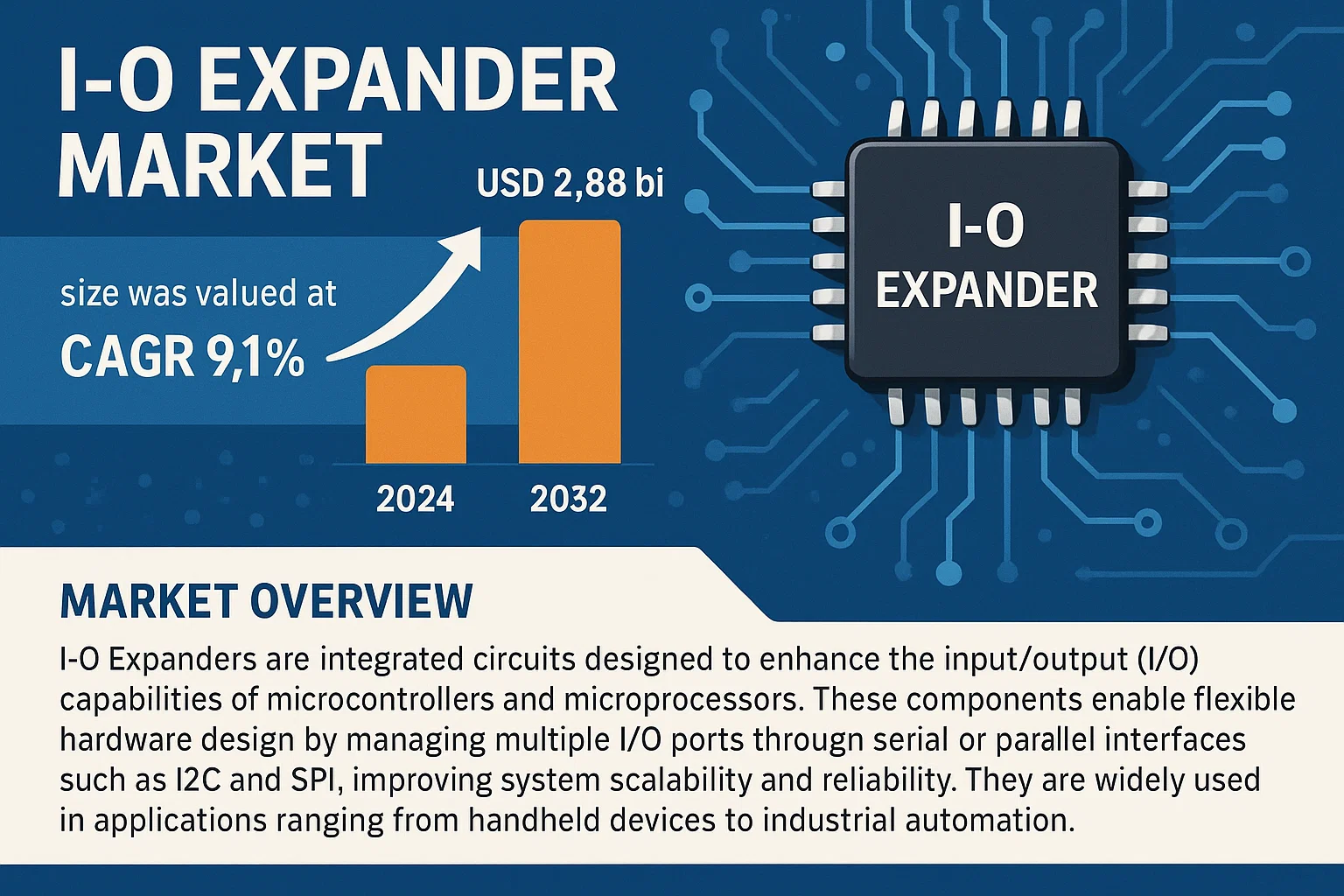
Global I-O Expander Market size was valued at USD 1.54 billion in 2024 to USD 2.88 billion by 2032, exhibiting a CAGR of 9.1% during the forecast period.
I-O Expanders are integrated circuits designed to enhance the input/output (I/O) capabilities of microcontrollers and microprocessors. These components enable flexible hardware design by managing multiple I/O ports through serial or parallel interfaces such as I2C and SPI, improving system scalability and reliability. They are widely used in applications ranging from handheld devices to industrial automation.
The market growth is driven by increasing demand for compact and energy-efficient electronic devices, along with rapid advancements in IoT and smart technologies. North America dominates the market with a 39% share, followed by Europe (20%) and China (16%). The I2C interface segment holds the largest market share at 72%, while handheld devices account for 49% of applications. Key players like NXP, TI, and Microchip collectively hold 59% of the market, leveraging innovations to maintain their competitive edge.
MARKET DRIVERS
Rising Demand for High-Performance Computing
The growth in artificial intelligence, machine learning, and big data analytics is creating unprecedented demand for servers with massive I/O capabilities. I/O expanders are critical for scaling the number of peripherals, storage drives, and network interfaces connected to a single host system, enabling the dense configurations required by modern data centers. This trend is a primary driver for the market.
Expansion of Cloud Infrastructure
Global investments in hyperscale cloud data centers continue to accelerate. These facilities rely on scalable server architectures where I/O expanders allow for flexible and cost-effective connection of numerous solid-state drives (SSDs) and other components, optimizing resource utilization and total cost of ownership.
➤ The transition to PCIe 4.0 and 5.0 interfaces is a key technological driver, as newer I/O expanders offer significantly higher bandwidth, reducing bottlenecks in data-intensive applications.
Furthermore, the proliferation of edge computing deployments is driving demand for compact, efficient servers that can handle multiple I/O streams, further bolstering the need for advanced I/O expansion solutions.
MARKET CHALLENGES
Design Complexity and Integration Hurdles
Integrating I/O expanders into modern server designs presents significant engineering challenges. As data rates increase with PCIe generations, signal integrity, power management, and thermal design become more complex and costly. Ensuring compatibility with a wide range of host processors and end devices requires extensive validation, slowing time-to-market.
Other Challenges
Cost-Sensitivity in Volume Markets
In highly competitive segments like mainstream cloud servers, every component cost is scrutinized. While I/O expanders enable port expansion, they add bill-of-materials cost, creating constant pressure on vendors to deliver more functionality at lower price points.
Rapid Technological Obsolescence
The fast pace of interface standard evolution, such as the move from PCIe 4.0 to 5.0 and beyond, means that I/O expander products can have a short lifecycle. Manufacturers must continually invest in R&D to keep pace, which can be a burden, especially for smaller players.
MARKET RESTRAINTS
Consolidation of Functions into SoCs
A significant restraint on the standalone I/O expander market is the industry trend toward System-on-Chip (SoC) designs that integrate more I/O controllers directly onto the main processor die. This integration reduces the need for discrete expansion chips for many applications, particularly in cost-sensitive or space-constrained environments, potentially limiting the addressable market for standalone components.
Supply Chain and Geopolitical Factors
The semiconductor supply chain remains vulnerable to disruptions, as evidenced by recent global chip shortages. I/O expanders, being specialized components, can face production bottlenecks. Additionally, trade tensions and export controls can create uncertainty and restrict market access, impacting growth.
MARKET OPPORTUNITIES
AI Server Proliferation
The explosive growth in dedicated AI servers represents a major opportunity. These systems require immense I/O bandwidth to connect GPUs, NPUs, and high-speed storage. I/O expanders that can efficiently manage these complex interconnect requirements are essential, creating a high-value segment for vendors.
Emerging Applications in Automotive and Industrial IoT
Beyond traditional data centers, new applications are emerging. Advanced driver-assistance systems (ADAS) and autonomous vehicles require robust computing platforms with multiple sensor inputs, creating a need for reliable I/O expansion. Similarly, sophisticated Industrial IoT gateways are another growth area for these components.
Adoption of CXL Protocol
The emergence of the Compute Express Link (CXL) protocol opens new frontiers. I/O expanders that support CXL can enable advanced memory pooling and sharing architectures in data centers, a potentially transformative opportunity that could redefine server design and create a new generation of expansion products.
I-O Expander Market Trends
Robust Global Growth Driven by Electronics Proliferation
The global I-O Expander market is experiencing significant expansion, with its value projected to grow from 1543 million in 2024 to US$ 2880 million by 2032, representing a compound annual growth rate (CAGR) of 9.1%. This sustained growth is primarily fueled by the increasing demand for sophisticated electronic components that enhance design flexibility and system reliability across a broad spectrum of applications. As electronic devices become more complex and feature-rich, the need for efficient input/output management is paramount, solidifying the role of I-O expanders in modern hardware design.
Other Trends
Market Consolidation and Regional Dominance
The competitive landscape is characterized by a high degree of consolidation, with the top five players—including NXP, TI, and Onsemi—collectively holding approximately 59% of the global market share. Geographically, North America is the dominant region, accounting for about 39% of the market. This leadership is attributed to the presence of major technology companies and advanced manufacturing sectors. Europe and the China Taiwan region follow, with shares of about 20% and 16%, respectively, highlighting a geographically diversified but concentrated market structure.
Interface and Application Preferences
Product segmentation reveals a strong preference for the I2C interface, which commands the largest segment with a share of about 72%. The I2C standard’s simplicity and efficiency in connecting multiple devices with minimal wiring make it highly suitable for space-constrained and cost-sensitive applications. In terms of application, Handheld Devices are the largest field, holding a 49% share. The proliferation of smartphones, tablets, and portable electronics drives this demand, as I-O expanders are critical for managing the numerous sensors, buttons, and peripherals in these compact devices.
Future Outlook and Strategic Imperatives
The market’s trajectory underscores a positive long-term outlook, driven by the continuous innovation in consumer electronics, data communications infrastructure, and industrial automation. For industry participants, success will depend on strategic focus on high-growth application areas like handheld devices, investment in R&D for advanced interface technologies, and navigating the competitive pressures from established leaders and emerging players in regions like Asia.
COMPETITIVE LANDSCAPE
Key Industry Players
An Oligopolistic Market Anchored by Semiconductor Giants
The global I-O Expander market is characterized by a high degree of consolidation, with the top five players collectively holding approximately 59% of the market share, as of 2024. This market structure is dominated by established semiconductor behemoths with extensive product portfolios and global reach. NXP Semiconductors stands as a clear leader, leveraging its strong position in microcontrollers and interface solutions. It is closely followed by Texas Instruments (TI) and onsemi, both of which command significant market presence through their broad analog and mixed-signal offerings. Renesas Electronics and Microchip Technology complete the top five, benefiting from their strong relationships in the automotive, industrial, and consumer electronics sectors. These leaders compete on technological innovation, product reliability, and extensive application support, creating significant barriers to entry for new players.
Beyond the top-tier companies, the market includes a number of significant players that have carved out strong positions in specific niches and regional markets. Companies like STMicroelectronics, Analog Devices, and MaxLinear offer robust I-O expander solutions that cater to high-performance and specialized applications, particularly in data communications and industrial automation. Furthermore, a cadre of other semiconductor manufacturers, including Nexperia, Diodes Incorporated, and Semtech, provide competitive alternatives, often focusing on cost-effectiveness and volume markets. The landscape also features regional specialists such as WCH (Jiangsu Qinheng) and XINLUDA from China, which are increasingly influential in the Asia-Pacific market, alongside emerging players like HTCSEMI, AWINIC, and HGSEMI, who contribute to the competitive dynamics, particularly in the handheld devices segment.
List of Key I-O Expander Companies Profiled
- NXP Semiconductors
- Texas Instruments (TI)
- onsemi
- Renesas Electronics
- Microchip Technology
- STMicroelectronics
- Analog Devices, Inc.
- MaxLinear, Inc.
- Nexperia
- Diodes Incorporated
- Semtech Corporation
- WCH (Jiangsu Qinheng)
- XINLUDA
- HTCSEMI
- AWINIC
- HGSEMI
Segment Analysis:
| Segment Category | Sub-Segments | Key Insights |
| By Type |
|
I2C Interface dominates the market due to its widespread adoption and inherent advantages in simplifying hardware design. This interface is highly favored for its ability to connect multiple devices using only two wires, which significantly reduces circuit complexity and board space. Its robustness and reliability make it the preferred choice for managing numerous input and output ports in space-constrained and cost-sensitive electronic designs. The protocol’s efficiency in low-speed communications further solidifies its leading position across a broad spectrum of applications. |
| By Application |
|
Handheld Devices represent the most significant application segment, driven by the relentless demand for smartphones, tablets, and portable gaming consoles. I-O expanders are critical in these devices for managing the increasing number of sensors, buttons, and peripheral interfaces without overburdening the main processor. The need for compact, power-efficient, and highly integrated solutions aligns perfectly with the capabilities of I-O expanders, making them indispensable for enabling advanced features and functionality in modern portable electronics while maintaining sleek form factors. |
| By End User |
|
Consumer Electronics is the leading end-user segment, fueled by the high-volume production of devices that require extensive I-O management. This sector’s growth is propelled by the continuous innovation and rapid product cycles in smartphones, smart home devices, and wearable technology. I-O expanders provide the necessary scalability and design flexibility that manufacturers need to quickly adapt to changing consumer demands and incorporate new features, thereby securing their central role in this dynamic and highly competitive industry. |
| By Interface Standard |
|
Serial Interface Expanders are the most prominent category due to their overwhelming dominance in modern electronic design. The shift towards serial communication protocols is driven by the need for reduced pin count, lower electromagnetic interference, and simpler PCB layout. Serial interfaces like I2C and SPI offer significant advantages in system integration and cost-effectiveness, making them the de facto standard for new designs. Their ability to daisy-chain multiple devices further enhances their appeal for building complex, scalable systems with minimal hardware overhead. |
| By Integration Level |
|
Standalone ICs hold a leading position in the market as they offer maximum design flexibility and are tailored for specific performance and pin-count requirements. These dedicated components allow engineers to optimize their system architecture without being constrained by the fixed peripheral set of a microcontroller. This segment benefits from the ability to select the most appropriate expander for a given application, ensuring optimal performance, power consumption, and cost. The versatility of standalone ICs makes them essential for both prototyping and high-volume production across diverse industries. |
Regional Analysis: I-O Expander Market
The region’s dominance is underpinned by its role as the global electronics manufacturing epicenter. A mature and deeply integrated supply chain allows for efficient production of I-O Expanders, reducing time-to-market and costs. This ecosystem supports everything from raw material sourcing to final assembly, providing a significant competitive advantage over other regions and attracting continuous investment from global technology firms seeking to optimize their operations and leverage local expertise.
Aggressive national policies and substantial public funding in countries like China and South Korea are accelerating the adoption of advanced computing and communications infrastructure. These initiatives, focused on areas like AI, IoT, and high-performance computing, create a direct and sustained demand for I-O Expanders. This top-down support de-risks investment for private companies and fosters a highly innovative environment that prioritizes the development and integration of next-generation interface technologies.
The explosive growth of hyperscale data centers across the region to support local and global digital services is a primary driver. These facilities require massive I-O expansion capabilities to manage high-speed data transfer between servers, storage, and networking equipment. The continuous build-out of cloud infrastructure by both international giants and regional players ensures a long-term, high-volume demand for high-performance I-O Expanders tailored for data-intensive applications.
A strong culture of research and development, supported by leading academic institutions and corporate R&D centers, keeps the region at the cutting edge of interface technology. This focus enables local companies to rapidly innovate and customize I-O Expander solutions for emerging applications, such as autonomous vehicles and smart manufacturing. The proximity of R&D to manufacturing facilitates quick prototyping and commercial deployment, maintaining the region’s technological leadership.
North America
North America remains a critical and high-value market for I-O Expanders, characterized by early adoption of advanced technologies and a concentration of leading cloud service providers, hyperscale data center operators, and enterprise IT purchasers. The market is driven by continuous infrastructure upgrades in enterprise data centers and significant investments in next-generation technologies like AI accelerators and high-performance computing clusters, which demand sophisticated I-O expansion solutions. The presence of major technology innovators and semiconductor companies fosters a competitive environment that pushes the boundaries of interface speed and efficiency. Market dynamics are influenced by stringent performance and reliability requirements from end-users, leading to a focus on high-end, feature-rich I-O Expander products rather than competing solely on cost. The region’s mature digital economy ensures steady, predictable demand for upgrades and expansions of existing IT infrastructure.
Europe
The European market for I-O Expanders is defined by a strong emphasis on industrial and automotive applications, alongside a growing demand from enterprise data centers. The region’s robust manufacturing sector, particularly in Germany and surrounding countries, utilizes I-O Expanders in industrial automation, robotics, and automotive electronics for advanced driver-assistance systems and in-vehicle networking. The market benefits from strict regulatory standards and a focus on quality and durability, which influences product specifications and vendor selection. While the pace of data center growth may be more measured compared to other regions, investments in research institutions and a push for digital sovereignty under initiatives like the European Chips Act are creating new opportunities for specialized I-O solutions tailored to European industrial and technological priorities, fostering a stable and quality-oriented market environment.
South America
The South American market for I-O Expanders is an emerging landscape with growth potential primarily linked to the gradual modernization of IT infrastructure and the expansion of telecommunications networks. Brazil is the largest market, driven by investments from the banking, telecommunications, and public sectors. The market dynamics are characterized by a cost-sensitive approach, with demand often for value-oriented I-O Expander solutions that meet essential performance criteria. Growth is incremental, fueled by the need to support increasing internet penetration, mobile data usage, and the initial stages of corporate digital transformation. While not a primary innovation hub, the region presents opportunities for market penetration as local economies stabilize and investment in digital infrastructure becomes a greater priority for both governments and private enterprises.
Middle East & Africa
The Middle East and Africa region represents a diverse and developing market for I-O Expanders, with growth concentrated in specific hubs. Gulf Cooperation Council countries, particularly the UAE and Saudi Arabia, are leading the charge with massive investments in smart city projects, sovereign wealth fund-backed technology initiatives, and large-scale data center constructions to establish themselves as digital hubs. This creates targeted demand for I-O expansion in high-performance computing and telecommunications infrastructure. In Africa, the market is nascent but growing, driven by mobile network expansions and the development of core digital infrastructure in key economies like South Africa, Nigeria, and Kenya. The regional dynamic is one of high growth potential from a small base, with demand closely tied to major government-led infrastructure projects and the gradual build-out of the digital economy.
Report Scope
This market research report provides a comprehensive analysis of the I-O Expander Market , covering the forecast period 2025–2032. It offers detailed insights into market dynamics, technological advancements, competitive landscape, and key trends shaping the industry.
Key focus areas of the report include:
- Market Overview: The report begins with an overview outlining its current market scenario, key growth indicators, and industry transformation drivers. It discusses macroeconomic factors, demand–supply balance, regulatory landscape, and the strategic role of semiconductors in powering advancements across industries such as automotive, telecommunications, consumer electronics, and industrial automation.
- Market Size & Forecast: Historical data and future projections for revenue, unit shipments, and market value across major regions and segments.
- Segmentation Analysis: Detailed breakdown by product type, technology, application, and end-user industry to identify high-growth segments and investment opportunities.
- Regional Insights: Insights into market performance across North America, Europe, Asia-Pacific, Latin America, and the Middle East & Africa, including country-level analysis where relevant.
- Competitive Landscape: Profiles of leading market participants, including their product offerings, R&D focus, manufacturing capacity, pricing strategies, and recent developments such as mergers, acquisitions, and partnerships.
- Technology Trends & Innovation: Assessment of emerging technologies, integration of AI/IoT, semiconductor design trends, fabrication techniques, and evolving industry standards.
- Market Drivers & Restraints: Evaluation of factors driving market growth along with challenges, supply chain constraints, regulatory issues, and market-entry barriers.
- Stakeholder Insights: Insights for component suppliers, OEMs, system integrators, investors, and policymakers regarding the evolving ecosystem and strategic opportunities.
Primary and secondary research methods are employed, including interviews with industry experts, data from verified sources, and real-time market intelligence to ensure the accuracy and reliability of the insights presented.
FREQUENTLY ASKED QUESTIONS:
What is the current market size of I-O Expander Market?
-> Global I-O Expander market was valued at USD 1543 million in 2024 and is projected to reach USD 2880 million by 2032, at a CAGR of 9.1% during the forecast period.
Which key companies operate in I-O Expander Market?
-> Key players include NXP, TI, Onsemi, Renesas Electronics, and Microchip, among others. The top five players hold a share of about 59%.
What are the key growth drivers?
-> Key drivers include the need for increased design flexibility in electronic devices and the ability to simplify hardware design processes while improving equipment reliability and scalability.
Which region dominates the market?
-> North America is the world’s largest market, holding a share of about 39%, followed by Europe and China Taiwan with shares of about 20% and 16%, respectively.
What are the emerging trends?
-> The adoption of different interface types, such as I2C Interface, which is the largest product segment with a share of about 72%, and the growing use in applications like Handheld Devices, which is the largest application field with a share of about 49%.

Get Sample Report PDF for Exclusive Insights
Report Sample Includes
- Table of Contents
- List of Tables & Figures
- Charts, Research Methodology, and more...
 Download Sample Report PDF