Key Statistics
Key Takeaways
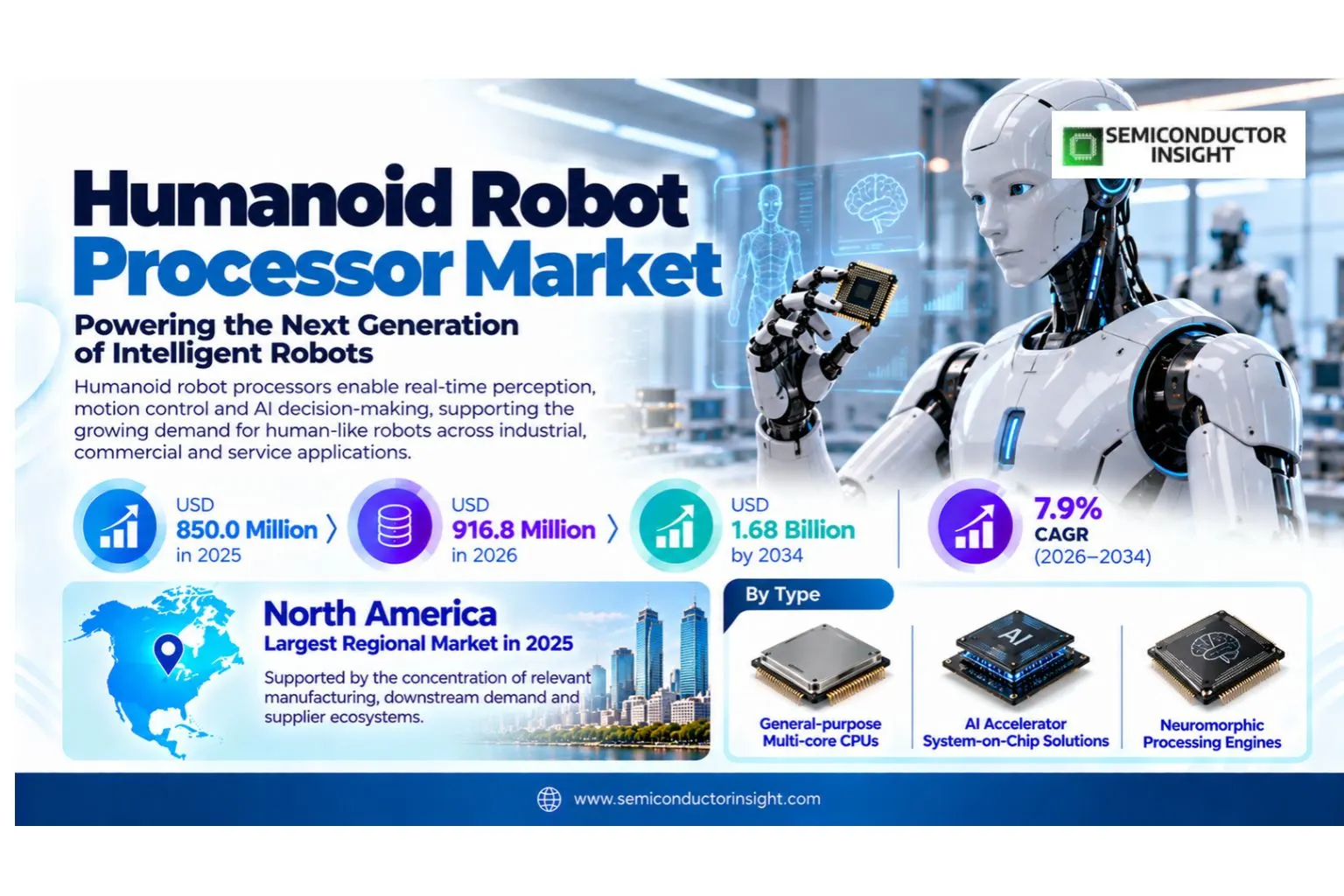
- Humanoid robot processor market was valued at USD 850.0 million in 2025 and is projected to reach USD 1.68 billion by 2034, representing a 7.9% CAGR over 2026–2034.
- AI accelerator SoCs are emerging as the leading processor type because humanoid robots require vision, language, planning and sensor fusion under strict power and thermal limits.
- Logistics and industrial material-handling deployments are moving fastest toward commercial scale because repetitive tasks create a measurable labor and productivity case for humanoid automation.
- North America leads through NVIDIA, major robotics developers and a dense AI software ecosystem, while Asia Pacific is scaling rapidly through manufacturing automation and robotics investment in China, Japan and South Korea.
- Processor competition is shifting toward complete robotics compute platforms that combine accelerators, safety-capable real-time cores, high-bandwidth memory and optimized software rather than standalone CPU performance.
Humanoid Robot Processor Market Overview
Humanoid robot processor market was valued at USD 850.0 million in 2025, is estimated at USD 916.8 million in 2026, and is projected to reach USD 1.68 billion by 2034, advancing at a 7.9% CAGR during 2026–2034. North America represents the largest regional market in 2025, supported by the concentration of relevant manufacturing, downstream demand and supplier ecosystems.
Humanoid robot processors are high-performance compute platforms designed to run perception, language, motion planning, sensor fusion and control inside bipedal or anthropomorphic robots. Unlike conventional embedded processors, they must coordinate many cameras, tactile sensors and actuators while keeping latency low enough for balance, collision avoidance and safe interaction with people.
The market is moving toward heterogeneous on-robot computers that combine CPU cores, GPU or tensor acceleration, dedicated sensor-processing engines and safety-oriented control. Cloud resources remain useful for training and fleet analytics, but balance and motion decisions must stay local, making edge inference performance per watt the central hardware metric.
The commercial structure of the humanoid robot processor market is shaped by design qualification, production economics and the interaction between component performance and downstream system requirements. Suppliers that can combine consistent manufacturing, application engineering and supply assurance are better positioned to convert technical eligibility into repeat business. Customer decisions increasingly account for lifecycle continuity, geographic resilience and integration cost, which makes proven process control and ecosystem compatibility as important as nominal product capability.
Segment Analysis: By Type
By type, the Humanoid Robot Processor market is segmented into General-purpose Multi-core CPUs, AI Accelerator System-on-Chip Solutions, Neuromorphic Processing Engines. AI accelerator SoCs provide the strongest commercial momentum because they combine general-purpose compute with dense inference acceleration. Multi-core CPUs remain essential for orchestration and deterministic software, while neuromorphic engines are still emerging for specialized low-power cognitive workloads. Purchasing decisions vary by performance requirement, qualification burden, integration complexity and lifecycle economics, so suppliers compete on application fit rather than on a single technical specification.
| Type | Role in the market | Demand characteristics |
|---|---|---|
| General-purpose Multi-core CPUs | General-purpose Multi-core CPUs addresses a distinct part of the product and process mix. Its commercial position depends on technical fit, manufacturing maturity, integration requirements and customer qualification rather than on headline specifications alone. | Demand is strongest where the segment aligns with established customer designs, predictable supply, and measurable system-level performance. Suppliers that can document repeatability, compatibility and lifecycle support are better placed to defend design wins. |
| AI Accelerator System-on-Chip Solutions | AI Accelerator System-on-Chip Solutions addresses a distinct part of the product and process mix. Its commercial position depends on technical fit, manufacturing maturity, integration requirements and customer qualification rather than on headline specifications alone. | Demand is strongest where the segment aligns with established customer designs, predictable supply, and measurable system-level performance. Suppliers that can document repeatability, compatibility and lifecycle support are better placed to defend design wins. |
| Neuromorphic Processing Engines | Neuromorphic Processing Engines addresses a distinct part of the product and process mix. Its commercial position depends on technical fit, manufacturing maturity, integration requirements and customer qualification rather than on headline specifications alone. | Demand is strongest where the segment aligns with established customer designs, predictable supply, and measurable system-level performance. Suppliers that can document repeatability, compatibility and lifecycle support are better placed to defend design wins. |
Segment Analysis: By End User
By end user, the Humanoid Robot Processor market is segmented into Robotics Manufacturers, System Integrators, Research Institutions. Robot manufacturers control most processor design wins, system integrators influence deployment-specific configurations, and research institutions are important early adopters of flexible developer platforms. Purchasing decisions vary by performance requirement, qualification burden, integration complexity and lifecycle economics, so suppliers compete on application fit rather than on a single technical specification.
| End User | Role in the market | Demand characteristics |
|---|---|---|
| Robotics Manufacturers | Robotics Manufacturers represents a relevant purchasing and deployment pathway within this market. Commercial attractiveness depends on how well it aligns with customer architecture, supply-chain constraints and required performance. | Growth is linked to design-in activity, installed-base transitions and the ability of suppliers to meet qualification, cost and availability requirements over the full product lifecycle. |
| System Integrators | System Integrators represents a relevant purchasing and deployment pathway within this market. Commercial attractiveness depends on how well it aligns with customer architecture, supply-chain constraints and required performance. | Growth is linked to design-in activity, installed-base transitions and the ability of suppliers to meet qualification, cost and availability requirements over the full product lifecycle. |
| Research Institutions | Research Institutions represents a relevant purchasing and deployment pathway within this market. Commercial attractiveness depends on how well it aligns with customer architecture, supply-chain constraints and required performance. | Growth is linked to design-in activity, installed-base transitions and the ability of suppliers to meet qualification, cost and availability requirements over the full product lifecycle. |
Segment Analysis: By Application
By application, the Humanoid Robot Processor market is segmented into Healthcare Assistance & Patient Monitoring, Logistics & Material Handling, Hospitality Service Robots, Consumer Companion Devices. Healthcare, logistics and industrial handling require dependable perception and motion control, but logistics is moving toward larger early deployments because repetitive workflows are easier to standardize. Hospitality and consumer companions create additional demand where natural-language interaction and battery life matter. Purchasing decisions vary by performance requirement, qualification burden, integration complexity and lifecycle economics, so suppliers compete on application fit rather than on a single technical specification.
| Application | Role in the market | Demand characteristics |
|---|---|---|
| Healthcare Assistance & Patient Monitoring | Healthcare Assistance & Patient Monitoring creates demand when the underlying system requires the market’s core function at production scale. Procurement is normally tied to platform launches, equipment upgrades, capacity expansion or replacement cycles. | Buyers evaluate reliability, qualification time, integration cost and vendor support alongside unit economics. Adoption accelerates when the solution removes a system bottleneck or supports a new performance tier without creating disproportionate redesign risk. |
| Logistics & Material Handling | Logistics & Material Handling creates demand when the underlying system requires the market’s core function at production scale. Procurement is normally tied to platform launches, equipment upgrades, capacity expansion or replacement cycles. | Buyers evaluate reliability, qualification time, integration cost and vendor support alongside unit economics. Adoption accelerates when the solution removes a system bottleneck or supports a new performance tier without creating disproportionate redesign risk. |
| Hospitality Service Robots | Hospitality Service Robots creates demand when the underlying system requires the market’s core function at production scale. Procurement is normally tied to platform launches, equipment upgrades, capacity expansion or replacement cycles. | Buyers evaluate reliability, qualification time, integration cost and vendor support alongside unit economics. Adoption accelerates when the solution removes a system bottleneck or supports a new performance tier without creating disproportionate redesign risk. |
| Consumer Companion Devices | Consumer Companion Devices creates demand when the underlying system requires the market’s core function at production scale. Procurement is normally tied to platform launches, equipment upgrades, capacity expansion or replacement cycles. | Buyers evaluate reliability, qualification time, integration cost and vendor support alongside unit economics. Adoption accelerates when the solution removes a system bottleneck or supports a new performance tier without creating disproportionate redesign risk. |
Segment Analysis: By Architecture
By architecture, the Humanoid Robot Processor market is segmented into Heterogeneous Multi-core Designs, Edge AI Inference Optimized Pipelines, Sensor-fusion Dedicated Accelerators. Heterogeneous architectures allocate vision, language, control and sensor-fusion workloads to different compute blocks, improving energy efficiency while preserving real-time response. Purchasing decisions vary by performance requirement, qualification burden, integration complexity and lifecycle economics, so suppliers compete on application fit rather than on a single technical specification.
| Architecture | Role in the market | Demand characteristics |
|---|---|---|
| Heterogeneous Multi-core Designs | Heterogeneous Multi-core Designs represents a relevant purchasing and deployment pathway within this market. Commercial attractiveness depends on how well it aligns with customer architecture, supply-chain constraints and required performance. | Growth is linked to design-in activity, installed-base transitions and the ability of suppliers to meet qualification, cost and availability requirements over the full product lifecycle. |
| Edge AI Inference Optimized Pipelines | Edge AI Inference Optimized Pipelines represents a relevant purchasing and deployment pathway within this market. Commercial attractiveness depends on how well it aligns with customer architecture, supply-chain constraints and required performance. | Growth is linked to design-in activity, installed-base transitions and the ability of suppliers to meet qualification, cost and availability requirements over the full product lifecycle. |
| Sensor-fusion Dedicated Accelerators | Sensor-fusion Dedicated Accelerators represents a relevant purchasing and deployment pathway within this market. Commercial attractiveness depends on how well it aligns with customer architecture, supply-chain constraints and required performance. | Growth is linked to design-in activity, installed-base transitions and the ability of suppliers to meet qualification, cost and availability requirements over the full product lifecycle. |
Segment Analysis: By Deployment Model
By deployment model, the Humanoid Robot Processor market is segmented into On-robot Embedded, Cloud-assisted, Hybrid Edge-cloud. On-robot embedded processing is mandatory for safety-critical motion, while hybrid edge-cloud architectures use remote compute for model updates, fleet learning and non-time-critical reasoning. Purchasing decisions vary by performance requirement, qualification burden, integration complexity and lifecycle economics, so suppliers compete on application fit rather than on a single technical specification.
| Deployment Model | Role in the market | Demand characteristics |
|---|---|---|
| On-robot Embedded | On-robot Embedded represents a relevant purchasing and deployment pathway within this market. Commercial attractiveness depends on how well it aligns with customer architecture, supply-chain constraints and required performance. | Growth is linked to design-in activity, installed-base transitions and the ability of suppliers to meet qualification, cost and availability requirements over the full product lifecycle. |
| Cloud-assisted | Cloud-assisted represents a relevant purchasing and deployment pathway within this market. Commercial attractiveness depends on how well it aligns with customer architecture, supply-chain constraints and required performance. | Growth is linked to design-in activity, installed-base transitions and the ability of suppliers to meet qualification, cost and availability requirements over the full product lifecycle. |
| Hybrid Edge-cloud | Hybrid Edge-cloud represents a relevant purchasing and deployment pathway within this market. Commercial attractiveness depends on how well it aligns with customer architecture, supply-chain constraints and required performance. | Growth is linked to design-in activity, installed-base transitions and the ability of suppliers to meet qualification, cost and availability requirements over the full product lifecycle. |
Regional Analysis
North America leads the humanoid robot processor market in 2025, while regional growth patterns differ according to manufacturing concentration, customer investment cycles, regulation, product mix and supply-chain access. The most important regional distinction is not simply market size; it is the mechanism that converts local investment and end-market demand into qualified purchases.
How does regional demand differ across the humanoid robot processor market?
Regional demand for humanoid robot processor is structurally uneven because manufacturing assets, design centers, downstream customers and qualification ecosystems are not distributed evenly. Asia Pacific typically has the deepest electronics manufacturing base, North America combines technology development with capital investment, Europe emphasizes reliability and industrial requirements, and emerging regions are more dependent on imported systems. These differences influence vendor selection, inventory policy, service expectations and the pace at which new technologies are adopted.
| Region | Market position | Growth outlook | Demand profile | Supplier-selection gate |
|---|---|---|---|---|
| North America | Largest | Strong | AI platform and robotics R&D led | Compute performance, software and safety |
| Europe | Advanced R&D market | Strong | Industrial robotics and safety led | Energy efficiency and regulatory compliance |
| Asia Pacific | Fastest scaling | Very strong | Manufacturing and robot production led | Cost-performance and supply scale |
| South America | Emerging | Selective | Industrial and logistics led | Robot cost and systems integration |
| Middle East & Africa | Developing | Selective | Hospitality, infrastructure and security led | Application ROI and support |
Detailed Regional Blocks
Competitive Landscape
Competition in the humanoid robot processor market is determined by technical qualification, manufacturing consistency, customer relationships and the ability to support product lifecycles. Price matters, but it rarely overrides reliability, integration effort or switching cost once a supplier has been designed into a production platform.
The competitive field includes NVIDIA, Qualcomm Technologies, Intel, Samsung Semiconductor, Texas Instruments, STMicroelectronics, alongside other specialized suppliers. Market share can shift when a vendor gains access to a new platform, expands qualified capacity or introduces a technology that materially improves system performance. Because customer validation can be lengthy, incumbent suppliers often benefit from continuity, while challengers need a clear technical or supply-chain advantage to displace an approved source.
Competitive strategy is increasingly multi-dimensional. Leading suppliers invest in process or product development, application engineering and regional support at the same time, while customers seek second-source options where technically feasible. This creates a market in which differentiation is sustained through documented performance, manufacturing yield, quality systems, responsiveness and the ability to support future roadmap transitions without forcing unnecessary redesigns.
| Company | Competitive position | Primary basis of competition |
|---|---|---|
| NVIDIA | Established global / strategic supplier | Competes through product capability, qualification, account access and supply execution. |
| Qualcomm Technologies | Established global / strategic supplier | Competes through product capability, qualification, account access and supply execution. |
| Intel | Established global / strategic supplier | Competes through product capability, qualification, account access and supply execution. |
| Samsung Semiconductor | Established global / strategic supplier | Competes through product capability, qualification, account access and supply execution. |
| Texas Instruments | Established global / strategic supplier | Competes through product capability, qualification, account access and supply execution. |
| STMicroelectronics | Specialist / regional competitor | Competes through product capability, qualification, account access and supply execution. |
| Renesas Electronics | Specialist / regional competitor | Competes through product capability, qualification, account access and supply execution. |
| MediaTek | Specialist / regional competitor | Competes through product capability, qualification, account access and supply execution. |
| Ambarella | Specialist / regional competitor | Competes through product capability, qualification, account access and supply execution. |
| Arm | Specialist / regional competitor | Competes through product capability, qualification, account access and supply execution. |
| Hailo | Focused challenger / niche participant | Competes through product capability, qualification, account access and supply execution. |
| SiMa.ai | Focused challenger / niche participant | Competes through product capability, qualification, account access and supply execution. |
| Rockchip | Focused challenger / niche participant | Competes through product capability, qualification, account access and supply execution. |
| NXP Semiconductors | Focused challenger / niche participant | Competes through product capability, qualification, account access and supply execution. |
| Horizon Robotics | Focused challenger / niche participant | Competes through product capability, qualification, account access and supply execution. |
Production Capacity Analysis
Humanoid-processor capacity is driven by access to advanced foundry nodes, high-bandwidth memory, advanced packaging and module assembly. The volumes are much smaller than smartphone or data-center processors, so vendors often adapt broader edge-AI platforms rather than creating a completely unique silicon process for humanoids.
North America leads platform design while Asia provides much of the semiconductor and electronics manufacturing scale. As robot production grows, supply reliability for memory, power-management ICs, networking and high-end compute modules will become as important as the main processor die.
Capacity should therefore be evaluated on a qualified-output basis rather than as nominal installed capability. A supplier may possess equipment or production lines that appear suitable but still require customer-specific validation, process tuning, test correlation or upstream material qualification. This distinction becomes especially important during demand spikes, when headline capacity can overstate the volume that is immediately available for a particular application, technology generation or reliability class.
Market Dynamics
The humanoid robot processor market is being shaped by rising performance requirements and technology transitions on the demand side, while qualification complexity, supply concentration and cost discipline constrain the pace of adoption. The balance of these forces favors suppliers that can solve a measurable system problem without increasing integration risk.
Demand expansion is not uniform across all product variants or customer groups. New technology creates attractive design opportunities, but buyers typically require a clear economic or performance case before changing a qualified architecture. At the same time, supply-chain localization, capacity investment and tighter quality requirements are changing procurement behavior. As a result, growth is likely to concentrate around applications where performance upgrades, manufacturing scale and lifecycle value reinforce one another.
Market Drivers
Four forces provide the strongest support for demand in the humanoid robot processor market: performance-driven technology upgrades, expansion of relevant downstream applications, investment in manufacturing or infrastructure, and the need for more resilient supply. Their importance varies by segment, but each creates a direct reason for customers to qualify or purchase additional solutions.
| Driver | Impact | Commercial mechanism |
|---|---|---|
| Physical AI models require much more edge compute | High | Vision-language-action and multimodal models increase inference demand inside robots, driving higher processor performance and memory bandwidth. |
| Industrial labor automation creates measurable ROI | High | Material handling, machine tending and repetitive manipulation provide clearer economics for early humanoid deployments. |
| Simulation shortens robot-development cycles | Medium-High | Digital twins and synthetic data allow processors and models to be tested before costly physical deployment. |
| Battery life rewards performance per watt | Medium-High | Every watt consumed by compute reduces robot operating time or increases battery weight, making energy efficiency a critical purchase criterion. |
Physical AI models require much more edge compute
Vision-language-action and multimodal models increase inference demand inside robots, driving higher processor performance and memory bandwidth. The commercial effect is strongest where customers can link the technology change to higher throughput, lower power, improved reliability, reduced lifecycle cost or access to a new end-market requirement.
Industrial labor automation creates measurable ROI
Material handling, machine tending and repetitive manipulation provide clearer economics for early humanoid deployments. The commercial effect is strongest where customers can link the technology change to higher throughput, lower power, improved reliability, reduced lifecycle cost or access to a new end-market requirement.
Simulation shortens robot-development cycles
Digital twins and synthetic data allow processors and models to be tested before costly physical deployment. The commercial effect is strongest where customers can link the technology change to higher throughput, lower power, improved reliability, reduced lifecycle cost or access to a new end-market requirement.
Battery life rewards performance per watt
Every watt consumed by compute reduces robot operating time or increases battery weight, making energy efficiency a critical purchase criterion. The commercial effect is strongest where customers can link the technology change to higher throughput, lower power, improved reliability, reduced lifecycle cost or access to a new end-market requirement.
Market Restraints
Growth is moderated by qualification burden, cyclical purchasing, technology substitution and supply-chain risk. These restraints do not eliminate demand, but they can extend sales cycles, limit supplier switching and reduce the speed at which technically superior solutions convert into production revenue.
| Restraint | Impact | Commercial consequence |
|---|---|---|
| Robot volumes remain low versus consumer electronics | High | Processor development costs are difficult to amortize across relatively small humanoid production runs. |
| Thermal limits constrain sustained AI performance | High | High compute density inside a compact moving chassis requires careful cooling and power management. |
| Safety validation is complex | Medium | Humanoid processors must support deterministic control and fault handling while also running probabilistic AI models. |
| Software ecosystems can lock in hardware choices | Medium | Robot developers may favor platforms with mature simulation, model and runtime support even when competing silicon has attractive raw specifications. |
Robot volumes remain low versus consumer electronics
Processor development costs are difficult to amortize across relatively small humanoid production runs. Suppliers can mitigate part of this pressure through stronger qualification support, transparent lifecycle planning, dual-source strategies and better alignment between product roadmaps and customer production schedules.
Thermal limits constrain sustained AI performance
High compute density inside a compact moving chassis requires careful cooling and power management. Suppliers can mitigate part of this pressure through stronger qualification support, transparent lifecycle planning, dual-source strategies and better alignment between product roadmaps and customer production schedules.
Safety validation is complex
Humanoid processors must support deterministic control and fault handling while also running probabilistic AI models. Suppliers can mitigate part of this pressure through stronger qualification support, transparent lifecycle planning, dual-source strategies and better alignment between product roadmaps and customer production schedules.
Software ecosystems can lock in hardware choices
Robot developers may favor platforms with mature simulation, model and runtime support even when competing silicon has attractive raw specifications. Suppliers can mitigate part of this pressure through stronger qualification support, transparent lifecycle planning, dual-source strategies and better alignment between product roadmaps and customer production schedules.
Market Opportunities
The most attractive opportunities in the humanoid robot processor market occur where a technology transition creates measurable value and where suppliers can enter before the customer architecture is locked. Early engagement, application-specific engineering and credible supply planning can convert these windows into durable design positions.
Production-grade physical AI modules
Integrated robot computers can bundle high-performance inference, sensor I/O and real-time control into standardized platforms. The opportunity is strongest for suppliers that can demonstrate performance with production-relevant data, provide engineering support during qualification and maintain a roadmap that gives customers confidence in long-term availability.
Neuromorphic and event-driven processing
Low-power architectures can reduce energy consumption for always-on sensing and reflex-like control. The opportunity is strongest for suppliers that can demonstrate performance with production-relevant data, provide engineering support during qualification and maintain a roadmap that gives customers confidence in long-term availability.
Safety-isolated heterogeneous processors
Combining AI acceleration with separate deterministic control domains can simplify certification and fault containment. The opportunity is strongest for suppliers that can demonstrate performance with production-relevant data, provide engineering support during qualification and maintain a roadmap that gives customers confidence in long-term availability.
Robot fleet learning
Processors integrated with cloud frameworks can support continuous model improvement while maintaining local autonomy. The opportunity is strongest for suppliers that can demonstrate performance with production-relevant data, provide engineering support during qualification and maintain a roadmap that gives customers confidence in long-term availability.
Supply Chain Analysis
Processor IP and AI architecture
CPU, GPU, NPU and safety cores define the computational foundation of the robot. Value capture at this stage depends on quality consistency, technical differentiation and the difficulty of substitution. Bottlenecks can propagate downstream when qualification or material compatibility prevents customers from shifting quickly to an alternative supplier.
Advanced-node wafer fabrication
Foundries manufacture processor dies with the performance and efficiency needed for edge AI. Value capture at this stage depends on quality consistency, technical differentiation and the difficulty of substitution. Bottlenecks can propagate downstream when qualification or material compatibility prevents customers from shifting quickly to an alternative supplier.
Module and memory integration
High-bandwidth memory, storage, networking and sensor I/O are integrated into production robot computers. Value capture at this stage depends on quality consistency, technical differentiation and the difficulty of substitution. Bottlenecks can propagate downstream when qualification or material compatibility prevents customers from shifting quickly to an alternative supplier.
Robot OEM and software integration
Manufacturers combine compute modules with sensors, actuators, control software and foundation models. Value capture at this stage depends on quality consistency, technical differentiation and the difficulty of substitution. Bottlenecks can propagate downstream when qualification or material compatibility prevents customers from shifting quickly to an alternative supplier.
Recent Developments
Recent developments show how technology roadmaps, manufacturing investment and standards are changing the competitive requirements of the humanoid robot processor market. The entries below are selected for their direct relevance to product capability, capacity, qualification or downstream adoption rather than for general corporate activity.
NVIDIA made Jetson AGX Thor developer kits and production modules generally available for physical AI and robotics. The platform delivers 7.5 times more AI compute and 3.5 times greater energy efficiency than Jetson Orin, raising the performance baseline for on-robot inference. Source
NVIDIA introduced Isaac GR00T N1, an open humanoid robot foundation model, alongside simulation frameworks and synthetic-data tools. The announcement strengthens the link between robot foundation models and high-performance embedded processor platforms. Source
NVIDIA’s Isaac GR00T platform continues to combine open robot foundation models, simulation, runtime libraries and Jetson Thor for real-time robot inference and control, illustrating the shift from standalone chips to integrated compute ecosystems. Source
Report Scope & Segmentation
| Report attribute | Coverage |
|---|---|
| Market | Humanoid Robot Processor |
| Base Year | 2025 |
| Estimated Year | 2026 |
| Forecast Period | 2026–2034 |
| 2025 Market Size | USD 850.0 million |
| 2026 Estimated Size | USD 916.8 million |
| 2034 Forecast Size | USD 1.68 billion |
| CAGR (2026–2034) | 7.9% |
| Largest Market in 2025 | North America |
| By Type | General-purpose Multi-core CPUs, AI Accelerator System-on-Chip Solutions, Neuromorphic Processing Engines |
| By Application | Healthcare Assistance & Patient Monitoring, Logistics & Material Handling, Hospitality Service Robots, Consumer Companion Devices |
| By End User | Robotics Manufacturers, System Integrators, Research Institutions |
| By Architecture | Heterogeneous Multi-core Designs, Edge AI Inference Optimized Pipelines, Sensor-fusion Dedicated Accelerators |
| By Deployment Model | On-robot Embedded, Cloud-assisted, Hybrid Edge-cloud |
| Companies Profiled | NVIDIA, Qualcomm Technologies, Intel, Samsung Semiconductor, Texas Instruments, STMicroelectronics, Renesas Electronics, MediaTek, Ambarella, Arm, Hailo, SiMa.ai, Rockchip, NXP Semiconductors, Horizon Robotics |
Frequently Asked Questions
What was the humanoid robot processor market size in 2025?
The global humanoid robot processor market was valued at USD 850.0 million in 2025. The 2025 value is the base-year reference used throughout this overview and provides the starting point for comparing the 2026 estimate and the 2034 forecast.
What is the projected humanoid robot processor market size in 2034?
The global market is projected to reach USD 1.68 billion by 2034. The forecast reflects the interaction of downstream adoption, technology transitions, production investment and the qualification requirements that shape commercial conversion across the market.
What is the CAGR of the humanoid robot processor market from 2026 to 2034?
The humanoid robot processor market is expected to expand at a 7.9% CAGR during 2026–2034. Growth will not be uniform across every product or region because customer qualification, capital cycles, supply constraints and application-specific performance requirements differ materially.
Which region is the largest humanoid robot processor market?
North America is the largest regional market in 2025. Its position is supported by the concentration of relevant manufacturing, customers, technology ecosystems and downstream demand, although the precise commercial mechanism differs by country and application.
How is the humanoid robot processor market segmented by type?
By type, the market is segmented into General-purpose Multi-core CPUs, AI Accelerator System-on-Chip Solutions, Neuromorphic Processing Engines. These categories address different performance, cost and integration requirements, so supplier selection depends on application fit, qualification history and lifecycle economics rather than a single specification.
What are the main applications for humanoid robot processor?
By application, the market covers Healthcare Assistance & Patient Monitoring, Logistics & Material Handling, Hospitality Service Robots, Consumer Companion Devices. Demand in each application is linked to platform launches, capacity expansion, equipment replacement and the degree to which the technology improves system performance or manufacturing economics.
What are the principal growth drivers for the humanoid robot processor market?
Key drivers include physical ai models require much more edge compute and industrial labor automation creates measurable roi. These forces increase demand when customers can translate technical improvements into higher performance, lower cost, greater reliability or access to new applications.
What are the main restraints in the humanoid robot processor market?
Important restraints include robot volumes remain low versus consumer electronics and thermal limits constrain sustained ai performance. The resulting qualification burden, purchasing cyclicality and technology risk can extend sales cycles and limit rapid supplier substitution even when new solutions offer clear technical advantages.
Which companies participate in the humanoid robot processor market?
Companies profiled in this market include NVIDIA, Qualcomm Technologies, Intel, Samsung Semiconductor, Texas Instruments, STMicroelectronics, Renesas Electronics, MediaTek. Competition centers on qualification, product or process performance, manufacturing consistency, customer support and the ability to maintain supply across the required product lifecycle.
What should buyers evaluate when selecting a humanoid robot processor supplier?
Buyers should evaluate demonstrated performance, qualification history, manufacturing consistency, lifecycle support, supply resilience and integration cost. A technically strong product can still face adoption barriers if it increases redesign risk, lacks regional support or cannot meet the customer’s production and quality requirements.
Research Sources & Evidence Base
View research sources used for this overview.
- NVIDIA. Jetson Thor general availability — Blackwell-based physical AI compute performance and robotics deployment context.
- NVIDIA. Isaac GR00T — Open humanoid robotics platform integrating models, simulation and Jetson Thor.
- NVIDIA. Humanoid Robots Use Case — Three-computer robotics architecture and on-robot compute requirements.
- NVIDIA. Isaac GR00T N1 announcement — 2025 foundation-model and simulation framework release for humanoid development.
Get Sample Report PDF for Exclusive Insights
Report Sample Includes
- Table of Contents
- List of Tables & Figures
- Charts, Research Methodology, and more...
 Download Sample Report PDF