AI Server Processor Market Insights
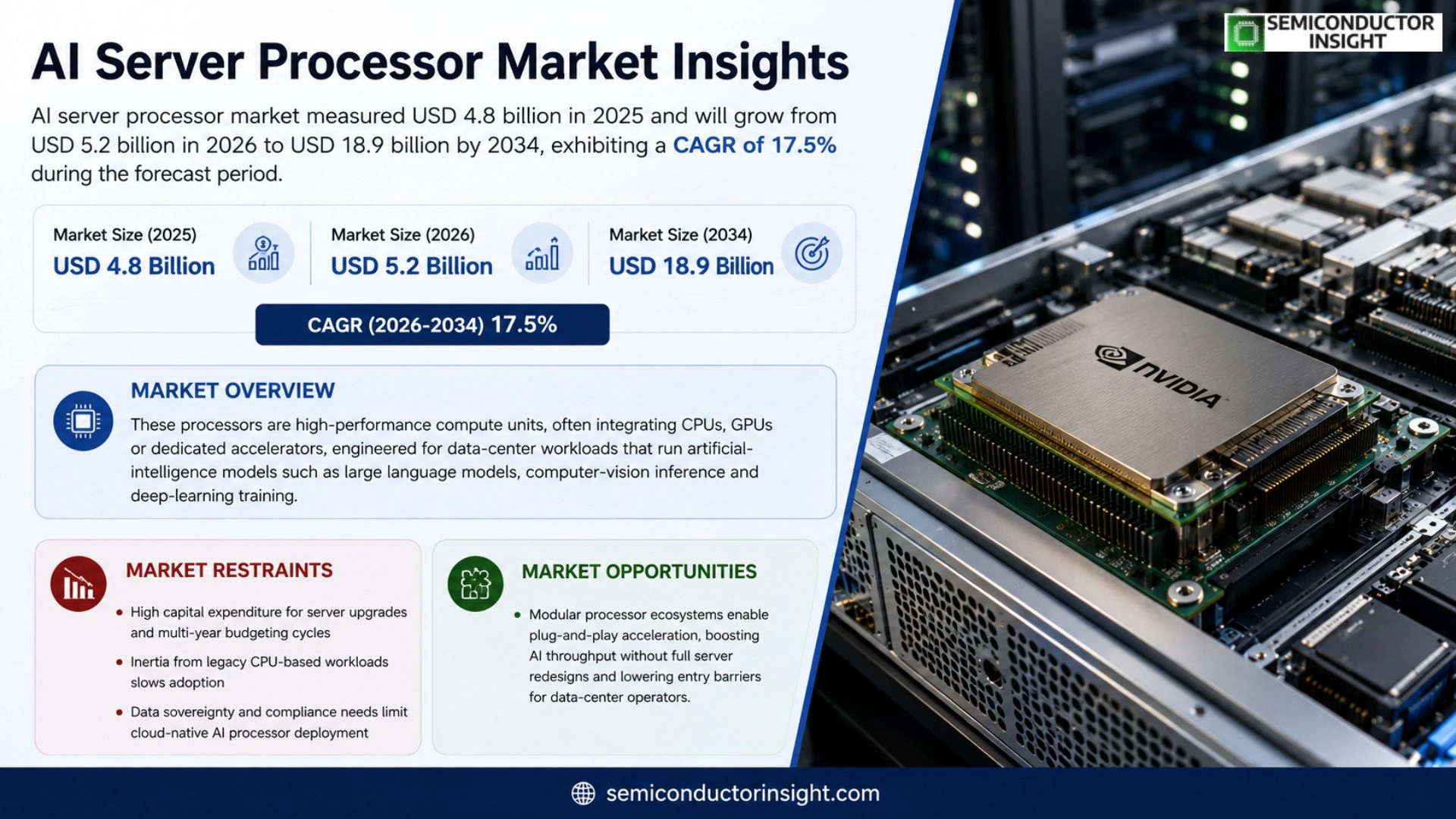
AI server processor market measured USD 4.8 billion in 2025 and will grow from USD 5.2 billion in 2026 to USD 18.9 billion by 2034, exhibiting a CAGR of 17.5 % during the forecast period.
These processors are high‑performance compute units,often integrating CPUs, GPUs or dedicated accelerators,engineered for data‑center workloads that run artificial‑intelligence models such as large language models, computer‑vision inference and deep‑learning training.
The expansion stems from the surge in generative‑AI services, rising cloud‑provider spend on hyperscale infrastructure and enterprises moving analytics closer to the edge; meanwhile, leading vendors including NVIDIA, AMD and Intel continue releasing next‑generation silicon,NVIDIA’s Grace Hopper platform launched in March 2024 exemplifies this momentum.
MARKET DRIVERS
Rising Demand for Edge‑Centric AI Workloads
Enterprises are migrating inference tasks from centralized data‑centers to edge locations to shave latency and cut bandwidth costs. This shift forces OEMs to embed higher‑performance compute blocks directly into servers that sit at the network edge, fueling AI server processor Market with new form‑factor specifications and thermal designs.
Growth of Generative AI Applications
Generative models for text, image, and code generation consume massive matrix multiplications. Vendors that can deliver processors with larger on‑chip SRAM and specialized tensor cores are seeing accelerated adoption across cloud providers, driving procurement cycles that outpace traditional CPU refreshes.
➤ Companies that integrate heterogeneous acceleration,combining GPUs, FPGAs, and ASICs,are positioning themselves to capture a larger share of AI server processor Market by offering flexible scaling paths for customers.
Regulatory pressure to improve energy efficiency in data‑center operations adds another layer of urgency; processors that deliver higher FLOPS per watt are becoming a decisive factor in vendor selection, prompting R&D spend to focus on low‑power architectures.
MARKET CHALLENGES
Supply‑Chain Volatility for Advanced Lithography
The scarcity of EUV equipment slots creates bottlenecks for mask production, extending lead times for cutting‑edge silicon. Manufacturers that cannot secure fab capacity risk missing critical launch windows, which dampens overall market momentum.
Other Challenges
Talent Shortage in AI‑Optimized Architecture
Design teams with deep expertise in both machine‑learning algorithms and silicon‑level optimization are limited, inflating hiring costs and slowing product cycles.
MARKET RESTRAINTS
High Capital Expenditure for Server Upgrades
Enterprises often face multi‑year budgeting cycles. Committing to next‑generation AI processors requires substantial upfront outlays, leading some organizations to defer upgrades until a clearer ROI can be demonstrated.
Moreover, legacy workloads that still rely on conventional CPUs generate inertia; organizations must balance migration risks against performance gains, which can slow adoption rates.
Compliance requirements around data sovereignty also compel certain sectors to retain on‑premise infrastructure, limiting the scale at which cloud‑native AI processors can be deployed.
MARKET OPPORTUNITIES
Modular Processor Ecosystems
Designs that enable plug‑and‑play acceleration modules allow data‑center operators to incrementally boost AI throughput without full server redesigns. This modularity lowers entry barriers and creates a recurring revenue stream for component vendors.
In parallel, open‑source software stacks that abstract hardware specifics are gaining traction, encouraging a broader set of developers to target AI server processors, thereby expanding the addressable market.
Geographically, emerging economies are investing heavily in AI‑driven smart‑city initiatives. Local data‑center build‑outs present a fertile ground for vendors capable of delivering cost‑effective yet high‑performance processors tailored to regional power‑grid constraints.
AI Server Processor Market Trends
Generative AI Accelerates Processor Demand
The emergence of large‑language models and image‑generation services has reshaped the compute profile of data centres. Cloud operators are allocating substantial budgets to refresh racks with silicon that can sustain high‑throughput inference and training cycles. Vendors such as NVIDIA, AMD and Intel are releasing architectures that blend traditional cores with matrix‑multiply engines, enabling a single package to handle both general workloads and AI‑specific kernels. This convergence reduces latency for enterprises that move analytics workloads closer to the edge, shortening the feedback loop between data ingestion and decision making. The net effect is a noticeable shift in procurement cycles, where procurement teams prioritize flexibility and AI‑ready instruction sets over sheer clock speed.
Other Trends
Hybrid Cloud Integration
Enterprises are increasingly stitching together on‑premise resources with public‑cloud AI clusters to balance data sovereignty with scale. Processor designs that expose uniform APIs across heterogeneous environments simplify orchestration tools, allowing workloads to migrate fluidly as demand spikes. This architecture encourages software vendors to abstract hardware specifics, fostering a marketplace where optimisation is achieved at the software layer rather than through bespoke silicon. As a result, organisations can experiment with generative AI pilots without committing to a single vendor’s ecosystem, preserving bargaining power while still tapping into cutting‑edge performance.
Emerging Chip Architectures Redefine Efficiency
Recent silicon releases emphasize power‑aware design, recognizing that data‑centre operators face tightening PUE targets. By integrating high‑bandwidth memory directly onto the processor die, manufacturers cut data movement overhead and improve throughput per watt. The industry’s focus on modular accelerators,plug‑and‑play cards that complement host CPUs,allows operators to scale AI capacity in line with actual utilisation patterns. For AI server processor Market, this trend translates into longer product lifecycles, as firms can upgrade acceleration capability without a full server refresh. The practical implication for vendors is a pivot toward ecosystem services, supporting firmware updates and performance tuning that extend the relevance of each silicon generation.
COMPETITIVE LANDSCAPE
Key Industry Players
Competitive Overview of AI Server Processor Ecosystem
NVIDIA remains the de‑facto benchmark in AI server processor arena, driven by its Grace Hopper family that unites high‑throughput GPUs with ARM‑based CPU cores. The architecture’s tight coupling of memory and interconnect fabrics has forced many hyperscale operators to redesign rack layouts around NVIDIA‑centric designs. Intel counters with a dual‑strategy that blends its Xeon line, the Habana Labs Gaudi accelerators, and a renewed focus on heterogeneous silicon, seeking to reclaim relevance in both training and inference workloads. AMD’s acquisition of Xilinx adds programmable logic to the mix, allowing customers to tailor data‑path optimizations without abandoning the familiar EPYC ecosystem. Together, these three vendors shape the top‑tier segment, where performance per watt and ecosystem support dictate procurement decisions.
Beyond the headline names, a constellation of specialist firms is expanding the competitive set. Google’s Tensor Processing Units, delivered via the Cloud TPU service, illustrate a vertical integration model that bypasses traditional hardware resale channels. Amazon Web Services promotes the Graviton 3+ family for cost‑efficient inference at scale, while Qualcomm’s Snapdragon 8cx Gen 3 targets edge‑centric AI workloads that still need server‑grade density. Samsung Electronics and Huawei Technologies have unveiled custom AI‑optimized ASICs, aiming to capture regional data‑center contracts in Asia‑Pacific. European players such as Graphcore and Cerebras Systems differentiate through unique chip‑architectures that prioritize massive parallelism, attracting niche research labs and boutique AI service providers. Tenstorrent and Alibaba Cloud’s Pingtou Ge processor further diversify the field, offering competitive price‑performance points for emerging AI startups.
List of Key AI Server Processor Companies Profiled
- NVIDIA Corporation
- Intel Corporation
- Advanced Micro Devices (AMD)
- Google Tensor Processing Units
- Amazon Web Services (AWS)
- Qualcomm Inc.
- Samsung Electronics
- Huawei Technologies Co., Ltd.
- IBM Corporation
- Graphcore Ltd.
- Cerebras Systems
- Tenstorrent Inc.
- Alibaba Cloud (Pingtou Ge)
- Fujitsu Ltd.
- Oracle Cloud Infrastructure
Segment Analysis:
| Segment Category | Sub-Segments | Key Insights |
| By Type |
|
GPU‑Accelerated Processors
|
| By Application |
|
Generative AI
|
| By End User |
|
Cloud Service Providers
|
| By Architecture |
|
Heterogeneous Multi‑Chip Module
|
| By Deployment Model |
|
Public Cloud
|
Regional Analysis: AI Server Processor Market
North America
Large‑scale retailers and manufacturers are converting batch inference pipelines to real‑time AI, demanding processors that sustain latency below a few milliseconds. This shift pushes vendors to integrate on‑chip memory hierarchies, reducing data movement penalties and supporting sustained AI workloads without compromising throughput.
Operators are consolidating legacy CPU farms into mixed‑purpose clusters, blending traditional workloads with AI acceleration. The resulting hybrid architecture forces silicon designers to expose programmable interfaces that cater to both high‑performance computing and AI inference in a single chassis.
A surge in PhD graduates specializing in hardware‑AI co‑design has expanded the talent pool available to chip firms. This influx reduces time‑to‑market for next‑gen processors and fuels collaborations between academia and industry.
Emerging data‑sovereignty rules compel providers to locate AI compute resources within national borders, prompting regional fabrication strategies that influence supply‑chain decisions and component sourcing.
Europe
European cloud providers are leveraging AI server processor Market to meet strict GDPR compliance while pursuing sustainability goals. Nations such as Germany and France are incentivizing green‑energy powered data centers, encouraging silicon manufacturers to prioritize power‑efficiency metrics. The region’s fragmented market, with many mid‑size system integrators, drives a preference for modular processor designs that can be tiled across diverse workloads. Collaborative research initiatives funded by the EU aim to standardize interconnect protocols, reducing integration friction for multinational enterprises. These dynamics position Europe as a testing ground for eco‑centric AI infrastructure strategies.
Asia-Pacific
In the Asia‑Pacific, rapid digital transformation across China, Japan, and South Korea fuels a demand for AI processors that can handle both consumer‑grade and industrial AI tasks. Government‑backed AI corridors are accelerating the construction of hyperscale facilities, yet the region’s cost‑sensitive market forces vendors to balance premium performance with aggressive pricing. Local semiconductor champions are increasingly adopting chip‑let architectures, enabling a mix‑and‑match approach that aligns with varied national standards. The convergence of massive data generation and a push for domestic chip capability reshapes supply chains and creates opportunities for collaborative development across the region.
South America
South American enterprises are cautiously entering AI server processor Market, spurred by growth in fintech and agritech sectors. Brazil’s push for digital sovereignty has led to public‑private partnerships aimed at establishing local AI compute nodes, reducing reliance on imported hardware. While infrastructure investment remains moderate, the region’s emphasis on cost‑effective scalability encourages providers to offer processors with flexible scaling options. The emerging ecosystem encourages niche players to target sector‑specific solutions, particularly in predictive analytics for crop yields and risk assessment in financial services.
Middle East & Africa
The Middle East & Africa region is witnessing nascent interest in AI server capabilities driven by oil‑and‑gas analytics and emerging smart‑city projects. Investment funds in the Gulf are allocating capital toward building sovereign data centers, prompting vendors to adapt processors for high‑temperature environments and limited cooling infrastructure. In Africa, mobile‑first operators are experimenting with edge AI processors to improve connectivity services, creating a demand for low‑power, compact silicon solutions. The combination of strategic state investment and localized use‑cases is shaping a distinctive trajectory for the market in this part of the world.
Report Scope
This market research report provides a comprehensive analysis of the AI Server Processor Market , covering the forecast period 2026–2034. It offers detailed insights into market dynamics, technological advancements, competitive landscape, and key trends shaping the industry.
Key focus areas of the report include:
- Market Overview: The report begins with an overview outlining its current market scenario, key growth indicators, and industry transformation drivers. It discusses macroeconomic factors, demand–supply balance, regulatory landscape, and the strategic role of semiconductors in powering advancements across industries such as automotive, telecommunications, consumer electronics, and industrial automation.
- Market Size & Forecast: Historical data and future projections for revenue, unit shipments, and market value across major regions and segments.
- Segmentation Analysis: Detailed breakdown by product type, technology, application, and end-user industry to identify high-growth segments and investment opportunities.
- Regional Insights: Insights into market performance across North America, Europe, Asia-Pacific, Latin America, and the Middle East & Africa, including country-level analysis where relevant.
- Competitive Landscape: Profiles of leading market participants, including their product offerings, R&D focus, manufacturing capacity, pricing strategies, and recent developments such as mergers, acquisitions, and partnerships.
- Technology Trends & Innovation: Assessment of emerging technologies, integration of AI/IoT, semiconductor design trends, fabrication techniques, and evolving industry standards.
- Market Drivers & Restraints: Evaluation of factors driving market growth along with challenges, supply chain constraints, regulatory issues, and market-entry barriers.
- Stakeholder Insights: Insights for component suppliers, OEMs, system integrators, investors, and policymakers regarding the evolving ecosystem and strategic opportunities.
Primary and secondary research methods are employed, including interviews with industry experts, data from verified sources, and real‑time market intelligence to ensure the accuracy and reliability of the insights presented.
FREQUENTLY ASKED QUESTIONS:
What is the current market size of AI Server Processor Market?
-> Global AI server processor market will grow from USD 5.2 billion in 2026 to USD 18.9 billion by 2034, exhibiting a CAGR of 17.5 %
Which key companies operate in AI Server Processor Market?
-> Key players include NVIDIA, AMD, Intel.
What are the key growth drivers?
-> Key growth drivers include surge in generative‑AI services, rising cloud‑provider hyperscale infrastructure spend, and enterprises moving analytics closer to the edge.
Which region dominates the market?
-> North America leads the market, driven by major cloud providers and semiconductor innovators.
What are the emerging trends?
-> Emerging trends include integration of CPUs, GPUs and dedicated AI accelerators, development of next‑generation silicon such as NVIDIA’s Grace Hopper platform, and increased focus on energy‑efficient AI compute.
Get Sample Report PDF for Exclusive Insights
Report Sample Includes
- Table of Contents
- List of Tables & Figures
- Charts, Research Methodology, and more...
 Download Sample Report PDF