Key Statistics
Key Takeaways
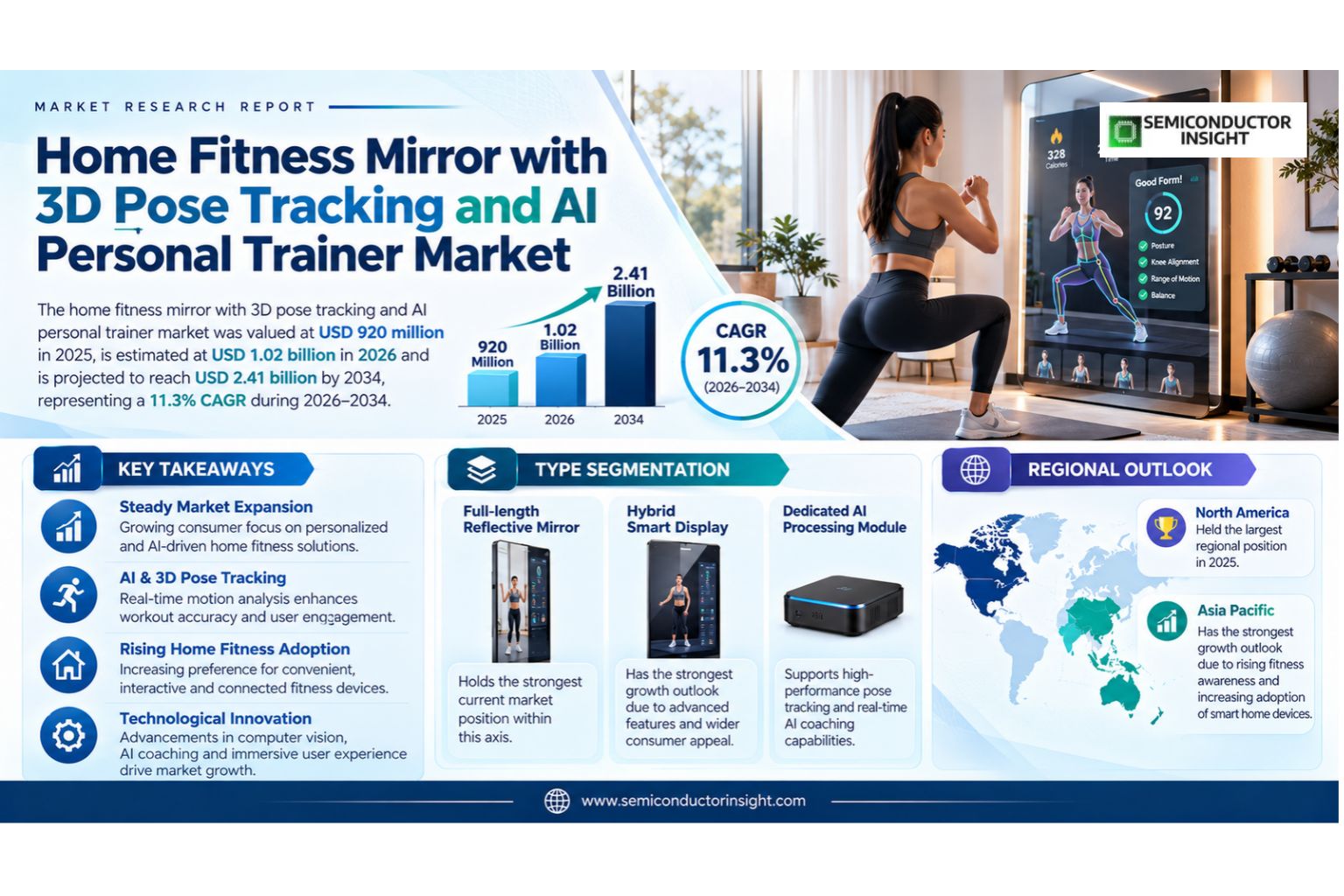
- The home fitness mirror with 3D pose tracking and AI personal trainer market was valued at USD 920 million in 2025, is estimated at USD 1.02 billion in 2026 and is projected to reach USD 2.41 billion by 2034, representing a 11.3% CAGR during 2026–2034.
- Full-length Reflective Mirror represents the leading type, while Hybrid Smart Display offers the strongest growth momentum because buyer requirements are shifting toward higher integration, flexibility and performance within the product architecture.
- Strength Training provides the largest application base, while Rehabilitation is developing faster as users prioritize measurable operating outcomes and application-specific functionality rather than generic hardware capability.
- North America is the largest regional market in 2025, supported by largest current revenue pool, supported by premium connected-fitness adoption, direct-to-consumer channels and mature subscription payment behavior. Asia Pacific has the fastest growth outlook as investment, adoption and supply ecosystems broaden.
- The principal growth mechanism is AI-guided personalization. It changes the economic case for adoption by improving utilization, performance or lifecycle value rather than relying on replacement demand alone.
- A meaningful restraint is High total ownership cost. Suppliers that reduce this barrier through integration support, qualification evidence and clearer total-cost economics are better placed to convert technical interest into repeatable commercial deployments.
Home Fitness Mirror with 3D Pose Tracking and AI Personal Trainer Market Overview
Home fitness mirror with 3D pose tracking and AI personal trainer market was valued at USD 920 million in 2025, is estimated at USD 1.02 billion in 2026 and is projected to reach USD 2.41 billion by 2034, representing a 11.3% CAGR during 2026–2034. North America held the largest regional position in 2025, while Asia Pacific has the strongest growth outlook.
Base year: 2025 · Estimated year: 2026 · Forecast period: 2026–2034 · Values in USD million unless stated otherwise
A home fitness mirror combines a reflective or display surface with cameras, depth sensing or phone-based vision, on-device or cloud software, and interactive coaching. The commercial product is not just a screen: value comes from motion capture, exercise recognition, form feedback, adaptive programming, connected content and recurring subscriptions. The market therefore sits at the intersection of connected fitness hardware, computer vision, digital coaching and consumer wellness services.
The category is moving away from a single premium-mirror formula toward a broader connected-training architecture. Tonal has pushed higher digital resistance and performance tracking, while Tempo uses phone-based 3D sensing to lower dedicated hardware requirements. Lululemon’s exit from new Mirror hardware sales and its Peloton content partnership also show that content economics, retention and recurring engagement are as important as the physical display. Suppliers that control both coaching intelligence and customer relationships are better positioned than hardware-only entrants.
Segment Analysis: By Type
By Type segmentation comprises Full-length Reflective Mirror, Hybrid Smart Display, Dedicated AI Processing Module. Full-length Reflective Mirror holds the strongest current market position within this axis, while Hybrid Smart Display has the strongest growth outlook. The distinction reflects differences in purchasing triggers, technical requirements and qualification intensity rather than a uniform shift across all customer groups. Type-level competition is therefore determined by architecture, performance and lifecycle economics at the product-design stage.
| Type | Market role | Commercial and technical analysis |
|---|---|---|
| Full-length Reflective Mirror | Leading segment | Full-length reflective systems preserve the familiar mirror form factor while layering camera-based motion capture, display content and coaching prompts onto a surface that remains usable outside a workout. Their commercial advantage is intuitive placement in bedrooms or dedicated workout rooms. The trade-off is higher shipping, installation and breakage exposure, so margins depend on premium positioning, durable mounting and sustained subscription engagement. |
| Hybrid Smart Display | Fastest-growing segment | Hybrid smart displays reduce dependence on a pure mirror aesthetic and can combine training, entertainment and household display functions. That flexibility can widen household utilization and improve the value case when a single screen serves multiple users. The segment benefits from lower display-component costs and modular sensing, but differentiation shifts toward software, computer vision and content because the physical hardware is easier for consumer-electronics suppliers to replicate. |
| Dedicated AI Processing Module | Established segment | Dedicated AI processing modules separate motion analysis from the display and can support lower-latency pose estimation, rep counting and personalized coaching at the edge. This architecture is attractive where privacy or connectivity makes continuous cloud processing undesirable. Commercially, it enables modular upgrades and licensing into third-party displays, but vendors must prove that dedicated compute improves coaching accuracy enough to justify added bill-of-material cost. |
Segment Analysis: By Application
By Application segmentation comprises Strength Training, Yoga & Flexibility, Cardio HIIT, Rehabilitation. Strength Training holds the strongest current market position within this axis, while Rehabilitation has the strongest growth outlook. The distinction reflects differences in purchasing triggers, technical requirements and qualification intensity rather than a uniform shift across all customer groups. Application-level demand follows the operating problem being solved, so adoption speed varies with the measurable value delivered to users.
| Application | Market role | Commercial and technical analysis |
|---|---|---|
| Strength Training | Leading segment | Strength training is the anchor use case because measurable repetitions, range of motion, load progression and rest intervals create a clear role for computer vision and adaptive programming. Systems can connect guidance directly to performance data rather than simply streaming classes. Buyers therefore evaluate resistance capability, exercise recognition and progressive overload features alongside content. Strong retention depends on whether the platform can demonstrate meaningful progression over months. |
| Yoga & Flexibility | Established segment | Yoga & Flexibility demand is driven by users who value guided sessions, immediate visual feedback and convenient access at home. The application benefits when pose tracking can distinguish meaningful movement quality rather than merely count session time. Commercially, vendors need content depth and progression pathways tailored to this activity, because a generic class library does not create the same retention as coaching that responds to technique, mobility or training history. |
| Cardio HIIT | Established segment | Cardio HIIT demand is driven by users who value guided sessions, immediate visual feedback and convenient access at home. The application benefits when pose tracking can distinguish meaningful movement quality rather than merely count session time. Commercially, vendors need content depth and progression pathways tailored to this activity, because a generic class library does not create the same retention as coaching that responds to technique, mobility or training history. |
| Rehabilitation | Fastest-growing segment | Rehabilitation is a smaller but strategically important application because controlled movement, adherence and range-of-motion quality can be monitored between supervised sessions. The purchasing logic differs from general fitness: clinical credibility, privacy controls and reliable movement measurement matter more than entertainment. Growth depends on partnerships with therapists and care providers, clear boundaries around medical claims, and workflows that allow progress data to be reviewed without burdening patients or clinicians. |
Additional Segment Analysis: By End User
By End User segmentation comprises Fitness Enthusiasts, Rehabilitation Patients, Tech-savvy Homeowners. Fitness Enthusiasts holds the strongest current market position within this axis, while Rehabilitation Patients has the strongest growth outlook. The distinction reflects differences in purchasing triggers, technical requirements and qualification intensity rather than a uniform shift across all customer groups. End-user economics differ in budget ownership, deployment scale and support expectations, creating distinct routes to purchase and renewal.
| End User | Market role | Commercial and technical analysis |
|---|---|---|
| Fitness Enthusiasts | Leading segment | Fitness Enthusiasts is an important end user category because it changes the purchasing criteria, qualification path and value captured by suppliers. Customers evaluate compatibility with the wider system, lifecycle support and operating performance rather than treating the category as interchangeable. Market growth in this segment therefore depends on design-in activity and application-specific proof points. Suppliers with documented performance and integration support are better positioned than vendors competing on unit price alone. |
| Rehabilitation Patients | Fastest-growing segment | Rehabilitation Patients is an important end user category because it changes the purchasing criteria, qualification path and value captured by suppliers. Customers evaluate compatibility with the wider system, lifecycle support and operating performance rather than treating the category as interchangeable. Market growth in this segment therefore depends on design-in activity and application-specific proof points. Suppliers with documented performance and integration support are better positioned than vendors competing on unit price alone. |
| Tech-savvy Homeowners | Established segment | Tech-savvy Homeowners is an important end user category because it changes the purchasing criteria, qualification path and value captured by suppliers. Customers evaluate compatibility with the wider system, lifecycle support and operating performance rather than treating the category as interchangeable. Market growth in this segment therefore depends on design-in activity and application-specific proof points. Suppliers with documented performance and integration support are better positioned than vendors competing on unit price alone. |
Additional Segment Analysis: By Integration Ecosystem
By Integration Ecosystem segmentation comprises Fitness Content Platforms, Wearable Device Synchronization, Smart-home Voice Assistants. Fitness Content Platforms holds the strongest current market position within this axis, while Wearable Device Synchronization has the strongest growth outlook. The distinction reflects differences in purchasing triggers, technical requirements and qualification intensity rather than a uniform shift across all customer groups. Ecosystem integration influences retention and interoperability, making partner compatibility an increasingly important part of supplier selection.
| Integration Ecosystem | Market role | Commercial and technical analysis |
|---|---|---|
| Fitness Content Platforms | Leading segment | Fitness Content Platforms is an important integration ecosystem category because it changes the purchasing criteria, qualification path and value captured by suppliers. Customers evaluate compatibility with the wider system, lifecycle support and operating performance rather than treating the category as interchangeable. Market growth in this segment therefore depends on design-in activity and application-specific proof points. Suppliers with documented performance and integration support are better positioned than vendors competing on unit price alone. |
| Wearable Device Synchronization | Fastest-growing segment | Wearable Device Synchronization is an important integration ecosystem category because it changes the purchasing criteria, qualification path and value captured by suppliers. Customers evaluate compatibility with the wider system, lifecycle support and operating performance rather than treating the category as interchangeable. Market growth in this segment therefore depends on design-in activity and application-specific proof points. Suppliers with documented performance and integration support are better positioned than vendors competing on unit price alone. |
| Smart-home Voice Assistants | Established segment | Smart-home Voice Assistants is an important integration ecosystem category because it changes the purchasing criteria, qualification path and value captured by suppliers. Customers evaluate compatibility with the wider system, lifecycle support and operating performance rather than treating the category as interchangeable. Market growth in this segment therefore depends on design-in activity and application-specific proof points. Suppliers with documented performance and integration support are better positioned than vendors competing on unit price alone. |
Regional Analysis
North America leads the market in 2025, while Asia Pacific has the fastest growth outlook. Regional demand differs materially because end-market investment, local manufacturing, qualification practices, channel structure and customer economics are not uniform. The comparison below treats each geography according to its own commercial mechanism rather than repeating one global narrative with different country names.
How does regional demand differ across the Home Fitness Mirror with 3D Pose Tracking and AI Personal Trainer market?
Regional strategy depends on where design decisions are made, where end users deploy equipment, and how local customers evaluate lifecycle value. North America benefits from largest current revenue pool, supported by premium connected-fitness adoption, direct-to-consumer channels and mature subscription payment behavior. Asia Pacific is expanding more quickly because new adoption, local supply capabilities and application investment are broadening from a smaller or less mature base. Other regions remain relevant where regulation, installed base or specialized end markets create defensible demand.
| Region | Position | Growth outlook | Demand profile | Primary market logic |
|---|---|---|---|---|
| North America | Largest | High | Premium subscription-led | Mature direct-to-consumer connected-fitness channels, high smart-device penetration and established recurring digital subscriptions support premium systems. |
| Europe | Second tier | Moderate | Design, privacy and value focused | European demand favors compact design, privacy controls and clear value relative to gyms and app-only services. |
| Asia Pacific | Fastest growing | Highest | Mobile-first and urban | Dense cities, rising digital-fitness use and strong consumer-electronics supply chains create a favorable long-term environment. |
| South America | Emerging | Moderate | Affordability led | Demand is shaped by smartphone-based fitness behavior and growing e-commerce rather than large premium showrooms. |
| Middle East & Africa | Selective | Moderate | Premium Gulf plus mobile-led Africa | Affluent Gulf cities can support high-end connected home gyms, especially where luxury wellness and smart-home adoption overlap. |
Detailed Regional Blocks
Competitive Landscape
Competition is increasingly defined by ecosystem depth rather than display hardware alone. Tonal emphasizes digitally controlled resistance and individualized strength progression, while Tempo combines vision-assisted coaching with physical weights and a lower-hardware configuration. Established fitness brands can leverage content libraries, instructor communities and financing, whereas technology-led entrants compete on motion-estimation accuracy, personalization and software cadence. The former Mirror business illustrates the risk of carrying high hardware acquisition costs without sufficient lifetime subscription value.
Competition in the home fitness mirror with 3d pose tracking and ai personal trainer market is shaped by design-in relationships, system integration and the cost of switching after qualification. Buyers do not evaluate suppliers solely on headline specifications. They also examine reliability, documentation, software or process compatibility, support response and the ability to maintain performance over the full product lifecycle. This favors vendors that can combine technical differentiation with repeatable delivery and customer engineering support.
The market includes established specialists, vertically integrated technology suppliers and emerging firms pursuing narrower application niches. The competitive boundary is therefore fluid: a supplier can lead in one segment without controlling the whole market. Partnerships, standards participation and ecosystem integration often matter as much as manufacturing scale because customers need assurance that a selected solution will remain compatible with future platforms and deployment requirements.
| Competitive group | Representative companies | Strategic position |
|---|---|---|
| Established / scale suppliers | Tonal, Tempo, Echelon Reflect | Compete on broad customer access, installed base, qualification history and global support. |
| Technology-focused challengers | ProForm, NordicTrack, JAXJOX | Compete through technical differentiation, product focus and faster adaptation to emerging requirements. |
| Specialists and ecosystem participants | Mirror / lululemon Studio, Peloton, LG Electronics | Serve specialized applications, regional demand or ecosystem roles that can be strategically important despite smaller scale. |
Profiled market participants
The profiled competitive set includes Tonal, Tempo, Echelon Reflect, ProForm, NordicTrack, JAXJOX, Mirror / lululemon Studio, Peloton, LG Electronics. The list spans suppliers with different scale, geographic exposure and product depth. Inclusion identifies commercial relevance to the market scope; it does not imply identical product coverage or an equal competitive position across every segment.
Production Capacity Analysis
Manufacturing capacity is relatively flexible compared with semiconductor equipment because assembly can be outsourced across display, camera, compute-module and metal-frame supply chains. The real bottlenecks are quality integration, calibration, logistics for large-format products, and availability of reliable depth or vision components at consumer price points. A shift toward phone-assisted or modular sensing lowers bill-of-materials risk and reduces the capital required for a dedicated vision stack, but it makes software compatibility and operating-system support more important.
Capacity should be interpreted as the ability to deliver qualified, repeatable product rather than as nominal factory floor alone. In home fitness mirror with 3d pose tracking and ai personal trainer, bottlenecks can sit in specialized materials, precision manufacturing, software validation, bonding or packaging, calibration, test, or customer qualification depending on the segment. A supplier with unused physical capacity may still be constrained if the required process window, certifications or engineering support are not available for a customer’s exact design.
Market Dynamics
Demand is supported by consumers seeking guided exercise without travel time, improving computer-vision capability, and recurring digital coaching models. At the same time, the market has learned that premium hardware alone does not guarantee durable economics: customer acquisition costs, subscription churn, content expense and installation complexity can outweigh gross margin on the device. The strongest vendors are therefore redesigning the value proposition around measurable progress, adaptive programming, multi-user households and cross-device data rather than simply adding a larger screen.
Market Drivers
| Driver | Relative influence | Why it matters |
|---|---|---|
| AI-guided personalization | High | Adaptive plans, rep tracking, range-of-motion feedback and progressive recommendations make the hardware useful beyond video streaming. The commercial effect is higher engagement because the system can respond to performance instead of delivering the same class to every user. This supports subscription retention, creates data-driven differentiation and allows brands to justify recurring fees when recommendations demonstrably change with the user’s strength, mobility and adherence. |
| Lower sensing and compute costs | High | Depth cameras, smartphone sensors and edge inference have made motion analysis available without custom industrial hardware. Tempo demonstrates one direction by using compatible iPhones for 3D sensing, while other systems embed cameras and processors directly. Lower component cost broadens addressable price points and gives vendors room to spend more on content, coaching and software. It also encourages modular designs that can be upgraded without replacing the entire mirror. |
| Hybrid home-fitness behavior | Medium to High | Consumers increasingly mix gym visits, outdoor activity and at-home training rather than choosing one exclusive channel. A connected mirror earns a place in that routine when it removes travel friction, supports short sessions and records progress consistently. The addressable market therefore expands beyond consumers abandoning gyms; it includes households buying a complementary coaching surface for strength, mobility and recovery. Vendors benefit when content libraries serve multiple training goals rather than one narrow format. |
| Wearable and health-data integration | Medium | Heart-rate monitors, smartwatches and phone health platforms can add recovery, effort and readiness context to motion data. When those signals are combined with exercise execution, the platform can adjust load, session intensity or rest recommendations. This creates a more defensible service layer and makes the mirror part of a wider personal-health workflow. Interoperability becomes commercially important because users resist duplicating data across disconnected fitness ecosystems. |
AI-guided personalization
Adaptive plans, rep tracking, range-of-motion feedback and progressive recommendations make the hardware useful beyond video streaming. The commercial effect is higher engagement because the system can respond to performance instead of delivering the same class to every user. This supports subscription retention, creates data-driven differentiation and allows brands to justify recurring fees when recommendations demonstrably change with the user’s strength, mobility and adherence.
Lower sensing and compute costs
Depth cameras, smartphone sensors and edge inference have made motion analysis available without custom industrial hardware. Tempo demonstrates one direction by using compatible iPhones for 3D sensing, while other systems embed cameras and processors directly. Lower component cost broadens addressable price points and gives vendors room to spend more on content, coaching and software. It also encourages modular designs that can be upgraded without replacing the entire mirror.
Hybrid home-fitness behavior
Consumers increasingly mix gym visits, outdoor activity and at-home training rather than choosing one exclusive channel. A connected mirror earns a place in that routine when it removes travel friction, supports short sessions and records progress consistently. The addressable market therefore expands beyond consumers abandoning gyms; it includes households buying a complementary coaching surface for strength, mobility and recovery. Vendors benefit when content libraries serve multiple training goals rather than one narrow format.
Wearable and health-data integration
Heart-rate monitors, smartwatches and phone health platforms can add recovery, effort and readiness context to motion data. When those signals are combined with exercise execution, the platform can adjust load, session intensity or rest recommendations. This creates a more defensible service layer and makes the mirror part of a wider personal-health workflow. Interoperability becomes commercially important because users resist duplicating data across disconnected fitness ecosystems.
Market Restraints
| Restraint | Relative influence | Commercial effect |
|---|---|---|
| High total ownership cost | High | Premium connected-fitness systems combine hardware, installation, accessories and recurring membership fees. That total cost competes with lower-priced apps, conventional equipment and gym memberships, especially after the initial novelty period. Financing can reduce the upfront barrier but does not solve weak retention. Vendors therefore need a credible progression model, content refresh and household utility to demonstrate value across multiple years rather than relying on a one-time hardware purchase. |
| Churn and content economics | Medium to High | Interactive fitness requires continuing expenditure on coaches, programs, software and cloud infrastructure. If users reduce workout frequency, the subscription can become the first discretionary expense to be cancelled. The economics are especially difficult when hardware is sold with promotional discounts. Providers need to balance content breadth with production cost and use personalization to surface relevant sessions, because an oversized library that users cannot navigate does not necessarily improve retention. |
| Privacy and camera sensitivity | Medium | The product category often operates in private rooms and may process body images, skeletal pose data, exercise history and biometric signals. Even when analysis is performed locally, consumers need clear controls around recording, cloud storage and account access. Privacy concerns can slow adoption in households or rehabilitation settings where sensitive information is involved. Trust therefore becomes part of the product specification, alongside sensor accuracy and coaching quality. |
| Hardware obsolescence and support | Medium | Large connected displays have longer physical replacement cycles than smartphones but depend on processors, operating systems, cameras and cloud services that change rapidly. Vendors must support firmware, security and app compatibility for years after sale. A discontinued hardware platform can damage customer confidence even when services remain available. Modular sensing, standardized connectivity and transparent support policies can reduce this risk, but they also increase engineering and lifecycle-management requirements. |
High total ownership cost
Premium connected-fitness systems combine hardware, installation, accessories and recurring membership fees. That total cost competes with lower-priced apps, conventional equipment and gym memberships, especially after the initial novelty period. Financing can reduce the upfront barrier but does not solve weak retention. Vendors therefore need a credible progression model, content refresh and household utility to demonstrate value across multiple years rather than relying on a one-time hardware purchase.
Churn and content economics
Interactive fitness requires continuing expenditure on coaches, programs, software and cloud infrastructure. If users reduce workout frequency, the subscription can become the first discretionary expense to be cancelled. The economics are especially difficult when hardware is sold with promotional discounts. Providers need to balance content breadth with production cost and use personalization to surface relevant sessions, because an oversized library that users cannot navigate does not necessarily improve retention.
Privacy and camera sensitivity
The product category often operates in private rooms and may process body images, skeletal pose data, exercise history and biometric signals. Even when analysis is performed locally, consumers need clear controls around recording, cloud storage and account access. Privacy concerns can slow adoption in households or rehabilitation settings where sensitive information is involved. Trust therefore becomes part of the product specification, alongside sensor accuracy and coaching quality.
Hardware obsolescence and support
Large connected displays have longer physical replacement cycles than smartphones but depend on processors, operating systems, cameras and cloud services that change rapidly. Vendors must support firmware, security and app compatibility for years after sale. A discontinued hardware platform can damage customer confidence even when services remain available. Modular sensing, standardized connectivity and transparent support policies can reduce this risk, but they also increase engineering and lifecycle-management requirements.
Market Opportunities
Rehabilitation and guided recovery
Rehabilitation creates a higher-value use case because correct range of motion, controlled repetition and adherence are measurable. Systems that can present therapist-approved routines, capture movement and share progress can support hybrid care between clinic visits. The commercial opportunity depends on validation, privacy controls and integration with clinical workflows rather than consumer-style gamification. Vendors that establish partnerships with rehabilitation providers can access a segment less dependent on seasonal fitness spending.
Household multi-user subscriptions
A mirror or wall-mounted system can serve several household members without requiring duplicate equipment. Pricing plans that support multiple profiles improve utilization and reduce effective cost per user. This model also generates richer engagement data across strength, mobility and conditioning. The opportunity is strongest for platforms able to personalize recommendations separately for each person while sharing the same hardware, content subscription and connected-device ecosystem.
Computer-vision licensing
The underlying pose-estimation and coaching stack can be licensed into televisions, displays, mobile devices, hotel rooms, corporate wellness installations and third-party fitness equipment. This expands revenue without requiring the vendor to manufacture every physical unit. Licensing also separates software innovation from bulky logistics. The challenge is maintaining accuracy across different camera placements and room conditions, but successful SDK models can produce higher-margin recurring revenue than direct hardware sales.
Regionalized content and pricing
Asia Pacific, Latin America and parts of the Middle East have large mobile-first consumer populations but lower tolerance for premium imported hardware. Local-language coaching, smaller footprints, phone-assisted sensing and lower subscription tiers can widen adoption. Regional partnerships with fitness creators and e-commerce platforms can also lower customer acquisition cost. The opportunity is therefore not just geographic expansion; it requires redesigning hardware and service economics for local purchasing power and living-space constraints.
Supply Chain Analysis
Upstream inputs
Core manufacturing
System integration & channels
End use & lifecycle
Upstream inputs
Materials, components, intellectual property and enabling production inputs define the technical ceiling and cost structure. Supplier concentration at this stage can affect lead times and qualification risk even when final assembly is geographically diversified. In the home fitness mirror with 3d pose tracking and ai personal trainer market, the balance of value shifts toward suppliers that solve integration and qualification problems instead of merely supplying an interchangeable physical component.
Core manufacturing
Fabrication, assembly, bonding, calibration, software integration or precision manufacturing converts inputs into a qualified product. Yield, process control and test discipline determine whether nominal capacity becomes saleable output. In the home fitness mirror with 3d pose tracking and ai personal trainer market, the balance of value shifts toward suppliers that solve integration and qualification problems instead of merely supplying an interchangeable physical component.
System integration & channels
OEMs, equipment builders, distributors, software platforms and integrators connect the product with the customer’s operating environment. This stage captures value through application engineering, configuration, distribution reach and support. In the home fitness mirror with 3d pose tracking and ai personal trainer market, the balance of value shifts toward suppliers that solve integration and qualification problems instead of merely supplying an interchangeable physical component.
End use & lifecycle
End users monetize the technology through productivity, performance, reliability or user outcomes. Replacement, subscriptions, maintenance, upgrades and installed-base support determine how much recurring value remains after the initial sale. In the home fitness mirror with 3d pose tracking and ai personal trainer market, the balance of value shifts toward suppliers that solve integration and qualification problems instead of merely supplying an interchangeable physical component.
Recent Developments
Tonal introduced Tonal 2 with up to 250 pounds of digital resistance, a higher ceiling than the prior 200-pound system. The launch reinforces a shift from screen-led connected fitness toward measurable strength progression and hardware that can serve more advanced users. For the market, higher resistance expands the addressable training range and supports premium pricing when software recommendations are tied directly to performance data.
Tempo added search across classes, personal records and training plans, illustrating how connected-fitness competition increasingly depends on software discoverability as libraries grow. Better navigation is commercially relevant because subscription value falls when users cannot quickly find appropriate sessions. Product improvement is therefore moving beyond sensors and displays into recommendation, content retrieval and longitudinal training data.
lululemon and Peloton announced a five-year global partnership under which Peloton became the exclusive digital fitness content provider for lululemon Studio. lululemon also stated that it intended to discontinue selling the Studio Mirror. The decision remains an important structural signal: successful connected fitness requires sustainable content and engagement economics, not simply premium hardware placement in the home.
Report Scope & Segmentation
This market overview covers the commercial value of home fitness mirror with 3d pose tracking and ai personal trainer across the defined product, application and buyer segmentation. The scope uses 2025 as the base year, 2026 as the estimated year and 2026–2034 as the forecast period. It distinguishes market revenue from adjacent system value and uses qualitative leadership language where public evidence does not support a reliable numerical share.
| Scope attribute | Coverage |
|---|---|
| Base year | 2025 |
| Estimated year | 2026 |
| Forecast period | 2026–2034 |
| 2025 market size | USD 920 million |
| 2026 estimated size | USD 1.02 billion |
| 2034 projected size | USD 2.41 billion |
| CAGR (2026–2034) | 11.3% |
| Largest market in 2025 | North America |
| By Type | Full-length Reflective Mirror, Hybrid Smart Display, Dedicated AI Processing Module |
| By Application | Strength Training, Yoga & Flexibility, Cardio HIIT, Rehabilitation |
| By End User | Fitness Enthusiasts, Rehabilitation Patients, Tech-savvy Homeowners |
| By Integration Ecosystem | Fitness Content Platforms, Wearable Device Synchronization, Smart-home Voice Assistants |
| Regions | North America; Europe; Asia Pacific; South America; Middle East & Africa |
| Profiled companies | Tonal, Tempo, Echelon Reflect, ProForm, NordicTrack, JAXJOX, Mirror / lululemon Studio, Peloton, LG Electronics |
Frequently Asked Questions
What is the size of the Home Fitness Mirror with 3D Pose Tracking and AI Personal Trainer market?
The global home fitness mirror with 3d pose tracking and ai personal trainer market was valued at USD 920 million in 2025, is estimated at USD 1.02 billion in 2026 and is projected to reach USD 2.41 billion by 2034. This represents a 11.3% CAGR during 2026–2034. The forecast reflects increasing adoption within the defined product and application scope rather than the value of broader adjacent systems.
Which region leads the Home Fitness Mirror with 3D Pose Tracking and AI Personal Trainer market?
North America holds the largest market position in 2025, supported by largest current revenue pool, supported by premium connected-fitness adoption, direct-to-consumer channels and mature subscription payment behavior. The region combines demand, supplier access and customer readiness in a way that gives it a stronger current revenue base than other geographies. Regional leadership should be interpreted through those structural factors rather than as an unsupported universal percentage.
Which region is growing fastest?
Asia Pacific has the fastest growth outlook within the forecast period. The region benefits from expanding technology adoption, new investment, local supply development and broader application deployment. Growth does not imply that every country follows the same trajectory; qualification practices, purchasing power, infrastructure and end-market concentration continue to create substantial differences inside the region.
Which product type currently has the strongest position?
Full-length Reflective Mirror has the strongest current position within the By Type segmentation. Its leadership reflects established customer use, application fit and a larger installed or design-in base. Hybrid Smart Display has the stronger growth outlook as product architectures evolve. Supplier success depends on matching performance and lifecycle support to the specific requirements of each type.
Which application is most important?
Strength Training is the largest application segment within the defined scope because it provides the broadest current demand base. Rehabilitation has the stronger growth outlook as customers place greater value on specialized outcomes and deeper integration. The application mix matters commercially because purchasing triggers, qualification requirements and willingness to pay differ significantly between use cases.
What is the primary market driver?
AI-guided personalization is a principal growth driver. Adaptive plans, rep tracking, range-of-motion feedback and progressive recommendations make the hardware useful beyond video streaming. The commercial effect is higher engagement because the system can respond to performance instead of delivering the same class to every user. This supports subscription retention, creates data-driven differentiation and allows brands to justify recurring fees when recommendations demonstrably change with the user’s strength, mobility and adherence. The effect is commercially meaningful because adoption accelerates when the technology improves measurable performance or lifecycle economics rather than simply adding a new feature.
What is the main restraint on market growth?
High total ownership cost is a significant restraint. Premium connected-fitness systems combine hardware, installation, accessories and recurring membership fees. That total cost competes with lower-priced apps, conventional equipment and gym memberships, especially after the initial novelty period. Financing can reduce the upfront barrier but does not solve weak retention. Vendors therefore need a credible progression model, content refresh and household utility to demonstrate value across multiple years rather than relying on a one-time hardware purchase. Suppliers can reduce the barrier through clearer value proof, integration support, qualification evidence and product architectures that lower total lifecycle risk for customers.
How is competition structured?
Competition is increasingly defined by ecosystem depth rather than display hardware alone. Tonal emphasizes digitally controlled resistance and individualized strength progression, while Tempo combines vision-assisted coaching with physical weights and a lower-hardware configuration. Established fitness brands can leverage content libraries, instructor communities and financing, whereas technology-led entrants compete on motion-estimation accuracy, personalization and software cadence. The former Mirror business illustrates the risk of carrying high hardware acquisition costs without sufficient lifetime subscription value. Buyers also consider integration support, qualification history, reliability and ecosystem compatibility, which means market share is not determined by a single technical specification. Competition therefore varies by application and customer class, with established suppliers and focused specialists often holding different advantages.
Why is supply capacity strategically important?
Manufacturing capacity is relatively flexible compared with semiconductor equipment because assembly can be outsourced across display, camera, compute-module and metal-frame supply chains. The real bottlenecks are quality integration, calibration, logistics for large-format products, and availability of reliable depth or vision components at consumer price points. A shift toward phone-assisted or modular sensing lowers bill-of-materials risk and reduces the capital required for a dedicated vision stack, but it makes software compatibility and operating-system support more important. Capacity matters because qualified output, not nominal floor space, determines what customers can actually buy. Yield, testing, specialized materials, software or process integration and customer approvals can all constrain shipment growth even when a supplier has physical expansion room.
What should buyers and suppliers watch through 2034?
Stakeholders should watch the pace of qualification, integration into wider ecosystems, regional investment, standards or certification changes, and the ability of suppliers to convert technical capability into repeatable production and lifecycle support. The strongest opportunities will emerge where performance gains are measurable and customer switching costs support durable relationships without creating unacceptable adoption friction.
Research Sources & Evidence Base
View research sources used for this overview.
- Tonal. Experience the Future of Fitness with Tonal 2 — Tonal 2 hardware, digital resistance and coaching features, January 2025.
- Tempo. Introducing the Tempo Move — Phone-based 3D sensing, form feedback and compact connected-training architecture.
- Tempo. New Text Search Feature — Software/content discovery update, May 2025.
- lululemon. lululemon and Peloton Announce Five-Year Strategic Global Partnership — Peloton content partnership and discontinuation plan for new Studio Mirror sales.

Get Sample Report PDF for Exclusive Insights
Report Sample Includes
- Table of Contents
- List of Tables & Figures
- Charts, Research Methodology, and more...
 Download Sample Report PDF