Key Statistics
Key Takeaways
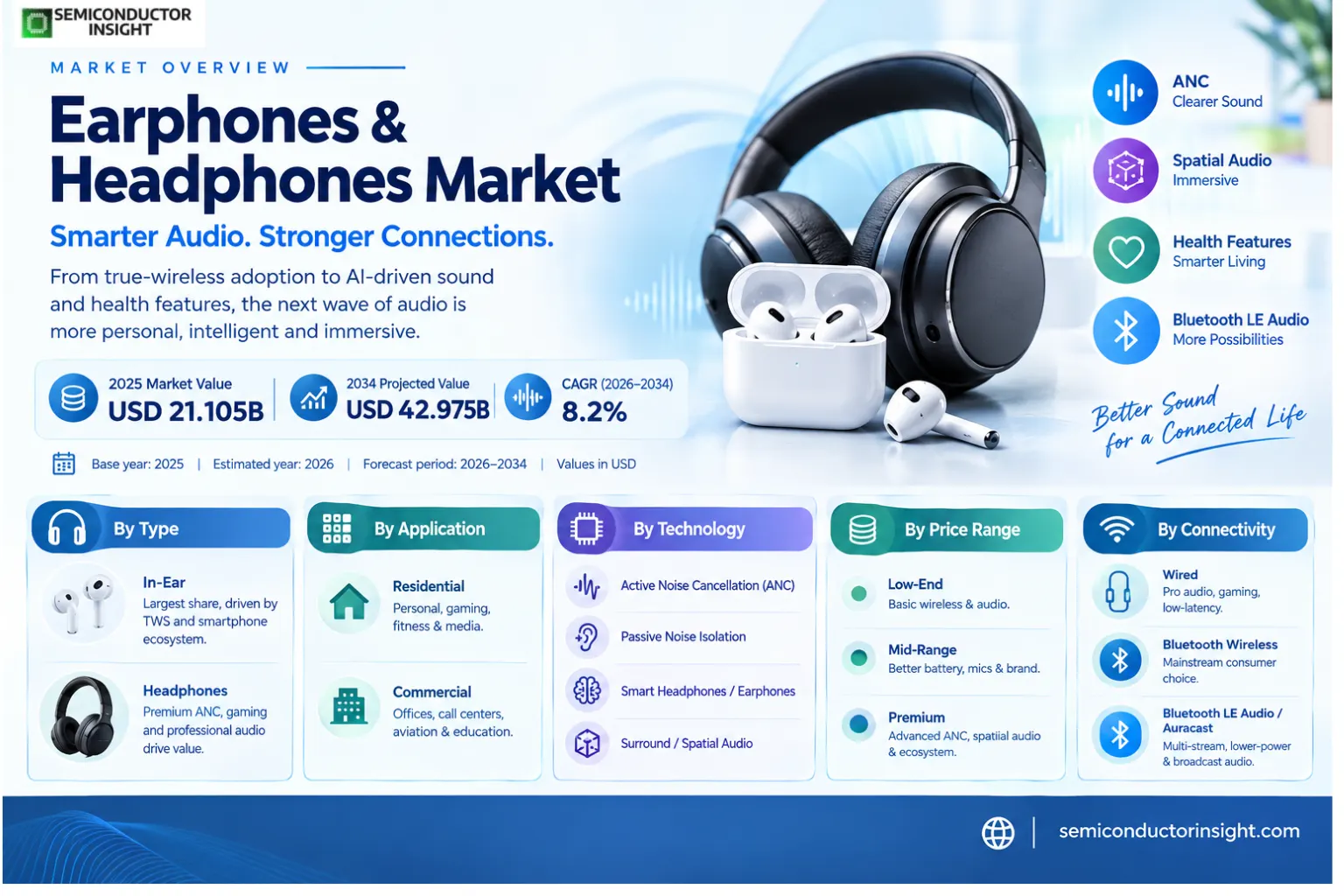
- Market size and growth: the market is valued at USD 21.105 billion in 2025 and is projected to reach USD 42.975 billion by 2034, representing a 8.2% CAGR across 2026–2034.
- In-Ear leads the type mix because true-wireless earbuds combine portability, smartphone integration and frequent replacement cycles, making them the largest high-volume form factor.
- Residential is the leading application, supported by personal music, calls, gaming, video and mobile-device use account for the majority of unit demand.
- North America is the largest geographic market, while Asia Pacific has the strongest incremental growth profile.
- Primary driver: true-wireless adoption, premium noise cancellation and deeper smartphone integration continue to lift product value and replacement demand
- Principal restraint: intense price competition, short product cycles and battery degradation can compress margins and raise replacement concerns
Market Overview
The earphones and headphones market was valued at USD 21.105 billion in 2025 and is projected to reach USD 42.975 billion by 2034, expanding at a 8.2% CAGR over 2026–2034. North America holds the leading market position in 2025, while the category is being reshaped by true-wireless adoption, active noise cancellation, spatial audio, health features and Bluetooth LE Audio..
Earphones and headphones are personal audio devices that convert electrical or digital audio signals into sound at or near the ear. The market includes wired and wireless in-ear products, on-ear and over-ear headphones, gaming headsets and premium noise-cancelling devices. Product value increasingly comes from integrated microphones, digital signal processing, wireless chipsets, batteries, sensors and software rather than from the acoustic driver alone.
Wireless products have become the main innovation platform because smartphones, tablets and laptops increasingly emphasize Bluetooth connectivity. Active noise cancellation, transparency modes, adaptive equalization, spatial audio and voice processing differentiate premium models, while true-wireless earbuds compete on compact charging cases, battery life and ecosystem integration. Apple’s 2026 AirPods 5 launch illustrates how open-ear products now combine stronger ANC, adaptive audio and intelligent voice features.
Bluetooth LE Audio adds another technology transition. The Bluetooth SIG completed the LE Audio specification suite and introduced Auracast broadcast audio, which enables one transmitter to broadcast to many nearby compatible receivers. Adoption will be gradual because both source and receiving devices need compatible hardware and software, but it broadens the use cases for earbuds and headphones in public spaces, televisions and assistive listening.
Segment Analysis: By Type
By type, the market is segmented into In-Ear, Headphones. In-Ear leads the current revenue mix, while product innovation is concentrated in performance, integration, reliability and system-level economics.
| Type | Function / role | Market position |
|---|---|---|
| In-Ear | Earbuds and in-ear monitors worn inside or at the entrance of the ear canal. | Largest type due to TWS adoption, portability and deep smartphone ecosystem integration. |
| Headphones | On-ear and over-ear products using larger earcups or pads. | Strong in premium ANC, gaming, professional audio and applications where comfort and larger acoustic drivers matter. |
Commercial implications by type
In-ear products lead unit growth because true-wireless form factors support frequent upgrades and ecosystem bundling. Over-ear headphones retain higher average selling prices in premium noise-cancelling, studio and gaming segments. Suppliers therefore compete across two different value models: scale and miniaturization in earbuds, and acoustic performance, comfort and feature depth in headphones.
Segment Analysis: By Application
By application, the market includes Residential, Commercial. Residential is the leading demand pool because purchasing is tied directly to system performance, reliability, user experience or operating continuity.
| Application | Demand characteristics |
|---|---|
| Residential | Largest application covering personal entertainment, calls, gaming, fitness, commuting and home media use. |
| Commercial | Contact centers, offices, broadcast, professional audio, aviation and education require headsets with reliability and communication performance. |
By Technology
| Technology | Commercial relevance |
|---|---|
| Active Noise Cancellation (ANC) | Premium feature using microphones and DSP to reduce external noise in earbuds and headphones. |
| Passive Noise Isolation | Physical sealing and earcup design reduce noise without electronic cancellation. |
| Smart Headphones / Earphones | Integrated sensors, assistants, adaptive audio and device ecosystems add software-driven value. |
| Surround / Spatial Audio | Head tracking and virtualization create more immersive media and gaming experiences. |
By Price Range
| Price Range | Commercial relevance |
|---|---|
| Low-End | Value products compete primarily on basic wireless connectivity and acceptable audio quality. |
| Mid-Range | Mainstream segment adds better battery life, microphones and brand differentiation. |
| Premium | Advanced ANC, spatial audio, high-end acoustics and ecosystem integration support higher margins. |
By Connectivity
| Connectivity | Commercial relevance |
|---|---|
| Wired | Retains relevance in professional audio, gaming and low-latency or battery-free use. |
| Bluetooth Wireless | Largest consumer connectivity mode across smartphones, PCs and tablets. |
| Bluetooth LE Audio / Auracast | Emerging standard enables multi-stream, lower-power and broadcast audio use cases. |
Regional Analysis
North America leads the market because the United States combines high consumer spending, premium-audio adoption, a large installed base of connected devices and strong retail channels. Asia Pacific has the strongest growth profile as investment and adoption shift toward large smartphone populations, rising disposable income, local electronics brands and rapid adoption of TWS products in China, India and Southeast Asia.
How does regional demand differ across this market?
North America remains the largest value market because premium products and strong brand ecosystems lift average selling prices. Asia Pacific is the strongest growth region through large smartphone user bases, local brands and electronics manufacturing. Europe is mature but attractive for premium ANC and hearing-related features. South America and the Middle East & Africa are more price-sensitive, although smartphone penetration and e-commerce continue to broaden the addressable consumer base.
| Region | Position | Growth outlook | Demand profile | Supplier selection |
|---|---|---|---|---|
| North America | Largest | Strong | Premium consumer and professional audio | Brand, features and ecosystem |
| Asia Pacific | Second | Fastest | High-volume TWS and electronics manufacturing | Price-performance and ecosystem |
| Europe | Third | Moderate | Premium ANC and lifestyle audio | Quality, comfort and compliance |
| South America | Smaller | Moderate | Value wireless audio | Price and distribution |
| Middle East & Africa | Emerging | Strong | Mobile-first consumer market | Affordability, battery life and availability |
Competitive Landscape
Competition is fragmented across ecosystem owners, specialist audio brands, gaming vendors and value-focused electronics companies.
Apple, Samsung, Sony and major smartphone ecosystem vendors compete by connecting earbuds tightly with phones, operating systems and cloud services. Seamless pairing, spatial audio, device switching and integrated voice features create switching costs that go beyond acoustic performance and help sustain premium pricing.
Specialist audio brands such as Bose, Sennheiser, Audio-Technica, Beyerdynamic and Bowers & Wilkins compete on sound tuning, comfort and noise cancellation. Gaming brands add microphones, low-latency wireless and platform compatibility, while value brands compete aggressively on feature replication and price.
Software has become a central competitive layer. Adaptive ANC, equalization, head tracking, hearing features and voice isolation depend on DSP algorithms and sensor fusion. This shifts part of the value chain from traditional acoustics toward chipsets, firmware and application ecosystems.
| Competitive tier | Representative participants | Competitive focus |
|---|---|---|
| Ecosystem leaders | Apple, Samsung, Sony | Smartphone integration, wireless features and high-volume TWS |
| Premium audio specialists | Bose, Sennheiser, Bowers & Wilkins, Beyerdynamic | Acoustics, ANC, comfort and brand value |
| Gaming / value brands | HyperX, Turtle Beach, Skullcandy, Xiaomi, Huawei | Gaming features, aggressive pricing and channel breadth |
Companies Profiled
Sennheiser, Sony, Shure, JVC, Skullcandy, Philips, Bose, Beats Electronics, Audio-Technica, Samsung / Harman, AKG, Apple, Huawei, Xiaomi, GN, B&O, Bowers & Wilkins, Beyerdynamic, HyperX, Turtle Beach
Production Capacity Analysis
Production capacity depends on acoustic drivers, Bluetooth audio SoCs, microphones, batteries, precision plastics and high-volume assembly, with much of the supply chain concentrated in Asia.
True-wireless earbuds combine very small batteries, multiple microphones, antennas, speakers, sensors and charging electronics inside compact housings. Yield depends on both component quality and acoustic calibration, so high-volume suppliers invest heavily in automated test and assembly. Product cycles are short, which means factories must ramp new designs quickly without sacrificing consistency.
Over-ear headphones use larger drivers and batteries but often include more complex mechanical structures, hinges and ear cushions. Premium ANC products require microphone matching and acoustic tuning that adds end-of-line calibration. Capacity can therefore be available in physical terms while still being constrained by qualified component supply and product-specific test throughput.
Market Dynamics
The market grows through feature migration as premium functions move into lower price tiers and consumers upgrade for convenience as well as sound quality.
TWS established wireless earbuds as a high-frequency upgrade category, but simple Bluetooth connectivity is no longer enough to sustain pricing. Vendors increasingly differentiate through ANC, adaptive audio, spatial processing, multipoint connectivity, health and hearing features. That raises software value while also increasing battery, microphone and processor requirements.
Market Drivers
Drivers Impact Analysis
| Driver | Impact | Commercial mechanism |
|---|---|---|
| True-wireless adoption | High | Compact charging cases and phone integration make earbuds convenient for daily communication and media. |
| Active noise cancellation | High | ANC has moved from premium over-ear products into mainstream earbuds, lifting average selling prices. |
| Gaming and remote communication | Medium | Low-latency audio and microphone quality support dedicated gaming and business headsets. |
| Bluetooth LE Audio | Medium | New low-energy and broadcast capabilities create fresh device and venue use cases. |
True-wireless adoption
Compact charging cases and phone integration make earbuds convenient for daily communication and media.
Active noise cancellation
ANC has moved from premium over-ear products into mainstream earbuds, lifting average selling prices.
Gaming and remote communication
Low-latency audio and microphone quality support dedicated gaming and business headsets.
Bluetooth LE Audio
New low-energy and broadcast capabilities create fresh device and venue use cases.
Market Restraints
Restraints Impact Analysis
| Restraint | Impact | Commercial mechanism |
|---|---|---|
| Intense price competition | High | Rapid feature replication compresses margins in mainstream wireless audio. |
| Short product cycles | Medium | Frequent model launches increase inventory and tooling risk. |
| Battery degradation | Medium | Small rechargeable batteries limit product life and can affect long-term user satisfaction. |
| Platform fragmentation | Low | Some advanced features work best inside a specific phone or software ecosystem, reducing cross-platform consistency. |
Intense price competition
Rapid feature replication compresses margins in mainstream wireless audio.
Short product cycles
Frequent model launches increase inventory and tooling risk.
Battery degradation
Small rechargeable batteries limit product life and can affect long-term user satisfaction.
Platform fragmentation
Some advanced features work best inside a specific phone or software ecosystem, reducing cross-platform consistency.
Market Opportunities
Auracacessing
Microwave plasma can create new demand in semiconductor, coating and industrial-treatment applications.
Supply Chain Analysis
Copper, ceramics, cathodes, magnets
Cavity machining, vacuum sealing, conditioning
Modulators, waveguides, cooling, controls
Appliances, radar, LINACs, industrial systems
Materials and vacuum parts
Cathode materials, copper cavities, ceramic insulators and magnetic systems determine power capability and lifetime.
Tube manufacturing
Vacuum integrity, dimensional control and conditioning are essential because small process deviations can alter frequency and reliability.
RF subsystems
Pulsed systems require modulators, waveguides, circulators and cooling matched to the magnetron’s operating envelope.
OEM integration
Customers qualify the source as part of a complete microwave system, making interface stability and service continuity important.
Recent Developments
2026 — Teledyne e2v maintains broad magnetron portfolio
Current products cover medical, transport, security and industrial applications with outputs from kilowatt-class to multi-megawatt pulsed systems. Source
2026 — Teledyne e2v integrates magnetrons into radiotherapy RF subsystems
Integrated magnetron modules are positioned for compact, maintainable radiotherapy platforms. Source
2023 — CPI C-band coaxial magnetron remains relevant for radar
CPI’s 100 kW C-band device illustrates continued use of tunable pulsed magnetrons in weather and threat-simulation radar. Source
Report Scope & Segmentation
| Attribute | Coverage |
|---|---|
| Market | Magnetron |
| Base Year | 2025 |
| Estimated Year | 2026 |
| Forecast Period | 2026–2034 |
| 2025 Market Size | USD 1.42 billion |
| 2026 Estimated Size | USD 1.45 billion |
| 2034 Forecast Size | USD 1.74 billion |
| CAGR | 2.3% (2026–2034) |
| By Type | Continuous Magnetrons, Pulse Magnetrons |
| By Application | Drying/Heating, Medical, Radar, Industrial LINACs, Plasma, Others |
| By End User | Consumer Electronics, Industrial, Healthcare, Defense & Security |
| By Technology | Standard Magnetrons, High-Efficiency Magnetrons, Frequency-Agile / Tunable Magnetrons |
| Regions | Asia Pacific, North America, Europe, South America, Middle East & Africa |
| Companies Profiled | LG Electronics, Toshiba Electronic Devices & Storage, Samsung Electronics, Teledyne e2v, Hitachi Power Solutions, NJR, Midea Group, Galanz, Panasonic Industrial Devices, L3Harris Technologies, Kunshan Guoli Microwave, CPI International |
Frequently Asked Questions
What is the magnetron market size in 2025?
The market is valued at USD 1.42 billion in 2025.
What is the projected market size by 2034?
The market is projected to reach USD 1.74 billion by 2034.
What is the CAGR from 2026 to 2034?
The market is expected to expand at a 2.3% CAGR.
Which region leads the market?
Asia Pacific is the largest region in 2025.
Which type leads the market?
Continuous Magnetrons is the leading type.
Which application leads demand?
Drying/Heating is the leading application.
What is the primary growth driver?
steady microwave-appliance demand and specialized radar, medical and industrial heating applications sustain the installed base.
What is the principal restraint?
solid-state RF sources are displacing magnetrons where frequency agility, lifetime and precise control justify higher system cost.
Where are the strongest opportunities?
medical LINACs, advanced radar, plasma processing and higher-efficiency microwave heating.
Which companies are active in the market?
LG Electronics, Toshiba Electronic Devices & Storage, Samsung Electronics, Teledyne e2v, Hitachi Power Solutions, NJR, Midea Group, Galanz.
Research Sources & Evidence Base
View primary and industry evidence used in this overview
- Teledyne e2v: Magnetrons — Current magnetron applications and product specifications.
- Teledyne e2v: RF Systems — System integration in medical and high-power RF.
- Communications & Power Industries: VMC1360GD C-Band Coaxial Magnetron — Radar magnetron performance example.

Get Sample Report PDF for Exclusive Insights
Report Sample Includes
- Table of Contents
- List of Tables & Figures
- Charts, Research Methodology, and more...
 Download Sample Report PDF