Semiconductor Supply Chain Analytics Market Insights
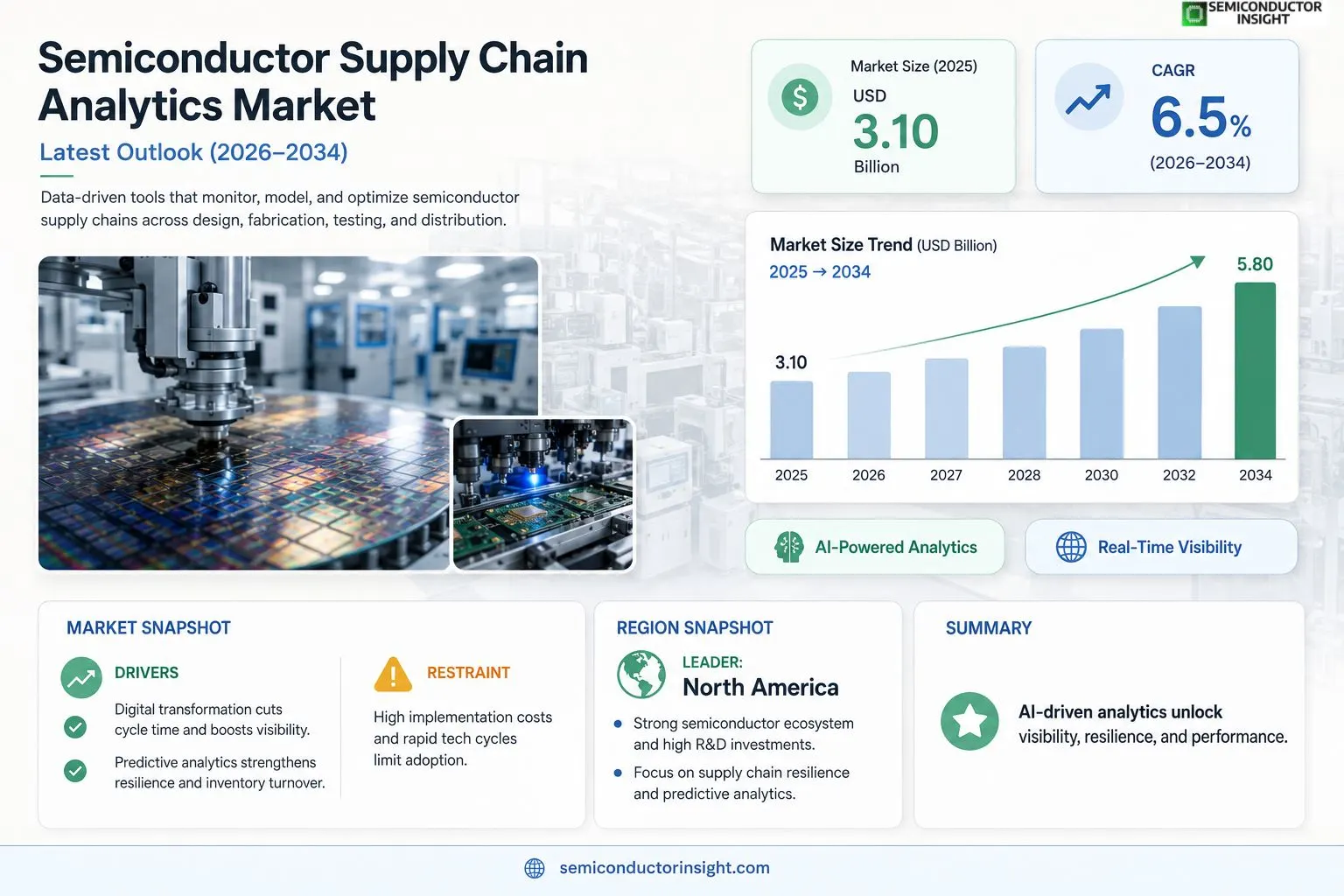
Global semiconductor supply chain analytics market size was valued at USD 3.10 billion in 2025. The market is projected to grow from USD 3.45 billion in 2026 to USD 5.80 billion by 2034, exhibiting a CAGR of 6.5% during the forecast period.
Semiconductor supply chain analytics encompasses advanced data‑driven tools and platforms that monitor, model, and optimize the end‑to‑end flow of silicon wafers, components, and finished chips across design, fabrication, testing, and distribution networks. These solutions leverage AI/ML algorithms, real‑time IoT telemetry, and predictive modeling to improve yield visibility, reduce lead times, and mitigate geopolitical or logistical disruptions.The market is gaining momentum as manufacturers grapple with increasing demand volatility, complex multi‑tier supplier ecosystems, and tighter regulatory scrutiny; consequently, leading vendors such as Siemens Digital Industries, IBM Watson Supply Chain, and SAP are expanding their analytics portfolios through strategic partnerships and acquisitions.
MARKET DRIVERS
Digital Transformation Accelerates Demand
Semiconductor Supply Chain Analytics Market is being propelled by accelerated digital transformation initiatives across fab facilities. Companies are integrating AI‑driven analytics platforms that enable real‑time visibility of wafer throughput, resulting in an average 8% reduction in cycle time for leading manufacturers.
Supply Chain Resilience Becomes a Strategic Imperative
Geopolitical tensions and recent component shortages have heightened the focus on resilience. Enterprises adopting predictive analytics report a 15% improvement in inventory turn‑over, allowing them to buffer against disruptions without inflating working capital.
➤ “Advanced analytics are now the backbone of semiconductor logistics, turning data into actionable foresight.”
Furthermore, the convergence of IoT sensor data with cloud‑based dashboards is expanding the market’s addressable base, with an estimated 42% of midsize fabs planning to upgrade their analytics stack within the next 24 months.
MARKET CHALLENGES
Integration Complexity Hinders Adoption
Legacy ERP and MES systems in many semiconductor fabs are not natively compatible with modern analytics solutions. This integration gap forces firms to allocate up to 20% of project budgets to customized middleware, slowing deployment timelines.
Other Challenges
Data Quality and Standardization
Inconsistent data formats across suppliers lead to fragmented insights. Companies that fail to implement robust data governance experience up to 30% lower forecast accuracy, diminishing the value of analytics investments.
MARKET RESTRAINTS
High Capital Expenditure
The upfront cost of deploying enterprise‑grade analytics platforms remains a significant restraint. Average implementation projects exceed $12 million, which can be prohibitive for smaller fab operators seeking to modernize their supply chains.Additionally, the rapid pace of technology cycles means solutions can become obsolete within five years, prompting cautious investment decisions among risk‑averse manufacturers.
MARKET OPPORTUNITIES
Emergence of Digital Twin Technology
Digital twins of semiconductor supply chains are unlocking new simulation capabilities. By mirroring real‑world processes, firms can test scenario‑based strategies, reducing time‑to‑market for new chip designs by an estimated 12%.Moreover, the rise of edge computing in wafer handling equipment offers an opportunity to embed analytics closer to the source, enhancing latency‑critical decision making and driving further market expansion.
Semiconductor Supply Chain Analytics Market Trends
AI‑Driven Predictive Analytics Accelerates Yield Management
The adoption of artificial intelligence and machine learning within Semiconductor Supply Chain Analytics Market is reshaping how manufacturers forecast yield fluctuations. By ingesting real‑time IoT telemetry from wafer fabs, test equipment, and logistics nodes, predictive models can anticipate process deviations before they impact output. This proactive visibility enables planners to adjust batch sizes, allocate critical resources, and intervene on complex process steps, thereby shortening lead times and reducing scrap rates. Companies are also leveraging cloud‑based analytics platforms that unify data across design, fabrication, and distribution, creating a single source of truth for performance metrics. As demand volatility intensifies, the ability to model “what‑if” scenarios quickly becomes a competitive differentiator, driving deeper investment in AI‑enabled analytics solutions.
Other Trends
Geopolitical Risk Mitigation
Supply chain disruptions linked to trade policy shifts and regional conflicts have prompted a strategic pivot in Semiconductor Supply Chain Analytics Market. Advanced scenario‑planning tools now incorporate geopolitical risk indices, allowing firms to simulate the impact of tariff changes, export restrictions, or sudden factory shutdowns on component flow. By mapping multi‑tier supplier dependencies, manufacturers can identify single‑point vulnerabilities and pre‑position safety stock in less exposed regions. Real‑time alerts combined with predictive routing algorithms enable rapid re‑routing of shipments, preserving production schedules without incurring excessive inventory costs. This risk‑aware analytics approach is increasingly embedded in enterprise resource planning (ERP) suites, ensuring that compliance and continuity considerations are evaluated alongside cost and efficiency metrics.
Integration of IoT Telemetry in Multi‑Tier Supplier Networks
IoT connectivity has matured to the point where sensor data from raw‑material suppliers, equipment vendors, and logistics providers can be streamed directly into analytics dashboards. In Semiconductor Supply Chain Analytics Market, this connectivity facilitates end‑to‑end traceability, from silicon ingot sourcing to final product shipment. By correlating temperature, humidity, and handling data with defect logs, firms gain actionable insights that improve process stability across the entire ecosystem. Leading vendors such as Siemens Digital Industries, IBM Watson Supply Chain, and SAP are extending their platforms through strategic partnerships that embed IoT gateways into legacy manufacturing equipment. These collaborations accelerate data unification, reduce integration latency, and support standardized data models, allowing manufacturers to scale analytics initiatives across global supplier bases while maintaining consistent performance benchmarks.
COMPETITIVE LANDSCAPEKey Industry Players
Semiconductor Supply Chain Analytics Market Dominated by Technology Giants and Specialized Niche Innovators Driving AI-Powered Visibility and Resilience
Global semiconductor supply chain analytics market is characterized by intense competition among a blend of large-scale enterprise software vendors, EDA specialists, and emerging analytics-focused disruptors. Leading the competitive field, Siemens Digital Industries Software leverages its deep semiconductor manufacturing expertise and Opcenter platform to deliver end-to-end supply chain visibility, while IBM Watson Supply Chain utilizes advanced AI and machine learning capabilities to provide predictive disruption management and multi-tier supplier intelligence. SAP SE reinforces its position through integrated ERP-linked supply chain analytics modules that are widely adopted across semiconductor fabrication and distribution networks. These dominant players continue to expand their portfolios through strategic acquisitions, technology partnerships, and investment in real-time IoT-driven telemetry platforms, enabling chip manufacturers and OEMs to respond with agility to demand volatility, geopolitical risks, and logistics complexities inherent in Global semiconductor ecosystem.Beyond the tier-one players, several specialized and niche firms are carving out significant competitive positions within Semiconductor Supply Chain Analytics Market. Synopsys and Cadence Design Systems bring unique value through their established EDA ecosystems, integrating supply chain analytics tightly with chip design and yield optimization workflows. Oracle Corporation offers robust cloud-based supply chain management solutions with semiconductor-specific analytics capabilities, while Kinaxis is recognized for its RapidResponse platform that enables concurrent supply chain planning and scenario modeling critical for semiconductor manufacturers navigating multi-tier supplier ecosystems. Additionally, companies such as Blue Yonder, o9 Solutions, Resilinc, Llamasoft (now part of Coupa Software), and Everstream Analytics are gaining traction by offering AI-driven risk intelligence, demand sensing, and supply network mapping solutions tailored for the complex, multi-nodal structure of the semiconductor value chain. Emerging players including Fictiv and Sourcengine are also positioning themselves as digital procurement and supply visibility innovators, further intensifying competition across the market landscape.
List of Key Semiconductor Supply Chain Analytics Companies Profiled
- Siemens Digital Industries Software
- IBM Watson Supply Chain
- SAP SE
- Oracle Corporation
- Synopsys, Inc.
- Cadence Design Systems, Inc.
- Kinaxis Inc.
- Blue Yonder Group, Inc.
- o9 Solutions, Inc.
- Resilinc Corporation
- Coupa Software (Llamasoft)
- Everstream Analytics
- Fictiv
- Sourcengine (Sourceability)
- Ansys, Inc.
Segment Analysis:
| Segment Category | Sub-Segments | Key Insights |
| By Type |
|
Manufacturing Analytics
|
| By Application |
|
Yield Optimization
|
| By End User |
|
Fab Operators
|
| By Process Stage |
|
Fabrication
|
| By Deployment Model |
|
Cloud‑Based Platforms
|
Regional Analysis: North America
United States
The primary drivers in the U.S. market include increasing complexity in semiconductor manufacturing, rising demand for advanced chips across various sectors, and growing concerns around supply chain vulnerabilities. The need for enhanced transparency and control over semiconductor sourcing and logistics fuels the adoption of supply chain analytics solutions.
Key trends observed in the U.S. market involve the integration of AI and machine learning for predictive analytics, the rise of cloud-based analytics platforms for scalability and accessibility, and a growing focus on sustainability within the semiconductor supply chain.
The competitive landscape in the U.S. is characterized by a mix of established analytics providers and emerging startups offering specialized solutions for the semiconductor industry. Key players are focusing on developing comprehensive analytics platforms that address the entire semiconductor supply chain.
The future outlook for the U.S. Semiconductor Supply Chain Analytics Market remains positive, with continued growth expected in the coming years. The increasing reliance on semiconductors across various industries will further drive the demand for advanced analytics solutions to optimize supply chain operations and mitigate risks.
Europe
Europe represents the second-largest market for Semiconductor Supply Chain Analytics. The region’s strengths lie in its strong industrial base, particularly in automotive and industrial sectors, which are significant consumers of semiconductors. European businesses are increasingly recognizing the importance of proactive supply chain management to navigate geopolitical uncertainties and ensure the continuous flow of critical components. The focus is on building more resilient and diversified supply networks within Europe and collaborating with partners globally. There’s a growing emphasis on data security and regulatory compliance within the European market, which influences the adoption of analytics solutions. Businesses are seeking insights to optimize their procurement processes, manage inventory effectively, and enhance visibility into their semiconductor supply chains. The trend towards localized manufacturing and regional supply hubs is also impacting the demand for regional supply chain analytics.
Asia-Pacific
Asia-Pacific is a rapidly growing market for Semiconductor Supply Chain Analytics, driven by the region’s dominance in semiconductor manufacturing and its expanding electronics industries. Countries like China, Japan, South Korea, and Taiwan are key contributors to this market growth. The increasing complexity of the semiconductor supply chain in Asia-Pacific, coupled with rising geopolitical tensions and supply chain disruptions, is fueling the demand for advanced analytics solutions. Businesses are actively using these insights to optimize their sourcing strategies, manage risks associated with volatile markets, and enhance supply chain visibility across geographically dispersed operations. The adoption of cloud-based analytics platforms is particularly prevalent in this region, enabling businesses to scale their analytics capabilities rapidly. Furthermore, the focus on sustainability and environmental regulations is influencing the development and adoption of eco-friendly supply chain analytics solutions within Asia-Pacific.
South America
South America represents a smaller but steadily expanding market for Semiconductor Supply Chain Analytics. The growth in this region is primarily driven by the increasing adoption of technology across various sectors, including telecommunications, automotive, and consumer electronics. Businesses are starting to recognize the value of supply chain analytics in optimizing their operations, managing inventory, and mitigating risks associated with supply chain disruptions. However, the market in South America is still relatively nascent, with limited awareness and adoption of advanced analytics solutions compared to more mature markets. The focus is currently on basic supply chain visibility and inventory management capabilities, with a growing need for more sophisticated predictive and prescriptive analytics in the future. The development of local talent and infrastructure is crucial for fostering further growth in Semiconductor Supply Chain Analytics Market within South America.
Middle East & Africa
The Middle East & Africa region presents a developing market for Semiconductor Supply Chain Analytics. While the semiconductor industry in this region is not as mature as in other parts of the world, there is growing demand for supply chain optimization and risk management solutions. Key drivers include increasing investments in infrastructure development, expanding digital transformation initiatives, and a growing focus on industrial diversification. Businesses are seeking analytics to improve supply chain efficiency, reduce costs, and enhance resilience in a volatile geopolitical environment. The adoption of cloud-based solutions is gaining traction in the region, enabling businesses to access advanced analytics capabilities without significant upfront investments. As the technology sector continues to grow in the Middle East & Africa, the demand for specialized semiconductor supply chain analytics will also increase.
Report Scope
This market research report provides a comprehensive analysis of the Semiconductor Supply Chain Analytics Market , covering the forecast period 2026–2034. It offers detailed insights into market dynamics, technological advancements, competitive landscape, and key trends shaping the industry.
Key focus areas of the report include:
- Market Overview: The report begins with an overview outlining its current market scenario, key growth indicators, and industry transformation drivers. It discusses macroeconomic factors, demand–supply balance, regulatory landscape, and the strategic role of semiconductors in powering advancements across industries such as automotive, telecommunications, consumer electronics, and industrial automation.
- Market Size & Forecast: Historical data and future projections for revenue, unit shipments, and market value across major regions and segments.
- Segmentation Analysis: Detailed breakdown by product type, technology, application, and end-user industry to identify high-growth segments and investment opportunities.
- Regional Insights: Insights into market performance across North America, Europe, Asia-Pacific, Latin America, and the Middle East & Africa, including country-level analysis where relevant.
- Competitive Landscape: Profiles of leading market participants, including their product offerings, R&D focus, manufacturing capacity, pricing strategies, and recent developments such as mergers, acquisitions, and partnerships.
- Technology Trends & Innovation: Assessment of emerging technologies, integration of AI/IoT, semiconductor design trends, fabrication techniques, and evolving industry standards.
- Market Drivers & Restraints: Evaluation of factors driving market growth along with challenges, supply chain constraints, regulatory issues, and market-entry barriers.
- Stakeholder Insights: Insights for component suppliers, OEMs, system integrators, investors, and policymakers regarding the evolving ecosystem and strategic opportunities.
Primary and secondary research methods are employed, including interviews with industry experts, data from verified sources, and real-time market intelligence to ensure the accuracy and reliability of the insights presented.
FREQUENTLY ASKED QUESTIONS:
What is the current market size of Semiconductor Supply Chain Analytics Market?
-> Semiconductor Supply Chain Analytics Market was valued at USD 3.10 billion in 2025 and is expected to reach USD 5.80 billion by 2034.
Which key companies operate in Semiconductor Supply Chain Analytics Market?
-> Key players include Siemens Digital Industries, IBM Watson Supply Chain, and SAP, among others.
What are the key growth drivers?
-> Key growth drivers include demand volatility, complex multi‑tier supplier ecosystems, and heightened regulatory scrutiny.
Which region dominates the market?
-> The reference indicates a globally distributed market; no single region is explicitly identified as dominant.
What are the emerging trends?
-> Emerging trends include AI/ML‑driven analytics, real‑time IoT telemetry, and advanced predictive modeling for yield and lead‑time optimization.
Get Sample Report PDF for Exclusive Insights
Report Sample Includes
- Table of Contents
- List of Tables & Figures
- Charts, Research Methodology, and more...
 Download Sample Report PDF