MARKET INSIGHTS
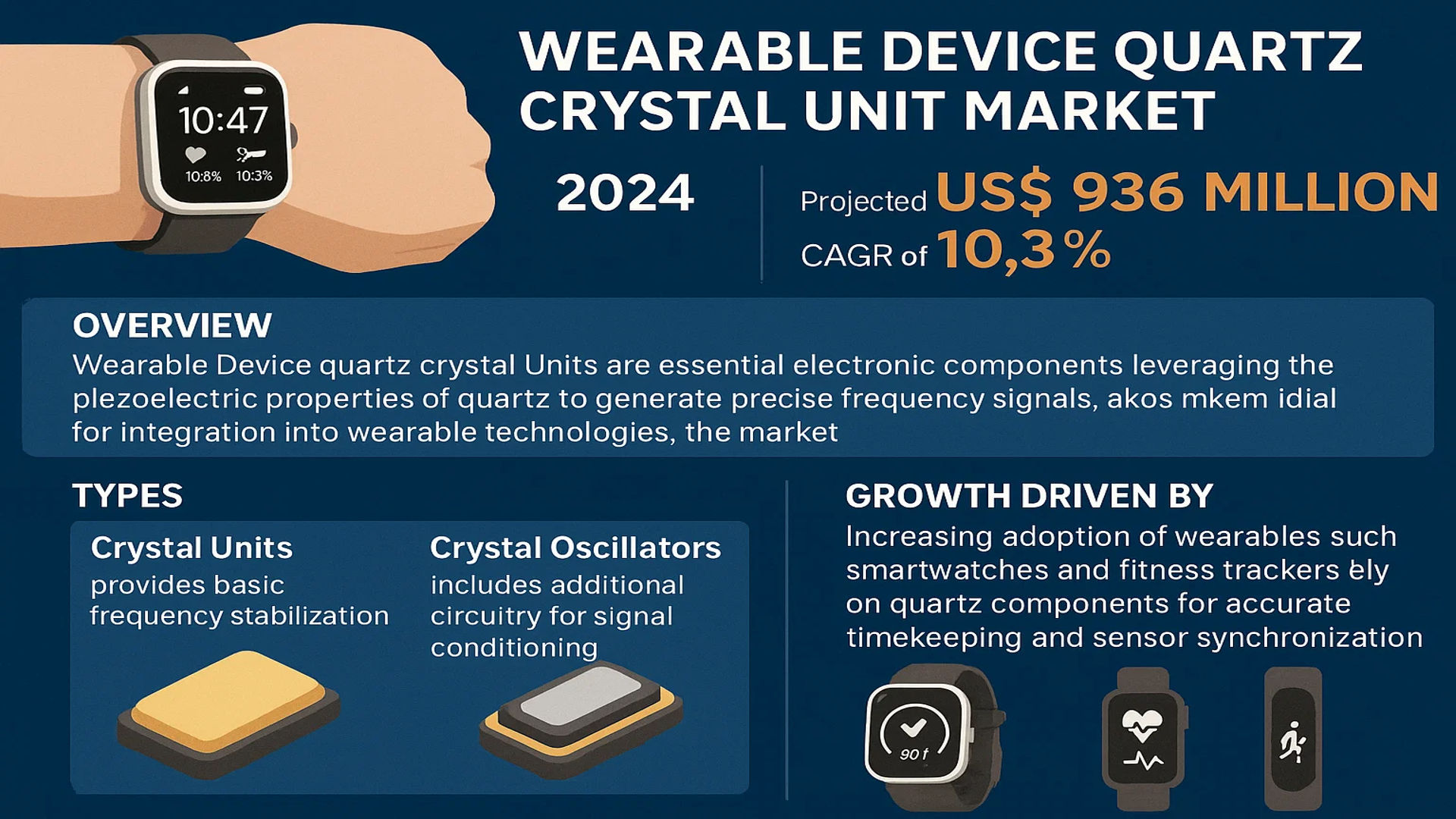
The global Wearable Device Quartz Crystal Unit Market was valued at 477 million in 2024 and is projected to reach US$ 936 million by 2032, at a CAGR of 10.3% during the forecast period.
Wearable Device Quartz Crystal Units are essential electronic components that leverage the piezoelectric properties of quartz to generate precise frequency signals. These units offer high stability, low power consumption, and compact sizing, making them ideal for integration into wearable technologies. The market comprises two primary types: Crystal Units, which provide basic frequency stabilization, and Crystal Oscillators, which include additional circuitry for signal conditioning.
Growth is driven by increasing adoption of wearables like smartwatches and fitness trackers, which rely on quartz components for accurate timekeeping and sensor synchronization. The U.S. and China dominate regional demand, with major manufacturers including Seiko Epson Corp, Murata Manufacturing, and NDK collectively holding significant market share. Recent advancements in miniaturization and energy efficiency further propel the industry, with applications expanding into emerging segments such as VR headsets and medical wearables.
MARKET DYNAMICS
MARKET DRIVERS
Proliferation of Smart Wearables and IoT Integration to Accelerate Market Expansion
The global wearable device market is experiencing unprecedented growth, with shipments projected to exceed 700 million units annually by 2028. This expansion is primarily driven by increasing consumer adoption of smartwatches, fitness trackers, and augmented reality devices that require precise timing components. Quartz crystal units serve as the fundamental timing heartbeat in these devices, ensuring accurate timekeeping, synchronization, and data processing capabilities. The integration of advanced features such as heart rate monitoring, GPS tracking, and wireless connectivity necessitates highly stable frequency control components that can maintain precision under varying environmental conditions and power constraints. As wearable technology becomes more sophisticated with the incorporation of 5G connectivity and edge computing capabilities, the demand for high-performance quartz crystal units with improved frequency stability and lower power consumption continues to escalate.
Miniaturization Trends and Power Efficiency Requirements Driving Technological Innovation
The relentless push toward smaller form factors in wearable devices has created significant opportunities for quartz crystal unit manufacturers. Modern wearables require components that occupy minimal space while delivering maximum performance, leading to the development of ultra-compact crystal units measuring less than 1.0 x 0.8 mm. These miniature components must maintain exceptional frequency stability despite their reduced size, presenting both engineering challenges and market opportunities. Additionally, power efficiency has become a critical differentiator in the wearable market, with consumers expecting devices to operate for extended periods between charges. Advanced quartz crystal units now feature power consumption as low as 1.0 μA while maintaining frequency stability of ±10 ppm, enabling wearable manufacturers to extend battery life without compromising performance. The convergence of miniaturization and power efficiency requirements has stimulated substantial research and development investments, resulting in innovative packaging technologies and materials that enhance overall device performance.
Healthcare and Fitness Monitoring Applications Creating Sustained Demand Growth
The healthcare sector’s increasing reliance on wearable technology for remote patient monitoring and preventive healthcare has emerged as a significant market driver. Medical-grade wearables require quartz crystal units that deliver exceptional accuracy and reliability, as these components directly impact the performance of vital sign monitoring sensors and data transmission systems. The global market for medical wearables is projected to grow at a compound annual growth rate of approximately 26% over the next five years, creating substantial demand for high-quality timing components. Furthermore, the fitness tracking segment continues to evolve with advanced biometric monitoring capabilities, requiring quartz crystal units that can maintain precise timing in dynamic environmental conditions. These applications demand components that can withstand temperature variations, mechanical stress, and electromagnetic interference while maintaining frequency stability within tight tolerances.
➤ For instance, recent regulatory approvals for wearable medical devices incorporating continuous glucose monitoring and cardiac rhythm analysis have created new requirements for ultra-stable timing components that ensure data integrity and synchronization across multiple sensors.
Furthermore, the integration of artificial intelligence and machine learning capabilities in wearable devices necessitates precise timing synchronization between sensors and processors, driving demand for advanced quartz crystal units with improved phase noise characteristics and faster startup times.
MARKET CHALLENGES
Intense Price Pressure and Manufacturing Cost Constraints Impacting Profit Margins
The wearable device quartz crystal unit market faces significant pricing challenges due to intense competition and ongoing cost reduction pressures from device manufacturers. As wearable technology becomes increasingly commoditized, original equipment manufacturers consistently demand lower component prices while expecting improved performance characteristics. The manufacturing process for quartz crystal units involves precision machining, specialized materials, and rigorous quality control measures, all contributing to relatively high production costs. Additionally, the requirement for miniaturization has increased manufacturing complexity, requiring advanced equipment and specialized expertise that further elevates production expenses. These cost pressures are particularly challenging for manufacturers operating in regions with rising labor and energy costs, creating margin compression throughout the supply chain.
Other Challenges
Technical Performance Requirements in Extreme Conditions
Wearable devices are subjected to diverse environmental conditions including temperature extremes, moisture exposure, and mechanical stress, creating significant challenges for quartz crystal unit performance. Maintaining frequency stability within ±10 ppm across temperature ranges from -40°C to +85°C requires advanced compensation techniques and specialized materials. The increasing demand for wearables that can operate in harsh environments, such as industrial settings or extreme sports applications, has amplified these technical challenges. Manufacturers must invest in sophisticated testing equipment and environmental simulation capabilities to ensure component reliability under real-world conditions.
Supply Chain Vulnerabilities and Material Sourcing Limitations
The quartz crystal unit manufacturing process relies on specialized raw materials including high-purity quartz crystals, ceramic packages, and precious metal electrodes. Recent global supply chain disruptions have highlighted vulnerabilities in material sourcing, with lead times for certain critical components extending beyond six months. Additionally, geopolitical tensions and trade restrictions have created uncertainties in the availability of essential materials, particularly high-quality quartz crystals that are predominantly sourced from limited geographical regions. These supply chain challenges necessitate increased inventory management and alternative sourcing strategies, adding complexity to manufacturing operations.
MARKET RESTRAINTS
Competition from Alternative Timing Technologies Limiting Market Growth Potential
While quartz crystal units currently dominate the wearable device timing component market, emerging alternative technologies present significant competitive challenges. Microelectromechanical systems (MEMS) oscillators have made substantial advancements in recent years, offering comparable performance characteristics with improved shock resistance and smaller form factors. These alternative technologies have achieved frequency stability within ±25 ppm while offering advantages in integration capabilities and manufacturing scalability. The adoption of MEMS-based timing solutions in consumer wearables has been gradually increasing, particularly in cost-sensitive market segments where price competition is intense. Although quartz technology maintains advantages in certain performance parameters, the continuous improvement of alternative timing solutions creates pressure on quartz crystal unit manufacturers to innovate while controlling costs.
Additionally, the development of system-on-chip solutions that integrate timing functions directly into main processors presents a long-term challenge to discrete quartz crystal unit demand. As semiconductor manufacturers continue to improve integrated timing capabilities, the need for external timing components may gradually decrease in certain application segments.
MARKET OPPORTUNITIES
Emerging Applications in Advanced Wearable Technologies Creating New Growth Frontiers
The rapid evolution of wearable technology into new application areas presents substantial growth opportunities for quartz crystal unit manufacturers. Emerging segments including augmented reality glasses, smart clothing, and implantable medical devices require timing components with unique performance characteristics. Augmented reality applications demand quartz crystal units with exceptional phase noise performance and minimal jitter to ensure precise synchronization between visual displays, motion sensors, and processing units. The global market for augmented reality wearables is projected to grow at a compound annual growth rate exceeding 40% over the next five years, creating significant demand for specialized timing components. Similarly, the development of smart textiles and flexible electronics requires quartz crystal units that can maintain performance while conforming to non-traditional form factors and withstanding repeated flexing cycles.
Furthermore, the expansion of wearable technology into industrial and enterprise applications creates additional opportunities for high-reliability quartz crystal units. These applications often require components that meet stringent industrial standards for temperature range, shock resistance, and long-term reliability. The increasing adoption of wearables in logistics, manufacturing, and healthcare environments drives demand for components that can withstand harsh operating conditions while maintaining precise timing characteristics.
Additionally, the integration of artificial intelligence and edge computing capabilities in next-generation wearables will require advanced timing solutions that can support complex data processing and communication functions. These technological advancements create opportunities for quartz crystal unit manufacturers to develop specialized products with enhanced performance characteristics tailored to specific application requirements.
WEARABLE DEVICE QUARTZ CRYSTAL UNIT MARKET TRENDS
Miniaturization and Enhanced Power Efficiency Emerge as Dominant Trends
The relentless drive towards smaller, lighter, and more power-efficient wearable devices is fundamentally reshaping the quartz crystal unit market. Manufacturers are under immense pressure to deliver components that consume less power to extend battery life—a critical purchasing factor for consumers—while simultaneously reducing their physical footprint to allow for sleeker, more comfortable device designs. This has led to significant investments in developing ultra-miniature, low-power crystal units, such as those in the 2016 and 1612 size packages. The demand for these compact components is directly correlated with the growth of the smartwatch and fitness tracker segments, which together accounted for over 75% of the wearable device market volume in 2024. Furthermore, advancements in semiconductor technology that enable lower operating voltages for System-on-Chips (SoCs) are pushing crystal unit suppliers to develop compatible oscillators that maintain high stability and low jitter even at voltages below 1.2V, a considerable technical challenge that is being met with innovative circuit design and new crystal cutting techniques.
Other Trends
Rising Demand for High-Precision Timing in Advanced Applications
While basic step-counting requires minimal timing precision, the next generation of wearables demands exceptional accuracy. The integration of advanced features like GPS synchronization, continuous health monitoring with medical-grade accuracy, and seamless connectivity protocols (Bluetooth 5.3, Wi-Fi 6E) necessitates quartz crystal units with extremely low frequency tolerance and high stability over temperature variations. For instance, photoplethysmography (PPG) sensors for heart rate monitoring require a stable clock to ensure accurate sampling rates, as even minor timing drifts can corrupt data. This trend is pushing the market towards higher-performance, higher-value crystal units, with a notable increase in the adoption of Temperature-Compensated Crystal Oscillators (TCXOs) and Oven-Controlled Crystal Oscillators (OCXOs) in premium wearable segments. The market for high-precision units in wearables is projected to grow at a CAGR exceeding 12% through 2032, outpacing the overall market growth.
Supply Chain Diversification and Regional Manufacturing Shifts
Recent global disruptions have underscored the vulnerability of concentrated supply chains, prompting a strategic shift towards diversification and regionalization. While Asia-Pacific remains the dominant manufacturing hub, accounting for approximately 68% of global production, there is a concerted effort by OEMs in North America and Europe to secure supply from a broader base of manufacturers and to foster local production capabilities. This is not just a risk mitigation strategy but also a response to geopolitical tensions and logistical challenges. Consequently, crystal unit manufacturers are expanding their production facilities beyond traditional centers in Japan, Taiwan, and China to regions like Southeast Asia and Eastern Europe. This trend is also driving innovation in logistics and inventory management, with an increased emphasis on vendor-managed inventory and strategic stocking programs to ensure a steady supply of these critical components and avoid production halts that could cost millions per day for major wearable brands.
COMPETITIVE LANDSCAPE
Key Industry Players
Manufacturers Focus on Miniaturization and Precision to Capture Wearable Market Share
The global competitive landscape for wearable device quartz crystal units is fragmented yet features several dominant players holding significant market share. The market is characterized by intense competition driven by technological innovation, miniaturization capabilities, and supply chain efficiency. Seiko Epson Corp and Murata Manufacturing are recognized as market leaders, primarily due to their extensive experience in quartz crystal technology and strong relationships with major wearable OEMs across smartwatch and fitness tracker segments.
TXC Corporation and NDK (Nihon Dempa Kogyo Co., Ltd.) also command substantial market presence, with their growth attributed to high-precision manufacturing processes and robust distribution networks throughout Asia and North America. These companies have consistently invested in advanced production facilities to meet the growing demand for smaller, more power-efficient crystal units required in next-generation wearables.
Additionally, companies are pursuing strategic expansions through mergers and acquisitions to enhance their technological portfolios and global reach. For instance, Micro Crystal’s expertise in ultra-small quartz components has made it a critical supplier for compact wearable designs, while companies like Rakon Limited are focusing on high-stability solutions for premium wearable applications.
Meanwhile, emerging players from Asia-Pacific, including Siward Crystal Technology and Failong Crystal Technologies, are strengthening their positions through competitive pricing and rapid adaptation to market trends. These companies are increasingly investing in R&D to develop innovative frequency control solutions that meet the stringent power and size requirements of modern wearable devices.
List of Key Wearable Device Quartz Crystal Unit Manufacturers Profiled
- Seiko Epson Corp (Japan)
- TXC Corporation (Taiwan)
- KCD (Korea Crystal Device) (South Korea)
- KDS (Daishinku Corp) (Japan)
- NDK (Nihon Dempa Kogyo Co., Ltd.) (Japan)
- Microchip Technology Inc. (U.S.)
- TKD Science (China)
- Hosonic Electronic (Taiwan)
- Murata Manufacturing Co., Ltd. (Japan)
- Micro Crystal (Switzerland)
- Harmony Electronics Corporation (Taiwan)
- Failong Crystal Technologies (China)
- Siward Crystal Technology Co., Ltd. (Taiwan)
- River Eletec Corporation (Japan)
- ZheJiang East Crystal (China)
- Guoxin Micro (China)
- Rakon Limited (New Zealand)
- NSK (JenJaan Quartek Corporation) (Japan)
- Abracon LLC (U.S.)
Segment Analysis:
By Type
Crystal Units Segment Leads Due to Wide Adoption in Compact Wearable Devices
The market is segmented based on type into:
- Crystal Units
- Subtypes: Surface Mount (SMD), Through-Hole, and others
- Crystal Oscillators
- Subtypes: Temperature-Compensated (TCXO), Voltage-Controlled (VCXO), and others
By Application
Smartwatches Segment Dominates Owing to Increasing Consumer Demand for Connected Devices
The market is segmented based on application into:
- Smartwatches
- Fitness Trackers
- VR Headsets
- Others
By Frequency Range
32.768 kHz Segment Remains Critical for Real-Time Clock Applications in Wearables
The market is segmented based on frequency range into:
- 32.768 kHz
- MHz Range
- Subtypes: 8MHz, 16MHz, 24MHz, and others
- GHz Range
By Material
Quartz Crystal Segment is Fundamental Due to Superior Performance Characteristics
The market is segmented based on material into:
- Quartz Crystal
- Ceramic
- Silicon
- Others
Regional Analysis: Wearable Device Quartz Crystal Unit Market
Asia-Pacific
The Asia-Pacific region dominates the global wearable device quartz crystal unit market, accounting for over 45% of global demand due to massive electronics manufacturing capabilities and strong adoption of wearable technology. Countries like China, Japan, and South Korea lead in both production and consumption, supported by major local manufacturers such as TXC Corporation, KDS, and Murata Manufacturing. Increasing smartphone penetration (over 60% in 2024) and growing health-conscious populations are fueling demand for smartwatches and fitness trackers. However, price competition among regional suppliers remains intense, pressuring profit margins while accelerating miniaturization and power efficiency innovations.
North America
North America represents the second-largest market, driven by high disposable incomes and early adoption of advanced wearable technologies. The U.S. accounts for approximately 30% of regional revenue, with key players like Microchip and Abracon expanding their high-frequency, low-power quartz crystal solutions. Strict FCC regulations ensure product quality while IoT and healthcare integration create new opportunities. Canada’s market is smaller but growing steadily, supported by government initiatives promoting digital health technologies. Challenges include supply chain dependencies on Asian component suppliers and increasing competition from MEMS-based timing solutions.
Europe
Europe maintains a strong position in the wearable quartz crystal market, particularly for medical and industrial-grade applications. Germany and the UK lead adoption, with stringent EU regulations driving demand for reliable, precision components. Market growth is somewhat constrained by slower consumer wearable adoption compared to other regions, though increasing investments in German automotive wearables (expected to grow at 8% CAGR through 2030) present new opportunities. Local players like Micro Crystal and Rakon Limited focus on niche applications, differentiating through enhanced stability and miniaturized packages suitable for harsh environments.
South America
The South American market remains in development stages, limited by economic volatility and lower wearable adoption rates. Brazil shows the most promise, with growing middle-class demand for affordable fitness trackers driving quartz crystal unit imports. Local manufacturing is nearly nonexistent due to infrastructure limitations, making the region dependent on Asian and North American suppliers. However, increasing mobile penetration and government health initiatives may stimulate growth, particularly for basic activity tracking devices using cost-effective crystal oscillator solutions.
Middle East & Africa
This emerging market shows potential but faces significant adoption barriers. The UAE and South Africa lead in wearable technology acceptance, though quartz crystal unit demand remains concentrated in smartphone applications rather than dedicated wearables. Limited local manufacturing capabilities result in complete dependence on imports. Market growth may accelerate with increasing digital healthcare initiatives and youth-driven adoption of smart accessories, but currently represents less than 5% of global quartz crystal demand for wearable applications.
Report Scope
This market research report provides a comprehensive analysis of the global Wearable Device Quartz Crystal Unit market, covering the forecast period 2024–2032. It offers detailed insights into market dynamics, technological advancements, competitive landscape, and key trends shaping the industry.
Key focus areas of the report include:
- Market Size & Forecast: Historical data and future projections for revenue, unit shipments, and market value across major regions and segments. The global market was valued at USD 477 million in 2024 and is projected to reach USD 936 million by 2032, growing at a CAGR of 10.3%.
- Segmentation Analysis: Detailed breakdown by product type (Crystal Units, Crystal Oscillators) and application (Smartwatches, Fitness Trackers, VR Headsets, Others) to identify high-growth segments and investment opportunities.
- Regional Outlook: Insights into market performance across North America, Europe, Asia-Pacific, Latin America, and the Middle East & Africa, including country-level analysis. The U.S. market size is estimated at USD million in 2024, while China is projected to reach USD million.
- Competitive Landscape: Profiles of leading market participants including Seiko Epson Corp, TXC Corporation, NDK, Murata Manufacturing, and Micro Crystal, covering their product offerings, market share, and recent developments.
- Technology Trends & Innovation: Assessment of emerging technologies in quartz crystal units, including miniaturization trends and integration with advanced wearable devices.
- Market Drivers & Restraints: Evaluation of factors driving market growth such as increasing wearable device adoption, along with challenges like supply chain constraints and raw material price volatility.
- Stakeholder Analysis: Insights for component manufacturers, wearable device OEMs, suppliers, and investors regarding market opportunities and strategic positioning.
The report employs both primary and secondary research methods, including interviews with industry experts and analysis of verified market data, to ensure accuracy and reliability.
FREQUENTLY ASKED QUESTIONS:
What is the current market size of Global Wearable Device Quartz Crystal Unit Market?
-> Wearable Device Quartz Crystal Unit Market was valued at 477 million in 2024 and is projected to reach US$ 936 million by 2032, at a CAGR of 10.3% during the forecast period.
Which key companies operate in Global Wearable Device Quartz Crystal Unit Market?
-> Key players include Seiko Epson Corp, TXC Corporation, NDK, Murata Manufacturing, and Micro Crystal, among others.
What are the key growth drivers?
-> Key growth drivers include increasing adoption of wearable devices, technological advancements in quartz crystals, and growing demand for miniaturized components.
Which region dominates the market?
-> Asia-Pacific leads the market due to strong electronics manufacturing presence, while North America shows significant growth in advanced wearable technologies.
What are the emerging trends?
-> Emerging trends include development of ultra-small quartz crystal units, low-power consumption designs, and integration with IoT-enabled wearables.

Get Sample Report PDF for Exclusive Insights
Report Sample Includes
- Table of Contents
- List of Tables & Figures
- Charts, Research Methodology, and more...