High Speed Wire-to-Board Connectors Market Insights
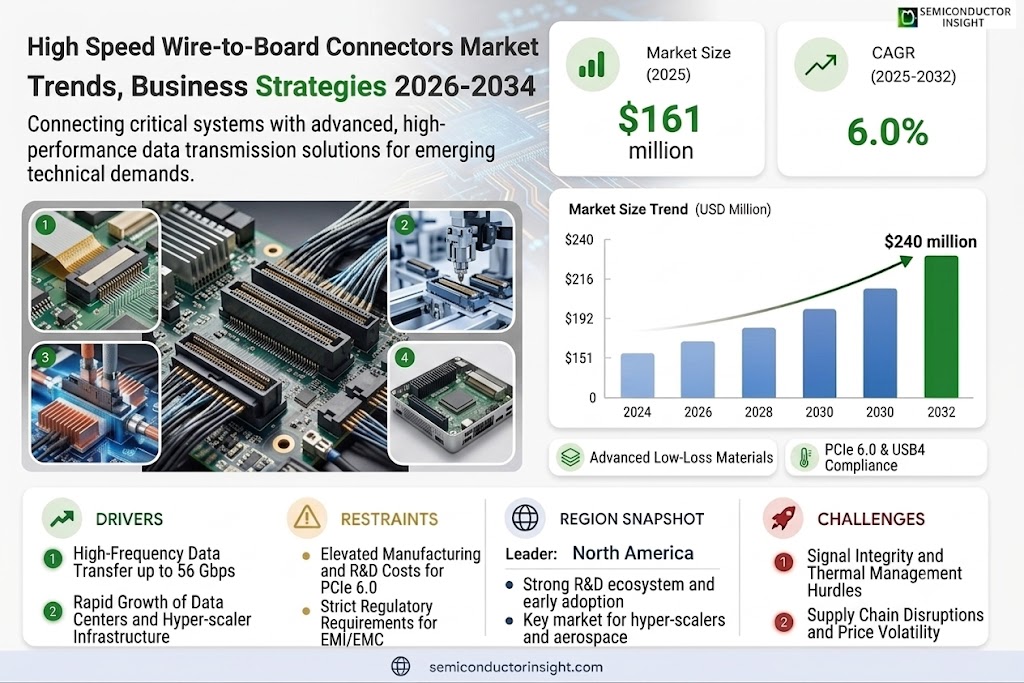
Global High Speed Wire-to-Board Connectors market size was valued at USD 161 million in 2025. The market is projected to reach USD 240 million by 2032, exhibiting a CAGR of 6.0% during the forecast period.
High-speed wire-to-board connectors are precision components designed to provide reliable electrical connections between wires and printed circuit boards (PCBs) in high-performance applications. These connectors are engineered to handle high-frequency signals and data transmission, offering low signal loss, reduced interference, and minimal crosstalk. Typically used in industries such as telecommunications, consumer electronics, automotive, and industrial automation, high-speed wire-to-board connectors feature compact, robust designs that ensure secure connections even in environments with vibration or mechanical stress. With advanced materials, precise contact mechanisms, and optimized geometry, these connectors are essential for ensuring fast, stable, and efficient signal integrity in modern electronic systems, particularly in applications requiring high data transfer rates and high-speed communication.
The market is experiencing rapid growth due to surging demand in telecommunications, automotive electrification, and consumer electronics sectors, where high-speed data handling is critical. Furthermore, the expansion of 5G infrastructure and industrial automation drives further adoption, as these connectors support superior signal performance under demanding conditions. Key players such as TE Connectivity, Samtec, Amphenol, Molex, Hirose, Japan Aviation Electronics Industry, Yamaichi Electronics, Kyocera, IMS Connector Systems, and Omron lead with diverse portfolios tailored to evolving industry needs.
MARKET DRIVERS
Rising Demand in Telecommunications and Data Centers
High Speed Wire-to-Board Connectors Market is propelled by the exponential growth in data transmission needs driven by 5G deployment and cloud computing expansion. Telecom infrastructure upgrades require connectors supporting data rates exceeding 56 Gbps, fostering robust demand as global 5G connections are projected to surpass 1.7 billion by 2025.
Electrification in Automotive Sector
Electric vehicles (EVs) and advanced driver-assistance systems (ADAS) necessitate high-speed, reliable interconnections for battery management and sensor fusion. With EV sales anticipated to reach 17 million units annually by 2028, automotive applications account for over 25% of market growth in High Speed Wire-to-Board Connectors.
➤ Miniaturization trends enable 20-30% reduction in connector size while maintaining signal integrity up to 112 Gbps.
Consumer electronics innovations, including AI-enabled devices, further accelerate adoption, with the overall market expected to grow at a CAGR of 9.2% through 2030.
MARKET CHALLENGES
Signal Integrity and Thermal Management
Maintaining signal integrity at high frequencies poses significant hurdles in High Speed Wire-to-Board Connectors Market, where crosstalk and attenuation degrade performance beyond 56 Gbps. Advanced materials like low-loss dielectrics are essential but increase complexity in design and testing.
Other Challenges
Supply Chain Disruptions
Geopolitical tensions and raw material shortages, such as high-purity copper and specialized polymers, have led to 15-20% price volatility, impacting production timelines for High Speed Wire-to-Board Connectors.
MARKET RESTRAINTS
Elevated Manufacturing and R&D Costs
High development expenses for precision engineering and compliance with standards like PCIe 6.0 and USB4 limit entry barriers in High Speed Wire-to-Board Connectors Market. R&D investments often exceed $50 million per product line, deterring smaller players.Strict regulatory requirements for EMI/EMC compliance in sectors like aerospace add to costs, with certification processes extending timelines by 12-18 months.Competition from wireless alternatives, though nascent, restrains wired connector growth in short-range applications, capturing about 10% market share in consumer segments.
MARKET OPPORTUNITIES
Expansion into IoT and Edge Computing
The proliferation of IoT devices, expected to exceed 75 billion by 2025, creates demand for compact High Speed Wire-to-Board Connectors in edge computing nodes, enabling low-latency data transfer. Industrial automation and robotics advancements offer growth potential, with Industry 4.0 initiatives driving adoption of connectors supporting up to 224 Gbps for real-time control systems. Emerging markets in Asia-Pacific, fueled by semiconductor hubs, present untapped potential, projected to contribute 40% of global High Speed Wire-to-Board Connectors Market expansion by 2030.
High Speed Wire-to-Board Connectors Market Trends
Miniaturization for High-Density Applications
In High Speed Wire-to-Board Connectors Market, miniaturization stands out as a dominant trend, driven by the need for compact, high-performance connections in modern electronics. These precision components support high-frequency signal transmission with minimal loss and crosstalk, essential for devices requiring elevated data rates. Industries such as telecommunications and consumer electronics increasingly rely on these connectors’ robust designs to maintain signal integrity amid space constraints and mechanical stresses.
Other Trends
Shift Toward SMT Technology
Surface-mount technology (SMT) is surpassing traditional through-hole methods in High Speed Wire-to-Board Connectors Market, favored for its efficiency in automated assembly lines and suitability for high-volume production. This transition enables slimmer profiles and improved thermal performance, aligning with demands in compact consumer devices and networking equipment.
Growth in Automotive and Industrial Sectors
Applications in transportation, including electric vehicles, and industrial automation are propelling adoption, where connectors must withstand vibration and harsh environments. Their advanced materials ensure reliable wire-to-PCB interfaces for control systems and sensors.
Expansion in Communication and IT Infrastructure
Leading manufacturers like TE Connectivity, Samtec, Amphenol, and Molex are innovating to meet surging needs in 5G networks, data centers, and servers within High Speed Wire-to-Board Connectors Market. Enhanced geometries reduce interference, supporting faster data transfer crucial for edge computing and high-speed networking. Aerospace and military sectors also contribute, valuing precision for mission-critical systems. Overall, these trends underscore a market evolving toward greater reliability and efficiency across diverse applications.
COMPETITIVE LANDSCAPE
Key Industry Players
High Speed Wire-to-Board Connectors Market Leading Manufacturers Analysis
High Speed Wire-to-Board Connectors Market is dominated by a few established global leaders, with TE Connectivity, Samtec, Amphenol, and Molex holding significant market shares. In 2025, the global top five players collectively accounted for a substantial portion of revenue in this market, valued at US$161 million and projected to grow to US$240 million by 2032 at a CAGR of 6.0%. These companies leverage advanced engineering in precision components for high-frequency signal transmission, low crosstalk, and robust designs suited for telecommunications, automotive, and industrial applications. The market structure features intense competition among multinationals focusing on innovation in SMT and through-hole technologies, with North America and Asia-Pacific as key revenue hubs.
Beyond the top tier, niche players like Hirose Electric, Japan Aviation Electronics Industry, Yamaichi Electronics, Kyocera, IMS Connector Systems, Omron, Smiths Interconnect, and IRISO Electronics contribute through specialized offerings in high-data-rate connectors for aerospace, military, and consumer electronics. These firms emphasize compact, vibration-resistant solutions and cater to regional demands, particularly in Japan and Europe. Emerging dynamics include mergers, product launches, and expansions driven by demand in communication IT and transportation segments, fostering a fragmented yet innovative landscape where mid-tier competitors challenge leaders via cost-effective, high-performance alternatives.
List of Key High Speed Wire-to-Board Connectors Companies Profiled
- TE Connectivity
- Samtec
- Amphenol
- Molex
- Hirose Electric
- Japan Aviation Electronics Industry
- Yamaichi Electronics
- Kyocera
- IMS Connector Systems
- Omron
- Smiths Interconnect
- IRISO Electronics
- JST Mfg. Co., Ltd.
- ERNI Electronics
- Nicomatic
Segment Analysis:
| Segment Category | Sub-Segments | Key Insights |
| By Type |
|
SMT dominates as the leading segment driven by its compatibility with automated assembly processes and high-density PCB designs.
|
| By Application |
|
Communication & IT leads owing to the surge in data-intensive networking and server infrastructure requirements.
|
| By End User |
|
Telecommunications holds the forefront position due to stringent needs for reliable signal transmission in network infrastructure.
|
| By Pitch |
|
0.5 mm emerges as the preferred pitch for high-density interconnects in advanced applications.
|
| By Number of Positions |
|
20-50 Positions commands leadership by striking an optimal balance between connectivity density and ease of handling.
|
Regional Analysis: High Speed Wire-to-Board Connectors Market
Asia-Pacific
Asia-Pacific’s vast electronics assembly lines drive High Speed Wire-to-Board Connectors Market, with facilities optimized for high-volume production of servers and smartphones. Advanced automation reduces defects, ensuring superior performance in harsh environments.
Electric vehicle boom in Asia-Pacific fuels demand for robust wire-to-board connectors handling high currents and speeds. Collaborations between automakers and connector firms yield designs resilient to vibrations and thermal stresses.
5G rollout across urban and rural areas necessitates high-speed connectors for base stations and edge computing. Asia-Pacific leads in deploying fiber-to-the-edge solutions integrated with reliable wire-to-board interfaces.
Localized ecosystems minimize lead times in High Speed Wire-to-Board Connectors Market, enabling just-in-time delivery. Strategic partnerships enhance customization for diverse applications like wearables and industrial automation.
North America
North America’s High Speed Wire-to-Board Connectors Market thrives on technological leadership and data center expansions. Hyperscalers prioritize connectors for AI workloads demanding ultra-high bandwidth and low latency. Innovation hubs in Silicon Valley drive development of advanced materials for signal integrity. Automotive electrification benefits from specialized connectors in ADAS systems. Regulatory focus on data privacy spurs investments in secure, high-speed interconnects. Despite higher costs, premium quality and R&D prowess maintain competitive edge, with exports bolstering regional influence.
Europe
Europe’s High Speed Wire-to-Board Connectors Market emphasizes precision engineering and sustainability. Stringent automotive standards propel demand for connectors in premium EVs and autonomous vehicles. Industrial automation sectors favor durable, high-speed solutions for smart factories. EU Green Deal initiatives promote recyclable materials in connector designs. Collaborative R&D across borders accelerates adoption in telecom for 6G precursors. Mature supply chains ensure reliability, though fragmented markets pose coordination challenges.
South America
High Speed Wire-to-Board Connectors Market in South America grows steadily through consumer electronics imports and nascent manufacturing. Brazil and Mexico emerge as assembly hubs for regional demand in telecom and computing. Infrastructure upgrades for digital inclusion drive basic high-speed connectivity needs. Partnerships with Asian suppliers bridge technology gaps, focusing on cost-effective solutions. Economic volatility tempers expansion, yet rising middle-class consumption supports gradual market penetration.
Middle East & Africa
Middle East & Africa’s High Speed Wire-to-Board Connectors Market accelerates with oil-funded diversification into tech and smart cities. Gulf nations invest in data centers for cloud services, requiring robust high-speed connectors. African telecom expansions prioritize affordable interconnects for mobile broadband. Harsh climates demand rugged designs resistant to dust and heat. International collaborations foster skill development, positioning the region for future High Speed Wire-to-Board Connectors Market contributions amid infrastructure builds.
Report Scope
This market research report provides a comprehensive analysis of High Speed Wire-to-Board Connectors Market, covering the forecast period 2026–2034. It offers detailed insights into market dynamics, technological advancements, competitive landscape, and key trends shaping the industry.
Key focus areas of the report include:
- Market Overview: The report begins with an overview outlining its current market scenario, key growth indicators, and industry transformation drivers. It discusses macroeconomic factors, demand–supply balance, regulatory landscape, and the strategic role of high-speed wire-to-board connectors in powering advancements across industries such as automotive, telecommunications, consumer electronics, and industrial automation.
- Market Size & Forecast: Historical data and future projections for revenue, unit shipments, and market value across major regions and segments.
- Segmentation Analysis: Detailed breakdown by product type, technology, application, and end-user industry to identify high-growth segments and investment opportunities.
- Regional Insights: Insights into market performance across North America, Europe, Asia-Pacific, Latin America, and the Middle East & Africa, including country-level analysis where relevant.
- Competitive Landscape: Profiles of leading market participants, including their product offerings, R&D focus, manufacturing capacity, pricing strategies, and recent developments such as mergers, acquisitions, and partnerships.
- Technology Trends & Innovation: Assessment of emerging technologies, integration of AI/IoT, semiconductor design trends, fabrication techniques, and evolving industry standards.
- Market Drivers & Restraints: Evaluation of factors driving market growth along with challenges, supply chain constraints, regulatory issues, and market-entry barriers.
- Stakeholder Insights: Insights for component suppliers, OEMs, system integrators, investors, and policymakers regarding the evolving ecosystem and strategic opportunities.
Primary and secondary research methods are employed, including interviews with industry experts, data from verified sources, and real-time market intelligence to ensure the accuracy and reliability of the insights presented.
FREQUENTLY ASKED QUESTIONS:
What is the current market size of High Speed Wire-to-Board Connectors Market?
-> High Speed Wire-to-Board Connectors Market was valued at USD 161 million in 2025 and is expected to reach USD 240 million by 2032, at a CAGR of 6.0% during the forecast period.
Which key companies operate in High Speed Wire-to-Board Connectors Market?
-> Key players include TE Connectivity, Samtec, Amphenol, Molex, Hirose, among others.
What are the key growth drivers?
-> Key growth drivers include demand for high-speed data transmission in telecommunications, consumer electronics, automotive, and industrial automation.
Which region dominates the market?
-> Asia is the fastest-growing region, while North America remains a dominant market.
What are the emerging trends?
-> Emerging trends include low signal loss, reduced crosstalk, compact designs, and high-frequency signal handling.

Get Sample Report PDF for Exclusive Insights
Report Sample Includes
- Table of Contents
- List of Tables & Figures
- Charts, Research Methodology, and more...
 Download Sample Report PDF