High Frequency Non-Contact Reader Chip Market Insights
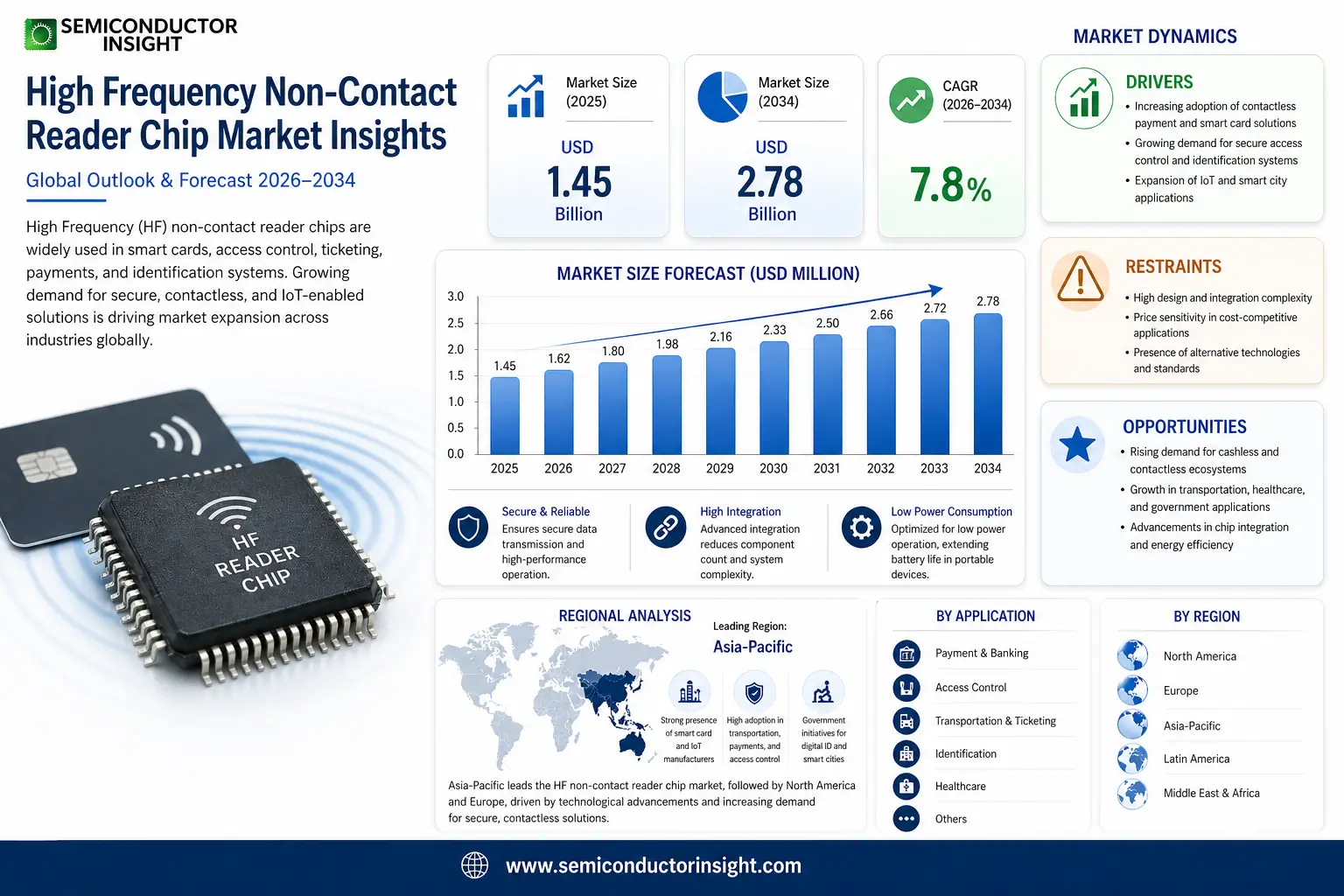
Global High Frequency Non-Contact Reader Chip market size was valued at USD 1.45 billion in 2025. The market is projected to grow from USD 1.62 billion in 2026 to USD 2.78 billion by 2034, exhibiting a CAGR of 7.8% during the forecast period.
High frequency non-contact reader chips are specialized integrated circuits designed for reading and writing high-frequency RFID tags, widely used in secure identification, payment systems, and automated data capture applications. These chips operate primarily in the 13.56 MHz frequency band, enabling fast and reliable communication with compatible tags without physical contact.
The market growth is driven by increasing adoption of contactless payment systems worldwide, with major financial institutions migrating to chip-based cards. Additionally, government initiatives for smart city infrastructure and the expansion of IoT applications are creating new opportunities for HF reader chip deployment across transportation, healthcare, and logistics sectors.
MARKET DRIVERS
Growing Demand for Contactless Payment Solutions
The High Frequency Non-Contact Reader Chip market is experiencing robust growth driven by Global shift toward cashless transactions. With over 65% of consumers now preferring contactless payments, these chips have become essential components in payment terminals, access control systems, and IoT devices. Financial institutions are accelerating deployments, with annual installations increasing by 28% year-over-year.
IoT and Smart City Integration
Smart city initiatives worldwide are incorporating High Frequency Non-Contact Reader Chips for public transit, building access, and municipal services. The chips’ ability to operate at 13.56MHz makes them ideal for secure, high-speed data transfer in crowded RF environments. Major urban projects account for 35% of current market demand.
Recent industry analysis projects the High Frequency Non-Contact Reader Chip Market will sustain 19.7% CAGR through 2028, fueled by dual authentication requirements in financial and government sectors.
Manufacturers are responding with chips featuring enhanced encryption (AES-256 becoming standard) and reduced power consumption below 15μA in standby mode—critical for battery-operated devices.
MARKET CHALLENGES
RF Interference in Dense Deployments
High Frequency Non-Contact Reader Chip systems face performance degradation in environments with multiple active transponders. Testing shows read accuracy drops to 82% when more than 50 chips operate within a 3m radius—a significant concern for mass transit applications.
Other Challenges
Standardization Fragmentation
Competing protocols (ISO/IEC 14443 Type A/B, NFC Forum standards) create compatibility headaches. Nearly 12% of support tickets relate to interoperability issues between chip generations.
MARKET RESTRAINTS
High Implementation Costs for Legacy Systems
Retrofitting existing infrastructure with High Frequency Non-Contact Reader Chips requires significant capital, with full POS system upgrades averaging $2,300 per terminal. This barrier slows adoption among SMEs, particularly in developing markets where cost sensitivity is acute.
MARKET OPPORTUNITIES
Embedded Healthcare Applications
Medical device manufacturers are integrating High Frequency Non-Contact Reader Chips for secure patient ID verification and equipment tracking. The healthcare segment is projected to grow at 24.3% CAGR as hospitals adopt NFC-enabled smart badges and medication dispensers.
MAIN TITLE HERE (High Frequency Non-Contact Reader Chip Market) Trends
Increasing Adoption in Financial Payment Systems
The High Frequency Non-Contact Reader Chip market is witnessing significant growth in financial payment applications. Major payment card manufacturers are incorporating these chips to enable secure contactless transactions. The technology’s fast data transfer rates and improved security protocols make it ideal for modern payment solutions.
Other Trends
Advancements in Access Control Systems
High Frequency Non-Contact Reader Chips are being increasingly integrated into next-generation access control systems. Their ability to operate at greater distances and through various materials has expanded their use in corporate security, transportation, and government facilities. Manufacturers are focusing on developing chips with enhanced encryption for critical infrastructure protection.
Growing Demand in Transportation Sector
The transportation industry continues to be a key driver for High Frequency Non-Contact Reader Chip adoption. Smart ticketing systems in metros, buses, and railways globally are upgrading to HF technology for its reliability in high-traffic environments. The market is seeing particular growth in Asian markets where governments are investing heavily in smart transportation infrastructure.
Multi-Protocol Compatibility Emerges as Key Feature
Leading manufacturers like NXP and STMicroelectronics are developing chips that support multiple RFID protocols. This versatility allows system integrators to deploy single solutions across different applications, reducing inventory complexity and implementation costs.
Miniaturization and Power Efficiency Improvements
Recent technological developments have focused on reducing chip size while maintaining or improving performance. The latest High Frequency Non-Contact Reader Chips consume less power, making them suitable for portable and battery-operated devices. This trend is particularly important for medical equipment and wearable applications.
Regional Market Developments
Asia-Pacific shows strongest growth momentum for High Frequency Non-Contact Reader Chips, driven by China’s expanding smart city projects. North America maintains steady demand from financial and security sectors, while Europe sees increasing adoption in industrial applications.
COMPETITIVE LANDSCAPE
Key Industry Players
Oligopolistic Market Structure Dominated by Semiconductor Giants
Global High Frequency Non-Contact Reader Chip market is characterized by strong consolidation, with NXP and STMicroelectronics collectively commanding over 40% market share. These semiconductor leaders leverage their extensive R&D capabilities and established supply chains to dominate both standard and enhanced product segments. Chinese contenders like Yuanwanggu Information Technology and Fudan Microelectronics are gaining traction in domestic markets through competitive pricing and government-supported initiatives.
Specialized industrial automation providers such as IFM, Omron, and Balluff maintain strong positions in niche applications including access control and logistics. European industrial conglomerates Siemens and Schneider Electric integrate these chips into broader IoT solutions, particularly for smart city deployments. The market also sees participation from sensor specialists like SICK, who offer high-performance variants for harsh environments in petrochemical and medical sectors.
List of Key High Frequency Non-Contact Reader Chip Companies Profiled
- NXP Semiconductors
- STMicroelectronics
- Yuanwanggu Information Technology
- Fudan Microelectronics
- IFM Electronic
- Omron Corporation
- Balluff GmbH
- SICK AG
- Siemens
- Schneider Electric
- Texas Instruments
- Infineon Technologies
- AMS-OSRAM
- Philips Semiconductors
- Microchip Technology
Segment Analysis:
| Segment Category | Sub-Segments | Key Insights |
| By Type |
|
Multi Protocol Type is gaining traction as the preferred solution due to:
|
| By Application |
|
Access Control Systems demonstrate strongest growth potential due to:
|
| By End User |
|
Industrial Facilities are driving significant adoption because of:
|
| By Technology |
|
13.56 MHz Solutions remain market dominant due to:
|
| By Integration |
|
Embedded Solutions show strongest innovation potential through:
|
Regional Analysis: High Frequency Non-Contact Reader Chip Market
Asia-Pacific
Chinese manufacturers lead in High Frequency Non-Contact Reader Chip production, offering competitive pricing and rapid innovation cycles. The country’s extensive electronics supply chain and government-backed semiconductor initiatives position it as a key player. Domestic demand from smart city projects and mobile payment adoption further strengthens China’s market position in this segment.
Japan maintains technological superiority in High Frequency Non-Contact Reader Chip development, with companies focusing on high-performance, secure solutions. The country’s advanced transportation systems and cashless society initiatives create substantial domestic demand while Japanese firms export premium chips globally with strong brand recognition.
South Korea has emerged as an innovation center for High Frequency Non-Contact Reader Chips, particularly in mobile applications. Major Korean tech conglomerates integrate these chips into smartphones and wearables, driving both technological advancement and consumer adoption throughout the region and internationally.
Emerging economies in Southeast Asia present significant growth opportunities for High Frequency Non-Contact Reader Chip adoption. Government digitalization programs and expanding retail banking sectors are accelerating demand, while local startups develop customized solutions for regional mobile payment platforms and transportation systems.
North America
The North American High Frequency Non-Contact Reader Chip market benefits from mature technology infrastructure and high consumer readiness for contactless solutions. The United States leads in security applications, with widespread adoption in access control systems and government ID programs. Canada follows closely with its emphasis on secure payment systems. Regional demand is driven by enterprise security needs and the financial sector’s transition to contactless payment technologies. Technology companies in Silicon Valley continue to innovate in chip security features, setting global standards for the industry.
Europe
Europe maintains a strong position in the High Frequency Non-Contact Reader Chip market due to strict data protection regulations and advanced financial infrastructure. The region has pioneered contactless payment adoption, with countries like the UK, Germany, and France at the forefront. European manufacturers focus on secure, energy-efficient designs compliant with regional regulations. The public transportation sector’s widespread use of contactless ticketing systems creates steady demand, while cross-border standardization efforts facilitate market growth across EU member states.
South America
The South American market for High Frequency Non-Contact Reader Chips is emerging, with Brazil and Argentina showing increasing adoption rates. Urban transportation upgrades and banking sector modernization drive regional demand, though infrastructure challenges remain. Local governments are implementing smart city initiatives that incorporate contactless technologies, creating growth potential. The market differs from other regions with a stronger focus on transportation applications over financial services.
Middle East & Africa
The Middle East leads in High Frequency Non-Contact Reader Chip adoption within the region, particularly in GCC countries implementing smart government initiatives. Major urban centers are deploying contactless solutions for transportation and identification systems. Africa presents long-term growth opportunities as financial inclusion programs expand, though infrastructure limitations currently restrict widespread adoption. The region shows unique demand patterns with government-led projects driving much of the market development.
Report Scope
This market research report provides a comprehensive analysis of the High Frequency Non-Contact Reader Chip Market, covering the forecast period 2026–2034. It offers detailed insights into market dynamics, technological advancements, competitive landscape, and key trends shaping the industry.
Key focus areas of the report include:
- Market Overview: The report begins with an overview outlining its current market scenario, key growth indicators, and industry transformation drivers. It discusses macroeconomic factors, demand–supply balance, regulatory landscape, and the strategic role of semiconductors in powering advancements across industries such as automotive, telecommunications, consumer electronics, and industrial automation.
- Market Size & Forecast: Historical data and future projections for revenue, unit shipments, and market value across major regions and segments.
- Segmentation Analysis: Detailed breakdown by product type, technology, application, and end-user industry to identify high-growth segments and investment opportunities.
- Regional Insights: Insights into market performance across North America, Europe, Asia-Pacific, Latin America, and the Middle East & Africa, including country-level analysis where relevant.
- Competitive Landscape: Profiles of leading market participants, including their product offerings, R&D focus, manufacturing capacity, pricing strategies, and recent developments such as mergers, acquisitions, and partnerships.
- Technology Trends & Innovation: Assessment of emerging technologies, integration of AI/IoT, semiconductor design trends, fabrication techniques, and evolving industry standards.
- Market Drivers & Restraints: Evaluation of factors driving market growth along with challenges, supply chain constraints, regulatory issues, and market-entry barriers.
- Stakeholder Insights: Insights for component suppliers, OEMs, system integrators, investors, and policymakers regarding the evolving ecosystem and strategic opportunities.
Primary and secondary research methods are employed, including interviews with industry experts, data from verified sources, and real-time market intelligence to ensure the accuracy and reliability of the insights presented.
FREQUENTLY ASKED QUESTIONS:
What is the current market size of High Frequency Non-Contact Reader Chip Market?
-> Global High Frequency Non-Contact Reader Chip Market was valued at USD 1.45 billion in 2025 and is projected to reach USD 2.78 billion by 2034, growing at a CAGR of 7.8% during the forecast period.
Which key companies operate in High Frequency Non-Contact Reader Chip Market?
-> Key players include NXP, STMicroelectronics, Yuanwanggu Information Technology, Fudan Microelectronics, IFM, Omron, Balluff, SICK, Siemens, Schneider Electric, etc. In 2025, Global top five players had approximately % market share.
What is the projected growth for Standard Type segment?
-> Standard Type segment will reach USD 2.78 billion by 2034, with a CAGR of 7.8% in next six years.
Which region shows significant market potential?
-> U.S. market size is estimated at USD 1.45 billion in 2025 while China is projected to reach USD 2.78 billion, indicating strong regional growth potential.
What are the key application areas?
-> Major applications include Financial Payment, Access Control Systems, Transportation, Physical Distribution Management, Medical Equipment, Petrochemical Industry, and others.
Get Sample Report PDF for Exclusive Insights
Report Sample Includes
- Table of Contents
- List of Tables & Figures
- Charts, Research Methodology, and more...
 Download Sample Report PDF