
Smart Servo Motor Market Overview
Smart servo motors are motors that have enhanced features than just positioning their shafts like standard servo motors. These motors are designed specifically to provide ease of use in robotics applications.
This report provides a deep insight into the global Smart Servo Motor market covering all its essential aspects. This ranges from a macro overview of the market to micro details of the market size, competitive landscape, development trend, niche market, key market drivers and challenges, SWOT analysis, value chain analysis, etc.
The analysis helps the reader to shape the competition within the industries and strategies for the competitive environment to enhance the potential profit. Furthermore, it provides a simple framework for evaluating and accessing the position of the business organization. The report structure also focuses on the competitive landscape of the Global Smart Servo Motor Market, this report introduces in detail the market share, market performance, product situation, operation situation, etc. of the main players, which helps the readers in the industry to identify the main competitors and deeply understand the competition pattern of the market.
In a word, this report is a must-read for industry players, investors, researchers, consultants, business strategists, and all those who have any kind of stake or are planning to foray into the Smart Servo Motor market in any manner.
Smart Servo Motor Market Analysis:
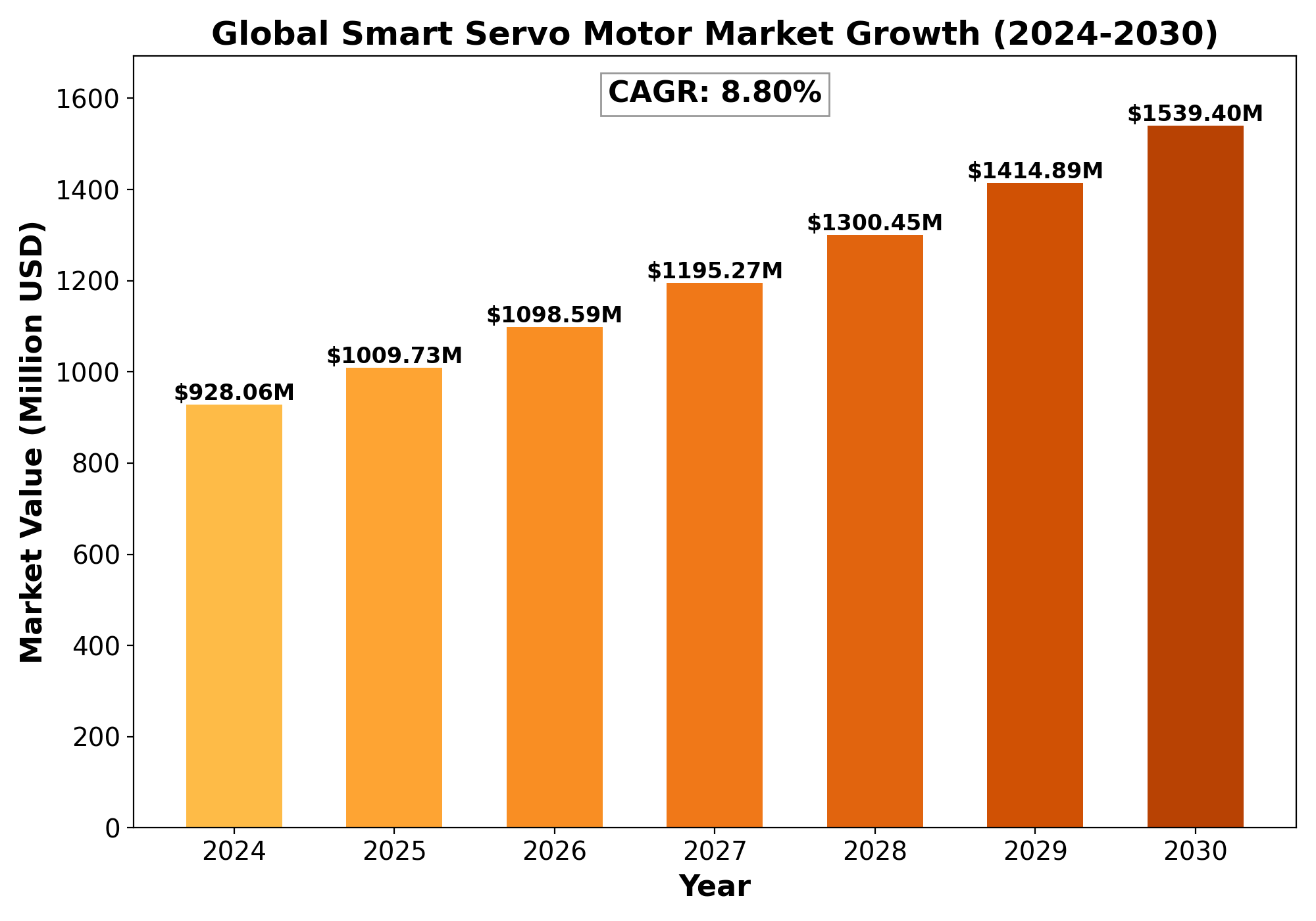
The Global Smart Servo Motor Market size was estimated at USD 853 million in 2023 and is projected to reach USD 1539.40 million by 2030, exhibiting a CAGR of 8.80% during the forecast period.
North America Smart Servo Motor market size was USD 222.27 million in 2023, at a CAGR of 7.54% during the forecast period of 2024 through 2030.
Smart Servo Motor Key Market Trends :
- Increased Adoption of Smart Servo Motors in Robotics: As automation and robotics continue to advance, the use of smart servo motors in industrial and medical robots is growing rapidly due to their superior performance and precision.
- Integration with IoT and AI: The integration of Internet of Things (IoT) and Artificial Intelligence (AI) in smart servo motors allows for real-time monitoring, predictive maintenance, and higher adaptability in industrial processes.
- Miniaturization and Enhanced Efficiency: As smart servo motors become more compact, their efficiency increases, making them ideal for applications with space and power constraints while offering enhanced performance.
- Growth in Automotive Industry: The automotive sector’s increasing demand for automation and precision is fueling the adoption of smart servo motors for various manufacturing processes, such as assembly lines and robotic operations.
- Technological Advancements in Control Systems: The development of advanced control systems for smart servo motors allows for greater customization, better precision, and improved energy efficiency, expanding their use in various applications.
Smart Servo Motor Market Regional Analysis :
-
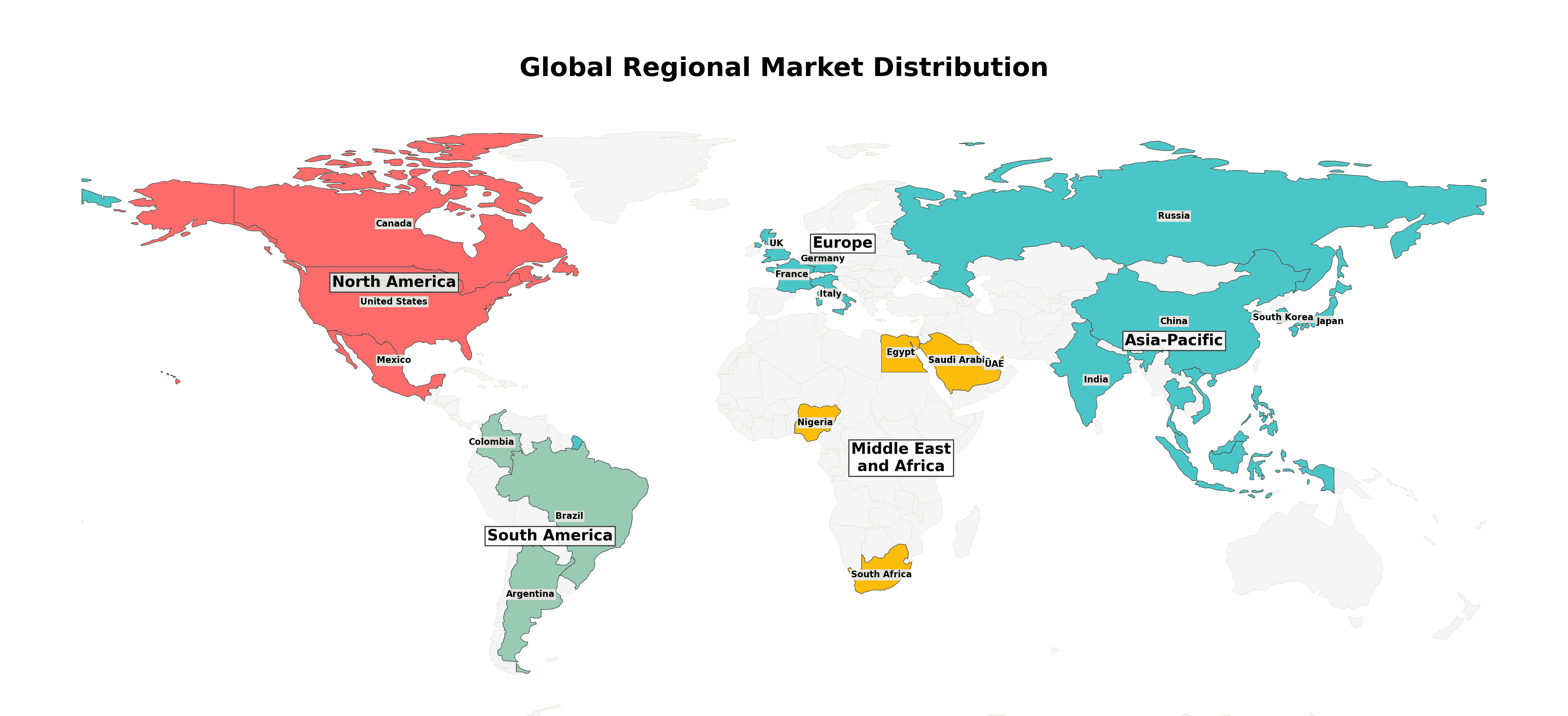
North America:
Strong demand driven by EVs, 5G infrastructure, and renewable energy, with the U.S. leading the market.
-
Europe:
Growth fueled by automotive electrification, renewable energy, and strong regulatory support, with Germany as a key player.
-
Asia-Pacific:
Dominates the market due to large-scale manufacturing in China and Japan, with growing demand from EVs, 5G, and semiconductors.
-
South America:
Emerging market, driven by renewable energy and EV adoption, with Brazil leading growth.
-
Middle East & Africa:
Gradual growth, mainly due to investments in renewable energy and EV infrastructure, with Saudi Arabia and UAE as key contributors.
Smart Servo Motor Market Segmentation :
The research report includes specific segments by region (country), manufacturers, Type, and Application. Market segmentation creates subsets of a market based on product type, end-user or application, Geographic, and other factors. By understanding the market segments, the decision-maker can leverage this targeting in the product, sales, and marketing strategies. Market segments can power your product development cycles by informing how you create product offerings for different segments.
Key Company
- Mitsubishi Electric
- Fanuc
- Bosch Rexroth
- Moog
- Lenze
- Parker Hannifin
- Beckhoff
- REV Robotics
- Pololu
- Nanotec
- Studica
- DFRobot
- Lynxmotion
- China Leadshine Tech
- Arcus Servo Motion
Market Segmentation (by Type)
- Operating Voltage below 9 V
- Operating Voltage above 9 V
Market Segmentation (by Application)
- Industrial Robot
- Medical Robot
- Others
Drivers:
- Rising Demand for Automation: The growing need for automation in industries like manufacturing, robotics, and healthcare is propelling the demand for smart servo motors due to their efficiency and accuracy in performing complex tasks.
- Technological Advancements: Innovations in smart servo motor technologies, such as integration with IoT, AI, and enhanced control systems, are improving their performance, thereby increasing their adoption across different sectors.
- Growth in Robotics and AI Applications: The increasing use of robots in both industrial and medical fields is driving the demand for smart servo motors, as they offer higher precision and functionality in robotic systems.
Restraints:
- High Initial Investment: The cost of smart servo motors and their integration with advanced control systems may limit their adoption, especially in small- and medium-sized enterprises that may not have sufficient budgets.
- Complexity in Installation and Maintenance: The advanced features of smart servo motors require specialized installation and maintenance, which could be a challenge for companies with limited technical expertise or resources.
- Intense Competition in the Market: The market for smart servo motors is becoming increasingly competitive, with numerous players offering similar products, leading to price wars and reduced profit margins for companies.
Opportunities:
- Expansion in Emerging Markets: As automation technologies are gradually making their way into emerging markets, there is a significant opportunity for growth in these regions for smart servo motor manufacturers.
- Customization and Tailored Solutions: Manufacturers can take advantage of the growing demand for highly specialized servo motors by offering customized solutions for niche applications in industries such as healthcare, aerospace, and automotive.
- Integration with Renewable Energy Systems: The use of smart servo motors in renewable energy systems, such as wind and solar energy turbines, presents a new opportunity for market growth as industries look to optimize energy production and storage.
Challenges:
- Technological Complexity: The rapid pace of technological change in the smart servo motor market presents a challenge in keeping up with new innovations, requiring companies to invest in continuous research and development.
- Supply Chain Disruptions: Global supply chain challenges, such as shortages of raw materials and transportation delays, can impact the production and delivery timelines of smart servo motors.
- Market Fragmentation: The large number of market players and the diversity of product offerings can make it difficult for companies to establish a strong foothold and differentiate themselves in the competitive landscape.
Key Benefits of This Market Research:
- Industry drivers, restraints, and opportunities covered in the study
- Neutral perspective on the market performance
- Recent industry trends and developments
- Competitive landscape & strategies of key players
- Potential & niche segments and regions exhibiting promising growth covered
- Historical, current, and projected market size, in terms of value
- In-depth analysis of the Smart Servo Motor Market
- Overview of the regional outlook of the Smart Servo Motor Market:
Key Reasons to Buy this Report:
- Access to date statistics compiled by our researchers. These provide you with historical and forecast data, which is analyzed to tell you why your market is set to change
- This enables you to anticipate market changes to remain ahead of your competitors
- You will be able to copy data from the Excel spreadsheet straight into your marketing plans, business presentations, or other strategic documents
- The concise analysis, clear graph, and table format will enable you to pinpoint the information you require quickly
- Provision of market value (USD Billion) data for each segment and sub-segment
- Indicates the region and segment that is expected to witness the fastest growth as well as to dominate the market
- Includes in-depth analysis of the market from various perspectives through Porters five forces analysis
- Provides insight into the market through Value Chain
- Market dynamics scenario, along with growth opportunities of the market in the years to come
- 6-month post-sales analyst support
Customization of the Report
In case of any queries or customization requirements, please connect with our sales team, who will ensure that your requirements are met.
FAQs
A1: The key drivers include the rise in automation demand, technological advancements, and growth in robotics. Opportunities lie in emerging markets, customization of solutions, and integration with renewable energy systems.
Q2: Which region is projected to have the largest market share?
A2: North America is expected to hold the largest market share, with a strong growth rate due to its high demand for automation in industries like robotics and manufacturing.
Q3: Who are the top players in the global Smart Servo Motor market?
A3: Key players in the global smart servo motor market include Mitsubishi Electric, Fanuc, Bosch Rexroth, Moog, and Lenze, among others.
Q4: What are the latest technological advancements in the industry?
A4: The latest advancements include integration with IoT and AI for real-time monitoring and predictive maintenance, along with improved control systems for better precision and efficiency.
Q5: What is the current size of the global Smart Servo Motor market?
A5: The global Smart Servo Motor market was valued at USD 853 million in 2023 and is projected to reach USD 1539.40 million by 2030, exhibiting a CAGR of 8.80%.

Get Sample Report PDF for Exclusive Insights
Report Sample Includes
- Table of Contents
- List of Tables & Figures
- Charts, Research Methodology, and more...
 Download Sample Report PDF


