Key Statistics
Key Takeaways
- Market trajectory: global revenue reached USD 123 million in 2025 and is forecast at USD 303 million by 2034, representing a 10.5% compound annual expansion during 2026–2034. Furnace qualification and the useful life of precision ceramic carriers determine when this revenue converts into orders.
- Horizontal boats accounted for an estimated ~58% of 2025 sales, supported by established horizontal diffusion furnaces; vertical designs, with an estimated ~42% share, grow faster as fabs value compact floor-space use and automated batch handling.
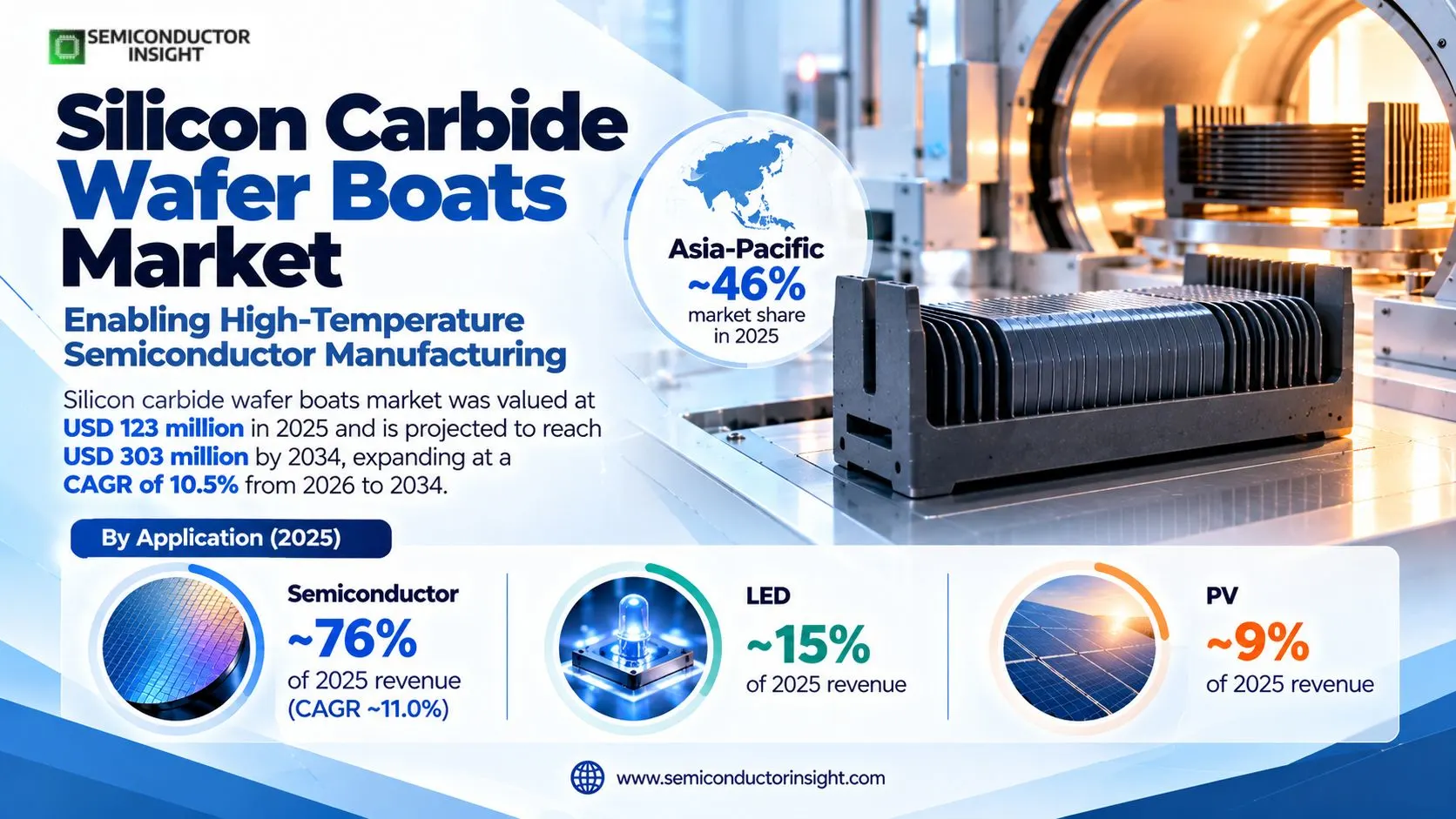
- Semiconductor processing represented an estimated ~76% of demand in 2025, ahead of LED at ~15% and photovoltaic applications at ~9%; qualification thresholds are especially demanding where contamination can affect device yield.
- Asia-Pacific led at an estimated ~46% of 2025 revenue and grows around ~11.4% annually, reflecting Taiwan, South Korea, China and Japan process-equipment ecosystems; North America followed with about ~27%.
- Competitive differentiation rests on silicon-carbide purity, machined slot precision, resistance to thermal cycling, furnace-specific dimensions and the supplier’s ability to support cleaning and requalification throughout the fixture lifetime.
Silicon Carbide Wafer Boats Market Overview
Silicon carbide wafer boats market was valued at USD 123 million in 2025 and is projected to reach USD 303 million by 2034, expanding at a CAGR of 10.5% from 2026 to 2034. Asia-Pacific held the largest market position in 2025 with an estimated ~46% share, supported by its extensive wafer-processing manufacturing base.
Silicon carbide wafer boats are high-temperature carriers with accurately machined slots that separate and support wafers during diffusion, oxidation, low-pressure chemical vapor deposition and related batch-furnace operations. A carrier must remain dimensionally stable after repeated heating and cooling, expose wafers uniformly to process gases and avoid shedding particles onto sensitive surfaces. Silicon carbide is chosen when mechanical rigidity and thermal endurance justify a higher initial component price than common quartz fixtures.
Revenue in this market covers finished silicon-carbide wafer boats supplied for semiconductor, LED and photovoltaic wafer processing, including horizontal and vertical designs, custom slot patterns and compatible high-purity ceramic construction. It excludes the wafers carried by the boats, SiC substrates used to fabricate power devices, furnace equipment sold as complete systems, standalone paddles and process tubes, and wafer shipping cassettes. These adjacent categories influence demand but are not added to the market value.
Procurement occurs at two distinct points in a furnace’s life. Equipment manufacturers specify carriers when they qualify a new thermal-processing chamber, whereas device manufacturers and maintenance teams purchase replacement units after inspections detect wear, warping or particle-related deterioration. Replacement demand provides continuity during equipment-spending pauses, but a new tool platform can take longer to qualify because temperature uniformity, wafer handling and cleaning procedures must all be assessed together.
The material specification is not uniform across customers. Reaction-bonded, sintered, recrystallized and chemical-vapor-deposited silicon-carbide approaches offer different balances of density, surface purity and manufacturing cost. CoorsTek identifies both recrystallized and CVD SiC in its semiconductor furnace portfolio; Kallex lists dense sintered SiC for horizontal boats. Purchasers therefore evaluate the finished carrier against actual furnace chemistry rather than treating every SiC grade as interchangeable.
The investment backdrop supports a multiyear demand pipeline without providing a direct measure of wafer-boat revenue. SEMI projected in October 2026 that worldwide 300 mm fab equipment spending could reach USD 149 billion in 2026 and USD 227 billion in 2029. Those figures cover broad capital equipment categories, not ceramic carriers, but they indicate how expanding fabrication capacity creates additional installed furnaces that eventually need original and replacement boats.
Segment Analysis: By Type
Two furnace-orientation types define this market. Horizontal boats lead at an estimated ~58% of 2025 revenue, while vertical carriers represent about ~42% and have a faster modeled ~11.5% CAGR. The split concerns the physical wafer support orientation and does not divide the market by SiC powder grade or wafer substrate material.
| Type | Design and use | Market position |
|---|---|---|
| Horizontal | Long carrier geometries travel into horizontal diffusion tubes and maintain a controlled slot pitch through repeated furnace cycles. Process engineers inspect cantilever support, edge contact and wafer bow to avoid scratches during loading. The configuration is common in installed equipment fleets where furnace retrofit is expensive and the original carrier drawing remains the procurement standard. | Largest type at an estimated ~58% of 2025 revenue, with modeled growth of ~9.7% CAGR. The segment benefits from replacement orders across existing thermal lines, although adoption of automated vertical tools constrains its share gain. Buyers compare 4-inch through 12-inch compatibility, cleaning tolerance and service history rather than catalog dimensions alone. |
| Vertical | Upright batch racks align wafers in a stacked geometry and are designed for vertical furnaces with robotic loading and controlled gas-flow patterns. Material density and coating adhesion matter at multiple support points, where a small particle event can affect several wafers in the same process batch. These designs often require closer integration with a tool maker’s handling cassette and elevator. | An estimated ~42% of 2025 sales and a modeled ~11.5% CAGR, faster than horizontal configurations. Higher-density fabs value footprint efficiency, but each design requires qualification for wafer size, thermal recipe, transfer robot and the specific slot interface. The growth outlook is therefore stronger in new lines than in low-utilization legacy furnaces. |
Material and furnace qualification within each type
Neither orientation determines material quality by itself. A horizontal carrier may use a dense sintered body for load-bearing strength, while a vertical rack may employ a CVD-coated surface to manage contamination under demanding LPCVD chemistry. A 200 mm carrier and a 300 mm carrier can share an orientation but differ sharply in slot dimensions, thermal mass and automated handling requirements. Qualification compares these characteristics under the buyer’s actual process temperature.
CoorsTek lists both vertical and horizontal wafer-boat configurations, and its technical portfolio includes PureSiC CVD material as well as recrystallized compositions. Kallex specifies dense sintered silicon carbide for high-temperature horizontal boats. These supplier examples show why purchasers must review a material certificate, drawing revision and cleaning protocol together; choosing the correct orientation alone cannot guarantee acceptable wafer-level yield.
Segment Analysis: By Application
Applications comprise Semiconductor, LED and PV. Semiconductor diffusion and deposition hold an estimated ~76% of 2025 revenue and grow near ~11.0% CAGR, compared with LED at ~15% and PV at ~9%. All three require thermal stability, but device yield requirements, batch throughput and price sensitivity differ substantially. A 150 mm LED process line cannot assume the same carrier specification as a 300 mm logic fab.
| Application | Demand characteristics |
|---|---|
| Semiconductor | Largest application at ~76% share and about ~11.0% CAGR. Front-end wafer fabs purchase precision boats for oxidation, diffusion, LPCVD and annealing steps where particles and mechanical damage threaten expensive process sequences. Thermal recipes may exceed 1,000°C, and buyers examine impurity control, wafer-to-wafer uniformity and compatibility with 200 mm or 300 mm furnace platforms. Replacement schedules depend on inspections rather than a fixed calendar. |
| LED | Estimated ~15% of 2025 revenue with modeled ~8.7% annual growth. LED production uses high-temperature and thin-film process steps but differs from mainstream logic and memory manufacturing in wafer materials, equipment mix and cost structure. Suppliers compete on carrier stability, custom small-batch geometry and resistance to repeated thermal loading, while mature lighting applications make purchasing more price sensitive than high-end chip manufacturing. |
| PV | Estimated ~9% of sales and a modeled ~9.1% CAGR. Photovoltaic cell lines use batch thermal treatment in selected diffusion and annealing processes, where carrier capacity and cost per wafer can dominate purchasing decisions. SiC competes with quartz and other ceramic materials; its longer service life may offset a higher purchase price when temperatures, corrosive gases or frequent handling create maintenance problems. |
Application requirements also determine the commercial channel. Semiconductor fabs commonly approve a carrier as part of a tool-specific bill of materials and insist on repeatability across replacement lots. LED and PV customers may buy more directly from regional ceramic fabricators for customized geometry and shorter lead times. In each case, a material substitution that appears inexpensive can require a lengthy process requalification, which favors suppliers with documented field performance.
A wafer boat should not be confused with a shipping cassette. Supwafer distinguishes furnace-exposed carriers from room-temperature transport containers and lists custom boats for 4-, 6-, 8- and 12-inch wafer sizes. That difference matters when comparing vendor catalogs, because firms selling both handling products and furnace ceramics may report combined revenue that cannot be used as the value of SiC wafer boats.
Regional Analysis
Asia-Pacific accounted for an estimated ~46% of 2025 silicon-carbide wafer-boat revenue, followed by North America at ~27%, Europe at ~20%, South America at ~4%, and Middle East & Africa at ~3%. Modeled regional growth rates range from ~8.7% to ~11.4% CAGR, reflecting differences in fab additions, replacement fleets, local machining capability and the pace of high-temperature process adoption.
Where are silicon carbide wafer boats purchased and qualified?
The regional market follows furnace ownership and tool qualification rather than the geography of silicon-carbide raw-material mining. Asian wafer fabs account for the largest recurring installed-base purchases; American and European buyers emphasize traceability and contamination control; smaller markets often import completed boats with the original furnace equipment. Global ceramic suppliers may manufacture in one country and qualify a design at a customer site in another, so production location is not always the same as the demand location.
Capital-equipment investment is a useful demand signal but not a direct revenue proxy. SEMI projected 2026–2028 spending of USD 94 billion in China, USD 86 billion in Korea and USD 75 billion in Taiwan in an October 2025 outlook. The scale supports an Asia-Pacific lead, while the forecast excludes the need to assume that each equipment dollar purchases the same quantity of furnace ceramics. Tool mix and utilization determine actual carrier consumption.
| Region | Position | Growth outlook | Demand profile | What decides supplier selection |
|---|---|---|---|---|
| Asia-Pacific | Largest (~46%) | Fastest (~11.4% CAGR) | High-volume memory, logic and foundry furnace fleets | Cleanliness qualification, local capacity, lead-time reliability |
| North America | Second (~27%) | Strong (~10.0% CAGR) | New domestic fabs and maintenance of established plants | Material traceability, OEM approval and technical support |
| Europe | Third (~20%) | Steady (~9.7% CAGR) | Specialty devices, power semiconductors and precision equipment | Documentation, process reproducibility and thermal endurance |
| South America | Fourth (~4%) | Developing (~8.7% CAGR) | Selective assembly, research and specialist process lines | Import cost, service response and batch-size flexibility |
| Middle East & Africa | Fifth (~3%) | Emerging (~9.3% CAGR) | Research facilities and targeted fabrication investments | Technical training, qualified distribution and import logistics |
Silicon Carbide Wafer Boats Competitive Landscape and Key Manufacturers
Competition in silicon-carbide furnace carriers is fragmented across global technical-ceramics producers, specialist Taiwanese firms and Chinese custom fabricators. Price alone rarely secures a semiconductor production account: the supplier must deliver accurate slot geometry, a stable ceramic microstructure and a traceable process history that can be repeated across future replacement lots.
CoorsTek provides a broad engineered-ceramics portfolio for diffusion and LPCVD processes, including wafer boats, pedestals and other furnace hardware in recrystallized and CVD silicon-carbide options. The breadth of the portfolio supports integrated qualification with process equipment manufacturers. Its position is based on technical product evidence rather than an independently established share of the global wafer-boat revenue total.
Kallex, based in Taiwan, identifies horizontal silicon-carbide boats made from dense sintered material and promotes customized specifications for high-temperature diffusion. The company also advertises vertical boat products in its corporate product communications. This illustrates a specialist strategy: compete on a well-defined carrier design, furnace compatibility and rapid customization rather than attempting to supply every category of semiconductor process equipment.
3X Ceramic Parts lists custom silicon-carbide wafer boats and emphasizes corrosion resistance, high-temperature service and cleaning convenience. Other named participants in the publisher landscape include Ferrotec Taiwan, FCT Tangshan, Xi’an Zhongwei New Materials, Zhejiang Dongxin New Material and Shandong Huamei New Material. These names should not be assigned specific market shares or current direct-supplier rankings without product-level confirmation.
Ferrotec illustrates an important boundary in competitor comparisons. Its official SiFusion page describes precision silicon furnace boats for LPCVD and annealing as alternatives to quartz and SiC fixtures. That establishes relevance to the same customer purchasing decision but does not establish that all of its silicon boat sales belong inside the SiC boat category. Likewise, quartz carrier vendors are substitutes, not automatically SiC boat manufacturers.
Tier structure
| Tier | Companies | Basis of competition |
|---|---|---|
| Verified specialist manufacturers | CoorsTek; Kallex; 3X Ceramic Parts | These suppliers publish product-level descriptions of silicon-carbide wafer boats or furnace components and can be evaluated on their stated ceramic grades, horizontal or vertical design options and semiconductor process use. A tier label here indicates verified product scope, not a quantified revenue ranking or proof of leadership in every region. |
| Adjacent equipment-material suppliers | Ferrotec; Kyocera; Schunk Technical Ceramics | Their documented silicon, ceramic carrier or silicon-carbide materials portfolios help buyers compare alternatives and process requirements. A material capability or non-SiC boat catalog is not evidence of SiC wafer-boat revenue, so these firms are treated as ecosystem participants unless a qualifying boat product is confirmed. |
| Additional publisher-listed participants | FCT (Tangshan); Xi’an Zhongwei New Materials; Zhejiang Dongxin New Material; Shandong Huamei New Material | The published competitive set includes these names, but available product-specific documentation does not justify assigning revenue shares or top-tier status. Supplier due diligence should establish the current legal entity, production capability, SiC grade and actual furnace-carrier catalog before a purchasing or benchmarking decision. |
Key companies profiled
- CoorsTek
- Kallex
- 3X Ceramic Parts
- Ferrotec Taiwan
- FCT (Tangshan)
- Xi’an Zhongwei New Materials
- Zhejiang Dongxin New Material
- Shandong Huamei New Material
Silicon Carbide Wafer Boat Production Capacity and Manufacturing Analysis
Production combines ceramic powder preparation, shaping or casting, sintering or recrystallization, precision machining, cleaning, inspection and sometimes chemical-vapor-deposited SiC surface treatment. Effective capacity is constrained not just by kiln volume but by how many finished carriers meet slot-pitch tolerances and particle limits after a complete manufacturing and cleaning cycle. A 200 mm fixture and a 300 mm rack can require separate machining setups and distinct inspection procedures.
Custom geometry complicates comparisons of nameplate output. A horizontal carrier for a legacy diffusion tube and a vertical rack for a modern 300 mm furnace can require different fixtures, machining time and inspection protocols. Suppliers may quote capacity in pieces, kilograms of ceramic or furnace batches, none of which converts cleanly into market revenue without the product mix. High-purity finishing and destructive testing can further reduce saleable throughput.
Manufacturers select between reaction-bonded, sintered, recrystallized and CVD SiC routes based on strength, contamination and cost. Schunk publishes material-specific properties rather than a universal SiC specification, while CoorsTek identifies distinct PureSiC and recrystallized options for semiconductor furnace use. Dense sintered components can offer rigidity, whereas CVD surface treatments may be selected for cleanliness in a specific chemical environment. The correct choice depends on qualification data.
Regional capacity is most useful when considered alongside customer support. Asian machining firms can supply a large share of custom carriers to local fabs, while European and American advanced-ceramics providers serve tool makers and process sites requiring detailed technical records. Lead times include design approval and sample qualification, not merely manufacturing. Replacement business is strongest where a supplier retains the original tool drawing and can reproduce it consistently over several years.
Silicon Carbide Wafer Boats Market Dynamics: Drivers, Restraints and Opportunities
The growth profile combines more thermal-processing equipment, demanding contamination requirements and recurring replacement of worn carriers. Costs and qualification delays offset these advantages, while competing quartz and silicon materials remain viable in less demanding recipes. The modeled impact framework allocates positive and negative contributions across the 2026–2034 horizon without treating adjacent fab capital expenditure as wafer-boat revenue.
MARKET DRIVERS
Drivers Impact Analysis*
| Market Drivers | Impact Rank | CAGR Contribution (%) | 2026–2028 | 2029–2031 | 2032–2034 |
|---|---|---|---|---|---|
| New fab and furnace installations | High | +4.30% | High | High | Medium |
| High-purity and particle-control specifications | High | +3.40% | High | High | High |
| Replacement demand from thermal cycling | Medium-High | +2.80% | Medium | High | High |
| Vertical-furnace adoption and tool automation | Medium | +1.70% | Medium | High | High |
| Specialty LED and PV thermal processing | Low-Medium | +1.10% | Medium | Medium | Medium |
| Others (customized furnace designs and regional sourcing) | Low | +0.90% | Low | Medium | Medium |
New furnace platforms generate first-fit carrier orders
A wafer boat is specified alongside a batch thermal-processing tool, so the installation of new diffusion or LPCVD furnaces creates an initial purchase opportunity. SEMI projected 20 new 300 mm fabs or lines beginning construction globally in 2026 and 18 in 2027. Only the subset with compatible thermal equipment translates into SiC carrier orders, but the wider construction pipeline supports the installed-base expansion behind the market forecast.
Purity and yield requirements favor engineered ceramics
High-value semiconductor processing places a premium on preventing particles, metallic contamination and wafer movement. CoorsTek offers CVD and recrystallized SiC for furnace applications, while Semixlab describes a sintered body with a dense CVD SiC coating. These offerings address different technical routes toward stability and cleanliness. Qualification is expensive, but a proven design can retain customer approval across multiple maintenance cycles.
Maintenance creates a recurring aftermarket
Repeated thermal loading and chemical cleaning eventually change the condition of process carriers, even when the underlying furnace remains productive. A fab may replace a boat because slot edges wear, surfaces become difficult to clean or an inspection detects a particle risk. Such orders are less closely synchronized with new equipment budgets, helping ceramic suppliers retain demand when semiconductor capital expenditure fluctuates.
Automated vertical handling raises design complexity
Vertical furnace carriers require precise alignment with robotic transfer systems and controlled wafer spacing. Their modeled ~42% base-year share grows faster than horizontal designs as customers invest in modernized batch-processing platforms. More intricate interfaces can support higher-value custom engineering, but a supplier must demonstrate that geometry, material and automation function together throughout the thermal process.
MARKET RESTRAINTS
Restraints Impact Analysis*
| Market Restraints | Impact Rank | CAGR Contribution (%) | 2026–2028 | 2029–2031 | 2032–2034 |
|---|---|---|---|---|---|
| Premium SiC materials and precision machining | High | -1.50% | High | High | Medium |
| Long qualification and change-control cycles | Medium-High | -1.10% | High | Medium | Medium |
| Quartz and silicon fixture substitution | Medium | -0.70% | Medium | Medium | High |
| Others (equipment-cycle volatility and freight delays) | Low | -0.40% | Medium | Low | Medium |
Manufacturing cost can delay material substitution
Silicon-carbide carrier fabrication can require high-temperature densification, specialized machining, surface treatment and extensive cleaning validation. Quartz or silicon may remain cheaper and technically adequate for some furnace recipes. Customers therefore compare lifetime cost rather than the maximum published material temperature. A more expensive carrier gains acceptance only if lower particle risk, reduced replacement frequency or better process stability justifies the additional investment.
Approval procedures slow the sales cycle
Changing a wafer carrier may affect contact points, gas exposure, temperature distribution and wafer breakage risk. Even a dimensionally similar alternative can require a trial run, inspection data and sign-off by process engineering. The qualification burden gives incumbent suppliers an advantage and can postpone revenue recognition for entrants, especially at high-volume fabs where downtime has a substantial cost.
Alternative materials remain technically competitive
Ferrotec markets silicon furnace boats designed to reduce particle generation and slip in selected processes, explicitly positioning them as replacements for existing quartz and SiC fixtures. This is a reminder that not every new furnace uses silicon carbide. Material choice depends on the process chemistry, allowable contamination, mechanical loading and tool maker’s validated bill of materials, so the SiC addressable share is not universal.
MARKET OPPORTUNITIES
Qualified refurbishment and replacement programs
Ceramic suppliers can extend customer relationships by offering inspection, cleaning guidance and repeatable replacement manufacturing against archived drawings. A standardized spare-part plan helps fabs avoid emergency procurement when a carrier fails. Service-oriented contracts may be particularly valuable for legacy horizontal furnaces whose original equipment manufacturers no longer keep every component in stock.
More demanding high-temperature recipes
Process engineers adopting new materials or tighter contamination limits may reconsider carrier grades even without buying a new furnace. A CVD-coated SiC solution or denser sintered design can become attractive when existing quartz or silicon parts show excessive wear. Such conversions require technical evidence, but they offer higher-value engineering work than straightforward commodity replacement.
Regional qualification partnerships
Fabs building local supply resilience may qualify an additional carrier vendor to reduce lead-time and single-source risk. A manufacturer able to supply material certificates, geometry records and application support can compete for second-source approval. The opportunity is strongest when a supplier demonstrates continuity across prototypes, pilot lots and regular production rather than relying on a low initial quotation.
Silicon Carbide Wafer Boats Supply Chain Analysis
The value chain starts with high-purity silicon-carbide powders and ceramic processing technology, passes through shaping, thermal densification, precision slot machining and optional CVD surface finishing, and ends with qualification by furnace equipment manufacturers or semiconductor fabs. Each stage can affect contamination performance and therefore the value of the finished carrier.
Materials. Powder chemistry and the densification route determine the ceramic microstructure, residual impurities and ability to machine a stable slot geometry. The same nominal SiC label can describe materials with different density and surface behavior. Technical purchasing teams therefore need grade-specific documentation rather than relying on a generic claim that silicon carbide resists high temperatures.
Fabrication. A carrier must retain its dimensions through firing and later thermal cycles. Precision machining defines wafer contact points and slot spacing, while cleaning and optional coating control the finished surface. Poor machining can create breakage risks even when the raw ceramic has excellent properties, so suppliers inspect both geometric tolerances and the contamination behavior of completed parts.
Distribution. Furnace manufacturers may specify the original carrier and supply approved replacements, while ceramic firms can also sell directly to device makers. Some buyers use local technical agents to coordinate specifications, logistics and inspection records. The channel chosen affects lead time and accountability when a process excursion requires rapid diagnosis of a consumable component.
Downstream. Semiconductor customers focus on yield and uptime, whereas LED and PV operators may place greater weight on carrier throughput and total operating cost. All three end uses require compatibility with furnace temperature, atmosphere and handling equipment. A long-lasting ceramic boat delivers value only if it can be cleaned and reinstalled without introducing a new process risk.
Recent Developments Affecting Silicon Carbide Wafer Boat Demand
- 13 October 2026 Projected
SEMI projected USD 149 billion of global 300 mm fab equipment spending in 2026 and USD 227 billion by 2029, with 20 new 300 mm fabs or lines beginning construction in 2026. The outlook covers equipment categories far beyond furnace ceramics, but it strengthens the forward demand context for qualified process carriers as new production lines move from construction toward tool installation. Source - 29 June 2026 Reported
SEMI raised its 2026 memory-equipment outlook to USD 52 billion and forecast USD 57 billion in 2027, driven by advanced DRAM and storage requirements. Memory fabs operate demanding thermal-processing steps, so their investment cycle can affect demand for new furnace fixtures and replacement ceramics. The reported equipment values are contextual demand indicators, not estimates of SiC wafer-boat sales. Source - 8 October 2025 Forecast
SEMI projected USD 374 billion of 300 mm fab equipment investment during 2026–2028, identifying China, Korea and Taiwan as major spending markets. The regional distribution helps explain why Asian fabs and tool makers represent the largest demand pool for precision furnace carriers. Actual SiC boat purchases depend on the fraction of equipment requiring compatible batch thermal processes and the replacement life of each installed fixture. Source - 23 May 2025 Product update
Kallex highlighted silicon-carbide paddles with high load-bearing capability in its technical product communications, complementing its catalog of SiC boats and carriers. Paddles are adjacent furnace-handling components and are excluded from the wafer-boat revenue boundary, but their development shows the importance of integrated high-temperature handling systems. Tool designers evaluate support hardware and carrier geometry together when improving process stability. Source - 7 January 2025 Announced
SEMI forecast 18 new semiconductor fab construction projects in 2025, including 15 facilities using 300 mm wafers and three using 200 mm wafers. The planned construction mix illustrates why ceramic suppliers must support different carrier diameters and furnace generations. A fab construction announcement is an early indicator only; tool installation, process qualification and actual component orders follow on separate schedules. Source
REPORT SCOPE & SEGMENTATION
| Attribute | Details |
|---|---|
| Study Period | 2020–2034 |
| Base Year | 2025 |
| Estimated Year | 2026 |
| Forecast Period | 2026–2034 |
| Historical Period | 2020–2024 |
| Market Size 2025 | USD 123 million |
| Market Size 2026 | USD 136 million |
| Market Size 2034 | USD 303 million |
| Growth Rate | CAGR of 10.5% from 2026–2034 |
| Unit | Value (USD Million); modeled regional and segment revenue shares |
| Segmentation | By Type, By Application and By Region |
| By Type | Horizontal · Vertical |
| By Application | Semiconductor · LED · PV |
| By Region | Each region examined by furnace type, application and country North AmericaUnited States, Canada, Mexico EuropeGermany, France, Italy, United Kingdom, Rest of Europe Asia-PacificChina, Taiwan, South Korea, Japan, India, Southeast Asia South AmericaBrazil, Argentina, Chile, Rest of South America Middle East & AfricaIsrael, UAE, South Africa, Rest of Middle East & Africa |
| Key Companies Profiled | CoorsTek, Kallex, 3X Ceramic Parts, Ferrotec Taiwan, FCT (Tangshan), Xi’an Zhongwei New Materials, Zhejiang Dongxin New Material, Shandong Huamei New Material |
| Customization Scope | Report customization can add country comparisons, furnace type and material-grade detail, supplier qualification criteria, replacement economics and specific semiconductor processing applications. |
Frequently Asked Questions
How large is the global silicon carbide wafer boats market?
The market was valued at USD 123 million in 2025 and is projected to reach USD 303 million in 2034, reflecting a 10.5% CAGR across 2026–2034. The value covers finished SiC wafer carriers used inside thermal-processing equipment, not silicon-carbide device wafers or complete furnaces. Equipment additions and the ongoing replacement of qualified fixtures support demand.
What is a silicon carbide wafer boat?
It is a precision ceramic support that holds semiconductor or other process wafers in a controlled arrangement during furnace operations. The carrier must resist thermal deformation, preserve wafer spacing and avoid introducing particles. Silicon carbide is selected for demanding thermal and chemical environments, although quartz and silicon remain suitable alternatives in some qualified process recipes.
Which type of silicon carbide wafer boat sells the most?
Horizontal carriers are the largest orientation class, representing an estimated ~58% of 2025 revenue, compared with vertical carriers at ~42%. Horizontal designs benefit from established diffusion-furnace fleets and replacement needs. Vertical racks are modeled to expand more rapidly, around ~11.5% CAGR, as automated furnace architectures gain share in new fabrication lines.
Which applications use these furnace carriers?
Semiconductor processing accounts for an estimated ~76% of sales, with LED at about ~15% and photovoltaic applications at ~9%. Semiconductor users prioritize contamination control and yield protection in diffusion and LPCVD. LED and PV customers also value temperature stability, but their process equipment and procurement economics differ, so the same ceramic design is not universally interchangeable.
Which region is the largest market for SiC wafer boats?
Asia-Pacific leads with an estimated ~46% of 2025 revenue and a modeled ~11.4% CAGR. The region hosts extensive semiconductor manufacturing capacity and several specialist ceramic suppliers. North America follows at ~27% and Europe at ~20%, with both markets purchasing qualified carriers for existing fabs as well as new thermal-processing installations.
Which companies manufacture silicon carbide wafer boats?
Verified product-level examples include CoorsTek, Kallex and 3X Ceramic Parts. The broader competitive landscape also contains names such as Ferrotec Taiwan and several Chinese ceramic companies, but a supplier’s presence in semiconductor materials does not automatically establish SiC wafer-boat production. Buyers should request the exact carrier catalog, grade, furnace compatibility and current legal manufacturing entity.
Why are silicon carbide boats preferred over quartz in some furnaces?
Silicon carbide can provide greater mechanical strength and resistance to severe thermal cycling, making it attractive for demanding furnace conditions. Some designs also use a dense CVD SiC surface to reduce contamination risk. Quartz may remain cost-effective in less aggressive recipes, so material substitution requires a lifetime-cost and process-qualification assessment rather than a simple comparison of maximum operating temperatures.
What limits the growth of this market?
High-purity ceramic processing and precision machining increase the upfront cost of a finished carrier. Customer approval can also be lengthy because a replacement material may affect wafer contact, gas flow and cleaning behavior. Alternative silicon and quartz fixtures retain share in qualified applications, while new-fab project delays can shift the timing of original equipment orders.
How does semiconductor investment affect carrier demand?
Fab construction creates the possibility of more diffusion, oxidation and deposition furnaces, each requiring qualified fixtures. Equipment-spending forecasts are not equivalent to ceramic boat revenue, because many purchased tools do not use wafer boats. The relevant demand emerges when a specific thermal tool is installed, its carrier design is approved and the operator later needs spare or replacement units.
What is included in the market coverage?
The study covers 2025 as the base year, a 2026 estimate and a forecast through 2034, with historical context from 2020–2024. Segmentation follows horizontal and vertical types and semiconductor, LED and PV applications across five world regions. It focuses on finished silicon-carbide wafer boats and excludes device substrates, complete furnaces and transport cassettes.
Research Sources & Evidence Base
Get Sample Report PDF for Exclusive Insights
Report Sample Includes
- Table of Contents
- List of Tables & Figures
- Charts, Research Methodology, and more...
 Download Sample Report PDF