Silicon Carbide (SiC) Power MOSFETs Market Overview
Silicon carbide MOSFETs have the characteristics of low on-resistance and small switching losses, which can reduce device losses and improve system efficiency, and are more suitable for high-frequency circuits. It is widely used in the fields of new energy vehicle motor controller, vehicle power supply, solar inverter, charging pile, UPS, PFC power supply and other fields.
This report provides a deep insight into the global Silicon Carbide (SiC) Power MOSFETs market covering all its essential aspects. This ranges from a macro overview of the market to micro details of the market size, competitive landscape, development trend, niche market, key market drivers and challenges, SWOT analysis, value chain analysis, etc.
The analysis helps the reader to shape the competition within the industries and strategies for the competitive environment to enhance the potential profit. Furthermore, it provides a simple framework for evaluating and accessing the position of the business organization. The report structure also focuses on the competitive landscape of the Global Silicon Carbide (SiC) Power MOSFETs Market, this report introduces in detail the market share, market performance, product situation, operation situation, etc. of the main players, which helps the readers in the industry to identify the main competitors and deeply understand the competition pattern of the market.
In a word, this report is a must-read for industry players, investors, researchers, consultants, business strategists, and all those who have any kind of stake or are planning to foray into the Silicon Carbide (SiC) Power MOSFETs market in any manner.
Silicon Carbide (SiC) Power MOSFETs Market Analysis:
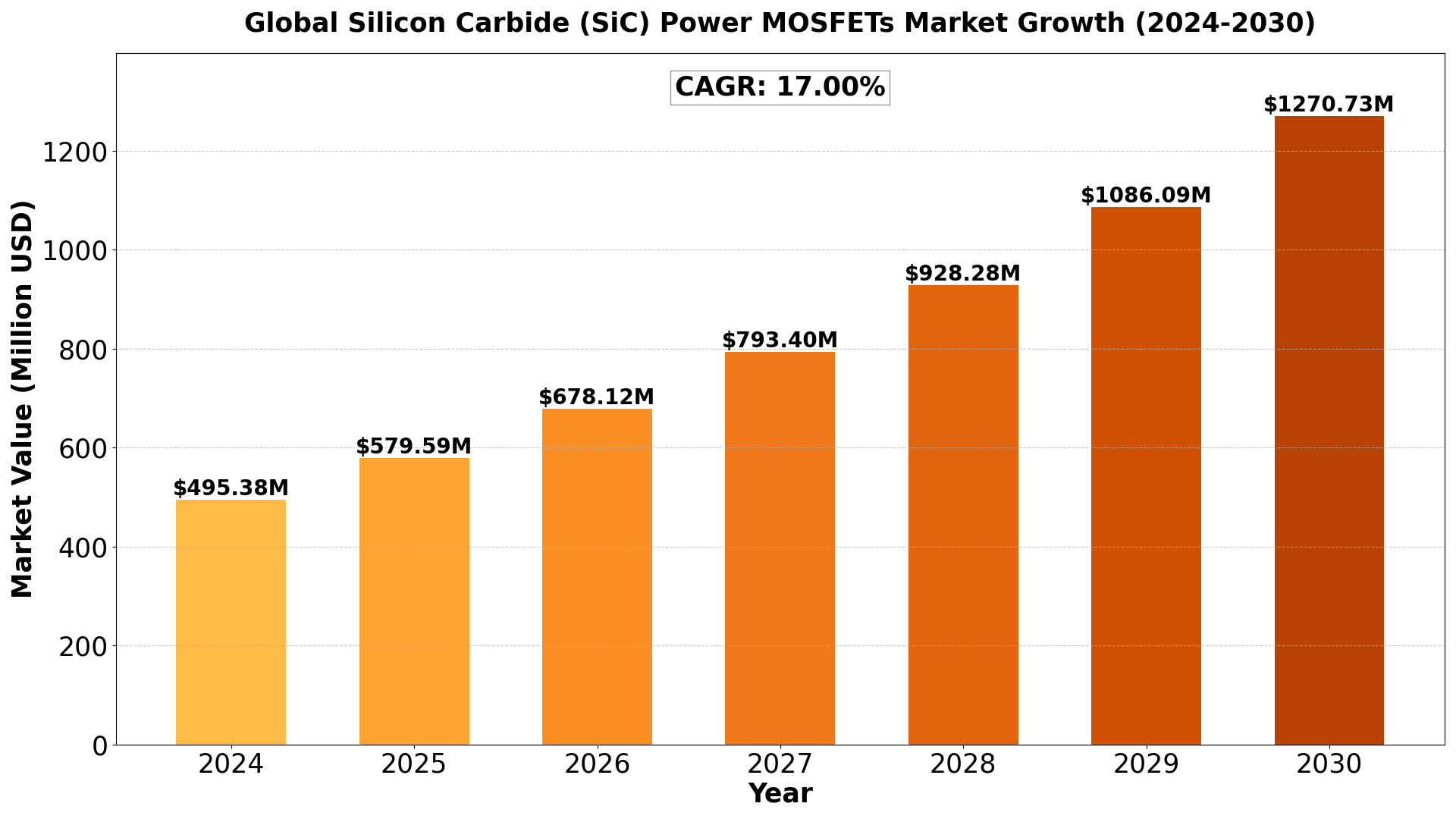
The Global Silicon Carbide (SiC) Power MOSFETs Market size was estimated at USD 423.40 million in 2023 and is projected to reach USD 1270.73 million by 2030, exhibiting a CAGR of 17.00% during the forecast period.
North America Silicon Carbide (SiC) Power MOSFETs market size was USD 110.33 million in 2023, at a CAGR of 14.57% during the forecast period of 2024 through 2030.
Silicon Carbide (SiC) Power MOSFETs Key Market Trends :
- Growth in Electric Vehicles (EVs): The demand for electric vehicles is one of the primary drivers of the SiC Power MOSFETs market. SiC devices, including MOSFETs, are essential for power inverters and charging stations in EVs due to their ability to handle high voltages and operate at high efficiencies, crucial for the overall performance and range of electric vehicles.
- Renewable Energy Integration: As the world transitions towards renewable energy, SiC Power MOSFETs are becoming integral in the development of solar inverters, wind turbines, and energy storage systems. These devices help manage power conversion with higher efficiency, which is vital for renewable energy systems that aim to maximize energy production and storage.
- Industrial Automation and Smart Grid Systems: In industrial automation, robotics, and smart grids, SiC MOSFETs are being used in power supplies, motor drives, and other critical applications that demand efficient, durable, and high-speed power devices. Their ability to operate at elevated temperatures and handle high-power loads with minimal loss makes them ideal for these sectors.
- Increased Adoption of SiC in Power Electronics: The adoption of SiC-based power devices has been growing due to their superior performance compared to traditional silicon-based semiconductors. As more industries demand energy-efficient, reliable, and high-performance power devices, SiC MOSFETs are seeing increased use in both consumer and industrial applications.
- Technological Advancements: Advancements in SiC manufacturing technologies are improving the availability and reducing the cost of SiC MOSFETs, which is further boosting their adoption. Additionally, innovations in device design are leading to enhanced performance and increased reliability.
Silicon Carbide (SiC) Power MOSFETs Market Regional Analysis :
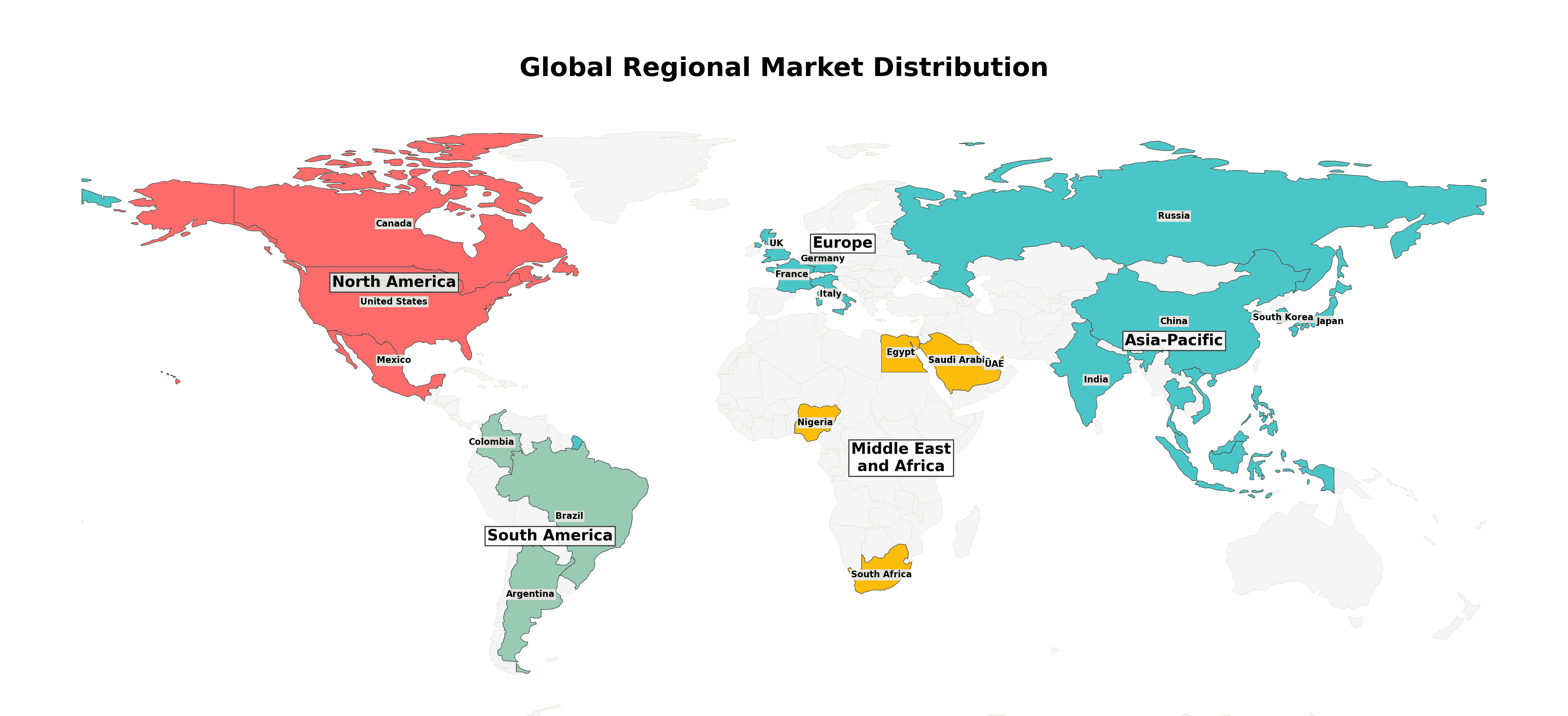
1. North America (USA, Canada, Mexico)
- USA: The largest market in the region due to advanced infrastructure, high disposable income, and technological advancements. Key industries include technology, healthcare, and manufacturing.
- Canada: Strong market potential driven by resource exports, a stable economy, and government initiatives supporting innovation.
- Mexico: A growing economy with strengths in automotive manufacturing, agriculture, and tourism, benefitting from trade agreements like the USMCA.
2. Europe (Germany, UK, France, Russia, Italy, Rest of Europe)
- Germany: The region’s industrial powerhouse with a focus on engineering, automotive, and machinery.
- UK: A hub for financial services, fintech, and pharmaceuticals, though Brexit has altered trade patterns.
- France: Strong in luxury goods, agriculture, and aerospace with significant innovation in renewable energy.
- Russia: Resource-driven economy with strengths in oil, gas, and minerals but geopolitical tensions affect growth.
- Italy: Known for fashion, design, and manufacturing, especially in luxury segments.
- Rest of Europe: Includes smaller yet significant economies like Spain, Netherlands, and Switzerland with strengths in finance, agriculture, and manufacturing.
3. Asia-Pacific (China, Japan, South Korea, India, Southeast Asia, Rest of Asia-Pacific)
- China: The largest market in the region with a focus on technology, manufacturing, and e-commerce. Rapid urbanization and middle-class growth fuel consumption.
- Japan: Technological innovation, particularly in robotics and electronics, drives the economy.
- South Korea: Known for technology, especially in semiconductors and consumer electronics.
- India: Rapidly growing economy with strengths in IT services, agriculture, and pharmaceuticals.
- Southeast Asia: Key markets like Indonesia, Thailand, and Vietnam show growth in manufacturing and tourism.
- Rest of Asia-Pacific: Emerging markets with growing investment in infrastructure and services.
4. South America (Brazil, Argentina, Colombia, Rest of South America)
- Brazil: Largest economy in the region, driven by agriculture, mining, and energy.
- Argentina: Known for agriculture exports and natural resources but faces economic instability.
- Colombia: Growing economy with strengths in oil, coffee, and flowers.
- Rest of South America: Includes Chile and Peru, which have strong mining sectors.
5. The Middle East and Africa (Saudi Arabia, UAE, Egypt, Nigeria, South Africa, Rest of MEA)
- Saudi Arabia: Oil-driven economy undergoing diversification with Vision 2030 initiatives.
- UAE: Financial hub with strengths in tourism, real estate, and trade.
- Egypt: Growing infrastructure development and tourism.
- Nigeria: Largest economy in Africa with strengths in oil and agriculture.
- South Africa: Industrialized economy with strengths in mining and finance.
- Rest of MEA: Includes smaller yet resource-rich markets like Qatar and Kenya with growing infrastructure investments.
Silicon Carbide (SiC) Power MOSFETs Market Segmentation :
The research report includes specific segments by region (country), manufacturers, Type, and Application. Market segmentation creates subsets of a market based on product type, end-user or application, Geographic, and other factors. By understanding the market segments, the decision-maker can leverage this targeting in the product, sales, and marketing strategies. Market segments can power your product development cycles by informing how you create product offerings for different segments.
Key Company
- ROHM
- Wolfspeed
- Mitsubishi Electric
- STMicroelectronics
- InfineonTechnologies
- Littelfuse
- Ascatron
- Fuji Electric Co.
- Ltd.
- Toshiba
- MicroSemi (Microchip)
- GeneSiC Semiconductor Inc.
- Global Power Technology Co.
- Ltd.
- Inc.
- Shenzhen BASiC Semiconductor LTD.
- InventChip Technology Co.
- Ltd.
- ON Semiconductor
- Yangzhou Yangjie Electronic Technology Co.
- Ltd.
Market Segmentation (by Type)
- Less than 500V
- 500V-1000V
- 1000V-1500V
- Above than 1500V
Market Segmentation (by Application)
- Rail
- Smart Grid
- Electric Vehicle
- Communication Power
- Others
Drivers
- Rising Demand for Electric Vehicles (EVs): The growth of the electric vehicle market is one of the primary drivers of the SiC power MOSFETs market. SiC-based MOSFETs are ideal for power conversion applications in electric vehicles (EVs) because of their ability to operate at higher voltages, lower losses, and higher temperatures. This leads to increased efficiency and performance of EV drivetrains and charging systems. As EV adoption continues to rise globally, the demand for SiC power MOSFETs will increase as they are key components in enhancing EV performance.
- Energy Efficiency and Renewable Energy Integration: The demand for energy-efficient solutions is accelerating across various industries, with power electronics playing a critical role in improving energy conversion and efficiency. SiC power MOSFETs are particularly advantageous in renewable energy systems, such as solar and wind power, where efficient power conversion is required. They are used in inverters and converters for renewable energy applications, enabling better integration of renewable energy into the grid by improving power efficiency and reducing system losses.
- Growing Adoption in Industrial Automation: Industrial automation systems require high-efficiency power electronics for motor drives, robotics, and control systems. SiC power MOSFETs are increasingly used in these systems due to their high switching speeds, reduced energy loss, and ability to operate in harsh environments with high power density. This growing demand for automation and industrial control systems is contributing to the expansion of the SiC power MOSFETs market.
- High-Performance and High-Power Applications: SiC power MOSFETs are known for their superior performance in high-power applications, which involve high voltage and high current. These devices have advantages over traditional silicon MOSFETs due to their ability to handle higher voltages, operate at higher frequencies, and dissipate heat more efficiently. Applications such as motor drives, uninterruptible power supplies (UPS), and power conversion systems benefit from the improved performance offered by SiC power MOSFETs, driving their adoption in the market.
- Government Regulations and Incentives: Governments around the world are pushing for greater energy efficiency, sustainability, and the electrification of transportation. Regulations and incentives aimed at reducing carbon emissions are fueling the demand for electric vehicles and renewable energy systems, both of which rely heavily on SiC power MOSFETs for efficient power conversion. These policies are contributing to the growth of the SiC power MOSFETs market.
Restraints
- High Cost of SiC Materials: The primary restraint for the widespread adoption of SiC power MOSFETs is the higher cost of silicon carbide compared to traditional silicon. SiC is more expensive to manufacture, and the processing technologies involved in producing high-quality SiC wafers and power MOSFETs are complex and costly. While the cost of SiC has been decreasing over time, it remains a barrier to entry for many manufacturers, especially in price-sensitive markets.
- Challenges in Manufacturing and Scaling Production: Manufacturing SiC power MOSFETs requires specialized equipment and expertise in handling SiC materials. The production process is more complex than for silicon-based MOSFETs, which can result in longer lead times and higher manufacturing costs. Furthermore, scaling up production to meet the increasing demand for SiC devices remains a challenge, as the availability of high-quality SiC wafers and substrates is limited.
- Competition from Silicon-Based Power Devices: While SiC power MOSFETs offer several advantages, traditional silicon-based power devices continue to be widely used in many applications. Silicon devices are more cost-effective, easier to manufacture, and readily available. For certain low- to mid-power applications, silicon MOSFETs remain a competitive alternative to SiC MOSFETs, limiting the growth potential of SiC power MOSFETs in some segments.
- Technical Barriers in Reliability and Performance: Despite their superior performance, SiC power MOSFETs still face technical challenges related to reliability, including issues like gate oxide reliability, temperature sensitivity, and failure mechanisms. Continuous improvements in design and manufacturing processes are needed to enhance the long-term reliability of SiC MOSFETs, especially in high-power and high-temperature applications.
Opportunities
- Increasing Adoption in Electric and Hybrid Vehicles: With the increasing adoption of electric and hybrid vehicles, there is a growing need for high-efficiency power electronics for traction inverters, charging systems, and DC-DC converters. SiC power MOSFETs are a natural fit for these applications because they can operate at higher voltages, higher frequencies, and are more efficient than silicon-based devices. As the automotive industry continues its shift toward electrification, the demand for SiC power MOSFETs in EVs and hybrid vehicles is expected to surge.
- Technological Advancements in SiC Manufacturing: Ongoing advancements in SiC wafer production and manufacturing processes are expected to reduce the cost of SiC-based power devices over time. Innovations in the growth of high-quality SiC crystals, advances in CVD (Chemical Vapor Deposition) processes, and improvements in the fabrication of power MOSFETs will help drive down costs and make SiC power MOSFETs more accessible to a broader range of industries.
- Expansion of 5G Infrastructure: The rollout of 5G technology and the need for power electronics in 5G infrastructure, such as base stations and communication systems, presents a significant growth opportunity for SiC power MOSFETs. These devices can provide the high efficiency and power density required for the high-frequency, high-power demands of 5G systems. As the 5G network continues to expand globally, demand for SiC power MOSFETs will likely increase.
- Integration in Aerospace and Defense Applications: SiC power MOSFETs offer excellent performance in high-power, high-frequency applications, making them suitable for aerospace, defense, and military systems. These systems often require robust and reliable power electronics that can perform well under extreme conditions. The adoption of SiC-based power devices in aerospace applications, including satellites and high-altitude aircraft, is an opportunity for growth in the SiC power MOSFETs market.
- Increasing Demand in Industrial Motor Drives and Robotics: The industrial automation and robotics sectors are rapidly adopting SiC power devices due to their efficiency and ability to handle high power densities. SiC power MOSFETs are well-suited for motor drives and robotics applications, where efficient and precise power control is critical. As industries move toward more automated, energy-efficient systems, the demand for SiC power MOSFETs is expected to grow.
Challenges
- Lack of Standardization: The lack of standardization across SiC power MOSFETs and related technologies may hinder market growth. Different manufacturers may use varying designs, processes, and materials, making it difficult for customers to compare products and adopt a unified solution. Industry-wide standards and specifications would help improve market transparency and facilitate wider adoption of SiC power MOSFETs.
- Complexity in System Integration: Integrating SiC-based power MOSFETs into existing systems and designs can be complex, especially when replacing traditional silicon-based devices. System engineers may face challenges in designing circuits and ensuring compatibility with existing systems, leading to longer development times and higher costs for end users.
- Market Education and Awareness: The SiC power MOSFET market is still evolving, and many companies and industries may not fully understand the benefits and capabilities of SiC power devices. Educating manufacturers, system designers, and end-users on the advantages of SiC-based solutions is crucial to expanding market adoption. Lack of awareness could slow the pace at which SiC power MOSFETs are adopted in mainstream applications.
Key Benefits of This Market Research:
- Industry drivers, restraints, and opportunities covered in the study
- Neutral perspective on the market performance
- Recent industry trends and developments
- Competitive landscape & strategies of key players
- Potential & niche segments and regions exhibiting promising growth covered
- Historical, current, and projected market size, in terms of value
- In-depth analysis of the Silicon Carbide (SiC) Power MOSFETs Market
- Overview of the regional outlook of the Silicon Carbide (SiC) Power MOSFETs Market:
Key Reasons to Buy this Report:
- Access to date statistics compiled by our researchers. These provide you with historical and forecast data, which is analyzed to tell you why your market is set to change
- This enables you to anticipate market changes to remain ahead of your competitors
- You will be able to copy data from the Excel spreadsheet straight into your marketing plans, business presentations, or other strategic documents
- The concise analysis, clear graph, and table format will enable you to pinpoint the information you require quickly
- Provision of market value (USD Billion) data for each segment and sub-segment
- Indicates the region and segment that is expected to witness the fastest growth as well as to dominate the market
- Analysis by geography highlighting the consumption of the product/service in the region as well as indicating the factors that are affecting the market within each region
- Competitive landscape which incorporates the market ranking of the major players, along with new service/product launches, partnerships, business expansions, and acquisitions in the past five years of companies profiled
- Extensive company profiles comprising of company overview, company insights, product benchmarking, and SWOT analysis for the major market players
- The current as well as the future market outlook of the industry concerning recent developments which involve growth opportunities and drivers as well as challenges and restraints of both emerging as well as developed regions
- Includes in-depth analysis of the market from various perspectives through Porters five forces analysis
- Provides insight into the market through Value Chain
- Market dynamics scenario, along with growth opportunities of the market in the years to come
- 6-month post-sales analyst support
Customization of the Report
In case of any queries or customization requirements, please connect with our sales team, who will ensure that your requirements are met.
FAQs
Q1. What is the Silicon Carbide (SiC) Power MOSFETs market?
A1. The Silicon Carbide (SiC) Power MOSFETs market involves the use of Silicon Carbide (SiC) technology to manufacture power metal-oxide-semiconductor field-effect transistors (MOSFETs). SiC MOSFETs offer high efficiency, fast switching speeds, and the ability to operate at higher temperatures and voltages than traditional silicon-based MOSFETs, making them ideal for applications in power electronics, electric vehicles, renewable energy systems, and industrial equipment.
Q2. What is the current market size and forecast for the Silicon Carbide (SiC) Power MOSFETs market until 2030?
A2. The Silicon Carbide (SiC) Power MOSFETs market size was estimated at USD 423.40 million in 2023 and is projected to reach USD 1270.73 million by 2030, exhibiting a CAGR of 17.00% during the forecast period.
Q3. What are the key growth drivers in the Silicon Carbide (SiC) Power MOSFETs market?
A3. The key growth drivers include the increasing demand for energy-efficient power electronics in various sectors such as electric vehicles (EVs), renewable energy systems (like solar and wind), and industrial applications. SiC MOSFETs’ superior properties, including high voltage tolerance, thermal conductivity, and reduced energy losses, are making them increasingly popular for high-performance applications, such as in automotive powertrains and electric vehicle charging infrastructure. Additionally, the growth in the electric vehicle market and renewable energy adoption is propelling the demand for SiC-based devices.
Q4. Which regions dominate the Silicon Carbide (SiC) Power MOSFETs market?
A4. The Asia-Pacific region, particularly China, Japan, and South Korea, is a dominant player in the SiC Power MOSFETs market due to the strong presence of semiconductor manufacturers and automotive industries. North America and Europe are also key markets, driven by the increasing adoption of SiC in electric vehicles, renewable energy, and industrial sectors.
Q5. What are the emerging trends in the Silicon Carbide (SiC) Power MOSFETs market?
A5. Emerging trends include continuous advancements in SiC MOSFET technology, such as improvements in manufacturing techniques that enhance efficiency and reduce costs. There is also an increasing focus on integrating SiC MOSFETs in next-generation electric vehicle powertrains, energy storage systems, and renewable energy applications. Furthermore, research and development efforts are concentrating on improving the overall performance of SiC-based components to handle higher power densities and further boost their adoption in power electronics.
Get Sample Report PDF for Exclusive Insights
Report Sample Includes
- Table of Contents
- List of Tables & Figures
- Charts, Research Methodology, and more...
 Download Sample Report PDF