Key Statistics
Key Takeaways
- Market outlook: The global silicon carbide MOSFET market was valued at USD 580 million in 2025 and is projected to reach USD 2,381 million by 2034, representing a 17.0% CAGR during 2026–2034 as designers replace silicon switching devices in high-voltage conversion.
- N Channel: Single N Channel products hold the largest estimated type share at ~58% in 2025 because discrete switching legs are used across converters, while Quad N Channel formats at ~14% gain more quickly in compact integrated assemblies at ~18.3% CAGR.
- Automobile Industry: Electric vehicle traction, onboard charging and auxiliary power conversion form the leading application at an estimated ~47% of 2025 revenue, with the ~17.9% growth outlook linked to 750 V and 1200 V device qualification.
- Regional concentration: Asia-Pacific accounts for an estimated ~46% of 2025 revenue and expands at about ~17.7% CAGR, reflecting the proximity of Chinese EV factories, Japanese power-semiconductor manufacturers and regional industrial electronics assembly.
- Technology and competition: Qualification at elevated junction temperatures, packaging thermal resistance and reliable gate drive determine purchase decisions; Infineon, ROHM, onsemi, STMicroelectronics and Wolfspeed maintain broad commercial device portfolios.
Silicon Carbide MOSFET Market Overview
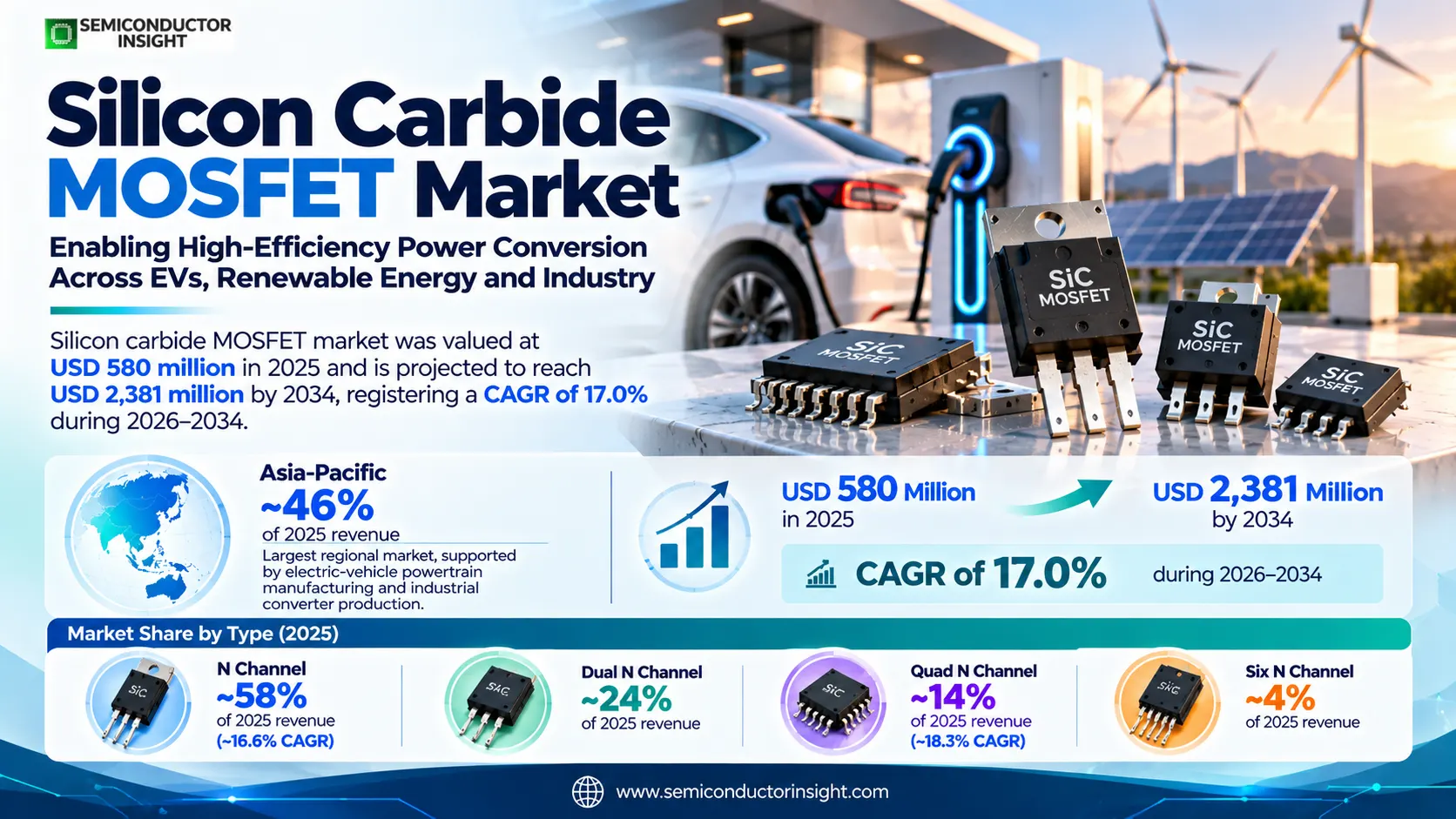
Silicon carbide MOSFET market was valued at USD 580 million in 2025 and is projected to reach USD 2,381 million by 2034, registering a CAGR of 17.0% during 2026–2034. Asia-Pacific represented the largest regional market with an estimated ~46% of 2025 revenue, supported by electric-vehicle powertrain manufacturing and industrial converter production.
Silicon carbide metal-oxide-semiconductor field-effect transistors control electrical energy by switching current through a wide-bandgap semiconductor channel. Compared with conventional silicon switches at equivalent high voltage, SiC devices can operate with lower switching losses and at higher temperatures. That advantage becomes especially valuable when a 400 V or 800 V vehicle battery feeds a traction motor, when a charging station must convert alternating current to direct current, or when a grid converter processes large amounts of variable renewable electricity.
The market boundary follows the published device-and-configuration categories: N Channel, Dual N Channel, Quad N Channel and Six N Channel silicon carbide MOSFET offerings used in Automobile Industry, Industrial Motor, Smart Grid and Other applications. It includes packaged devices and MOSFET configurations supplied within the publisher-defined product scope, but not the full selling price of electric vehicles, power conversion cabinets, solar installations or upstream substrate wafers. Gate drivers and cooling components are relevant adjacent inputs, not standalone MOSFET revenue.
A silicon carbide transistor is not interchangeable with a silicon MOSFET merely because its voltage rating matches. Engineers evaluate threshold voltage, body-diode behaviour, short-circuit endurance, drain-source on-resistance, gate-oxide robustness and switching transients at the intended operating temperature. Faster edges reduce loss but increase electromagnetic interference, so board layout and gate-resistor selection influence the performance achieved in the finished inverter. Qualification therefore spans both the component and the power stage in which it is installed.
Commercial design activity is shifting from simply proving the energy-efficiency benefit to reducing the total cost of the conversion system. Lower conduction loss permits smaller heat sinks and may allow less coolant, while high switching frequency can shrink magnetic components. Those savings must outweigh the premium for SiC dies, more complex packaging and application engineering. The outcome differs by power rating: a high-mileage vehicle or a continuously operated industrial drive can justify SiC more readily than a low-duty-cycle consumer appliance.
Supply is shaped by substrate quality, wafer diameter and manufacturing yield as well as device architecture. Suppliers are moving production toward 200 mm platforms, although qualification of epitaxy, crystal defects and automotive reliability remains demanding. In June 2026 Wolfspeed introduced fifth-generation 750 V and 1200 V MOSFET technology from its qualified 200 mm manufacturing platform; this illustrates the continuing emphasis on lower on-resistance per die area rather than on switching speed alone.
Segment Analysis: By Type
By type, the market comprises N Channel, Dual N Channel, Quad N Channel and Six N Channel silicon carbide MOSFET configurations. N Channel leads with an estimated ~58% of 2025 revenue and ~16.6% CAGR, while Quad N Channel at ~14% grows at roughly ~18.3% as integrated multi-switch layouts simplify compact power conversion assemblies. The published categories describe switch arrangement rather than mutually exclusive wafer technologies.
| Type | Electrical role and implementation | Market position and buying criteria |
|---|---|---|
| N Channel | A single controllable N-channel MOSFET is selected for discrete switching legs in boost converters, isolated power supplies and inverter assemblies. Designers pair multiple devices into a bridge as required, selecting voltage classes such as 650 V, 750 V, 1200 V or higher according to bus voltage and surge margin. The discrete approach lets the engineer choose a package, gate driver and cooling interface independently for each stage. | Largest type: estimated ~58% share in 2025, ~16.6% CAGR. Broad product availability supports replacement and new designs across automotive and industrial equipment. Procurement teams compare drain-source resistance at hot junction temperatures, qualification records and long-term package availability rather than judging devices only by headline current rating. Standardised discrete packages help secondary sourcing but do not remove the need to repeat thermal and electromagnetic compatibility tests. |
| Dual N Channel | Two MOSFET channels are arranged to suit a paired switching function, reducing the number of separate power packages in designs that require two complementary current paths. This format is relevant to compact DC-DC conversion, half-bridge implementations and some charging architectures where interconnect length and heat spreading affect efficiency. The electrical connection and isolation scheme remain design-specific rather than universal. | Estimated ~20% share in 2025 and ~17.4% CAGR. Integrating two switches can lower assembly count and shorten high-current loops, yet customers require evidence that both die positions can dissipate heat under asymmetric loading. The segment competes with discrete devices where serviceability and sourcing flexibility matter, while higher-volume vehicle programmes can absorb the qualification expense associated with a custom paired package. |
| Quad N Channel | Four controllable channels can be used where designers need multiple switching functions in one assembly, particularly in integrated motor-drive or multi-phase conversion architectures. The economic advantage depends on module interconnect geometry, shared thermal paths and gate-drive integration, not simply on the number of chips. Qualification must address current imbalance and simultaneous switching stress across the four positions. | Estimated ~14% of 2025 sales and fastest type growth near ~18.3% CAGR. Compact vehicle auxiliaries and integrated industrial drives reward higher functional density when packaging replaces separate assemblies. However, a defect in one channel may require replacement of the complete integrated part, so field-service economics and production yield become more important than for a single discrete transistor. |
| Six N Channel | Six-switch arrangements correspond to the three half-bridges required for a conventional three-phase motor inverter and are offered in power-module families. The package may incorporate six SiC switches while leaving control and protection circuits external. ROHM and Infineon product catalogues illustrate six-in-one and sixpack offerings for high-voltage power conversion, though package geometry and automotive qualification differ. | Estimated ~8% share in 2025, expanding near ~16.3% CAGR. Motor-control designers benefit from a single mechanically integrated power stage, particularly where coolant plate dimensions are fixed. Customers assess stray inductance, thermal cycling and repair cost before choosing this layout. Its smaller revenue position reflects the narrower range of systems that need a complete six-switch bridge rather than flexible discrete devices. |
Electrical topology and voltage-class selection
Topology is the relevant commercial distinction between the four published type groups: the number of MOSFET channels changes interconnect design, mechanical assembly and qualification burden. At 650 V and 750 V, compact charging and auxiliary converters often favour discrete or paired parts; at 1200 V, designers weigh integrated layouts for 800 V traction and high-power industrial systems. This is a technology discussion within the published Type axis, not a separate invented market-share category.
A single-channel product can be assembled into a six-switch inverter, so the labels describe the purchased device configuration rather than the total number of switches inside an end system. For market accounting, a finished purchased unit is assigned to the relevant publisher type and counted once. ROHM’s six-in-one product examples show why packaging configuration and application are distinct analytical axes, even though both influence the customer’s final bill of materials.
Segment Analysis: By Application
The four published applications are Automobile Industry, Industrial Motor, Smart Grid and Other. Automobile Industry accounts for an estimated ~47% of 2025 revenue, while Industrial Motor represents ~26%, Smart Grid ~17% and Other ~10%. Their estimated growth rates are ~17.9%, ~16.4%, ~16.8% and ~14.1%, respectively, reflecting distinct duty cycles and qualification requirements.
| Application | Demand characteristics |
|---|---|
| Automobile Industry | Largest application, ~47% share and ~17.9% CAGR. Vehicle traction inverters, onboard chargers, DC-DC converters and high-voltage auxiliaries benefit from reduced switching losses and improved thermal efficiency. The IEA recorded more than 20 million electric car sales worldwide in 2025, but vehicle sales are an adjacent demand indicator, not MOSFET market revenue. Automotive buyers require extensive reliability evidence, long programme support and control over lot-to-lot electrical variation. |
| Industrial Motor | Estimated ~26% share and ~16.4% CAGR. Variable-frequency drives for pumps, compressors, production equipment and heavy-duty motors can justify a SiC power stage when energy savings accrue over thousands of operating hours. Designers may increase switching frequency to reduce audible noise and filter size, but industrial buyers often prioritise maintenance access, overload capability and spare-part continuity over the highest possible efficiency figure. |
| Smart Grid | Estimated ~17% share with ~16.8% CAGR. Solid-state breakers, renewable-power inverters, high-voltage DC conversion and grid-support equipment require robust switching under electrical transients. Wolfspeed has demonstrated 10 kV-class SiC MOSFET technology for high-voltage power conversion, while most commercial equipment uses voltage ratings matched to converter topology. Grid procurement cycles are longer than automotive programmes and require utility-specific validation. |
| Other | Estimated ~10% share, growing near ~14.1% CAGR. This residual application includes server power supplies, uninterruptible power systems, specialist transport, medical equipment and high-efficiency infrastructure conversion not assigned to the three named applications. A device chosen for continuous server operation may be optimised for thermal density, whereas a medical converter may require unusually strict electromagnetic compatibility and component traceability. |
The difference between applications lies in the value of avoided loss. A traction inverter benefits from a smaller cooling system and improved vehicle energy use, but it must withstand vibration and repeated thermal cycling. A factory motor drive faces a more predictable environment but often runs for many hours each day, making lifetime electricity consumption the decisive purchasing argument. A grid converter, by contrast, must accommodate external surges and maintenance practices specified by its operator.
The application shares are estimates of silicon carbide MOSFET revenue rather than counts of electric cars, factory motors or solar installations. They are calibrated to the supplier product mix and the relative maturity of each end-use. Their growth rates are intentionally differentiated: electrification raises the automotive share, while the Other category advances more slowly because some low-voltage power supplies remain economical with advanced silicon or gallium-nitride switches.
Regional Analysis
Asia-Pacific held an estimated ~46% of 2025 silicon carbide MOSFET revenue, ahead of North America at ~24% and Europe at ~19%; South America and the Middle East & Africa contributed ~6% and ~5%. The regional growth outlook is ~17.7% for Asia-Pacific, ~16.8% for North America, ~16.5% for Europe, ~16.8% for South America and ~12.7% for the Middle East & Africa.
How do semiconductor production and end-market demand shape regional MOSFET purchasing?
The location of an automotive assembly plant does not necessarily identify where a SiC MOSFET was fabricated. Japanese, European and American manufacturers ship devices to power-electronics plants across Asia, while wafer processing and final module assembly may occur in different countries. Regional revenue is therefore attributed to the location of demand for the relevant switching component rather than to the headquarters of a supplier or the location of a substrate producer.
Asia-Pacific combines the world’s largest electric-vehicle production base with mature Japanese power-semiconductor design expertise and South Korean power-electronics assembly. North America has advanced device manufacturers, data-centre demand and vehicle electrification programmes, whereas Europe has established automotive Tier 1 engineering and industrial automation customers. South America and the Middle East & Africa represent smaller but strategically relevant opportunities where renewable-power projects and electric mobility gradually broaden the installed base.
| Region | Position | Growth outlook | Demand profile | What decides supplier selection |
|---|---|---|---|---|
| Asia-Pacific | Largest (~46%) | Fastest regional outlook (~17.7% CAGR) | China EV production, Japan device engineering, Korean automotive electronics | Cost per ampere, automotive qualification and local application engineering |
| North America | Second (~24%) | Expansion near ~16.8% CAGR | US power-semiconductor design, charging equipment, industrial drives | Supply assurance, packaging qualification and customer-specific reliability testing |
| Europe | Third (~19%) | Steady gains near ~16.5% CAGR | German and French automotive systems, Italian semiconductor operations | Traceability, vehicle platform approvals and long-term programme support |
| South America | Emerging (~6%) | Selective growth near ~16.8% CAGR | Brazilian renewable-energy conversion and electrified transport pilots | Imported component access, technical distribution and service support |
| Middle East & Africa | Developing (~5%) | Moderate growth near ~12.7% CAGR | Gulf charging networks, solar projects and African industrial power | Environmental durability, installer capability and procurement financing |
Leading Silicon Carbide MOSFET Manufacturers and Competitive Landscape
Competition in silicon carbide MOSFETs depends on die efficiency, wafer yield, automotive approval and the thermal characteristics of the finished package. Established suppliers offer 650 V to 1200 V families and selected higher-voltage devices, while customers compare switching loss at real operating temperatures rather than accepting headline room-temperature resistance alone. The supplier field spans integrated semiconductor producers, specialist wide-bandgap manufacturers and historical brands now owned by larger companies.
Infineon, ROHM, onsemi, STMicroelectronics and Wolfspeed compete through device technology and system-level support. A supplier with proven automotive qualification can participate in several vehicle platforms, but winning one design does not guarantee broad market leadership. Infineon promotes CoolSiC devices in discrete and module formats, while ROHM provides packaged multi-switch solutions. onsemi and ST serve traction and industrial converters with their own power-device families, and Wolfspeed differentiates through SiC materials and high-voltage technology.
Microchip and Toshiba address customers needing well-documented discrete MOSFETs and a broad choice of packages. Microchip offers silicon carbide switches for industrial and power management applications, whereas Toshiba has introduced 650 V devices in compact surface-mount packages to reduce switching-loop parasitics. Product breadth matters because the same customer may need 650 V devices in an auxiliary converter and 1200 V devices in the main high-voltage power stage, with different gate-drive and isolation requirements.
The publisher’s company list contains historical names that should not be treated as independent current competitors. IXYS became part of Littelfuse, and UnitedSiC was acquired by Qorvo. These brands can remain useful for product lineage or installed-base analysis, but a competitive tier table should reflect the current corporate owner rather than counting acquired businesses twice. Historical identity is not evidence of a separate current manufacturing footprint or a standalone market share.
Pricing pressure is concentrated where products are electrically comparable and qualified in the same application. Customers can benchmark total switching energy, package thermal resistance and high-temperature resistance drift, then request design support and long-term supply commitments. Suppliers with larger qualified wafer output may improve cost per ampere, but a nominal die-cost advantage can be lost through poor module yield, expensive assembly or high warranty exposure. This makes packaging and field failure history decisive commercial differentiators.
Tier structure
| Tier | Companies | Basis of competition |
|---|---|---|
| Tier 1 | Infineon Technologies; ROHM; onsemi; STMicroelectronics; Wolfspeed | Broad qualified product families and engineering support for vehicle traction, industrial conversion and charging. These companies compete through silicon carbide process development, thermal packaging and long customer qualification cycles rather than a single voltage rating or claimed global revenue rank. |
| Tier 2 | Microchip Technology; Toshiba Electronic Devices & Storage; Littelfuse (including IXYS lineage); Qorvo (including UnitedSiC lineage) | Focused device and package offerings that serve discrete switching, industrial converters and specialist applications. Qualification documentation, gate-drive design tools and distribution availability determine which programmes they can win against the broadest portfolios. |
| Historical or specialist position | IXYS and UnitedSiC as historical brands; additional niche suppliers subject to product verification | Historical brand names are retained for continuity with legacy product specifications and installed equipment, but the relevant current owners are Littelfuse and Qorvo. The group is not an additional set of independent market-share leaders. |
Key companies profiled
- Infineon Technologies
- IXYS (historical brand; Littelfuse)
- Littelfuse
- Microchip Technology
- onsemi
- ROHM
- STMicroelectronics
- Toshiba Electronic Devices & Storage
- UnitedSiC (historical brand; Qorvo)
- Wolfspeed
Silicon Carbide MOSFET Production Capacity and Manufacturing Analysis
Commercial silicon carbide MOSFET capacity is governed by crystal quality, epitaxial deposition, device fabrication and packaging yield. Moving from 150 mm toward 200 mm wafers can improve output per manufacturing cycle, but usable die count depends on defect density and qualification, not on wafer diameter alone. Manufacturing strategies therefore combine material investment with automotive process control and application-specific packaging lines.
SiC crystal growth and wafer preparation are more technically demanding than conventional silicon processing because the substrate must meet tight defect and flatness specifications before epitaxy. Dislocations and other crystal imperfections can affect device reliability, while the high hardness of SiC complicates slicing and polishing. A supplier with secure substrate access is better positioned to maintain device yield and supply continuity, but the substrate producer’s sales cannot be added to MOSFET revenue without double counting upstream material.
Device fabrication involves epitaxial growth, gate-oxide formation, implantation, contact metallisation and repeated electrical screening. Automotive customers require evidence of stability under thermal cycling, bias stress and high-temperature switching. Wolfspeed’s June 2026 announcement linked its Gen 5 devices to a qualified 200 mm platform, illustrating why larger wafers matter only when process capability is mature. Production planning must account for lengthy customer qualification even after the wafer process has achieved acceptable yields.
Packaging has become a major source of differentiation. Surface-mount packages can reduce parasitic inductance, while top-side cooling and integrated multi-switch modules change the thermal path from the die to the external heat sink. Toshiba’s May 2025 650 V DFN8×8 announcement highlighted a Kelvin-source connection that supports high-speed switching. The engineering gain depends on circuit layout and test conditions; a manufacturer cannot simply apply a laboratory loss reduction to every customer application.
Regional production networks cross national boundaries. European and US chip suppliers serve Asian vehicle assemblers, while Japanese device makers ship into global industrial equipment channels. This creates exposure to export controls, logistics disruptions and changes in local-content procurement rules. Buyers increasingly request information about fabrication location, package assembly site and long-term capacity commitments, especially when a power module is qualified into an automotive platform expected to remain in production for many years.
Silicon Carbide MOSFET Market Dynamics: Drivers, Restraints and Opportunities
Vehicle electrification, higher-efficiency motor control and expanding power-conversion infrastructure underpin demand, while device cost, qualification time and alternative switching technologies constrain adoption. The contribution model assigns positive effects to five major drivers and negative effects to four restraints, with the net matching the 2026–2034 market growth rate. Relative strength varies across early design cycles, mid-period production ramps and later replacement demand.
MARKET DRIVERS
Drivers Impact Analysis*
| Market Drivers | Impact Rank | CAGR Contribution (%) | 2026–2028 | 2029–2031 | 2032–2034 |
|---|---|---|---|---|---|
| EV traction inverter and onboard charger penetration | High | +8.20% | High | High | Medium |
| Higher-efficiency industrial motor conversion | Medium-High | +5.10% | Medium | High | High |
| Fast-charging infrastructure and DC power distribution | Medium | +3.40% | High | High | Medium |
| Grid-connected renewable and solid-state switching | Low-Medium | +2.90% | Medium | High | High |
| Others (compact power supplies and specialised conversion) | Low | +1.70% | Medium | Medium | High |
Automotive conversion raises the value of every efficiency improvement
An 800 V vehicle platform needs efficient conversion across traction, charging and auxiliary loads, and a small percentage improvement can translate into less waste heat or a smaller cooling assembly. The IEA reported global electric car sales above 20 million in 2025, showing the scale of potential vehicle production. SiC penetration depends on the architecture chosen by each manufacturer, so the driver concerns component content per qualifying vehicle rather than assuming every electric car uses SiC.
Industrial motors reward lower lifetime electricity consumption
Variable-speed drives for compressors, pumps and process machinery often run for long periods, making conversion loss economically meaningful. SiC MOSFETs may permit higher switching frequency and reduced filter size, but the optimal design balances switching stress, acoustic performance and serviceability. Manufacturers of industrial equipment adopt the technology where expected energy savings and maintenance benefits exceed the initial device premium, producing a steadier demand stream than model-year vehicle launches.
High-power charging creates demanding switching duty cycles
Rapid chargers process substantial electrical power while operating in public or commercial environments with constrained cabinet space. Switching efficiency can reduce the heat that must be removed and allow more compact magnetic components, especially in isolated conversion stages. SiC’s advantage is strongest when designers can combine appropriate voltage ratings with well-controlled gate drive, although installation economics still depend on grid connection, charger utilisation and overall equipment reliability.
Grid equipment needs robust high-voltage semiconductor switches
Renewable generation and modern power networks use converters to control voltage, frequency and power flow. Solid-state protection can respond rapidly to electrical faults, while high-voltage SiC technology enables design options that are difficult with lower-voltage silicon devices. Wolfspeed’s 10 kV device development demonstrates a technical direction, but utility adoption requires extensive validation and is not equivalent to immediate high-volume sales of every announced voltage class.
Compact infrastructure power supplies broaden non-automotive demand
Telecommunications, servers, backup systems and specialist transportation increasingly demand dense and efficient power supplies. High-frequency SiC switching can improve converter size and thermal performance in selected voltage classes, although gallium nitride or advanced silicon may be more economical at lower voltages. This driver represents diversified product development rather than an assumption that one semiconductor material will replace all competing switches across every power rating.
MARKET RESTRAINTS
Restraints Impact Analysis*
| Market Restraints | Impact Rank | CAGR Contribution (%) | 2026–2028 | 2029–2031 | 2032–2034 |
|---|---|---|---|---|---|
| High device and packaging costs | High | -1.90% | High | Medium | Medium |
| Lengthy automotive and industrial qualification | Medium-High | -1.20% | High | Medium | Low |
| Crystal defects and yield variability | Medium | -0.80% | High | Medium | Low |
| Others (silicon and GaN competition, supply disruptions) | Low | -0.40% | Medium | Medium | High |
Cost premiums remain visible in price-sensitive equipment
Silicon carbide substrates, epitaxial processing and specialised packaging increase component costs relative to mature silicon devices in many designs. System savings can offset the premium when the converter runs at high voltage or high utilisation, but the economics are less compelling in lower-cost equipment. Buyers therefore evaluate the cost of the complete power stage rather than comparing MOSFET catalogue prices alone, which slows adoption in smaller industrial drives and consumer applications.
Qualification requirements delay commercial conversion
Automotive and grid customers demand long reliability histories and evidence that a switching device will withstand the electrical and thermal stresses of its final system. Changing from one SiC supplier to another can require new gate-drive tuning, thermal testing and electromagnetic compatibility checks. This makes design wins durable once achieved but lengthens the period between an initial product announcement and material production revenue, especially for custom integrated configurations.
Wafer quality and packaging yield can constrain supply
Crystal imperfections and process variability may lower the number of qualified dies produced from each silicon carbide wafer. A finished device must also survive package assembly and electrical screening, so improvements at the substrate stage do not guarantee equal gains in sellable MOSFET output. Manufacturers investing in larger wafers face a period of process learning, and customers may require capacity buffers when a new fabrication line is ramping.
Alternative devices retain attractive application niches
Silicon IGBTs and super-junction MOSFETs remain established choices in many converters, while gallium nitride is competitive in selected high-frequency lower-voltage designs. Engineers may choose these alternatives when component cost, gate-drive simplicity or proven field experience outweigh the efficiency advantage of SiC. This competition is particularly relevant for modest power ratings and applications with short operating hours, where lower system cost is often more valuable than a small reduction in loss.
MARKET OPPORTUNITIES
Application-specific six-switch modules for compact inverters
Integrated multi-channel layouts can reduce interconnect length and simplify the mechanical assembly of three-phase drives. A manufacturer that offers reliable thermal models, compatible gate-drive recommendations and repeatable package dimensions can become part of a customer’s platform design. The opportunity is strongest where customers have enough production volume to justify custom qualification and where replacing several discrete parts reduces total assembly cost.
Solid-state protection and medium-voltage power conversion
Higher-voltage SiC devices create opportunities for fault interruption and specialised grid conversion beyond conventional automotive ratings. Technical development in 10 kV-class devices suggests a longer-term pathway for equipment that needs high blocking voltage and rapid control. Commercial adoption will depend on utility testing, insulation design and lifecycle cost, so the opportunity is attractive but should not be confused with present-day mass-market device shipments.
Smaller cooling systems in continuously operated infrastructure
Data-centre and telecommunications power supplies face pressure to raise power density while limiting heat and maintenance requirements. SiC can reduce switching and conduction losses in suitable topologies, allowing engineers to reconsider heat sinks and magnetic components. Suppliers able to document system-level efficiency at realistic ambient temperatures can differentiate their devices, although customers will require independent validation of performance in their own power architecture.
Cost reduction through qualified larger-diameter wafer processes
A stable 200 mm fabrication process may increase output per wafer run and improve long-term device economics when crystal quality and packaging yield are controlled. The opportunity is not automatic: new equipment, epitaxy and defect screening must be qualified before the potential area advantage becomes a commercial cost reduction. Suppliers that coordinate substrate, device and package improvements can offer customers better cost predictability over multiyear product programmes.
Silicon Carbide MOSFET Supply Chain and Value Chain Analysis
The value chain links crystal growth, wafer processing, epitaxy, MOSFET fabrication, package assembly, qualification and integration into power converters. The most demanding upstream steps determine defect exposure, while the final package and gate-drive implementation determine how much device performance a customer can use. Vehicle and industrial buyers typically approve a finished power stage, not an isolated wafer specification.
Upstream. High-quality SiC crystals and epitaxial wafers are essential to predictable device reliability. The material’s hardness and the sensitivity of electrical behaviour to crystalline defects raise processing costs, particularly as wafer diameters increase. Manufacturers may source substrates externally or integrate more of the chain, but the purchased substrate is an input to the MOSFET rather than an additional finished-device sale. Long-term sourcing agreements matter when automotive programmes require consistent electrical characteristics over many years.
Fabrication. MOSFET producers create the transistor structure through multiple high-temperature and precision steps, then test electrical behaviour at wafer level before packaging. Gate-oxide stability and device-to-device variation are important because a converter may contain many switches operating together. Yield improvement reduces the cost of qualified devices, but the benefits are realised only when production equipment, process controls and failure-analysis capability are mature enough to support high-volume automotive or industrial supply.
Packaging and distribution. Finished transistors are offered in discrete packages or integrated switching configurations, and the package controls heat flow and parasitic inductance. Distributors support prototyping and smaller industrial programmes, while automotive customers usually negotiate qualification and supply directly through semiconductor manufacturers or Tier 1 power-electronics integrators. Engineering support for gate drivers, layout and thermal simulation is a commercial service that influences device selection even though it is not counted as separate MOSFET market revenue.
Downstream. Vehicle makers, charging-system manufacturers, industrial equipment suppliers and grid integrators translate transistor performance into usable efficiency. Their specifications include operating voltage, fault response, cooling architecture, service life and procurement risk. A design win may generate orders for several years, yet a new supplier cannot assume that a technically compatible part will be accepted without system-level retesting. This qualification barrier shapes competition as strongly as the semiconductor process itself.
Recent Developments in the Silicon Carbide MOSFET Market
- 9 June 2026 Announced
Wolfspeed introduced fifth-generation SiC MOSFET technology covering 750 V and 1200 V automotive and industrial designs, citing a qualified 200 mm manufacturing platform and improved specific on-resistance. The announcement is relevant to the industry’s shift toward smaller die area and lower conduction loss, but its stated efficiency comparisons apply to specified test conditions rather than every inverter design. Source - 2026 Published
The International Energy Agency reported that worldwide electric car sales exceeded 20 million in 2025, increasing 20% from the prior year. China remained the largest market, while Europe recorded particularly strong growth. This establishes the scale of an adjacent vehicle market for power-semiconductor suppliers, but the sales figure is not a direct measure of silicon carbide MOSFET revenue or penetration. Source - 20 May 2025 Launched
Toshiba released four 650 V third-generation silicon carbide MOSFETs in DFN8×8 surface-mount packages for industrial equipment, solar power conditioning and charging systems. The company highlighted a four-pin Kelvin-source arrangement and reduced package volume relative to leaded alternatives. The product development illustrates how assembly parasitics and automated mounting can be commercially important alongside improvements in the transistor die. Source - 2025 Selected
Infineon reported that FORVIA HELLA selected its automotive CoolSiC technology for a high-voltage charging design. The selection links a device supplier to an automotive power-electronics application in which conversion efficiency and packaging matter. Such announcements demonstrate qualification pathways, although the commercial scale of an individual design cannot be inferred from the existence of the partnership alone. Source - 15 April 2025 Announced
Mitsubishi Electric announced plans to ship samples of full-SiC and hybrid-SiC SLIMDIP modules for appliance and motor-control applications. The launch reflects continuing development of compact power modules beyond traction inverters and underscores the competition between silicon carbide and mixed semiconductor architectures. Sample availability is a product-development milestone, not evidence of a corresponding full-year market-revenue contribution. Source
REPORT SCOPE & SEGMENTATION
| Attribute | Details |
|---|---|
| Study Period | 2020–2034 |
| Base Year | 2025 |
| Estimated Year | 2026 |
| Forecast Period | 2026–2034 |
| Historical Period | 2020–2024 |
| Market Size 2025 | USD 580 million |
| Market Size 2026 | USD 678 million |
| Market Size 2034 | USD 2,381 million |
| Growth Rate | CAGR of 17.0% from 2026–2034 |
| Unit | Value (USD Million); application and type shares are estimated revenue percentages |
| Segmentation | By Type, By Application and By Region |
| By Type | N Channel · Dual N Channel · Quad N Channel · Six N Channel |
| By Application | Automobile Industry · Industrial Motor · Smart Grid · Other |
| By Region | Regional analysis by published Type and Application dimensions, with estimated revenue shares and growth rates North AmericaUnited States, Canada, Mexico EuropeGermany, France, United Kingdom, Italy, Rest of Europe Asia-PacificChina, Japan, South Korea, India, Southeast Asia, Rest of Asia-Pacific South AmericaBrazil, Argentina, Chile, Rest of South America Middle East & AfricaSaudi Arabia, United Arab Emirates, South Africa, Rest of Middle East & Africa |
| Key Companies Profiled | Infineon Technologies; IXYS (Littelfuse lineage); Littelfuse; Microchip Technology; onsemi; ROHM; STMicroelectronics; Toshiba Electronic Devices & Storage; UnitedSiC (Qorvo lineage); Wolfspeed |
| Customization Scope | Free report customization (equivalent to up to 4 analyst working days) with purchase. Additional segmentation, country splits and application-specific analysis may be discussed within the agreed project scope. |
Frequently Asked Questions
What is the current size of the global silicon carbide MOSFET market?
The silicon carbide MOSFET market stood at USD 580 million in 2025 and is projected to reach USD 2,381 million by 2034, with a CAGR of 17.0% during 2026–2034. Demand is supported by vehicle power electronics, industrial motor drives and grid-connected conversion, although device pricing and qualification requirements affect the timing of adoption across end uses.
Which suppliers are active in silicon carbide MOSFETs?
The profiled companies include Infineon, ROHM, onsemi, STMicroelectronics, Wolfspeed, Microchip, Toshiba and Littelfuse, alongside historical names such as IXYS and UnitedSiC. UnitedSiC became part of Qorvo, while IXYS belongs to Littelfuse, so these names should not be interpreted as independent current market-share positions. Suppliers compete through product reliability, voltage classes and support for the customer’s complete power stage.
What makes a silicon carbide MOSFET different from a silicon device?
Silicon carbide has a wider bandgap and higher critical electric field than silicon, enabling high-voltage switching designs with lower losses under suitable operating conditions. A finished SiC MOSFET can help reduce heat generation or passive component size, but actual benefits depend on package inductance, gate drive, switching frequency and cooling. The material alone does not guarantee an efficient or reliable converter.
Which type of silicon carbide MOSFET holds the largest market share?
N Channel is the largest published type with an estimated ~58% of 2025 revenue and growth near ~16.6% CAGR. Dual N Channel represents about ~20%, Quad N Channel ~14% and Six N Channel ~8%. These categories describe the arrangement of purchased switching channels, not the number of transistors used in an entire vehicle or industrial system.
What are the leading applications for silicon carbide MOSFETs?
Automobile Industry leads with an estimated ~47% of 2025 demand, followed by Industrial Motor at ~26%, Smart Grid at ~17% and Other at ~10%. The automotive category covers traction, charging and auxiliary conversion, while the industrial category includes variable-speed drives. Grid equipment requires different fault protection and qualification, and the residual group includes specialist power supplies and infrastructure.
Which region dominates silicon carbide MOSFET demand?
Asia-Pacific is the largest region at an estimated ~46% of 2025 revenue and has an outlook near ~17.7% CAGR. North America follows with ~24%, Europe ~19%, South America ~6% and the Middle East & Africa ~5%. The regional pattern reflects the concentration of electric vehicle manufacturing, semiconductor engineering and power converter assembly rather than the location of supplier headquarters alone.
Why do electric vehicles increase silicon carbide MOSFET demand?
Electric vehicles use high-voltage converters in traction inverters, onboard chargers and auxiliary power systems, where switching loss can affect cooling requirements and usable battery energy. Silicon carbide is particularly attractive in selected 800 V architectures, but not every vehicle adopts the same devices. Demand depends on powertrain topology, vehicle production volume, qualification and the trade-off between semiconductor price and system savings.
What prevents faster silicon carbide MOSFET adoption?
Device cost remains a challenge because substrates, epitaxy and package assembly are more demanding than established silicon manufacturing. Qualification can take years for automotive or utility equipment, and changing supplier may require renewed thermal and electromagnetic testing. Alternative silicon and gallium-nitride devices also remain competitive in applications where their lower cost or established service record is more important than SiC efficiency.
How does wafer diameter influence MOSFET manufacturing economics?
A larger wafer can provide more die area per fabrication cycle, but only if substrate quality, epitaxy and device yield remain controlled. Moving to 200 mm platforms requires capital spending and extensive process qualification, and defective regions reduce the usable output. The commercial benefit is therefore lower cost per qualified transistor over time, not a guaranteed proportional increase in revenue or production from every new wafer.
What is included in this silicon carbide MOSFET market study?
The analysis covers global silicon carbide MOSFET devices and published multi-channel configurations from 2025 through 2034, with 2026 as the estimate year. It segments demand by N Channel, Dual N Channel, Quad N Channel and Six N Channel, and by Automobile Industry, Industrial Motor, Smart Grid and Other applications. Five regional markets are examined; upstream substrate sales and finished converter revenue are excluded.
Research Sources & Evidence Base

Get Sample Report PDF for Exclusive Insights
Report Sample Includes
- Table of Contents
- List of Tables & Figures
- Charts, Research Methodology, and more...
 Download Sample Report PDF