Key Statistics
Key Takeaways
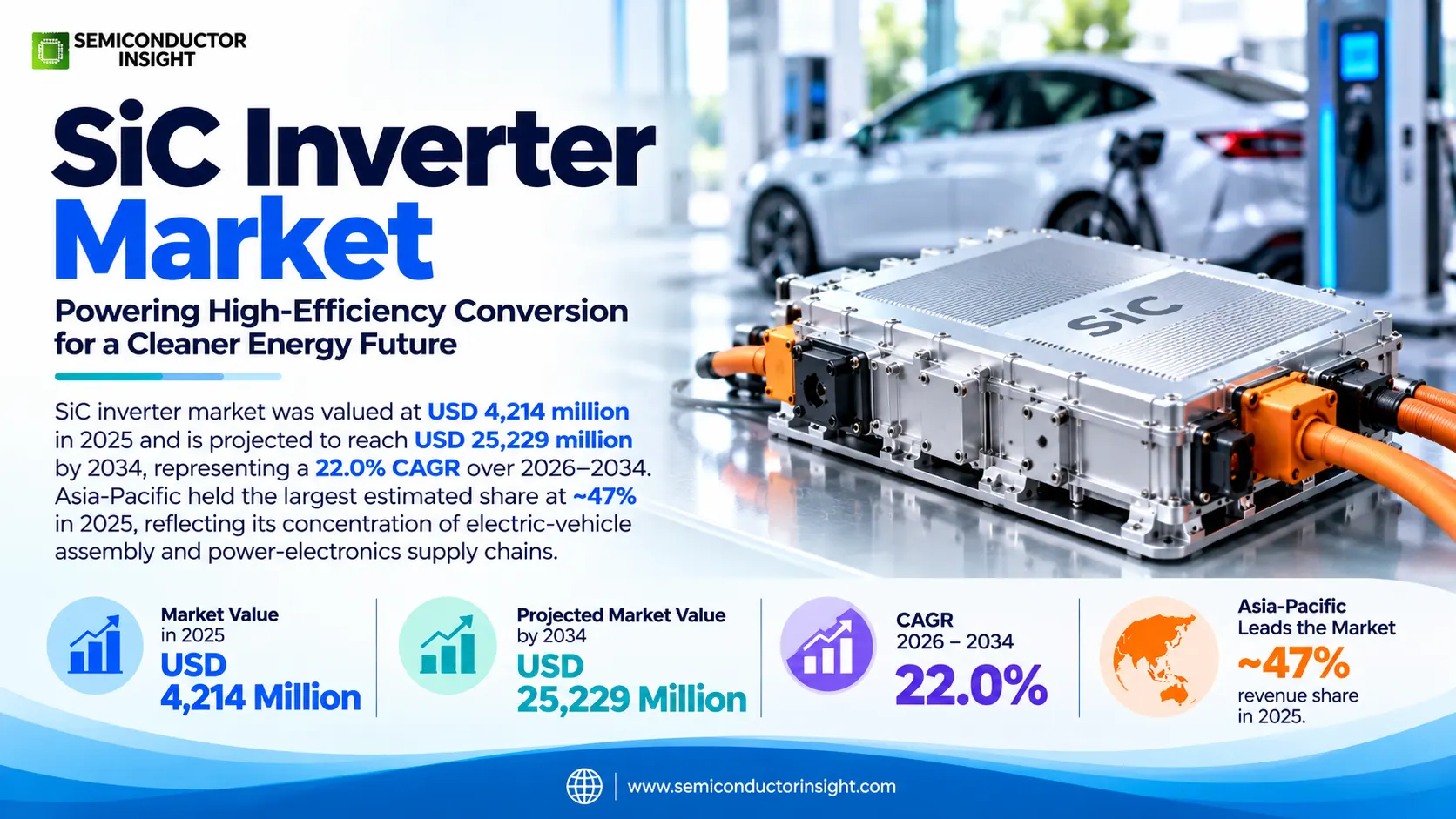
- Market scale: The global market reached USD 4,214 million in the 2025 base year, reflecting demand for finished inverter assemblies rather than standalone SiC semiconductors.
- Forecast: Revenue is projected to reach USD 25,229 million by 2034, with a 22.0% CAGR for the 2026–2034 outlook as vehicle architectures move toward higher switching efficiency.
- Leading type: The 800V category accounts for an estimated ~55% of base-year revenue, supported by traction platforms that prioritize fast charging, packaging density and low switching loss.
- Type growth: The 800V category also leads growth at ~25.0% CAGR, while the 300kW class represents ~27% and other configurations account for ~18% of modeled demand.
- Application leadership: Automobile Industry contributes an estimated ~72% of demand, ahead of Aerospace & Defense at ~12% and other uses at ~16%.
- Regional concentration: Asia-Pacific holds the largest modeled share at ~47%, followed by North America at ~24% and Europe at ~18%; South America and Middle East & Africa remain smaller.
- Commercial drivers: Vehicle electrification, compact power stages, 800V charging platforms, renewable integration and tighter system-efficiency requirements shape supplier qualification.
- Market constraints: Device procurement costs, thermal-management integration, reliability testing and uneven adoption of electric vehicles can slow program awards despite favorable electrical performance.
Global SiC Inverter Market Overview
SiC inverter market was valued at USD 4,214 million in 2025 and is projected to reach USD 25,229 million by 2034, representing a 22.0% CAGR over 2026–2034. Asia-Pacific held the largest estimated share at ~47% in 2025, reflecting its concentration of electric-vehicle assembly and power-electronics supply chains.
Silicon carbide switching enables inverter designers to reduce conversion losses while handling high bus voltages and demanding thermal cycles. The commercial product is a complete inverter power stage, including semiconductors, drivers, control boards, cooling interfaces and enclosure. This boundary captures finished automotive traction inverters as well as stationary and specialized conversion systems, but excludes loose wafers, discrete MOSFETs, battery packs, solar modules and unrelated drivetrain hardware. A vehicle e-axle is counted only for its inverter portion, not for the motor or transmission.
Electrification is broadening the performance envelope required of traction electronics. Manufacturers are moving from conventional 400V architectures toward 800V systems on selected passenger and commercial platforms, while plug-in hybrids continue to require efficient compact converters. Silicon carbide has a particularly attractive trade-off where switching losses, cooling volume and high-frequency operation matter more than the lowest semiconductor purchase price. The technology is not universal: silicon IGBT solutions retain a cost advantage in lower-stress vehicles and in programs where electrical efficiency yields limited customer value.
Demand from power generation and storage has a different purchasing logic from automotive. Utility-scale battery systems value conversion efficiency, maintainability, grid-code compliance and service support over long project lifetimes. Solar installations emphasize energy yield, thermal derating and balance-of-system economics. Industrial motor applications may adopt SiC when a smaller enclosure or higher switching frequency is commercially meaningful, but conventional silicon inverters remain widespread. These distinctions create different qualification cycles and margin profiles despite a common semiconductor technology.
The 2026 market estimate is a modeled USD 5,141 million, rather than a separately observed revenue census. Forecast growth is supported by original-equipment manufacturer platform awards and expansion of battery-electric architectures, but delivery schedules can change after design selection. The base-year mix assigns ~55% to the 800V type class and ~72% to automobile applications; these are analytical allocations rather than measured company disclosures. The mixed 800V, 300kW and Others type taxonomy is retained as published instead of being replaced with invented technical categories.
Competitive differentiation depends on whole-system performance rather than switching devices alone. Power-module attachment, laminated busbars, gate-drive calibration, coolant compatibility and functional-safety software determine whether a laboratory efficiency advantage survives vehicle qualification. Customers evaluate cost per delivered kilowatt, durability across temperature cycles and manufacturing traceability. Component suppliers can influence inverter designs through SiC devices and controls, but they should not automatically be counted as independent sellers of finished inverter assemblies.
Segment Analysis: By Type
The publisher type classes are 800V, 300kW and Others. These categories mix a voltage designation with a power rating and are therefore preserved as commercial labels rather than treated as a strict engineering taxonomy. The 800V class leads with an estimated ~55% share and the fastest modeled growth at ~25.0% CAGR; 300kW accounts for ~27% with ~20.0% CAGR, while Others represents ~18% with ~11.9% CAGR.
| Type | Typical design and buying context | Market position |
|---|---|---|
| 800V | Traction inverters built for high-voltage battery systems, compact cooling packages and high switching efficiency; applicable products are qualified within vehicle platforms. | Largest category (~55% of 2025 revenue; ~25.0% CAGR). Vehicle makers select this class when charging speed, copper mass and system-level losses justify the higher device and packaging costs. Qualification emphasizes thermal cycling, fault response, electromagnetic compatibility and integration with vehicle controls, while procurement volume depends on vehicle production schedules and awarded platforms. |
| 300kW | High-output inverters suitable for heavier electric vehicles, buses and industrial duty cycles where sustained torque and cooling performance drive package design. | Second category (~27% share; ~20.0% CAGR). Commercial vehicle designs can use SiC to improve continuous power density without enlarging coolant loops. Procurement remains project-specific because drive-axle geometry, peak-load duty, voltage class and operator service requirements differ materially between bus, truck and industrial applications. |
| Others | Configurations outside the two named commercial groups, including lower-voltage traction designs and specialized stationary or aerospace converter variants. | Remaining category (~18% share; ~11.9% CAGR). A heterogeneous collection of inverter ratings serves fleet retrofits, hybrid powertrains and non-road machinery. Silicon-based alternatives retain share where procurement price dominates, while bespoke SiC designs can command premiums when weight or temperature tolerance matters more than production scale. |
800V traction architectures and platform economics
An 800V battery bus can lower current for a given power transfer, reducing resistive losses in conductors and enabling lighter cables when the complete charging system supports the voltage. Inverter designers still face insulation spacing, protection coordination and thermal interface challenges. SiC devices permit faster switching, but electromagnetic interference and motor insulation requirements can offset some gains. Supplier selection therefore depends on validated system integration rather than the voltage label by itself.
BorgWarner and Motion Applied illustrate two different routes to 800V commercialization. One is a high-volume vehicle-platform approach built around dual-sided cooling and repeatable manufacturing; the other emphasizes compact motorsport-derived power electronics with flexible integration. These design priorities produce different qualification evidence and different annual volume expectations. Both create demand for gate drivers, low-inductance packaging and serviceable inverter controls without implying identical end-market pricing.
300kW power-density requirements in commercial transport
The 300kW category captures demand where continuous thermal loading and vehicle uptime are central purchase criteria. A bus inverter may encounter frequent acceleration, regenerative braking and high ambient temperatures, so the cooling system must protect semiconductor junctions during repeated power excursions. Fleet operators also assess field replacement procedures, diagnostic access and parts availability. The modeled ~27% share is a market allocation, not a count of all inverters carrying an exact 300kW nameplate.
Other voltage and power combinations
Other inverter configurations include lower-output passenger applications, stationary power conversion and specialized aerospace propulsion. Their requirements diverge: aircraft systems place exceptional value on weight and fault tolerance, while battery-storage installations focus on service life and grid interconnection. The aggregate ~18% share is therefore not a single interchangeable product family. Growth remains positive but slower as many customers continue to use established silicon technology when equipment footprint is less critical.
Segment Analysis: By Application
Automobile Industry is the largest application with an estimated ~72% share and ~24.0% CAGR, because high-volume electric and plug-in hybrid platforms account for the broadest production opportunity. Aerospace & Defense contributes ~12% with ~20.0% CAGR, while Others holds ~16% with ~10.0% CAGR across stationary storage, solar conversion, industrial drives and specialty uses.
| Application | Demand characteristics |
|---|---|
| Automobile Industry | Leading application (~72% of 2025 demand; ~24.0% CAGR). Inverters connect high-voltage batteries to traction motors and are specified early in vehicle-platform development. Passenger cars, commercial fleets and plug-in hybrids require different cooling and packaging solutions. Orders depend on vehicle production rather than announced nameplate capacity, and qualification includes electromagnetic compatibility, vibration, thermal cycling and functional-safety behavior across a defined operating envelope. |
| Aerospace & Defense | Specialized application (~12% share; ~20.0% CAGR). Hybrid-electric aircraft demonstrators and military electrification programs favor lightweight, efficient power electronics with controlled fault modes. Sales volumes are lower than automotive but engineering value can be higher. Certification, redundancy and environmental qualification extend timelines, making prototype and low-rate production revenue meaningful before broad deployment occurs. |
| Others | Distributed application group (~16% share; ~10.0% CAGR). Battery-storage power conversion, utility solar equipment, industrial motors and marine systems buy inverters according to project economics. The decision turns on total losses, cooling requirements, expected utilization and maintenance access. Some buyers prefer mature silicon systems, so equipment upgrades occur selectively rather than uniformly across installed infrastructure. |
Application demand cannot be inferred from vehicle sales alone because inverter content per vehicle differs by architecture, supplier integration and power rating. A high-voltage traction system may carry greater semiconductor and cooling value than a compact hybrid design, while a utility battery installation can use multiple conversion blocks within one project. Automotive buyers often negotiate multi-year programs; industrial customers more frequently procure equipment by project, producing different revenue recognition and inventory patterns.
Electric-vehicle demand also has regional volatility. China retains the deepest manufacturing ecosystem, Europe responds to emissions standards and changing affordability, and North American incentives and model availability affect near-term sales. Aerospace programs face long development and certification schedules, while stationary projects respond to grid-connection queues and financing. These differences explain why the modeled automobile growth rate exceeds the stationary and miscellaneous application group.
Regional Analysis
Regional demand is concentrated in Asia-Pacific (~47% of 2025 revenue, ~24.0% CAGR), followed by North America (~24%, ~19.0% CAGR) and Europe (~18%, ~20.0% CAGR). South America contributes ~5% at ~23.0% CAGR, while Middle East & Africa accounts for ~6% at ~20.9% CAGR. These shares are modeled estimates tied to electric-vehicle manufacturing, inverter supply chains and the timing of storage and industrial projects.
Which regions generate the strongest SiC inverter demand and why?
The five regional markets differ in the share of finished inverters purchased for new vehicles versus stationary installations. Asia-Pacific benefits from high vehicle assembly volumes and established electronics suppliers; Europe is shaped by vehicle efficiency regulation and premium platforms; North America combines domestic automotive programs with storage deployment. South America and the Middle East & Africa remain smaller but can expand quickly from limited starting bases when electric buses, solar projects and industrial electrification are funded.
Regional revenue is attributed to demand for inverter assemblies, not to the location where SiC wafers were fabricated. A European carmaker may source a power module from Asia and integrate it into a vehicle assembled in another country. Procurement can also shift when an original-equipment manufacturer changes its inverter architecture or brings power-electronics assembly in house. The estimated regional shares should therefore be interpreted as commercial market positions rather than exact customs-trade statistics.
| Region | Position | Growth outlook | Demand profile | What decides supplier selection |
|---|---|---|---|---|
| Asia-Pacific | Largest (~47%) | Fastest major region (~24.0% CAGR) | High-volume vehicle manufacturing | Local automotive qualification, thermal reliability and high-throughput production |
| North America | Second (~24%) | Selective expansion (~19.0% CAGR) | Vehicle platforms and utility storage | Domestic support, service network and cost of validated integration |
| Europe | Third (~18%) | Premium transition (~20.0% CAGR) | 800V vehicles and commercial fleets | Efficiency, safety certification and multi-year program delivery |
| South America | Smaller (~5%) | Emerging adoption (~23.0% CAGR) | Electric buses and distributed power | Project finance, import costs and after-sales technical support |
| Middle East & Africa | Developing (~6%) | Project-led (~20.9% CAGR) | Solar-storage and transport pilots | Heat tolerance, grid compatibility and project commissioning capability |
Competitive Landscape of the Global SiC Inverter Market
Competition is organized around finished inverter engineering and automotive qualification, with BorgWarner, DENSO, ZF, Marelli and specialized Motion Applied designs occupying different customer segments. Semiconductor providers such as Wolfspeed and NXP influence component selection but should not automatically be classified as independent suppliers of complete inverter assemblies. Tier positioning depends on manufacturing scale, product responsibility and the ability to support fielded systems.
High-volume automotive suppliers compete for platform awards that may span several vehicle generations. Buyers examine power density, efficiency across a drive cycle, software interfaces, cooling compatibility and production traceability. A supplier with an existing relationship can reduce integration risk because the automaker has already validated diagnostics, controls and manufacturing quality. New entrants can still win when they deliver a step change in packaging or cost, but qualification expenditure and warranty exposure create substantial barriers.
Specialized engineering groups serve motorsport, aerospace and industrial customers that require high power density at comparatively low production volumes. These programs can fund rapid development and unique thermal designs, yet their revenue profile differs from passenger-vehicle production. The customer may buy a complete converter, a configurable power stage or engineering services. Such flexibility creates opportunities for technology specialists but limits the comparability of nominal unit prices across suppliers.
The upstream supply chain shapes bargaining power. SiC device manufacturers determine transistor availability, switching characteristics and some module packaging options, while control-chip vendors supply microcontrollers, gate drivers and sensing interfaces. These firms can participate in reference designs without selling finished inverters. A disciplined competitive comparison therefore separates system integrators from device enablers and recognizes that internal vehicle-maker production may not be visible as merchant sales.
Mergers, brand changes and strategic partnerships can alter the list of active suppliers. Motion Applied is the current branding associated with the MCU-800 product family formerly marketed under McLaren Applied, and current product documents should take precedence over historical branding. A former supplier name is useful for tracing installed systems, but it should not be treated as a separate active competitor when operations have been transferred or consolidated.
Tier structure
| Tier | Companies | Basis of competition |
|---|---|---|
| Volume integrators | BorgWarner; DENSO; ZF Friedrichshafen; Marelli | Multi-year vehicle programs, power-stage design ownership, thermal engineering and qualified production lines |
| Specialized systems | Motion Applied; Punch Powertrain; JJE | Customizable high-voltage platforms, niche vehicle applications and differentiated packaging or controls |
| Technology enablers | Wolfspeed; NXP; onsemi; STMicroelectronics | SiC switches, controllers and device-level support used within third-party inverter assemblies |
Key companies profiled
- BorgWarner
- DENSO
- ZF Friedrichshafen
- Marelli
- Motion Applied (formerly McLaren Applied)
- Punch Powertrain
- JJE
- Wolfspeed (component enabler)
- NXP Semiconductors (control enabler)
- onsemi (device supplier)
- STMicroelectronics (device supplier)
SiC Inverter Production and Capacity Analysis
Production capacity depends on automotive-grade assembly, test throughput and power-module supply, not only on semiconductor wafer starts. Inverter factories require repeatable busbar welding, thermal-interface control, firmware programming, end-of-line electrical testing and traceable component lots. Automotive lines are often dedicated to customer platforms, whereas stationary converters may be assembled in more configurable production cells.
A vehicle inverter production line typically integrates power modules, control boards, current sensors, housings and coolant connections before subjecting the unit to insulation, switching and thermal checks. Yield losses can occur from solder voids, bond degradation, assembly contamination or software configuration errors. Scaling output therefore requires robust manufacturing engineering and supplier quality agreements as well as available SiC devices. Nominal module capacity is not equivalent to saleable inverter output.
Geographic capacity is distributed across automotive electronics centers in Asia, Europe and North America, with additional conversion-equipment manufacturing linked to storage and renewable projects. Localizing final assembly can shorten logistics chains and support customer-specific validation, but advanced semiconductors may still cross borders several times. A single new vehicle award can justify dedicated fixtures and tooling, while delays in vehicle launch timing may leave specialized production assets underutilized.
Capacity utilization follows end-market volatility. Battery-electric vehicle programs can be delayed by pricing pressure or charging-infrastructure gaps, and grid projects may await interconnection approval before equipment shipment. Suppliers manage these risks through modular designs, multiple qualified device sources and production cells that can accommodate several power ratings. Maintaining test capacity and field-service readiness is especially important when moving from pilot volumes to long-duration commercial contracts.
Global SiC Inverter Market Dynamics, Drivers, Restraints and Opportunities
The modeled growth profile reflects accelerating high-voltage electrification, demand for compact and efficient power conversion, and investment in storage-connected infrastructure. Adoption is moderated by higher device costs, engineering qualification, price-sensitive vehicle segments and project execution risk. The impact tables express estimated percentage-point contributions to the forecast growth profile rather than separately observed accounting items.
MARKET DRIVERS
Drivers Impact Analysis*
| Market Drivers | Impact Rank | CAGR Contribution (%) | 2026–2028 | 2029–2031 | 2032–2034 |
|---|---|---|---|---|---|
| Battery-electric vehicle traction platform expansion | High | +11.00% | High | High | High |
| 800V vehicle and fast-charging architecture adoption | High | +7.50% | High | High | Medium |
| Compact SiC power-stage and cooling improvements | Medium-High | +5.50% | Medium | High | High |
| Utility battery-storage and solar conversion demand | Medium | +3.50% | Medium | High | High |
| Commercial transport and industrial electrification | Low-Medium | +2.70% | Medium | Medium | High |
| Others (aerospace pilots, marine drives, grid services, specialty converters) | Low | +1.80% | Low | Medium | High |
Vehicle-platform electrification raises inverter content
Battery-electric vehicles require high-power DC-to-AC conversion between the traction battery and motor, creating a direct market for finished inverters. More demanding vehicle platforms can justify SiC devices through lower switching losses and smaller thermal systems. The commercial effect depends on actual vehicle output and awarded inverter content, however, rather than on electric-vehicle announcements alone. Supplier revenue may lag a program award by several model years.
800V architectures reward efficient high-voltage switching
Moving toward 800V battery systems reduces current for equivalent power and can enable faster charging when infrastructure and battery design are compatible. Inverters must then manage higher insulation stress, transient behavior and electromagnetic emissions. SiC switches can improve conversion efficiency at these operating points, supporting the estimated ~55% type share. The benefit remains application-dependent because the total system must absorb device, packaging and validation costs.
Power density reduces vehicle and cabinet packaging burdens
Smaller inverter enclosures can release valuable space in vehicle platforms and storage cabinets, while reduced losses may ease cooling requirements. The economic value is especially visible in commercial transport and tightly packaged drivetrains. System designers must validate the complete heat path from semiconductor junction to coolant, so power density improvements require advances in busbars, interfaces, sensors and controls rather than a simple substitution of transistor material.
Grid conversion and specialized transport diversify demand
Stationary battery storage, photovoltaic installations and selected aerospace programs extend the market beyond passenger cars. Utility customers value high efficiency over long operating hours, while aviation demonstrators emphasize weight and controlled fault behavior. These buyers have different certification and purchasing cycles, creating an additional demand base that is less directly tied to consumer vehicle incentives. Project financing and grid access nevertheless determine when many systems are actually delivered.
MARKET RESTRAINTS
Restraints Impact Analysis*
| Market Restraints | Impact Rank | CAGR Contribution (%) | 2026–2028 | 2029–2031 | 2032–2034 |
|---|---|---|---|---|---|
| SiC devices and qualified power-module costs | High | -4.00% | High | Medium | Medium |
| Thermal, electromagnetic and safety qualification burdens | Medium-High | -2.80% | High | High | Medium |
| Uneven electric-vehicle adoption and platform delays | Medium | -1.80% | High | Medium | Medium |
| Others (silicon competition, grid delays, sourcing concentration, service costs) | Low | -1.40% | Medium | Medium | Low |
Higher semiconductor cost challenges price-sensitive programs
SiC devices can command a purchase-price premium relative to mature silicon alternatives, particularly when the application does not fully exploit higher voltage or switching frequency. An automaker must compare energy savings with warranty risk, cooling-system redesign and production tooling. Lower-cost vehicle segments may retain silicon IGBTs, and price negotiations can reduce supplier margins even where SiC is technically selected. These economics temper the speed of broad adoption.
Qualification cycles can delay shipment recognition
Automotive inverters must demonstrate functional safety, electromagnetic compatibility, insulation integrity and resistance to repeated thermal cycling. A design change in the power module can trigger extensive revalidation of software, cooling and fault protection. Aerospace applications introduce additional certification obligations. Consequently, engineering prototypes and announced customer awards do not necessarily convert into high-volume revenue in the same year, creating a timing gap between technology adoption and reported sales.
Vehicle demand differs sharply by region and incentive policy
Electric-car adoption remains uneven across major markets, and purchase incentives, charging access and household affordability affect demand for higher-cost drivetrains. A supplier with strong exposure to one vehicle platform can face utilization pressure when production plans are revised. The IEA documented different 2025 market trajectories in China, Europe and the United States, highlighting the risk of applying a single global vehicle growth rate to every inverter supplier.
Established silicon and project execution remain competitive
Silicon inverter technology continues to satisfy many lower-voltage vehicles and industrial systems at attractive cost. Stationary power-conversion projects may also be delayed by grid connections, financing or construction schedules unrelated to semiconductor performance. Field-service limitations can discourage buyers from adopting an unfamiliar inverter design. Vendors must demonstrate an improvement in lifecycle economics rather than assume that wide-bandgap material properties automatically guarantee a purchase.
MARKET OPPORTUNITIES
Multi-generation 800V platform awards
Automotive suppliers can capture sustained revenue by winning inverter designs that carry across multiple vehicle models and future model-year updates. Shared cooling, controls and module architecture reduce engineering duplication while permitting higher current or improved efficiency in later variants. A supplier that controls software, power-stage packaging and manufacturing qualification may preserve its position even as individual SiC transistor generations change, making long-term customer relationships strategically valuable.
Commercial fleets with demanding thermal duty
Electric buses and trucks experience repeated acceleration, regenerative braking and long operating hours, increasing the economic importance of converter losses and thermal durability. Suppliers that integrate SiC inverters with serviceable cooling and diagnostics can target fleet operators focused on vehicle uptime. The opportunity extends beyond the largest passenger-car markets, but each commercial platform requires validation against its own power rating, operating cycle and maintenance practices.
Stationary storage and solar integration
Grid-scale storage installations create demand for efficient high-voltage converters that can operate for extended periods while satisfying interconnection requirements. SiC can support smaller thermal systems and reduced electrical losses, but customers also need warranties, commissioning expertise and spare-parts supply. Suppliers able to deliver a complete conversion platform with monitoring and service may capture a broader share of project value than semiconductor vendors selling only power devices.
Hybrid-electric aviation and specialty propulsion
Aircraft demonstrators and other specialized propulsion systems value inverter power density because weight and cooling burden directly affect vehicle performance. Flexible SiC control platforms can accelerate development when the customer needs unusual operating modes or packaging. Commercial scale remains uncertain and certification takes time, so the near-term opportunity is strongest in engineering contracts, pilot units and low-rate production rather than assumptions of mass-market aircraft electrification.
Global SiC Inverter Supply Chain Analysis
The supply chain connects SiC wafer and device manufacturing with power-module packaging, inverter system integration, customer qualification and field service. Value is not distributed evenly: finished inverter suppliers carry responsibility for system efficiency, software, thermal performance and warranty, while upstream device companies control critical switching technology. The commercial boundary is the completed inverter assembly sold to a vehicle or equipment customer.
Upstream. Silicon carbide devices depend on high-quality substrates, epitaxial layers and controlled fabrication processes, so wafer yield and device qualification influence inverter cost. Gate drivers, sensing chips and passive components add further sourcing dependencies. A finished inverter manufacturer may qualify several device vendors, but changes to switching behavior can require control recalibration and new reliability testing. Semiconductor availability therefore affects both the bill of materials and the schedule of vehicle-platform approvals.
Manufacturing. System assembly converts device-level capability into a reliable product. Manufacturers join power modules to busbars and cooling structures, install control electronics and run insulation, switching and thermal tests. Consistency matters because voids, contamination or firmware configuration errors can undermine field reliability. Automotive traceability systems link each finished unit to material lots and test results, while specialized inverter lines may prioritize flexibility for small production runs over maximum throughput.
Channel. Automotive original-equipment manufacturers usually select inverter suppliers through long design and qualification programs rather than open-market spot purchasing. Utility and industrial customers may buy complete conversion systems through engineering contractors or integrators, placing more weight on commissioning and warranty support. In specialty aviation, a development partner can supply prototype hardware and software before commercial certification. These channels differ in negotiation leverage, revenue timing and expected technical service.
Downstream. The end user ultimately pays for delivered propulsion or conversion performance, not for semiconductor material alone. Vehicle manufacturers assess range, drivability, cooling and safety, while grid customers evaluate energy losses, availability and maintenance costs. Fleets consider duty-cycle reliability and spare-parts logistics. These distinct performance measures influence which SiC inverter features command a premium and where established silicon-based equipment remains economically competitive.
Recent Developments in the Global SiC Inverter Market
- 3 August 2026 Announced
BorgWarner secured extensions of several high-volume high-voltage inverter programs with a major European vehicle manufacturer. The awards cover plug-in hybrid and 800V battery-electric applications, with the battery-electric design using SiC-based Viper switches and dual-sided cooling. Production is planned for 2029, so the announcement demonstrates future design commitment rather than an immediate increase in completed inverter shipments. Source - 26 February 2026 Announced
Motion Applied and Odys Aviation described integration of the AMPEX MCU-600 SiC inverter into a hybrid-electric propulsion program. The project highlights the role of compact conversion electronics in emerging aircraft architectures, where weight and power density are important design constraints. Its significance lies in system-development activity and prototype integration; commercial certification and fleet adoption remain separate milestones that determine eventual revenue scale. Source - 10 October 2025 Published
DENSO described a new traction inverter selected for Toyota’s updated bZ4X, using SiC power semiconductors and a flat dual-sided cooling structure. The company reported a reduction in inverter power loss of about 70% relative to its previous silicon-based product and a smaller core module. These are manufacturer-specific design comparisons, not a global market efficiency average or a guarantee of identical gains in other vehicles. Source - 24 July 2025 Announced
onsemi expanded its collaboration with Schaeffler around an EliteSiC-based plug-in hybrid electric vehicle platform. The development is relevant because inverter designers increasingly coordinate semiconductor selection with the entire propulsion system. onsemi supplies enabling devices rather than automatically selling the completed traction inverter, so the announcement supports the technology adoption narrative without being counted as direct merchant inverter revenue. Source - 7 May 2025 Announced
GE Vernova introduced a 1.5kV FLEXINVERTER option using SiC technology for utility-scale battery energy storage and expanded its 2kV photovoltaic inverter availability for international markets. The announcement illustrates a stationary application with different procurement and maintenance requirements from passenger vehicles. The company identified production activity in India and the United States, highlighting the importance of regional assembly and service capabilities. Source - 29 April 2025 Presented
BorgWarner showcased power-module developments at the Vienna Motor Symposium, including SiC technology for higher-voltage traction systems and advances in cooling integration. The presentation matters because inverter efficiency is determined by electrical packaging and heat removal as well as transistor characteristics. Commercial adoption still depends on customer platform qualification, repeatable manufacturing and the cost of the full power stage. Source - 20 March 2025 Announced
SMA introduced the Sunny Central Storage UP-S battery inverter family with SiC MOSFET technology, extending wide-bandgap adoption in large stationary conversion systems. Storage customers prioritize lifetime losses, grid-code compliance and maintenance economics rather than vehicle-style packaging alone. The product provides direct evidence that SiC-based inverter architectures are commercial in energy infrastructure, although individual project delivery dates depend on installation schedules. Source - 21 January 2020 Published
SMA and Infineon described their cooperation on SiC technology for solar inverters, emphasizing conversion efficiency and power-density advantages. The earlier development is a useful historical marker showing that stationary conversion preceded some current automotive deployments. It should not be interpreted as a current-year order announcement; its relevance is the engineering pathway through which wide-bandgap switches moved into commercially supported power-conversion equipment. Source
REPORT SCOPE & SEGMENTATION
| Attribute | Details |
|---|---|
| Study Period | 2023–2034 |
| Base Year | 2025 |
| Estimated Year | 2026 |
| Forecast Period | 2026–2034 |
| Historical Reference | 2023–2024 |
| Market Size 2025 | USD 4,214 million |
| Market Size 2026 | USD 5,141 million |
| Market Size 2034 | USD 25,229 million |
| Growth Rate | CAGR of 22.0% during 2026–2034 |
| Unit | Revenue (USD Million); modeled regional and segment shares are percentages |
| Segmentation | By Type, By Application and By Region |
| By Type | 800V · 300kW · Others |
| By Application | Automobile Industry · Aerospace & Defense · Others |
| By Region | Regional demand analyzed by application, type and key countries North AmericaUnited States, Canada, Mexico EuropeGermany, France, Italy, United Kingdom, Nordic Countries, Rest of Europe Asia-PacificChina, Japan, South Korea, India, Southeast Asia, Rest of Asia-Pacific South AmericaBrazil, Chile, Argentina, Colombia, Rest of South America Middle East & AfricaSaudi Arabia, UAE, South Africa, North Africa, East Africa, Rest of Middle East & Africa |
| Key Companies Profiled | BorgWarner, DENSO, ZF Friedrichshafen, Marelli, Motion Applied, Punch Powertrain, JJE, Wolfspeed, NXP Semiconductors |
| Customization Scope | Custom analysis may add country demand, voltage and power-rating cross-tabs, vehicle-platform adoption, stationary applications and supplier comparisons within the defined SiC inverter assembly boundary. |
Frequently Asked Questions
What is the size and growth outlook of the global SiC inverter market?
The global market was valued at USD 4,214 million in 2025 and is projected to reach USD 25,229 million by 2034, representing a 22.0% CAGR for 2026–2034. The figures refer to finished SiC-based inverter assemblies and their integrated electronics rather than standalone switching devices or wafer sales. Vehicle-platform electrification is the principal demand driver, while stationary conversion and specialized transport add smaller opportunities.
Which region has the largest share of SiC inverter revenue?
Asia-Pacific is the largest regional market with an estimated ~47% share in 2025 and a modeled ~24.0% CAGR. Its position reflects electric-vehicle assembly scale, local electronics supply chains and demand for compact high-voltage power stages. North America follows at ~24%, with Europe at ~18%; those markets have different mixes of vehicle programs, storage systems and qualification requirements.
What are the leading SiC inverter product types?
The commercial type split includes 800V, 300kW and Others, preserving the original mixture of voltage and power designations. The 800V category leads at ~55% of estimated 2025 revenue and grows at ~25.0% CAGR. The 300kW class holds ~27% and Others ~18%, reflecting different vehicle, fleet and specialty requirements rather than a single uniform rating hierarchy.
Which application generates the greatest demand for SiC inverters?
Automobile Industry contributes an estimated ~72% of the base-year market and expands at ~24.0% CAGR, driven by battery-electric and plug-in hybrid traction platforms. Aerospace & Defense accounts for ~12%, while other applications contribute ~16% across storage, solar and industrial conversion. Actual revenue depends on inverter content per system, qualification timing and equipment shipments rather than electric-vehicle sales alone.
Why do 800V electric vehicles use silicon carbide inverter technology?
Higher-voltage vehicle systems can reduce current for equivalent delivered power, while SiC switches can limit conversion losses at demanding switching conditions. The benefits may include lighter conductors and reduced cooling burden when the complete vehicle architecture is optimized. Designers still must control electromagnetic emissions, insulation stress and semiconductor cost, so adoption is concentrated where the total system delivers measurable value.
Are SiC inverters used outside passenger electric vehicles?
Yes. Commercial buses and trucks use high-power conversion electronics for traction, while utility battery storage and photovoltaic plants require efficient DC-to-AC conversion. Hybrid-electric aircraft demonstrators also investigate lightweight SiC power stages. These applications have distinct reliability, certification and purchasing requirements, and their revenue should not be conflated with finished vehicles, battery packs or complete solar installations.
What factors limit the adoption of SiC-based inverters?
The main constraints are semiconductor and power-module costs, long qualification cycles, thermal and electromagnetic engineering burdens, and competition from mature silicon-based designs. Vehicle demand can fluctuate with pricing and incentives, while storage projects depend on grid connections and financing. Buyers require evidence of lifecycle savings and field reliability before replacing established conversion systems, particularly in cost-sensitive applications.
How does the SiC inverter supply chain operate?
Upstream suppliers provide SiC wafers, MOSFETs, gate drivers and supporting electronics. Module and inverter manufacturers then integrate power stages, cooling, controls and enclosures before testing finished assemblies. Vehicle manufacturers award platform contracts, whereas stationary customers often buy through engineering integrators. Device companies may support the design without selling the finished inverter, making the commercial roles of suppliers important for market comparisons.
How do Europe and North America compare in the forecast?
North America holds an estimated ~24% of 2025 revenue and grows at ~19.0% CAGR, with demand from vehicle programs and utility storage. Europe represents ~18% with ~20.0% CAGR, supported by premium electric vehicles, commercial transport and established automotive engineering. The comparison reflects modeled demand allocation; it is not a statement that every inverter installed in either region was manufactured locally.
What does the forecast include and exclude?
The scope covers finished SiC-based inverter assemblies for traction, stationary energy conversion, industrial uses and specialized propulsion, including integrated control and thermal hardware. It excludes discrete SiC transistors, standalone substrates, battery cells, photovoltaic modules and unrelated drivetrain components. Revenue for a complete electric axle is limited to the inverter portion, preventing motors and transmissions from being counted as inverter sales.
Research Sources & Evidence Base
Get Sample Report PDF for Exclusive Insights
Report Sample Includes
- Table of Contents
- List of Tables & Figures
- Charts, Research Methodology, and more...
 Download Sample Report PDF