Market Insights
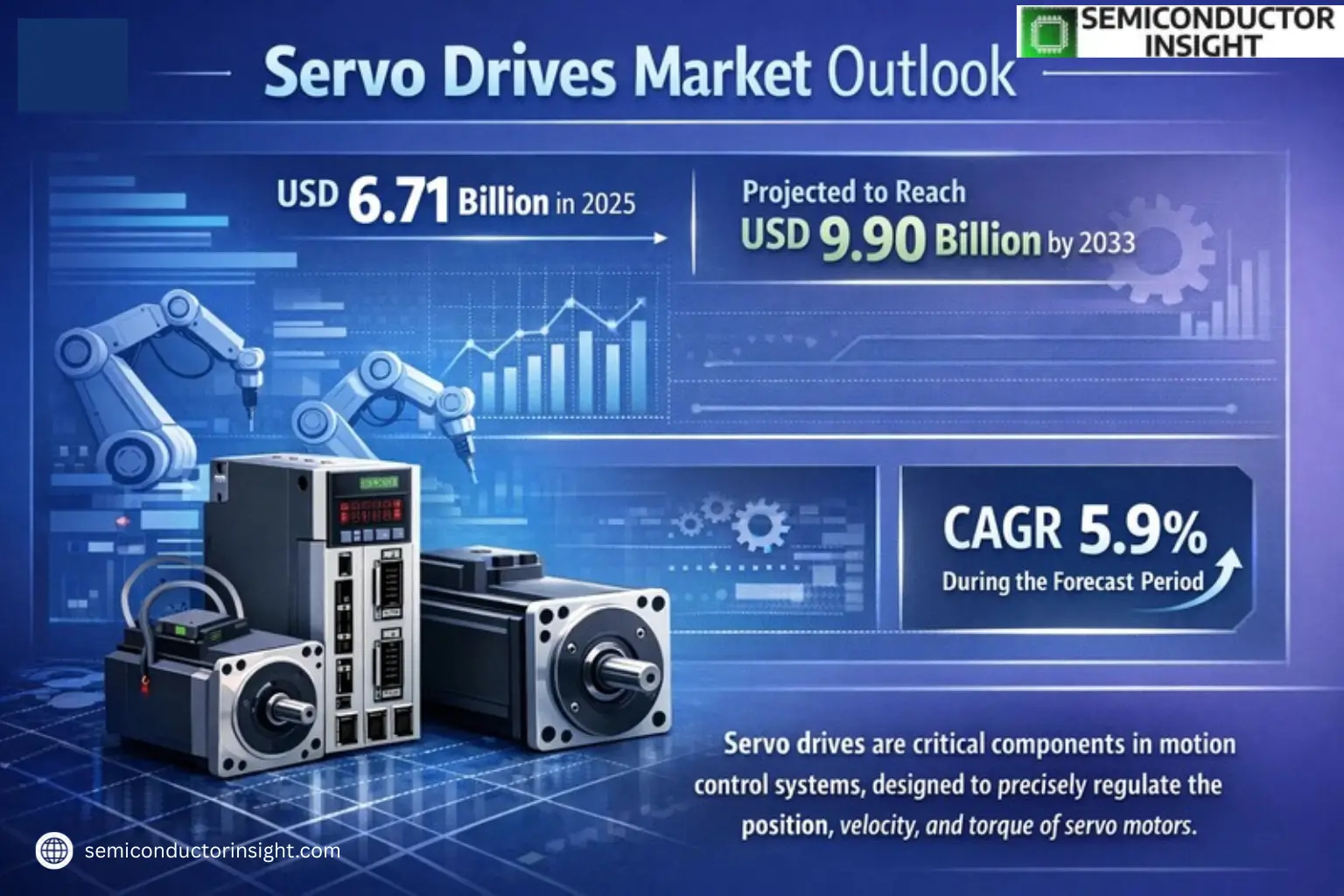
Global Servo Drives Market size was valued at USD 6.71 billion in 2025 and is projected to reach USD 9.90 billion by 2033, exhibiting a CAGR of 5.9% during the forecast period.
Servo drives are critical components in motion control systems, designed to precisely regulate the position, velocity, and torque of servo motors. These devices enable high-performance automation in applications such as robotics, CNC machinery, packaging equipment, and industrial manufacturing. The technology ensures accurate motion profiles by dynamically adjusting motor performance based on real-time feedback.
The market growth is driven by increasing industrial automation demand across sectors like automotive, electronics, and aerospace. China currently dominates with a 24% market share due to its robust manufacturing sector, followed by Europe (22%) and Japan (21%). Key product segments include drives ranging from 1KW to 5KW power capacity, which account for 52% of sales. Leading manufacturers such as Yaskawa, Mitsubishi Electric, and Siemens collectively hold about 45% market share through continuous innovation in energy-efficient drive technologies.
MARKET DRIVERS
Rising Demand for Industrial Automation
Servo Drives Market is experiencing significant growth due to the increasing adoption of automation across manufacturing sectors. Factories are upgrading their production lines with servo drives to enhance precision, speed, and energy efficiency. Global shift toward Industry 4.0 technologies is a key factor driving this demand.
Advancements in Motion Control Systems
Technological innovations in servo drive systems, including better torque control and improved feedback mechanisms, are accelerating market growth. The integration of smart servo drives with IoT capabilities allows for real-time monitoring and predictive maintenance, further boosting adoption.
Additionally, stringent regulations on energy efficiency are compelling manufacturers to replace traditional motor systems with servo drives, supporting market expansion.
MARKET CHALLENGES
High Initial Investment Costs
The adoption of servo drives is hindered by their relatively high upfront costs compared to conventional motor systems. Small and medium enterprises (SMEs) often face budget constraints, limiting their ability to invest in advanced motion control solutions.
Other Challenges
Complexity in Integration
Retrofitting existing machinery with servo drives can be technically challenging, requiring specialized expertise and additional components, which adds to implementation costs.
MARKET RESTRAINTS
Supply Chain Disruptions
Servo Drives Market faces constraints due to ongoing semiconductor shortages and logistical challenges, which delay the production and delivery of critical components. These disruptions impact manufacturers’ ability to meet growing demand on schedule.
MARKET OPPORTUNITIES
Emergence of Collaborative Robots (Cobots)
The increasing deployment of collaborative robots in manufacturing presents a lucrative opportunity for the Servo Drives Market. Servo drives are essential for cobots’ precise motion control, and their demand is expected to rise as cobot adoption grows by 30% annually.
Renewable Energy Sector Expansion
Servo drives play a crucial role in wind turbine pitch control and solar panel positioning systems. The rapid growth of renewable energy infrastructure worldwide is creating new avenues for servo drive manufacturers.
Servo Drives Market Trends
Asia-Pacific Dominates Servo Drives Market Growth
The Asia-Pacific region, led by China, remains the largest market for servo drives, accounting for 24% of global revenue in 2025. China’s manufacturing automation boom and expanding electronics industry continue to drive demand. Japan follows closely with 21% market share, maintaining strong positions in robotics and precision machinery applications. Europe holds 22% market share, fueled by advanced manufacturing adoption in Germany and Italy.
Other Trends
Increased Demand for Medium-Power Servo Drives
The 1KW-5KW power segment dominates the Servo Drives Market with 52% share, as this range satisfies requirements for most industrial automation applications. Growth in CNC machinery and packaging equipment is particularly driving adoption of these mid-range servo drive solutions.
Industry 4.0 Integration and Smart Manufacturing
Major manufacturers are incorporating IIoT capabilities into servo drives to enable predictive maintenance and real-time performance monitoring. This aligns with global smart factory initiatives, creating opportunities for networked servo drive systems. Leading players like Siemens and Yaskawa are investing heavily in connected servo drive technologies.
Other Trends
Sustained Growth in Robotics Adoption
Industrial robots represent one of the fastest-growing application segments for servo drives, with collaborative robots and high-precision assembly robots driving innovation. The automotive and electronics sectors remain primary adopters of servo-driven robotic solutions.
Electrification Trend in Manufacturing
The shift from pneumatic to electric motion control systems continues across multiple industries, benefiting servo drive manufacturers. Energy efficiency requirements and precision demands are key factors in this transition, particularly in packaging, printing, and material handling applications.
COMPETITIVE LANDSCAPE
Key Industry Players
Strategic Positioning and Market Share Dynamics in Servo Drives Industry
Servo Drives Market is dominated by established industrial automation leaders, with Yaskawa, Mitsubishi, and Fanuc collectively holding nearly 30% of global market share. These Japanese manufacturers maintain strong positions through technological excellence in precision motion control and extensive OEM partnerships. Siemens and Rockwell Automation represent the European and American competitive presence, specializing in integrated automation solutions for heavy industries. The market exhibits moderate consolidation, with the top five players accounting for approximately 45% of 2025 revenues, while regional specialists and Chinese manufacturers are gaining traction through competitive pricing.
Chinese manufacturers like INVT and He Chuan Tech are rapidly expanding their footprint through aggressive pricing strategies and government-supported industrial automation initiatives. Specialized players such as Kollmorgen and Moog focus on high-performance aerospace and defense applications, while Delta Electronics and Oriental Motor cater to cost-sensitive segments. The competitive landscape is further diversified by robotic specialists (Fanuc, ABB) and CNC system integrators (Bosch Rexroth, Wuhan Huazhong) offering vertically integrated solutions.
List of Key Servo Drives Companies Profiled
- Yaskawa Electric Corporation
- Mitsubishi Electric
- Fanuc Corporation
- Panasonic Corporation
- Siemens AG
- Rockwell Automation
- ABB Ltd
- Nidec Corporation
- Delta Electronics
- Schneider Electric
- SANYO DENKI
- Rexroth (Bosch)
- Moog Inc.
- Teco Electric & Machinery
- Oriental Motor
Segment Analysis:
| Segment Category | Sub-Segments | Key Insights |
| By Type |
|
From 1KW to 5KW dominates the segment due to its optimal balance between power output and energy efficiency.
|
| By Application |
|
Machinery-related Industries show strongest adoption due to extensive automation requirements.
|
| By End User |
|
Automotive Manufacturers lead in servo drive adoption due to production line automation needs.
|
| By Control Method |
|
Digital Control methods are gaining prominence in modern servo drive systems.
|
| By Communication Protocol |
|
EtherCAT emerges as the preferred communication protocol for high-performance applications.
|
Regional Analysis: Global Servo Drives Market
China’s Pearl River Delta has become the world’s largest cluster for servo drive implementation, with thousands of factories integrating smart motion control systems across electronics and automotive production lines.
Japan maintains technological dominance with precision servo drives for robotics applications, while South Korean manufacturers focus on compact, high-performance solutions for semiconductor equipment.
Southeast Asian nations are witnessing accelerated servo drive adoption as multinational corporations establish production bases in Vietnam, Thailand, and Malaysia to diversify supply chains.
India’s growing automotive sector is driving development of customized servo solutions, with local manufacturers collaborating with global technology providers for specialized motion control applications.
North America
The North American Servo Drives Market benefits from advanced manufacturing practices and strong R&D capabilities. U.S. manufacturers emphasize high-performance servo systems for aerospace, defense, and medical equipment applications. Canada’s growing robotics industry presents new opportunities for precision motion control solutions. The region sees increasing integration of IoT capabilities in servo drives for predictive maintenance applications.
Europe
European manufacturers focus on energy-efficient servo drives complying with strict environmental regulations. Germany leads in industrial automation applications, particularly in automotive production lines. Eastern European countries are emerging as important markets as manufacturing bases shift closer to Western European consumers. The region shows strong demand for servo drives with integrated safety features.
South America
Brazil dominates the South American Servo Drives Market, with growing adoption in food processing and packaging industries. Argentina shows increasing demand for servo systems in agricultural equipment manufacturing. Infrastructure constraints and economic volatility remain challenges, but local manufacturers are investing in basic automation solutions.
Middle East & Africa
The Middle East shows growing interest in servo drives for oil & gas equipment and infrastructure projects. UAE and Saudi Arabia lead in adopting industrial automation solutions. Africa presents long-term growth potential as manufacturing capabilities develop, particularly in South Africa and North African countries.
Report Scope
This market research report provides a comprehensive analysis of the Servo Drives Market, covering the forecast period 2025–2033. It offers detailed insights into market dynamics, technological advancements, competitive landscape, and key trends shaping the industry.
Key focus areas of the report include:
- Market Overview: The report begins with an overview outlining its current market scenario, key growth indicators, and industry transformation drivers. It discusses macroeconomic factors, demand–supply balance, regulatory landscape, and the strategic role of servo drives in powering advancements across industries such as robotics, CNC machinery, automated manufacturing, and industrial automation.
- Market Size & Forecast: Historical data and future projections for revenue, unit shipments, and market value across major regions and segments.
- Segmentation Analysis: Detailed breakdown by product type, power rating, application, and end-user industry to identify high-growth segments and investment opportunities.
- Regional Insights: Insights into market performance across North America, Europe, Asia-Pacific, Latin America, and the Middle East & Africa, including country-level analysis where relevant.
- Competitive Landscape: Profiles of leading market participants, including their product offerings, R&D focus, manufacturing capacity, pricing strategies, and recent developments such as mergers, acquisitions, and partnerships.
- Technology Trends & Innovation: Assessment of emerging technologies, integration of AI/IoT, motion control trends, and evolving industry standards.
- Market Drivers & Restraints: Evaluation of factors driving market growth along with challenges, supply chain constraints, regulatory issues, and market-entry barriers.
- Stakeholder Insights: Insights for component suppliers, OEMs, system integrators, investors, and policymakers regarding the evolving ecosystem and strategic opportunities.
Primary and secondary research methods are employed, including interviews with industry experts, data from verified sources, and real-time market intelligence to ensure the accuracy and reliability of the insights presented.
FREQUENTLY ASKED QUESTIONS:
What is the current market size of Servo Drives Market?
-> Servo Drives Market size was valued at USD 6.71 billion in 2025 and is projected to reach USD 9.90 billion by 2033, exhibiting a CAGR of 5.9% during the forecast period.
Which key companies operate in Servo Drives Market?
-> Key players include Yaskawa, Mitsubishi, Fanuc, Panasonic, Siemens, Rockwell, Inovance, ABB, Nidec, and Delta, among others. The top five players hold about 45% market share.
What are the key applications of servo drives?
-> Servo drives are primarily used in machinery-related industries (39% share), electronics-related industries, industrial robots, and other automation applications.
Which region dominates the market?
-> China is the largest market with 24% share, followed by Europe (22%) and Japan (21%).
What is the largest product segment?
-> The 1KW to 5KW power range segment dominates with 52% market share.

Get Sample Report PDF for Exclusive Insights
Report Sample Includes
- Table of Contents
- List of Tables & Figures
- Charts, Research Methodology, and more...
 Download Sample Report PDF