Key Statistics
Key Takeaways
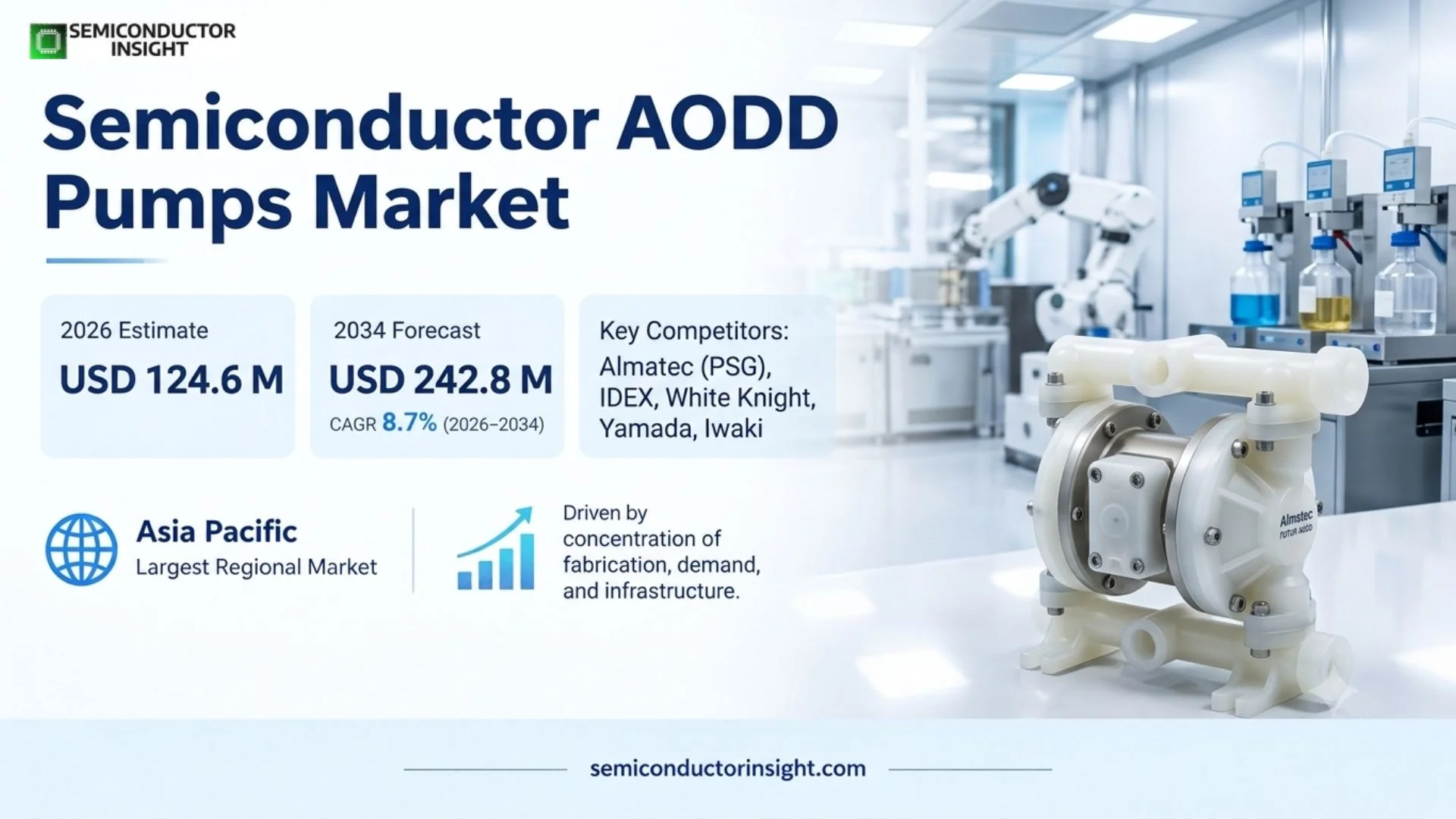
- Market size and growth: the market is estimated at USD 124.6 million in 2026 and is projected to reach USD 242.8 million by 2034, representing an 8.7% CAGR during 2026–2034.
- Plastic AODD pumps lead semiconductor applications because PTFE and high-purity polyethylene constructions reduce corrosion and contamination risk when handling acids, solvents and slurries.
- High-purity chemical delivery is a core application because wafer fabrication depends on reliable movement of aggressive process chemicals without metallic contamination or seal-generated particles.
- Asia Pacific is the largest market through the concentration of fabs in China, Taiwan, South Korea and Japan, while new U.S. and European facilities broaden regional service demand.
- Fab investment remains a direct demand driver: SEMI’s Q3 2026 outlook projects USD 149 billion in global 300mm front-end equipment spending during 2026, enlarging the process-fluid infrastructure that requires pumps.
Semiconductor AODD Pumps Market Overview
Semiconductor AODD Pumps Market was valued at USD 114.6 million in 2025 and is estimated at USD 124.6 million in 2026. The market is projected to reach USD 242.8 million by 2034, representing a CAGR of 8.7% during 2026–2034. Asia Pacific is the largest regional market, supported by the strongest concentration of manufacturing, end-use demand and supplier infrastructure.
Base year: 2025 · Estimated year: 2026 · Forecast period: 2026–2034 · Values in USD million unless otherwise stated
Semiconductor air-operated double-diaphragm pumps are positive-displacement pumps adapted for high-purity and aggressive chemical service in wafer fabrication. Two flexible diaphragms isolate the process fluid from the air-drive mechanism, allowing acids, bases, solvents and slurries to be transferred without a rotating shaft seal. Semiconductor designs add high-purity wetted materials, minimized internal surfaces and low-particle construction so the pump can operate in chemical-delivery, cleaning and CMP systems without introducing contamination that could affect process stability or wafer yield.
Plastic AODD designs are particularly important because PTFE and high-purity polyethylene can handle aggressive chemistry while avoiding metallic contact with the fluid stream. Almatec’s semiconductor portfolio describes pumps built from solid UHMW-PE or PTFE with seal-less wetted areas and flow paths intended to reduce contamination. Metal-body pumps remain useful for compatible utility and waste applications, but purity-sensitive front-end systems place a stronger premium on non-metallic wetted construction and repeatable chemical resistance.
Demand follows fab capacity and process complexity. New wafer-fabrication lines require bulk chemical distribution, wet cleaning, slurry handling and waste-treatment infrastructure, while existing fabs continuously replace pumps according to diaphragm life, contamination performance and preventive-maintenance schedules. SEMI’s Q3 2026 300mm Fab Outlook projects record front-end fab equipment spending of USD 149 billion in 2026, reinforcing the expanding installed fluid-handling base that supports recurring pump and spare-parts consumption.
Segment Analysis: By Type
By type, the market is segmented into metal and plastic AODD pumps. Plastic pumps lead semiconductor process applications because PTFE, UHMW-PE and related high-purity polymers resist aggressive acids and solvents without exposing the fluid to metallic surfaces. Metal designs remain relevant in utility, waste and compatible chemical services where mechanical robustness and broader industrial standardization are more important than ultra-low ionic contamination.
| Type | Market role | Commercial outlook |
|---|---|---|
| Metal Type | Metal body or wetted constructions for compatible chemicals, utilities and selected support systems. | Smaller semiconductor share; used where corrosion and ionic contamination are controlled. |
| Plastic Type | PTFE, PE or UHMW-PE constructions for acids, solvents, slurries and high-purity chemical delivery. | Leading type; strongest fit for contamination-sensitive front-end process chemistry. |
Segment Analysis: By Application
Applications include high-purity chemical delivery, cleaning equipment, CMP slurry delivery and other fab fluid duties. Chemical delivery provides the broadest demand because every wet process needs reliable transfer and dispense, while CMP slurry handling creates special wear and solids-management requirements. Cleaning systems add high-cycle use where safe chemical isolation, chemical compatibility and low particle generation directly influence equipment uptime and process repeatability.
| Application | Demand characteristics |
|---|---|
| High Purity Chemical Delivery | Transfers acids, solvents and bases from bulk or day tanks to tools with emphasis on purity and leak prevention. |
| Cleaning Equipment | Supports wet benches, parts cleaning and wafer-cleaning equipment where compatibility and repeatable flow are essential. |
| CMP Slurry Delivery | Moves abrasive slurries while controlling shear, settling and particle contamination. |
| Others | Includes waste chemical handling, reclaim systems and selected utility transfer. |
Segment Analysis: By Material of Construction
Material construction is commercially meaningful because the wetted surface determines corrosion resistance and contamination risk. PTFE is favored for the harshest chemical environments, while UHMW-PE and related high-purity plastics provide strong chemical resistance and mechanical durability at lower cost in suitable services. Metal designs are used selectively when fluid chemistry allows it or where a utility application values structural robustness more than ultra-high process purity.
| Material | Semiconductor use |
|---|---|
| PTFE | Aggressive acids, solvents and high-purity process chemicals. |
| UHMW-PE / PE | Broad chemical transfer with low particle generation and strong mechanical durability. |
| Metal | Utilities, waste or compatible chemicals where metal contamination is not the primary risk. |
Segment Analysis: By Fluid Handling Duty
The fluid handled determines diaphragm material, pump body, valve configuration and service interval. Acids and solvents demand chemical inertness and clean internal geometry, CMP slurries require solids tolerance and low shear, while cleaning chemicals may combine aggressive chemistry with high cycle rates. Semiconductor fabs therefore qualify several AODD configurations rather than relying on one universal pump model across every wet-process application and maintenance environment.
| Fluid Handling Duty | Selection criteria |
|---|---|
| Acids & Solvents | Chemical resistance, purity, low leakage risk and material compatibility. |
| Slurries | Solids tolerance, low shear, wear resistance and consistent flow. |
| Cleaning Chemicals | High cycle life, compatibility and low particle generation. |
| Others | Waste, reclaim and support fluids with application-specific requirements. |
Regional Analysis
Asia Pacific is the largest regional market because most semiconductor wafer fabrication is concentrated in China, Taiwan, South Korea and Japan. North America is growing strategically as U.S. fabs expand and require local chemical-delivery support, while Europe maintains high-specification demand around automotive, power-semiconductor and equipment ecosystems. Regional pump selection is heavily influenced by local applications support and fast availability of qualified wetted materials and service kits.
AODD pump demand closely tracks fab geography because process-fluid systems are installed with each wafer-fabrication facility and then maintained throughout its operating life. Dense fab clusters support local distributors, service centers and inventory of diaphragms and wetted components. Asia Pacific therefore combines the largest installed base with the deepest semiconductor fluid-handling ecosystem, while newer regional fab investments create opportunities for suppliers that can qualify products quickly and maintain local technical support.
| Region | Position | Growth profile | Demand mechanism | Supplier selection |
|---|---|---|---|---|
| Asia Pacific | Largest | High | Large fab installed base | Purity, service and price |
| North America | Strategic growth | High | New fabs and domestic localization | Qualification and service |
| Europe | Established | Moderate | Automotive / power semiconductor fabs | Reliability and compliance |
| South America | Small | Selective | Limited front-end manufacturing | Distributor coverage |
| Middle East & Africa | Emerging | Selective | Research and selective investments | Technical support |
Competitive Landscape
Competition is divided between global fluid-handling groups and semiconductor-focused specialists. Suppliers differentiate through wetted-material purity, diaphragm life, air efficiency, particle generation, dead-volume reduction and service support. A pump that performs well in general chemical service can still fail semiconductor qualification if it sheds particles, traps chemistry or introduces ionic contamination, so validated process performance carries more weight than nominal flow capacity or purchase price alone.
PSG’s Almatec brand positions FUTUR and E-Series AODD pumps for semiconductor production using PTFE or UHMW-PE bodies and contamination-conscious flow paths. IDEX and other diversified pump groups compete through broader chemical-handling portfolios and global service. White Knight, Yamada, Iwaki and regional Japanese or Asian suppliers compete where local fab support, materials expertise and high-purity specialization influence qualification decisions.
Materials engineering creates durable differentiation because fluoropolymer machining, diaphragm formulation and surface finish determine compatibility with aggressive chemistries. Semiconductor customers also evaluate pulsation behavior, air consumption and maintenance access, since pump replacement inside a chemical system can create significant downtime and safety procedures. Suppliers that combine clean fluid paths with predictable service intervals can therefore sustain premium pricing even when lower-cost industrial pumps are available.
Local field support matters because fabs operate continuously and often hold qualified spares rather than waiting for overseas replacement. Strong suppliers establish distribution, repair capability and application engineers near major fab clusters. This favors global groups with regional networks but also creates opportunities for local specialists that can provide rapid response, preserve contamination-control procedures and keep critical spare parts available close to the customer.
| Competitive tier | Representative companies | How they compete |
|---|---|---|
| Global AODD / fluid-handling leaders | PSG (Dover), IDEX Corporation, Yamada, Iwaki | Broad portfolios, global service and established chemical-handling expertise. |
| Semiconductor-focused specialists | White Knight Fluid Handling, YTS Japan, Bueno Technology | High-purity materials, semiconductor qualification and local fab relationships. |
| Regional / niche suppliers | Argal, Dellmeco, Sandpiper, Skylink, Wuhan Huaxin | Competitive cost, regional distribution and selected chemical-service strengths. |
Key Participants
The profiled competitive set includes PSG (Dover), IDEX Corporation, YAMADA, Iwaki, YTS Japan, White Knight Fluid Handling, Argal Srl, Bueno Technology, Dellmeco GmbH, Sandpiper (Warren), Skylink, Wuhan Huaxin. Market participation varies by product depth, geography, qualification history and application specialization. The strongest suppliers combine technical engineering with dependable production, field support and customer-specific validation, while regional specialists can remain competitive where they possess unique design wins, process expertise or cost structures suited to a particular end-use segment.
Production Capacity Analysis
Production capacity in the semiconductor aodd pumps market depends on more than nominal factory throughput. Suppliers must combine qualified inputs, controlled assembly or processing, final inspection and customer-specific validation before output becomes commercially interchangeable. The practical bottleneck is therefore qualified capacity rather than installed machinery alone. This distinction is important in markets serving semiconductor, automotive or industrial customers because a new line may require months of process stabilization and customer approval before it can support high-volume programs.
Geographic capacity also affects commercial resilience. Customers increasingly prefer suppliers that can support major production clusters with local inventory, technical engineering and rapid replacement or failure-analysis capability. A diversified manufacturing footprint lowers disruption risk, but moving production between sites is not automatic when materials, tooling and process controls are tied to an approved specification. Leading companies consequently invest in both manufacturing scale and duplicate qualification capability rather than relying on a single centralized plant.
Upstream availability of high-purity PTFE, UHMW-PE and specialty diaphragm materials can constrain finished-product growth even when downstream assembly capacity is adequate. Long lead-time inputs, specialized materials and application-specific components create exposure to supply shocks and price volatility. Buyers respond through dual sourcing, strategic inventory and earlier design qualification. Suppliers that secure critical inputs and maintain transparent lifecycle planning can convert supply assurance into a competitive advantage, particularly for programs expected to remain in production for several years.
| Capacity / supply factor | Market implication |
|---|---|
| High-Purity Ptfe, Uhmw-Pe And Specialty Diaphragm Materials | Availability and qualification of critical inputs determine how quickly finished capacity can expand. |
| Qualified manufacturing | Process control and customer approval define usable output rather than nominal equipment capacity. |
| Regional support | Local inventory and engineering reduce downtime, logistics risk and launch delays. |
| Lifecycle continuity | Long-term component and material planning protects customers from forced redesigns. |
Market Dynamics
The market benefits from fab expansion, increasing wet-process complexity and the recurring replacement cycle of chemical pumps. Growth is restrained by the cost of semiconductor-grade materials, compressed-air consumption, application limits and the need to qualify materials against customer chemistries. Opportunities are strongest in high-purity plastic pumps, lower-air-consumption designs, connected maintenance and localized service near new fab clusters where uptime and supply continuity are critical.
MARKET DRIVERS
| Driver | Impact on growth | Commercial mechanism |
|---|---|---|
| Fab capacity expansion | High | Each new fab adds chemical delivery, cleaning and slurry-transfer infrastructure. |
| High-purity chemical handling | High | Contamination limits favor specialized non-metallic pumps. |
| Preventive maintenance | Medium-High | Diaphragms and valves create recurring replacement demand. |
Fab capacity expansion
SEMI projects record 300mm front-end fab equipment spending in 2026. New fabs and capacity additions require bulk-chemical systems, wet-process tools, CMP infrastructure and waste handling, each containing multiple pump duties. AODD pumps benefit where self-priming, dry-run capability and chemical isolation are preferred, creating both initial installation demand and a long replacement tail through diaphragms, valves and preventive-maintenance cycles.
High-purity chemical handling
Modern wafer processes can be sensitive to particles, metals and trace chemical contamination. High-purity AODD pumps reduce risk through PTFE or UHMW-PE wetted paths, seal-less designs and minimized sliding parts. This requirement protects the market from full commoditization because a general industrial pump cannot automatically substitute for a qualified semiconductor chemical-transfer design without demonstrating comparable cleanliness and chemical compatibility.
Preventive maintenance
Diaphragms, balls, seats and air valves experience wear from cycling, chemistry and slurry exposure. Fabs manage this risk through preventive-maintenance schedules and spare inventory, which creates recurring aftermarket demand independent of new fab construction. Suppliers with predictable component life and fast service response can therefore grow revenue even during slower capital-equipment cycles and strengthen customer retention through parts availability.
MARKET RESTRAINTS
| Restraint | Impact on growth | Commercial mechanism |
|---|---|---|
| High-purity material cost | Medium-High | PTFE and specialty diaphragms cost more than general industrial components. |
| Application limits | Medium | Some pressure, flow or metering duties are better served by other pump technologies. |
| Compressed-air efficiency | Medium | Operating cost can be sensitive to plant-air consumption. |
High-purity material cost
Semiconductor-grade PTFE, machined polymer bodies and specialized diaphragms cost more than general-purpose pump materials. Customers accept the premium where contamination risk is critical, but utility and lower-risk duties may use cheaper alternatives. This confines the highest-value products to process areas where purity, corrosion resistance and leak prevention clearly justify the additional cost over the equipment’s operating life.
Application limits
AODD pumps are robust and flexible, but other technologies can provide smoother metering, higher pressure or different efficiency characteristics. Certain precision-dosing or continuous high-flow duties may therefore use centrifugal, bellows or metering pumps instead. Market growth depends on applications where AODD operating characteristics align with process requirements rather than replacing every pump technology inside a fab.
Compressed-air efficiency
AODD pumps use compressed air, an expensive utility in large manufacturing facilities. Newer air-valve and flow designs reduce consumption, but customers still evaluate lifecycle energy cost when pumps operate continuously. This creates pressure on suppliers to improve pneumatic efficiency and can favor electrically driven alternatives in stable high-duty applications where lower operating energy outweighs the flexibility of air operation.
MARKET OPPORTUNITIES
High-purity PTFE platforms
Advanced chemical systems need low-contamination handling of acids and solvents, giving specialized PTFE designs room to capture premium value. Product differentiation can come from smoother flow paths, fewer trapped volumes, improved diaphragm life and controlled cleaning rather than simply higher flow capacity.
Smart pump monitoring
Stroke counting, pressure sensing and predictive diaphragm replacement can reduce unplanned maintenance and integrate pumps into fab-wide automation. Suppliers that make condition data useful to maintenance teams can move beyond replacement parts toward higher-value reliability programs.
Localized service near new fabs
U.S. and European fab expansion increases demand for regional spares, repair and application support rather than distant global-only supply. A qualified local service center can shorten downtime and become a differentiator when several pump suppliers offer similar chemical compatibility.
Lower-air-consumption designs
Improving pneumatic efficiency directly lowers fab utility cost and can defend AODD technology against electrically driven alternatives. The commercial opportunity is strongest in continuously cycled applications where small efficiency improvements accumulate across many pumps and years of operation.
Supply Chain Analysis
High-purity polymers, metals and elastomers
Pump body, diaphragm and valve manufacturing
Clean assembly, testing and qualification
Fab chemical distribution, integration and maintenance
Upstream materials include PTFE, UHMW-PE, stainless alloys and specialty elastomers used in diaphragms, balls and seats. Semiconductor customers require consistent grades and traceability because a change in polymer formulation can affect extractables, chemical resistance or service life. Material qualification therefore creates stronger supplier discipline than in general industrial pumping and can make alternate sourcing difficult during periods of feedstock tightness.
Manufacturing includes precision machining or molding of pump bodies, diaphragm production, air-valve assembly and final leak or performance testing. High-purity products may receive additional cleaning and controlled packaging to avoid contamination before installation. The manufacturer must also ensure smooth internal geometry and minimal dead volume where residual chemistry could create particles or cross-contamination, making production quality directly relevant to fab process performance.
Downstream integration occurs in bulk chemical systems, wet benches, CMP slurry delivery and cleaning equipment. Fabs typically qualify specific configurations by fluid, pressure and duty cycle, then maintain spare pumps and repair kits. This creates a closed aftermarket loop in which local technical support and consistent replacement parts can be as important as the original pump sale, particularly for continuously operating production facilities.
Recent Developments
3Q 2026 – SEMI raises 300mm fab-equipment outlook
SEMI projects record 300mm front-end fab equipment spending of USD 149 billion in 2026, indicating continued expansion of the process infrastructure that supports chemical-delivery, cleaning and slurry-handling pump demand. Source
2026 – Almatec highlights semiconductor AODD portfolio
PSG’s Almatec portfolio positions FUTUR and E-Series pumps for high-purity chemical transfer using PTFE or UHMW-PE construction and contamination-conscious flow paths. Source
2026 – Fab localization increases the value of regional fluid support
New capacity in major semiconductor regions increases the need for qualified chemical-handling infrastructure, local spare parts and responsive field engineering around wet-process systems. Source
REPORT SCOPE & SEGMENTATION
| Base Year | 2025 |
| Estimated Year | 2026 |
| Forecast Year | 2034 |
| 2025 Market Size | USD 114.6 million |
| 2026 Market Size | USD 124.6 million |
| 2034 Market Size | USD 242.8 million |
| CAGR | 8.7% during 2026–2034 |
| Largest Market | Asia Pacific |
| By Type | Metal Type; Plastic Type |
| By Application | High Purity Chemical Delivery; Cleaning Equipment; CMP Slurry Delivery; Others |
| By Material of Construction | PTFE; UHMW-PE / PE; Metal |
| By Fluid Handling Duty | Acids & Solvents; Slurries; Cleaning Chemicals; Others |
Frequently Asked Questions
What is the semiconductor AODD pumps market size?
The market is estimated at USD 124.6 million in 2026 and is projected to reach USD 242.8 million by 2034, representing an 8.7% CAGR during 2026–2034. The 2025 market size is USD 114.6 million.
Why are plastic AODD pumps important in fabs?
PTFE and high-purity polyethylene constructions resist aggressive acids and solvents while reducing metallic contamination risk, making them suitable for high-purity chemical delivery, wet cleaning and selected CMP applications.
Which applications generate the most demand?
High-purity chemical delivery, cleaning equipment and CMP slurry transfer are the core applications because each requires reliable movement of process chemicals with strict control of contamination, leakage and material compatibility.
Which region leads the market?
Asia Pacific leads because China, Taiwan, South Korea and Japan contain the largest concentration of semiconductor wafer-fabrication capacity and the deepest local process-fluid ecosystem.
What drives growth?
Fab construction, advanced wet-process complexity, high-purity chemical requirements and recurring diaphragm or valve replacement all support demand. Regional fab localization also increases the value of local spares and service.
What limits AODD pump adoption?
High-purity material cost, compressed-air operating cost, application-specific pressure or flow limits and customer qualification requirements can favor alternative pump technologies in selected duties.
Research Sources & Evidence Base

Get Sample Report PDF for Exclusive Insights
Report Sample Includes
- Table of Contents
- List of Tables & Figures
- Charts, Research Methodology, and more...
 Download Sample Report PDF