Key Statistics
Key Takeaways
- Market size: The global PMOLED display panel and module business is valued at USD 7,155.62 million in 2025 and advances to an estimated USD 7,878.34 million in 2026, with a projected 2034 value of USD 17,011.14 million. These values describe the publisher-defined product scope rather than the entire OLED display industry.
- Type leadership: Monochrome PMOLED holds an estimated ~68% of 2025 revenue because status indicators, industrial meters and appliance interfaces generally need high-contrast text rather than full-motion colour imagery; full-colour products are a smaller but faster-expanding specialty.
- Application demand: Consumer electronics leads with an estimated ~48% share in 2025, followed by home appliances, medical equipment and other embedded uses. Compact displays serve a different engineering purpose from primary smartphone screens and large automotive infotainment panels.
- Regional position: Asia-Pacific represents an estimated ~46% of the market in 2025, reflecting Taiwan-based OLED panel specialists, Japanese display engineering and Chinese assembly networks. North America and Europe generate specification-led industrial and healthcare demand.
- Technology economics: Passive row-column addressing avoids the transistor backplane used by AMOLED, simplifying small pixel-count designs. Its duty-cycle and peak-current limitations nevertheless create a practical boundary around larger or more demanding colour screens.
- Supplier selection: OEM buyers assess luminous uniformity, optical bonding, interface compatibility, temperature qualification, long-term availability and customization, rather than choosing a panel solely by diagonal size or nominal brightness.
- Market pressure: Competition from low-cost monochrome LCDs, TFT modules and AMOLED alternatives limits price realization. Moisture-sensitive organic stacks, encapsulation requirements and controller availability can also interrupt smaller production programmes.
- Forecast frame: The analysis uses 2025 as its base year, 2026 as the estimate and 2034 as the endpoint, with a 10.1% compound annual rate derived from the publisher headline anchors and modeled shares for type, application and geography.
Global Passive Matrix Organic Light Emitting Diode Market Overview
Passive matrix organic light emitting diode market was valued at USD 7,155.62 million in 2025 and is projected to reach USD 17,011.14 million by 2034, implying 10.1% CAGR across the forecast trajectory. The 2026 market estimate is USD 7,878.34 million, while Asia-Pacific remains the largest regional market with an estimated ~46% share in the base year.
A passive-matrix organic light-emitting diode display addresses light-emitting pixels through crossing rows and columns rather than individual thin-film transistors beneath every subpixel. That architecture removes the need for a conventional active-matrix backplane, reducing the complexity of compact displays with modest resolution. It works particularly well when the content consists of digits, short text, symbols, menus or intermittent status messages rather than high-frame-rate video. Unlike a backlit liquid-crystal module, each active OLED pixel emits its own light, giving deep black backgrounds and clear contrast in small viewing windows.
The defined revenue boundary comprises finished PMOLED display panels and integrated display modules sold to original-equipment manufacturers. It includes glass-based and thin-film configurations, monochrome and full-colour formats, and panels supplied with connectors, controller mounting or touch integration when these features form part of the display module. AMOLED panels, complete watches and appliances, separately marketed driver integrated circuits, LCD modules and stand-alone touch controllers fall outside this boundary. This distinction matters because a semiconductor vendor can supply the controller for a PMOLED without being a manufacturer of the finished panel itself.
The manufacturing proposition depends on fit rather than maximum pixel density. A supplier may support a 128-by-64 character or graphic panel for years while an appliance manufacturer keeps the surrounding enclosure unchanged. The display must tolerate the selected duty cycle, satisfy ambient temperature and humidity requirements, and preserve readability after repeated use. Such long-lived embedded programmes are commercially unlike the rapid replacement cycles of mobile phones. They reward stable connector pinouts, predictable firmware integration, custom flex circuits and a reliable source of compatible controller chips.
Panel design also involves a trade-off between brightness and operating life. Passive scanning energizes each row for only a portion of the frame period, so peak drive current may need to increase as the number of rows rises. This makes higher-resolution or larger full-colour layouts less attractive than active-matrix alternatives. For a small instrument screen, however, a manufacturer may accept a modest pixel count in exchange for thin packaging, wide viewing angles and immediate response. Procurement decisions therefore follow the intended information density and duty profile rather than the headline display technology alone.
Market participation spans display-glass specialists, module assemblers, flexible-circuit integrators and controller-IC developers. Raystar describes OLED glass fabrication in Taiwan alongside module assembly in China, while Futaba lists both standard and semi-custom formats and Winstar offers a broad range of graphic, character and touch-enabled OLED modules. Those product portfolios establish the continuing availability of PMOLED hardware; they do not disclose a direct market-revenue series. The market values in this analysis follow the publisher headline figures, while segment and regional percentages are explicitly modeled estimates.
Segment Analysis: By Type
By type, the market is divided into Monochrome and Full-Color PMOLED displays. Monochrome holds an estimated ~68% of base-year revenue, supported by embedded instruments that prioritize legibility, supply continuity and low integration effort. Full-color accounts for the remaining ~32% and competes in differentiated control interfaces where limited graphics can improve product usability without requiring an AMOLED backplane.
| Type | Engineering and use profile | Market position |
|---|---|---|
| Monochrome | A single-colour emitting stack supports alphanumeric readouts, icons and line graphics on compact glass or film substrates. Futaba lists 0.5-inch to 3.6-inch glass-based monochrome examples, while Winstar provides 256-by-64 modules for instrumentation. The relatively simple optical specification can reduce qualification complexity for products whose display remains unchanged across several hardware generations. | Largest type, estimated ~68% of 2025 revenue. Demand is sustained by medical meters, household equipment, industrial controls and compact connected products. Buyers emphasize predictable brightness, controller compatibility and replacement continuity. The estimated growth profile is ~8.8% CAGR, below the total market, because mature monochrome sockets face competition from both LCD and low-cost TFT modules. |
| Full-Color | Colour-capable passive-matrix products place more emphasis on emissive-material selection, RGB layout and brightness balance across multiple subpixels. Futaba lists 1.0-inch, 1.4-inch and 1.5-inch film-based full-colour variants with different pixel arrangements. Their usefulness is concentrated in compact information panels and distinctive wearable interfaces, not in the large, high-refresh display formats associated with mainstream smartphones. | Specialty type, estimated ~32% of 2025 revenue. An estimated ~12.5% growth rate reflects a gradual move toward richer appliance menus and branded device interfaces. Higher pixel-current demands, thermal limits and production yield restrain expansion. The addressable opportunity remains strongest where the screen is small and its colour content is relatively static. |
Design choices within the type categories
A monochrome panel is not necessarily a low-specification product. Engineers can specify white, yellow, blue, red or green emissions, choose a protective cover or integrate a touch surface, and select either chip-on-glass or chip-on-flex packaging. The same pixel matrix may be sold with different connectors and operating-temperature grades. These design variants change unit value without changing the publisher’s Monochrome type classification.
Full-colour PMOLED modules have to balance the optical benefits of colour with the electrical penalties of sequential row selection. A small dashboard badge or wearable notification window may need only a few colours at modest refresh rates, whereas moving video or high-resolution mapping rapidly pushes the design toward an active matrix. The two technologies are therefore complementary in some end products but are not interchangeable across every display socket.
| Futaba reference | Diagonal | Pixels | Thickness | Weight | Typical luminance |
|---|---|---|---|---|---|
| EPW0702BA · film mono | 0.7 in | 128 × 80 | 0.15 mm | 0.2 g | 1400 cd/m² |
| EPW1804AA · film mono | 1.8 in | 160 × 32 | 0.15 mm | 0.5 g | 1500 cd/m² |
| EPW2001AA · film mono | 2.0 in | 256 × 64 | 0.15 mm | 0.7 g | 1400 cd/m² |
| EPF1003AA · film colour | 1.0 in | 64 × RGB × 128 | 0.15 mm | 0.3 g | 400 cd/m² |
| EPF1402CA · film colour | 1.4 in | 128 × RGB × 16 | 0.15 mm | 0.1 g | 550 cd/m² |
| EPF1501AA · film colour | 1.5 in | 176 × RGB × 176 | 0.15 mm | 0.8 g | 180 cd/m² |
| ELW0501AB · glass mono | 0.5 in | 60 × 32 | 1.085 mm | 0.6 g | 250 cd/m² |
| ELW0901AA · glass mono | 0.9 in | 128 × 36 | 0.94 mm | 0.64 g | 500 cd/m² |
| ELW1004AA · glass mono | 0.96 in | 128 × 64 | 1.189 mm | 1.05 g | 180 cd/m² |
| ELW1005AA · glass mono | 0.96 in | 128 × 64 | 1.139 mm | 0.95 g | 50 cd/m² |
| ELW1101AA · glass mono | 1.1 in | 128 × 128 | 1.525 mm | 2.4 g | 100 cd/m² |
| ELW1301AA · glass mono | 1.3 in | 128 × 40 | 1.03 mm | 1.43 g | 350 cd/m² |
| ELW1501AA · glass mono | 1.5 in | 128 × 128 | 1.3 mm | 3.5 g | 200 cd/m² |
| ELW1904BA · glass mono | 1.9 in | 160 × 128 | 1.22 mm | 4.3 g | 500 cd/m² |
| ELW2106AA · glass mono | 2.1 in | 256 × 64 | 1.34 mm | 2.7 g | 250 cd/m² |
| ELW2701AA · glass mono | 2.7 in | 176 × 52 | 2.005 mm | 10.3 g | 120 cd/m² |
| ELW3601AAR · glass mono | 3.6 in | 256 × 64 | 1.54 mm | 8.8 g | 140 cd/m² |
These manufacturer-listed specifications illustrate the engineering range of selected catalogue products; the model numbers, pixel formats and luminance ratings are not shipment counts or market-share estimates. Film thickness excludes driver ICs, and brightness varies with the specified configuration and test conditions. These technical comparisons are drawn from Futaba’s published standard product lineup and should be checked against the current individual datasheet before component selection or regulatory qualification.
Segment Analysis: By Application
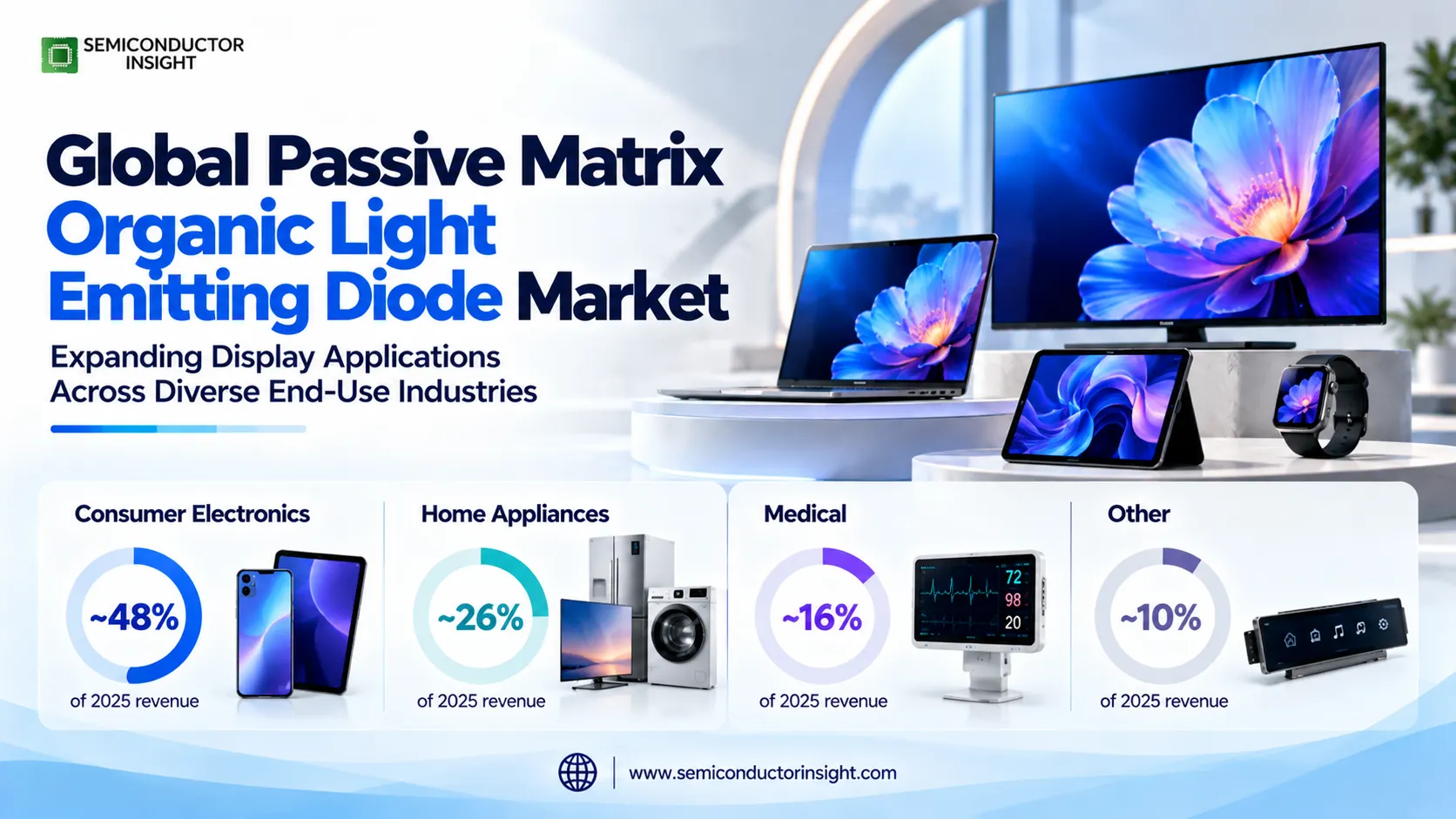
By application, the publisher identifies Consumer Electronics, Home Appliances, Medical and Other. Consumer Electronics leads at an estimated ~48% of 2025 revenue, with Home Appliances contributing ~26%, Medical ~16% and Other ~10%. These modeled allocations represent display-panel and module demand rather than the retail value of the equipment in which the screens are installed.
| Application | Demand characteristics |
|---|---|
| Consumer Electronics | Largest application, estimated ~48% share. Compact audio products, wearable accessories, charging interfaces and handheld controllers benefit from an emissive screen that can remain dark outside a small information area. Futaba describes film OLED displays for smart remotes and curved wearable surfaces. OEM procurement is driven by thickness, user-interface visibility, battery constraints and the ability to customize the flex cable without redesigning the enclosure. |
| Home Appliances | Estimated ~26% share. Coffee machines, air-treatment equipment, cooking controls and connected home panels use compact OLED readouts for timers, set points and short menus. Designers can remove a separate LED backlight and obtain crisp white-on-black labels, but the selected panel must survive repeated temperature changes, cleaning agents and long product-support periods. Cost competition with segment LCDs remains particularly intense in value-oriented appliance ranges. |
| Medical | Estimated ~16% share. Thermometers, monitoring instruments, diagnostic peripherals and portable treatment controllers require small screens with clear symbols and reliable viewing angles. Futaba documents a thermometer use case, while Winstar markets touch-equipped graphic OLED modules for instrument panels. Medical qualification favors stable firmware interfaces, traceable supply changes and optical consistency over frequent cosmetic upgrades, supporting longer customer relationships for approved suppliers. |
| Other | Estimated ~10% share. Industrial gauges, test equipment, point-of-sale peripherals, access systems and specialist vehicle controls form a fragmented set of low-volume designs. The display is frequently integrated into a larger sealed module and purchased through distributors or custom engineering channels. Its commercial value is often associated with qualification effort, extended availability and rugged packaging rather than the raw panel area. |
Application growth differs because the cost of redesign is not the same across end products. A consumer accessory can adopt a new panel during its next annual refresh, but a clinical instrument or industrial controller may remain qualified around the same connector and driver for a decade. Consequently, a supplier with a reliable catalogue and replacement policy can retain an installed customer even while faster-growing consumer categories account for a greater share of new programme launches.
The allocation does not include AMOLED phone screens merely because they are OLED devices, and it does not count driver-chip sales a second time. A display module incorporated into a medical monitor is classified by the monitor application, while its panel colour is classified separately under the Type axis. The two axes describe the same total revenue from different angles and should not be added together.
Regional Analysis
Asia-Pacific is the largest regional PMOLED market, with an estimated ~46% of 2025 revenue and ~11.3% annual growth in the modeled regional trajectory. North America accounts for ~24%, Europe ~18%, South America ~7%, and the Middle East and Africa ~5%. The percentages represent a geographic allocation of the publisher-defined global market, not reported regional sales from the manufacturers cited below.
Where do PMOLED modules find their strongest regional demand?
Production location and customer location are not the same. Taiwan and China provide important panel-glass and module-assembly capacity, Japan contributes specialty film and industrial display engineering, and buyers in North America and Europe often purchase the same modules through distributors or equipment integrators. Regional shares therefore combine a modeled demand view with manufacturer and application evidence rather than equating a factory address with all the sales attributed to that geography.
The regional growth outlook is differentiated by the pace of connected-device adoption, the installed base of industrial equipment and the ability of OEMs to qualify alternative technologies. Asia-Pacific benefits from dense supplier networks and appliance manufacturing; North America has a high share of specification-led healthcare and instrumentation demand; Europe emphasizes industrial qualification and extended support; emerging regions tend to import integrated control assemblies. The five regional trajectories are reconciled to the global forecast rather than extrapolated independently.
| Region | Position | Growth outlook | Demand profile | What decides supplier selection |
|---|---|---|---|---|
| Asia-Pacific | Largest (~46%) | Above average (~11.3% CAGR) | Panel manufacturing and OEM integration | Glass fabrication, custom modules and domestic sourcing |
| North America | Second (~24%) | Moderate (~8.2% CAGR) | Medical and industrial equipment | Compliance documentation and long support |
| Europe | Third (~18%) | Steady (~9.3% CAGR) | Instrumentation and appliance controls | Environmental qualification and distributor stock |
| South America | Fourth (~7%) | Near average (~10.8% CAGR) | Imported appliance and device assemblies | Landed cost, repairability and availability |
| Middle East & Africa | Smallest (~5%) | Moderate (~8.8% CAGR) | Equipment integration and service | Temperature resilience and channel access |
PMOLED Display Manufacturers and Competitive Landscape
Competition in passive-matrix OLED modules is shaped by a network of panel makers, assembly specialists and controller suppliers rather than by the smartphone OLED leaders alone. Winstar, WiseChip, Raystar, Futaba and Truly provide relevant finished-display product evidence, while Solomon Systech participates primarily as an upstream driver-IC supplier. Product breadth and engineering support matter more than unsupported claims of global revenue leadership.
Catalogue depth is a competitive advantage because an OEM can often adapt an existing panel rather than fund a completely new mask and electronics programme. Winstar offers graphic, character, transparent and touch-integrated OLED products; Futaba supports standard and semi-custom glass or film configurations; WiseChip supplies mini and transparent displays; and Raystar emphasizes low-minimum-order module projects. These offerings serve different customers, and the presence of a product in a catalogue does not establish its sales volume.
The value chain separates companies that manufacture OLED glass from firms that assemble and customize modules. Raystar describes its own glass lines in Taiwan and module operations in China, giving it a different manufacturing profile from a reseller that sources completed panels. Engineering services such as optical bonding, flex routing, controller firmware support and protective-cover integration can create customer stickiness even when a basic monochrome panel is available from several competing vendors.
Controller availability also affects supplier choice. Solomon Systech reports an established PMOLED driver-IC business and in August 2026 described demand linked to drones and action cameras, but its IC shipments cannot be equated with finished PMOLED panel sales. A display manufacturer must qualify the controller, panel duty cycle and electrical interface together; a change in controller supply can trigger firmware work even when the visible display dimensions remain unchanged.
Large active-matrix display groups are an important competitive force but not necessarily direct PMOLED panel suppliers. Tianma showcased automotive OLED and other high-resolution technologies at CES 2025, illustrating how richer user interfaces can move to active-matrix formats. The commercial boundary is therefore technology-specific: AMOLED investment is relevant as competitive context, not as evidence that all OLED panel revenue belongs to the passive-matrix market.
Tier structure
| Tier | Companies | Basis of competition |
|---|---|---|
| Specialist PMOLED module suppliers | Winstar Display, WiseChip Semiconductor, Raystar Optronics, Futaba Corporation, Truly Semiconductors | Established catalogues of small OLED displays, customized mechanical formats, OEM application engineering and product support for embedded interfaces. Qualification and long-term availability influence purchase decisions. |
| Adjacent display and integration participants | Tianma, Visionox, industrial display distributors and equipment integrators | Active-matrix OLED or broader display technologies that compete for some small-screen designs, together with firms that incorporate purchased PMOLED modules into finished products. Their total display sales are not PMOLED market shares. |
| Upstream component ecosystem | Solomon Systech and display controller, substrate, flex and encapsulation suppliers | Driver integrated circuits, electrical interfaces, glass and barrier materials determine reliability and production cost. These suppliers influence panel economics without necessarily selling finished passive-matrix modules. |
Key companies profiled
- Winstar Display (Taiwan)
- WiseChip Semiconductor (Taiwan)
- Raystar Optronics (Taiwan)
- Futaba Corporation (Japan)
- Truly Semiconductors (China)
- Solomon Systech (Hong Kong; driver IC supplier)
- Tianma (China; adjacent display technologies)
- Visionox (China; adjacent AMOLED technologies)
PMOLED Production Capacity and Manufacturing Structure
PMOLED production relies on organic-layer deposition, patterned electrodes, glass or film handling, moisture-barrier encapsulation and final module assembly. Unlike high-volume AMOLED lines for smartphones, many small passive-matrix programmes compete on flexible production scheduling and the ability to supply modest quantities of custom panel shapes. Manufacturing location is relevant to lead times but cannot by itself establish market revenue shares.
Raystar identifies OLED glass fabrication in Central Taiwan Science Park and complementary module-assembly operations in China. This arrangement illustrates the separation between the fabrication of the emitting panel and the later addition of driver circuitry, flexible printed circuits and mechanical features. For small industrial orders, the ability to combine standardized glass formats with customized downstream assembly can reduce the need for an entirely new display design.
Organic light-emitting stacks require controlled handling and effective encapsulation because oxygen and moisture can degrade emissive performance. Uniformity becomes difficult when an unusual panel shape, high peak current or extended operating-temperature requirement is introduced. Manufacturers therefore balance tooling flexibility with process yield, inspection effort and the cost of maintaining spare inventory for customers that may reorder the same module years after launch.
Capacity comparisons should not be drawn from broad OLED factory announcements without identifying the backplane technology. A new large-generation AMOLED line is designed around different deposition, lithography and thin-film-transistor processes from a small PMOLED glass line. It may intensify competition for suppliers and engineering talent, but it does not automatically add interchangeable passive-matrix panel capacity. The market outlook consequently emphasizes specialty manufacturing continuity rather than an unsupported count of global PMOLED production lines.
Passive Matrix OLED Market Dynamics: Drivers, Restraints and Opportunities
Demand is supported by compact connected devices, appliance controls, portable medical instruments and the replacement of qualified embedded interfaces. Technical limits on multiplexed row drive, pressure from LCD and AMOLED substitutes, and moisture-sensitive manufacturing temper the opportunity. The impact allocations below are modeled percentage-point contributions to the headline compound growth rate, not independently reported company forecasts.
MARKET DRIVERS
Drivers Impact Analysis*
| Market Drivers | Impact Rank | CAGR Contribution (%) | 2026–2028 | 2029–2031 | 2032–2034 |
|---|---|---|---|---|---|
| Compact consumer-device interfaces | High | +5.00% | High | High | Medium |
| Smart home and appliance controls | High | +3.60% | High | High | High |
| Portable medical and diagnostic displays | Medium-High | +2.50% | Medium | High | High |
| Long-life industrial replacement demand | Medium | +1.80% | High | Medium | Medium |
| Thin-film and touch-integrated module designs | Low-Medium | +1.20% | Medium | High | High |
| Others (custom graphics, connected sensors and distributor reach) | Low | +0.80% | Low | Medium | Medium |
Compact interfaces remain commercially useful
Many connected accessories need only a small window for battery state, a numeric reading or a short instruction. An OLED can keep most pixels dark while presenting a high-contrast symbol, avoiding the backlight hardware of a conventional LCD. The opportunity is not to replace a smartphone display; it is to serve small embedded surfaces where a few rows of information are sufficient and where the product designer values a thin, readable module.
Home appliances add more informative controls
Appliance makers increasingly offer programmable cycles, connected status information and maintenance prompts on equipment that formerly used indicator lamps alone. A PMOLED provides a compact graphic interface without the complexity of a large active-matrix panel. The strongest opportunity is in premium models where interface differentiation justifies a higher component cost, while basic appliances still favor inexpensive segmented LCDs or simple LEDs.
Medical devices require dependable visual feedback
Thermometers, portable monitors and diagnostic accessories rely on clear readouts that can be interpreted quickly under varied lighting conditions. Futaba documents an OLED thermometer application, and suppliers offer touch-capable graphic modules for instrument makers. Regulatory requirements are imposed on the complete medical device, not automatically satisfied by the panel, so successful vendors support stable documentation, component change control and long product availability.
Installed industrial equipment sustains replenishment
An industrial control board may remain in service long after the display technology ceases to be fashionable. Replacing a failed module with a matching electrical interface can be far cheaper than redesigning the controller and enclosure. This creates a continuing aftermarket for known panel formats, although annual order quantities may be irregular and manufacturers must plan inventory carefully to avoid excessive stocks of low-volume variants.
Integration options improve design flexibility
Film-based OLEDs, custom flex cables and integrated touch surfaces allow a display to fit equipment that has little room for a separate backlight or mechanical keypad. Futaba publishes ultra-thin film specifications and Winstar offers touch-equipped graphic modules. These capabilities can increase the value of a finished module beyond the bare panel, provided the customer has a suitable use case and accepts the additional qualification effort.
MARKET RESTRAINTS
Restraints Impact Analysis*
| Market Restraints | Impact Rank | CAGR Contribution (%) | 2026–2028 | 2029–2031 | 2032–2034 |
|---|---|---|---|---|---|
| AMOLED and low-cost LCD substitution | High | -1.90% | High | High | High |
| Passive duty-cycle and brightness limits | Medium-High | -1.40% | Medium | High | High |
| Encapsulation yield and lifetime risk | Medium | -0.90% | High | Medium | Medium |
| Others (controller availability, procurement delays and price pressure) | Low | -0.60% | Medium | Medium | Low |
Alternative screens limit pricing power
A small OLED must compete against inexpensive monochrome LCDs for basic numeric interfaces and against TFT or AMOLED panels when richer graphics are required. LCD technology can offer low cost and established sourcing, while active-matrix displays can support more pixels without the same row-scanning penalty. This leaves PMOLED suppliers strongest in carefully defined niches rather than in every new display design.
Multiplexing constrains large pixel matrices
In passive addressing, a pixel emits during the portion of the frame when its row is selected. As the number of rows rises, the required peak current and brightness management become harder, especially for colour imagery. A product that needs high resolution, fast video or prolonged full-screen brightness can move beyond the economic and electrical strengths of PMOLED, reducing the addressable design space.
Organic materials demand reliable sealing
Moisture ingress, thermal exposure and sustained high-current operation can degrade an OLED module before the host equipment reaches the end of its useful life. Manufacturers must control barrier quality, inspect pixels and verify performance over relevant temperature and humidity conditions. These steps add cost, and an unexpected material change may require an OEM to repeat a lengthy qualification process.
Supply continuity is a commercial constraint
Some embedded products require a particular controller command set and connector geometry for many years, even when annual demand is small. A panel discontinuation or driver shortage can force redesign of the host electronics. Buyers may therefore prefer suppliers with transparent end-of-life notices and alternative-part guidance, while small manufacturers face the cost of maintaining specialized tooling and slow-moving inventory.
MARKET OPPORTUNITIES
Medical and laboratory instrument upgrades
A supplier that provides stable small-screen interfaces and documented operating characteristics can win projects in handheld diagnostic devices, laboratory meters and patient-care peripherals. The opportunity is strongest where the display improves readability without imposing a substantial power or enclosure penalty. The manufacturer must nevertheless avoid presenting component qualification as equivalent to approval of the finished medical product.
Transparent and mini OLED modules
WiseChip lists transparent and high-brightness mini OLED products, indicating demand for unusual optical formats. Such designs can serve status overlays, compact wearable interfaces and specialized instruments, although not every near-eye display uses passive addressing. Suppliers that can verify optical performance and integrate a suitable controller may capture higher engineering value than sellers of standard rectangular monochrome modules.
Custom mechanical integration for industrial OEMs
Industrial designers frequently need an uncommon flex length, protective window or display aspect ratio that a commodity panel cannot supply. Futaba describes semi-custom options for flex cables, emitting colours, touch and covers, while Raystar emphasizes low-volume flexibility. These services support margin through design support and reduce the risk that a customer will switch suppliers for a small unit-price saving.
Regional distribution and replacement services
Many buyers purchase small OLED modules in quantities too low for direct factory contracts. Distributors that maintain accurate technical files, compatible replacement stock and application support can extend a specialist manufacturer’s reach. The opportunity is especially relevant in imported-equipment markets where customs costs and long shipping times make local stock more valuable than the lowest nominal factory quotation.
PMOLED Supply Chain, Components and Integration
The passive-matrix OLED value chain connects organic emitters and glass or film substrates with electrode patterning, encapsulation, driver integration and final module assembly. Procurement risk often arises at the interface between the display and its controller, while the downstream customer values a complete, qualified module rather than an isolated emitting panel.
Materials. Organic emitters and barrier materials determine the optical and environmental performance of a PMOLED before the module reaches the assembly stage. Film substrates can reduce thickness and permit curved installation, but they introduce different handling and sealing considerations from rigid glass. Materials selection affects yield, usable lifetime and the scope for custom shapes, so suppliers must document changes that could alter a customer’s established qualification.
Controller electronics. A driver integrated circuit translates the host system’s commands into row and column signals, setting the display duty cycle and refresh behavior. Solomon Systech supplies PMOLED driver ICs and reports demand for transparent PMOLED applications, but its semiconductor revenue is distinct from the value of a finished display module. Compatibility across generations is commercially important because firmware redesign can outweigh the price of the screen.
Assembly and channels. Final integration may include chip-on-glass mounting, a flexible cable, a protective cover or capacitive touch. A manufacturer can customize these features around a standard panel, while distributors provide small-lot stock and local engineering support. The result is a supply chain in which the same basic display technology reaches very different applications through direct OEM contracts, contract manufacturers and regional component resellers.
Recent Developments in PMOLED Displays and Competing Technologies
- 09 Jan 2025 Adjacent display competition
Tianma detailed its CES 2025 automotive display portfolio, including curved OLED configurations and other high-resolution cockpit technologies. The announcement is evidence of the alternatives available to equipment designers, not a PMOLED panel sales disclosure. Its significance for the passive-matrix niche is that sophisticated, video-oriented interfaces increasingly use active-matrix architectures, leaving compact status and instrument readouts as more defensible PMOLED applications. Source - 05 Mar 2026 Supplier exhibition
Winstar announced participation in Embedded World 2026 in Nuremberg, scheduled for 10–12 March, with displays for industrial, medical and smart embedded systems. Its showcase included OLED alongside TFT, e-paper and development boards, illustrating the multi-technology choice facing OEM engineers. The announcement demonstrates product marketing and access to European design teams; it does not quantify orders or market share for PMOLED modules. Source - 16 Mar 2026 Product demonstration
Winstar published an Embedded World 2026 demonstration video covering compact OLED products and display integration for embedded equipment. The material provides visual product evidence for module form factors and practical use cases rather than a measured change in industry revenue. For component buyers, the relevance is the ability to inspect a supplier’s physical designs before committing to controller compatibility tests and enclosure engineering. Source - 19 Mar 2026 Driver IC results
Solomon Systech released its 2025 annual results, reporting approximately 342 million display-IC units shipped across its business and US$93.3 million in company revenue. The figures cover multiple integrated-circuit product categories and must not be used as the value of PMOLED panel shipments. The company’s discussion of OLED driver development nevertheless provides evidence of an active upstream controller ecosystem serving embedded display manufacturers. Source - 21 Aug 2026 Transparent PMOLED support
Solomon Systech reported first-half 2026 results and discussed growth in OLED display IC activity associated with drone and action-camera programmes, together with promotion of transparent PMOLED drivers. It disclosed approximately 153.7 million IC units shipped across its business in the first half, not a count of PMOLED panels. The development matters because controller support can enable new display formats while wafer costs remain a constraint. Source
REPORT SCOPE & SEGMENTATION
| Attribute | Details |
|---|---|
| Report Title | Global Passive Matrix Organic Light Emitting Diode Market Size, Share and Industry Analysis |
| Base Year | 2025 |
| Estimate Year | 2026 |
| Forecast Period | 2026–2034 |
| Base Market Value | USD 7,155.62 million |
| Estimated Market Value | USD 7,878.34 million |
| Forecast Market Value | USD 17,011.14 million |
| CAGR | 10.1% |
| Currency and Boundary | USD million; finished passive-matrix OLED panels and integrated display modules, excluding AMOLED and separately sold driver ICs |
| By Type | Monochrome; Full-Color |
| By Application | Consumer Electronics; Home Appliances; Medical; Other |
| By Region | Geographic shares are modeled 2025 demand allocations, reconciled to 100% across the five regions; they are not direct company disclosures. North AmericaUnited States, Canada, Mexico EuropeGermany, France, United Kingdom, Italy, Nordic countries, Rest of Europe Asia-PacificChina, Taiwan, Japan, South Korea, India, Southeast Asia, Rest of Asia-Pacific South AmericaBrazil, Argentina, Chile, Colombia, Rest of South America Middle East & AfricaSaudi Arabia, UAE, South Africa, Egypt, Morocco, Rest of region |
| Key Companies Profiled | Winstar Display, WiseChip Semiconductor, Raystar Optronics, Futaba Corporation, Truly Semiconductors, Solomon Systech (driver ICs), Tianma (adjacent display technology), Visionox (adjacent AMOLED) |
| Customization Scope | Country-level demand estimates, additional product and end-use splits, OEM procurement analysis, supplier qualification and customized module specifications may be scoped separately. |
Frequently Asked Questions
How large is the global PMOLED market in 2025?
The publisher-defined global passive-matrix OLED panel and module market is valued at USD 7,155.62 million in 2025, with a 2026 estimate of USD 7,878.34 million and a 2034 projection of USD 17,011.14 million. The implied annual compound rate is 10.1%. These values cover finished PMOLED display products rather than all organic light-emitting displays, and should not be combined with revenue from separately sold driver chips.
What distinguishes a PMOLED from an AMOLED screen?
A PMOLED selects intersecting rows and columns sequentially without assigning an individual thin-film transistor to every pixel, while AMOLED uses an active backplane for pixel-level control. Passive addressing can simplify compact displays that show text and symbols, but higher row counts create peak-current and duty-cycle challenges. AMOLED is therefore usually more suitable for large, dense or video-oriented screens, while PMOLED retains value in simpler embedded interfaces.
Which PMOLED type has the largest market share?
Monochrome is the largest type with an estimated ~68% share of 2025 revenue, reflecting widespread use in meters, appliances, instruments and small electronic accessories. Full-colour passive-matrix products represent a smaller specialty segment because they require additional control of subpixel brightness and colour balance. The percentages are analyst-modeled allocations supported by manufacturer product catalogues, not disclosed worldwide shipments by individual suppliers.
Which end-use category drives PMOLED purchases?
Consumer electronics is the largest modeled application at ~48% of the base-year market, followed by home appliances, medical devices and other embedded systems. A PMOLED may provide a compact information window on an audio accessory or handheld controller, whereas appliance demand comes from menus and status displays. The categories refer to the host device and do not include the retail value of that finished equipment.
Why does Asia-Pacific lead PMOLED manufacturing and demand?
Asia-Pacific accounts for an estimated ~46% of global demand in 2025, supported by the proximity of Taiwanese panel specialists, Japanese OLED engineering and Chinese electronics assembly. Taiwanese manufacturers combine specialty OLED glass processing with downstream module operations; Japan adds thin-film engineering and customized panel formats. The regional share is modeled from these industry structures and end-use patterns; manufacturer factory locations are not treated as direct sales totals.
Can PMOLED displays be used in medical instruments?
Yes. Compact emissive readouts can support thermometers, portable monitors, laboratory meters and other instruments where clarity and enclosure space matter. Futaba documents thermometer applications, and Winstar offers graphic modules with touch integration. The panel supplier must still provide appropriate environmental and electrical information, while the medical-device manufacturer remains responsible for validating and certifying the complete finished product.
What limits growth in passive-matrix OLED technology?
The main technical limit is the sequential scanning duty cycle, which becomes harder to manage as resolution and brightness requirements increase. Organic materials also require effective sealing against moisture, and long-lived industrial products need stable driver availability. Commercially, low-cost LCD modules compete for basic readouts, while AMOLED and TFT options win designs requiring more elaborate graphics. These pressures limit pricing even when device adoption expands.
Are flexible and transparent OLED modules part of this market?
They are included when the underlying panel is a passive-matrix OLED sold as a finished display or integrated module. Film substrates and transparent designs can suit curved housings or see-through information windows, but the technology must be identified at product level. A flexible AMOLED phone screen or a separate controller IC does not qualify simply because it is related to OLED technology; the revenue boundary follows the panel architecture and sold product.
What do buyers evaluate when selecting a PMOLED supplier?
Engineers typically compare pixel format, diagonal size, brightness, drive interface, operating-temperature range, moisture protection, flex-cable layout and the supplier’s replacement policy. Custom covers or touch surfaces may reduce mechanical assembly work, but each option adds qualification requirements. For long-lived equipment, the cost of redesigning firmware or a housing after a panel discontinuation can exceed the saving from switching to a cheaper display.
What is covered by the 2026–2034 market outlook?
The outlook follows the 2025 base and 2026 estimate through a 2034 forecast for finished passive-matrix OLED panels and modules. It examines Monochrome and Full-Color types, Consumer Electronics, Home Appliances, Medical and Other applications, and five geographic regions. Regional and segment shares are modeled allocations that reconcile to the global total; supplier announcements and adjacent display investments are treated as context, not as independent market-size measurements.
Research Sources & Evidence Base

Get Sample Report PDF for Exclusive Insights
Report Sample Includes
- Table of Contents
- List of Tables & Figures
- Charts, Research Methodology, and more...
 Download Sample Report PDF