OLED Lighting Panels Market Insights
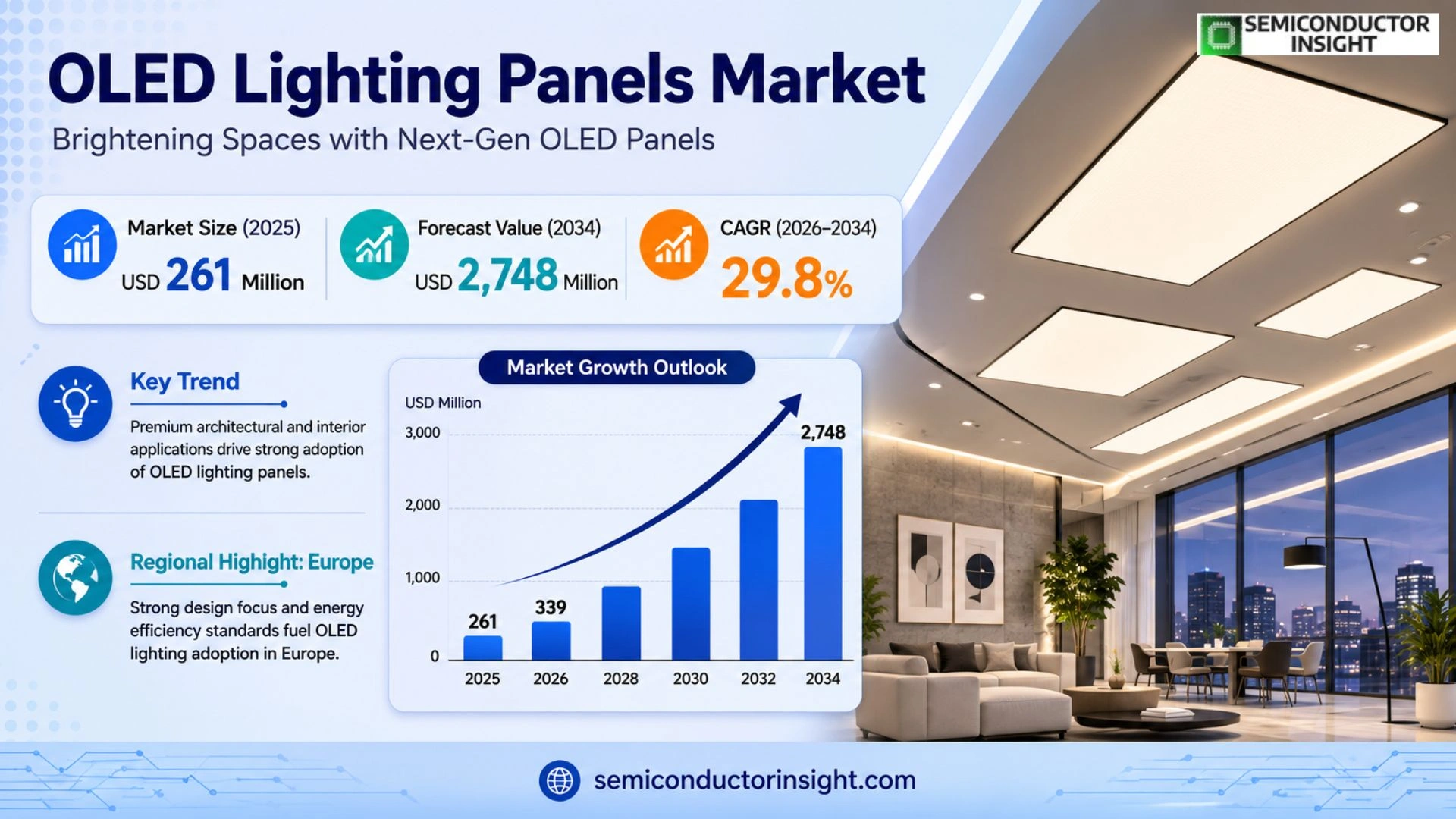
OLED Lighting Panels market size was valued at USD 261 million in 2025. The market is projected to grow from USD 339 million in 2026 to USD 2,748 million by 2034, exhibiting a CAGR of 29.8% during the forecast period.
OLED lighting panels are area‑emitting sources built on organic semiconductor stacks that typically consist of a substrate (glass or flexible film), a transparent anode such as ITO, charge‑transport layers, an emissive layer composed of small‑molecule or polymer emitters, a metal cathode and an encapsulation/barrier system that shields moisture‑sensitive organics. When electrically powered they deliver uniform illumination across large surfaces, offering ultra‑thin form factors, low glare and design flexibility,including rigid, flexible or semi‑transparent formats,making them suitable for surface‑integrated architectural lighting and premium automotive interiors.
MARKET DRIVERS
Energy‑Efficiency Gains
OLED Lighting Panels Market benefits from the inherent low‑power draw of organic emitters. Compared with conventional sources, OLED panels convert a higher proportion of electricity into usable light, reducing operating expenses for commercial and residential users. Clients that prioritize sustainability are therefore migrating toward this technology to meet corporate ESG targets while curbing utility bills.
Design Flexibility and Premium Aesthetics
Because OLED sheets can be fabricated as ultra‑thin, bendable surfaces, designers are integrating them into installations that were previously impossible with rigid lighting solutions. The result is a surge in demand from high‑end retail spaces, hospitality venues, and cultural institutions that seek a seamless, glare‑free ambience. Architectural firms now list OLED lighting as a differentiator in tender proposals, driving project‑level spend.
➤ “The shift from point‑source fixtures to diffuse OLED panels is reshaping interior lighting budgets across premium segments.”
Collectively, these forces are accelerating the adoption curve for OLED Lighting Panels Market, compelling manufacturers to expand capacity and invest in next‑generation organic materials.
MARKET CHALLENGES
High Production Costs
Manufacturing OLED panels involves vacuum deposition and encapsulation steps that remain capital‑intensive. The cost structure translates into retail prices that exceed those of mature LED alternatives, limiting price‑sensitive buyers from switching. Cost‑averse segments such as large‑scale public lighting projects therefore adopt OLEDs at a slower pace.
Other Challenges
Supply Chain Constraints
The organic semiconductors and high‑purity barrier films required for OLED panels are sourced from a narrow pool of suppliers. Recent disruptions in raw‑material logistics have tightened lead times, creating uncertainty for OEMs that rely on just‑in‑time inventory practices.
MARKET RESTRAINTS
Limited Operational Lifespan Compared with LEDs
Organic emitters degrade more rapidly under continuous high‑temperature operation, resulting in a shorter useful life than conventional LED arrays. This degradation manifests as reduced brightness and color shift, compelling end‑users to factor replacement cycles into total cost of ownership calculations.
Furthermore, the performance drop in humid environments necessitates robust encapsulation, which adds material cost and complexity. These technical constraints restrain broader acceptance, especially in industrial settings where uptime is critical.
MARKET OPPORTUNITIES
Expansion in Automotive Interior Lighting
Automakers are exploring OLED Lighting Panels Market to create uniform, glare‑free ambient lighting that can be integrated into curved dashboards and door panels. The technology aligns with the premium‑cab‑interior trend, offering designers a tool to personalize cabin ambience without adding bulky fixtures. Early adopters report enhanced perceived quality, opening a lucrative niche for panel suppliers.
Similarly, the convergence of IoT and smart‑home ecosystems presents an opening for OLED panels equipped with dynamic color‑changing capabilities. By embedding wireless control modules, manufacturers can target residential consumers who seek both energy savings and experiential lighting, thereby expanding the addressable market base.
OLED Lighting Panels Market Trends
Premium Architectural Adoption Accelerates
OLED Lighting Panels Market is witnessing a notable shift toward high‑end architectural projects where design flexibility outweighs cost considerations. In 2025, manufacturers delivered roughly 180,000 sq m of panels at an average price of US$ 1,600 per square meter, highlighting that premium customers are willing to pay a premium for ultra‑thin, glare‑free luminance. Architects favor the seamless surface‑integrated appearance and the ability to shape or partially transparent panels, creating ambient environments that conventional LEDs cannot replicate. This preference is reshaping the revenue mix: rigid panels, which hold a 70 % share of production, dominate because they meet the structural stability demanded by large‑scale installations. Traditional lighting applications remain the bulk of deployments, but automotive ambient lighting is emerging as a secondary focus, leveraging the low‑glare comfort that premium vehicle cabins require.
Other Trends
Supply Chain Evolution
The upstream ecosystem is consolidating around a handful of material specialists and equipment providers. Companies such as Universal Display Corp., Merck, and Sumitomo Chemical supply emissive layers, while AGC and Corning dominate substrate production. Equipment manufacturers like Canon Tokki and AIXTRON are introducing hybrid deposition tools that blend vacuum evaporation with ink‑jet printing, a move aimed at reducing the cost barrier associated with large‑area yield. Although the market still grapples with barrier‑film reliability, incremental improvements in thin‑film encapsulation are extending operational lifetimes, enabling OEMs to justify the higher upfront investment for design‑centric projects.
Integration with Smart Lighting Systems
A second trend gaining traction is the coupling of OLED panels with intelligent lighting controls. Because OLEDs emit uniform area light, they lend themselves to dimming schemes that prioritize visual comfort and energy efficiency without the hotspot issues typical of point LEDs. Early deployments in smart office spaces and hospitality venues demonstrate that integrated driver electronics can deliver seamless luminance adjustments while preserving the panel’s thin profile. This synergy is prompting system integrators to bundle OLED modules with occupancy sensors and networked controls, turning the panels into a component of broader building‑automation strategies rather than isolated fixtures.
COMPETITIVE LANDSCAPE
Key Industry Players
OLED Lighting Panels Market: Competitive Overview
OLED lighting arena is still top‑heavy, with LG Display commanding the lion’s share of volume through its high‑capacity thin‑film production line and deep integration with major architectural OEMs. Its strategy of pairing rigid‑panel technology with a portfolio of design‑focused luminaire partners has entrenched it as the de‑facto supplier for flagship retail and premium hospitality projects. OLEDWorks, operating a vertically integrated model that spans material sourcing to end‑product integration, remains the second‑largest contender, leveraging a flexible‑panel platform that appeals to automotive interior designers seeking curved or semi‑transparent solutions. Both firms benefit from early‑stage cost advantages derived from proprietary encapsulation processes, allowing them to price above conventional LEDs while still delivering a differentiated aesthetic.
Beyond the dominant duo, a cadre of specialized players adds depth to the supply chain. Sumitomo Chem and Lumiotec supply high‑performance organic emitters and barrier films that underpin the reliability of large‑area panels, while Kaneka and First‑O‑Lite focus on niche flexible‑panel applications for aviation and specialty transport. European outfits such as Konica and NEC Lighting have carved out market niches by bundling OLED modules with smart‑control electronics, targeting office‑building retrofits that value glare‑free illumination. German‑based Osram and UK‑based Solomon Systech provide driver‑ICs and integration services that enable system‑level offerings. Material innovators like Universal Display and Novaled sustain the ecosystem by delivering phosphorescent dopants that boost efficiency, ensuring that panel manufacturers can meet the demanding luminance levels required by high‑end architectural clients.
List of Key OLED Lighting Panels Companies Profiled
- LG Display
- OLEDWorks
- Sumitomo Chemical
- Lumiotec
- Kaneka
- First‑O‑Lite
- Konica
- NEC Lighting
- Osram
- Solomon Systech
- Universal Display
- Novaled
- 3M
- Canon Tokki
- Applied Materials
Segment Analysis:
| Segment Category | Sub-Segments | Key Insights |
| By Type |
|
Rigid Panel dominates because it offers a proven manufacturing pathway and superior barrier integrity. • Provides ultra‑thin form factor that integrates seamlessly into ceiling and façade systems. • Delivers consistent luminance and low glare, meeting premium architectural design criteria. • Supports larger area sizes while maintaining reliability, reinforcing its appeal for high‑end projects. |
| By Application |
|
Traditional Lighting is the primary application where OLED panels showcase their design‑centric strengths. • Enables surface‑integrated fixtures that eliminate visible housings, creating seamless visual experiences. • Offers uniform, glare‑free illumination that enhances visual comfort in offices, museums, and premium retail spaces. • Aligns with increasing demand for sustainable, low‑maintenance lighting solutions in architectural projects. |
| By End User |
|
Premium Residential leverages OLED panels for experiential lighting that reinforces brand‑level ambience. • Designers exploit the ability to shape panels into curved or semi‑transparent surfaces, creating bespoke lighting art. • Low‑glare output supports relaxed living environments while preserving aesthetic elegance. • Integration with smart home ecosystems is emerging, allowing dynamic mood‑setting without compromising panel thinness. |
| By Technology Architecture |
|
Top Emission is preferred in most premium installations because it simplifies integration with ceiling and façade architectures. • Eliminates the need for additional reflective layers, reducing overall system thickness. • Provides consistent upward light distribution ideal for decorative wash lighting. • Aligns with the market’s focus on minimal visual clutter and high aesthetic fidelity. |
| By Market Positioning |
|
Integrated Driver Systems are emerging as the preferred approach for scalable deployment. • Consolidates power management and dimming within the panel, simplifying installation and reducing auxiliary components. • Enhances reliability by minimizing inter‑connect points, a critical factor for premium projects. • Facilitates seamless integration with building management and IoT platforms, supporting future‑proof smart lighting strategies. |
Regional Analysis: OLED Lighting Panels Market
Europe
Luxury hotels and flagship retail outlets across major European cities are specifying OLED panels to replace traditional luminaires, valuing the seamless glare‑free output that complements minimalist interiors. Designers cite the ability to create continuous light planes without visible fixtures, a factor that drives specification cycles toward OLED solutions.
EU directives on energy performance and material recyclability have tightened, nudging manufacturers toward low‑power OLED emitters that meet the latest standards. Compliance incentives accelerate product qualification processes, making OLED panels an attractive alternative to conventional LED arrays.
Several European venture funds have backed startups that produce organic electroluminescent layers domestically, reducing reliance on Asian substrates. This shift shortens lead times and aligns with the continent’s push for resilient, locally sourced manufacturing ecosystems.
Collaborative research hubs in the Netherlands and France are experimenting with curved and transparent OLED panels, expanding form‑factor possibilities beyond flat sheets. These efforts generate intellectual property that strengthens Europe’s position as an innovation leader in OLED Lighting Panels Market.
North America
In the United States and Canada, commercial real‑estate developers are exploring OLED panels for modern office campuses that demand high design flexibility. The market benefits from strong venture capital activity around thin‑film organic emitters, fostering a pipeline of next‑generation products. Corporate sustainability pledges also encourage the shift toward low‑heat, energy‑savvy lighting, reinforcing demand among tech‑focused tenants who seek both aesthetic appeal and operational efficiency.
Asia‑Pacific
The Asia‑Pacific region leverages its extensive electronics manufacturing base to produce OLED substrates at scale, but adoption remains uneven. While Japan’s design‑intensive sectors and South Korea’s high‑tech showrooms integrate OLED panels for brand differentiation, many emerging economies prioritize cost‑effective LED solutions. Nevertheless, growing consumer awareness of flexible lighting concepts hints at a gradual upswing as price points improve.
South America
Brazil and Argentina are witnessing modest interest in OLED lighting within premium hospitality projects, where architects value the technology’s slim profile for boutique hotels. Limited local production capacity means most panels are imported, creating price sensitivity that confines wider market penetration. However, regional trade agreements are easing tariff barriers, allowing niche distributors to introduce OLED options to upscale retailers.
Middle East & Africa
In the Gulf Cooperation Council, luxury residential developments and iconic public spaces are turning to OLED lighting to convey a high‑tech image while meeting stringent daylight‑simulation goals. African markets, still early in the adoption curve, are observing these flagship projects and beginning to consider OLED panels for flagship commercial venues, recognizing the technology’s potential to differentiate premium venues from conventional offerings.
Report Scope
This market research report provides a comprehensive analysis of the OLED Lighting Panels Market , covering the forecast period 2026–2034. It offers detailed insights into market dynamics, technological advancements, competitive landscape, and key trends shaping the industry.
Key focus areas of the report include:
- Market Overview: The report begins with an overview outlining its current market scenario, key growth indicators, and industry transformation drivers. It discusses macroeconomic factors, demand–supply balance, regulatory landscape, and the strategic role of semiconductors in powering advancements across industries such as automotive, telecommunications, consumer electronics, and industrial automation.
- Market Size & Forecast: Historical data and future projections for revenue, unit shipments, and market value across major regions and segments.
- Segmentation Analysis: Detailed breakdown by product type, technology, application, and end-user industry to identify high-growth segments and investment opportunities.
- Regional Insights: Insights into market performance across North America, Europe, Asia-Pacific, Latin America, and the Middle East & Africa, including country-level analysis where relevant.
- Competitive Landscape: Profiles of leading market participants, including their product offerings, R&D focus, manufacturing capacity, pricing strategies, and recent developments such as mergers, acquisitions, and partnerships.
- Technology Trends & Innovation: Assessment of emerging technologies, integration of AI/IoT, semiconductor design trends, fabrication techniques, and evolving industry standards.
- Market Drivers & Restraints: Evaluation of factors driving market growth along with challenges, supply chain constraints, regulatory issues, and market-entry barriers.
- Stakeholder Insights: Insights for component suppliers, OEMs, system integrators, investors, and policymakers regarding the evolving ecosystem and strategic opportunities.
Primary and secondary research methods are employed, including interviews with industry experts, data from verified sources, and real-time market intelligence to ensure the accuracy and reliability of the insights presented.
FREQUENTLY ASKED QUESTIONS:
What is the current market size of OLED Lighting Panels Market?
-> OLED Lighting Panels market is projected to grow from USD 339 million in 2026 to USD 2,748 million by 2034, exhibiting a CAGR of 29.8%
Which key companies operate in OLED Lighting Panels Market?
-> Key players include LG Display, OLEDWorks, Sumitomo Chem, Lumiotec, Kaneka, First-O-Lite, Konica, NEC Lighting, Osram, Solomon Systech, Universal Display, Novaled.
What are the key growth drivers?
-> Key growth drivers include premium design‑driven demand for ultra‑thin, glare‑free, flexible lighting, architectural and automotive interior applications, and advancements in barrier technologies and scalable printing processes.
Which region dominates the market?
-> Japan holds the largest market share at about 30%, with China and Europe each contributing significant shares exceeding 40% collectively.
What are the emerging trends?
-> Emerging trends include scalable printing and hybrid manufacturing, system‑level integration of drivers and optics, and convergence with smart, comfort‑centric lighting solutions for mobility and architectural spaces.

Get Sample Report PDF for Exclusive Insights
Report Sample Includes
- Table of Contents
- List of Tables & Figures
- Charts, Research Methodology, and more...
 Download Sample Report PDF