Key Statistics
Key Takeaways
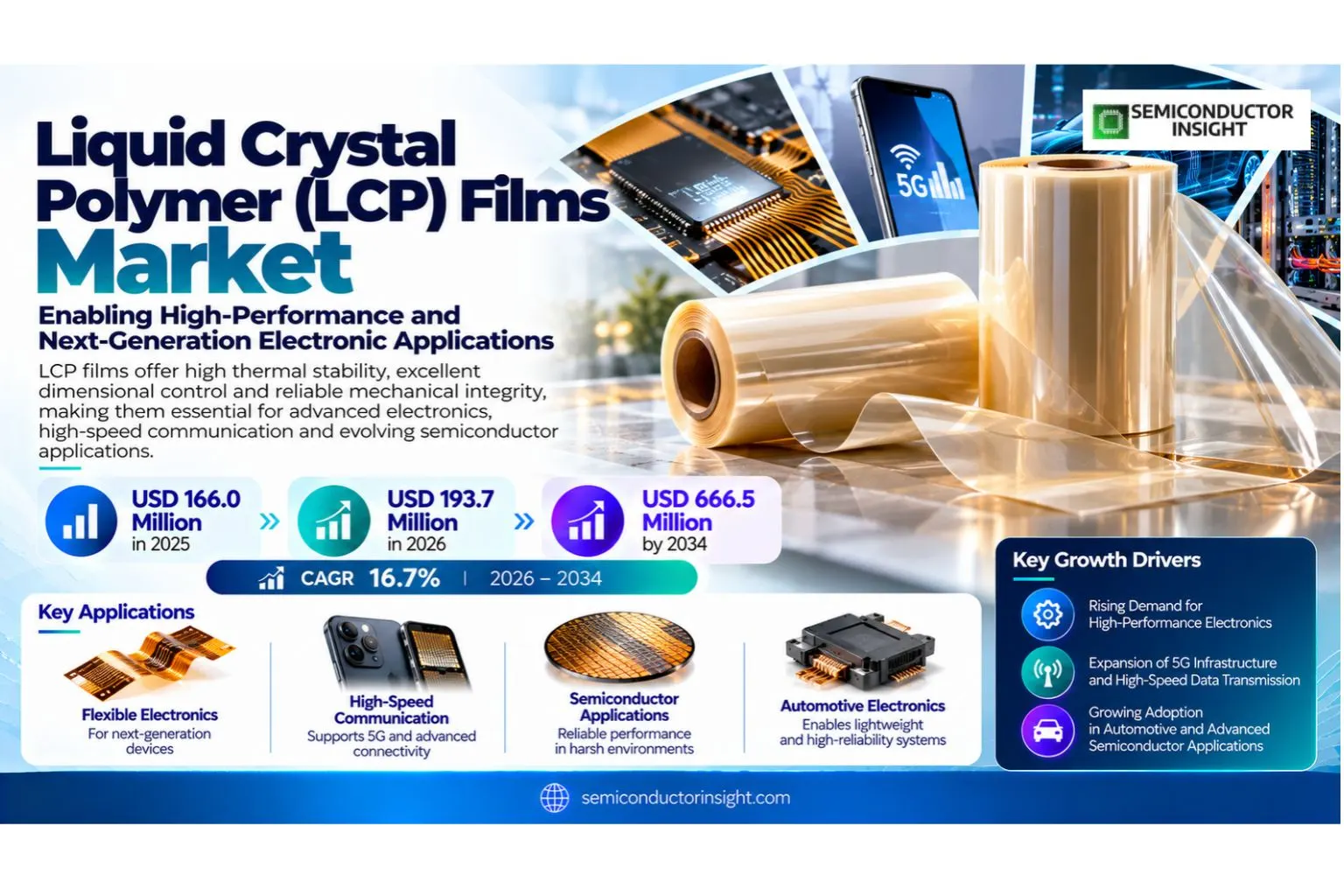
- The market is valued at USD 166.0 million in 2025 and is projected to reach USD 666.5 million by 2034, representing a 16.7% CAGR over 2026–2034.
- High Melting Point Grade is a major product segment, while adjacent variants are expanding as performance, integration and cost requirements evolve.
- Antenna is a leading application area, supported by demand across Circuit Board, Others.
- North America is the largest market in 2025 based on current demand, manufacturing concentration and ecosystem maturity.
Liquid Crystal Polymer (LCP) Films Market Overview
Liquid Crystal Polymer (LCP) Films are thermoplastic high-performance films with low moisture absorption, strong chemical resistance, excellent dimensional stability and low dielectric loss at high frequency. These characteristics allow very thin flexible circuits and antenna structures to maintain electrical performance under humidity and thermal cycling. Commercial adoption of Liquid Crystal Polymer (LCP) Films products therefore depends on system-level productivity, integration requirements, reliability expectations and the economics of replacing established alternatives in real operating environments.
The market is being pulled by higher-frequency wireless systems, automotive radar and increasingly dense flexible electronics. LCP’s role extends from standalone film to copper-clad laminates and engineered cavity structures, so suppliers compete not only on resin properties but also on film uniformity, copper adhesion and multilayer processability. Suppliers that translate technical improvements into measurable gains in efficiency, uptime, cost, throughput or workflow simplicity are better positioned to win long-duration programs and repeat purchases.
Segment Analysis: By Type
High-melting-point LCP films are important where reflow temperature, dimensional stability and mechanical integrity must be maintained through electronics assembly. Lower-melting-point grades support lamination and multilayer processing where controlled thermoplastic behavior improves bonding and fabrication. Within this segment, customers increasingly compare lifecycle support, qualification requirements, integration effort and total ownership cost rather than relying on a single specification or upfront price.
| Type | Market relevance |
|---|---|
| High Melting Point Grade | Higher thermal stability for demanding electronics. |
| Low Melting Point Grade | Improved lamination and multilayer processing. |
Segment Analysis: By Application
Antenna and circuit-board applications dominate because LCP offers low dielectric loss, low moisture absorption and strong dimensional stability at high frequency. These properties make the film attractive for smartphone antennas, millimeter-wave radar, flexible circuits and compact RF interconnects. Within this segment, customers increasingly compare lifecycle support, qualification requirements, integration effort and total ownership cost rather than relying on a single specification or upfront price.
| Application | Market relevance |
|---|---|
| Antenna | Smartphone, radar and high-frequency antenna substrates. |
| Circuit Board | Flexible printed circuits and high-speed interconnects. |
| Others | Sensors, membranes and specialty structures. |
Segment Analysis: By End Use
Consumer electronics currently provide large volume, while automotive radar and telecom infrastructure create premium high-frequency demand. Medical and sensor applications are expanding where chemical resistance, thin construction and low moisture absorption help maintain stable electrical or mechanical behavior. Within this segment, customers increasingly compare lifecycle support, qualification requirements, integration effort and total ownership cost rather than relying on a single specification or upfront price.
| End Use | Market relevance |
|---|---|
| Consumer Electronics | Largest volume in compact RF electronics. |
| Automotive & Radar | Millimeter-wave radar and harsh-environment electronics. |
| Telecom Infrastructure | 5G/6G antennas and high-frequency modules. |
| Medical & Sensors | Implantable, sensing and chemical-resistant applications. |
Segment Analysis: By Product Form
Base film is the material foundation, FCCL converts LCP into directly processable flexible-circuit material, and laminated specialty forms serve multilayer structures or sensors. Value rises as suppliers integrate copper adhesion, surface treatment and stack-up engineering. Within this segment, customers increasingly compare lifecycle support, qualification requirements, integration effort and total ownership cost rather than relying on a single specification or upfront price.
| Product Form | Market relevance |
|---|---|
| Base Film | Film converted by downstream fabricators. |
| FCCL / Copper-Clad Film | Direct flexible circuit substrate material. |
| Laminated / Specialty Film | Application-specific engineered constructions. |
Regional Analysis
North America holds the largest current value position on the report page, supported by high-frequency electronics and telecom demand, while Asia Pacific is the manufacturing center and strongest supply-side region through Japan, China and Taiwan. Regional share also reflects supplier depth, engineering support, manufacturing concentration and the speed at which new Liquid Crystal Polymer (LCP) Films designs can move from evaluation into repeat deployment.
| Region | 2025 Position | Growth Outlook | Demand Profile |
|---|---|---|---|
| North America | Largest | Strong | RF electronics and high-value end use led |
| Asia Pacific | Manufacturing center | Very strong | Film, FCCL and electronics manufacturing led |
| Europe | Specialty market | Strong | Automotive, industrial and sensor led |
| South America | Emerging | Moderate | Electronics and automotive led |
| Middle East & Africa | Developing | Moderate | Telecom and specialty electronics led |
Detailed Regional Blocks
Why is North America important to this market?
North America has the largest current market position on the report page, with the United States driving demand in telecom, aerospace, medical devices and high-frequency electronics. Material adoption is strongest where stable dielectric performance justifies a premium over conventional flexible substrates. In North America, procurement decisions also depend on service coverage, qualification resources, logistics and long-term availability, so ecosystem maturity can materially influence adoption even when core technology performance is similar.
| Country / Subregion | Role | Market Context |
|---|---|---|
| United States | Largest regional market | RF electronics, medical and aerospace demand support premium films. |
| Canada | Telecom and research niche | High-frequency and sensor applications create selective demand. |
- The report page estimates North America at USD 41.51 million in 2023, more than one-third of global market value.
- LCP films are attractive in high-frequency electronics because low water absorption helps preserve dielectric behavior under humidity.
- Automotive and defense radar create premium demand for flexible low-loss materials.
Why is Asia Pacific important to this market?
Asia Pacific is the core supply region because Kuraray, Murata and multiple Chinese producers support film, FCCL and electronic-device manufacturing. Regional smartphone, automotive and telecom production gives suppliers direct access to high-volume qualification programs. In Asia Pacific, procurement decisions also depend on service coverage, qualification resources, logistics and long-term availability, so ecosystem maturity can materially influence adoption even when core technology performance is similar.
| Country / Subregion | Role | Market Context |
|---|---|---|
| Japan | Technology and supplier hub | Kuraray and Murata lead high-frequency LCP material development. |
| China | Fast electronics manufacturing growth | Antenna, FPC and connector demand supports volume. |
| Taiwan | Flexible-circuit and semiconductor ecosystem | High-frequency substrates support advanced electronics. |
- Kuraray states that VECSTAR is the world’s first LCP film and is widely used as a circuit-board substrate for high-speed and high-frequency electronics.
- Murata began mass production of ULTICIRC in 2025, using an internal cavity structure to achieve dielectric constant below 2.0 for future 6G-class frequencies.
- Regional scale in FPC and smartphone assembly accelerates design-in of new film grades.
Why is Europe important to this market?
Europe is a specialty market with strong automotive radar, industrial sensing and medical-device demand. LCP’s dimensional stability and chemical resistance support electronics exposed to humidity, thermal cycling or compact packaging. In Europe, procurement decisions also depend on service coverage, qualification resources, logistics and long-term availability, so ecosystem maturity can materially influence adoption even when core technology performance is similar.
| Country / Subregion | Role | Market Context |
|---|---|---|
| Germany | Automotive and industrial hub | Radar and sensor systems support LCP substrates. |
| France | Aerospace and electronics niche | High-frequency modules create demand. |
| Switzerland | Medical and precision electronics | Specialty flexible circuits support premium films. |
- Millimeter-wave radar benefits from low dielectric loss and low moisture uptake.
- Medical and sensor devices value thin chemically resistant film constructions.
- Premium use cases make performance more important than raw material price.
Why is South America important to this market?
South America remains a smaller direct market because most LCP film conversion occurs elsewhere. Brazil provides the strongest demand through automotive, telecom and electronics assembly. In South America, procurement decisions also depend on service coverage, qualification resources, logistics and long-term availability, so ecosystem maturity can materially influence adoption even when core technology performance is similar.
| Country / Subregion | Role | Market Context |
|---|---|---|
| Brazil | Largest regional opportunity | Automotive and electronics create downstream demand. |
| Argentina | Selective industrial use | Direct film consumption is limited. |
- Most LCP enters the region inside finished circuits or imported laminates.
- Telecom upgrades increase indirect high-frequency substrate demand.
- Local conversion capability is a key limiting factor.
Why is Middle East & Africa important to this market?
Middle East and Africa demand is developing through telecom infrastructure, defense electronics and selected medical or sensor applications. Direct film conversion remains limited and is supplied largely through imported laminates. In Middle East & Africa, procurement decisions also depend on service coverage, qualification resources, logistics and long-term availability, so ecosystem maturity can materially influence adoption even when core technology performance is similar.
| Country / Subregion | Role | Market Context |
|---|---|---|
| United Arab Emirates | Telecom and defense niche | High-frequency systems support specialty materials. |
| Israel | RF and medical electronics | Advanced design teams create selective LCP demand. |
| South Africa | Industrial electronics niche | Direct volume remains modest. |
- 5G and future 6G infrastructure are the clearest long-term demand drivers.
- High-frequency circuits favor materials with stable dielectric properties under humidity.
- The region remains dependent on Asian and global material suppliers.
Competitive Landscape
Kuraray, Murata Manufacturing, Chiyoda, Shanghai PRET, Legion Compound Material, Ningbo Jujia, Youwei Juhe and Kingfa compete through dielectric loss, dimensional stability, heat resistance, film thickness and conversion into FCCL or specialty structures. Japanese suppliers lead high-frequency technology, while Chinese companies add cost-competitive capacity.
| Company | Position | Relevant capability |
|---|---|---|
| Kuraray | Key participant | VECSTAR LCP film and FCCL with low dielectric dissipation and broad RF substrate use. |
| Murata Manufacturing | Key participant | MetroCirc and 2025 ULTICIRC cavity-structured LCP flexible substrate for very-low-loss high-frequency applications. |
| Chiyoda | Key participant | Competes through product breadth, integration capability, qualification and customer support. |
| Shanghai PRET | Key participant | Competes through product breadth, integration capability, qualification and customer support. |
| Legion Compound Material | Key participant | Competes through product breadth, integration capability, qualification and customer support. |
| Ningbo Jujia | Key participant | Competes through product breadth, integration capability, qualification and customer support. |
| Youwei Juhe | Key participant | Competes through product breadth, integration capability, qualification and customer support. |
| Kingfa | Key participant | Chinese high-performance polymer supplier with LCP materials and regional scale. |
Production Capacity Analysis
LCP film capacity depends on high-purity thermoplastic LCP resin, specialized melt extrusion or film-forming processes, biaxial property control and surface treatment. Uniform thin-film production is more demanding than resin molding because dielectric and dimensional consistency must be maintained across wide rolls. Scaling output without degrading consistency requires stable upstream materials, disciplined process control and final testing that catches performance drift before products reach high-value customer systems.
Japan retains strong technology leadership, while Chinese suppliers are expanding capacity and price competition. Effective supply also includes copper-clad lamination and downstream FPC processing, because many customers buy circuit-ready substrates rather than bare film. Second-source planning and regional technical support therefore become increasingly important as deployments expand and buyers seek supply continuity without repeating lengthy qualification work.
Market Dynamics
The market benefits from frequency migration. As RF links move into millimeter-wave and future FR3/6G bands, conductor and dielectric losses become more important, increasing the value of low-loss substrate films even when their material price is higher. This is changing competitive behavior because vendors increasingly sell system-level value, workflow integration and lifecycle economics rather than an isolated component specification.
Competition with polyimide and modified polyimide remains application specific. LCP tends to win where low moisture absorption, dimensional stability and high-frequency electrical performance justify a more specialized manufacturing flow. Buyers consequently evaluate total ownership cost, qualification effort and roadmap stability across the life of a program instead of focusing only on initial purchase price.
Market Drivers
| Factor | Analyst Interpretation |
|---|---|
| 5G and 6G RF systems | Higher frequencies increase the value of low-loss dielectric materials. |
| Automotive radar | Millimeter-wave sensors require stable substrate performance. |
| Flexible electronics | Thin, bendable circuit structures support compact antennas and interconnects. |
| Low moisture absorption | Stable properties under humidity improve RF consistency. |
Market Restraints
| Factor | Analyst Interpretation |
|---|---|
| High material cost | LCP films are more expensive than many conventional flexible substrates. |
| Specialized processing | Film formation and multilayer lamination require dedicated know-how. |
| Raw material concentration | Qualified thermoplastic LCP resin supply is limited. |
| Competing materials | MPI, PTFE and other low-loss substrates compete by application. |
Market Opportunities
| Factor | Analyst Interpretation |
|---|---|
| 6G FR3 substrates | Very-low-loss LCP structures can support 7–24 GHz and higher-frequency systems. |
| Automotive radar | Higher channel counts and integrated antennas expand substrate demand. |
| Sensor films | Dimensional stability supports strain, underwater and precision sensing. |
| Ultra-thin FCCL | Thinner copper-clad constructions can reduce device thickness and RF loss. |
Supply Chain Analysis
The value chain begins with LCP resin, then moves through film formation, surface treatment, copper lamination, circuit fabrication and final electronic assembly. Process control is critical because film orientation and moisture behavior affect dielectric and dimensional performance. Traceability and coordination between component suppliers, integrators and end users are important because failures found late in the chain can be far more expensive than the underlying part itself.
| Supply Chain Stage | Role in the Market |
|---|---|
| LCP resin production | Specialized thermoplastic resin provides high-frequency and chemical properties. |
| Film formation | Proprietary extrusion and orientation processes create thin uniform film. |
| FCCL and lamination | Copper foil is bonded to LCP for flexible circuits and antennas. |
| Electronics integration | Converted films enter smartphones, radar, telecom and sensor systems. |
Recent Developments
| Date | Development | Source |
|---|---|---|
| December 2025 | Murata launched and began mass production of ULTICIRC, an inner-cavity LCP flexible substrate with dielectric constant below 2.0 for future 6G applications. | Murata Manufacturing |
| September 2025 | Kuraray showcased VECSTAR LCP film for sensing, cryogenic and actuator-insulation applications at Sensor Expo Japan 2025. | Kuraray |
| 2026 | Kuraray continues VECSTAR LCP film and FCCL for antennas, high-speed circuits and automotive millimeter-wave radar. | Kuraray |
Report Scope & Segmentation
| Scope Item | Coverage |
|---|---|
| Base Year | 2025 |
| Estimated Year | 2026 |
| Forecast Period | 2026–2034 |
| 2025 Market Size | USD 166.0 million |
| 2026 Estimated Size | USD 193.7 million |
| 2034 Forecast Size | USD 666.5 million |
| CAGR (2026–2034) | 16.7% |
| Largest Market in 2025 | North America |
| Category | Electronic Materials / LCP Films / High-Frequency Substrates |
| By Type | High Melting Point Grade, Low Melting Point Grade |
| By Application | Antenna, Circuit Board, Others |
| By End Use | Consumer Electronics, Automotive & Radar, Telecom Infrastructure, Medical & Sensors |
| By Product Form | Base Film, FCCL / Copper-Clad Film, Laminated / Specialty Film |
Frequently Asked Questions
What is the 2025 market size of the Liquid Crystal Polymer (LCP) Films market?
The market is valued at USD 166.0 million in 2025.
What is the projected 2034 market size of the Liquid Crystal Polymer (LCP) Films market?
The market is projected to reach USD 666.5 million by 2034.
What is the CAGR of the Liquid Crystal Polymer (LCP) Films market from 2026 to 2034?
The market is expected to expand at a CAGR of 16.7% during 2026–2034.
Which region leads the Liquid Crystal Polymer (LCP) Films market?
North America is the largest market in 2025 based on the current demand, manufacturing and deployment structure.
Which type segment is important in the Liquid Crystal Polymer (LCP) Films market?
High Melting Point Grade is a major segment, while adjacent product variants are gaining share as performance and integration requirements evolve.
What is the main application for Liquid Crystal Polymer (LCP) Films products?
Antenna is a leading application, with additional growth coming from Circuit Board, Others.
What drives growth in the Liquid Crystal Polymer (LCP) Films market?
Higher frequencies increase the value of low-loss dielectric materials.
What is a key restraint for the Liquid Crystal Polymer (LCP) Films market?
LCP films are more expensive than many conventional flexible substrates.
Which companies participate in the Liquid Crystal Polymer (LCP) Films market?
Key participants include Kuraray, Murata Manufacturing, Chiyoda, Shanghai PRET, Legion Compound Material, alongside other specialized suppliers and system companies.
What technology trend is shaping the Liquid Crystal Polymer (LCP) Films market?
Very-low-loss LCP structures can support 7–24 GHz and higher-frequency systems.
Research Sources & Evidence Base
View research sources used for this overview.
- Kuraray — VECSTAR LCP Film: Material properties, high-frequency performance and current applications. Source
- Kuraray — VECSTAR FCCL: Flexible copper-clad laminate applications in smartphone antennas, radar and base stations. Source
- Murata Manufacturing — ULTICIRC Launch: 2025 mass production of ultra-low-loss cavity LCP flexible substrate for 6G. Source
Get Sample Report PDF for Exclusive Insights
Report Sample Includes
- Table of Contents
- List of Tables & Figures
- Charts, Research Methodology, and more...
 Download Sample Report PDF