
Key Statistics
Key Takeaways
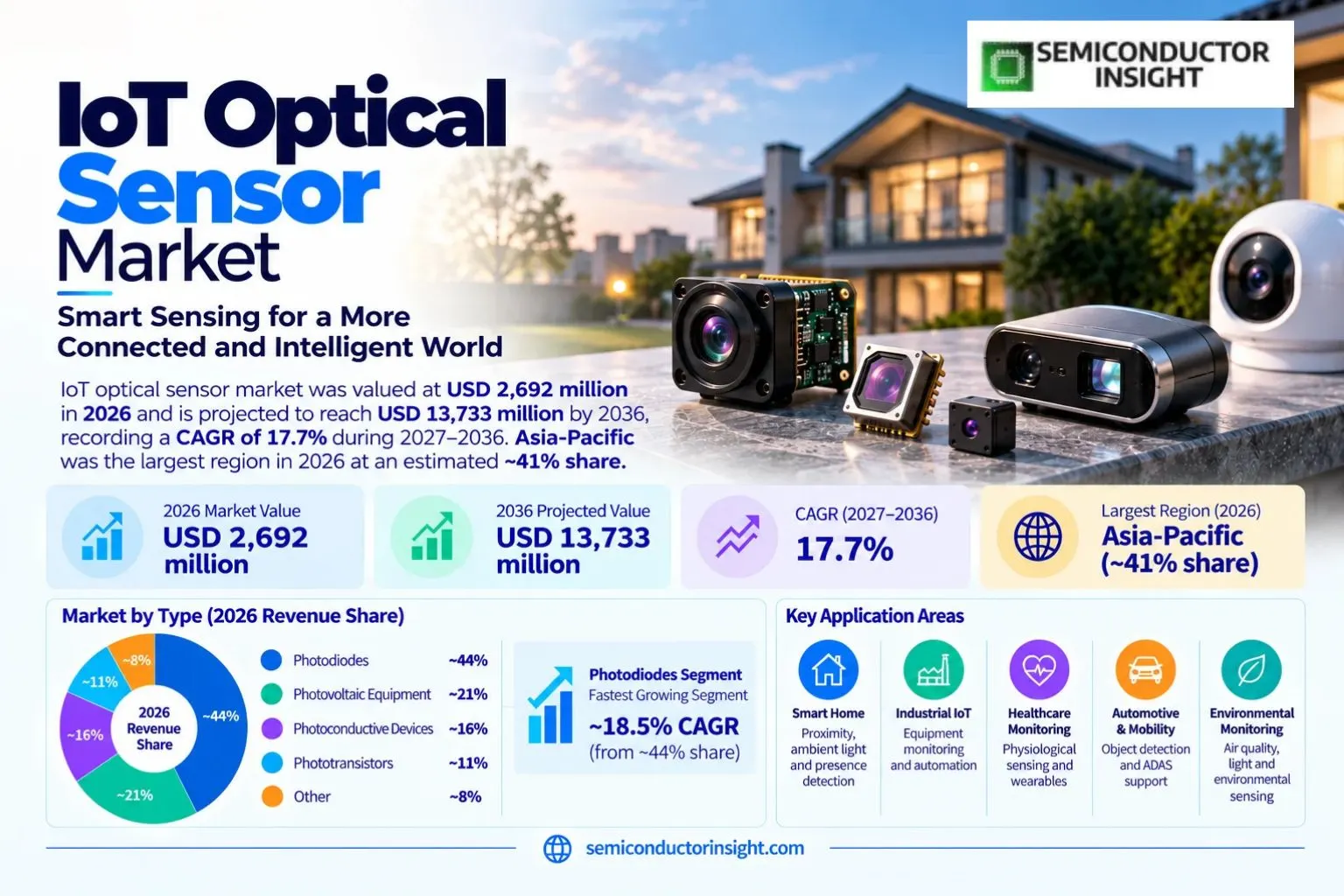
- Market trajectory: The global iot optical sensor market reached USD 2,692 million in 2026 and is projected to reach USD 13,733 million by 2036 at 17.7% CAGR over 2027–2036. Demand follows the actual sale of silicon or compound-semiconductor light detectors, integrated optical filters, infrared emitters and readout circuits for proximity, physiological, ambient-light, object-detection and connected equipment feedback, rather than the full revenue of adjacent digital infrastructure.
- Photodiodes leadership: Photodiodes has the largest estimated type share at ~44% in 2026. The fastest-growing type is Photodiodes, at ~18.5% CAGR from an estimated ~44% share. Photodiodes supply controlled photocurrent and fast detection for ambient-light, PPG and optical ranging circuits. Vishay introduced AEC-Q102 qualified automotive PIN photodiode sensors in June 2026, while Analog Devices documents dual-channel optical PPG readout front ends.
- Smart Home & Wearables demand: Smart Home & Wearables leads application revenue at an estimated ~29% in 2026, while Healthcare grows most rapidly near ~18.9% CAGR. Optical presence, proximity, color and pulse monitoring improve automated lighting, displays and personal health devices. Designers prioritize battery life, form factor, algorithmic calibration and privacy as well as raw sensor accuracy. For end-use systems in 2027, the purchase decision depends on explicit equipment compatibility, verifiable component performance and whether the supplier can sustain replacement support throughout the planned service interval.
- Asia-Pacific position: Asia-Pacific represents the largest regional revenue pool at an estimated ~41% in 2026. Asia-Pacific has the highest regional modeled growth at ~18.5% CAGR. China and Japan combine large sensor-device assembly supply chains with consumer demand for wearables, security modules and smart home automation. ST and ams OSRAM ToF solutions demonstrate how compact depth optics can serve electronics designs. India adds connected healthcare and logistics deployments but domestic sensor-chip production is less mature than module assembly.
- Principal constraint: Sensor accuracy under ambient illumination is a fundamental restraint. Purchase decisions are also affected by cybersecurity and personal data requirements. Both conditions limit the speed at which a promising optical product can move into enduring installations; careful lifecycle support remains vital. In the adoption barriers setting, an engineering advantage becomes a sale only after procurement teams review validation evidence, inventory risk, maintenance requirements and the operating economics of the intended deployment.
IoT Optical Sensor Market Overview
iot Optical sensor market was valued at USD 2,692 million in 2026 and is projected to reach USD 13,733 million by 2036, recording a CAGR of 17.7% during 2027–2036. Asia-Pacific was the largest region in 2026 at an estimated ~41% share. The market centers on silicon or compound-semiconductor light detectors, integrated optical filters, infrared emitters and readout circuits for proximity, physiological, ambient-light, object-detection and connected equipment feedback.
IoT optical sensors transduce an illumination, proximity, pulse or object-detection event into electronic information that a connected controller can interpret. A photodiode converts photons into current, a phototransistor amplifies a small light response, and a time-of-flight module measures the delay between an infrared emission and its return. Different designs require different packaging, noise rejection and calibration routines. Devices serve smart-home automation, connected manufacturing, wearable health systems and security equipment.
The defined commercial boundary includes standalone photodiodes, phototransistors, photoconductive and photovoltaic optoelectronic sensing devices and integrated optical distance, light and biometric front-ends used in connected IoT equipment; excludes complete wearables, unrelated image cameras, communications subscriptions and industrial control-system markups. This distinction prevents a finished datacenter, networking service or unrelated electronic product from being mistaken for direct sales of the specialized component. Supplier comparisons are meaningful only when the invoiced product and its value contribution fall within the stated market boundary.
Modern IoT optical sensing combines emitters, optical filters, detector pixels, analog-to-digital conversion and firmware that suppresses false readings under variable background light. STMicroelectronics specifies 64-zone ToF ranging, while Texas Instruments OPT4048 covers four spectral channels and Analog Devices documents low-power optical PPG acquisition. Integration creates opportunities to move detection closer to the edge processor, but also increases sensor testing and software validation obligations across consumer, industrial and medical markets.
Commercial demand is generated when connected device designers decide to add a measurable optical input rather than rely only on a camera, electrical transducer or mechanical switch. A connected wearable needs stable PPG under motion; a smart light controller must reject sunlight interference; an automated conveyor requires predictable optical presence detection. The ITU estimated six billion internet users during 2025, but this connectivity measure should not be mistaken for optical sensor shipments or revenue.
Technology priorities are evolving toward more reliable and serviceable optical architectures. Design qualification in integrated product architecture creates sustained demand for documented sensor behavior, particularly where false readings would disrupt automation. Integration teams working on integrated product architecture need stable electrical interfaces, application-specific optics and reliable supply of calibrated replacement modules. The commercial challenge is to turn those technical characteristics into repeat purchasing, while addressing loss of compatibility, changing interfaces and the long-term economics of support.
Segment Analysis: By Type
By type, the iot optical sensor market comprises Photoconductive Devices, Photovoltaic Equipment, Photodiodes, Phototransistors, Other. Photodiodes leads with an estimated ~44% revenue share in 2026; Photodiodes expands most rapidly at about ~18.5% CAGR from a ~44% share. Different physical designs lead to different suppliers, levels of qualification and possible expansion rates. This matters for type overview, because the technically feasible option must also be installable, serviceable and properly documented across the operating life of the equipment and its supporting software.
| Type | Function | Market position |
|---|---|---|
| Photoconductive Devices | Light-dependent conductance devices are economical for slow illumination and detection tasks but need circuitry to compensate temperature drift and nonlinearity. Their installed use persists in switching, alarms and low-frequency controls despite pressure from integrated digital ambient light sensors. Each product specification maps to a different material bill, operating environment and qualification procedure. Suppliers therefore need to establish how the Photoconductive Devices variant affects installation requirements and ongoing service. | Estimated ~14% of 2026 revenue and ~16.5% CAGR. Photoconductive Devices is a distinct product category, with demand linked to the particular requirements of its buyers. For Photoconductive Devices products, suppliers must balance optical sensitivity with package size, firmware support and the costs of testing completed modules. Adoption in Photoconductive Devices products can advance with better emitter control and ambient-light suppression while remaining sensitive to unit pricing and inventory cycles. Procurement teams evaluate component availability, unit cost and the necessary test records. |
| Photovoltaic Equipment | Photovoltaic sensing devices use photo-generated voltage or current to indicate illumination without an external excitation requirement. They can operate in self-powered detection or specialized energy harvesting interfaces but are not equivalent to full photovoltaic power generation installations. Design qualification in Photovoltaic Equipment products creates sustained demand for documented sensor behavior, particularly where false readings would disrupt automation. Suppliers therefore need to establish how the Photovoltaic Equipment variant affects installation requirements and ongoing service. | Estimated ~12% of 2026 revenue and ~16.7% CAGR. Photovoltaic Equipment is a distinct product category, with demand linked to the particular requirements of its buyers. Commercial expansion in Photovoltaic Equipment products follows new device designs and approved component bills of materials rather than changes in connectivity statistics alone. Products for Photovoltaic Equipment products compete on detection range, optical interference tolerance, long-term drift and firmware compatibility across installed equipment. Procurement teams evaluate component availability, unit cost and the necessary test records. |
| Photodiodes | Optical transducer selection for Photodiodes products depends on received signal strength, sunlight rejection and available standby power within the connected device. In Photodiodes products, equipment designers verify illumination response, detector linearity and interface timing before qualifying sensors for volume assembly. Procurement decisions involving Photodiodes products often require environmental screening and repeatable calibration rather than higher nominal accuracy alone. Suppliers therefore need to establish how the Photodiodes variant affects installation requirements and ongoing service. | Estimated ~44% of 2026 revenue and ~18.5% CAGR. Photodiodes is the largest type by value, with demand linked to the particular requirements of its buyers. For Photodiodes products, suppliers must balance optical sensitivity with package size, firmware support and the costs of testing completed modules. Adoption in Photodiodes products can advance with better emitter control and ambient-light suppression while remaining sensitive to unit pricing and inventory cycles. Procurement teams evaluate component availability, unit cost and the necessary test records. |
| Phototransistors | Phototransistors offer high optical gain in object-presence switching and low-cost optical barriers, trading bandwidth and linearity against sensitivity. Factory photoelectric products combine these elements with optics, housings, control logic and environmental sealing. Design qualification in Phototransistors products creates sustained demand for documented sensor behavior, particularly where false readings would disrupt automation. Suppliers therefore need to establish how the Phototransistors variant affects installation requirements and ongoing service. | Estimated ~21% of 2026 revenue and ~17.2% CAGR. Phototransistors is a distinct product category, with demand linked to the particular requirements of its buyers. Commercial expansion in Phototransistors products follows new device designs and approved component bills of materials rather than changes in connectivity statistics alone. Products for Phototransistors products compete on detection range, optical interference tolerance, long-term drift and firmware compatibility across installed equipment. Procurement teams evaluate component availability, unit cost and the necessary test records. |
| Other | Integrated spectral, time-of-flight and specialized photonic front ends have distinct architectures; ST VL53L8CX combines a 940nm emitter and 8×8 multizone array, while ams OSRAM announced multispectral and spatial sensing in September 2026. Optical transducer selection for Other products depends on received signal strength, sunlight rejection and available standby power within the connected device. Suppliers therefore need to establish how the Other variant affects installation requirements and ongoing service. | Estimated ~9% of 2026 revenue and ~17.8% CAGR. Other is a distinct product category, with demand linked to the particular requirements of its buyers. Procurement decisions involving Other products often require environmental screening and repeatable calibration rather than higher nominal accuracy alone. Procurement teams evaluate component availability, unit cost and the necessary test records. |
Segment Analysis: By Application
Application segments are Smart Home & Wearables, Smart Energy, Smart Security, Manufacturing, Transportation & Logistics, Healthcare, Others. Smart Home & Wearables takes the largest estimated 2026 revenue share at ~29%, whereas Healthcare is the fastest-growing application at ~18.9% CAGR. Channel structure, end-user servicing needs and purchasing cadence create distinct addressable opportunities despite shared underlying optical technologies.
| Application | Demand characteristics |
|---|---|
| Smart Home & Wearables | Estimated ~29% of 2026 revenue and ~17.6% CAGR. Optical inputs in smart homes support proximity-triggered lighting and adaptive brightness, while the chosen photodiode or color sensor determines the electronic controller interface. Products for Smart Home & Wearables applications compete on detection range, optical interference tolerance, long-term drift and firmware compatibility across installed equipment. Purchasers assess the entire cost of deploying and operating the optical function, including testability, compatible equipment and procurement lead times. |
| Smart Energy | Estimated ~9% of 2026 revenue and ~17.1% CAGR. Light-based sensors support optical monitoring and smart building lighting controls, while whole-building energy metering remains largely electronic. Their business case involves small sensing devices integrated into automated electrical systems rather than the value of electricity sold. In Smart Energy applications, equipment designers verify illumination response, detector linearity and interface timing before qualifying sensors for volume assembly. |
| Smart Security | Estimated ~16% of 2026 revenue and ~17.9% CAGR. Photoelectric barriers, reflected-light proximity systems and optical authentication modules trigger connected access and intrusion workflows. Security OEMs select sensors according to nuisance-alarm rate, tamper tolerance, field environment and cybersecurity of the host gateway. The practical revenue opportunity for Smart Security applications arises when device manufacturers integrate separately priced optical sensing hardware into qualified products. |
| Manufacturing | Estimated ~18% of 2026 revenue and ~17.3% CAGR. Optical switches, imaging-adjacent detectors and photoelectric distance sensors monitor conveyor items, production tool presence and machine positioning. Repeatability under dust, vibration and uncontrolled background illumination is often a stronger procurement factor than the cheapest sensor unit. Adoption in Manufacturing applications can advance with better emitter control and ambient-light suppression while remaining sensitive to unit pricing and inventory cycles. |
| Transportation & Logistics | Estimated ~9% of 2026 revenue and ~17.2% CAGR. Warehouse automation, sorting and vehicle sensing use object-detection optics to track physical movement. Reliability and a fast digital interface affect uptime, while vehicle qualification and system integration limit substitution between industrial and automotive components. Integration teams working on Transportation & Logistics applications need stable electrical interfaces, application-specific optics and reliable supply of calibrated replacement modules. |
| Healthcare | Estimated ~15% of 2026 revenue and ~18.9% CAGR. Connected wearable PPG and medical-device proximity sensors measure transmitted or reflected light, combining photodiodes with synchronized emitters and readout electronics. Analog Devices MAX86176 documents dual-channel PPG, rejecting ambient-light interference in low-power wearable applications. Products for Healthcare applications compete on detection range, optical interference tolerance, long-term drift and firmware compatibility across installed equipment. |
| Others | Estimated ~4% of 2026 revenue and ~17.1% CAGR. Specialty research instruments, educational electronics and environmental control devices use optical measurement for varied tasks. Customer orders are fragmented and often depend on engineering samples or distribution support. In Others applications, equipment designers verify illumination response, detector linearity and interface timing before qualifying sensors for volume assembly. |
The commercial channel is shaped by smart home product designers, wearable OEMs, factory automation integrators, security providers, healthcare device developers and smart-building system contractors. Direct equipment purchase, specialist distributor supply and OEM qualification have different order economics. Volume can be won through stable specifications and documented reliability, while replacement sales depend on spare availability and retained interface compatibility over the 2027–2036 period.
Regional Analysis
Asia-Pacific leads global revenue with an estimated ~41% share in 2026. North America follows at ~27% and Europe at ~19%. Asia-Pacific has the fastest growth at ~18.5% CAGR. Regional purchases and supplier manufacturing footprints must be distinguished for market comparisons. A commercial evaluation of regional lead therefore compares the cost of qualified materials, process yield, lead times, quality assurance and post-installation support rather than product specifications alone.
How do regional purchasing patterns differ in iot optical sensor?
Asia-Pacific: China and Japan combine large sensor-device assembly supply chains with consumer demand for wearables, security modules and smart home automation. Adoption in Regional Analysis supply can advance with better emitter control and ambient-light suppression while remaining sensitive to unit pricing and inventory cycles. Design qualification in Regional Analysis supply creates sustained demand for documented sensor behavior, particularly where false readings would disrupt automation. North America: The United States combines connected-health R&D, industrial sensor qualification and smart-building monitoring. Energy management and patient wearables create distinct purchase cycles: the former values ruggedness and long replacement intervals, while the latter depends on motion compensation, low power and protection of sensitive health information. Europe has distinct qualification and network compliance requirements; South America and the Middle East and Africa rely more heavily on imported products and local distribution service.
| Region | Position | Growth outlook | Demand profile | What decides supplier selection |
|---|---|---|---|---|
| Asia-Pacific | Largest (~41%) | ~18.5% CAGR | Products for Asia-Pacific purchasing compete on detection range, optical interference tolerance, long-term drift and firmware compatibility across installed equipment. Optical transducer selection for Asia-Pacific purchasing depends on received signal strength, sunlight rejection and available standby power within the connected device. In Asia-Pacific purchasing, equipment designers verify illumination response, detector linearity and interface timing before qualifying sensors for volume assembly. Within Asia-Pacific, design wins may be awarded to specialist suppliers offshore even when the finished optical equipment is installed locally, making customer qualification and international logistics decisive commercial factors. | Buyers in Asia-Pacific require engineering fit, credible warranty conditions, appropriate import arrangements, and a qualified local service path. For silicon or compound-semiconductor light detectors, integrated optical filters, infrared emitters and readout circuits for proximity, physiological, ambient-light, object-detection and connected equipment feedback, interface stability and the availability of replacement products can determine whether a promising order proceeds beyond initial evaluation. |
| North America | Second (~27%) | ~17.1% CAGR | The United States combines connected-health R&D, industrial sensor qualification and smart-building monitoring. The practical revenue opportunity for North America purchasing arises when device manufacturers integrate separately priced optical sensing hardware into qualified products. Within North America, design wins may be awarded to specialist suppliers offshore even when the finished optical equipment is installed locally, making customer qualification and international logistics decisive commercial factors. | Buyers in North America require engineering fit, credible warranty conditions, appropriate import arrangements, and a qualified local service path. Adoption in North America purchasing can advance with better emitter control and ambient-light suppression while remaining sensitive to unit pricing and inventory cycles. Customer qualification must address background-light immunity, sensing accuracy and a reproducible calibration process for the installed IoT system. For North America, longer-term supplier agreements depend on replacing failed units without changing the qualified downstream equipment architecture. |
| Europe | Third (~19%) | ~17.0% CAGR | European automotive and industrial suppliers emphasize functional safety, device cybersecurity and photodiode reliability. Vishay announced two AEC-Q102 automotive-grade ambient-light PIN photodiodes in June 2026, which target measurement under harsh conditions. EU connectivity policy supports IoT deployment, but the chip market is limited to the optical portion of connected devices. Within Europe, design wins may be awarded to specialist suppliers offshore even when the finished optical equipment is installed locally, making customer qualification and international logistics decisive commercial factors. | Buyers in Europe require engineering fit, credible warranty conditions, appropriate import arrangements, and a qualified local service path. Integration teams working on Europe purchasing need stable electrical interfaces, application-specific optics and reliable supply of calibrated replacement modules. Design qualification in Europe purchasing creates sustained demand for documented sensor behavior, particularly where false readings would disrupt automation. For Europe, longer-term supplier agreements depend on replacing failed units without changing the qualified downstream equipment architecture. |
| South America | Fourth (~7%) | ~16.8% CAGR | Brazilian industrial and agricultural automation, remote asset monitoring and connectivity expansion can increase optical sensing deployments in ports, warehouses and production systems. Imported components pass through integrators; installation skills, local currency and availability of replacement sensors have a larger effect than global semiconductor supply announcements. Within South America, design wins may be awarded to specialist suppliers offshore even when the finished optical equipment is installed locally, making customer qualification and international logistics decisive commercial factors. | Buyers in South America require engineering fit, credible warranty conditions, appropriate import arrangements, and a qualified local service path. Products for South America purchasing compete on detection range, optical interference tolerance, long-term drift and firmware compatibility across installed equipment. Commercial expansion in South America purchasing follows new device designs and approved component bills of materials rather than changes in connectivity statistics alone. For South America, longer-term supplier agreements depend on replacing failed units without changing the qualified downstream equipment architecture. |
| Middle East & Africa | Fifth (~6%) | ~17.5% CAGR | Saudi Arabia and the UAE have emerging smart-building and industrial monitoring projects where proximity sensing, optical presence detection and energy efficiency can reduce operational costs. South African industrial maintenance emphasizes robust photoelectric sensing rather than very low-cost smartphone ambient sensors. Imported modules need local calibration and service capability. Within Middle East & Africa, design wins may be awarded to specialist suppliers offshore even when the finished optical equipment is installed locally, making customer qualification and international logistics decisive commercial factors. | Buyers in Middle East & Africa require engineering fit, credible warranty conditions, appropriate import arrangements, and a qualified local service path. In Middle East & Africa purchasing, equipment designers verify illumination response, detector linearity and interface timing before qualifying sensors for volume assembly. Optical transducer selection for Middle East & Africa purchasing depends on received signal strength, sunlight rejection and available standby power within the connected device. For Middle East & Africa, longer-term supplier agreements depend on replacing failed units without changing the qualified downstream equipment architecture. |
Competitive Landscape
Competition is led by firms with relevant silicon or compound-semiconductor light detectors, integrated optical filters, infrared emitters and readout circuits for proximity, physiological, ambient-light, object-detection and connected equipment feedback. The competitive field includes established manufacturers, original equipment suppliers and historical product brands whose present scope differs. Buyers compare product-specific technical evidence and order terms instead of total corporate turnover, because an optical component represents only part of a finished digital system.
Bosch and Honeywell illustrate different capabilities within the sector. Their product portfolios, production locations and support arrangements cannot be assumed identical. Procurement departments typically request specification sheets, samples, aging or thermal data and a long-term sourcing plan before designating a manufacturing source for a multi-year contract. The 2027–2036 opportunity in manufacturer capability is linked to deployment timing and customer acceptance, with supplier selection reflecting reliability, supply continuity, interface requirements and actual unit economics.
NXP, Infineon, Analog Devices, Panasonic, InvenSense appear in the wider manufacturer and distributor field. The roles of those entities require separation: component design, module assembly, systems integration and distribution do not produce the same category of invoice. Market rivalry occurs at the level of the particular sold device, not across unrelated corporate divisions.
Other suppliers and historical business names include Vishay, Hanwei Electronics, Semtech, Omron. Legacy corporate names and regional branches may persist in industry directories, while actual current production must be checked against updated company disclosures. Product-life-cycle changes can alter sourcing qualification even if an installed system continues to function with existing spare inventories. For historical company list in 2032, the purchase decision depends on explicit equipment compatibility, verifiable component performance and whether the supplier can sustain replacement support throughout the planned service interval.
For 2027–2036, vendor differentiation will depend on manufacturing yield, documentation, reliable delivery and compatibility with demanding optical interfaces. Price competition may intensify in mature configurations, whereas improved optical sensor processes or interface packages offer specialized margins. A customer switching supplier must weigh requalification, sample validation and operational interruption against lower unit costs. In the competitive economics setting, an engineering advantage becomes a sale only after procurement teams review validation evidence, inventory risk, maintenance requirements and the operating economics of the intended deployment.
Tier structure
| Tier | Companies | Basis of competition |
|---|---|---|
| Tier 1 | Bosch; Honeywell; NXP | Direct manufacturers with published optical product or packaging activities differentiate through established process control and established technical catalogs. The first technical gate is the ability to supply silicon or compound-semiconductor light detectors, integrated optical filters, infrared emitters and readout circuits for proximity, physiological, ambient-light, object-detection and connected equipment feedback in a documented, reproducible format, followed by customer qualification and reliable lead times. |
| Tier 2 | Infineon; Analog Devices; Panasonic; InvenSense | Regional producers and equipment suppliers compete through specialized configurations, responsive design assistance and local service. Customers generally request traceable quality records and samples in the exact form factor they need. Lower production scale can be balanced by shorter engineering response times or customization of critical interfaces. This matters for tier 2, because the technically feasible option must also be installable, serviceable and properly documented across the operating life of the equipment and its supporting software. |
| Tier 3 | TI; Silicon Laboratories; ABB; STM; TE Connectivity; Huagong Tech; Sensirion; Zhonghang Electronic Measuring Instruments; Vishay; Hanwei Electronics; Semtech; Omron | The broader value chain includes historical participants, distributors, integrators and component companies with adjacent expertise. Their names may appear in sector coverage without establishing that each currently sells an identical qualified device. Product applicability is determined by specific device families, production status and customer approvals. A commercial evaluation of tier 3 therefore compares the cost of qualified materials, process yield, lead times, quality assurance and post-installation support rather than product specifications alone. |
Key companies profiled
- Bosch
- Honeywell
- NXP
- Infineon
- Analog Devices
- Panasonic
- InvenSense
- TI
- Silicon Laboratories
- ABB
- STM
- TE Connectivity
- Huagong Tech
- Sensirion
- Zhonghang Electronic Measuring Instruments
- Vishay
- Hanwei Electronics
- Semtech
- Omron
Production Capacity Analysis
Production capacity relies on specialized manufacturing and testing for silicon or compound-semiconductor light detectors, integrated optical filters, infrared emitters and readout circuits for proximity, physiological, ambient-light, object-detection and connected equipment feedback. Effective output is constrained by qualified material lots, process yield, equipment availability and completion of electrical, optical and environmental tests. Announced industrial capability should not be equated automatically with installed sales or usable nameplate capacity.
Initial manufacturing operations include silicon or compound-semiconductor light detectors, integrated optical filters, infrared emitters and readout circuits for proximity, physiological, ambient-light, object-detection and connected equipment feedback. Yield is influenced by each fabrication and assembly stage, while changes in materials or process equipment can require formal requalification. Japan, China and other Asia-Pacific manufacturing centers support considerable supplier capacity, although customer purchasing decisions may originate elsewhere.
Diversified capacity can reduce country-of-origin exposure and help supply different qualification requirements. However, transferring tooling and process knowledge between plants takes time, and products made in new locations may require fresh qualification. Strong inventory controls and component traceability are important during a period of changing designs and volatile customer orders. The 2027–2036 opportunity in capacity diversification is linked to deployment timing and customer acceptance, with supplier selection reflecting reliability, supply continuity, interface requirements and actual unit economics.
Upstream constraints include materials, specialized assembly equipment and trained optical manufacturing staff. For iot optical sensor, packaging, testing and maintenance infrastructure shape the ability to convert a technical design into reproducible revenue. Companies should distinguish capacity for direct in-scope products from headline capacity for the much larger adjacent electronics manufacturing market. For capacity bottlenecks in 2027, the purchase decision depends on explicit equipment compatibility, verifiable component performance and whether the supplier can sustain replacement support throughout the planned service interval.
Market Dynamics
Demand is driven by growth in connected wearables and remote monitoring and industrial photoelectric automation requirements. Growth depends on matching the optical product to qualification requirements, logistics and total ownership cost. Supplier economics also reflect the negative impact of sensor accuracy under ambient illumination, particularly when customers require long operational support. In the dynamics lead setting, an engineering advantage becomes a sale only after procurement teams review validation evidence, inventory risk, maintenance requirements and the operating economics of the intended deployment.
MARKET DRIVERS
Drivers Impact Analysis*
| Driver | (~) % impact on CAGR forecast | Geographic relevance | Impact timeline |
|---|---|---|---|
| Growth in connected wearables and remote monitoring | +1.8% | Asia-Pacific | 2027–2036 |
| Industrial photoelectric automation requirements | +1.4% | Global | 2028–2034 |
| Smart building light and proximity control | +1.1% | North America | 2027–2031 |
| Advanced low-power ToF and spectral front ends | +0.9% | Europe | 2029–2036 |
| Demand for machine-readable optical feedback | +0.7% | Global | 2028–2035 |
Growth in connected wearables and remote monitoring
Growth in connected wearables and remote monitoring supports specialized purchases for iot optical sensor. silicon or compound-semiconductor light detectors, integrated optical filters, infrared emitters and readout circuits for proximity, physiological, ambient-light, object-detection and connected equipment feedback must be integrated into customer processes, inspected and supported. The growth effect is directional, not a separate addition to the headline CAGR. Actual adoption depends on confirmed orders, service requirements and the lifecycle of equipment already installed.
Industrial photoelectric automation requirements
Industrial photoelectric automation requirements supports specialized purchases for iot optical sensor. silicon or compound-semiconductor light detectors, integrated optical filters, infrared emitters and readout circuits for proximity, physiological, ambient-light, object-detection and connected equipment feedback must be integrated into customer processes, inspected and supported. The growth effect is directional, not a separate addition to the headline CAGR. Commercial expansion in driving factors follows new device designs and approved component bills of materials rather than changes in connectivity statistics alone.
Smart building light and proximity control
Smart building light and proximity control supports specialized purchases for iot optical sensor. silicon or compound-semiconductor light detectors, integrated optical filters, infrared emitters and readout circuits for proximity, physiological, ambient-light, object-detection and connected equipment feedback must be integrated into customer processes, inspected and supported. The growth effect is directional, not a separate addition to the headline CAGR. Optical transducer selection for driving factors depends on received signal strength, sunlight rejection and available standby power within the connected device.
Advanced low-power ToF and spectral front ends
Advanced low-power ToF and spectral front ends supports specialized purchases for iot optical sensor. silicon or compound-semiconductor light detectors, integrated optical filters, infrared emitters and readout circuits for proximity, physiological, ambient-light, object-detection and connected equipment feedback must be integrated into customer processes, inspected and supported. The growth effect is directional, not a separate addition to the headline CAGR. Procurement decisions involving driving factors often require environmental screening and repeatable calibration rather than higher nominal accuracy alone.
MARKET RESTRAINTS
Restraints Impact Analysis*
| Restraint | (~) % impact on CAGR forecast | Geographic relevance | Impact timeline |
|---|---|---|---|
| Sensor accuracy under ambient illumination | −1.5% | Global | 2027–2036 |
| Cybersecurity and personal data requirements | −1.1% | Europe and North America | 2027–2034 |
| Price pressure and substitution from non-optical sensing | −0.8% | Asia-Pacific | 2028–2035 |
| Cost of calibration in harsh environments | −0.6% | Global | 2029–2036 |
Sensor accuracy under ambient illumination
Sensor accuracy under ambient illumination increases the effort required to qualify or replace iot optical sensor. A technical disadvantage can translate into delayed procurement, more maintenance work or poorer economics for the user. Suppliers that demonstrate stable performance and clear service processes may offset some of this commercial risk, but the constraint remains important for 2027–2036 forecasts. This matters for Sensor accuracy under ambient illumination restraint, because the technically feasible option must also be installable, serviceable and properly documented across the operating life of the equipment and its supporting software.
Cybersecurity and personal data requirements
Cybersecurity and personal data requirements increases the effort required to qualify or replace iot optical sensor. Integration teams working on restraints need stable electrical interfaces, application-specific optics and reliable supply of calibrated replacement modules. Commercial expansion in restraints follows new device designs and approved component bills of materials rather than changes in connectivity statistics alone. A commercial evaluation of Cybersecurity and personal data requirements restraint therefore compares the cost of qualified materials, process yield, lead times, quality assurance and post-installation support rather than product specifications alone.
Price pressure and substitution from non-optical sensing
Price pressure and substitution from non-optical sensing increases the effort required to qualify or replace iot optical sensor. Optical transducer selection for restraints depends on received signal strength, sunlight rejection and available standby power within the connected device. In restraints, equipment designers verify illumination response, detector linearity and interface timing before qualifying sensors for volume assembly. The 2027–2036 opportunity in Price pressure and substitution from non-optical sensing restraint is linked to deployment timing and customer acceptance, with supplier selection reflecting reliability, supply continuity, interface requirements and actual unit economics.
Cost of calibration in harsh environments
Cost of calibration in harsh environments increases the effort required to qualify or replace iot optical sensor. The practical revenue opportunity for restraints arises when device manufacturers integrate separately priced optical sensing hardware into qualified products. For restraints, suppliers must balance optical sensitivity with package size, firmware support and the costs of testing completed modules. For Cost of calibration in harsh environments restraint in 2032, the purchase decision depends on explicit equipment compatibility, verifiable component performance and whether the supplier can sustain replacement support throughout the planned service interval.
MARKET OPPORTUNITIES
Multizone depth sensing in robotics
Multizone depth sensing in robotics creates an opportunity to improve deployment or the supplier value proposition. The relevant engineering work concerns silicon or compound-semiconductor light detectors, integrated optical filters, infrared emitters and readout circuits for proximity, physiological, ambient-light, object-detection and connected equipment feedback. Buyers still require evidence of stable operation, a practical purchasing channel, training and a predictable replacement schedule. The commercial impact is strongest where those requirements can be standardized across several customers.
Connected clinical monitoring platforms
Connected clinical monitoring platforms creates an opportunity to improve deployment or the supplier value proposition. Optical transducer selection for commercial opportunities depends on received signal strength, sunlight rejection and available standby power within the connected device. In commercial opportunities, equipment designers verify illumination response, detector linearity and interface timing before qualifying sensors for volume assembly. Procurement decisions involving commercial opportunities often require environmental screening and repeatable calibration rather than higher nominal accuracy alone.
Smart warehouse optical presence monitoring
Smart warehouse optical presence monitoring creates an opportunity to improve deployment or the supplier value proposition. For commercial opportunities, suppliers must balance optical sensitivity with package size, firmware support and the costs of testing completed modules. Adoption in commercial opportunities can advance with better emitter control and ambient-light suppression while remaining sensitive to unit pricing and inventory cycles. Design qualification in commercial opportunities creates sustained demand for documented sensor behavior, particularly where false readings would disrupt automation.
Spectral color sensing in consumer electronics
Spectral color sensing in consumer electronics creates an opportunity to improve deployment or the supplier value proposition. Commercial expansion in commercial opportunities follows new device designs and approved component bills of materials rather than changes in connectivity statistics alone. Products for commercial opportunities compete on detection range, optical interference tolerance, long-term drift and firmware compatibility across installed equipment. The practical revenue opportunity for commercial opportunities arises when device manufacturers integrate separately priced optical sensing hardware into qualified products.
Supply Chain Analysis
The supply chain links specialized raw materials, device fabrication, verification, system integration and servicing for iot optical sensor. A failure at any stage can invalidate the qualified end product. Vendor selection is therefore affected by more than selling price: replacement-component availability, inspection data, lead time and the ability to support legacy interfaces are commercially significant.
Upstream materials. Integration teams working on Supply Chain supply need stable electrical interfaces, application-specific optics and reliable supply of calibrated replacement modules. For iot optical sensor, controlling change across this stage enables traceability, reliability and repeatable delivery. Purchasing teams demand technical records that explain product behavior and clarify responsibility if a component fails after deployment.
Manufacturing. Fabrication, alignment, sealing or recording operations matched to the market boundary. Products for Supply Chain supply compete on detection range, optical interference tolerance, long-term drift and firmware compatibility across installed equipment. Optical transducer selection for Supply Chain supply depends on received signal strength, sunlight rejection and available standby power within the connected device. This matters for Manufacturing chain, because the technically feasible option must also be installable, serviceable and properly documented across the operating life of the equipment and its supporting software.
Channels. OEM engineering contracts, technical distributors and integrated storage or optical equipment vendors. Procurement decisions involving Supply Chain supply often require environmental screening and repeatable calibration rather than higher nominal accuracy alone. The practical revenue opportunity for Supply Chain supply arises when device manufacturers integrate separately priced optical sensing hardware into qualified products. A commercial evaluation of Channels chain therefore compares the cost of qualified materials, process yield, lead times, quality assurance and post-installation support rather than product specifications alone.
Downstream users. Adoption in Supply Chain supply can advance with better emitter control and ambient-light suppression while remaining sensitive to unit pricing and inventory cycles. Design qualification in Supply Chain supply creates sustained demand for documented sensor behavior, particularly where false readings would disrupt automation. Commercial expansion in Supply Chain supply follows new device designs and approved component bills of materials rather than changes in connectivity statistics alone.
Recent Developments
- 15 September 2026 Announced
ams OSRAM introduced smartphone sensing that combines ambient spectral color sensing and direct time-of-flight measurement in an integrated imaging-to-display pipeline. Its collaboration with vivo illustrates a product path where multiple optical inputs feed cameras, display adjustment and spatial interfaces; these functions raise the design value of optical detectors and calibration software. The 2027–2036 opportunity in IoT Optical Sensor development 15 September 2026 is linked to deployment timing and customer acceptance, with supplier selection reflecting reliability, supply continuity, interface requirements and actual unit economics. Source - 23 June 2026 Announced
Vishay introduced two automotive-grade PIN photodiode ambient-light sensing devices with a spectral response targeted at visible illumination and reduced infrared contamination. Automotive qualification and stable calibration matter because vehicle lighting and display controls operate across large temperature ranges, vibration exposure and long replacement cycles. For IoT Optical Sensor development 23 June 2026 in 2032, the purchase decision depends on explicit equipment compatibility, verifiable component performance and whether the supplier can sustain replacement support throughout the planned service interval. Source - 17 June 2026 Published
The European Commission released its 2026 Digital Decade monitoring of national digital infrastructure and access. Improvements in connected networks support industrial remote monitoring, although transmission-network coverage by itself does not quantify shipments of optical detector chips. European suppliers must still qualify connected sensing devices to customer performance and security requirements. In the IoT Optical Sensor development 17 June 2026 setting, an engineering advantage becomes a sale only after procurement teams review validation evidence, inventory risk, maintenance requirements and the operating economics of the intended deployment. Source - 15 September 2026 Published
GSMA described a large global digital adoption gap as internet access and smartphone cost remain uneven. Optical sensor opportunities in mobile phones and wearables are tied to shipped hardware designs and user adoption, not to the gross number of internet subscriptions. Affordable low-power optical chips can help integrate sensing into mainstream devices. This matters for IoT Optical Sensor development 15 September 2026, because the technically feasible option must also be installable, serviceable and properly documented across the operating life of the equipment and its supporting software. Source - January 2026 Announced
ams OSRAM presented multizone direct time-of-flight and optical force sensing solutions at CES 2026. Its TMF8829 design increases the number of sampled zones to 48 by 32 in a compact package, adding finer spatial information for robot and user-interface designs. Broader deployment requires acceptable energy consumption and host processing cost. A commercial evaluation of IoT Optical Sensor development January 2026 therefore compares the cost of qualified materials, process yield, lead times, quality assurance and post-installation support rather than product specifications alone. Source - July 2025 Published
STMicroelectronics specified the VL53L8CX 8×8 multizone time-of-flight sensor using an infrared VCSEL and calibrated ranging output up to four metres. Integrated optical emitter and receiver packaging demonstrates a commercially available alternative to single-point proximity switching, expanding potential sensing functions in smart home automation and connected equipment. The 2027–2036 opportunity in IoT Optical Sensor development July 2025 is linked to deployment timing and customer acceptance, with supplier selection reflecting reliability, supply continuity, interface requirements and actual unit economics. Source - 6 February 2026 Published
The Semiconductor Industry Association reported global semiconductor sales of USD 791.7 billion for 2025. The statistic shows the scale of the broader chip supply chain but should not be treated as the revenue of connected optical sensing alone. Optical sensor makers compete for foundry, testing and packaging resources across other semiconductor categories. For IoT Optical Sensor development 6 February 2026 in 2027, the purchase decision depends on explicit equipment compatibility, verifiable component performance and whether the supplier can sustain replacement support throughout the planned service interval. Source
REPORT SCOPE & SEGMENTATION
| Attribute | Details |
|---|---|
| Study Period | 2021–2036 |
| Base Year | 2026 |
| Estimated Year | 2027 |
| Forecast Period | 2027–2036 |
| Historical Period | 2021–2025 |
| Base Year Market Size | USD 2,692 million |
| Estimated Year Market Size | USD 3,168 million |
| Forecast Year Market Size | USD 13,733 million |
| CAGR | 17.7% |
| Unit | USD million |
| Market Definition | standalone photodiodes, phototransistors, photoconductive and photovoltaic optoelectronic sensing devices and integrated optical distance, light and biometric front-ends used in connected IoT equipment; excludes complete wearables, unrelated image cameras, communications subscriptions and industrial control-system markups |
| By Type | Photoconductive Devices · Photovoltaic Equipment · Photodiodes · Phototransistors · Other |
| By Application | Smart Home & Wearables · Smart Energy · Smart Security · Manufacturing · Transportation & Logistics · Healthcare · Others |
| By Region | Five region market segmentation is based on where the final specialized optical equipment is sold, not the location of raw-material fabrication. Asia-PacificChina · Japan · India · South Korea North AmericaUnited States · Canada · Mexico EuropeGermany · United Kingdom · France South AmericaBrazil · Chile · Argentina Middle East & AfricaSaudi Arabia · United Arab Emirates · South Africa |
| Key Companies Profiled | Bosch; Honeywell; NXP; Infineon; Analog Devices; Panasonic; InvenSense; TI; Silicon Laboratories; ABB; STM; TE Connectivity; Huagong Tech; Sensirion; Zhonghang Electronic Measuring Instruments; Vishay; Hanwei Electronics; Semtech; Omron |
| Customization Scope | Supplier, type, application and regional price analysis for iot optical sensor; estimated market shares in 2026 and differentiated growth paths for 2027–2036. |
Frequently Asked Questions
What is the global iot optical sensor market size?
The global iot optical sensor market is valued at USD 2,692 million in 2026 and is forecast to reach USD 13,733 million by 2036, with 17.7% CAGR during 2027–2036. The demand boundary is specific to the optical equipment and technology defined here rather than the full revenue of all data-center, media, automotive or electronics systems.
Which geographic region is the largest market?
Asia-Pacific is the leading 2026 regional market with an estimated ~41% of revenue. North America and Europe follow at ~27% and ~19%, respectively. Differences in OEM manufacturing locations and customer purchasing geography can otherwise distort region comparisons. In the FAQ 2 setting, an engineering advantage becomes a sale only after procurement teams review validation evidence, inventory risk, maintenance requirements and the operating economics of the intended deployment.
Which region has the fastest growth rate?
Asia-Pacific has the highest estimated regional expansion at ~18.5% CAGR through 2036. Adoption in regional and product comparisons can advance with better emitter control and ambient-light suppression while remaining sensitive to unit pricing and inventory cycles. Design qualification in regional and product comparisons creates sustained demand for documented sensor behavior, particularly where false readings would disrupt automation. Integration teams working on regional and product comparisons need stable electrical interfaces, application-specific optics and reliable supply of calibrated replacement modules. The rate is linked to equipment deployment, supplier qualification and the technology mix, rather than broad GDP growth alone.
Which type holds the largest revenue share?
Photodiodes represents an estimated ~44% of the 2026 market. Products for regional and product comparisons compete on detection range, optical interference tolerance, long-term drift and firmware compatibility across installed equipment. Optical transducer selection for regional and product comparisons depends on received signal strength, sunlight rejection and available standby power within the connected device. Buyers need to verify its performance, equipment compatibility and the available delivery chain before treating it as an interchangeable substitute for another optical format.
Which type is projected to expand fastest?
Photodiodes carries the strongest estimated type growth at ~18.5% CAGR, from around ~44% of 2026 revenue. The product mix changes as users adopt performance-enhancing configurations, but engineering qualification and lifecycle servicing determine how quickly that potential converts into orders. This matters for FAQ 5, because the technically feasible option must also be installable, serviceable and properly documented across the operating life of the equipment and its supporting software.
What is the leading application?
Smart Home & Wearables is the largest application at approximately ~29% of 2026 revenue. The practical revenue opportunity for regional and product comparisons arises when device manufacturers integrate separately priced optical sensing hardware into qualified products. For regional and product comparisons, suppliers must balance optical sensitivity with package size, firmware support and the costs of testing completed modules. Procurement specifications depend on actual operating conditions; total revenue in the wider user industry is not a direct proxy for the value of optical equipment purchased.
Which application grows fastest?
Healthcare is projected to grow at ~18.9% CAGR from approximately ~15% of 2026 revenue. Connected healthcare equipment increasingly pairs photodiode readout with controlled illumination and motion-robust signal processing, but wearable and clinical devices require separate product approvals. Analog Devices MAX86176 documents dual-channel PPG, rejecting ambient-light interference in low-power wearable applications. Growth is affected by price changes and supplier qualification as well as physical unit demand.
Which companies are included?
The profiled market participants include Bosch, Honeywell, NXP, Infineon, Analog Devices, Panasonic. These companies may operate in different parts of the value chain and in some cases retain historical naming. Comparisons need to distinguish direct in-scope equipment manufacturing from distribution, materials and wider group revenues. A commercial evaluation of FAQ 8 therefore compares the cost of qualified materials, process yield, lead times, quality assurance and post-installation support rather than product specifications alone.
What restrains adoption?
Sensor accuracy under ambient illumination is a notable limitation, alongside cybersecurity and personal data requirements. Customers must also examine service cost, quality-control requirements and purchasing terms. Technical improvement will not necessarily produce corresponding annual revenue growth without reproducible production and access to qualified buyers. The 2027–2036 opportunity in FAQ 9 is linked to deployment timing and customer acceptance, with supplier selection reflecting reliability, supply continuity, interface requirements and actual unit economics.
What is the study period and segmentation scope?
The base year is 2026, the estimated year is 2027, and the forecast runs through 2036 with historical context from 2021–2025. Segmentation by type covers Photoconductive Devices, Photovoltaic Equipment, Photodiodes, Phototransistors, Other and by application covers Smart Home & Wearables, Smart Energy, Smart Security, Manufacturing, Transportation & Logistics, Healthcare, Others. Five geographic regions are included.
Research Sources & Evidence Base
Get Sample Report PDF for Exclusive Insights
Report Sample Includes
- Table of Contents
- List of Tables & Figures
- Charts, Research Methodology, and more...
 Download Sample Report PDF





