AI Chip Cybersecurity IP Market Insights
Global AI Chip Cybersecurity IP market size was valued at USD 1.05 billion in 2025. The market will increase from USD 1.12 billion in 2026 to USD 1.84 billion by 2034, reflecting a CAGR of 6.8 % over the forecast period.
AI Chip Cybersecurity IP encompasses patents, design‑rights and verification frameworks that safeguard artificial‑intelligence accelerators against side‑channel leakage, model extraction attacks and unauthorized firmware modifications. These protections are embedded at silicon level through cryptographic key stores, secure boot chains and runtime attestation mechanisms tailored for high‑throughput neural‑network workloads.
The upward trend stems from larger R&D allocations for secure silicon by semiconductor leaders, heightened demand from cloud service providers for trustworthy inference platforms, and emerging standards from international bodies on hardware‑level AI safety. In July 2024 NVIDIA signed a licensing deal with a leading security vendor to integrate cryptographic key management directly into its Hopper GPU line‑up.
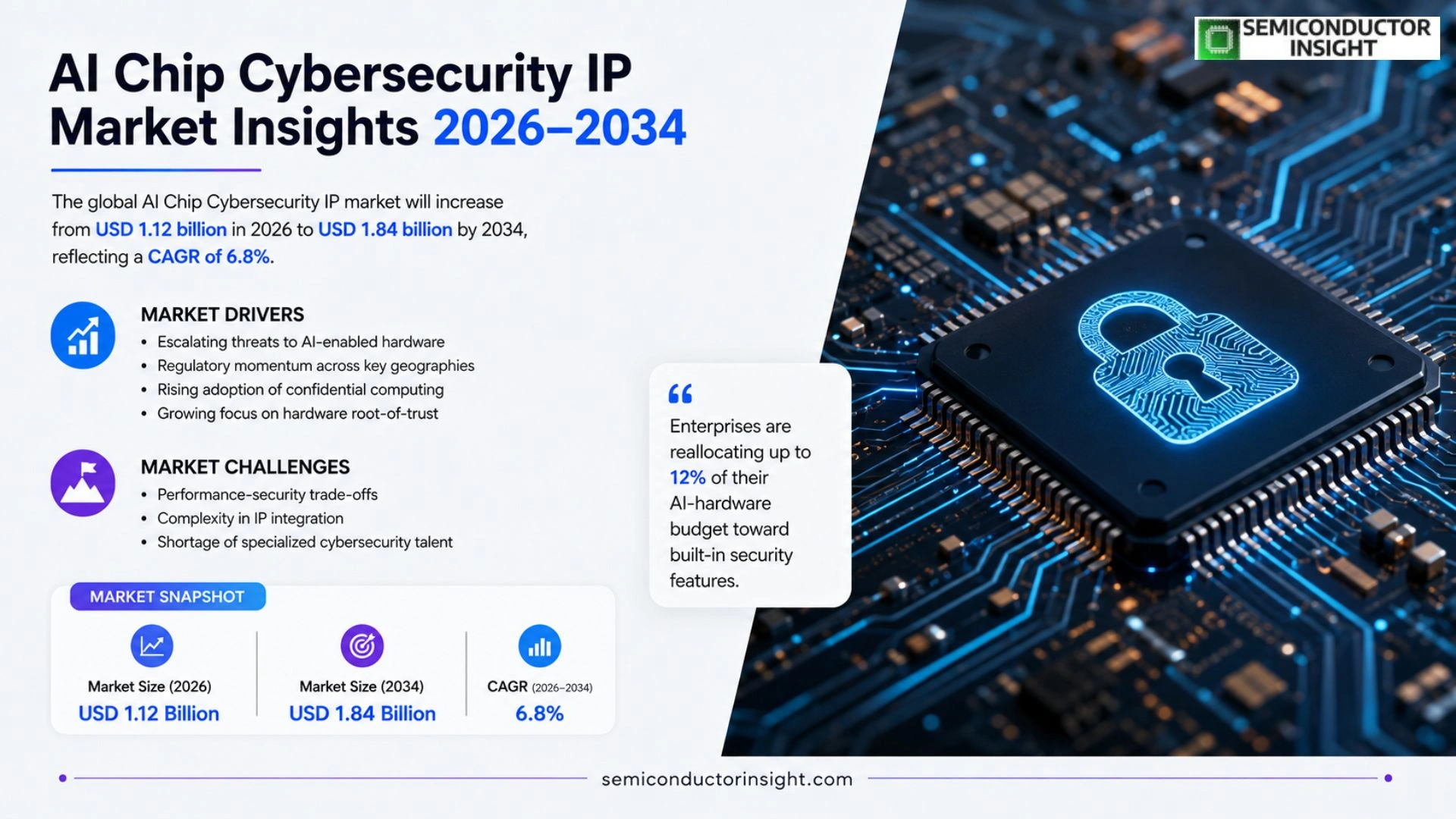
MARKET DRIVERS
Escalating Threats to AI‑Enabled Hardware
The proliferation of AI accelerators in data centers and edge devices has created a lucrative target surface for sophisticated attackers. Breaches that compromise inference models can exfiltrate proprietary algorithms, prompting vendors to embed robust security IP directly into silicon. Protecting the compute layer therefore becomes a prerequisite for maintaining competitive advantage.
Regulatory Momentum Across Key Geographies
Legislative initiatives in the EU, United States, and several Asian economies now require encryption and tamper‑proof features for AI processors used in critical infrastructure. Companies that fail to certify their chips risk market exclusion, which accelerates investment in dedicated cybersecurity IP blocks. Compliance pressure is turning into a catalyst for market expansion.
➤ “Enterprises are reallocating up to 12 % of their AI‑hardware budget toward built‑in security features.”
Venture capital flows into startups focusing on cryptographic cores, side‑channel resistance, and secure boot solutions underscore the financial vigor behind this trend. As AI workloads become mission‑critical, AI chip cybersecurity IP Market is seeing a steady inflow of capital and strategic partnerships.
MARKET CHALLENGES
Performance‑Security Trade‑offs
Integrating advanced security mechanisms can introduce latency and power overhead that erode the efficiency gains promised by AI accelerators. Design teams often grapple with balancing throughput against protection, leading to deferred adoption in latency‑sensitive applications such as autonomous driving.
Other Challenges
Talent Shortage
Skilled engineers who understand both hardware cryptography and AI inference pipelines remain scarce, inflating development costs and extending time‑to‑market for secure chip solutions.
MARKET RESTRAINTS
High Capital Expenditure for IP Integration
Embedding security IP demands additional silicon area and verification cycles, which can increase bill of materials by 8‑15 %. For OEMs operating under thin margins, this cost premium acts as a deterrent, especially in commodity‑grade AI chips where price sensitivity is acute.
The fragmented nature of the IP ecosystem forces vendors to negotiate multiple licensing agreements, complicating supply‑chain management and inflating legal overhead.
Furthermore, legacy systems that lack reconfigurable security blocks cannot be retrofitted easily, creating a lock‑in effect that slows overall market penetration.
MARKET OPPORTUNITIES
Secure AI Edge Deployments
Edge devices such as smart cameras, industrial robots, and IoT gateways are beginning to host on‑device inference models. Protecting these distributed nodes from tampering opens a sizable niche for lightweight yet resilient security IP. Companies that can deliver low‑power, post‑quantum capable cores stand to capture a growing slice of the edge market.
Another avenue lies in licensing models that bundle security updates with firmware services. Subscription‑based protection schemes enable continuous vulnerability remediation, aligning revenue streams with the recurring nature of cybersecurity threats.
Finally, cross‑industry collaborations,particularly between semiconductor firms and cloud service providers,are fostering standards for secure AI compute. Early adopters that align their product roadmaps with emerging specifications can secure preferential access to ecosystem partners and benefit from network effects that accelerate market adoption.
AI Chip Cybersecurity IP Market Trends
Escalating Investment in Secure Silicon
Semiconductor manufacturers are allocating noticeably larger portions of their R&D budgets to protect AI accelerators at the silicon level. The shift reflects a growing acknowledgment that traditional software‑only defenses cannot fully mitigate side‑channel leakage, model extraction, or unauthorized firmware alterations in high‑throughput neural‑network engines. Embedded safeguards such as on‑chip cryptographic key stores, immutable secure‑boot chains, and continuous runtime attestation are being woven directly into the design of new GPUs and ASICs. Cloud service providers, which operate massive inference fleets, have begun to demand demonstrable hardware provenance as a prerequisite for contract awards. A tangible illustration occurred in July 2024 when NVIDIA signed a licensing agreement with a leading security vendor to integrate dedicated key‑management modules into its Hopper GPU lineup, cementing the trend toward built‑in protection mechanisms.
Other Trends
Standardization Momentum
International standards bodies are accelerating the definition of hardware‑level AI safety specifications, creating a de‑facto benchmark for vendors seeking to market secure AI chips. These emerging frameworks address not only cryptographic primitives but also verification protocols that validate the integrity of model parameters during runtime. As regulators in major data‑centric economies adopt these guidelines, compliance will transition from a competitive advantage to a market entry requirement, prompting firms to align product roadmaps with the nascent standards early in the development cycle.
Strategic Partnerships Shaping the Landscape
Beyond internal R&D, collaboration between chip designers and specialty security firms is reshaping the value chain. Joint ventures enable rapid incorporation of proven attestation techniques without incurring the full cost of in‑house development. Recent announcements highlight alliances where AI chip producers license patented verification frameworks, thereby accelerating time‑to‑market for secure silicon solutions. For customers, the ripple effect is clearer procurement criteria: vendors that can substantiate hardware‑level IP protection are more likely to secure long‑term contracts, especially in sectors such as finance and autonomous systems where data integrity is non‑negotiable. These partnership dynamics suggest that AI chip cybersecurity IP Market will increasingly reward firms that blend cutting‑edge performance with verifiable security guarantees.
COMPETITIVE LANDSCAPE
Key Industry Players
Assessing Competitive Positioning in Secure AI Chip IP
AI chip cybersecurity IP arena is anchored by a handful of semiconductor powerhouses that command the majority of design‑right portfolios and licensing activity. NVIDIA, with its recent cryptographic key‑management partnership for the Hopper GPU family, illustrates how a leading graphics‑processor maker transforms a traditional performance asset into a security differentiator, attracting cloud providers that require verifiable inference pipelines. Intel follows a parallel trajectory, embedding secure‑boot and attestation blocks across its Xeon line‑up and leveraging its extensive patent estate to set de‑facto standards for data‑center silicon. AMD, now encompassing the Xilinx portfolio, adds programmable logic capabilities that enable bespoke encryption modules for edge deployments, while Qualcomm’s Snapdragon AI accelerators incorporate on‑chip key stores that appeal to mobile OEMs seeking hardware‑level protection. The concentration of IP within these firms creates a tiered licensing ecosystem in which large customers gravitate toward the broad‑scope solutions of the top three, leaving room for niche collaborations and cross‑licensing arrangements.
Beyond the dominant tier, a diverse group of specialists is shaping the next wave of protection mechanisms tailored to emerging workloads. Graphcore’s IPAM (Intelligent Architecture Management) suite introduces runtime attestation optimized for its proprietary M‑Series IPU, positioning the firm as a go‑to partner for high‑frequency trading firms. Cerebras offers a wafer‑scale engine with integrated side‑channel resistance, a feature that resonates with research institutions handling massive model training tasks. MediaTek’s mid‑range AI cores now embed lightweight key‑vaults, expanding secure silicon into consumer‑grade devices. Huawei’s HiSilicon continues to file patents on secure firmware update paths, despite regulatory pressures, while Alibaba Cloud’s custom ASICs embed proprietary verification protocols that differentiate its public‑cloud inference services. These players, though smaller in market share, supply critical plug‑ins that larger chipmakers often lack, fostering a competitive environment where innovation is measured not only by raw performance but by the depth of embedded security functions.
List of Key AI Chip Cybersecurity IP Companies Profiled
- NVIDIA
- Intel
- AMD
- Qualcomm
- Samsung Electronics
- TSMC
- Xilinx (AMD)
- ARM Holdings
- Marvell Technology
- Broadcom Inc.
- Graphcore
- Cerebras Systems
- MediaTek
- Huawei (HiSilicon)
- Alibaba Cloud (Aliyun)
Segment Analysis:
| Segment Category | Sub-Segments | Key Insights |
| By Type |
|
Cryptographic Key Management enables AI accelerators to store encryption keys within protected silicon enclaves, reducing exposure to external probing; It creates a foundation for trusted execution that aligns with emerging hardware‑level AI safety standards; Design teams appreciate the modularity of key‑store IP, allowing rapid integration across diverse GPU and ASIC families. |
| By Application |
|
Cloud Data Center Inference demands robust protection against model extraction, prompting providers to embed IP that continuously verifies firmware integrity; The high‑throughput nature of data‑center GPUs benefits from lightweight attestation that does not impede inference latency; Vendors highlight the strategic advantage of offering a seamless security layer that aligns with service‑level trust commitments. |
| By End User |
|
Cloud Service Providers view integrated security IP as a prerequisite for differentiated AI offerings, enabling them to assure customers that inference models remain confidential; Their internal security teams value IP that simplifies compliance with emerging hardware‑level AI regulations; Strategic partnerships with IP vendors accelerate roadmap alignment, ensuring that next‑generation accelerators ship with built‑in threat mitigation. |
| By Security Feature |
|
Side‑Channel Resistance is prized for its ability to mask power and electromagnetic signatures, thwarting attackers who attempt to reverse‑engineer neural‑network parameters; Design philosophies increasingly embed noise‑generation and randomization directly within the silicon, providing a transparent shield without sacrificing performance; Customers appreciate a holistic approach where side‑channel defenses coexist with other security primitives in a unified IP bundle. |
| By Deployment Model |
|
On‑Premise Silicon appeals to organizations that require absolute control over hardware trust chains, allowing them to embed IP directly into custom ASICs; Hosted Secure IP Services offer a flexible subscription model where security updates can be delivered over the air, aligning with the rapid evolution of threat landscapes; Hybrid Integrated Solutions blend on‑device protection with cloud‑based attestation, delivering a layered defense that satisfies both latency‑sensitive and centrally managed use cases. |
Regional Analysis: AI Chip Cybersecurity IP Market
The talent pool in the United States and Canada blends cryptographic research with silicon expertise, fostering cross‑disciplinary teams that can translate algorithmic breakthroughs into silicon‑level implementations. Universities are increasingly offering joint programs that attract engineers keen on securing AI workloads at the hardware tier.
Federal guidance surrounding critical infrastructure protection has nudged chip makers toward embedding provenance‑tracking modules. While the rules are still evolving, the expectation of compliance drives early adoption of secure boot and attestation features within AI chips.
Suppliers are re‑engineering foundry processes to incorporate side‑channel resistance as a standard parameter. This shift reduces the need for post‑fab add‑ons, streamlining production and lowering the barrier for smaller vendors to enter the security‑focused segment.
Venture capitalists are allocating capital to firms that can demonstrate a viable pathway from AI model protection to silicon patents. The emphasis is on firms that own both the algorithmic IP and the physical implementation, creating a defensible market position.
Europe
European nations are orchestrating a coordinated response to AI‑driven security challenges, with collaborative frameworks that link research institutes to chip manufacturers across the continent. The emphasis on data‑privacy legislation has prompted hardware designers to prioritize built‑in anonymization capabilities, ensuring compliance without sacrificing performance. Cross‑border consortia are sharing threat intelligence, which fuels the development of adaptable security kernels that can be licensed across multiple fab sites. This collective approach softens the competitive pressure on individual players, allowing them to focus on niche innovations such as quantum‑resistant encryption cores embedded directly within AI accelerators.
Asia‑Pacific
In the Asia‑Pacific arena, rapid adoption of AI workloads by cloud providers fuels a surge in demand for chips that can safeguard large model deployments. National strategies in several economies stress self‑reliance, encouraging domestic fabs to integrate proprietary security blocks into AI silicon. The region’s manufacturing scale brings cost advantages, yet the fragmented regulatory environment creates divergent security standards. Companies that can navigate these variations and offer modular security IP find a receptive market, especially as OEMs look to differentiate their AI offerings through embedded trust mechanisms.
South America
South American markets are transitioning from import‑reliant models toward localized design hubs, driven by governmental incentives aimed at bolstering digital sovereignty. Although the ecosystem is still maturing, early adopters are experimenting with hardware‑rooted authentication to protect critical sectors such as finance and energy. Partnerships between regional universities and multinational foundries are accelerating knowledge transfer, positioning the continent to develop bespoke security IP that addresses region‑specific threat vectors, such as satellite‑link interception.
Middle East & Africa
The Middle East and Africa are witnessing nascent activity in AI chip security, primarily spurred by sovereign cloud initiatives that require end‑to‑end protection. Strategic investments are being directed toward building design capabilities that integrate tamper‑evident modules into AI processors. While the talent pipeline is still developing, collaborations with established global vendors provide a conduit for technology transfer. The focus on ruggedized hardware for oil‑and‑gas operations drives interest in chips that can maintain integrity under extreme conditions, opening a niche for security‑centric IP developers.
Report Scope
This market research report provides a comprehensive analysis of the AI Chip Cybersecurity IP Market , covering the forecast period 2026–2034. It offers detailed insights into market dynamics, technological advancements, competitive landscape, and key trends shaping the industry.
Key focus areas of the report include:
- Market Overview: The report begins with an overview outlining its current market scenario, key growth indicators, and industry transformation drivers. It discusses macroeconomic factors, demand–supply balance, regulatory landscape, and the strategic role of semiconductors in powering advancements across industries such as automotive, telecommunications, consumer electronics, and industrial automation.
- Market Size & Forecast: Historical data and future projections for revenue, unit shipments, and market value across major regions and segments.
- Segmentation Analysis: Detailed breakdown by product type, technology, application, and end-user industry to identify high-growth segments and investment opportunities.
- Regional Insights: Insights into market performance across North America, Europe, Asia-Pacific, Latin America, and the Middle East & Africa, including country-level analysis where relevant.
- Competitive Landscape: Profiles of leading market participants, including their product offerings, R&D focus, manufacturing capacity, pricing strategies, and recent developments such as mergers, acquisitions, and partnerships.
- Technology Trends & Innovation: Assessment of emerging technologies, integration of AI/IoT, semiconductor design trends, fabrication techniques, and evolving industry standards.
- Market Drivers & Restraints: Evaluation of factors driving market growth along with challenges, supply chain constraints, regulatory issues, and market-entry barriers.
- Stakeholder Insights: Insights for component suppliers, OEMs, system integrators, investors, and policymakers regarding the evolving ecosystem and strategic opportunities.
Primary and secondary research methods are employed, including interviews with industry experts, data from verified sources, and real-time market intelligence to ensure the accuracy and reliability of the insights presented.
FREQUENTLY ASKED QUESTIONS:
What is the current market size of AI Chip Cybersecurity IP Market?
-> AI chip cybersecurity IP Market was valued at USD 1.05 billion in 2025 and is expected to reach USD 1.84 billion by 2034, reflecting a CAGR of 6.8 % over the forecast period.
Which key companies operate in AI Chip Cybersecurity IP Market?
-> Key players include NVIDIA and leading security vendors that provide cryptographic key management solutions for AI accelerators.
What are the key growth drivers?
-> Key growth drivers include increased R&D investments for secure silicon, rising demand from cloud service providers for trustworthy inference platforms, and emerging international standards for hardware‑level AI safety.
Which region dominates the market?
-> Regional dominance is not explicitly disclosed in the provided data; the market is considered global with significant activity across major semiconductor hubs.
What are the emerging trends?
-> Emerging trends include integration of cryptographic key management into GPU architectures (e.g., NVIDIA Hopper) and the development of hardware‑level AI safety standards.

Get Sample Report PDF for Exclusive Insights
Report Sample Includes
- Table of Contents
- List of Tables & Figures
- Charts, Research Methodology, and more...
 Download Sample Report PDF