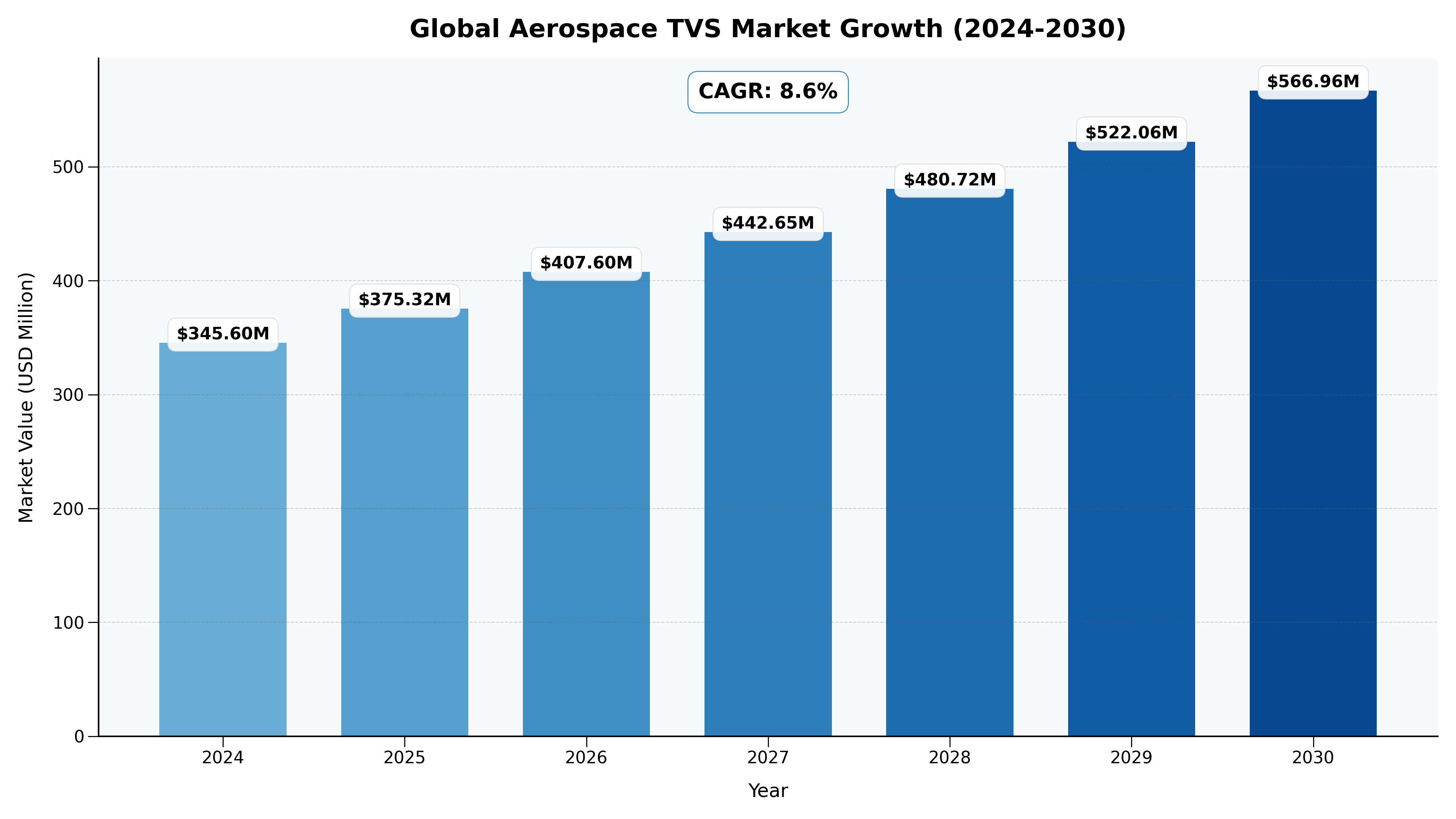
The Global Aerospace TVS Market size was valued at US$ 345.6 million in 2024 and is projected to reach US$ 566.96 million by 2030, at a CAGR of 8.6% during the forecast period 2024-2030.
The United States Aerospace TVS market size was valued at US$ 91.2 million in 2024 and is projected to reach US$ 146.5 million by 2030, at a CAGR of 8.2% during the forecast period 2024-2030.
High-reliability TVS devices for aerospace applications.
Report Overview
This report provides a deep insight into the global Aerospace TVS market covering all its essential aspects. This ranges from a macro overview of the market to micro details of the market size, competitive landscape, development trend, niche market, key market drivers and challenges, SWOT analysis, value chain analysis, etc.
The analysis helps the reader to shape the competition within the industries and strategies for the competitive environment to enhance the potential profit. Furthermore, it provides a simple framework for evaluating and accessing the position of the business organization. The report structure also focuses on the competitive landscape of the Global Aerospace TVS Market, this report introduces in detail the market share, market performance, product situation, operation situation, etc. of the main players, which helps the readers in the industry to identify the main competitors and deeply understand the competition pattern of the market.
In a word, this report is a must-read for industry players, investors, researchers, consultants, business strategists, and all those who have any kind of stake or are planning to foray into the Aerospace TVS market in any manner.
Global Aerospace TVS Market: Market Segmentation Analysis
The research report includes specific segments by region (country), manufacturers, Type, and Application. Market segmentation creates subsets of a market based on product type, end-user or application, Geographic, and other factors. By understanding the market segments, the decision-maker can leverage this targeting in the product, sales, and marketing strategies. Market segments can power your product development cycles by informing how you create product offerings for different segments.
Key Company
- Infineon
- Nexperia
- SEMTECH
- Vishay
- Littelfuse
- BrightKing
- Amazing
- STMicroelectronics
- ON Semiconductor
- WAYON
- Diodes Inc.
- Bourns
- LAN technology
- ANOVA
- MDE
- TOSHIBA
- UN Semiconductor
- PROTEK
- INPAQ
- EIC
- SOCAY
- Uni-polar TVS
- Bi-polar TVS
- Military Aerospace
- Civil Aerospace
- North America (USA, Canada, Mexico)
- Europe (Germany, UK, France, Russia, Italy, Rest of Europe)
- Asia-Pacific (China, Japan, South Korea, India, Southeast Asia, Rest of Asia-Pacific)
- South America (Brazil, Argentina, Columbia, Rest of South America)
- The Middle East and Africa (Saudi Arabia, UAE, Egypt, Nigeria, South Africa, Rest of MEA)
- Industry drivers, restraints, and opportunities covered in the study
- Neutral perspective on the market performance
- Recent industry trends and developments
- Competitive landscape & strategies of key players
- Potential & niche segments and regions exhibiting promising growth covered
- Historical, current, and projected market size, in terms of value
- In-depth analysis of the Aerospace TVS Market
- Overview of the regional outlook of the Aerospace TVS Market:
- Access to date statistics compiled by our researchers. These provide you with historical and forecast data, which is analyzed to tell you why your market is set to change
- This enables you to anticipate market changes to remain ahead of your competitors
- You will be able to copy data from the Excel spreadsheet straight into your marketing plans, business presentations, or other strategic documents
- The concise analysis, clear graph, and table format will enable you to pinpoint the information you require quickly
- Provision of market value (USD Billion) data for each segment and sub-segment
- Indicates the region and segment that is expected to witness the fastest growth as well as to dominate the market
- Analysis by geography highlighting the consumption of the product/service in the region as well as indicating the factors that are affecting the market within each region
- Competitive landscape which incorporates the market ranking of the major players, along with new service/product launches, partnerships, business expansions, and acquisitions in the past five years of companies profiled
- Extensive company profiles comprising of company overview, company insights, product benchmarking, and SWOT analysis for the major market players
- The current as well as the future market outlook of the industry concerning recent developments which involve growth opportunities and drivers as well as challenges and restraints of both emerging as well as developed regions
- Includes in-depth analysis of the market from various perspectives through Porters five forces analysis
- Provides insight into the market through Value Chain
- Market dynamics scenario, along with growth opportunities of the market in the years to come
- 6-month post-sales analyst support
In case of any queries or customization requirements, please connect with our sales team, who will ensure that your requirements are met.
Drivers
- Increasing Demand for Aircraft Electronics
The growing adoption of advanced avionics and electronic systems in modern aircraft, including navigation, communication, and control systems, has significantly driven the demand for TVS devices. These components are essential to protect sensitive electronic circuits from voltage surges, ensuring reliability and safety. - Rising Focus on Safety and Reliability
Aerospace systems operate in harsh environments with significant exposure to electrical transients caused by lightning strikes, electromagnetic interference (EMI), and switching operations. The critical nature of aerospace applications emphasizes the need for robust surge protection, which TVS devices provide effectively. - Growth in Space Exploration and Satellite Launches
The increasing number of satellite launches and investments in space exploration programs by governments and private entities worldwide has amplified the need for durable and high-performance TVS components. These devices protect vital electronics in satellites from radiation-induced transients and voltage spikes. - Advancements in TVS Technology
Innovations in TVS devices, such as enhanced power-handling capabilities, reduced clamping voltage, and miniaturization, have made them more suitable for aerospace applications. These advancements cater to the evolving requirements of lightweight and compact electronic systems in modern aircraft and spacecraft.
Restraints
- High Manufacturing Costs
The stringent quality and performance standards required for aerospace-grade TVS devices increase production costs. Specialized materials, extensive testing, and certifications contribute to higher costs, limiting market growth among price-sensitive buyers. - Complex Certification Processes
Aerospace TVS components must comply with rigorous industry standards, such as DO-160 and MIL-STD-461, which prolong product development timelines and add to expenses. The lengthy certification processes may discourage new entrants and innovation. - Limited Suppliers of Aerospace-Grade TVS Devices
The aerospace sector demands TVS components with exceptional reliability and performance. The limited number of suppliers capable of meeting these requirements creates supply chain constraints and potential price volatility.
Opportunities
- Increasing Electrification in Aerospace
The transition towards more electric aircraft (MEA) and the adoption of electric propulsion systems present new opportunities for TVS manufacturers. As electrical systems become more integral to aerospace platforms, the need for robust surge protection solutions will rise. - Emerging Markets in Asia-Pacific
The rapid expansion of the aerospace industry in emerging markets, such as China and India, due to rising air travel demand and government investments in defense and space sectors, provides lucrative opportunities for TVS manufacturers. - Integration of TVS in UAVs and Drones
Unmanned Aerial Vehicles (UAVs) and drones are witnessing increased adoption for military, commercial, and research purposes. These systems require compact and efficient TVS solutions to safeguard their sensitive electronics from power surges and EMI. - Focus on Sustainability
With the aerospace industry’s emphasis on reducing carbon emissions, the development of greener aircraft technologies involves advanced electrical systems that rely on robust TVS devices to ensure performance and safety.
Challenges
- Harsh Operating Environments
Aerospace TVS devices must withstand extreme conditions such as wide temperature ranges, high altitudes, and exposure to cosmic radiation. Developing devices that perform reliably under these conditions poses technical challenges. - Competition from Alternative Technologies
Other surge protection technologies, such as Metal Oxide Varistors (MOVs) and Gas Discharge Tubes (GDTs), can compete with TVS diodes in certain applications. Market players must continually innovate to maintain their edge. - Short Product Lifecycle in Aerospace Electronics
Rapid technological advancements in aerospace electronics require TVS manufacturers to frequently update their product offerings. The need to stay ahead in terms of compatibility and performance adds pressure on R&D and operational efficiency. - Economic Uncertainty and Budget Constraints
Fluctuations in defense and aerospace budgets, particularly in regions experiencing economic instability, can impact the adoption of TVS devices. Market participants need to navigate these uncertainties to sustain growth.

Get Sample Report PDF for Exclusive Insights
Report Sample Includes
- Table of Contents
- List of Tables & Figures
- Charts, Research Methodology, and more...
 Download Sample Report PDF