MARKET INSIGHTS
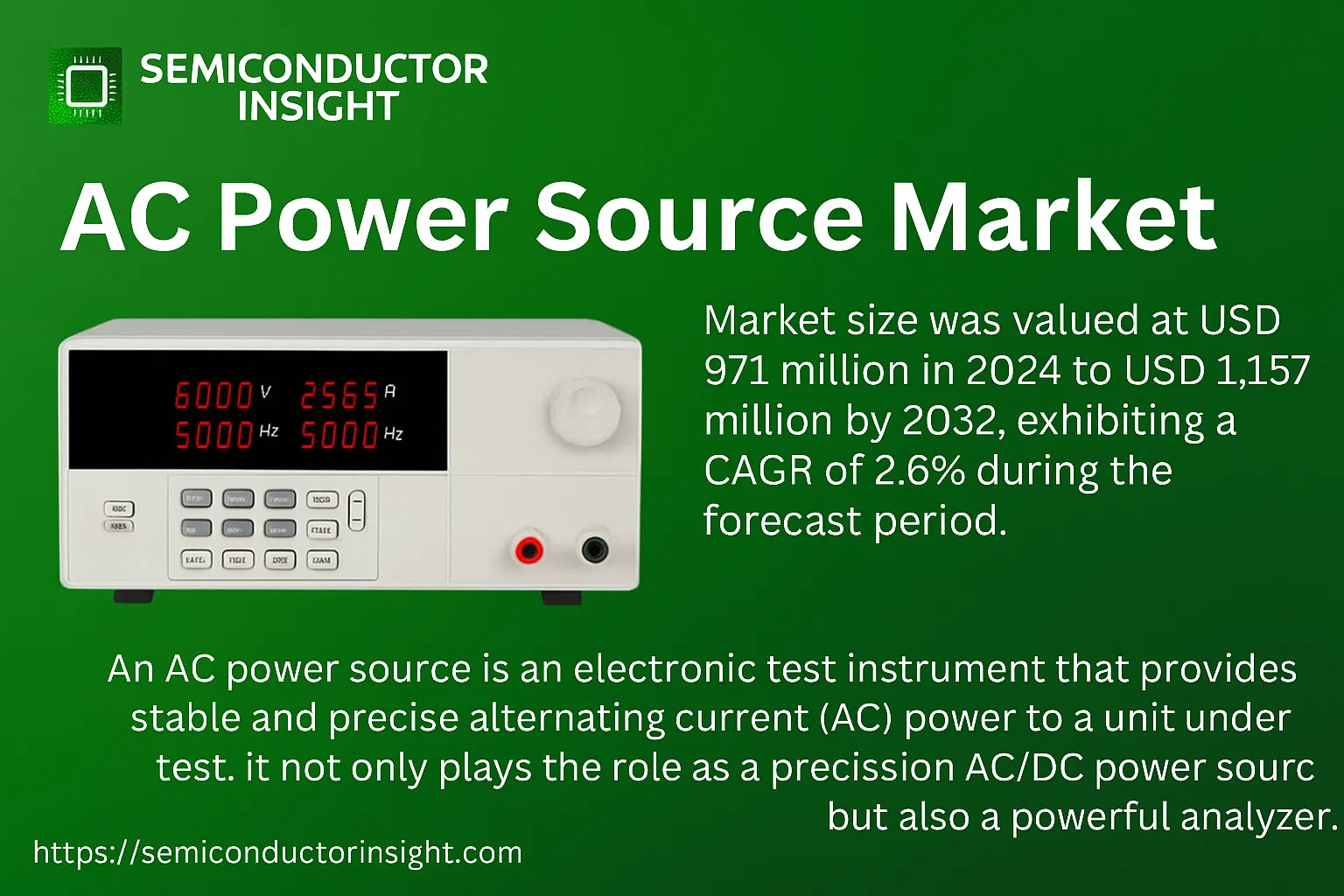
Global AC Power Source Market size was valued at USD 971 million in 2024 to USD 1,157 million by 2032, exhibiting a CAGR of 2.6% during the forecast period.
An AC power source is an electronic test instrument that provides stable and precise alternating current (AC) power to a unit under test. It not only plays the role as a precision AC/DC power source but also a powerful analyzer. These devices contain abundant features for the testing and characteristic analysis of power supplies, electronic devices, components, and modules, offering programmable control over voltage, frequency, and waveform.
The market is experiencing steady growth driven by increasing demand for reliable power testing across various industries. Key factors include the expansion of the electronics manufacturing sector and stringent quality assurance standards. Furthermore, the rising adoption of renewable energy systems necessitates advanced AC sources for grid simulation and inverter testing. Initiatives by key players are also expected to fuel market growth. For instance, manufacturers are continuously developing products with higher power density and enhanced digital interfaces to meet evolving industry needs. North America is the largest regional market for AC power sources, holding a share of about 37%. Ainuo Instrument, Chroma Systems Solutions, AMETEK, Keysight, and ITECH are among the top manufacturers in the industry.
MARKET DRIVERS
Demand from Electronics Manufacturing and Testing
Global expansion of consumer electronics, electric vehicles (EVs), and industrial automation is a primary driver for the AC Power Source Market. These industries require highly reliable and precise AC power supplies for Research & Development (R&D), design validation, and production line testing. The need to simulate various global power grid conditions, including voltage fluctuations and harmonic distortions, to ensure product compliance and reliability is fueling market growth.
Growth in Renewable Energy Integration
The rapid adoption of renewable energy sources, particularly solar and wind power, necessitates advanced AC power sources for testing inverters and other grid-interconnection equipment. Inverters must efficiently convert DC power to stable, grid-compliant AC power, requiring sophisticated testing with programmable AC sources that can mimic real-world grid behavior and fault conditions.
Furthermore, stringent government regulations and international standards for energy efficiency and electromagnetic compatibility (EMC) mandate rigorous product testing, further propelling the demand for high-performance AC power sources.
MARKET CHALLENGES
High Initial Investment and Cost Sensitivity
The significant capital expenditure required for high-precision, programmable AC power sources can be a barrier to entry for small and medium-sized enterprises (SMEs) and research labs. These sophisticated instruments represent a substantial investment, making cost a critical factor in purchasing decisions and potentially limiting market penetration in price-sensitive segments.
Other Challenges
Technical Complexity and Skilled Labor Shortage
Operating and maintaining advanced AC power sources requires specialized technical knowledge. A shortage of skilled technicians and engineers who can fully utilize the complex features of these systems can hinder their effective deployment and slow down adoption rates.
Competition from Used Equipment and Local Players
The market faces competition from the availability of reliable refurbished equipment, which offers a lower-cost alternative for budget-conscious buyers. Additionally, the rise of local manufacturers, particularly in the Asia-Pacific region, offering lower-priced products intensifies price competition.
MARKET RESTRAINTS
Economic Volatility and Supply Chain Disruptions
Global economic uncertainties and fluctuations in industrial production can lead to reduced capital spending on test and measurement equipment, including AC power sources. Furthermore, disruptions in the supply chain for critical components like semiconductors and power modules can lead to increased lead times and higher production costs, restraining market growth.
Maturation of Key End-Use Industries
While still growing, certain core end-use industries such as general consumer electronics are experiencing a level of maturity. This can lead to slower growth in demand for new test equipment compared to emerging sectors, acting as a moderating factor on the overall market expansion.
MARKET OPPORTUNITIES
Expansion of Electric Vehicle (EV) Infrastructure
Global push for electrification of transportation creates substantial opportunities. The development and testing of EV charging stations, onboard chargers, and power electronics require highly accurate AC power sources to ensure safety, efficiency, and compatibility with different grid standards, opening a significant new growth avenue.
Advancements in Aerospace and Defense Testing
Increasing investments in next-generation aircraft, unmanned aerial vehicles (UAVs), and defense systems drive the need for robust MIL-STD-704 compliant AC power sources. These applications demand equipment that can test avionics and electrical systems under extreme conditions, creating demand for high-power, high-frequency AC sources.
Adoption of Energy Storage Systems (ESS)
The integration of battery energy storage systems with renewable energy grids presents a key opportunity. Testing the bi-directional power converters and grid-support functions of these systems requires sophisticated AC power sources capable of simulating both source and load conditions, driving innovation and demand in the market.
AC Power Source Market Trends
Sustained Growth Driven by Precision Testing Requirements
Global AC Power Source market is on a trajectory of steady expansion, driven by its essential dual role as a precision power supply and a sophisticated analyzer. The market, valued at USD 971 million in 2024, is projected to reach USD 1157 million by 2032, reflecting a Compound Annual Growth Rate (CAGR) of 2.6% during the forecast period. This growth is underpinned by the increasing complexity of electronic devices and the stringent testing requirements across key industries. The instruments’ abundant features for testing and analyzing power supplies, components, and modules make them indispensable for ensuring product reliability and compliance with international standards.
Other Trends
Regional Market Dynamics
North America stands as the largest regional market, holding an estimated 37% share of the global AC Power Source market. This dominance is attributed to a strong industrial base, significant investments in research and development, and the presence of leading manufacturers. The market landscape is further characterized by consolidation among top players. Ainuo Instrument, Chroma Systems Solutions, AMETEK, Keysight, and ITECH represent the top five manufacturers in the industry, collectively accounting for approximately 37% of the market share. This concentration highlights the competitive nature of the market and the importance of technological leadership.
Segmentation and Application Trends
The market is segmented by type into Linear AC Power Sources and PWM (Pulse Width Modulation) AC Power Sources, each catering to specific performance and efficiency needs. In terms of application, Manufacture Test is a primary driver, utilizing these sources for quality assurance in production lines. Other significant application sectors include Aerospace, Energy, and Communication. The demand from the aerospace and communication sectors, in particular, is fueled by the critical need for highly reliable and stable power conditioning and testing solutions for sensitive electronic systems.
Competitive Landscape and Strategic Focus
The competitive environment is marked by continuous innovation as key players like Pacific Power Source, Kikusui Electronics, and Matsusada Precision focus on enhancing product features, accuracy, and user interface. Market participants are actively engaged in strategic developments, including mergers and acquisitions, to expand their product portfolios and geographic reach. The industry faces challenges such as price pressures and the need for continuous technological upgrades, but the persistent demand for precision power testing across evolving sectors like renewable energy and electric vehicles presents substantial growth opportunities for manufacturers who can navigate these dynamics effectively.
COMPETITIVE LANDSCAPE
Key Industry Players
A dynamic market characterized by technological innovation and strategic competition
Global AC Power Source market is moderately concentrated, with the top five manufacturers—Ainuo Instrument, Chroma Systems Solutions, AMETEK, Keysight, and ITECH—collectively holding approximately 37% of the market share as of 2024. These established players dominate due to their comprehensive product portfolios, strong R&D capabilities, extensive global sales networks, and longstanding reputation for precision and reliability in critical testing applications such as manufacturing, aerospace, and energy. North America is the largest regional market, accounting for about 37% of the global share, which further solidifies the position of key players with a strong foothold in this region. Competition is largely based on product performance, accuracy, power range, programmability, and the integration of advanced analysis features. Companies are engaged in continuous innovation to offer solutions that cater to the evolving needs of electronics testing, including support for renewable energy components and next-generation communication devices.
Beyond the dominant leaders, a range of significant niche players contribute to the competitive dynamics. Companies like Pacific Power Source and Kikusui Electronics are recognized for their high-power AC source solutions, serving demanding industrial and aerospace applications. MUNK and Matsusada Precision offer specialized, high-precision instruments popular in research and development laboratories. B&K Precision and Preen (AC Power Corp.) compete effectively in the mid-range segment, providing cost-effective solutions for general manufacturing test benches. Other important participants, including Behlman Electronics, NF Holdings Corp., and Jingtong Regulator, focus on specific regional markets or application segments, often competing on price, customization, and responsive customer support. This tiered structure ensures a competitive environment that drives technological advancement across all product categories.
List of Key AC Power Source Companies Profiled
- Ainuo Instrument
- Chroma Systems Solutions
- AMETEK Programmable Power
- Keysight Technologies
- ITECH
- Pacific Power Source
- Kikusui Electronics
- MUNK
- Preen (AC Power Corp.)
- B&K Precision Corp
- Matsusada Precision
- Behlman Electronics
- Jingtong Regulator
- NF Holdings Corp
Segment Analysis:
| Segment Category | Sub-Segments | Key Insights |
| By Type |
|
PWM AC Power Sources are demonstrating significant market leadership due to their superior efficiency, smaller physical footprint, and lighter weight compared to linear alternatives. These characteristics make PWM sources highly desirable in applications where space and power consumption are critical constraints. Their ability to handle a wide range of loads with good transient response further solidifies their position, particularly in modern electronics testing scenarios that demand compact and energy-efficient solutions without compromising on performance accuracy and reliability. |
| By Application |
|
Manufacture Test remains the dominant application segment for AC power sources, underpinned by the essential role these instruments play in production line quality assurance. The relentless global production of electronic components, consumer devices, and industrial equipment fuels consistent, high-volume demand for reliable testing solutions. AC power sources are critical for verifying performance under various voltage and frequency conditions, ensuring product reliability and compliance with international standards, which is a non-negotiable requirement for manufacturers aiming to maintain brand reputation and avoid costly recalls. |
| By End User |
|
Electronics & Semiconductor Companies constitute the leading end-user segment, driven by their fundamental need for precision power during both component development and high-volume manufacturing testing. The complexity and sensitivity of modern semiconductors and consumer electronics require power sources capable of providing clean, stable, and programmable AC power to simulate real-world conditions and stress-test designs. This segment’s growth is inextricably linked to technological advancements and the continuous miniaturization of electronics, which demand ever more sophisticated testing capabilities to ensure device integrity and functionality. |
| By Output Power Rating |
|
Medium Power (5 kVA – 20 kVA) units are the leading segment, effectively balancing versatility and capability to serve a broad spectrum of applications. This power range is ideally suited for benchtop testing in R&D labs, as well as for testing a wide array of industrial equipment and sub-assemblies on production lines. Their capacity is sufficient for testing most consumer electronics, telecommunications gear, and industrial controls, making them a highly practical and widely adopted solution that avoids the cost and size of high-power units while providing more capability than low-power alternatives. |
| By Phase Configuration |
|
Single-Phase AC power sources hold a dominant position in the market, primarily due to their alignment with the most common residential and commercial power standards globally. Their widespread use in testing consumer electronics, household appliances, IT equipment, and smaller industrial devices creates a substantial and steady demand. The relative simplicity and lower cost of single-phase systems compared to three-phase variants make them the default choice for a vast majority of standard testing applications, ensuring their continued leadership as the workhorse of the industry for general-purpose verification and quality control tasks. |
Regional Analysis: AC Power Source Market
The region’s dominance is underpinned by its role as the global electronics manufacturing center. This creates intrinsic demand for AC power sources used in quality assurance, burn-in testing, and compliance verification for a vast array of consumer electronics, industrial equipment, and telecommunications hardware before they are shipped worldwide.
Ambitious national targets for solar and wind energy adoption are driving the need for grid simulation and power conditioning equipment. AC power sources are critical for testing inverters, ensuring grid compatibility, and validating the performance of renewable energy systems under various simulated grid conditions, supporting the region’s energy transition.
The rapid expansion of the electric vehicle market, particularly in China, is a major growth driver. AC power sources are essential for developing and testing EV charging infrastructure, on-board chargers, and power electronics, with regional automakers and component suppliers investing heavily in advanced testing capabilities.
A strong focus on research and development within the consumer electronics, aerospace, and defense sectors sustains demand for high-precision, programmable AC power sources. Leading technology firms and research institutions require these instruments to pioneer next-generation devices and ensure they meet stringent performance and safety standards.
North America
North America represents a mature yet technologically advanced market for AC power sources, characterized by stringent regulatory standards and a high concentration of aerospace, defense, and telecommunications companies. The region’s demand is primarily driven by the need for highly reliable and precise power testing for critical infrastructure, military applications, and cutting-edge consumer electronics. The ongoing modernization of the power grid and increased investment in renewable energy projects also contribute to steady market growth. Furthermore, the presence of major automotive manufacturers and a growing electric vehicle ecosystem creates significant opportunities for power source applications in charging system development and component validation.
Europe
The European market is defined by its strong regulatory framework, particularly concerning energy efficiency and electromagnetic compatibility, which fuels demand for compliant testing equipment. The region’s robust automotive industry, with its rapid pivot towards electromobility, is a key consumer of AC power sources for EV powertrain and charging infrastructure testing. Additionally, significant investments in industrial automation, renewable energy integration, and aerospace sectors support a stable demand for high-quality power conversion and simulation tools. The presence of numerous research institutions and a focus on sustainable technology innovation further underpins the market’s strength.
South America
The South American market for AC power sources is emerging, with growth influenced by gradual industrial development and infrastructure modernization efforts, particularly in countries like Brazil and Argentina. Demand is primarily linked to the power generation sector, including hydropower and growing renewable energy projects, which require testing and commissioning equipment. The industrial manufacturing sector also contributes to demand for basic power source equipment for maintenance and quality control. However, the market growth is often tempered by economic volatility and slower adoption rates of advanced testing technologies compared to more developed regions.
Middle East & Africa
This region presents a mixed landscape for the AC Power Source Market. The Middle East, particularly the Gulf Cooperation Council countries, shows demand driven by large-scale infrastructure projects, investments in diversifying power generation (including solar), and a growing industrial base. In Africa, the market is more nascent, with demand primarily stemming from the telecommunications sector for base station power systems and small-scale renewable energy installations. Overall, market growth is closely tied to economic stability and the pace of industrial and energy infrastructure development across the diverse nations within the region.
Report Scope
This market research report provides a comprehensive analysis of the AC Power Source Market , covering the forecast period 2025–2032. It offers detailed insights into market dynamics, technological advancements, competitive landscape, and key trends shaping the industry.
Key focus areas of the report include:
- Market Overview: The report begins with an overview outlining its current market scenario, key growth indicators, and industry transformation drivers. It discusses macroeconomic factors, demand–supply balance, regulatory landscape, and the strategic role of semiconductors in powering advancements across industries such as automotive, telecommunications, consumer electronics, and industrial automation.
- Market Size & Forecast: Historical data and future projections for revenue, unit shipments, and market value across major regions and segments.
- Segmentation Analysis: Detailed breakdown by product type, technology, application, and end-user industry to identify high-growth segments and investment opportunities.
- Regional Insights: Insights into market performance across North America, Europe, Asia-Pacific, Latin America, and the Middle East & Africa, including country-level analysis where relevant.
- Competitive Landscape: Profiles of leading market participants, including their product offerings, R&D focus, manufacturing capacity, pricing strategies, and recent developments such as mergers, acquisitions, and partnerships.
- Technology Trends & Innovation: Assessment of emerging technologies, integration of AI/IoT, semiconductor design trends, fabrication techniques, and evolving industry standards.
- Market Drivers & Restraints: Evaluation of factors driving market growth along with challenges, supply chain constraints, regulatory issues, and market-entry barriers.
- Stakeholder Insights: Insights for component suppliers, OEMs, system integrators, investors, and policymakers regarding the evolving ecosystem and strategic opportunities.
Primary and secondary research methods are employed, including interviews with industry experts, data from verified sources, and real-time market intelligence to ensure the accuracy and reliability of the insights presented.
FREQUENTLY ASKED QUESTIONS:
What is the current market size of AC Power Source Market?
-> AC Power Source Market size was valued at USD 971 million in 2024 to USD 1,157 million by 2032, exhibiting a CAGR of 2.6% during the forecast period.
Which key companies operate in AC Power Source Market?
-> Key players include Ainuo Instrument, Chroma Systems Solutions, AMETEK, KEYSIGHT, ITECH, Pacific Power Source, Kikusui Electronics, MUNK, Preen (AC Power Corp.), B&K Precision Corp, AMETEK Programmable Power, Matsusada Precision, Behlman Electronics, Jingtong Regulator, and NF Holdings Corp, among others.
What are the key growth drivers?
-> Key growth drivers include the critical role of AC Power Sources as precision power sources and powerful analyzers for testing and characteristic analysis of power supplies, electronic devices, components, and modules, driving demand across various industries.
Which region dominates the market?
-> North America is the largest region for the AC Power Source market, with a share of about 37%.
What are the emerging trends?
-> Emerging trends include technological advancements in AC Power Sources that enhance their analytical capabilities and testing features for a wide range of electronic components and devices.

Get Sample Report PDF for Exclusive Insights
Report Sample Includes
- Table of Contents
- List of Tables & Figures
- Charts, Research Methodology, and more...
 Download Sample Report PDF