
MARKET INSIGHTS
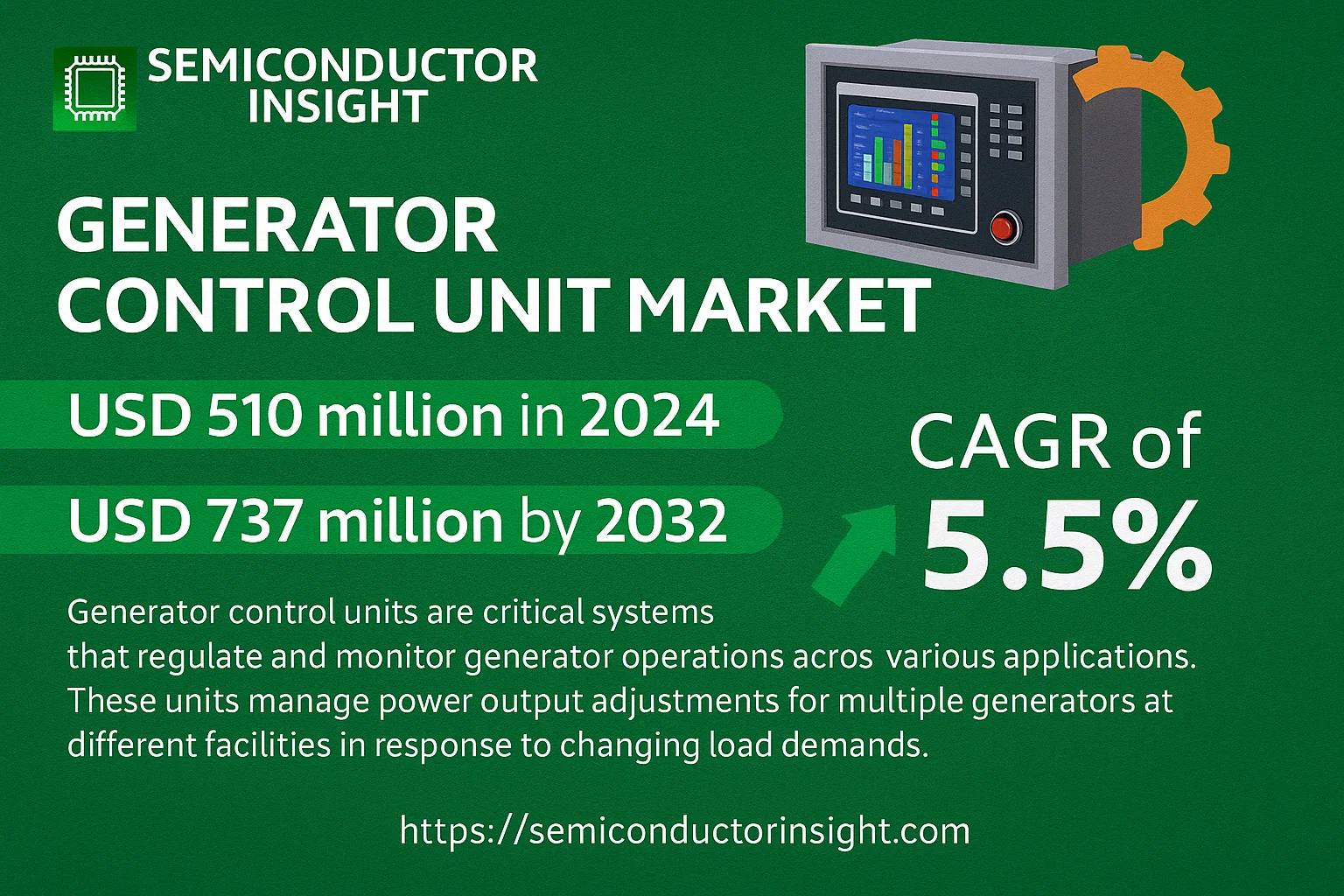
Global Generator Control Unit Market size was valued at USD 510 million in 2024 to USD 737 million by 2032, exhibiting a CAGR of 5.5% during the forecast period.
Generator control units are critical systems that regulate and monitor generator operations across various applications. These units manage power output adjustments for multiple generators at different facilities in response to changing load demands. Since electrical grids require precise balance between generation and consumption, these controllers make frequent adjustments to maintain system stability by monitoring frequency changes – increased frequency indicates excess generation while decreased frequency signals insufficient power supply.
The market is experiencing steady growth driven by increasing demand for reliable power backup solutions, expansion of industrial infrastructure, and growing adoption of automated control systems. Additionally, rising investments in smart grid technologies and renewable energy integration are contributing to market expansion. Key industry players are actively developing advanced digital control units with enhanced monitoring capabilities. For instance, leading manufacturers like GE, Comap, DSE, Kohler and Emerson collectively hold significant market share, with the top three companies accounting for approximately 31% of total revenue. Europe represents the largest regional market with about 30% share, followed closely by North America at approximately 29%, reflecting mature infrastructure development and stringent power reliability requirements.
MARKET DRIVERS
Rising Demand for Uninterrupted Power Supply
The increasing reliance on digital infrastructure and Global push towards electrification are primary drivers for the Generator Control Unit (GCU) market. The critical need for backup power in data centers, healthcare facilities, telecommunications, and industrial operations to prevent costly downtime is fueling demand. With Global data center power market projected to grow significantly, advanced GCUs are essential for managing generator sets efficiently and ensuring seamless automatic transfer during grid failures.
Stringent Emission Regulations and Fuel Efficiency
Governments worldwide are imposing stricter emissions standards, such as the EPA’s Tier 4 regulations in the US and Stage V in Europe, compelling manufacturers to adopt sophisticated GCUs. These advanced control units optimize engine performance, monitor emissions in real-time, and ensure compliance, while also improving fuel efficiency by up to 15% compared to older manual systems.
The integration of the Internet of Things (IoT) and Industrial IoT (IIoT) is a significant driver, enabling real-time diagnostics, predictive maintenance, and remote control of generator sets. This reduces operational costs and enhances reliability, making smart GCUs a preferred choice for modern power generation assets.
MARKET CHALLENGES
High Initial Investment and System Integration
The adoption of advanced GCUs, particularly those with smart features like IoT connectivity and sophisticated software, requires significant capital investment. Integrating these new control units with existing legacy power systems and diverse manufacturer equipment presents technical challenges and can lead to increased project timelines and costs, which may deter some potential buyers.
Other Challenges
Cybersecurity Vulnerabilities
As GCUs become more connected, they are increasingly susceptible to cyber-attacks. Protecting critical power infrastructure from potential threats requires robust security protocols, which adds another layer of complexity and cost for both manufacturers and end-users.
Supply Chain Disruptions
The GCU market, like many electronics-dependent industries, faces challenges from global semiconductor shortages and supply chain instability. This can lead to increased component costs and longer lead times for manufacturing, potentially hampering market growth.
MARKET RESTRAINTS
Competition from Alternative Power Sources
The growth of the GCU market is restrained by the increasing adoption of alternative and renewable energy sources with integrated energy storage systems (ESS), such as large-scale battery storage. These systems can provide immediate backup power without the need for a generator start-up, reducing the demand for traditional generator sets and their associated control units in some applications.
Economic Volatility and Capital Expenditure Delays
Global economic uncertainties and fluctuations can lead to delays or reductions in capital expenditure for industrial and commercial projects that utilize generator sets. During periods of economic downturn, investments in new power generation equipment, including advanced GCUs, are often deferred, acting as a significant restraint on market expansion.
MARKET OPPORTUNITIES
Expansion of Microgrids and Distributed Generation
Global trend towards decentralized power generation through microgrids presents a substantial opportunity for the GCU market. Generator sets are a core component of many microgrids for reliability, and advanced GCUs are essential for managing their operation, synchronization with renewables, and participation in grid services, creating a growing niche market.
Development of Hybrid Power Systems
There is a significant opportunity in the development of integrated control solutions for hybrid systems that combine generators with solar PV, wind, and battery storage. GCUs that can intelligently manage multiple power sources to ensure optimal efficiency and reliability are in high demand, particularly in remote and off-grid applications.
Growth in Emerging Markets
Rapid industrialization, urbanization, and ongoing infrastructure development in emerging economies across Asia-Pacific, Latin America, and Africa present a strong growth frontier. The need for reliable power backup in these regions, coupled with less saturated markets, offers significant expansion opportunities for GCU manufacturers.
Generator Control Unit Market TrendsSteady Growth Anchored in Grid Modernization
Global Generator Control Unit (GCU) market is on a consistent growth trajectory, valued at USD 510 million in 2024 and projected to reach USD 737 million by 2032, exhibiting a compound annual growth rate (CAGR) of 5.5%. This expansion is primarily driven by the escalating global demand for reliable power backup solutions and significant investments in modernizing aging power infrastructures. Modern GCUs are integral to managing power output across multiple generators, ensuring the precise balance between generation and consumption required for electrical grid stability. These systems make continuous adjustments by monitoring frequency changes, where increased frequency signals excess generation and decreased frequency indicates insufficient supply, thereby maintaining system integrity and preventing outages.
Other Trends
Shifting Regional Dynamics
Europe represents the largest regional production market, accounting for approximately 30% of Global total, closely followed by North America at about 29%. This market concentration reflects the regions’ advanced industrial infrastructure and stringent regulatory requirements for power reliability. The competitive landscape is characterized by significant market share held by a few key players, with the top three manufacturers GE, COMAP, and DSE collectively accounting for roughly 31% of total market revenue. This indicates a moderately concentrated market where technological leadership and established customer relationships are critical competitive advantages.
Market Segmentation and Application Evolution
The market is segmented by technology into Analog-Based and Digital-Based units, with a clear trend favoring digital systems due to their superior precision, enhanced monitoring capabilities, and better integration with smart grid technologies. In terms of application, the Power Plant sector remains the dominant end-user, driven by the critical need for stable and continuous power generation. Significant growth is also observed in the Industrial Manufacturing and Transportation sectors, where operational continuity depends on robust backup power systems. This diversification underscores the expanding role of GCUs beyond traditional power generation into critical infrastructure support.
Convergence with Smart Technologies
A major trend is the integration of IoT capabilities and predictive maintenance features into Generator Control Units. Leading manufacturers are developing intelligent systems that enable real-time remote monitoring, predictive analytics for maintenance scheduling, and enhanced cybersecurity to protect critical infrastructure. This technological evolution addresses the growing complexity of power grids and the increasing integration of renewable energy sources, which require highly responsive and adaptable control systems. The move towards standardized, modular designs also facilitates easier installation and scalability, meeting the diverse needs of a rapidly evolving energy landscape.
COMPETITIVE LANDSCAPE
Key Industry Players
A Consolidated Market Dominated by Global Technology Leaders
Global Generator Control Unit Market is characterized by a consolidated competitive environment with a few major players holding significant market share. GE, COMAP, and DSE are identified as the clear market leaders, with the top three producers collectively accounting for approximately 31% of the total market. These companies leverage their extensive global presence, strong R&D capabilities, and broad product portfolios catering to diverse applications from power plants to industrial manufacturing. Their dominance is further reinforced by long-standing relationships with key end-users in critical infrastructure sectors, making market entry for new players challenging. Europe stands as the largest production region, contributing about 30% to Global market, closely followed by North America at approximately 29%, indicating the geographical concentration of major manufacturing and technological hubs.
Beyond the top tier, the market includes several well-established and specialized niche players that compete effectively in specific segments or regions. Companies such as Kohler and Emerson are prominent players with strong brand recognition. The competitive landscape also features specialized firms like Deif, Beckwith, and Avionic Instruments, which focus on advanced control solutions for marine, power generation, and aerospace applications. Asian manufacturers, including Smartgen and Kutai, are increasingly significant, offering competitive products and contributing to the market’s growth, particularly within the Asia-Pacific region. These companies often compete on factors such as product reliability, technical support, and price, creating a dynamic and multi-layered competitive environment.
List of Key Generator Control Unit Companies Profiled
- GE
- COMAP
- Deep Sea Electronics (DSE)
- Kohler
- Emerson
- Avionic Instruments
- Deif
- Beckwith
- Smartgen
- Jenoptik
- HCT
- Lamar Technologies
- Dongguan Tuan Cheng
- Harsen
- Enovation Controls
- Kutai
- Blandon Systems
Segment Analysis:
| Segment Category | Sub-Segments | Key Insights |
| By Type |
|
Digital Based units are firmly established as the leading segment, driven by their superior precision for real-time frequency stabilization and superior integration with modern smart grid infrastructures. The market is undergoing a significant and sustained transition from analog systems towards sophisticated digital platforms that offer enhanced programmability, comprehensive remote monitoring capabilities, and advanced communication protocols. This shift is fundamental for managing the complex demands of contemporary power generation, where adaptability to changing energy loads and grid conditions is paramount for operational stability and efficiency across the board. |
| By Application |
|
Power Plant application remains the most dominant and critical segment due to the fundamental requirement for precise, large-scale control over generator output to maintain a continuous balance between supply and demand on the electrical grid. The operational imperative for grid frequency stability in these facilities necessitates highly reliable and sophisticated control units that can make moment-to-moment adjustments, making them a major driver of market demand. While growth is robust in transportation and industrial sectors for backup power, the scale, complexity, and criticality of power generation facilities solidify this segment’s leading position, fostering continuous technological advancement from manufacturers. |
| By End User |
|
Utilities and Grid Operators represent the predominant end-user segment, as they are the primary entities responsible for the reliable functioning of the entire electrical network. Their absolute need for sophisticated control units to manage base load and peak load power plants, ensuring grid reliability and frequency control, drives substantial and continuous investment. This segment typically engages in long-term partnerships with leading manufacturers, demanding high-capacity, feature-rich systems that are customized for seamless integration and offer unparalleled reliability. The critical nature of their operations makes them less price-sensitive and more focused on performance and long-term support, shaping the high-end segment of the market. |
| By Control Feature |
|
Automatic Generation Control (AGC) is the pivotal and most sophisticated control feature, directly addressing the core market need for balancing generator output with the constantly fluctuating electrical load in real-time. The demand for highly responsive and accurate AGC capabilities is paramount, as it is essential for maintaining system-wide stability by instantly correcting frequency deviations. This feature’s inherent complexity and critical importance make it a primary area for innovation and a key differentiator among high-end product offerings from leading manufacturers, who continuously invest in refining these algorithms to enhance grid responsiveness and efficiency. |
| By Sales Channel |
|
Direct Sales (OEM) is the dominant channel, especially for critical, large-scale power generation projects supplied to major utilities and industrial clients. The technical complexity of Generator Control Units and the necessity for seamless, customized integration with generator sets foster a strong preference for direct manufacturer relationships. This channel allows companies like GE and Kohler to provide comprehensive solutions directly, ensuring expert technical support, precise system design from the initial specification stage, and robust warranty management. This direct engagement is crucial for meeting the exacting requirements of clients for whom system reliability and performance are non-negotiable. |
Regional Analysis: Generator Control Unit Market
The region’s relentless industrial expansion and large-scale infrastructure projects, including ports, transportation networks, and urban development, are primary drivers. These sectors demand high-reliability power backup, creating a sustained market for sophisticated generator control units that ensure operational continuity and protect critical assets from power disruptions, far exceeding demand in other global regions.
Governments across the region are actively bolstering national energy security through policies that encourage or mandate backup power for critical facilities like hospitals, data centers, and telecommunications. This strategic focus generates consistent demand for advanced control units with features for grid paralleling, automatic transfer, and remote monitoring, making it a policy-driven market.
A robust local manufacturing ecosystem for generators, sensors, and electronic components provides a significant cost and supply chain advantage. This allows for the rapid development and customization of control units tailored to specific regional requirements and price points, fostering innovation and making advanced technology accessible to a broader customer base.
There is a growing emphasis on integrating generator sets with renewable energy sources like solar power to create hybrid microgrids, particularly in remote or island communities. This trend is driving demand for intelligent control units capable of sophisticated power management, load sharing, and optimizing generator run-time, positioning the region as a hub for hybrid control system development.
North America
The North American market for generator control units is characterized by a mature yet stable demand, driven largely by the need for high reliability in critical infrastructure. The region has a well-established base of data centers, healthcare facilities, and telecommunications networks that require uninterruptible power supplies with sophisticated monitoring and control capabilities. Strict regulatory standards and building codes, particularly in sectors like healthcare and finance, mandate reliable backup power systems, which fuels the adoption of advanced control units featuring remote diagnostics, cloud connectivity, and compliance reporting. The market is also influenced by a trend towards replacing aging generator fleets with newer, more efficient models that incorporate digital control panels, creating a steady replacement cycle. Furthermore, the increasing frequency of severe weather events has heightened the focus on residential and commercial standby power, broadening the market base for user-friendly control systems.
Europe
Europe represents a significant market for generator control units, with demand shaped by a strong emphasis on energy efficiency, emissions reduction, and integration with renewable energy systems. The region’s stringent environmental regulations, such as the EU’s emissions standards for off-road engines, drive the need for control units that can optimize generator performance to minimize fuel consumption and pollutant output. There is growing demand for control systems that enable the seamless operation of generators in hybrid configurations with solar, wind, and battery storage, particularly in the commercial and industrial sectors aiming for energy independence. The market is also supported by critical infrastructure projects and a reliable base of industrial applications. Additionally, the need for backup power in the telecommunications and data center sectors, coupled with a focus on smart grid compatibility, supports the adoption of intelligent and networked control solutions.
Middle East & Africa
The Middle East and Africa region exhibits strong growth potential for generator control units, primarily fueled by infrastructure development, unreliable grid power in many areas, and economic diversification efforts. In the Middle East, nations focused on economic diversification beyond oil are investing heavily in construction, tourism, and industrial projects, all of which require dependable power and sophisticated control systems. The region’s extreme climate conditions also necessitate robust backup power for cooling and essential services. Across Africa, the market is driven by limited grid coverage and frequent power outages, making generators a primary power source for businesses, mines, and telecommunications. This creates demand for durable and often remote-monitoring capable control units that can operate reliably in challenging environments. The uptake of hybrid power systems incorporating solar energy is also beginning to influence control unit specifications.
South America
The South American market for generator control units is developing, with demand influenced by economic fluctuations, infrastructure gaps, and a growing industrial sector. Countries with large industrial bases, such as Brazil, see demand from manufacturing and mining operations that require reliable power to maintain productivity in the face of an occasionally unstable electrical grid. The commercial sector, including retail and office buildings, also contributes to demand for standby power solutions. Hydropower-dependent nations are increasingly vulnerable to droughts, highlighting the need for backup generation and thus control units. While the market is price-sensitive, there is a gradual trend towards adopting more advanced control features for better efficiency and remote management, particularly in larger industrial and utility-scale applications. Renewable energy integration is a slower but emerging driver.
Report Scope
This market research report provides a comprehensive analysis of the Generator Control Unit Market , covering the forecast period 2025–2032. It offers detailed insights into market dynamics, technological advancements, competitive landscape, and key trends shaping the industry.
Key focus areas of the report include:
- Market Overview: The report begins with an overview outlining its current market scenario, key growth indicators, and industry transformation drivers. It discusses macroeconomic factors, demand–supply balance, regulatory landscape, and the strategic role of semiconductors in powering advancements across industries such as automotive, telecommunications, consumer electronics, and industrial automation.
- Market Size & Forecast: Historical data and future projections for revenue, unit shipments, and market value across major regions and segments.
- Segmentation Analysis: Detailed breakdown by product type, technology, application, and end-user industry to identify high-growth segments and investment opportunities.
- Regional Insights: Insights into market performance across North America, Europe, Asia-Pacific, Latin America, and the Middle East & Africa, including country-level analysis where relevant.
- Competitive Landscape: Profiles of leading market participants, including their product offerings, R&D focus, manufacturing capacity, pricing strategies, and recent developments such as mergers, acquisitions, and partnerships.
- Technology Trends & Innovation: Assessment of emerging technologies, integration of AI/IoT, semiconductor design trends, fabrication techniques, and evolving industry standards.
- Market Drivers & Restraints: Evaluation of factors driving market growth along with challenges, supply chain constraints, regulatory issues, and market-entry barriers.
- Stakeholder Insights: Insights for component suppliers, OEMs, system integrators, investors, and policymakers regarding the evolving ecosystem and strategic opportunities.
Primary and secondary research methods are employed, including interviews with industry experts, data from verified sources, and real-time market intelligence to ensure the accuracy and reliability of the insights presented.
FREQUENTLY ASKED QUESTIONS:
What is the current market size of Generator Control Unit Market?
-> Global Generator Control Unit Market was valued at USD 510 million in 2024 and is projected to reach USD 737 million by 2032, exhibiting a CAGR of 5.5% during the forecast period.
Which key companies operate in Generator Control Unit Market?
-> Key players include GE, COMAP, DSE, Kohler, and Emerson, among others, with the top three players accounting for approximately 31% of the total market.
What are the key growth drivers?
-> Key growth drivers include the imperative for power grid stability, the need for moment-to-moment balance between generation and load, and frequent adjustments to generator output in response to changes in system frequency.
Which region dominates the market?
-> Europe is the largest production market, accounting for about 30% of the total market, followed by North America with about 29%.
What are the emerging trends?
-> Emerging trends include the evolution from Analog Based to Digital Based control units, along with increasing adoption across Power Plant, Transportation, and Industrial Manufacturing applications.

Get Sample Report PDF for Exclusive Insights
Report Sample Includes
- Table of Contents
- List of Tables & Figures
- Charts, Research Methodology, and more...
 Download Sample Report PDF


