Key Statistics
Key Takeaways
- Market value: the GaN power discrete device market increases from USD 186.94 million in 2025 to USD 717.27 million by 2034, with a forecast CAGR of 16.1% during 2026–2034, as device-level integration improves efficiency in compact power supplies and larger conversion systems.
- Voltage leadership: GaN Power >600V is the largest modeled type at ~62% of 2025 value, supported by a broad 650V product catalogue, while the 200V–600V category represents ~25% and devices below 200V account for ~13%.
- Application mix: Power Supply holds a modeled ~42% share, followed by Electric Vehicles at ~17% and Data Center & Telecom at ~16%; switching-loss reduction and reduced power-stage size underpin demand across these different purchasing environments.
- Regional structure: Asia-Pacific leads with an estimated ~43% of revenue, North America follows at ~25%, and Europe accounts for ~23%; supplier qualification, device fabrication and system-design ecosystems explain the regional pattern.
- Commercial constraints: semiconductor fabrication cost, switching-noise control and qualification risk remain material restraints, while 650V bidirectional devices and improved package cooling create opportunities for new converter topologies.
GaN Power Discrete Device Market Overview
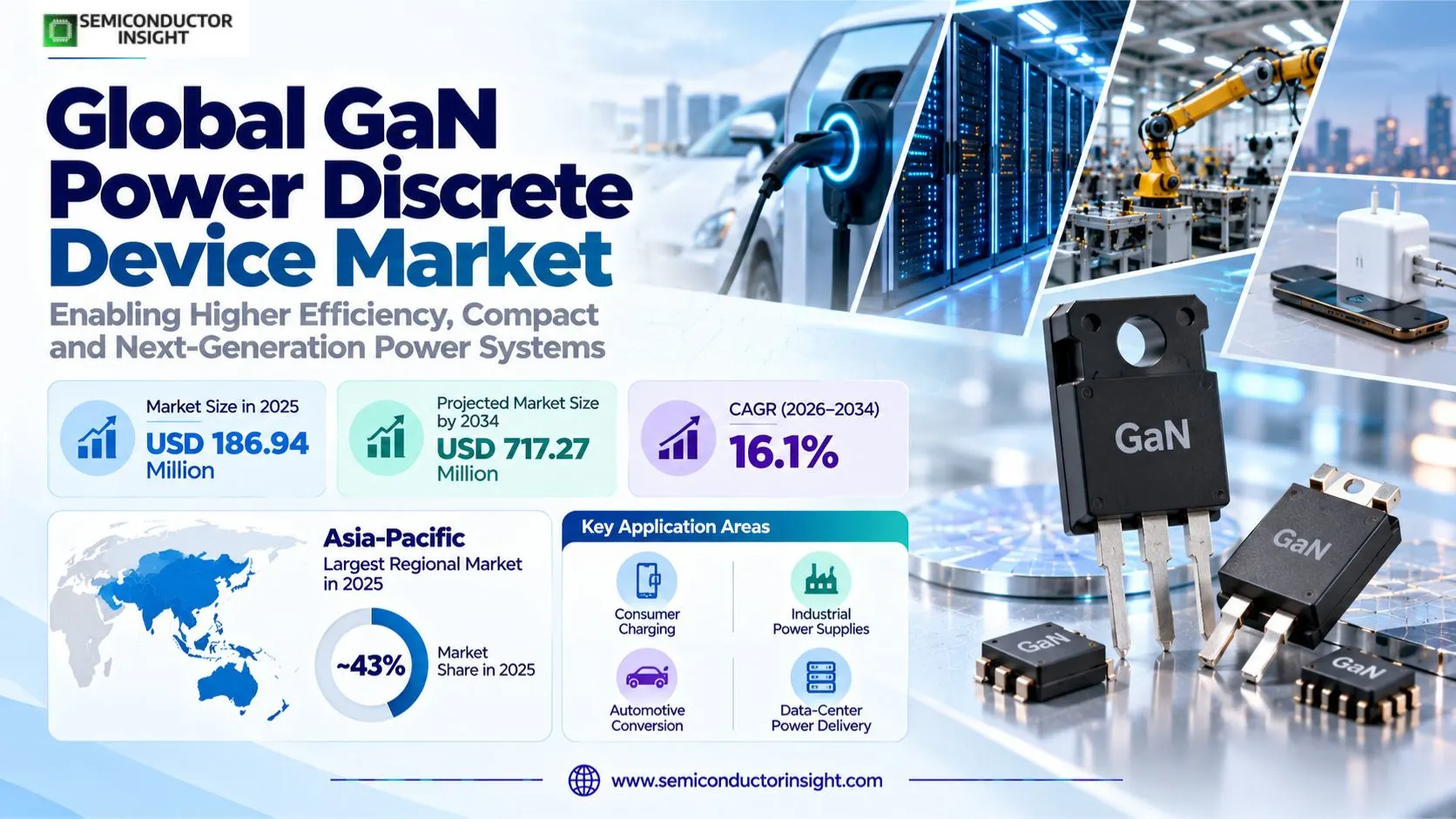
GaN power discrete device market was valued at USD 186.94 million in 2025 and is projected to reach USD 717.27 million by 2034, representing a CAGR of 16.1% over 2026–2034. Asia-Pacific leads the regional market at an estimated ~43% of 2025 revenue, with demand spread across consumer charging, industrial power supplies, automotive conversion and data-center power delivery.
GaN power discrete devices are individual semiconductor switching components made with gallium nitride structures rather than conventional silicon-only channels. Their attraction is a combination of low switching charge, rapid transitions and the potential to reduce magnetic and cooling requirements in a complete power stage. They are sold in a variety of packages and voltage classes, ranging from compact 100V enhancement-mode transistors to 650V devices intended for high-density conversion.
The revenue boundary includes merchant GaN power transistors, packaged single-switch devices and qualifying products that incorporate a driver while retaining a single-device switching function. Complete multi-switch power modules, finished chargers, inverters, bare substrates and unrelated radio-frequency power-amplifier products are excluded. The distinction matters because a power-supply manufacturer may buy one integrated 650V transistor as a component while a separate equipment supplier sells an entire converter containing several such parts.
The monetary framework begins with a global market value of USD 161 million in 2024 and an endpoint of USD 532 million in 2032. Those two values imply annual compound growth of about 16.1143%, giving an estimated 2026 value of USD 217.07 million and a 2034 level above USD 717 million. The published 17.8% headline growth label is inconsistent with its monetary endpoints, so the numerical forecast follows the endpoints rather than the inconsistent percentage.
Product evolution is changing the buyer’s integration choices. Infineon offers 650V CoolGaN G5 transistors in top-side and bottom-side cooled packages, while Texas Instruments integrates drivers, protection and temperature reporting with 600V or 650V switching devices. At the opposite end of the voltage spectrum, EPC provides compact enhancement-mode switches whose appeal is controlled switching charge and board-level power density rather than mains-voltage blocking capability. These different form factors create distinct price, qualification and distribution dynamics inside one device market.
Commercial adoption depends on more than peak efficiency in a demonstration. Engineers examine dynamic on-resistance, gate-drive tolerance, switching-node ringing, transient protection and package thermal impedance before replacing a silicon design. Automotive and industrial customers may require long reliability histories, while consumer charger producers place a heavier weight on cost and assembly simplicity. The result is a market with broad technical applicability but uneven speed of conversion into production orders.
Segment Analysis: By Type
Voltage segmentation separates GaN Power >600V, GaN Power 200V-600V and GaN Power <200V. Devices above 600V lead with modeled ~62% share in 2025 and ~17.0% segment CAGR; 200V–600V products hold ~25% and grow near ~14.7%, while below-200V components represent ~13% with modeled ~13.9% growth. The >600V class includes 650V and 900V subcategories, whereas low-voltage offerings include 100V and 150V designs.
| Type | Device characteristics | Commercial position |
|---|---|---|
| GaN Power >600V | The high-voltage group is anchored by 650V enhancement-mode transistors used in offline AC-DC supplies, photovoltaic conversion, data-center equipment and electric-vehicle charging. Infineon lists top-side cooled 25mΩ and 35mΩ CoolGaN G5 variants, while Renesas offers a 650V device with a dual-side-cooled 8 × 8 mm package. The publisher also names 900V variants, but their commercial maturity should not be inferred from 650V catalogue availability. | Largest type at modeled ~62% share. Broad product selection and power-supply demand support the category, with estimated ~17.0% annual expansion. Customers evaluate switching loss, thermal paths and transient performance under specific converter topologies, so higher voltage alone does not guarantee a design win. Competition is especially active around 650V devices, where different cooling and integration approaches address distinct equipment constraints. |
| GaN Power 200V-600V | Intermediate-voltage GaN devices can support specialized DC conversion, industrial power stages and systems whose electrical buses exceed low-voltage point-of-load ranges without requiring the highest offline ratings. The category covers a range of current and package options rather than one standard product. Engineers choose it when voltage headroom, gate-drive complexity and switching speed offer a better total power-stage solution than using an oversized 650V part. | Modeled ~25% share in 2025. The segment grows at an estimated ~14.7% as intermediate-bus architectures and compact industrial converters expand selectively. Its demand is more fragmented than mainstream 650V charging applications, and the product selection process is often controlled by the OEM’s established driver and protection design. Price competition with mature silicon MOSFETs is particularly relevant in this voltage range. |
| GaN Power <200V | Low-voltage enhancement-mode GaN transistors serve 48V DC-DC conversion, point-of-load power stages, brushless motor control, LiDAR and synchronous rectification. EPC2090 is specified at 100V and 5.2mΩ, while EPC2367 offers a 100V, 101A device with 1.2mΩ typical on-resistance. The smaller switching charge and package footprint can matter more than absolute voltage rating in tightly constrained low-voltage assemblies. | Modeled ~13% share in 2025. Growth near ~13.9% reflects adoption in specialized high-frequency systems, where the customer must justify the device premium against low-cost silicon MOSFETs. Wafer-level and chip-scale packaging can support small form factors, but layout quality and thermal management remain essential. This category is not interchangeable with high-voltage GaN used in mains-connected chargers. |
High-voltage GaN power devices and cooling choices
Infineon offers a 650V transistor in a top-side cooled DSO package and a related bottom-side cooled format, illustrating that thermal connection is an important part of the device specification. Extracting heat through two package faces can ease the power-density trade-off in densely populated conversion boards, provided mechanical contact and isolation are designed together. Designers compare the electrical loop, package mounting and achievable junction temperature together; an identical voltage label can conceal substantial differences in integration cost.
Low-voltage GaN devices for 48V and point-of-load systems
EPC’s 100V portfolio demonstrates how GaN is used below mains-voltage conversion, where board area and switching frequency influence compact power distribution. A 100V transistor specified for tens of amperes can support a 48V converter without the cost and gate-drive compromises of an unnecessarily high-voltage device. The commercial challenge is that silicon MOSFET suppliers have extensive offerings in this range, requiring clear system-level performance advantages.
Segment Analysis: By Application
Applications are Power Supply, Wireless Charging, Electric Vehicles, Industrial Motor Drives, Data Center & Telecom and Others. Power Supply leads at modeled ~42% of 2025 value, while Electric Vehicles hold ~17% and Data Center & Telecom ~16%. Wireless Charging and Industrial Motor Drives each contribute ~10%, with the remaining ~5% assigned to specialized systems.
| Application | Demand characteristics |
|---|---|
| Power Supply | Offline AC-DC converters, fast chargers and industrial switch-mode power supplies use GaN devices to raise switching frequency and reduce passive-component dimensions. This category leads at modeled ~42% of 2025 revenue, reflecting a broad base of consumer and professional equipment. Suppliers compete on electrical robustness, package integration and cost per converted watt rather than device switching speed alone, because a finished adapter must satisfy safety and electromagnetic standards. |
| Wireless Charging | Resonant power-transfer circuits can benefit from fast transitions and reduced switching loss, especially where compact coils and control electronics constrain available space. Wireless Charging accounts for a modeled ~10% share and grows near ~14.2% annually. The market includes consumer accessories and specialized industrial charging, but the commercial value depends on system efficiency, alignment tolerance and controller compatibility rather than the GaN transistor specification in isolation. |
| Electric Vehicles | Onboard chargers, auxiliary DC-DC conversion and selected high-frequency vehicle power stages create demand for high-voltage GaN devices. Electric Vehicles represent an estimated ~17% share and the fastest modeled application growth near ~18.4%. Innoscience and Inovance reported a 6.6kW charger system using 650V GaN in December 2025, illustrating how device qualification can translate into a complete vehicle power solution. |
| Industrial Motor Drives | Motor-control inverters and compact drive electronics need predictable switching under changing load and temperature conditions. This application contributes a modeled ~10% of 2025 value with an estimated ~14.6% growth profile. Lower switching loss can improve equipment efficiency, but the device must survive repeated transients and maintain stable operation in electrically noisy environments. Procurement often follows long industrial equipment redesign cycles. |
| Data Center & Telecom | Power-delivery systems for computing racks and telecom infrastructure place growing value on efficient conversion and compact thermal designs. Data Center & Telecom holds a modeled ~16% share and ~17.4% annual growth. Renesas introduced a 650V dual-side cooled device aimed at high-density 800V architectures in September 2026, while Navitas has described a 400V distribution converter using its GaNSense technology. |
| Others | Medical supplies, specialized lighting, robotics, aerospace support equipment and niche converters form the modeled ~5% remainder. These uses can favor GaN where switching behavior solves a specific size or energy problem, but order sizes vary and technical qualification is application-specific. Some defense and communications systems use RF GaN amplifiers, which are not automatically part of the power-discrete revenue boundary considered here. |
The same GaN transistor family can appear in several application categories without creating multiple device sales. A 650V switch may be designed into an automotive charger or a data-center supply, but revenue belongs to the end-use channel that purchases the component. The commercial mix therefore depends on shipment destination and customer qualification rather than simply the number of published reference designs.
Regional Analysis
Asia-Pacific accounts for a modeled ~43% of the 2025 GaN power discrete device market, with an estimated ~18.0% regional CAGR. North America follows at ~25% and ~15.3% growth, while Europe represents ~23% and ~14.4%. South America at ~5% and the Middle East & Africa at ~4% are smaller demand pools where imported converters and industrial power systems shape component adoption.
How do regional semiconductor supply chains influence GaN discrete-device demand?
The regional market follows both semiconductor manufacturing geography and downstream design activity. Asian fabs and electronics assemblers support broad device availability; American engineering groups shape high-density converter specifications; European industrial suppliers emphasize reliability and controlled product life cycles. South American buyers typically access devices through equipment importers, whereas Middle Eastern and African demand is linked to renewable-energy and computing infrastructure projects. These differences influence which voltage classes and package formats win business.
| Region | Position | Growth outlook | Demand profile | What decides supplier selection |
|---|---|---|---|---|
| Asia-Pacific | Largest (~43%) | ~18.0% CAGR | Consumer electronics, EV components and fabs | Cost, fabrication scale and customer-specific qualification |
| North America | Second (~25%) | ~15.3% CAGR | Converter design and server power | Device models, thermal data and application engineering |
| Europe | Third (~23%) | ~14.4% CAGR | Industrial controls and automotive supply | Reliability, traceability and long-term product availability |
| South America | Fourth (~5%) | ~12.8% CAGR | Imported solar and motor equipment | Distribution inventory, warranties and currency exposure |
| Middle East & Africa | Fifth (~4%) | ~12.2% CAGR | Power infrastructure and data centers | Thermal qualification, project integrators and field service |
GaN Power Discrete Device Manufacturers and Competitive Landscape
Competition spans vertically integrated semiconductor manufacturers, low-voltage GaN specialists and suppliers that integrate drivers or protection into a packaged power switch. Infineon, EPC, Texas Instruments, Innoscience, onsemi and Navitas address different parts of the voltage and application mix. The product-level distinction matters because a broad power-semiconductor catalogue does not prove equivalent revenue from merchant GaN discrete devices.
Infineon offers CoolGaN 650V G5 transistors with alternative cooling orientations, while its acquisition of GaN Systems in October 2023 brought an established GaN portfolio under one owner. The company’s 300mm manufacturing roadmap is relevant to potential supply economics, but wafer processing milestones should not be counted as finished device sales. Customers compare package characteristics, availability and quality documentation before choosing between the 25mΩ and 35mΩ product options.
EPC is differentiated by enhancement-mode low-voltage GaN devices for 48V distribution, motor control and compact DC-DC conversion. Its 100V products include a 5.2mΩ EPC2090 and a 101A EPC2367, illustrating the range of current and die configurations available. These devices compete against mature silicon MOSFETs, so the economic case often depends on reducing switching losses and shrinking surrounding magnetic components rather than selling a higher-priced transistor.
Texas Instruments combines GaN switching with gate-drive and protection technology, offering 600V and 650V products that simplify power-stage control. STMicroelectronics markets MASTERGAN6 as an active 650V half-bridge system-in-package, which is relevant to integrated alternatives but should not be automatically treated as a standalone discrete-device shipment. onsemi announced GaNEXUS sampling across 40V–650V in June 2026, providing evidence of product entry rather than a verified market-share ranking.
Innoscience supplies GaN devices used in a documented vehicle onboard charger, while Navitas markets integrated GaNSense power products for high-density conversion. Renesas, which acquired Transphorm in 2024, offers 650V devices including bidirectional and dual-side-cooled variants. Mitsubishi Electric appears in the publisher’s competitive list, but its relevance should be assessed through specific products rather than assumed leadership in the standalone transistor segment. Former GaN Systems and Transphorm businesses are not counted as independent current owners.
Tier structure
| Tier | Companies | Basis of competition |
|---|---|---|
| Broad high-voltage platforms | Infineon Technologies; Texas Instruments; Renesas Electronics; onsemi | Suppliers with high-voltage GaN product lines, control technologies or manufacturing roadmaps that support 600V and 650V converter applications. They compete through qualification resources, package choices, protection integration and long-term availability. The group includes different levels of commercial maturity, so product launch and sampling announcements are not treated as equivalent audited shipment volumes. |
| Low-voltage and specialist suppliers | Efficient Power Conversion; Innoscience Technology; Navitas Semiconductor | Device makers offering differentiated 100V or 650V switching products and application support for compact supplies, vehicle electronics and high-density power delivery. EPC focuses on enhancement-mode discrete transistors, while Innoscience and Navitas also participate in integrated power designs. Their competitive strength depends on design wins, manufacturing consistency and total system performance rather than broad company revenue alone. |
| Adjacent integrated and ecosystem vendors | STMicroelectronics; Mitsubishi Electric Corporation; legacy GaN Systems | Organizations associated with integrated GaN stages, downstream power equipment or historical GaN businesses that influence device selection but should not be ranked as separate standalone-transistor leaders without direct sales evidence. ST’s MASTERGAN products illustrate integrated switching stages; GaN Systems is included within Infineon ownership. This classification prevents component, module and corporate-ownership boundaries from being conflated. |
Key companies profiled
- Infineon Technologies AG (including GaN Systems)
- onsemi
- Efficient Power Conversion (EPC)
- Innoscience Technology
- Texas Instruments Incorporated
- STMicroelectronics
- Navitas Semiconductor
- Mitsubishi Electric Corporation
- Renesas Electronics (including Transphorm)
GaN Power Discrete Device Production Capacity Analysis
Power-discrete capacity depends on epitaxial processing, device fabrication, wafer probing, package assembly and reliability screening. GaN-on-silicon manufacturing can leverage portions of established semiconductor infrastructure, but yield and switching-device quality require specialized control. A larger wafer diameter can improve potential die output without proving that every additional wafer becomes a qualified 650V transistor available to a converter manufacturer.
Moving a GaN process to a larger wafer diameter may increase potential chip throughput, but package qualification and customer design approvals remain separate commercial milestones. The company said a 300mm wafer offers 2.3 times the chip count of a 200mm wafer under comparable conditions. That comparison describes wafer geometry and potential processing economics, not a measured increase in global discrete-device market revenue or a guarantee of identical yield across device types.
Packaging remains a critical production variable because fast-switching GaN devices are sensitive to inductance, heat flow and gate-control tolerances. Package design now spans several ways of extracting heat from the silicon mounting surface, with the DSO, TOLT and QFN families imposing different converter assembly choices. Each approach changes the assembly process and thermal interface of the finished converter, so suppliers need package-specific screening and customer application support in addition to wafer output.
The availability of 100V products from EPC and 650V devices from multiple vendors shows a widening catalogue, but commercial capacity must be assessed at each qualified product level. Automotive parts require more demanding traceability and reliability documentation than many consumer charger components. Device makers that can maintain consistent electrical characteristics across lots and support customer redesigns are better positioned to convert fabrication investment into stable recurring sales.
GaN Power Discrete Device Market Dynamics: Drivers, Restraints and Opportunities
Demand rises when equipment makers can use GaN transistors to improve converter efficiency, power density or control performance without creating excessive qualification cost. Consumer charging, electric-vehicle power electronics and high-density computing provide different routes to adoption. Production yield, packaging expense, switching-noise management and mature silicon alternatives remain meaningful counterweights, particularly for price-sensitive equipment.
MARKET DRIVERS
Drivers Impact Analysis*
| Market Drivers | Impact Rank | CAGR Contribution (%) | 2026–2028 | 2029–2031 | 2032–2034 |
|---|---|---|---|---|---|
| Compact AC-DC chargers and power supplies | High | +6.20% | High | High | Medium |
| Automotive onboard charging and DC conversion | High | +4.80% | Medium | High | High |
| AI data-center and telecom power density | Medium-High | +3.70% | Medium | High | High |
| Improved 650V cooling and protection | Medium | +2.60% | High | High | Medium |
| Low-voltage 48V and motor-control adoption | Low-Medium | +1.80% | Medium | Medium | High |
| Others (wireless charging and specialized conversion) | Low | +0.90% | Low | Medium | Medium |
Fast-charging supplies create a broad component channel
Power-adapter manufacturers can justify GaN when a smaller converter and lower switching loss improve the final product’s size and operating temperature. The 650V class provides devices suitable for offline conversion, while integrated driver products reduce layout uncertainty. This creates a route to high-volume demand through established electronics assemblers, although cost and electromagnetic testing still influence which consumer product lines adopt the technology.
Vehicle power electronics broaden high-voltage demand
Innoscience and Inovance documented a 6.6kW onboard charger using 650V GaN devices, providing a concrete example of automotive system integration. Such applications require robust protection and predictable operation over long duty cycles, so qualification can take longer than in consumer accessories. Once an OEM approves a device, however, the supplier may benefit from sustained demand across the vehicle platform’s production life.
Computing power density favors advanced thermal packages
Renesas introduced a dual-side-cooled 650V device in September 2026 for high-density data-center architectures, emphasizing 20mΩ on-resistance and an 8 × 8 mm package. These characteristics address the need to manage heat in compact switching stages. Converter designers still evaluate the entire power architecture, but improved package cooling can help GaN devices compete for positions where thermal constraints previously favored other technologies.
Low-voltage GaN addresses demanding point-of-load conversion
EPC’s 100V portfolio includes devices for 48V DC-DC systems, brushless motor drives and synchronous rectification. The smaller electrical charge associated with GaN switching can permit higher operating frequencies and more compact passive components. Market expansion depends on proving that these system-level benefits outweigh the price and engineering familiarity of silicon MOSFETs, which remain highly competitive in low-voltage applications.
MARKET RESTRAINTS
Restraints Impact Analysis*
| Market Restraints | Impact Rank | CAGR Contribution (%) | 2026–2028 | 2029–2031 | 2032–2034 |
|---|---|---|---|---|---|
| Fabrication yield and device qualification cost | High | -1.60% | High | Medium | Medium |
| Package thermal and gate-drive complexity | Medium-High | -1.30% | High | High | Medium |
| Incumbent silicon and SiC alternatives | Medium | -0.70% | Medium | Medium | High |
| Others (design skills and sourcing uncertainty) | Low | -0.30% | Medium | Low | Low |
GaN fabrication requires consistent process control
Defect management, epitaxial uniformity and electrical screening influence the number of usable power transistors produced from each wafer. Larger manufacturing infrastructure can reduce unit costs over time, but a product must also satisfy the reliability requirements of its intended application. Suppliers without stable yield and qualification documentation can face expensive redesigns or customer delays even when a laboratory device demonstrates attractive switching characteristics.
Fast switching raises system-level engineering demands
A GaN device can transition quickly enough that board inductance, gate-drive timing and electromagnetic emissions become major design constraints. Thermal management also differs across top-side, bottom-side and dual-side cooled packages, affecting the converter assembly process. Equipment makers may avoid changing an established silicon design when the expected energy savings are too small to offset engineering, safety testing and supply-chain risks.
Mature alternatives retain strong cost and reliability positions
Silicon MOSFETs and silicon-carbide transistors already serve many voltage and current requirements with extensive supplier qualification records. A GaN device must demonstrate a specific benefit at the power-stage level, such as reduced losses, lower weight or smaller passive components. This competitive pressure is strongest in applications where the system has enough space for conventional cooling and where purchase price dominates operating cost.
MARKET OPPORTUNITIES
Bidirectional switching can simplify converter topology
Renesas introduced a 650V bidirectional GaN switch in March 2026, targeting applications such as solar microinverters and onboard chargers. A single device capable of blocking both current directions can replace certain back-to-back arrangements and reduce component count. The commercial opportunity depends on whether system engineers can preserve protection, thermal performance and control stability while simplifying the switching path.
Dual-side cooling creates denser power stages
A 650V, 20mΩ device in an 8 × 8 mm package illustrates how advanced cooling can support high-current switching in limited board area. The most promising opportunities lie in computing power supplies and industrial converters where thermal interface design determines achievable power density. Customers still need application-level evidence under continuous load, because package specifications alone do not establish converter performance.
Automotive qualification supports longer device life cycles
Vehicle onboard chargers and auxiliary converters provide a path for GaN suppliers to secure repeat orders once they complete reliability and safety validation. The initial qualification expense is high, but an approved component may remain in production for several years. Suppliers that document switching behavior, failure modes and manufacturing traceability can differentiate themselves from vendors relying mainly on attractive laboratory efficiency figures.
GaN Power Discrete Device Supply Chain Analysis
The discrete-device value chain begins with GaN epitaxy and wafer fabrication, proceeds through transistor processing and packaging, and ends with converter designers, electronics manufacturers and industrial distributors. Value is captured through reliable switching performance, package engineering and customer qualification. A manufacturer’s total power-semiconductor sales cannot be used as a direct measure of merchant GaN device revenue.
Upstream semiconductor processing. GaN epitaxial layers and transistor structures must deliver stable blocking voltage, low dynamic on-resistance and predictable switching under stress. Device manufacturers control these characteristics through wafer processing and electrical screening, with 200mm and emerging 300mm infrastructure influencing potential scale. Production geography affects supply security, but the final market value is realized when a qualified power device is sold to a downstream customer.
Packaging and reliability. High-speed switching requires a package that minimizes parasitic inductance and removes heat effectively. Suppliers use different cooling arrangements, including top-side, bottom-side and dual-side designs, and may integrate drivers or protection functions into a single package. The qualification burden rises when the component enters an automotive or industrial system, where a minor package revision can trigger additional validation and traceability requirements.
Commercial distribution. Consumer charger manufacturers often buy high-volume components through direct semiconductor supply relationships, whereas smaller industrial firms rely on distributors and application engineers. Automotive customers may involve a Tier 1 power-electronics supplier in part selection and reliability approval. The sales channel therefore changes the importance of pricing, design support and long-term availability across the same voltage class.
Downstream converter integration. The device’s contribution to the final system is determined by the switching topology, control circuit, thermal path and surrounding passive components. A transistor that improves laboratory efficiency may require additional filtering or a different board layout before it delivers a commercial advantage. System integrators assess these trade-offs against silicon and silicon-carbide alternatives when deciding whether to adopt GaN in a new equipment generation.
Recent Developments in the GaN Power Discrete Device Market
- 30 September 2026 Device launch
Renesas introduced a 650V GaN transistor with dual-side cooling, specifying 20mΩ on-resistance in an 8 × 8 mm package for high-density computing power architectures. The announcement highlights the importance of thermal-path innovation as rack power rises. Its significance is a new device option for converter designers rather than a verified change in global market share. Source - 9 June 2026 Portfolio launch
onsemi announced its GaNEXUS power portfolio, with devices sampling across 40V to 650V and protection-integrated variants planned for demanding power applications. The launch adds another semiconductor platform to the competitive field, but sampling status is not equivalent to sustained high-volume shipments. Customers will evaluate electrical performance and qualification documentation as the portfolio matures. Source - 23 March 2026 Technology introduction
Renesas unveiled a 650V-class bidirectional GaN switch intended for solar microinverters, data-center power and electric-vehicle charging. The single-device blocking arrangement can simplify certain converter topologies that previously required back-to-back switches. Commercial adoption will depend on the device’s gate-drive compatibility, transient behavior and thermal qualification in production equipment. Source - 9 December 2025 Automotive application
Innoscience and Inovance Automotive described a 6.6kW GaN onboard charger integrated into Changan vehicles, using 650V power devices. This is a specific example of device technology reaching a vehicle power subsystem. The announcement supports the automotive demand narrative but should not be extrapolated into a global GaN transistor shipment total. Source - 15 April 2025 Qualification update
Navitas announced automotive qualification of high-power GaNSafe ICs and discussed its bidirectional 650V product approach. The development indicates how reliability and protection functions are becoming part of supplier differentiation for vehicle and renewable applications. It is relevant to discrete-device competition, although integrated power IC revenue must be interpreted consistently with the product boundary. Source - 2 July 2025 Manufacturing roadmap
Infineon reported progress on 300mm GaN wafer manufacturing, with first customer samples anticipated in the fourth quarter of 2025. The larger wafer platform could influence future device economics and supply flexibility. The announcement concerns upstream fabrication capability, however, and does not independently establish the size or growth rate of the global merchant device market. Source
REPORT SCOPE & SEGMENTATION
| Attribute | Details |
|---|---|
| Study Period | 2020–2034 |
| Base Year | 2025 |
| Estimated Year | 2026 |
| Forecast Period | 2026–2034 |
| Historical Period | 2020–2024 |
| Market Size 2025 | USD 186.94 million |
| Market Size 2026 | USD 217.07 million |
| Market Size 2034 | USD 717.27 million |
| Growth Rate | CAGR of 16.1% during 2026–2034 |
| Unit | Value (USD million), modeled regional and segment shares |
| Segmentation | By Type, By Application, By End-Use Industry and By Region |
| By Type | GaN Power >600V · GaN Power 200V-600V · GaN Power <200V |
| By Application | Power Supply · Wireless Charging · Electric Vehicles · Industrial Motor Drives · Data Center & Telecom · Others |
| By End-Use Industry | Consumer Electronics · Automotive · Industrial · Telecommunication · Aerospace & Defense |
| By Region | Regional market analysis by voltage category, application and end-use sector North AmericaUnited States, Canada, Mexico EuropeGermany, France, Italy, United Kingdom, Rest of Europe Asia-PacificChina, Japan, South Korea, India, Southeast Asia, Rest of Asia-Pacific South AmericaBrazil, Argentina, Chile, Rest of South America Middle East & AfricaSaudi Arabia, UAE, South Africa, Rest of Middle East & Africa |
| Key Companies Profiled | Infineon Technologies AG (including GaN Systems), onsemi, Efficient Power Conversion, Innoscience Technology, Texas Instruments, STMicroelectronics, Navitas Semiconductor, Mitsubishi Electric Corporation, Renesas Electronics (including Transphorm) |
| Customization Scope | Country-level analysis, device voltage classes, end-use applications, competitive product mapping and technical qualification can be tailored to the buyer’s requested scope. |
Frequently Asked Questions
What is the global GaN power discrete device market size?
The global market stood at USD 186.94 million in 2025 and is projected to reach USD 717.27 million by 2034, at a CAGR of 16.1% during 2026–2034. The forecast is calculated from monetary endpoints of USD 161 million in 2024 and USD 532 million in 2032. It covers merchant GaN power switching devices rather than complete chargers, power modules or unrelated RF amplifier products.
Which region leads GaN power discrete devices?
Asia-Pacific has the largest modeled 2025 share at ~43% and an estimated ~18.0% annual growth profile. Semiconductor fabrication, consumer charging and automotive electronics contribute to its position, while North America remains influential in device design and Europe in industrial power. Regional shares are analytical market allocations, not audited company revenue splits or measures of domestic wafer capacity.
What voltage class represents the largest market?
GaN Power >600V leads with modeled ~62% of 2025 revenue, reflecting broad 650V product availability and demand from offline power conversion. The 200V–600V class contributes ~25%, while below-200V devices account for ~13%. These groups serve different electrical bus architectures, and a lower-voltage part cannot simply replace a 650V transistor without redesigning the system.
Which applications use GaN discrete power devices?
Power Supply represents the largest modeled application at ~42%, followed by Electric Vehicles at ~17% and Data Center & Telecom at ~16%. Wireless Charging and Industrial Motor Drives each contribute ~10%, with other uses completing the market. Adoption depends on the value of higher switching frequency, reduced losses and compact packaging under the particular equipment’s operating conditions.
How does GaN compare with conventional silicon power transistors?
GaN can offer lower switching charge and faster transitions, helping designers reduce energy loss or shrink magnetic components in suitable converter topologies. Silicon MOSFETs remain competitive on cost, availability and design familiarity, however. The decision must be made at the power-stage level, where gate-drive behavior, thermal management, electromagnetic emissions and protection circuitry determine the actual system benefit.
What are the main obstacles to wider GaN adoption?
Manufacturing yield, package thermal design, reliability qualification and high-speed switching control are important barriers. A component that performs well in a short laboratory test may still need extensive screening before an automotive or industrial customer approves it. Engineering teams also compare the cost of redesigning an established silicon power stage against the expected energy and space savings.
Are GaN power discrete devices the same as GaN power modules?
No. A discrete device is generally a single power transistor or qualifying single-switch packaged component, whereas a module integrates multiple switches into a defined power stage. Integrated drivers may be present in a discrete product, but complete half-bridge assemblies are treated separately to preserve the revenue boundary. Both markets can serve similar converters without having interchangeable monetary totals.
Why is 650V GaN important for power conversion?
The 650V rating is widely represented in products for mains-connected supplies, vehicle charging and industrial conversion. Suppliers differentiate their devices through on-resistance, protection, package cooling and gate-drive requirements rather than voltage alone. Renesas and Infineon offer distinct thermal package approaches, illustrating why a system designer may choose between several devices with the same nominal blocking rating.
How does the automotive sector affect future demand?
Automotive demand becomes commercially meaningful when a semiconductor passes the full vehicle power-electronics approval process and remains specified through a production platform. Automotive approval requires endurance testing, traceability and predictable fault handling, which can delay first shipments. Once a device becomes part of a production platform, however, the supplier may gain recurring demand over multiple model years, supporting a faster growth outlook than in mature industrial applications.
Which manufacturers are active in the GaN device ecosystem?
Infineon, EPC, Texas Instruments, Innoscience, Navitas, onsemi and Renesas offer relevant GaN device technologies, while STMicroelectronics supplies integrated power stages. Historical brands must be grouped with their current owners: GaN Systems belongs to Infineon and Transphorm to Renesas. Competitive participation should be judged through actual product specifications and qualifications, not broad corporate power-semiconductor revenue.
Research Sources & Evidence Base
Get Sample Report PDF for Exclusive Insights
Report Sample Includes
- Table of Contents
- List of Tables & Figures
- Charts, Research Methodology, and more...
 Download Sample Report PDF