GaN Discrete Devices Market Insights
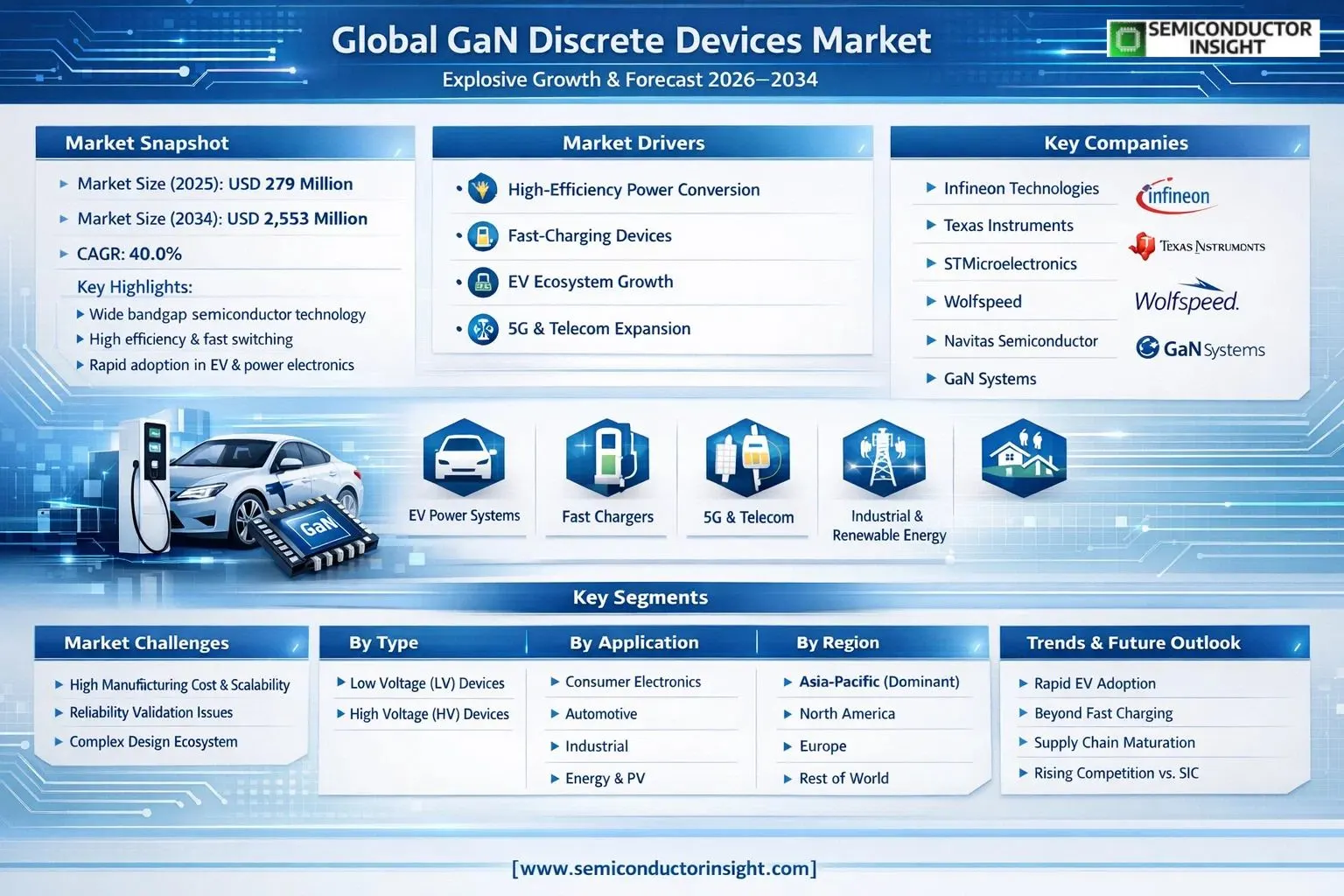
Global GaN discrete devices market size was valued at USD 279 million in 2025. The market is projected to grow from USD 391 million in 2026 to USD 2,553 million by 2034, exhibiting a CAGR of 40.0% during the forecast period.
Gallium Nitride (GaN) discrete devices are semiconductor components that operate under high-power conditions, offering superior performance over traditional silicon. These devices primarily include High Electron Mobility Transistors (HEMTs) and Field-Effect Transistors (FETs), which are fundamental building blocks for power electronics. Their key advantages,such as higher efficiency, faster switching speeds, and the ability to operate at higher temperatures and voltages,make them critical for next-generation applications.
The market is experiencing explosive growth driven by the rapid electrification of multiple sectors. A primary catalyst is the automotive industry’s shift towards electric vehicles (EVs); global EV sales reached 14.65 million units in 2023, with China alone accounting for 9.50 million units. This surge creates immense demand for GaN devices in onboard chargers (OBC) and DC-DC converters. Furthermore, while Silicon Carbide (SiC) currently holds a larger market share in power devices,valued at approximately USD 3.1 billion in 2023,GaN is gaining rapid traction due to its cost-effectiveness for medium-power applications and continuous technological advancements. The competitive landscape is intensifying with active participation from key players like Infineon, Texas Instruments, STMicroelectronics, and Navitas Semiconductor, who are driving innovation and strategic collaborations to capture this high-growth market.
MARKET DRIVERS
Demand for High-Efficiency Power Conversion
The relentless push for energy efficiency across electronic systems is a primary driver for the GaN Discrete Devices Market. Gallium nitride offers significantly lower switching losses and higher operating frequencies than traditional silicon, enabling smaller, lighter, and more efficient power adapters, servers, and renewable energy inverters. This performance advantage is critical for meeting stringent global energy standards and reducing operational costs, fueling rapid adoption of GaN technology.
Proliferation of Fast-Charging Solutions
The consumer electronics sector’s demand for rapid charging is a major catalyst. GaN discrete devices are at the heart of compact, high-power chargers for smartphones, laptops, and other portable devices. Their ability to handle high power densities allows for charger designs that are up to 50% smaller and more efficient than silicon-based solutions, creating a substantial and growing application segment for the GaN Discrete Devices Market.
➤ The transition to Wide Bandgap semiconductors in the automotive industry, particularly for electric vehicle onboard chargers and DC-DC converters, represents a high-growth vector for the GaN Discrete Devices Market.
Furthermore, the expansion of 5G infrastructure requires RF GaN discrete devices for efficient power amplification in base stations. The superior power density and thermal performance of GaN are essential for the high-frequency bands used in 5G networks, ensuring strong demand from the telecommunications sector.
MARKET CHALLENGES
Cost and Manufacturing Scalability
Despite their advantages, GaN discrete devices face challenges related to production costs. Fabrication on non-native substrates like silicon carbide or silicon introduces complexities, and yields can be lower than for mature silicon processes. Achieving economies of scale to make GaN cost-competitive with silicon-based IGBTs and MOSFETs in all application areas remains a significant hurdle for the GaN Discrete Devices Market.
Other Challenges
Reliability and Long-Term Performance Data
While lab data is promising, the industry still requires extensive field data to fully validate the long-term reliability of GaN discrete devices under diverse, real-world operating conditions, particularly concerning high-voltage stability and ruggedness.
Design Complexity and Ecosystem Maturation
Effective implementation of GaN technology requires specialized design knowledge for high-frequency circuits, thermal management, and gate driving. The relative novelty of the technology means the ecosystem of compatible components, reference designs, and experienced engineers is still developing compared to silicon.
MARKET RESTRAINTS
Strong Competition from Established Silicon Technologies
The entrenched position of silicon-based power semiconductors acts as a key restraint. Silicon IGBTs and super-junction MOSFETs benefit from decades of optimization, extremely high manufacturing volumes, and deeply entrenched supply chains. For many cost-sensitive, medium-power applications, the performance leap offered by GaN discrete devices may not yet justify the price premium, slowing market penetration.
Material and Supply Chain Vulnerabilities
The GaN Discrete Devices Market is reliant on the stable supply of key raw materials, such as gallium and the substrates for epitaxial growth. Geopolitical factors and concentration in the supply of these materials can introduce volatility and risk, potentially impacting production capacity and pricing stability for discrete GaN device manufacturers.
MARKET OPPORTUNITIES
Electrification of Automotive and Industrial Systems
The broad trend toward electrification presents immense opportunities. In automotive, beyond fast-charging infrastructure, GaN discrete devices are poised for integration into next-generation electric vehicle traction inverters to extend range. In industrial settings, they enable more efficient motor drives and uninterruptible power supplies (UPS), opening large new addressable markets for the GaN Discrete Devices Market.
Data Center and Aerospace & Defense Applications
The need for power-dense, efficient computing is relentless. GaN-based power solutions can dramatically reduce energy loss in data center server power supplies and voltage regulators. Simultaneously, the demanding performance requirements in aerospace, defense, and satellite communications for high-frequency, high-power, and radiation-tolerant components create a premium, high-value niche perfectly suited to GaN discrete device capabilities.
Trends
Accelerated Penetration in Automotive Power Electronics
The GaN Discrete Devices Market is witnessing a transformative trend driven by rapid adoption in electric vehicle (EV) power systems. These high-electron-mobility transistors (HEMTs) are increasingly specified for critical applications like on-board chargers (OBC) and DC-DC converters due to their superior efficiency and power density at high frequencies. The robust growth of the EV sector, particularly in dominant markets like China, creates a substantial and sustained demand driver. As automakers prioritize faster charging and extended range, the performance advantages of GaN discrete devices over traditional silicon solutions make them a cornerstone for next-generation automotive power designs.
Other Trends
Expansion Beyond Consumer Fast Charging
While consumer electronics, especially fast-charge adapters, provided the initial commercial launchpad, the GaN Discrete Devices Market is diversifying. High-volume deployment in photovoltaic inverters and energy storage systems is now a significant trend, leveraging the technology’s efficiency to minimize energy loss. Furthermore, adoption is expanding within industrial and telecom power supplies, where the reduction in system size and cooling requirements offers substantial operational benefits. This broadening of application segments is critical for mitigating market cyclicality and ensuring long-term, diversified growth.
Maturation of the Supply Chain and Competitive Landscape
A defining trend in the GaN Discrete Devices Market is the strategic evolution of the competitive ecosystem. The market features participation from established semiconductor leaders, specialized pure-play GaN firms, and emerging regional players, intensifying competition and accelerating innovation. This activity is fostering a more resilient and scaled supply chain, which is crucial for meeting the rising demand across automotive, industrial, and energy sectors. Concurrent R&D is focused on improving device reliability, voltage ratings, and cost structures to further unlock new high-power applications and solidify GaN’s position within the broader power semiconductor landscape.
COMPETITIVE LANDSCAPE
Key Industry Players
In-Depth GaN Discrete Devices Market Analysis: Leadership and Innovation
The competitive landscape for Gallium Nitride (GaN) Discrete Devices is characterized by intense rivalry among established global semiconductor leaders and agile, specialized innovators. The market, while rapidly expanding at a projected CAGR of 40.0%, remains concentrated, with key players like Infineon, Texas Instruments, and STMicroelectronics leveraging their extensive power semiconductor expertise to capture significant shares. These leaders are driving forward the commercialization of High Electron Mobility Transistors (HEMTs/FETs) for high-power applications, investing heavily in R&D to improve device performance, reliability, and cost-effectiveness. The strategic focus extends from consumer electronics and photovoltaics into the high-growth automotive sector, particularly for electric vehicle onboard chargers (OBC) and DC-DC converters, a move accelerated by global EV sales exceeding 14.6 million units in 2023.
Beyond the top-tier incumbents, a dynamic segment of niche significant players is shaping the market’s future. Companies such as GaN Systems, Navitas Semiconductor, and Transphorm are pioneering device design and integration, often focusing on specific voltage ranges or application optimized solutions. The entry of firms like Innoscience and Efficient Power Conversion Corporation (EPC) emphasizes the potential for disruptive innovation and vertically integrated manufacturing. This vibrant ecosystem also includes significant contributions from Asia-Pacific, with players like Sumitomo Electric, ROHM, and Chinese manufacturers including CR Micro and Foshan NationStar Semiconductor competing vigorously, indicating a geographically diverse and technologically competitive environment poised for further consolidation and partnership.
List of Key GaN Discrete Devices Companies Profiled
- Infineon Technologies AG
- Texas Instruments Incorporated
- STMicroelectronics N.V.
- NXP Semiconductors N.V.
- Wolfspeed, Inc.
- GaN Systems Inc.
- ROHM Semiconductor
- Microchip Technology Inc.
- Mitsubishi Electric Corporation
- Sumitomo Electric Industries, Ltd.
- Navitas Semiconductor
- Transphorm, Inc.
- Nexperia
- Innoscience
- Efficient Power Conversion Corporation (EPC)
Segment Analysis:
| Segment Category | Sub-Segments | Key Insights |
| By Type |
|
Low Voltage (LV) Devices currently represent the dominant segment, primarily due to their established adoption and synergistic fit with mainstream power conversion requirements. Their leadership is anchored by widespread commercial deployment in consumer power adapters and fast chargers, creating a robust initial demand base. Furthermore, LV GaN devices demonstrate clear technical advantages in high-frequency switching, which directly enables significant reductions in power supply size and improvements in energy efficiency. The technology’s maturity in this voltage range, combined with active development and support from a broad ecosystem of semiconductor manufacturers, continues to accelerate design-ins and volume production across diverse electronic applications. |
| By Application |
|
Consumer Electronics stands as the current primary application area, fundamentally driven by the wholesale transition to gallium nitride technology in compact fast-charging solutions for smartphones, laptops, and tablets. The leadership of this segment is propelled by intense consumer demand for faster charging and smaller power adapter form factors, a need perfectly met by GaN’s high efficiency and thermal performance. This application acts as the critical technological proving ground, fostering manufacturing scale and cost reductions that benefit other markets. However, the Automotive application, particularly for on-board chargers (OBC) and DC-DC converters in electric vehicles, is widely regarded as the most significant future growth vector due to Global acceleration of vehicle electrification. |
| By End User |
|
Power Supply & Charger Manufacturers are the leading end-user segment, as they are the immediate and primary integrators of GaN discrete devices into finished products for the booming consumer electronics and computing markets. Their dominance is characterized by aggressive product innovation cycles aimed at achieving market differentiation through smaller size and higher efficiency. This segment drives rapid iterations in GaN-based designs and maintains intense pressure on device suppliers for performance improvements and cost optimization. Collaborations between these manufacturers and semiconductor companies are crucial for developing application-specific solutions and validating reliability, thereby paving the way for adoption in more demanding industrial and automotive environments. |
| By Technology Node |
|
GaN HEMT technology is the foundational and leading architecture, valued for its superior electron mobility and high-frequency switching capabilities which are critical for power conversion efficiency. Its dominance stems from extensive research history and proven reliability in commercial applications, making it the preferred choice for most current power device designs. The technology’s inherent advantages enable operation at higher temperatures and voltages compared to traditional silicon, which is a key driver for its adoption. Continuous innovation is focused on enhancing the performance of HEMT structures through improved epitaxial growth and advanced packaging techniques to further reduce switching losses and parasitic elements. |
| By Competitive Landscape |
|
Established Power Semiconductor Giants leverage their significant segment influence through vast manufacturing scale, entrenched customer relationships, and comprehensive product portfolios that integrate GaN with other technologies. Their leadership is underpinned by the ability to offer complete system solutions and provide the robust supply chain and global technical support that large-scale industrial and automotive clients demand. These companies are actively shaping the market by driving standardization, investing heavily in next-generation fabrication facilities, and acquiring niche GaN innovators to consolidate technology portfolios. This dynamic creates a high-barrier environment where technological excellence must be coupled with execution capability in volume manufacturing and quality assurance. |
Regional Analysis: Global GaN Discrete Devices Market
Asia-Pacific
The region is the world’s primary manufacturing center for smartphones, laptops, and fast-charging adapters. This massive production base creates consistent, high-volume demand for GaN discrete devices, particularly for power delivery applications, driving down costs and fostering rapid technology iteration and adoption across the supply chain.
National initiatives and significant state-backed funding in countries like China and South Korea are actively promoting domestic semiconductor capabilities. These policies specifically target advancements in wide-bandgap semiconductors, including GaN, to reduce import dependency and secure technological leadership in critical future industries.
A dense network of leading research institutes, dedicated foundries, and integrated device manufacturers (IDMs) specializing in compound semiconductors exists here. This collaborative environment accelerates the development of advanced epitaxial growth techniques and packaging for GaN discrete devices, translating lab innovations into commercial products faster.
The rapid proliferation of electric vehicles and associated charging infrastructure in China and other regional markets presents a major growth vector. GaN discrete devices are increasingly favored for onboard chargers and DC-DC converters due to their efficiency, which is critical for extending vehicle range and reducing charging times.
North America
North America remains a critical innovation and high-value design center for the GaN discrete devices market, characterized by strong academic research, defense applications, and leadership in data center technologies. The presence of pioneering GaN technology firms and close collaboration with aerospace & defense contractors drives the development of specialized, high-reliability devices. The region’s focus on next-generation telecommunications, including 5G base stations and satellite communications, provides a steady demand stream. Furthermore, the push for energy-efficient computing in hyperscale data centers is accelerating the adoption of GaN-based power supplies, where performance and density are paramount. Venture capital investment and strategic partnerships between startups and established semiconductor players continue to fuel advanced prototyping and early commercial deployment.
Europe
Europe is emerging as a significant player with a strong focus on industrial, automotive, and renewable energy applications within the GaN discrete devices market. The region’s stringent energy efficiency regulations and ambitious green energy targets are powerful drivers for adopting advanced power semiconductors. European automotive manufacturers and Tier-1 suppliers are actively integrating GaN technology into electric vehicle powertrains and onboard systems. Furthermore, the region’s leadership in industrial automation and high-quality power supply manufacturing creates demand for robust and efficient GaN discrete devices. Collaborative research projects under frameworks like Horizon Europe bolster material science and device reliability, positioning the region as a leader in high-performance, application-specific GaN solutions for demanding environments.
South America
The GaN discrete devices market in South America is at a nascent but growing stage, with potential primarily linked to incremental modernization in telecommunications and power infrastructure. The gradual rollout of 4G+ and 5G networks in major urban centers could drive demand for efficient RF GaN devices in telecommunications equipment. There is also budding interest in renewable energy projects, particularly in solar and wind, where efficient power conversion is crucial. However, market growth is tempered by economic volatility, limited local semiconductor manufacturing, and a reliance on imported electronic components. The adoption trajectory will likely follow the region’s broader industrialization and infrastructure investment trends, with initial focus on high-value niche applications.
Middle East & Africa
The Middle East & Africa region represents a developing market for GaN discrete devices, with growth pockets centered on telecommunications infrastructure and diversification into technology sectors. Gulf Cooperation Council (GCC) nations, in their economic diversification efforts, are investing in advanced telecommunications and data center infrastructure, which may incorporate GaN technology for efficiency. The expansion of mobile networks across Africa to support digital inclusion also presents a long-term opportunity. However, the overall market is currently small, constrained by limited local electronics manufacturing and a primary focus on deploying established technologies rather than cutting-edge semiconductors. Strategic investments in smart city projects and renewable energy could gradually stimulate demand for efficient power devices in the coming years.
Report Scope
This market research report provides a comprehensive analysis of the GaN Discrete Devices Market , covering the forecast period 2026–2034. It offers detailed insights into market dynamics, technological advancements, competitive landscape, and key trends shaping the industry.
Key focus areas of the report include:
- Market Overview: The report begins with an overview outlining its current market scenario, key growth indicators, and industry transformation drivers. It discusses macroeconomic factors, demand–supply balance, regulatory landscape, and the strategic role of semiconductors in powering advancements across industries such as automotive, telecommunications, consumer electronics, and industrial automation.
- Market Size & Forecast: Historical data and future projections for revenue, unit shipments, and market value across major regions and segments.
- Segmentation Analysis: Detailed breakdown by product type, technology, application, and end-user industry to identify high-growth segments and investment opportunities.
- Regional Insights: Insights into market performance across North America, Europe, Asia-Pacific, Latin America, and the Middle East & Africa, including country-level analysis where relevant.
- Competitive Landscape: Profiles of leading market participants, including their product offerings, R&D focus, manufacturing capacity, pricing strategies, and recent developments such as mergers, acquisitions, and partnerships.
- Technology Trends & Innovation: Assessment of emerging technologies, integration of AI/IoT, semiconductor design trends, fabrication techniques, and evolving industry standards.
- Market Drivers & Restraints: Evaluation of factors driving market growth along with challenges, supply chain constraints, regulatory issues, and market-entry barriers.
- Stakeholder Insights: Insights for component suppliers, OEMs, system integrators, investors, and policymakers regarding the evolving ecosystem and strategic opportunities.
Primary and secondary research methods are employed, including interviews with industry experts, data from verified sources, and real-time market intelligence to ensure the accuracy and reliability of the insights presented.
FREQUENTLY ASKED QUESTIONS:
What is the current market size of GaN Discrete Devices Market?
-> Global GaN Discrete Devices Market was valued at USD 279 million in 2025 and is projected to reach USD 2553 million by 2034, at a CAGR of 40.0% during the forecast period.
Which key companies operate in GaN Discrete Devices Market?
-> Key players include Infineon, Texas Instruments, Microchip Technology, Mitsubishi Electric, Toshiba, STMicroelectronics, Wolfspeed, Sumitomo Electric, GaN Systems, Navitas Semiconductor, among others.
What are the key growth drivers?
-> Key growth drivers include the rapid penetration of the electric vehicle (EV) market (e.g., in OBC and DC-DC converters), widespread adoption in consumer electronics chargers and adapters, and expansion into photovoltaics and energy storage applications.
Which region dominates the market?
-> Asia is a key market, particularly China, which leads global new energy vehicle sales and production. North America and Europe also show significant growth trajectories in the EV and industrial sectors.
What are the emerging trends?
-> Emerging trends include the increasing penetration of GaN technology in electric vehicles, competition and comparison with SiC power devices, and continuous technological advancements by a growing number of companies in the gallium nitride industry.

Get Sample Report PDF for Exclusive Insights
Report Sample Includes
- Table of Contents
- List of Tables & Figures
- Charts, Research Methodology, and more...
 Download Sample Report PDF