Gallium Nitride RF Devices Market Insights
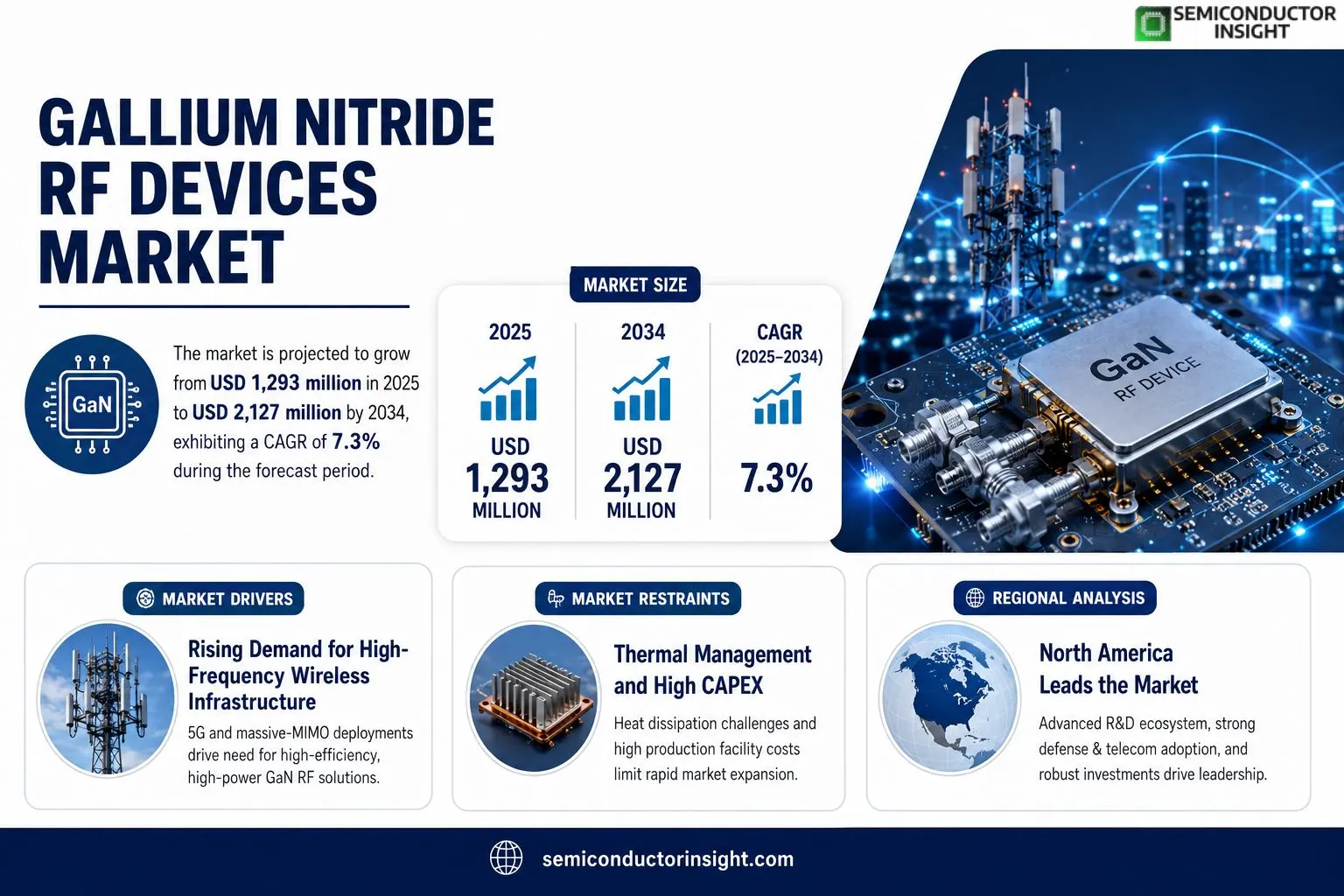
Gallium Nitride RF Devices market size was valued at USD 1,293 million in 2025. The market is projected to grow from USD 1,293 million in 2025 to USD 2,127 million by 2034, exhibiting a CAGR of 7.3% during the forecast period.
Gallium Nitride RF devices are high‑power, high‑efficiency semiconductor components employed in radio‑frequency, microwave and millimeter‑wave signal chains. The product scope comprises discrete GaN power transistors (die or packaged), GaN MMICs that integrate PA/driver/LNA/switch functions, and system‑level PA/driver modules.The market expands because substantial capital is flowing into 5G macro and massive‑MIMO base stations, aerospace radar and satellite communications require higher power density and thermal robustness. Recent collaborationssuch as Qorvo’s joint effort with a leading foundry to scale GaN‑on‑Si productiondemonstrate how manufacturers address cost and volume pressures. Leading players including MACOM, Sumitomo Electric Device Innovations (SEDI) and NXP continue broadening their GaN portfolios.
MARKET DRIVERS
Rising Demand for High‑Frequency Wireless Infrastructure
Gallium Nitride RF Devices Market is being propelled by mobile operators accelerating rollout of 5G services that rely on millimeter‑wave bands. Gallium nitride’s ability to sustain high power density while delivering low-phase‑noise performance enables compact base‑station architectures, cutting site acquisition costs and power‑grid strain. As network densification intensifies, operators favor GaN solutions because they reduce the number of required transceiver modules.
Energy‑Efficient Power Amplifiers in Consumer Electronics
Smart‑phone and IoT manufacturers are gravitating toward GaN power amplifiers to meet stricter battery‑life expectations. The material’s high electron mobility allows amplification at lower supply voltages, translating into up to 30% energy savings compared with traditional silicon devices. This efficiency premium is especially critical for wearables and AR/VR headsets where thermal budgets are tight.
➤ Gallium nitride’s superior electron mobility translates into lower loss and higher output power.
For OEMs, the convergence of telecom and consumer‑tech demands creates a dual‑track growth avenue. Companies that secure GaN‑foundry partnerships can leverage economies of scale, shortening time‑to‑market for next‑generation RF chips while preserving margins.
MARKET CHALLENGES
Thermal Management Constraints
Although GaN devices generate higher output power, they also dissipate more heat per unit area than silicon counterparts. Integrating effective heat‑sink solutions within compact modules adds bill‑of‑materials cost and complicates PCB layout, particularly for handset designs where space is at a premium.
Other Challenges
Manufacturing Yield Variability
Yield fluctuations during epitaxial growth and wafer handling can erode the cost advantage of GaN. Early‑stage fabs still experience defect densities that lead to scrap rates above 10%, prompting buyers to negotiate price concessions or seek multiple supply sources.
MARKET RESTRAINTS
High Capital Expenditure for Production Facilities
Establishing a dedicated GaN production line requires multi‑million‑dollar investment in MOCVD reactors, clean‑room infrastructure, and metrology equipment. Smaller players often lack the financial bandwidth to fund such projects, which narrows the competitive field and concentrates market power among a few large fabs.
MARKET OPPORTUNITIES
Adoption in 5G Millimeter‑Wave Base Stations
Emerging deployments of 5G at 28 GHz and higher create a clear opening for GaN‑based power amplifiers that can operate efficiently under high‑temperature, high‑power conditions. Vendors that integrate tunable matching networks and silicon‑based driver stages alongside GaN final stages stand to capture a sizable share of the upcoming equipment refresh cycle.
Gallium Nitride RF Devices Market Trends
Cost‑Driven Migration to GaN‑on‑Si Platforms
Gallium Nitride RF Devices Market is seeing a pronounced shift from GaN‑on‑SiC toward GaN‑on‑Si as manufacturers chase lower wafer costs and higher volumes. Silicon substrates enable the use of mature, high‑throughput fab lines, reducing per‑die expense while still delivering sufficient power density for many 5G macro‑cell and backhaul applications. This cost advantage is prompting telecom equipment providers to redesign power‑amplifier chains around GaN‑on‑Si modules, thereby accelerating deployment schedules in emerging markets where capex constraints are acute. Suppliers that can demonstrate comparable reliability and thermal performance on silicon are poised to capture a larger share of the infrastructure spend.
Other Trends
Higher‑Frequency Scaling for Sub‑6 GHz and mmWave Base‑Stations
Advances in device geometry and epitaxial quality are pushing GaN HEMTs into the upper sub‑6 GHz and low‑mmWave bands. Designers are emphasizing linearity and wide instantaneous bandwidth to meet the stringent spectral‑efficiency targets of modern base‑station architectures, including Doherty and envelope‑tracking configurations. The resulting performance gains translate into smaller antenna arrays and lower operating costs for network operators, while also opening new avenues for fixed wireless access and private‑network deployments that demand high‑power, low‑distortion output.
Integration and Thermal‑Management Innovations
Packaging engineers are converging on multi‑chip module (MCM) approaches that embed GaN power transistors, driver stages, and passive components within a single thermal package. By minimizing interconnect parasitics and providing dedicated heat‑spreading paths, these solutions sustain high power‑density operation without compromising device lifetime. The trend is particularly relevant for defense and aerospace customers, where ruggedized, compact RF front‑ends are essential for AESA radar and satellite‑communication payloads. Companies that master this co‑design of silicon and package are likely to secure contracts that value reliability as highly as performance.
COMPETITIVE LANDSCAPE
Key Industry Players
Gallium Nitride RF Devices – Competitive Overview
Qorvo commands the upper tier of the GaN RF ecosystem, leveraging its integrated‑device approach that couples GaN HEMT power transistors with advanced packaging and system‑level design. The company’s vertically‑aligned modelspanning epitaxy partnerships, in‑house MMIC development, and a test networksupplies the bulk of 5G macro‑base‑station amplifiers and high‑power radar modules. By concentrating R&D on high‑frequency scaling and linearity optimization, Qorvo extracts premium margins and sets the benchmark for thermal management in dense array deployments. Its market share reflects a blend of large‑volume contracts with telecom operators and defense programs, reinforcing a structure where a handful of IDMs dominate the high‑end segment while feeding specialized foundries with design wins.Beyond the headline names, a cohort of specialty firms deepens the competitive fabric. MACOM and NXP have carved niches in GaN‑on‑Si MMIC production, targeting cost‑sensitive infrastructure where wafer scalability is paramount. Sumitomo Electric Device Innovations (SEDI) and RFHIC focus on GaN‑on‑SiC platforms for aerospace and electronic‑warfare applications, emphasizing thermal robustness for high‑power density modules. Regional players such as Youjia Technology, Shenzhen Taigao Technology, and Hebei Sinopack Electronic Technology supply discrete GaN transistors to domestic OEMs, enabling localized supply chains in China. Meanwhile, Ampleon, UMS RF, and Dynax Semiconductor bolster the ecosystem through customized driver and switch solutions that complement the larger PA blocks, creating a layered value chain that balances volume, performance, and price points.
List of Key Gallium Nitride RF Devices Companies Profiled
- Qorvo
- MACOM
- Sumitomo Electric Device Innovations (SEDI)
- NXP Semiconductors
- RFHIC Corporation
- Raytheon Technologies
- Dynax Semiconductor
- Mitsubishi Electric
- Ampleon
- UMS RF
- CETC 55
- Northrop Grumman
- ReliaSat (Arralis)
- WAVICE Inc.
- Microchip Technology
- Youjia Technology (Suzhou) Co., Ltd.
- Shenzhen Taigao Technology
Segment Analysis:
| Segment Category | Sub-Segments | Key Insights |
| By Type |
|
GaN MMICs are emerging as the most compelling type because:
|
| By Application |
|
Wireless Infrastructure drives the market because:
|
| By End User |
|
Telecom Operators represent the leading end‑user segment because:
|
| By Technology |
|
GaN‑on‑SiC is the dominant technology because:
|
| By Device Function |
|
Power Amplifiers remain the key function because:
|
Regional Analysis: Gallium Nitride RF Devices Market
Localized wafer fab capacity and strategic inventory buffers allow North American firms to mitigate semiconductor shortages, ensuring uninterrupted production of high‑frequency GaN modules for critical infrastructure projects.
Close collaboration between chip designers and system integrators shortens the validation loop, leading to bespoke GaN architectures that address specific carrier‑grade power density and linearity requirements.
Stringent emissions standards and defense procurement policies incentivize the transition to higher‑efficiency RF solutions, positioning GaN as the preferred technology for next‑generation communication grids.
Telecom operators prioritize network densification and are increasingly allocating capital toward GaN‑based power amplifiers that deliver larger coverage with lower operational expenditure.
Europe
European markets exhibit a measured yet progressive shift toward GaN RF technology, driven mainly by the continent’s ambitious 5G rollout targets and a strong emphasis on energy efficiency. Major aerospace and defense agencies allocate funds for lightweight, high‑power amplifiers, prompting local semiconductor firms to form joint ventures with U.S. partners. While overall investment levels trail North America, EU funding mechanisms for green communications create a supportive backdrop that encourages incremental adoption across carrier networks and industrial IoT deployments.
Asia‑Pacific
The Asia‑Pacific region presents a heterogeneous landscape where rapid mobile broadband expansion fuels demand for compact, high‑output RF components. Countries such as China, South Korea, and Japan invest heavily in domestic GaN fabs to reduce reliance on imports, yet the ecosystem remains fragmented. Market participants focus on cost‑effective designs for consumer devices, while defense-oriented programs in India and Taiwan drive niche high‑performance applications, creating a dual‑track growth pattern.
South America
South American adoption of GaN RF devices remains nascent, constrained by limited local manufacturing and modest capital availability. Nevertheless, regional telecom operators are beginning pilot projects that evaluate GaN‑based power amplifiers for remote‑area coverage, motivated by the technology’s superior power efficiency in challenging topographies. Early collaborations with multinational suppliers hint at a gradual build‑up of expertise that could accelerate over the next few years.
Middle East & Africa
In the Middle East & Africa, strategic priorities revolve around defense modernization and the rollout of high‑capacity broadband in affluent Gulf states. Government‑backed initiatives fund the procurement of GaN solutions for satellite ground stations and next‑generation radar, while African markets observe gradual per‑site trials aimed at extending network reach in sparsely populated regions. The prevailing trend suggests a cautious but purposeful entry of GaN technology, anchored by defense spend and targeted telecom upgrades.
Report Scope
This market research report provides a comprehensive analysis of the Gallium Nitride RF Devices Market , covering the forecast period 2026–2034. It offers detailed insights into market dynamics, technological advancements, competitive landscape, and key trends shaping the industry.
Key focus areas of the report include:
- Market Overview: The report begins with an overview outlining its current market scenario, key growth indicators, and industry transformation drivers. It discusses macroeconomic factors, demand–supply balance, regulatory landscape, and the strategic role of semiconductors in powering advancements across industries such as automotive, telecommunications, consumer electronics, and industrial automation.
- Market Size & Forecast: Historical data and future projections for revenue, unit shipments, and market value across major regions and segments.
- Segmentation Analysis: Detailed breakdown by product type, technology, application, and end-user industry to identify high-growth segments and investment opportunities.
- Regional Insights: Insights into market performance across North America, Europe, Asia-Pacific, Latin America, and the Middle East & Africa, including country-level analysis where relevant.
- Competitive Landscape: Profiles of leading market participants, including their product offerings, R&D focus, manufacturing capacity, pricing strategies, and recent developments such as mergers, acquisitions, and partnerships.
- Technology Trends & Innovation: Assessment of emerging technologies, integration of AI/IoT, semiconductor design trends, fabrication techniques, and evolving industry standards.
- Market Drivers & Restraints: Evaluation of factors driving market growth along with challenges, supply chain constraints, regulatory issues, and market-entry barriers.
- Stakeholder Insights: Insights for component suppliers, OEMs, system integrators, investors, and policymakers regarding the evolving ecosystem and strategic opportunities.
Primary and secondary research methods are employed, including interviews with industry experts, data from verified sources, and real-time market intelligence to ensure the accuracy and reliability of the insights presented.
FREQUENTLY ASKED QUESTIONS:
What is the current market size of Gallium Nitride RF Devices Market?
-> Gallium Nitride RF Devices Market was valued at USD 1,293 million in 2025 and is expected to reach USD 2,127 million by 2034, at a CAGR of 7.3% during the forecast period.
Which key companies operate in Gallium Nitride RF Devices Market?
-> Key players include Sumitomo Electric Device Innovations (SEDI), MACOM, Qorvo, NXP, RFHIC Corporation, Raytheon, Dynax Semiconductor, Mitsubishi Electric, CETC 55, Northrop Grumman, Ampleon, UMS RF, CETC 13, ReliaSat (Arralis), WAVICE Inc, Microchip Technology, Youjia Technology (Suzhou) Co., Ltd, Shenzhen Taigao Technology, Hebei Sinopack Electronic Technology.
What are the key growth drivers?
-> Key growth drivers include expanding 5G and 5G‑Advanced wireless infrastructure (macro, massive‑MIMO, backhaul, mmWave), increasing aerospace & defense requirements (radar, EW, satcom), and rising demand for high‑power industrial microwave systems, all fueled by the superior performance of GaN technology.
Which region dominates the market?
-> Asia‑Pacific holds the largest market share, driven by strong demand in China, Japan, South Korea, and Southeast Asia, while also being a hub for major GaN manufacturers.
What are the emerging trends?
-> Emerging trends include device scaling for higher frequencies, Doherty‑friendly PA architectures for improved efficiency, advanced thermal‑reliability engineering, and integration of GaN devices into sub‑6 GHz and mmWave 5G base‑station solutions.
Get Sample Report PDF for Exclusive Insights
Report Sample Includes
- Table of Contents
- List of Tables & Figures
- Charts, Research Methodology, and more...
 Download Sample Report PDF