FPC Stiffener for Consumer Electronics Market Insights
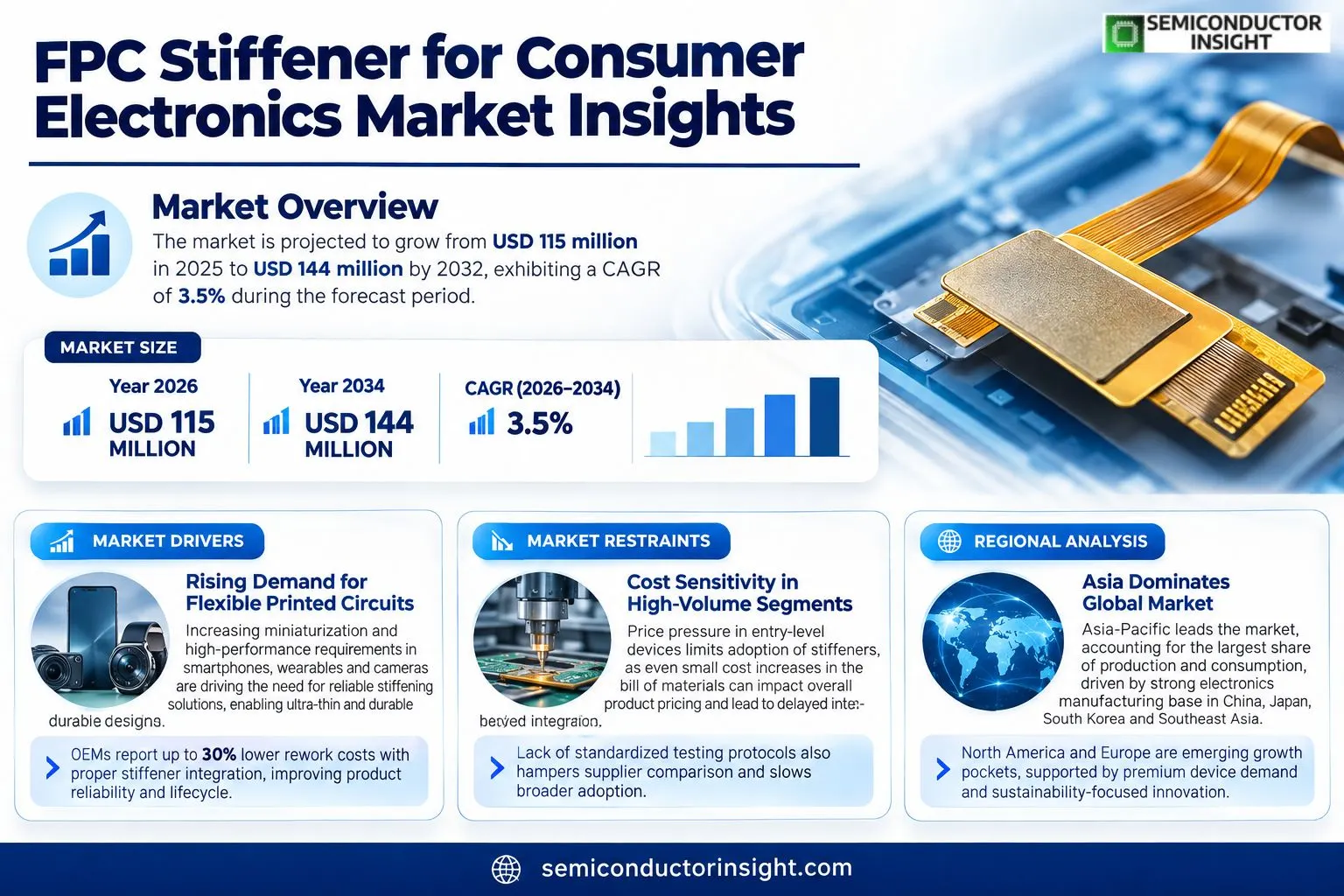
FPC Stiffener for Consumer Electronics Market size was USD 115 million in 2025. It will grow to USD 144 million by 2032, delivering a CAGR of 3.5% over the forecast period.
FPC stiffeners are bonded onto designated zones of flexible printed circuit boards (FPCB) to add thickness, improve mechanical rigidity and enable reliable surface‑mount component placement. Although they carry no electrical function, they are critical for ultra‑thin designs found in smartphones, wearables, compact cameras and other high‑density modules where flexibility must be halted at connector or component islands. In 2024 global production reached roughly 73 million sq m with an average selling price of USD 18.5 per sq m, generating an industry gross margin close to 25%.
MARKET DRIVERS
Increasing Miniaturization of Consumer Devices
Manufacturers are pushing the envelope on device thickness, prompting a need for structural reinforcement that does not compromise flexibility. FPC stiffeners provide a thin yet rigid backbone, enabling ultra‑slim smartphones and wearables to retain durability during daily handling.
Demand for High‑Performance Flex Circuits
As data‑intensive applications such as high‑resolution cameras and augmented‑reality displays proliferate, the electrical performance of flexible printed circuits becomes a competitive differentiator. A well‑designed stiffener maintains planar geometry, reducing signal distortion and improving yield in high‑frequency routing.
➤ Integrating stiffeners early in the design phase cuts rework costs by up to 30 % while extending product lifecycle.
These forces converge to elevate the FPC Stiffener for Consumer Electronics Market, encouraging OEMs to allocate greater engineering resources toward flexible‑rigid hybrid solutions.
MARKET CHALLENGES
Complexity of Material Selection
Choosing between metal, composite, or polymer stiffeners involves trade‑offs in thermal expansion, weight, and corrosion resistance. Misalignment of material properties with a device’s operating envelope can trigger premature failure, deterring conservative adopters.
Other Challenges
Manufacturing Yield Variability
Variations in adhesive application and curing cycles create inconsistent stiffness levels, forcing downstream testing and increasing scrap rates.
MARKET RESTRAINTS
Cost Sensitivity in High‑Volume Segments
Price‑pressured product lines such as entry‑level tablets allocate a modest budget to component‑level reinforcement. Adding a stiffener can raise the bill‑of‑materials by a marginal yet decisive amount, prompting cost‑focused buyers to postpone adoption.Furthermore, the absence of standardized testing protocols for stiffener performance hampers cross‑supplier comparisons, limiting confidence among procurement teams.
MARKET OPPORTUNITIES
Emergence of Foldable Displays
Foldable smartphones and tablets impose repetitive bending stresses that exceed the capability of conventional flex circuits. Tailored stiffener designs that accommodate curvature while preserving electrical continuity present a clear growth niche for suppliers.In parallel, the rise of IoT wearables with stringent weight constraints creates demand for ultra‑light polymer stiffeners that deliver sufficient support without adding bulk, opening avenues for material‑innovative entrants.
FPC Stiffener for Consumer Electronics Market Trends
Mechanical Support Becomes Cost Driver in Ultra‑Thin Devices
The FPC Stiffener for Consumer Electronics Market is feeling the pressure of ever‑thinner form factors. In 2024 manufacturers shipped roughly 73 million sq m of stiffeners at an average price of US$18.5 per sq m, delivering a gross profit margin near 25 %. Because stiffeners are not part of the electrical bill of materials, their cost is often hidden behind higher yield rates and fewer field failures. OEMs that can lock flatness and connector engagement height with a well‑placed stiffener see tangible reductions in re‑work expense, especially in smartphones and wearables where Z‑axis tolerance is measured in microns. The combination of tight mechanical tolerances and a modest price point makes stiffeners a quietly strategic investment for producers chasing reliability without sacrificing the sleekness consumers demand.
Other Trends
Material Choices Shaping Performance
Within the market, polymer‑based (PI) and metal stiffeners dominate the mix, while FR4 and specialty composites hold niche positions. PI offers a balance of flexibility before reinforcement and high temperature resistance, making it attractive for high‑density connector zones. Metal variants, although costlier, deliver superior rigidity for semi‑rigid applications where solder joint stress is a known failure mode. Suppliers are experimenting with hybrid adhesion methodsPSA, thermoset epoxies, and heat laminationto fine‑tune the cure cycle and improve handling during automated assembly. These material shifts are not driven by fashion but by the need to match the mechanical profile of each device segment, thereby extending the life of the underlying flexible printed circuit.
Regional Production Shifts and Capacity Expansion
Asia continues to host the bulk of production capacity, yet Europe is gaining traction as a source of high‑spec metal stiffeners for automotive‑grade wearables. North American OEMs are increasingly specifying locally sourced stiffeners to shorten lead times and mitigate supply‑chain volatility. The forecast for 2032 places market revenue at US$144 million, up from US$115 million in 2025, reflecting an annual growth rate of 3.5 %. While the overall volume increase appears moderate, the underlying driver is the expanding variety of devices that now require localized rigidityeverything from compact cameras to modular IoT hubs. Companies that align their manufacturing footprint with these regional demand patterns stand to capture incremental margin while supporting the broader market’s reliability agenda.
COMPETITIVE LANDSCAPE
Key Industry Players
Competitive Overview of FPC Stiffener Suppliers for Consumer Electronics
Taiflex remains the market anchor, leveraging a vertically integrated production line that couples polymer extrusion with precision lamination. Its ability to scale to the 73 million sq m annual volume while maintaining a 25 % gross margin gives it pricing flexibility that many rivals lack. The company’s recent investment in a high‑throughput PSA coating line has shortened lead times for smartphone manufacturers that demand sub‑100 µm stack heights. This operational advantage translates into stronger negotiating power with OEMs, especially in the high‑growth wearables segment where mechanical tolerances are razor‑thin. Competitors that rely on third‑party coating facilities experience higher unit costs and longer cycle times, limiting their appeal for volume‑driven projects.Beyond Taiflex, the field is populated by a mixture of legacy material specialists and newer entrants focused on niche adhesive technologies. Arisawa Mfg. Co., Ltd and ITEQ Corporation dominate the metal‑based stiffener niche, supplying high‑rigidity solutions to premium camera modules. Companies such as Innox Advanced Materials and Hanwha Advanced Materials have carved out market share by offering semi‑rigid FR4 alternatives that balance flexibility with structural support. Smaller but technically agile firms like SYTECH, Dongyi, and OTIS Co., Ltd exploit localized demand in Southeast Asia, providing rapid‑turn PSA‑laminated products that cater to regional assemblers seeking cost‑effective, low‑volume runs. The overall competitive picture is one of concentration around a few large, vertically integrated players, with a healthy ecosystem of specialist suppliers that address specific material or adhesion requirements.
List of Key FPC Stiffener Companies Profiled
- Taiflex
- Arisawa Mfg. Co., Ltd
- ITEQ Corporation
- Innox Advanced Materials
- RISHO KOGYO CO
- Hanwha Advanced Materials
- SYTECH
- Dongyi
- OTIS Co., Ltd
- Zhengye Technology
- Nikkan
- Asia Electronic Material
- Nelco
- Kingboard
- Nan Ya
- Isola
Segment Analysis:
| Segment Category | Sub-Segments | Key Insights |
| By Type |
|
Polyimide (PI) is perceived as the leading segment because it offers superior thermal stability and flexibility.
|
| By Application |
|
Smartphones dominate this dimension as they continuously push the limits of thinness and high‑density routing.
|
| By End User |
|
OEMs are the primary drivers, integrating stiffeners to enhance assembly reliability.
|
| By Strength |
|
Rigid stiffeners are preferred where absolute dimensional stability is required.
|
| By Adhesion Method |
|
Pressure Sensitive Adhesive (PSA) leads due to its ease of application and reliable bonding.
|
Regional Analysis: FPC Stiffener for Consumer Electronics Market
Manufacturers are reshoring certain stencil and carrier material steps to mitigate geopolitical risk, yet they maintain offshore sourcing for raw polymers where cost differentials remain steep. This hybrid model gives OEMs the agility to respond to sudden component shortages without sacrificing volume discounts, a balance that directly supports the stiffener market’s stability in the region.
The relentless push toward thinner, lighter devices forces engineers to extract maximum rigidity from minimal material. Innovations such as micro‑grooved stiffener patterns and laser‑etched reinforcement zones are emerging from R&D labs in Japan and Singapore, setting new benchmarks for mechanical performance while keeping weight footprints flat.
Even as performance expectations rise, price pressure remains a dominant lever. Tier‑1 contract manufacturers negotiate stiffener pricing on a per‑square‑meter basis, leveraging volume commitments to extract incremental savings that cascade through the bill of materials, influencing overall device pricing strategies.
Emerging environmental directives in China and India call for reduced hazardous substances in polymer composites. Vendors that pre‑emptively certify compliance gain a preferential slot in supplier shortlists, nudging the market toward greener stiffener chemistries without sacrificing durability.
North America
In North America, the FPC stiffener market is shaped by a mature consumer electronics ecosystem that values reliability over sheer cost advantage. Major smartphone assemblers and IoT device producers rely on a concentrated pool of specialty material suppliers headquartered in the United States and Canada. The region’s emphasis on stringent electromagnetic interference (EMI) standards drives demand for stiffeners that incorporate conductive pathways. Meanwhile, emerging venture capital funding for flexible display startups fuels niche applications in automotive infotainment and augmented‑reality headsets, creating pockets of high‑margin opportunities for firms that can certify automotive‑grade durability.
Europe
European OEMs prioritize sustainability and long‑term component lifecycle, influencing procurement decisions for FPC stiffeners. The European Union’s circular‑economy agenda encourages the use of recyclable polymers, prompting manufacturers to explore bio‑based resin blends. Additionally, a strong heritage in precision engineering pushes suppliers toward ultra‑tight thickness tolerances, essential for premium wearables marketed across Germany, France, and the Nordics. Regulatory scrutiny on chemical usage, especially under REACH, compels vendors to provide transparent material safety data sheets, which in turn becomes a differentiator when winning contracts with multinational electronics brands.
South America
South American markets exhibit a gradual uptake of flexible electronics, driven largely by the smartphone renewal cycle and growing demand for affordable wearables. The region’s fragmented supply base often relies on imports from Asia-Pacific, but local assembly hubs in Brazil and Argentina are beginning to experiment with in‑house stiffener stamping to reduce lead times. Cost competitiveness remains the overriding factor; however, a rising consumer awareness of device fragility is prompting brands to incorporate modest stiffening solutions that can extend product lifespans in harsh tropical climates.
Middle East & Africa
The Middle East & Africa present a heterogeneous landscape where high‑end consumer devices coexist with price‑sensitive markets. In the Gulf Cooperation Council, premium smartphones and smart‑home devices drive demand for sophisticated stiffener designs that can survive extreme temperature fluctuations. Conversely, Sub‑Saharan retailers focus on ruggedized entry‑level gadgets, prompting suppliers to offer cost‑effective stiffeners with basic bend resistance. Emerging local electronics incubators, particularly in the United Arab Emirates, are fostering collaborations between material innovators and device makers, hinting at a modest but strategic expansion of the regional supply chain.
Report Scope
This market research report provides a comprehensive analysis of the FPC Stiffener for Consumer Electronics Market , covering the forecast period 2026–2034. It offers detailed insights into market dynamics, technological advancements, competitive landscape, and key trends shaping the industry.
Key focus areas of the report include:
- Market Overview: The report begins with an overview outlining its current market scenario, key growth indicators, and industry transformation drivers. It discusses macroeconomic factors, demand–supply balance, regulatory landscape, and the strategic role of semiconductors in powering advancements across industries such as automotive, telecommunications, consumer electronics, and industrial automation.
- Market Size & Forecast: Historical data and future projections for revenue, unit shipments, and market value across major regions and segments.
- Segmentation Analysis: Detailed breakdown by product type, technology, application, and end-user industry to identify high-growth segments and investment opportunities.
- Regional Insights: Insights into market performance across North America, Europe, Asia-Pacific, Latin America, and the Middle East & Africa, including country-level analysis where relevant.
- Competitive Landscape: Profiles of leading market participants, including their product offerings, R&D focus, manufacturing capacity, pricing strategies, and recent developments such as mergers, acquisitions, and partnerships.
- Technology Trends & Innovation: Assessment of emerging technologies, integration of AI/IoT, semiconductor design trends, fabrication techniques, and evolving industry standards.
- Market Drivers & Restraints: Evaluation of factors driving market growth along with challenges, supply chain constraints, regulatory issues, and market-entry barriers.
- Stakeholder Insights: Insights for component suppliers, OEMs, system integrators, investors, and policymakers regarding the evolving ecosystem and strategic opportunities.
Primary and secondary research methods are employed, including interviews with industry experts, data from verified sources, and real-time market intelligence to ensure the accuracy and reliability of the insights presented.
FREQUENTLY ASKED QUESTIONS:
What is the current market size of FPC Stiffener for Consumer Electronics Market?
-> FPC Stiffener for Consumer Electronics Market was valued at USD 115 million in 2025 and is expected to reach USD 144 million by 2032, growing at a CAGR of 3.5% over the forecast period.
Which key companies operate in FPC Stiffener for Consumer Electronics Market?
-> Key players include Taiflex, Arisawa Mfg. Co., Ltd, ITEQ Corporation, Innox Advanced Materials, RISHO KOGYO CO, Hanwha Advanced Materials, SYTECH, Dongyi, OTIS Co., Ltd, Zhengye Technology, Nikkan, Asia Electronic Material, Nelco, Kingboard, Nan Ya, Isola, among others.
What are the key growth drivers?
-> Key growth drivers include rising penetration of flexible printed circuits in smartphones, wearables, cameras and other consumer devices; the need for localized rigidity at high‑stress areas such as connectors and component islands; OEM pursuit of thinner Z‑axis heights and tighter mechanical tolerances; and the role of stiffeners in preventing assembly defects and field failures.
Which region dominates the market?
-> Asia dominates the market, driven by large‑scale production in China, Japan, South Korea and Southeast Asia, which together account for the majority of global volume and revenue.
What are the emerging trends?
-> Emerging trends include the adoption of metal and FR4 stiffener materials, development of semi‑rigid solutions, and advanced adhesion methods such as PSA, thermoset/epoxy and heat lamination, which enhance reliability and enable ultra‑thin form‑factor designs.
Get Sample Report PDF for Exclusive Insights
Report Sample Includes
- Table of Contents
- List of Tables & Figures
- Charts, Research Methodology, and more...
 Download Sample Report PDF