Key Statistics
Key Takeaways
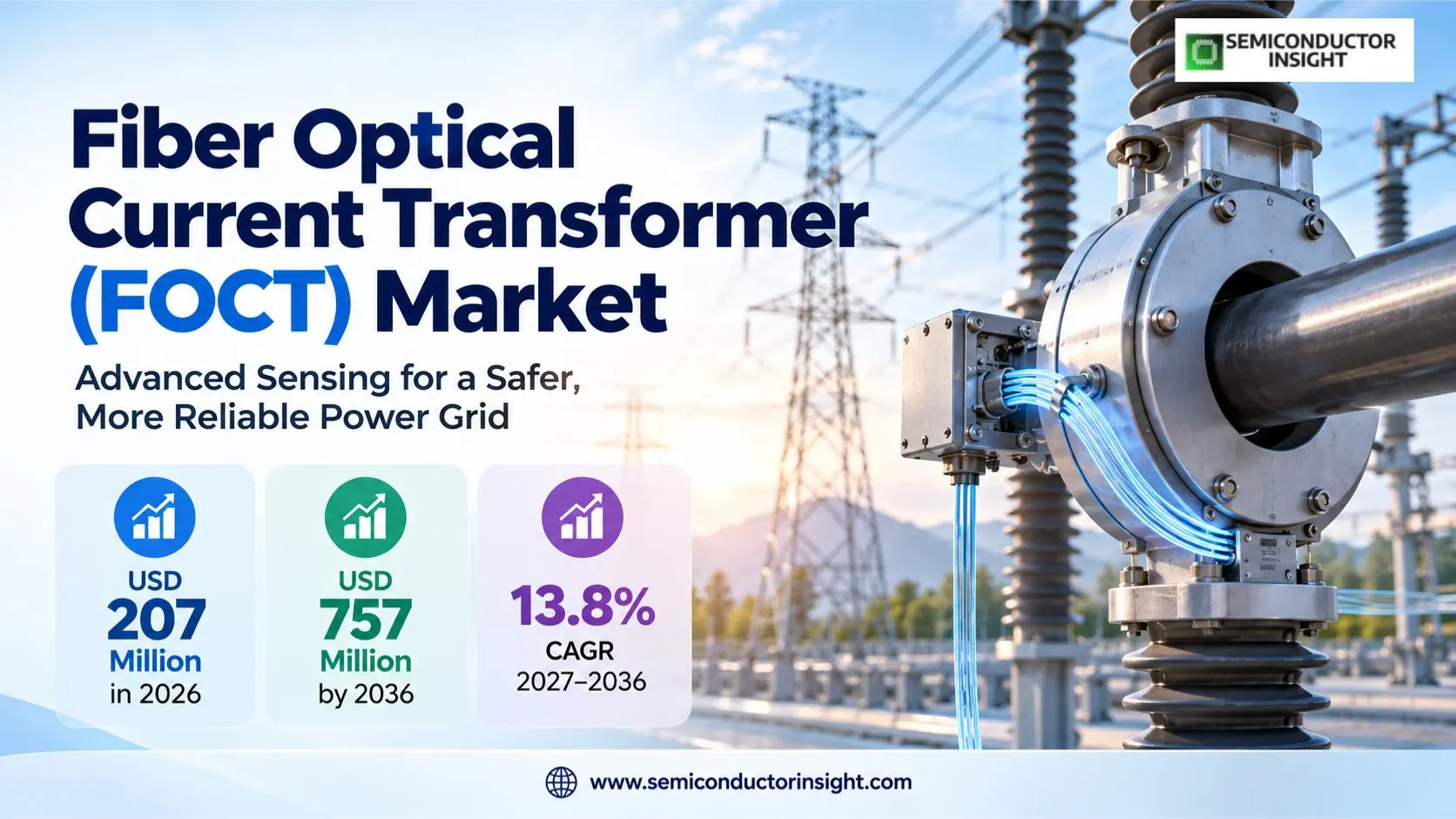
- Market value: the global FOCT market is valued at USD 207 million in 2026 and is projected to reach USD 757 million by 2036, expanding at a 13.8% CAGR during 2027–2036 as HVDC converter projects and digital substation procurement increase demand for optical protection and metering.
- Independent Pillar Type retains the largest type position with an estimated ~37% of 2026 value, while GIS Integrated Type holds ~35% and is estimated to grow fastest at ~15.4% CAGR as equipment manufacturers increasingly package primary sensors into compact switchgear bays.
- Converter Station is the leading application with ~53% of 2026 revenue and an estimated ~15.1% CAGR; Substation follows at ~40%, supported by IEC 61869-9 sampled-value integration and the replacement of copper-heavy secondary measurement architecture.
- Asia-Pacific leads at ~37% of 2026 revenue and is the fastest-growing region at ~15.2% CAGR, while Europe holds ~33% and North America ~25%; the balance is dispersed across newer HVDC and specialty high-voltage projects.
- Qualification costs and procurement concentration temper growth because IEC-compatible outputs, accuracy testing, environmental endurance and grid-operator commissioning are required before optical sensors can displace familiar inductive current transformers on protection-critical high-voltage networks.
Fiber Optical Current Transformer (FOCT) Market Overview
Fiber optical current transformer (FOCT) market was valued at USD 207 million in 2026 and is projected to reach USD 757 million by 2036, growing at a CAGR of 13.8% over 2027–2036. Asia-Pacific is the largest market, accounting for an estimated ~37% of 2026 revenue, closely linked to HVDC installations and manufacturing in China and transmission procurement in India.
A fiber optical current transformer measures the current in an energized conductor by analyzing the influence of its magnetic field on light. Unlike an inductive current transformer, an all-fiber Faraday sensor can provide a broad dynamic range without ferromagnetic saturation; optical isolation allows the sensing element to remain passive near energized equipment. The commercial system includes the optical sensing head or loop, an optical interrogator, transmission fiber, power and redundancy arrangements for electronics, and either digital sampled-value or analog measurement outputs.
The revenue boundary covers dedicated fiber optical current transformer systems, including freestanding independent-pillar assemblies, optical devices integrated into gas-insulated switchgear, and other qualifying fiber-based current sensors supplied for high-voltage substation, HVDC converter-station and adjacent electrical-grid use. It excludes inductive transformers, stand-alone protection relays, generic communication fiber, voltage-only transformers and the total value of converter or transmission projects. This distinction matters because major grid-equipment contractors deliver multibillion-dollar electrical packages in which the current sensor is a specialized component, not the full system value.
Faraday-effect sensing is attractive where DC current, transient fault behavior and insulation risk complicate conventional magnetic measurement. Hitachi Energy describes a three-phase free-standing optical sensor qualified for 72.5–800 kV systems, with digital IEC 61850-9-2LE output; Arteche describes an SDO-OCT architecture combining a passive optical transducer, insulator and merging unit. Both examples show that competition centers on metrology performance, immunity to saturation, environmental robustness and engineering of the interface into protection devices rather than optical fiber alone.
Electrical network reinforcement is widening the addressable installation pipeline. The International Energy Agency reports that more than 2,500 GW of renewable, storage and major-load projects are waiting in grid connection queues, while annual grid spending would need to rise by roughly 50% from about USD 400 billion by 2030 to meet projected demand. These figures measure the broader transmission investment environment rather than sales of optical sensors. Their importance is that each new converter terminal, upgraded high-voltage bay or digital process bus provides potential demand after engineering qualification.
Commercial adoption is being reshaped by three parallel developments: multi-gigawatt HVDC interconnectors in North America and Asia, digital process-bus architecture under IEC 61869-9, and optical measurement products engineered for retrofit protection of mixed overhead and underground lines. Arteche documents 20 km remote flexible-current measurement for challenging line transitions, while current-sensor vendors are adding more modular electronics and redundancy. The resulting market is growing but remains specialized: purchase decisions are governed by utility qualification and project sequencing, not by the aggregate number of kilometers of ordinary transmission line.
Segment Analysis: By Type
By type, the market comprises Independent Pillar Type, GIS Integrated Type and Other. Independent Pillar Type accounts for an estimated ~37% of 2026 revenue and expands at ~12.4% CAGR; GIS Integrated Type contributes ~35% and grows fastest at ~15.4% CAGR. Other devices, including flexible optical loops and application-specific packaged sensors, account for ~28% and expand at an estimated ~13.6% CAGR.
| Type | Function | Market position |
|---|---|---|
| Independent Pillar Type | Independent-pillar devices position the passive optical sensing head on a dedicated high-voltage insulating support, with the interrogation and communications electronics placed at a suitable safe distance. This architecture is appropriate for outdoor AIS bays and converter-station measurement positions where physical separation, creepage distance and access for inspection govern design. Hitachi Energy describes an outdoor 72.5–800 kV free-standing system using nitrogen-filled supports and remote electronic cabinets. | Largest type at an estimated ~37% of 2026 revenue; ~12.4% CAGR. Existing substation engineering conventions allow pillar-mounted optical sensors to be specified beside other primary equipment, often with minimal changes to protection-bay topology. The model is mature relative to embedded optical alternatives, so growth follows HVDC converter procurement, replacement of conventional sensing assemblies and digital substations; price competition increases when project specifications treat the insulator and electronics as separate packages. |
| GIS Integrated Type | GIS-integrated sensors locate optical current-measurement elements within or adjacent to a gas-insulated switchgear module, minimizing separate switchyard structures and enabling integrated factory qualification. Manufacturers must manage optical routing, thermal drift, electromagnetic compatibility and maintenance access as the sensor becomes part of an expensive primary equipment assembly. The arrangement is especially relevant for dense urban substations and converter yards where footprint and factory-tested assemblies carry a premium. | Fastest-growing type at an estimated ~35% share and ~15.4% CAGR. GIS integration shifts the purchasing decision toward high-voltage switchgear OEMs and large substation contractors rather than independent metering suppliers. Integration can shorten site work but lengthen type-approval cycles, since utilities assess protection accuracy alongside enclosure reliability and overall serviceability. The position also benefits from high land costs in Europe and Asian urban grids, where compact solutions can justify a higher bundled equipment price. |
| Other | The Other group includes flexible fiber-based sensing loops, busbar-specific optical current transducers, test installations and specialized arrangements for transitions between overhead conductors and insulated power cables. Arteche documents a passive flexible sensor that wraps around an insulated cable section, with optical interrogation from a remote merging unit and no local auxiliary supply. These products are usually engineered around a precise protection challenge rather than a general instrument-transformer replacement program. | An estimated ~28% of 2026 revenue; ~13.6% CAGR. Niche formats serve power-network retrofits, mixed-line protection, demonstration bays and high-current industrial systems where a traditional freestanding sensor would be mechanically awkward. Commercial performance depends on custom engineering, interoperability and technical support rather than standard unit volume. Growth is less uniform because many projects require tailored applications, and a successful demonstration may be followed by several years of utility evaluation before wider adoption. |
Segment Analysis: By Application
Applications are classified as Substation, Converter Station and Other. Converter Station is the largest at an estimated ~53% of 2026 revenue and the fastest-growing at ~15.1% CAGR. Substation contributes ~40% at ~12.3% CAGR, while the Other group, which includes selected industrial and special-purpose high-voltage measurement installations, represents ~7% at ~12.8% CAGR.
| Application | Demand characteristics |
|---|---|
| Substation | An estimated ~40% of 2026 revenue and ~12.3% CAGR. High-voltage substations specify optical current sensing when an existing magnetic-transformer arrangement is difficult to integrate with sampled-value process buses, or when compactness, fault-current dynamics and primary insulation are strategic priorities. Protection-class accuracy and integration with IEC 61869-9-compliant merging units shape tender requirements. Retrofits can be constrained by relay interoperability, existing control-wiring standards and the risk that a sensor must operate for decades without replacement. |
| Converter Station | Largest application with ~53% share and ~15.1% CAGR. HVDC converter stations require precise monitoring of DC and transient current on converter valves, buses and associated AC interfaces, making the wide dynamic range of optical Faraday sensing attractive. Procurement is usually part of an engineered HVDC converter package, not a small standalone instrument order. The CHPE 1,250 MW link and SunZia 3,000 MW system illustrate the scale and technical complexity of current converter-related grid deployment, without implying that every new terminal uses FOCT technology. |
| Other | An estimated ~7% of 2026 revenue and ~12.8% CAGR. Other applications encompass selected industrial high-current systems, mixed overhead-underground cable protection, specialized research installations and space-constrained power-electronics facilities. Flexible sensing loops can be installed around insulated conductors without adding a conventional high-voltage pillar, offering particular value where the primary circuit should not be disturbed. Demand remains project-specific, and commercialization depends on successful relay integration, acceptance tests and supportability in outdoor or harsh industrial conditions. |
The application mix also determines the route to market. Converter-station sensors are typically selected through HVDC OEM engineering and long-lead procurement, whereas substation devices may be procured directly by utilities, switchgear suppliers or protection-system integrators. For mixed-line protection, engineering consultants can influence a purchase by validating that optical measurements solve a selective tripping problem. Across channels, the most defensible supplier position combines field-tested hardware with merging-unit firmware, type-test documentation and commissioning support that can survive stringent electricity-network procurement reviews.
Regional Analysis
Asia-Pacific leads with an estimated ~37% of global FOCT revenue in 2026 and the fastest regional growth of ~15.2% CAGR; Europe contributes ~33%, and North America ~25%. The remaining ~3% in South America and ~2% in the Middle East & Africa reflects smaller but project-sensitive markets. The regional mix aligns with concentration in Asian HVDC projects, European digital-protection engineering and North American long-distance converter investments.
How does high-voltage sensing demand differ by region?
The distinction across geographic markets is as much about qualification channel as installed transmission capacity. China supports domestic optical-component manufacture and very large grid engineering, Europe stresses interoperability and process-bus standards, and North America uses converter-scale project procurement shaped by lifecycle support. Chile and Brazil present selective project opportunities rather than broad domestic manufacturing, while the UAE emphasizes industrial HVDC sites and harsh-climate engineering. Demand shares refer only to FOCT sensor-system revenue and should not be read as the percentage of all high-voltage grid construction occurring in each market.
| Region | Position | Growth outlook | Demand profile | What decides supplier selection |
|---|---|---|---|---|
| Asia-Pacific | Largest (~37%) | ~15.2% CAGR | HVDC buildout and manufacturing | Grid-owner testing and OEM qualification |
| Europe | Second (~33%) | ~13.0% CAGR | Digital process-bus and grid retrofit | IEC compliance and utility acceptance |
| North America | Third (~25%) | ~12.7% CAGR | Large HVDC interconnections | Owner standards and supply assurance |
| South America | Fourth (~3%) | ~14.4% CAGR | Renewable integration and selective projects | Concession procurement and import logistics |
| Middle East & Africa | Fifth (~2%) | ~14.3% CAGR | High-capacity links and harsh-climate sites | EPC contracts and harsh-climate qualification |
Competitive Landscape
The FOCT supplier structure combines specialist optical measurement houses, high-voltage instrument-transformer vendors and converter-system integrators. Published competitors include ABB, Profotech, Arteche, GE Grid Solutions, NR Electric Co, Comcore Optical Intelligence Technologies and XJ Electric Corporation. Product-level evidence is strongest for Hitachi Energy’s FOCS, Arteche’s SDO-OCT and Profotech’s optical current sensors; discontinued lines and corporate transfers require careful interpretation of historical vendor names.
In the established supplier tier, Hitachi Energy markets a free-standing Faraday-effect optical sensing system with IEC 61850-9-2LE output, redundant optoelectronics and a declared 72.5–800 kV rating. Arteche offers passive optical transducers with modular insulators and IEC 61869-9 merging-unit architecture, along with specialist flexible fiber-loop arrangements. These products illustrate a market in which integration experience, accuracy class and long service support often matter more than a low component invoice price.
Profotech competes from a specialist optical instrumentation position, with publicly accessible product material covering high-current optical measurements and demanding ambient operating ranges. Yangtze Optical Electronic, although outside the seven names in the published company profile set, also markets a dedicated all-fiber FOCT system and demonstrates the upstream significance of optical coil and component expertise. Such suppliers may sell directly or work through utility-approved integrators with established relay and converter relationships.
Historical company names need commercial care. The report’s ABB entry overlaps with the optical sensor business now marketed by Hitachi Energy, following the transfer of ABB’s power-grids operation. Meanwhile, GE Grid Solutions published a 2021 notice discontinuing several CTO and COSI digital instrument-transformer products, pointing customers toward conventional CT/VT systems with merging units. Treating GE’s legacy product references as evidence of current FOCT shipment leadership would misrepresent its documented product status.
Competition also turns on supply security and lifecycle integration. Utilities may specify accuracy and transient performance, optical-fiber resilience, digital interface standards, cybersecurity, electrical insulation and spare-part support for 20 years or longer. A converter contractor can influence technical acceptance of a sensor while keeping the hardware hidden within a larger system purchase. Consequently, total transmission contractor revenue cannot be used as a proxy for FOCT sales, and comparative vendor positioning must be linked to verifiable product lines and project approvals.
Tier structure
| Tier | Companies | Basis of competition |
|---|---|---|
| Optical CT specialists | Hitachi Energy; Arteche; Profotech | These suppliers provide identifiable optical current measurement technologies and technical documentation. Hitachi Energy offers a 3-phase 72.5–800 kV free-standing system, Arteche offers modular passive SDO-OCT transformers and flexible loops, and Profotech documents dedicated electronic fiber-optical measurement. Their competition revolves around metrology performance, temperature endurance, type testing, merging-unit compatibility and installation references rather than broad revenue attributed to other electrical equipment. |
| Specialist optical systems | Yangtze Optical Electronic Co. (YOEC) | The manufacturer provides a defined all-fiber FOCT system and fiber-optic coil expertise, supporting a niche supply position centered on optical sensor hardware. Winning utility orders requires conversion of component capability into an accepted protection or measurement system, including digital interfaces, redundancy and engineering documentation. Its Chinese production presence provides an alternative to European specialist sourcing for projects that accept the required tests and country-of-origin conditions. |
| Broader and historical grid vendors | ABB; GE Grid Solutions; NR Electric Co; Comcore Optical Intelligence Technologies; XJ Electric Corporation | These names are retained for coverage of the published company landscape but should not automatically be treated as verified current manufacturers of a complete FOCT product. ABB technology is associated with the later Hitachi Energy business, and GE has issued an optical digital instrument-transformer discontinuation notice. Remaining organizations require product-by-product qualification before being ranked as active fiber-optical current transformer suppliers. |
Key companies profiled
- ABB
- Profotech
- Arteche
- GE Grid Solutions
- NR Electric Co
- Comcore Optical Intelligence Technologies
- XJ Electric Corporation
Production Capacity Analysis
FOCT manufacturing capacity consists of specialized optical coils and light-source packages, low-volume high-voltage insulating structures, precision optoelectronics, merging units and system calibration benches. Production cannot be inferred from generic transmission-grid or optical-communications output: a saleable high-voltage current transformer also needs phase-error characterization, fault-transient testing, environmental verification and traceable quality processes. Demand is strongly project-driven, so factory utilization can fluctuate with converter-station and utility tender timing.
Optical sensing inputs have a concentrated technology base. Yangtze Optical Electronic in Wuhan advertises an all-fiber FOCT system whose Faraday-effect measurement depends on stable optical phase detection, signaling an upstream component and assembly presence in China. European manufacturers add specialist transducer integration and digital electronics, while international grid-equipment organizations retain high-voltage test capabilities and local service networks. Production leadership is therefore multidimensional: fiber-coil supply, optical calibration, insulating-housing fabrication and approved utility delivery may reside in different countries.
For converter-station suppliers, capacity planning is controlled by engineering schedules rather than a conventional consumer-device forecast. A project can require design freeze, type testing, site acceptance and several commissioning phases, while spare sensors and redundant interrogation channels may be included in the same order. The 3,000 MW SunZia and 1,250 MW CHPE project announcements illustrate the magnitude of HVDC construction, but not the FOCT quantities purchased. Manufacturers must reserve specialist test slots without overstating order intake from broad project capacity disclosures.
Upstream constraints include optical component reproducibility, hardened fiber routing, reliable polarized-light electronics and high-voltage insulator sourcing. A completed device must also communicate accurately across a digital process bus using synchronization and redundancy consistent with IEC 61869-9 and IEC 61850-9-2. Qualification failure can be costly because a converter or substation protection scheme cannot be delayed for one unapproved instrument. This favors suppliers able to provide full systems, reference test documents and aftersales engineers rather than a bare sensing coil.
Market Dynamics
Demand growth reflects both the physics of non-saturating optical current measurement and the changing structure of high-voltage networks. The growth potential is substantial in converter stations and advanced substations, but procurement cycles are long, initial engineering costs are high and an approved conventional current transformer remains a strong substitute. Directional impact ranges below express scenario sensitivities rather than additive components of the market-wide growth rate.
MARKET DRIVERS
Drivers Impact Analysis*
| Driver | (~) % impact on CAGR forecast | Geographic relevance | Impact timeline |
|---|---|---|---|
| HVDC converter construction | +2.0% | Asia-Pacific; North America; Middle East | 2026–2036 |
| IEC digital process-bus adoption | +1.5% | Europe; Asia-Pacific | 2027–2034 |
| Grid-scale renewable integration | +1.2% | Global transmission corridors | 2026–2036 |
| High fault-current sensing demand | +0.8% | Converter halls; industrial power | 2027–2036 |
| Compact switchgear packages | +0.7% | Europe; urban Asia | 2028–2036 |
HVDC converter-station procurement
The strongest direct market driver is the engineering of HVDC converter stations that need reliable high-current protection and measurement across DC and fault-transient conditions. Hitachi Energy announced operation of the 3,000 MW SunZia line in June 2026 and a separate 1,250 MW CHPE connection from Québec to New York City. Such projects represent potential component procurement rather than demonstrated FOCT deliveries; sensors must pass the converter OEM’s design and owner qualification before revenue is realized.
Digital protection and sampled values
IEC 61869-9 defines digital interfaces for instrument transformers, and IEC 61850-9-2 standardizes the conveyance of sampled measurement values. These protocols let passive optical sensing connect to wider substation automation without long analog copper runs between outdoor bays and relay rooms. Arteche’s SDO-MU supports time synchronization and redundant networking, showing how technical specifications become commercial differentiators. Acceptance remains contingent on complete relay interoperability and protection performance under abnormal conditions.
Optical measurement under challenging currents
Faraday-effect sensing avoids magnetic-core saturation, making it suitable where high fault currents or DC offsets distort conventional transformer measurements. Hitachi Energy describes this behavior in its FOCS-FS range, and Arteche states that its optical products support DC current measurement. The advantage matters particularly in converter systems, large busbars and modern grid protection, yet procurement teams still weigh error stability, electronic redundancy, failure alarms and long-term calibration traceability before approving new instruments.
Renewable-grid connection pressure
The IEA estimates that more than 2,500 GW of energy and large-load projects are constrained by connection queues, and annual grid investment may need to rise roughly 50% from a USD 400 billion baseline by 2030. The immediate implication is a broader transmission and converter pipeline, not a proportional increase in optical sensors. FOCT suppliers benefit only where project designs select digital instrumentation, high-voltage optical isolation or specialized metering and protection that conventional equipment cannot match economically.
MARKET RESTRAINTS
Restraints Impact Analysis*
| Restraint | (~) % impact on CAGR forecast | Geographic relevance | Impact timeline |
|---|---|---|---|
| Utility qualification time | −1.4% | All transmission operators | 2026–2032 |
| Conventional CT replacement inertia | −1.2% | Brownfield substations | 2026–2036 |
| Specialist optical component cost | −0.9% | Imported-sensor markets | 2026–2030 |
| Legacy product lifecycle uncertainty | −0.6% | Multi-vendor installed systems | 2026–2034 |
Long qualification and type-testing cycles
Optical instrument transformers form part of protection systems whose failure can interrupt major grid assets. Engineers therefore require proof of metering and protection accuracy, full temperature behavior, transient performance, electromagnetic immunity and digital-output compatibility. Trial projects may run optical and inductive sensors in parallel before replacement. These costs disproportionately affect smaller suppliers, since a technically successful product must still overcome established utility standards and multi-year procurement processes to achieve recurring volume.
Conventional current-transformer availability
Inductive current transformers remain familiar, widely manufactured and supported by established electrical contractors. They can be digitized through stand-alone merging units, as demonstrated by GE Grid Solutions’ migration advice for discontinued digital instrument-transformer lines. This alternative lets utilities adopt a process bus without buying a new optical primary sensor. Where saturation limits and primary footprint are acceptable, the lowest-risk engineering solution may therefore remain conventional CT technology rather than FOCT substitution.
Optoelectronic lifecycle cost and specialized service
A passive optical sensing loop still depends on lasers, receivers, processing electronics, synchronization and communication infrastructure located in the system. Those elements require spares, software maintenance, fiber inspection and technicians who understand polarization-sensitive current measurement. In regions with limited local support, a low initial device quote can lose its advantage after commissioning and service costs are included. Utility tenders consequently favor vendors able to offer documented replacement strategies and tested modular electronics.
Vendor continuity and technology obsolescence
GE Grid Solutions’ formal 2021 notice ending manufacture of certain CTO and COSI optical instrument-transformer systems illustrates a material commercial risk for transmission owners. High-voltage assets may remain in service long after electronics or digital interfaces change generation. Procurement specifications increasingly consider whether a supplier can maintain analog and sampled-value compatibility, provide migration options and support calibration over the full asset life, which can slow adoption even for superior new sensing designs.
MARKET OPPORTUNITIES
Compact GIS retrofits and new substation bays
Gas-insulated switchgear projects can integrate optical sensing into a tight primary-equipment envelope, limiting the need for separate insulator structures and lengthy copper secondary circuits. European city substations and rapidly urbanizing Asian networks provide the clearest setting because footprint and maintenance access are expensive. GIS Integrated Type represents an estimated ~35% of 2026 FOCT revenue and a modeled ~15.4% CAGR, but individual switchgear makers must validate accuracy and service access during factory qualification.
Flexible loops for mixed-line protection
Arteche documents a flexible fiber sensor wrapped around insulated cable transitions, communicating with its merging unit across up to 20 km and requiring no local auxiliary power at the sensing point. This creates a specialized opportunity in mixed overhead-underground lines where protection needs to identify the location and character of a fault. Indonesia’s 150 kV installation provides a field example, and similar engineering needs could support targeted deployments in mountainous or urban networks outside Southeast Asia.
HVDC links connecting distant renewables
Chile’s Kimal–Lo Aguirre development and India’s Leh–Kaithal 350 kV HVDC procurement are examples of long-distance power transmission driven by generation-to-load imbalances. FOCT vendors can participate by qualifying current measurement for converter interfaces, neutral return paths or protective monitoring in high-current installations. The addressable revenue remains a small and project-dependent fraction of total HVDC capital spending, emphasizing the need for early technical engagement with system designers and substation engineers.
Interoperable digital measurement upgrades
A utility replacing protection relays and building a standards-based process bus may evaluate fiber current sensing alongside digitized conventional transformers. The benefit is not just accurate current measurement but simpler architecture, selectable redundancy and the ability to locate electronics away from the primary energized structure. IEC 61869-9 and IEC 61850-9-2 provide a common language for interfaces; suppliers that certify timing, calibration and cybersecurity integration can offer retrofit packages without requiring wholesale replacement of every substation bay.
Supply Chain Analysis
FOCT supply chains connect photonic component production to high-voltage utility approval. Upstream fiber coils, light sources and precision detectors are combined with passive transducer mechanics, interrogation electronics, optical fiber links and a digital or analog output stage. Integrators must prove the complete measurement chain rather than just its component specifications; purchasing parties often differ between a conventional substation, a GIS bay and an HVDC converter station.
Upstream input quality. The optical fiber loop is the physical measurement element, but its long-term stability depends on polarization behavior, mechanical packaging and optical path control. Laser and detector electronics must resolve the light response under varying temperatures, fault transients and vibration. Yangtze Optical Electronic’s published FOCT system provides direct evidence of specialized fiber-component production, and utilities normally require end-to-end test documentation rather than separate approvals for each upstream part.
Factory integration and testing. Transformers can be delivered as independent insulating columns, embedded GIS components or flexible wrapped sensors. Manufacturing work therefore extends beyond clean optical assembly to high-voltage insulation engineering, precision calibration, environmental cycling and system interfaces. Hitachi Energy’s FOCS-FS characteristics and Arteche’s SDO-OCT architectures demonstrate different packaging approaches. This diversity makes simple nameplate capacity comparisons misleading and raises the value of certified high-voltage test facilities.
Channels and installation. Converter-station equipment suppliers often select FOCT hardware within a larger controls and protection design, whereas conventional substations may tender primary measurement devices as separate packages. Local contractors must handle fiber routing, optical connector integrity, clock synchronization and commissioning of digital sampled-value streams. Arteche’s Statnett test case demonstrates why multi-vendor interfaces can be more commercially important than the sensing element specification in isolation.
Downstream operating value. End users buy accurate current information during normal operation and abnormal events, plus confidence that the measurement chain will remain supported over many decades. Optical systems can reduce saturation concerns and primary wiring exposure but introduce reliance on optoelectronics and network interfaces. Project owners compare outage risk, spare modules, climate qualification and digital relay compatibility against the installed conventional CT alternative; those factors determine the true addressable market beyond engineering feasibility.
Recent Developments
- 06 Oct 2026 Published
Arteche updated its published information on passive flexible current transformer protection for mixed overhead-underground high-voltage circuits. The technology connects remote optical loops through fiber to a merging unit and can discriminate protection conditions without local auxiliary power at the transition point. The market relevance is the creation of a specialized retrofit sensor application outside the standard independent-pillar and GIS transformer architectures, particularly where cable sections complicate line protection. Source - 30 Sep 2026 Published
Chile’s Coordinador Eléctrico Nacional published the July–August 2026 bimonthly progress material for the Kimal–Lo Aguirre HVDC transmission project. This official publication demonstrates continuing planning and delivery oversight for a long-distance converter-linked electricity corridor. Specialized instrument-transformer suppliers can use the project timetable to understand future engineering packages, although no FOCT award, installed sensor count or related product revenue is stated in the project listing. Source - 22 Sep 2026 Announced
Brazil’s ANEEL approved the details of its October 30 transmission auction, covering eight lots, 1,866 km of planned new lines and R$ 8.9 billion of expected investment. New substations and transmission reinforcements can create opportunities for digital current measurement, but equipment specifications determine whether optical rather than inductive sensing is purchased. The announcement indicates investment timing and scale, not a measurable share of FOCT demand. Source - 04 Sep 2026 Published
Arteche’s updated optical current transformer product material describes the SDO-OCT passive sensing architecture with a separate optical transducer, selectable insulation arrangement and merging-unit connection. The product information emphasizes Faraday-effect current measurement, broad current range and class 0.2 accuracy for metering, with DC-current capability. These specifications support the commercial positioning of optical sensing for high-voltage and converter applications where dynamic behavior, primary safety and process-bus compatibility matter. Source - 19 Jun 2026 Reported
Hitachi Energy and Pattern Energy reported that the SunZia HVDC transmission connection was fully operational, delivering up to 3,000 MW of electricity from New Mexico toward Arizona. The milestone is significant to the specialist current-sensing market because high-power converter installations require demanding protection and measurement engineering. It should not, however, be interpreted as evidence that FOCT hardware was installed on SunZia without a separate technical disclosure identifying the chosen instruments. Source - 16 Jun 2026 Reported
Hitachi Energy reported the commissioning of the 1,250 MW Champlain Hudson Power Express connection from Québec into New York City. The project adds a high-power city-center HVDC infeed and offers evidence of the pace of complex North American converter development. Optical current measurement can address DC and transient measurement challenges in this equipment class, but the release does not disclose sensor technology selection or supplier revenues for FOCT systems. Source - 20 Mar 2026 Reported
Hitachi Energy described the New England Clean Energy Connect project as operating and transferring 1,200 MW of Québec hydropower into the U.S. New England region. The cross-border power link illustrates the continuing importance of reliable converter controls, dynamic current monitoring and high-voltage protection in a renewable electricity system. Actual FOCT penetration remains contingent on the technical architecture specified at each station, so the project is a demand-context indicator rather than a confirmed sensor shipment. Source - 10 Mar 2026 Published
The International Energy Agency published its financing assessment of the ASEAN Power Grid, focusing on how regional cross-border connections could be funded and developed. Growing interconnection ambition may expand future high-voltage and converter equipment procurement, including selected current-measurement technology. For FOCT producers, financing and transmission planning shape the timing of opportunities, but the report’s investment analysis should not be equated with orders for specialized optical instrument transformers. Source
REPORT SCOPE & SEGMENTATION
| Attribute | Details |
|---|---|
| Study Period | 2021–2036 |
| Base Year | 2026 |
| Estimated Year | 2027 |
| Forecast Period | 2027–2036 |
| Historical Period | 2021–2025 |
| 2026 Market Size | USD 207 million |
| 2027 Estimated Size | USD 236 million |
| 2036 Projected Size | USD 757 million |
| Growth Rate (2027–2036) | 13.8% |
| Revenue Unit | USD million; specialized FOCT sensor systems and associated measurement electronics |
| Primary Product Boundary | Dedicated fiber-optical current measurement systems for grid protection and metering; excludes conventional CTs, generic communications fiber and full HVDC construction value |
| By Type | Independent Pillar Type · GIS Integrated Type · Other |
| By Application | Substation · Converter Station · Other |
| By Region | Regional revenue shares are estimated for 2026: Asia-Pacific ~37%; Europe ~33%; North America ~25%; South America ~3%; Middle East & Africa ~2%. Asia-PacificChina · Japan · India · South Korea · Indonesia · Southeast Asia EuropeGermany · France · Spain · United Kingdom · Norway · Rest of Europe North AmericaUnited States · Canada · Mexico South AmericaBrazil · Chile · Colombia · Rest of South America Middle East & AfricaUAE · Saudi Arabia · South Africa · Rest of Middle East & Africa |
| Key Companies Profiled | ABB · Profotech · Arteche · GE Grid Solutions · NR Electric Co · Comcore Optical Intelligence Technologies · XJ Electric Corporation |
| Customization Scope | Country-level FOCT deployments, current transformer type, metering versus protection requirements, HVDC converter project specifications, factory testing, digital interfaces and supplier procurement arrangements. |
Frequently Asked Questions
What is the size and forecast growth rate of the global FOCT market?
The global fiber optical current transformer market was valued at USD 207 million in 2026 and is forecast to reach USD 757 million in 2036, representing a 13.8% CAGR during 2027–2036. Market revenue covers optical current measurement assemblies and associated electronics used in high-voltage networks. Growth is driven chiefly by selected HVDC converter applications, IEC-compatible digital substations and specialized grid protection rather than all conventional current transformer installations.
Which FOCT product type has the largest revenue share?
Independent Pillar Type leads with an estimated ~37% of 2026 revenue because standalone optical measurement structures remain a familiar option for outdoor high-voltage bays and converter-station positions. GIS Integrated Type follows at ~35%, with the strongest estimated type growth of ~15.4% CAGR, while Other products account for ~28%. Type selection depends on physical installation, insulation design, access for maintenance and the equipment manufacturer responsible for protecting the energized primary circuit.
Which application represents the largest FOCT demand segment?
Converter Station is the largest application at an estimated ~53% of 2026 FOCT revenue and ~15.1% CAGR. DC measurement, high fault-current dynamics and complex protection interfaces favor optical technology in selected designs. Substation contributes ~40%, particularly through digital process-bus projects, while Other applications account for ~7%. The shares measure FOCT system revenue; a multibillion-dollar converter construction award is not itself FOCT sales.
Which region leads the fiber optical current transformer market?
Asia-Pacific is estimated to lead with ~37% of global 2026 FOCT revenue and ~15.2% annual growth, supported by Chinese optical component capabilities and major transmission projects. Europe is second at ~33%, while North America is third at ~25%. South America holds ~3% and Middle East and Africa ~2%. Regional positioning depends on the commissioning schedule of specialized projects, utility approvals and availability of qualified optical measurement products.
How do FOCT devices differ from conventional current transformers?
An all-fiber optical current transformer uses the Faraday effect to infer current from the change in light traveling through a sensing element. It does not require the ferromagnetic core used by traditional inductive CTs and can therefore avoid magnetic saturation during severe transients or DC-offset conditions. However, optical systems still require reliable interrogator electronics, precision calibration, communications and environmental qualification, so the technical benefit must be weighed against lifecycle service cost.
Which standards govern FOCT digital integration?
IEC 61869-9 specifies the digital interface requirements for instrument transformers, while IEC 61850-9-2 defines the mapping of sampled measurement values through Ethernet communication. Vendors must additionally address accuracy and transient-performance requirements relevant to the selected current sensor. The interface is important because a passive optical measurement is commercially useful only if merging units, network clocks and downstream protection relays can process measurements correctly under both normal and fault conditions.
What are the main barriers to wider FOCT adoption?
The most significant barriers are utility qualification costs, conservative protection procurement, specialized optoelectronic maintenance and competition from conventional current transformers. A traditional sensor connected to a stand-alone merging unit can already support a digital process bus, reducing the incentive for a new optical measurement head. A 2021 GE Grid Solutions notice discontinuing certain optical transformer product families also underlines the importance of vendor continuity, spares availability and migration planning.
Are fiber optical current transformers suitable for HVDC systems?
Fiber optical current transformers can be well suited to HVDC current measurement because Faraday-effect sensing can address DC current as well as rapid transient changes without ferromagnetic saturation. Arteche specifically markets optical transformer products for HVDC applications, and Profotech documents specialized high-current measurement. Suitability is nevertheless model- and project-specific; a converter supplier must verify the complete sensor’s accuracy, insulation, redundancy, timing and protection-interface response before incorporating it into an operating station.
What is the role of optical sensors in GIS and digital substations?
Optical sensing can reduce some physical installation and wiring constraints when paired with gas-insulated switchgear and digital substation process buses. GIS Integrated Type represents an estimated ~35% of 2026 FOCT revenue, supported by compact high-voltage equipment and factory-assembled measurement packages. Digital substations benefit when optical outputs can connect through qualified merging units. Integration is not automatic because relay compatibility, replacement access, time synchronization and utility testing remain mandatory.
What markets and company profiles are covered?
Coverage includes Independent Pillar Type, GIS Integrated Type and Other FOCT devices; Substation, Converter Station and Other applications; and five geographic regions with key national demand centers. The published competitor set includes ABB, Profotech, Arteche, GE Grid Solutions, NR Electric Co, Comcore Optical Intelligence Technologies and XJ Electric Corporation. Company comparisons distinguish verifiable current optical products from historical or discontinued offerings and focus on technical sourcing, qualification and project delivery.
Research Sources & Evidence Base
Get Sample Report PDF for Exclusive Insights
Report Sample Includes
- Table of Contents
- List of Tables & Figures
- Charts, Research Methodology, and more...
 Download Sample Report PDF